Showing posts with label Crimean War 1854. Show all posts

Wednesday, 15 February 2017

Crimean War Royal Naval Artillery

I am delighted to finally see this group posted here, not least because they have secured me some much needed points in the ‘VII Analogue Hobbies Painting Challenge’.  I am doubly delighted to have them completed as they were a gift from my Mother in Law, who herself was a proud member of the Senior Service.  The Royal Naval artillery crew and guns are from ‘Wargames Foundry’ and are a tad diminutive in comparison to the more ‘heroically’ scaled miniatures of today.  That said, they are more than serviceable and required very little in the way of preparation.  
I was somewhat taken by the officer with his foot resting nonchalantly on a cannonball and was instantly reminded of a truly great Victorian hero, Captain William Peel RN.  Born in 1824 Sir William Peel, son of Sir Robert Peel was an adventurous soul.  He was awarded the Victoria Cross during the Crimean War having been cited three times for acts of conspicuous bravery.  His citations read as follows:
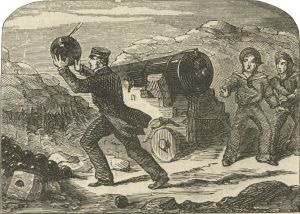
 "For having on the 18th October, 1854, at the greatest possible risk, taken up a live shell, the fuse still burning, from among several powder-cases, outside the magazine, and thrown it over the parapet (the shell bursting as it left his hands), thereby saving the magazine and the lives of those immediately round it."
"On the 5th November, 1854, at the Battle of Inkerman for joining the officers of the Grenadier Guards and assisting in defending the Colours of that Regiment when were hard pressed at the Sandbag Battery." (Sir S. Lushington is authorised to make this statement by the Lieutenant-General commanding the Division, His Royal Highness the Duke of Cambridge, who is ready to bear testimony to the fact)
"On the 18th June 1855, for volunteering to lead the Ladder Party at the assault on the Redan, and carrying the first ladder until wounded."
Incredibly Peel managed to find himself in the thick of the action from the Siege of Sebastopol in 1854, to the Battle of Inkerman the following month and finally leading the assault on the Redan in 1855.  It wasn’t long before Peel had recovered from his wounds and found himself, once again, in action this time during the Indian Mutiny of 1857.  Peel played an important role in the capture of Lucknow, but was badly wounded by a musket ball.  During his evacuation to Cawnpore, Peel contracted smallpox, which would ultimately call time on the astonishing life of this truly amazing man.  There is a rather splendid entry for him at the ‘Victoria Cross Online’ website along with a couple of interesting images.
Finally then to the gun emplacements, which had been a bit of an impulse buy from 'Tabletop Art'.  I had come across these when looking for basing ideas for my crews, initially thinking that I would build something similar myself.  I kept looking at the marvellously painted examples on the company’s website and in the end succumbed and placed my order, justifying the purchase on the basis of saving time.  
I have to say that I was incredibly impressed with the customer service and the products arrived in jolly good time and were faultless in the casting of the resin.  I simply painted them to match the examples I had seen, which interestingly led me to base the miniatures on clear Perspex discs from ‘Sally 4th’ purely so that I could use the emplacements with other miniatures in the future.
So a good job done, not least because they have allowed me to post about a genuine Victorian hero on my misnomer of a Blog!  Seeing them finally painted and with the addition of the gun emplacements, I have to confess to being delighted with the results, certainly some of my favourite work this year.

Wednesday, 27 May 2015

Tea time in the Crimea


As we are currently enjoying a half term break, I thought I would indulge myself and post some finished work for a change and so for your delectation, I present theses additions to my Crimean War collection.  Now every now and then I come across a miniature and think I just have to have one of those.  This has often resulted in some truly spectacularly ill-advised purchases, that now languish somewhere in the lead pile, I ask you who buys roller skate wearing waitresses wielding baseball bats?  Well that would be me!


These however, stood a fair to middling chance of not only getting painted but also of actually being of some use.  The tea time collection of miniatures by 'North Star Military Figures' is such a wonderful idea, demonstrating a company that is so confident about its position in the market place that it has persuaded the companies under its banner to contribute with individually commissioned miniatures enjoying a cup a tea - how charmingly English!  The first up, 'Tommy Atkins', painted as a member of the 19th Regiment of Foot, the Green Howards; his ruddy complexion betraying the fact that he has sought solace and bravery in the shape of a bottle and not a tea leaf.*

*Pun most definitely intended, as I'm fairly sure that he has requisitioned his bottle from the Offices' Mess!

This is one of two contributions to the tea time collection from 'Great War Miniatures'; eluding to the infamous story of the short-tempered Lord Cardigan,** who, on seeing Captain Reynolds and not Captain Nolan as the 1968 film would have us believe, place a bottle of Moselle wine directly on the table, flew into such a rage as to have Captain Reynolds placed under military arrest!  

**James Thomas Brudenell, 7th Earl of Cardigan.


The second of 'Great War Miniatures' contributions comes in the shape of this Guards’ officer, painted here as a Grenadier.  I am afraid that I stole the idea of the cannonball landing as his feet directly from the 'Northstar' site, but it really was too good an idea not to do so.   Finally then a Russian General that arrived in the post from that splendid chap, Stefan A.K.A. Monty of 'Monty's Caravan' fame.  Stefan is a hugely generous person who thought that I might enjoy painting this up and indeed I certainly did! 


I believe this is part of the Russian High Command pack from 'Foundry Miniatures', but I am ashamed to say that my knowledge of Russian Generals is a little patchy at best, but my superficial research unearthed some reference material and a name in, Dmitri Jerofejewitsch Graf von der Osten-Sacken, which seemed to fit the bill nicely.  My thanks to Stefan and I hope you approve of my humble efforts at bringing him to life?


Finally, just because I can, enjoy the fictional retelling of the 'Black Bottle' incident from Tony Richardson's much maligned 1968 film, 'The Charge of the Light Brigade' starring Trevor Howard as the overbearing Lord Cardigan.


"You are drinking beer, sir, porter beer!"


Saturday, 10 May 2014

Cannon to right of them,

Cannon to left of them,
 
 
I'm afraid there is no 'Paint Table Saturday' for me this week as the run up to the public examinations sees me running some extra classes this morning.  That said, as I wait for the next batch of eager minds to arrive, I thought I would use the time to finally post one of my larger entries in the 'Fourth Annual Analogue Hobbies Painting Challenge'. 

 
I thoroughly enjoyed the variety that the bonus rounds brought to my painting table during the challenge, but this entry is what the painting challenge was all about for me - focus! After a wonderful summer full of dinosaur and zombie distractions, this was an entry that saw me back at the heart of the Victorian era - the Crimean War.
 
 
This small battery of four 6lb Field Guns each with a Russian crew of four are all 28mm from the 'Wargames Foundry' range. I find large batches (this represents a large batch for me!) of similar miniatures difficult to work on, due mostly to my inability to focus on one thing for any length of time, but a relatively recent article in Wargames, Soldiers & Strategy magazine introduced me to the concept of faces and bases! Having mentally prepared myself that I didn't have to lavish as much individual detail on each miniature the whole unit seemed to come together quite quickly.

 
The only down side was when I dug out the Light Brigade for the final photograph, I realised that I no longer liked the cavalry bases they were on; still that can be a job for the summer holidays!

Monday, 6 May 2013

Captain William Morris...

…The Pocket Hercules.


So named because of his short stature, forty three inch chest and immense strength, Captain Morris completes the triumvirate of the Charge of the Light Brigade Characters from ‘Great War Miniatures’ distributed in the United Kingdom through ‘North Star Military Figures’.  This is a cracking little miniature and perhaps my favourite of the three.  Again a one piece sculpt, nicely proportioned and dynamic in its portrayal of the man who led the 17th Lancers into the ‘Valley of Death’ astride his favourite charger, ‘Old Trumpeter’.


Morris was one of those rare creatures in that he was a professional and experienced soldier having attended the Royal Military College and saw service in India during the Sikh Wars winning medals for gallantry at Sobraon and Aliwal, but this active service saw him looked down upon by those with wealth and social standing who referred to men like Morris as 'Indian' officers.  


Captain Morris would be one of the first to reach the Russian guns and survived the charge only to endure an untimely death from dysentery in Poona during the Indian Mutiny.


Friday, 3 May 2013

'There is your enemy! There are your guns!'


Captain Nolan, the second miniature in the Charge of the Light Brigade Character Pack from ‘Great War Miniatures’ distributed in the United Kingdom through ‘North Star Military Figures’.  A one piece cast that I have to say, I was less than enamoured with.  The sculpt of the horse was superb with particular attention given to the saddlery, my issue, however, was with the face that just seemed to be badly misshapen; not the end of the world really but a little disappointing given that this was a ‘character’ pack.  That said Captain Nolan is displayed nonchalantly waving the written order in the direction of the Russian guns – the prelude to what would become one of the most disastrous cavalry engagements in history.


Much has been written about the charge and who was to blame, certainly reading contemporary reports the dashing and enthusiastic Nolan finds much of the responsibility placed at his feet.  Perhaps not the time to debate the matter here, suffice to say that this chap’s opinion is that the whole catastrophic event was the result of a series of disastrous decisions and interpretations that, combined, led to the finest Brigade of Light Cavalry ever to leave the shores of England smashed by the force of the Russian guns.


Did Captain Nolan deliberately misinterpret the order or even embellish Lord Raglan’s verbal command?  We shall never know, but what is not disputed is that he was the first casualty of the charge; an exploding shell sending shrapnel through the young office’s heart.  The infamous hand written order can be seen below.


‘Lord Raglan wishes the cavalry to advance rapidly to the front, follow the enemy & try to prevent the enemy carrying away the guns. Troop Horse Artillery may accompany. French cavalry is on your left. Immediate. R. Airey.’
Perhaps the last words on the whole disastrous event should be those of the French Marshal, Pierre Bosquet, who having witnessed the charge is reputed to have said,


"C'est magnifique, mais ce n'est pas la guerre." ("It is magnificent, but it is not war.")

Marshal Pierre Bosquet


Tuesday, 30 April 2013

Butcher Jack


Having completed my latest instalment of the Flashman papers, 'Flashman at the Charge' it seemed only appropriate to paint up a miniature that was in some way related to that ill fated cavalry engagement during the Crimea War of 1854.

This fine, two piece miniature was part of a Charge of the Light Brigade character pack from 'Great War Miniatures' available through 'North Star Military Figures' and was great fun to do.  


I first became aware of the exploits of Trooper John Vahey of the 17th Lancers when reading Terry Brighton's wonderful, 'Hell Riders'.  'Butcher Jack' is one of those characters that populate the annuls of British Military History, the sort of chap legends are crafted around.   Acting as the regimental butcher, Jack spent the night before Balaclava under guard because of over-indulging in commissariat rum.  When he awoke the next morning, "deucedly muzzy" the camp was empty, returning to his tent for a refresher from an inexhaustible rum bottle he became aware that the Light Brigade was forming up in the valley below.


Although no regimental mounts were available to him, 'Butcher Jack' was able to take advantage of a riderless Russian pony, its saddle emptied by the 'Charge of the Heavy Brigade' earlier that morning.  So it was that Jack Vahey trotted up to take his position in the line still in his bloody overalls and wielding a butcher's axe.  

'Butcher Jack' would go on to survive the charge and avoid a court martial instead he was awarded a Distinguished Conduct Medal for his actions on that fateful day.


Sunday, 28 April 2013

Book Review#16. - Flashman at the Charge


This will be the third time that I’ve seen fit to write the briefest of reviews about another of George MacDonald Fraser's ‘Flashman’ books and so far all have been magnificently entertaining.
  
Our cowardly and lecherous Flashy continues to find himself at some of the most dangerous hot spots of 19th century history, usually looking for a place to hide, trembling in fear as the heat of battle reaches fever pitch, praying that he is not discovered by the enemy or, more likely, the cuckolded husband of his latest conquest!

As with all MacDonald Fraser's tall tales, it is his ability to weave fact into fiction that makes them so appealing and ‘Flashman at the Charge’ is no exception.   Apparently Fraser’s ‘favourite’ novel, Flashman’s behaviour continues to appall and delight in equal measures and while it might seem unnecessary to keep apologising for some of the language used it is important, nonetheless, to say that some might find it uncomfortable.   

In this instalment of the recently discovered Flashman Papers our eponymous antihero is persuaded out of retirement to nursemaid one of Queen Victoria's cousins through the seemingly unavoidable Crimea campaign.  Little is to go Flashy's way as he is somehow an unwitting participant at the 'The Thin Red Line', the 'Charge of the Heavy Brigade' and ultimately, powered by fear and flatulence, ill-fated 'Charge of the Light Brigade'.  

If the morning's work wasn't bad enough he is immediately captured by the fearsome Russians and here begins another great adventure across the snow covered Steppe, ultimately leading to the North West frontier and an action that would see Flashman defending the Jewel in the Crown!  Undeniably my favourite yet and a hugely entertaining yarn, that brings out the best, and perhaps more entertainingly, the worst of Harry Paget Flashman Esq. to the fore - a flatulence favoured four crowns!


Saturday, 21 January 2012

"Tipped with a line of steel"


During the Crimean War, the 93rd Sutherland Highlanders formed part of the Highland Brigade that distinguished itself throughout the campaign.   However it was at Balaclava that the regiment won immortal fame when, under the command of Sir Colin Campbell, it formed line in two ranks and repelled a charge of Russian cavalry.  Campbell is reported to have said, "There is no retreat from here, men. You must die where you stand." Never has a regimental motto, 'Sans Peur', (without fear) been more appropriate as the men stood firm against the thunderous advance of the advancing Hussars.


It was the London Times correspondent, William H. Russell who wrote that he could see nothing between the charging Russians and the British except "the thin red streak, tipped with a line of steel". Russell was of course referring to the 93rd Highlanders; they were the only unit standing between the Russian cavalry and an unprepared and disorganised British camp.  British Army tactics of the time would have dictated that  the infantry stand four deep to present a rolling volley of fire.  Furthermore, to have received  a cavalry charge in the open they would normally form into a square to protect themselves; cavalry could easily break a line of infantry!  Why was it then that Sir Colin Campbell stretched his men into only two thin ranks? 


Shortly before the charge the Highlanders were coming under artillery fire; clearly  the best form of defence for this would be an extended line and not huddled together in a square!  In fact rather than surrender a tactically advantageous position Campbell had had the Highlanders lay face down below the crest of the hill effectively making them invisible.

Forming square.

Campbell was an experienced soldier and undoubtedly would have realised the importance of his position; he would have been  fully aware of the need to spread as far as possible in a bid to cover more ground, protect the camp and present more firepower per volley.  Although there are conflicting reports it is believed that the 93rd fired three volleys, the first at such a range that it had little effect.  The second and third, however, delivered such withering fire that the Russian Hussars checked and ultimately turned, breaking off the charge.  So elated where the Highlanders that some began to mount the famed Highland counterattack only to be met by a fierce Campbell roaring, "Ninety-third, Ninety-third , damn all that eagerness!"

On the march.

Throughout the project I was becoming more and more acutely aware that I had been naive in basing the miniatures as individuals.  This was simply a lack of experience and understanding on my behalf.  Now a little older and potentially wiser I’ve constructed the following dynamic movement trays that allow me to place the miniatures in whatever alignment suits their use best.  I can take very little credit for the idea, which I have appropriated from a wonderful posting on the ‘Gentlemen’s Wargames Parlour’ that can be found here.

From this ...
to this!
A huge thank you to James at 'Oshiro Model Terrain' who sorted me out with laser-cut Perspex rings to my specification.
Interesting fact: The Argyll and Sutherland Highlanders (now known of 5 Scots) are the only infantry regiment in the British Army to have "Balaclava" in their list of battle honours.


It is only right and proper to acknowledge the painting that has in turn inspired the miniatures that are posted here.  Robert Gibb was an Edinburgh born artist, who in 1881, created one of the finest military paintings of the nineteenth century; certainly in my humble opinion anyway! ‘The Thin Red Line’, was inspired by Alexander Kinglake's account of the 93rd Highlanders at Balaclava in his book ‘The Invasion of the Crimea’.   It is alleged that Gibb had taken a walking holiday in the English Peak District during which time he was reading Kinglake's book.  One afternoon while out walking near Haddon Hall, he glanced up to a slight rise and imagined that he saw a line of burly highlanders, "all plaided and plumed in their tartan array."  On his return to his lodgings, Gibb sketched out his mental image and the rest, as they say, was history.


Monday, 16 January 2012

Sir Colin Campbell

 "There is no retreat from here, men. You must die where you stand."

The immortal words spoken by Sir Colin Campbell to the 93rd Highlanders as they prepared to receive the Russian cavalry's charge  at Balaclava.  Campbell had been appointed as the commander of the Highland Brigade of the 1st Division under the command of the Duke of Cambridge; the Division consisting of the 42nd, 79th, and 93rd Highlanders.  His first engagement, during the Crimean War, was at the battle of the Alma, where he led his brigade against the redoubt which had been retaken by the enemy and overthrew the last columns of the Russians.


Leading from the front Campbell was so impressed with courage of the Highlanders at Alma, that after the battle the only reward he asked for was permission to wear the highland bonnet instead of the cocked hat of a general officer.  This permission was duly granted and he started sporting a specially commissioned plume, the top third red in honour of the 42nd and bottom two thirds white for the 79th & 93rd.


More from Great War Miniatures' Crimean range and rather lovely they were too, although I have to admit I was a little anxious at first given that horse and rider were a one piece sculpt.  I decided to base the two together forming a command stand but raised Campbell's miniature a little higher using a piece of slate in deference to his seniority.


Below is Roger Fenton's portrait of Sir Colin Campbell (for more Fenton information may I respectfully direct you to a previous post entitled, 'I'm ready for my close up, Mr. Fenton') depicting a man clearly feeling the strain of the position of office that he holds.  The lines of concern and anxiety are heavily chiseled across his forehead.  On the 9th April 1855, Fenton wrote of him: "Sir Colin Campbell I have not yet got; he is up at four every morning and either writing and not to be disturbed, or scampering about".

Wednesday, 11 January 2012

Stand Firm!

I appreciate that this may appear all too similar to a previous post, but I can assure you that many more hours have been spent toiling away, not to mention more blood, sweat and tears shed in finishing these off. 


Closing in on the finishing line now and hope to bring this little project to a natural conclusion soon.  As before, Great War Miniatures' Crimean range, available through Northstar Military Figures.
Related Posts Plugin for WordPress, Blogger...