Showing posts with label access code. Show all posts

Friday, 12 September 2008

No To the Spirit of the Law

I watched this clip from the BBC News site: link

As soon as landowners talked about people following "the spirit of the law instead of the letter of the law", I thought "sod that". As I've said in the past, the letter of the law is good enough - these guys aren't "wild campers", they forfeit the right to access as soon as they disobey the law.

Leaving litter, using a heavyweight tent chucked out of a car, lighting fires in an irresponsible way, etc etc. All are handled within the letter of the law, not the spirit of the law. I must have said this before, folks: RTFM. These lawbreakers are not wild campers. Education and enforcement are the issues, not the law.

Wednesday, 3 September 2008

MCoS Statement on Alladale

Robin across at BlogPackingLight pointed me to the Mountaineering Council of Scotland's recent position statement on the Alladale Project (pdf link). They conclude that:

The member organisations of this group find this unofficial, but well-publicised project, as unacceptable as stated. We call for a recognition that the unnatural density, probable artificial feeding and commercial nature shows that this project is a safari park, which would require a zoo licence, and hence is completely different from what it is promoted as which is a re-wilding project. A full project study should be undertaken, followed by an environmental statement stating the legal basis on which this project will be based.

And here's a link to the YouTube version

I wrote some notes earlier on the recent programme shown on the BBC, and then immediately repeated after the 6 episodes were finished showing on BBC Scotland. I didn't post anything about later episodes as I really could not be bothered reporting on the one-sided shallow programme. It was not a documentary. I don't know what it was other than merely following around people on the estate. No attempt was made to do any follow up. Unlike "Trawlermen", the estate and Mr Lister's project is not a sealed bubble, but the programme may have given that impression.

Overall, I find it intriguing that the Scottish Government does not get involved when its own access laws are being challenged, and seems to just wait for people to raise objections, despite the publicity. I find it ludicrous that the MCoS or the Ramblers' Association get involved in court cases when it is the rights of people in Scotland that are being challenged. Maybe I'm missing the point, but isn't that what our government is for?

Monday, 25 August 2008

Don't be a div, wild camp responsibly

There's a good article by TGO's Cameron McNeish across on his blog: Wild Camping in Scotland

There is still confusion in Scotland about wild camping. The law is clear on the matter. If you do not follow the "leave no trace" rules, you have given up the right to access. If you are not lightweight, you have given up the right to access. Further information posted earlier (epetition-scotland).

Many of the car campers that I have seen (eg outside Braemar) have taken a huge family tent out of the car and pitched it by the road. Sometimes large open fires are started. This is not wild camping. I have heard second-hand of the police going out to move them on, and a couple of people who were hiking got caught up in the sweep.

Outdoor-Access: Be a responsible camper and poster (290kb, pdf download)

We have all heard of landowners dragging their heels about access legislation, and the bias of the media on recent tv. So, don't be a div, make sure you wild camp in a responsible manner (even if you don't use an Akto, and the tent is red).

Thursday, 17 April 2008

ListerWorld

I'll reply here to Mike's post across on "Puppy's World" about the BBC "Natural World" program last night about Paul Lister's Alladale development. I've mentioned it a few times here in the past, so isn't new news (posts). I'll state here that I haven't watched the programme yet. I'm waiting for a more relaxing time, as I have heard/read interviews about this in the past and the stance taken by the developers winds me up.

But I wish people wouldn't keep using the Outdoor Access Code, and Land Reform Act as a hammer to knock developers. Would there be objections if the land was flat? Or there wasn't a Munro in the vicinity? But then we have Blair Drummond safari park, and zoos in Scotland already and no-one is suggesting that access laws are used to allow people to walk freely into the enclosures. Of course not. Are there any rights of way being removed? I haven't heard of any, but I could be wrong.

I have objections to the development, but other people have arguments in favour. There have been a number of high level planning 'debates' (totally the wrong word for these arguments) in Scotland recently. It would seem that no-one is happy with the planning laws. But they are the laws that we have, and people should not be allowed to sidestep them. That is what we have state authorities for - to make sure that people from the lowest to the highest in the land all obey the laws. I think I managed to keep a straight face writing that bit!

I'd love to go hiking amongst native woodlands rather than the bland industrially-minded plantations. Deer kept on the move by the threat of a wolf pack would probably benefit the native plants. Bears are different, and when one escaped in Scotland in the 1980's (or was it the 70's?), an intensive search was mounted to catch it. This is what we have licensing and official approvals for - to make sure that everything is up to standards before dangerous animals are released into such a large area (where this differs from smaller safari parks and zoos). I'm sure the insurance companies and backers also demand no less.

If, in future, there are hiking and camping tours through land clear of bears and nasties, I'd pay a fee for that privilege - to hear the wolves howl in the distance, and see the elk plod across the hillside. Just so long as there was no grizzly ripping my tent open and making off with half my face attached to its claws.

I'll second Mike's comment "Right i am off to get the flak jacket and tin helmet and find a big deep hole to hide in".

If you missed the programme and want to watch it, you'll find it in the BBC iPlayer - don't tell me what happens.

Thursday, 10 April 2008

The 1350

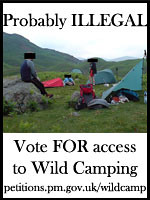
The pro-wild camping ePetition is under 90 signatures short of 1300. To be honest, with the lack of interest from certain hiking magazines (where apparently wild camping law is "complex" in England & Wales), and the "if it ain't broke, don't fix it" attitude of people on forums, I thought the idea of mentioning the 1350 people involved in the Scottish consultation would be an unfeasible target. There seemed to be little real interest from people in England & Wales, and if they can't be bothered, why should us Northerners force them into something they aren't interested in legalising. As I said in a video-clip, "we'll take your money".

With about 6 weeks left on the ePetition, and the number of signatures climbing daily, 1350 looks a reachable target now. Despite the lack of support in the printed medium. A well, maybe the medium is broken, but it isn't my job to fix it.

More info on the official site.

Friday, 7 March 2008

Wild Camping Economics 2

Good article across in Alistair's eBothy: Why you can wild camp north but not south of the border He points out that the walking industry is worth £438million (US Dollars) to the economy. The source, www.scotland.org, states in full:

Walking is a major part of the Scottish tourist industry and is now worth £438 million a year, supporting thousands of jobs. Local communities all over Scotland are developing facilities for walkers. One fine example is the 6.2 mile (10km) Wildcat Trail around the village of Newtonmore in Strathspey in the Cairngorms National Park. This lovely walk encompasses riverside, forest and moorland. There’s a Wildcat Walking Centre in Newtonmore where you can find information on the trail and collect a certificate after completing it (always a plus!). The Wildcat Trail is popular with visitors and locals and over 5000 people walk it every year.

Walking is good news for the health of Scots and tourists alike. Consequently the Scottish Executive has launched a programme called Paths for All, to raise awareness of the amazing health benefits. For more information on the initiative, visit www.pathsforall.org.uk.

The real incentive for all, however, must be the number of stunning, beautiful walks that freely give tourists access to our glorious Scottish countryside, wildlife and history.

I have no idea how many people wild camp for at least one evening. If it's 1%, then they bring in £4,380,000 per annum. Drop the figure to 1 in a thousand people, and that's still £438,000 per annum (£1,200 per day). People buy meals, need to get too and from the trail heads, top up on kit, get civilised, pay for petrol, send postcards. And possibly over a larger area than just the main tourist centres.

For the record, I did contact Visit Scotland (31 Jan 08) asking them if they had any information about wild camping tourism. At the time of posting, I hadn't received a reply.

--

Previous article on Wild Camping Economics

ePetition ends day on 733 signatures.

Wednesday, 5 March 2008

Eight Years Later

John Manning posted this article, We’ve been shunned before! , which I have transcribed below.

Are backpackers losing out?

While the Government's Countryside and Rights of Way Bill has generally been welcomed, suggestions that wild camping on the new areas of access land is to be outlawed has caused considerable concern among Britain's backpackers.

As president of the Backpackers Club, I'm particularly saddened that the Government hasn't grasped the opportunity to make an exception for backpackers who are travelling through an area, distinguishing them from New Age campers and those who would set their tents up in one place for a week at a time.

The outlawing of camping is included in a list of restrictions to be observed by people having access to access land in Schedule 2 of the bill. The list also includes skinny dipping in any non-tidal water, mountain biking, use of four wheel drive vehicles, lighting fires and neglecting to close gates. Indeed the Country Landowners' Association has suggested that anyone found breaking these restrictions should be convicted of a criminal offence. One wonders what sort of mind equates a harmless and quiet overnight bivouac, or failing to close a gate, with crimes like burglary, assault and theft. The CLA also wants to restrict access to daylight hours, and some Tory MP's have suggested that 24 hour access tantamounts to a "burglar's charter".

Backpacking is enjoyed by thousands of people in the UK and the Backpackers' Club, founded in 1972, has over 1,300 members. The doctrine of the activity emphasises good environmental awareness and can be described as 'no-trace' camping - the backpacker determines to leave no trace of his passing and cause no disturbance to either the land or livestock. The international motto of backpacking is 'leave only footprints, take only photographs' and most backpackers today try not to even leave footprints!

The proposed restriction raises implications not only for the future of the Backpackers' Club and similar hill-walking clubs but organisations such as the Duke of Edinburgh Award Scheme, the Scout movement and Outward Bound, organisations which are recognised as being highly beneficial in the positive development of young people.

Most people understand the Government's concern over the possibility of New Age camps being set up in the access areas or the possibility of people erecting 'tent villages' for weeks at a time during holidays but by outlawing all forms of camping the Government is taking a sledgehammer to crack a nut.

Backpacking is an enjoyable, law abiding and environmentally-friendly activity and overnight wild camping in remote locations is a fundamental part of the activity. If such lightweight, wild camping was to be outlawed on the hills and high moorland areas of England and Wales then many individuals would be deprived of the opportunity of communing with the natural world in a way which they can enjoy at the present. It would be a retrograde step and contrary to the very principle of freedom-to-roam.

Andrew Bennet MP, who is president of the RA, has asked the Minister to consider the issues of high-level camping and bivouacking. "The provisions for them need to be clear in the Bill," he said, but comments from the DETR suggest that in many areas camping is subject to local bye-laws and indeed that will still be the case, and while many councils turn a blind eye to the casual backpacker who quietly and unobtrusively pitches his tent for a few hours on some remote location it's a pity the Government couldn't follow the example of many European countries which allow backpackers to camp if travelling through a region, ie they are not setting up a semi-permanent camp of several days or weeks duration.

In effect, nothing has changed since the 1949 Bill. That legislation restricted camping too, and my advice to backpackers is carry on as before.

Cameron McNeish - Editor, TGO Magazine, May 2000

--

Links

Monday, 3 March 2008

Outdoor Access Code Monitoring Form

Not often I jump at the chance to fill in a form, but when I found the review forms for the OutdoorAccessScotland website, with the note:

This form is designed to help SNH monitor the effectiveness of the Scottish Outdoor Access (the Code). The resulting information will help SNH to determine when a review of the Code may be required.

So, a quick download and I'll be chavvin' awa at the form so that it can wing it's way to Inverness post haste. Where a golden eagle will pluck it out of the aether and use it to line the nest.

What can I write ? Coming up here and wild camping without a reciprocal agreement, mutter mutter, interfechering with our right to reive across the border....

Spot the Paddy - Take 2

11 months after the first "Spot the Paddy" game, lets see if you can find well-known author, hiker and Tilley-wearer (watch out for the elephant). Hint, he's number 714.

If you haven't any of his books, then shame on you. Just shame.

Sunday, 2 March 2008

Wild Camping ePetition

The 700th signature added to the ePetition to legalise wild camping in England & Wales was added this morning (Centralised site). That's 500 more than the government need to undertake their promised action. Sadly we've already head back from a few democratically elected officials, who respond in the negative without pausing to draw breath.

Anyway, here's what the text on the petition website says:

Once your petition has closed, usually provided there are 200 signatures or more, it will be passed to officials who work for the Prime Minister in Downing Street, or sent to the relevant Government department for a  response. Every person who signs such a petition will receive an email detailing the Government's response to the issues raised. Source

Ain't democracy wonderful? Everyone looking for the angle, for the way to make money or save themselves doing any work instead of thinking - hmm, we could encourage people to get out onto the land that we own, enjoy the countryside, all for the passing of some emails to government landowning bodies. But life isn't as simple as that, as wanting people to have better health (mental and physical), waking up under 'canvas', enjoying a family multi-day trip. Everyone thinks of the loss of B&B trade, of more litter (apparently day-trippers don't litter. Ha!), of camping above an imaginary height line. Instead, just doing something for the benefit of those who wish to wild camp.

But, what the heck. There's more important things in life: love and respect to Mothers everywhere.

Thursday, 28 February 2008

Còd Slighean Dùthchail na h-Alba

Campadh air an dùthaich

Tha còraichean-slighe a’ buntainn ri campadh air an dùthaich. Tha an seòrsa seo de champadh aotrom agus cha bhi ach beagan dhaoine ga dhèanamh airson dhà no trì oidhche anns an aon àite. Faodaidh tu campadh ann an dòigh seo àite sam bith far a bheil còraicheanslighe buailteach ach faodaidh tu daoine agus stiùirichean-fearainn ionadail a chuideachadh gus nach èirigh duilgheadasan gun a bhith a’ campadh ann an achadh far a bheil bàrr a’ fàs ann no cluain pàircichte le beathaichean innteagus le bhith a’ cumail astar math air falbh bho thogalaichean, rathaidean no làraichean eachdraidheil. Dèan cinnteach nach cuir thu bacadh air stailceadh fèidh no sealg chearcan-fraoich. Ma tha thu airson campadh faisg air taigh no togalach, faigh cead an t-sealbhadair roimhe. Na fàg lorgan anns na
dòighean seo leanas:

  • thoir air falbh an sgudal gu lèir agad;
  • cuir às do lorg do theanta agus teine fosgailte sam bith (lean an stiùireadh air lasadh theintean);
  • na adhbharaich truailleadh sam bith.

Fios air a’ Chòd mus falbh thu

--

I loved running some of the words through the Sabhal Mòr Ostaig translator :

  • truaillidh  a. despicable, polluted
  • dùthaich  nf. g. dùthcha; pl. dùthchannan, country, native country

There's a Woody Guthrie song now playing in my head. Says it all really.

--

ePetition: 675 signatures.

Wednesday, 27 February 2008

Strathspey Herald Article

There's an article in the Strathspey Herald which I'll reel off parts of ...

THERE is currently a petition on the Prime Minister's website which is calling for wild camping to be made legal in England and Wales, as it is in Scotland.

...

The new legislation quite clearly states that members of the public can wild camp anywhere there are access rights. And yet, in the Scottish Outdoor Access Code, the booklet that offers advice on how to "act responsibly", it clearly says this type of camping should be "lightweight", but doesn't actually define what "lightweight" is.

The Land Reform Act (2003) opened the way for the legalisation of wild camping in Scotland, which came in under the Scottish Outdoor Access Code. The history can be found on at www.outdooraccess-scotland.com - the setting out of the Access Code is in Chapter 3 of the 2003 Act. So the Act and the Code are the legislation.

As to the legislation not defining "lightweight", this is true. For me, going 4 days in the Cairngorms with a 50 litre backpack is easy, but 2 years ago, I was taking a 70 litre pack out for a weekend. For me, the spirit of the law is that you aren't forming a human chain to pass canvas, suitcases, and the like up the hill for a session. Other definitions of lightweight camping are here: scottishsport.co.uk or read Ryan Jordan's book or any copy of Scotland's own TGO magazine.

Back to the article ...

I must confess I am concerned about the future of this part of the Scottish legislation, simply because it is so poorly defined in the Act.

I can't help but think that those who park their car on the roadside, then camp only a few feet from the verge, are abusing the new legislation, although I do appreciate there are some areas where this is ignored by the landowner.

Err, the Access Code is clear on this point, stating:

This type of camping is lightweight, done in small numbers and only for two or three nights in any one place. You can camp in this way wherever access rights apply but help to avoid causing problems for local people and land managers by not camping in enclosed fields of crops or farm animals and by keeping well away from buildings, roads or historic structures.

See my previous post on the Landward program from June 2007 that the article writer referred to (wild-camping-thoughts).

At the heart of the article is the ePetition, and the writer raises points from the June 2007 episode of Landward that looked at wild camping, but in fact most was dealing with damage caused by people who ignored the Access Code and therefore lost their rights to access under Scots law.

If nothing else, if there was a serious discussion with politicians about the possibility of seeing genuine wild camping made legal in England and Wales then it could also help the situation in Scotland where that part of the Land Reform Act could be under threat because the wording of the law has been so poorly defined.

Sadly, it looks like the serious discussion has already taken place even before the petition is closed. Now, did someone somewhere write that only having 600 signatures was unDemocratic? Means that there's more work to do. In Scotland, over 1500 people were consulted for the Access Code - it would be nice if the same number of signatures were attached to the England & Wales document - then, maybe, just maybe, the democratically elected representatives of the people would at least consider consultations before just waving it aside in to the "too expensive" pile.

Oh, and one more thing, for all these folk who say that Scots law was "different" before the Land Reform Act came in, here's a wee piece of legislation that was amended by the Act - in other words, it was still valid pre 2003.

Trespass (Scotland) Act 1865 Section 3 (which creates the offence of occupying or camping on land without the consent of its owner or occupier) ... source

Sounds similar to the comments in a magazine today "the laws regarding wild camping are a little complicated...". In my opinion, they aren't. The only complication is that people writing in print can't tell readers that what you are doing is against the law, even if the landowner's only redress is minor. Corporate lawyers would have something to say, I'd guess.

--

More posts at the central site: legalisewildcamping.com

ePetition: The Beast has Landed

The ePetition supporting the legalisation of wild camping in England & Wales has now reached 668. The Beast, the 666th person to sign up, was ... Christine.

Robin, of Team Geared Up, missed it it by one.

--

More posts at the central site: www.legalisewildcamping.com

Wild Camping Economics

Answering a question across on the Legalise Wild Camping site - what do wild campers bring to local communities:

I went to the trailhead (outside Braemar). I have paid my National Trust for Scotland membership, so parking is free. I hike a short distance on Friday night and I wild camp. Hike some more and return to car. In to Braemar. Gear shop and lunch, then back to city.

All in all, my single trip has netted around a tenner from me for a couple of shops in Braemar. Half again on a wee torch in Aberdeen before the trip, plus hiking food in Asda.

I can not afford to pay for brick accommodation, and prefer being out in the wilds. For not using any of their facilities, Braemar has earned a tenner from me.

The only cost to Braemar was those involved in the provision of the services that I paid money for. If I wasn't there, the businesses would still have paid for the staff, heating, etc. I'm passing trade. I'm made to feel welcome, and enticed in by the provision of goods and services (eg another dry-bag and a venison burger & chips).

On the Southern Upland Way, I wild camped, or bothy camped. Twice I paid for brick shelters, and in one of these cases I could have wild camped, but I felt like a change. Again, I was passing trade. I see little difference between vehicular passing trade and this chap trudging across country. Where a car requires roads, and the like, I'll be happy with access, leaving no trace and just the space to pitch a tent out of the way of anyone.

Arriving in a community, I may spend money on goods (postcards home, foods to take, or eat out of way, batteries, replacement kit, etc), or services (cooked foods, refreshments, Internet connection), and I may wish to upgrade to a brick shelter. Just because I am on foot does not make me less of a human being.

Wild camping opens new communities to long-reaching trips. Those on a trailhead are better served to make money from multi-day trekkers, but those in the hinterland may find that they are now getting more people visiting, and taxis being called to run people back to their transport, or busses being used more often.

Wild campers, true wild campers, leave less trace than many. Wild campers are as much part of the tourist industry as any day trippers. Naturally, walking for 2 days from a trailhead rather than just 1 day is better for people's health and maybe even their mental wellbeing.

Wild camping doesn't suit everyone, and not all camping is wild camping. There is still a need for brick shelters and official campsites. The Kings House by Glencoe is a case in point. Their 'wild camping' facilities bring in people as well as those paying for a roof, but people pay for meals and refreshments. It is a business and with business acumen.

Scenario - Jack is determined to wild camp no matter what the weather. He drives to xxxx, arriving late, he hikes past the closed village facilities into the night, wild camps and enjoys a Saturday on the hills, camping again that night, and hikes back to  the car park. Settling the bill for parking, he buys some snacks at the local shop and drives off home contented. Jack tells his friends on the forum about this place, and three of them arrange to head off the following weekend to see what the fuss is. They arrive earlier, buy a pub meal and make to head into the hills. One wants to stay in the pub, so the other two head off to the hills, meeting their pal the next day.

Life isn't black and white. I wild camp. I spend money on kit. Tent, sleeping kit, cookset, etc - I spend more than if I was just day-trekking. Wild camping allows me the opportunity to spend my money in different ways. I'm still a tourist and potential customer - if a shop wishes to treat me as a second class citizen then I simply walk out and take my money elsewhere. I also have the opportunity to mention this treatment to other people. Poor service is poor service, whether wild camping or brick camping.

--

Wild camping ePetition reached 663 signatures. One-two-Beast!

Tuesday, 26 February 2008

The Wild Camping Association

Had some thoughts when hiking on Saturday – cleared work from mind (after 2-3hrs of thinking on it), and then moved onto other matters.

Big plan … long term thoughts, not instant action …

I’m not a townie. I was brought up “free range”.  Some, but not all here may be the same, I don’t care, we all have our motivations.

I hate the way that the recent responses include the fact that “ Scotland is different”. We aren’t. Our small communities make money from trade – Lord Smith made that clear in Andy’s podcast. Why shouldn’t the same be true of England & Wales.

Wild camping opens up the country to new routes, new days, new experiences and new vistas.

So, lets change tack.

We start pushing for an “opt in scheme”. Communities and Access Land owners can “opt in” to the wild camping scheme. Like the Mountain Bothies Association, membership for public would be optional, but...like the MBA, membership money would be spent on behalf of the facilities.

Now, I know that’s a big step up from the ePetition, and we all accept that it is early days in getting any changes, but it means that we are serious, and that we don’t have to rely on the kindness of strangers. Strangers who have their own motivations, their own concerns, their own priorities.

The Wild Camping Association

--

ePetition up to 656 signatories, minus those who don't like some of the talk being bandied around and wish to maintain the status quo. That makes just 10 until "the Beast" signs - I wonder who it'll be? Lord Smith of Finsbury? Brian Blessed? Ben Fogle? Julia Bradbury?

Monday, 25 February 2008

ePetition: Scotland

As the world and it's MPs all seem to think that we in Scotland are a special case, here's what the fuss is all about - the Scottish Outdoor Access Code (PDF link):

Responsible behaviour by the public

Access rights extend to wild camping. This type of camping is lightweight, done in small numbers and only for two or three nights in any one place. You can camp in this way wherever access rights apply but help to avoid causing problems for local people and land managers by not camping in enclosed fields of crops or farm animals and by keeping well away from buildings, roads or historic structures. Take extra care to avoid disturbing deer stalking or grouse shooting. If you wish to camp close to a house or building, seek the owner’s permission.

Leave no trace by:

  • taking away all your litter;
  • removing all traces of your tent pitch and of any open fire (follow the guidance for lighting fires);
  • not causing any pollution

Responsible behaviour by land managers

If you are experiencing large numbers of roadside campers or have well-used wild camping areas, you could work with your local authority and with recreational bodies to assist the management of such camping.

Where and when you can exercise access rights
2.2 Everyone, whatever their age or ability, can exercise access rights over most land and inland water in Scotland, at any time of day or night, providing they do so responsibly. These rights do not extend to all places or to all activities (see paragraphs 2.11 to 2.15). Provided you do so responsibly (see Parts 3 and 5 of the Code), you can exercise access rights in places such as:

  • hills, mountains and moorland;
  • woods and forests;
  • most urban parks, country parks and other managed open spaces;
  • rivers, lochs, canals and reservoirs;
  • riverbanks, loch shores, beaches and the coastline;
  • land in which crops have not been sown;
  • on the margins of fields where crops are growing or have been sown;
  • grassland, including grass being grown for hay or silage (except when it is at such a late stage of growth that it is likely to be damaged);
  • fields where there are horses, cattle and other farm animals;
  • on all core paths agreed by the local authority;
  • on all other paths and tracks where these cross land on which access rights can be exercised;
  • on grass sports or playing fields, when not in use, and on land or inland water developed or set out for a recreational purpose, unless the exercise of access rights would interfere with the carrying on of that recreational use;
  • golf courses, but only for crossing them and providing that you do not take access across greens or interfere with any games of golf;
  • on, through or over bridges, tunnels, causeways, launching sites, groynes, weirs, boulder weirs, embankments of canals and similar waterways, fences, walls or anything designed to facilitate access (such as gates or stiles).

Where do access rights not apply?
2.11 Access rights do not apply in the following places.
...and there's a big long list ... including nearby houses (privacy), sport grounds, land excluded by byelaws

What activities are excluded from access rights?
2.12 Access rights must be exercised in ways that are lawful and reasonable. By definition this excludes any unlawful or criminal activity from the time at which it occurs. Furthermore, being on or crossing land for the purpose of doing anything which is an offence or a breach of an interdict or other order of a court is excluded from access rights. This means that a person intent on such a purpose is excluded from access rights at the time they seek to enter the land. This is also taken to include the carrying of any firearm, except where the person is crossing land or water to immediately access land or water, or return from such, where shooting rights are granted, held or held in trust or by any person authorised to exercise such rights.
2.13 A list of the more obvious statutory offences relating to people’s behaviour is provided at Annex 1. This list includes poaching, vandalism, not clearing up after your dog has fouled in a public place, being responsible for a dog worrying livestock, dropping litter, polluting water, and disturbing wild birds, animals and plants. There are also common law of such as breach of the peace

Look - just go and read it yourself, you'll feel a lot better for it, folks. Then, if you think that a group of economic migrants can use the access code to set up a canvas shanty town on the outskirts of your village, you'll see that it can't. In fact, Annex 1 of the code lists crimes, and remedies for them. Collective trespass; damage/disturbance to animals/wild birds/plants; Dropping of litter; Lighting fires; Polluting water; Vandalism.

Communities makes money from visitors to areas of the country. Wild camping opens up new communities to new people. New ways to make money. Turning away wild campers is cutting the throats of some communities. But, what the heck, I live in a country that has incoming tourists who like our access laws.

--

BG!'s take on wild camping for England & Wales (link)

BBC Countryfile's forum discussion (link)

ePetition closed the weekend with 639 signatures, and a new centralised website.

Sunday, 24 February 2008

ePetition: State of the Nation

I know nothing of The Ramblers Association.

Why would someone who Rambles be interested in wild camping?

Why would someone who goes out to watch birds and wildlife (eg CountryFile folk) be interested in Wild Camping?

Why would the National Parks be interested in giving access to people who wild-camp?

Why should they bother? People drive from the urban areas to the rural areas and the rural folk have only a few hours to suck as much money out of them as possible. Wild camping stops people paying for hotels, B&B and the like. They can damage the region by lying down on the grass, throwing litter away, setting fires for cooking etc etc.

None of this is the pre-requisite of people camping overnight, let alone the true wild camper. Will the next stage be anti-fishing, anti-mountain-biking, anti-hang-gliding?

So many restrictions in the outdoors, it is much easier to just stay on the sofa and watch tv about the increases in obesity.

Ironic, isn't it.

ePetition: Mr Manning gets a reply

Another update on the wild camping petition comes from John Manning's blog. He writes about the reply that he has received from his local MP, Tony Curry, who had kindly enquired of Secretary of State for the Environment, Hilary Benn.

Wild camping – “no way”, says Benn

"I believe in a fairer society. And that practical policies can help us get there." Hillary Benn - website.

So, by strange coincidence, when I looked up "They Work For Us", I noticed that Mr Benn has one registered shareholding: United Business Media.

At UBM, we believe all our businesses have a role to play as a member of the community in which each operates around the world. We recognise the importance of community involvement at all levels throughout the group and are committed to supporting our communities through financial contributions, donations in kind and employee volunteering. (source)

A noble statement. So, I went to a subsidiary to see what they do (CMP Information), and found some new reading material: farmersguardian.com

Isn't the Web great for throwing up links like that? So, although John received a negative reply, even that hints to positive action.

--

636 signatories just now. More news on the website. Who'll be "The Beast"?

Friday, 22 February 2008

The 600th

The "legalise wild camping" ePetition has reached the 600 mark. Well done to Nicole Morschett.

Darren has set up a stand-alone website called "Legalise Wild Camping" (his post), the address is www.legalisewildcamping.com

Thursday, 21 February 2008

PeerCast: ‘Lord Smith Interview’

The Outdoors Station is hosting Andy Howell's interview with Lord Smith of Finsbury. Amongst many, many other things, Lord Smith is the President of the Ramblers’ Association, and a compleater.

Podzine - Lord Smith Interview

Download MP3 File

He's a great speaker, and it comes across well in Andy's piece. Amongst everything else, a wonderful history of the rights of access in England & Wales and Scotland. The facts he has were educational - estimated that sixty million pounds to the Scottish economy from walking tourism.

If you have signed the wild camping ePetition, or have refused to sign it, or have concerns, listen to this podzine.

Also available on iTunes.

Terms of reference: the late John Smith; Kinder Trespass; Michael Meacher (and his blog)