Showing posts with label Red. Show all posts

Sunday, 19 June 2011

#57 Russula persanguinea

Notice the striations around the rim of the cap

A characteristic feature of identification of Russula species is the snapping like chalk of a fresh stem.  A pure white stem of Russula persanguinea will distinguish this species from Russula. aff. rosacea which has a pale pink stem.

Russula persanguinea is mychorrhizal with eucalypt roots and is found in wetter areas of eastern states of Australia, as well as Western Australia. It can be found fruiting at the base of live eucalypts, on the ground where there is buried wood, as well as around the base of dead eucalypt stumps. I am led to believe that it is the only species of Russula that fruits on dead wood, but I have not substantiated this.

Cap (up to about 70mm) is red, convex at first, broadening and flattening with maturity, usually with a shallow central depression where the colour is darker. The cap is viscid (or slippery) when wet, and striated around the rim at maturity. [There are no hints of purple or yellow]  Gills are white, crowded, and all of the same length.  Stem (up to about 70mm) is white, solid when young, and often thickening towards the base.  Spore print is white.

Toxicity: Some Russula species are known to be poisonous, so, although I have found no specific information on the toxicity of Russula persanguinea, it should be avoided.

The wet cap is slippery, the stem widens at base

The central depression in cap is a darker colour

White gills are crowded and all the same length

A wet, collapsed specimen is soggy all over, and pinkish
My sightings of Russula Persanguinea

[This will be updated with new sightings]

Brunkerville, NSW - at base of dead stump in wet mixed forest, Aug 2010, Jun 2011

Tuesday, 24 August 2010

#46 Amanita muscaria

Many years ago when I first saw the distinctive spotted red toadstool Amanita muscaria (then nameless to me), I couldn't believe my eyes - I'd previously thought they were only fanciful creations of fairy tales. But there they were growing on a grassy bank beneath big old pine trees in the NSW Southern Highlands, right beside the road.

I've since found them several times in the pine plantations of Hanging Rock in the mountains south east of Tamworth, NSW. They make a spectacular sight.

A cluster of Amanita muscaria at all stages of maturity
Hanging Rock pine plantations, April 2003


Amanita muscaria (pronunciation: Aman-ee-ta musk-air-ee-ah), is commonly known as Fly Agaric. It is an introduced poisonous fungus.

Habitat: Amanita muscaria is a micorrhizal species found on the ground and in leaf litter, mainly under exotic conifers and broadleaved trees. It occurs in large groups, and is common. Of some concern, it is extending its range into some native forests. This spread will change the ecosystem, causing decline or elimination of some native fungi.

Characteristics: In its mature, but fresh, state, Amanita muscaria is unmistakable with its bright red cap dotted with white 'warts'. Immature fruit bodies are completely enclosed in a white membranous universal veil, which ruptures to form the cap scales and volva. The cap diameter can be as large as 250mm, with the white shaggy stem as tall as 220mm. The stem is bulbous at the base, with a high skirt-like, soft, white ring. Gills are white, close, and of various lengths. Spore print is white.

An immature fruit body of Amanita muscaria encased in a dry, white, scaly covering that will separate with the expansion of the cap, to form the white 'warts' on the red surface.


Note the concentration of remains of the universal veil around the rim of the cap. Also note the white skirt-like ring that is edged in an orange-buff 'frill'.


A typical rounded cap of Amanita muscaria


A tall specimen need not have an equally large cap. Note the scaly bulbous base, and the 'frilly' ring high on the stem.


With age, the cap of Amanita muscaria may flatten
out and turn up, fading to orange.


My sightings of Amanita muscaria

[This will be updated with new sightings]

Southern Highlands, NSW - grass under exotic pines

Hanging Rock, NSW - leaf litter under plantation pines, Apr 03, Mar 05.

***** ***** *****

It is thought that Amanita muscaria probably originated in Asia or Europe. From there it spread to cover most parts of the northern hemisphere. In more recent times it has been transported (unintentionally by humans) to areas of the southern hemisphere.

Today it can be found scattered across the globe, from places as far north as Alaska and Siberia to areas as far south as Australia, South Africa, and South America.

The name of the mushroom (muscaria) is reportedly derived from the Latin word musca, which means fly. It was traditionally thought that this was because Amanita muscaria was be used as an insecticide to kill flies.

However, there apparently exists no firm evidence the Fly Agaric was ever used in Europe (as a fly killer) before medieval times. Rather, it has been suggested this is a linguistic reflection of the apparent narcotic potency of Amanita muscaria and its shamanic and religious past.

Tuesday, 15 May 2007

#12 Aseroe rubra


Aseroe rubra, commonly called Anemone Stinkhorn or Starfish Fungus, is from family Phallaceae. Pronunciation Ass-er-row-ee roo-bra.

Stinkhorns are short-lived fungi rising from gelatinous egg-like sacs, and upon maturity, produce a sticky spore-bearing substance with a foul smell that attracts flies. The flies injest and trample the spores, therefore distributing them further afield providing a means of starting new fungi colonies.

Aseroe rubra with two unruptured egg-like sacs


Aseroe rubra grows in high altitude grasslands and woodlands, and is also often seen in gardens and woodchips. According to Fungimap Australia, its distribution includes southeastern Qld, eastern NSW, eastern Vic, Tasmania, and southeastern SA.

The red arms that are split at the tip, emerge from a gelatinous dirty-white egg-like sac up to 30mm diameter. The hollow stem of the fruiting body can reach 100mm, or can be ground-hugging. There are between 6 and 9 pairs of 'arms'.

If an egg-like sac is dissected, it contains a fully formed compressed fruiting body.

There are more pictures of Aseroe rubra and other stinkhorn fungi on my Nature Blog.

A wrinkled arm emerging from gelatinous sac


The ragged cup-like volva forms from the 'egg'


My sightings of Aseroe rubra
[This will be updated with future sightings]
Barrington Tops National Park - rainforest on Gloucester Tops: Jan, Mar.
New England National Park - alpine grassland: May.
Hunter Region Botanic Gardens - Heatherbrae, NSW - in mulched gardens: Feb, Apr, May, Jul, Aug, Oct, Jun 2011, Jun 2012.

Brunkerville, NSW - on natural leaf litter in mixed forest, Jun 2011.

Newcastle University, NSW - on mulched gardens, Jun 2012.


#11 Dermocybe splendida


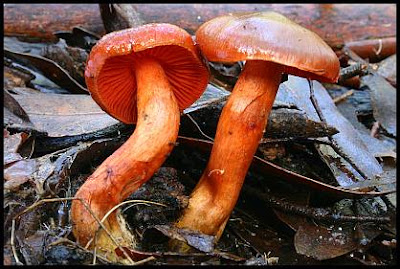
Dermocybe splendida has the common name of Splendid Red Skinhead, and is from family Cortinariaceae. Pronunciation is Dermo-sigh-be splendid-da.


The Cortinariaceae group of fungi are typically recognised by the presence of a 'cortina'. The cortina is a veil of silky or cobwebby fibrous threads which protects the gills of a young mushroom. The veil collapses as the cap opens in most cases, often leaving hairs on the stem which then stain brown from the spores.


Young Dermocybe splendida with veil covering gills


In the image below, the fibrous veil has been stretched as the cap expands. And in the image below this, the cobwebby strands have almost completely separated from the cap.

The cortina (fibrous veil) tearing as the cap expands


And the veil is almost completely separated from cap


This attractive fungus grows in soil in Eucalyptus and Leptospermum (tea-tree) forests in eastern NSW, Victoria, Tasmania, south-eastern SA, and south-western WA.

Orange-red caps are initially convex (domed), expanding up to 90mm into a broadly umbonate red-brown cap. An 'umbo' is a dome-like swelling in the centre of the cap. A slight umbo can be seen in the fungus on the right of the first photograph. The cap is dry and smooth. This fungus can be found singly, or in small or large groups.

The stem can reach 130mm in height, tapering upwards, and can be bulbous at the base. The tapering of the stalk is evident in the following image, and a bulbous base can be seen in the previous picture.

Two distinguishing features are the bright paprika-red gills, and the yellowish base of the brown-red stem and yellow mycelium. The mycelium is a mass of underground filaments (hyphae) which are often visible at the base of the fungus. The yellow mycelium is noticable in the foreground of the next image.

A dusting of rust-brown spores can be seen on caps in the following picture. This is a common occurence amongst Cortinariaceae as spores drop from overhanging fungi. The red gills stain brown as the cap ages.

Young and mature Splendid Red Skinheads


My sightings of Dermocybe splendida

[This will be updated with more sightings]

Hanging Rock, NSW - Eucalyptus woodland with tussock grass - Jun.

Barrington Tops National Park, NSW - Rainforest, in leaf litter - Apr.

New England National Park, NSW - Eucalyptus woodland with tussock grass - May.