One-to-Three Photo Processing Challenge: June 2026
I found this display of indigenous art in the National Gallery of Australia. This installation is titled The Aboriginal Memorial and consists of 200 painted, hollow log coffins from Central Arnhem Land. It was created by 43 artists to commemorate Indigenous Australians who died defending their land since 1788
The Original
Here is a favourite of many of you, Cubism I increased the effect level to 78%
I went looking in the post photo effects where I don’t usually go except for using selective colour and to resize for blogs. Art is an effect I wondered what the result would be. It took a while to render the photo. What do you think?
The colours matched one of yours and my favourite effect, Retro Pop. A few changes made, saturation and lighten mainly.
We are still in Kiama for this weeks Thursday Doors. This week it’s the Post Office
Kiama Post Office is associated with the first post office established in the town in 1841, and as such is linked with the early development of the town in the mid-nineteenth century. Kiama Post Office has been the centre of communications for Kiama for over a century, and reflects the growing population and demands for improved mail and telegraph services in the area.
It was in January 1841 when Kiama’s first post office was opened, located in premises on Michael Hindmarsh’s allotment in Shoalhaven Street
Several decades later, in January 1878, a tender from W.R. Vaughan for £3,300 was accepted for the construction of a post and telegraph office on its current site. The building was completed in December 1878; however, in April 1879, Postal Inspector Davies reported that arrangements for posting letters in the new building were unsafe. By December 1879, alterations were completed to improve the new building that had thus far remained unoccupied. And so it was that on 19 January 1880, the new purpose-built post office building was finally opened for business. Mr Tyter was the postmaster.
Kiama Post Office also provides evidence of the changing nature of postal and telecommunications practices in NSW and features the earliest surviving use of the corner clock tower as a design element in NSW. Kiama Post Office is aesthetically significant because it is a substantial, intact and picturesque example of the Victorian Italianate style, and makes an important aesthetic contribution to the civic precinct in Kiama. Kiama Post Office is also associated with the Colonial Architect’s Office under James Barnet, a key practitioner of the Victorian Italianate style of architecture.
The Post Office clock was installed by Angelo Tornaghi (born in Milan, Italy), who arrived in Sydney at the age of 24. He became a maker of scientific instruments and was appointed the position of being in charge of all NSW Government turret clocks, including the clock at the Sydney GPO.
Yes, I didn’t look at the Wrens as I thought I had already posted the Wrens. Therefore, first Wren will be the smallest of the fairy wrens the Red-backed Fairy Wren Malurus melanocephalus
Red-backed Fairy Wrens are endemic (found only there) to north and east Australia.
They are found in dense understorey dominated by tall grasses in tropical and sub-tropical areas.
This is their call. The call is a weak high-pitched reeling song, soft and unobtrusive, often only heard from quite close so listening ears needed..
Red-backed Fairy Wrens feed on small insects and arthropods, feeding in small groups among tall grasses and shrubs, sometimes in trees.
Little is known about their breeding habits. The small dome-shaped nest is well-hidden and placed close to the ground, often in grass tussocks. The nest is made of grasses, bark strips and spiders web, lined with fine grasses and feathers. The eggs are white, splotched and spotted with red-brown marks. The female mainly incubates and broods the young. Both parents feed the nestlings, sometimes helped by others in the group, and remove the faecal sacs.
You know I don’t usually post lots of photos knowing it takes a lot of your time. This time things just took over. So here’s a song to travel along this watery path
Looks like it’ll rain don’t you think?
Looks like it’s set in. How about we sit inside in the warm and have a cup of tea.
The dark clouds are retreating and a rainbow has appeared.
Aren’t rainbow marvellous. This rainbow and reflection on the Clarence River is a photo I took from my desk where I used to work
As the rain stops, left behind are the last of the rainwaters presence.
Nourishing all living things, washing yesterday away
and helping today to flourish.
Don’t foggy morning give an air of mystery
What lies below the mist
Perhaps a bit of a water logged garden
or puddles making art in the streets in town
In the headwaters, the run-off from the rain has started a flow in the creek
Some creeks send their water cascading down the mountains to join the waters flowing in the creeks
Which have joined into another larger creek starting their journey downstream
As more water enters the system, flows increase in their intensity
Sometimes increasing so much the water spreads up to the high bank and churns over the bridge
If there’s been a lot of rain upstream more water has to spread out far and wide. Compare the trees on the far bank.
Eventually the water makes it way to the towns and cities that have grown along the river bank.
Causing a lot of inconvenience. When the water recedes it leaves behind ankle deep mud, and yes it doesn’t smell all that nice after a week or so
Once at the coast the river changes again and the intrusion of salty sea water up the river mouth changes riverbank vegetation and there’s more recreational activities available
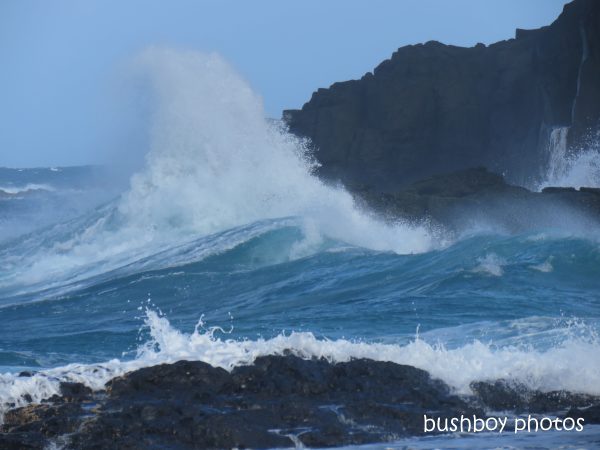
Eventually the water reaches the coast with little waterfalls tumbling from the cliffs
Our rainwater is now starting it’s life at sea. At first moving along the coastline until it’s picked up by a current and taken out to sea




 bushboys world