During WWII Japan’s
Foreign Ministry used several cryptologic systems in order to protect its
diplomatic communications from eavesdroppers. In 1939 the PURPLE cipher
machine was introduced for the most important embassies, however not
all stations had this equipment so hand ciphers continued to play an important
role in the prewar period and during the war.
The main hand
systems were transposed codes.
Historical
overview
The first
Japanese diplomatic system identified by US codebreakers was introduced during
WWI and it was a simple bigram code called ‘JA’. There were two code tables,
one of vowel-consonant combinations and the other of consonant-vowel. Similar
systems, some with 4-letter code tables were introduced in the 1920’s.
These
unenciphered codes were easy to solve simply by taking advantage of the
repetitions of the codegroups of the most commonly used words and phrases. US
codebreakers solved these codes and thus learned details of Japan’s foreign
policy. During the Washington
Naval Conference the codebreakers of Herbert Yardley’s Black Chamber were
able to solve the Japanese code and their success allowed the US diplomats to
pressure the Japanese representatives to agree to a battleship ratio of 5-5-3
for USA-UK-Japan. However this success became public knowledge when in
1931 Yardley published ‘The
American Black Chamber’, a summary of the codebreaking achievements of his
group. The book became an international best seller and especially in Japan it
led to the introduction of new, more secure cryptosystems.
In the 1930’s
the Japanese Foreign Ministry upgraded the security of its communications by
introducing the RED and PURPLE cipher machines and by enciphering their codes mainly with
transposition systems.
Japanese
transposed codes J-16 to J-19
The J-19 code
had bigram and 4- letter code tables similar to the ones used previously by the
Japanese Foreign Ministry. According to the NSA study ‘West Wind Clear:
Cryptology and the Winds Message Controversy A Documentary History’ it was
used from 21 June 1941 till 15 August 1943.
In terms of
security the J-19 FUJI and the similar codes J-16 MATSU to J-18 SAKURA, that
preceded it in the period 1940-41, were much more sophisticated than the older
Japanese diplomatic systems. They had roughly double the number of code groups
at ~1.600, these included 676 bigram entries and in addition there was a 4-letter table with 900
entries for ‘common foreign words, usually of a technical nature, proper
names, geographic locations, months of the year, etc’.
These codes
were enciphered mainly by columnar transposition based on a numerical key, with
a stencil being used for additional security. The presence of ‘blank’ cages in
the box created irregular lengths for each column of the text.
Examples of
the stencils and numerical keys from ‘West Wind Clear’:
The
replacements of J-19 FUJI
In summer ’43
J-19 FUJI was replaced by three new systems. The transposed codes TOKI and GEAM
and the enciphered code ‘Cypher Book No1’.
TOKI was used
in the period 1943-45 and it was similar to J-19 in that it was a code
transposed on a stencil. The TOKI system was used by Japan’s embassies and
consulates in Europe (2).
Just like its
predecessor it was solved by the Anglo-Americans and the German codebreakers.
Allied exploitation
of the TOKI cipher
The US
effort
The TOKI
transposed code was different from its predecessor J-19 FUJI in that it was
used by European posts, while J-19 was used by Japanese diplomatic missions from
around the world. Also TOKI was made up of 2 and 3 letter code groups while
J-19 had 2 and 4 letter groups. The code groups were arranged in a non
systematic manner thus making solution more difficult (3).
Examples of
recovered code values (4):
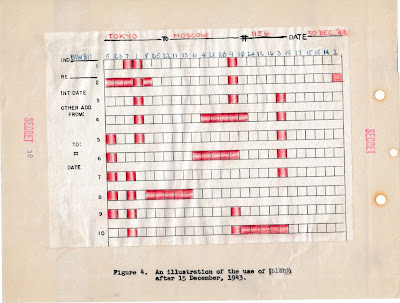
The TOKI
messages were enciphered using stencils and transposition keys that changed
within the same message. Specifically the indicator of the message designated 3
stencils and 3 numerical keys to be used in encipherment. Each table had 250
blocks (25x10) but 50 were crossed out according to a specific system, thus 200
letters could be enciphered. If the message was longer than that then the next
stencil and numerical key designated by the indicator was used.
Initially the
date of the message and the signature of the originator were used to select null
and blank blocks (5). In December 1943 this procedure was changed. Null blocks
were abolished and the new procedure for crossing out blocks was the following
(6):
‘at the intersection of the column and row;
five blanks are inserted; the odd blanks are inserted vertically, the even
blanks horizontally, for numbers 1-10 in numerical order. Blanks to be inserted
below row 10 are continued at row 1. If a blank is already present in a space
to be used for another blank, it is skipped over; always five blanks are
inserted for each intersection point, so that the total number of blanks is 50,
and the number of letters in the matrix is 200. Three such matrices and three
such random sequences are used for each indicator, if the length of the message
warrants this. If a message is longer than 600 textual letters, the first
sequence is used for a fourth block, the second for a fifth block, etc..’
Examples of
stencils and transposition keys (7):


The use of a
2 and 3 letter code together with different stencils and transposition keys
made solution difficult. The main method used was to analyze a large number of
messages ‘in depth’ (enciphered with the same settings, identified by having
the same indicator), then it was possible to use anagramming in order to solve
the encipherment and recover the code values.
The report
SRH-361 ‘History of the Signal Security Agency Volume Two The General
Cryptanalytic Problems’, p283 says about TOKI/JBA:
JBA, a transposition system of a
degree of security second only to the Purple machine-cipher system (JAA), was
solved by statistical methods within six weeks. This solution is believed to be
the first instance of the recovery of an unknown transposition of an unknown
code by purely statistical means. Beginning groups, and later, code groups
within the body of the text were found by matching stretches of cipher text
from several messages with the same indicator. Frequent digraphs were recorded,
and eventually the transposition patterns and tetragraphic code groups were
recovered despite the presence of occasional trigraphic groups, the use of
blanks in the matrix, and the use of the letters of the signature as nulls
throughout the message.
Apart from statistical methods it
was possible to solve messages by taking advantage of operator mistakes such as
sending the same message in two different keys, enciphering the same message on
TOKI and GEAM ciphers, having stereotyped beginnings etc
The
Gee-Whizzer
During the
war traffic on the J-series codes increased significantly and the solution of
the daily changing settings became a problem for the small number of people
working on Japanese systems, so there was an effort to automate the process.
The device built was an attachment for standard IBM punch card equipment called
the ‘Electromechanagrammer’ or ‘Gee-Whizzer’.
According to
the NSA study ‘It Wasn’t All Magic: The Early Struggle to Automate
Cryptanalysis, 1930s – 1960s’, p50-51:
‘The Gee
Whizzer had been the first to arrive. In its initial version it did not look
impressive; it was just a box containing relays and telephone system type
rotary switches. But when it was wired to one of the tabulating machines, it
caused amazement and pride. Although primitive and ugly, it worked and saved
hundreds of hours of dreadful labor needed to penetrate an important diplomatic
target. It proved so useful that a series of larger and more sophisticated
"Whizzers" was constructed during the war……………….When the Japanese
made one of their diplomatic "transposition" systems much more
difficult to solve through hand anagramming (reshuffling columns of code until
they made "sense"), the American army did not have the manpower
needed to apply the traditional hand tests.
Friedman's
response was to try to find a way to further automate what had become a
standard approach to mechanically testing for meaningful
decipherments……………………………………..Rosen and the IBM consultants realized that not
much could be done about the cards; there was no other viable memory medium.
But it was thought that it might be possible to eliminate all but significant
results from being printed. Rosen and his men, with the permission and help of
IBM, turned the idea into the first and very simple Gee Whizzer. The Whizzer's
two six-point, twenty-five-position rotary switches signalled the tabulator
when the old log values that were not approaching a criterion value should be
dropped from its counters. Then they instructed the tabulator to start building
up a new plain-language indicator value.
Simple,
inexpensive, and quickly implemented, the Gee Whizzer reinforced the belief
among the cryptoengineers in Washington that practical and evolutionary changes
were the ones that should be given support.’
Importance of the TOKI system
From the
available statistics on the solved TOKI messages and the reports issued it is
clear that it was one of the high level Japanese diplomatic hand systems
(together with JBB/GEAM and JBC/Cypher Book No1) (8).
In the period
1943-45 the main Japanese diplomatic systems decoded and forwarded to the
Military Intelligence Service were the Purple cipher
machine (JAA), the ciphers TOKI (JBA), GEAM (JBB), Cypher Book No1 (JBC)
and the unenciphered code LA (JAH).
The
Australian effort
In Australia
the Diplomatic Special Section (D
Special Section) of the Australian Military Forces HQ in Melbourne decrypted
Japanese diplomatic ciphers. This unit was headed in the period 1942-44 by A.D.
Trendall, Professor of Greek at Sydney University. Despite the small size of
the unit considerable success was achieved in the solution of Japanese
communications (9).
According to
the report ‘Special Intelligence Section report - Japanese Diplomatic
ciphers’ (10) the TOKI cipher was the first of the new Japanese
Foreign Office ciphers to be broken.
The system
was quickly compromised by the Japanese Ambassador in Lisbon Morishima Morito.
The report says that he committed a fatal mistake by sending the same message
in two different keys. This allowed the two messages to be solved and a few
code groups to be identified.
More
codegroups were recovered when some messages were sent both in the TOKI and GEAM
ciphers. Since GEAM (JBB) was easier to solve it was then possible to identify
the equivalent groups in solved TOKI (JBA) messages. When the cipher was
modified in December 1943 it was possible to break in again by solving two
messages sent in the same key.
Regarding the
content of the messages the report says:
‘BA was used only to a moderate extent and
the material it contained was of varying interest ranging from general Tokyo
circulars upon international happenings to dull routine matters about couriers.
Most BA messages from Russia were on the subject of couriers, visas and
rations. However Stockholm was in the habit of sending all his chōhōsha (spy reports) in BA and much
information was obtained therefrom. Although the second system of BA cypher
might well have proved unbreakable the Foreign Ministry did not regard it very
highly and issued instructions that it was to be used only for routine matters;
more confidential material was to be sent in the recyphering tables. This was
satisfactory from our point of view as we encountered far more difficulty in
breaking and reading the second BA system than we did in recovering recyphering
tables’.
The German
effort
Foreign
diplomatic codes and ciphers were worked on by three different German agencies,
the German High Command’s deciphering department – OKW/Chi, the
Foreign Ministry’s deciphering department Pers Z and the Air
Ministry’s Research Department - Reichsluftfahrtministerium Forschungsamt.
OKW/Chi
effort
At the High
Command’s deciphering department - OKW/Chi, Japanese diplomatic systems were
worked on by a subsection of Referat 13, headed by 1st Lieutenant dr Adler.
About 15 people were employed by the unit (11) and according to Reinhard Wagner
(a member of the section) the TOKI cipher was solved by the department.
Wagner said
in his postwar interrogation report (12):
(3) A transposition procedure
(Wuerfelverfahren), on which WAGNER did not work himself and which he knew only
through having translated messages passed in the system. He could say of this
system only that there was a daily changing keyword, and the reciphering
process was complicated by Raster. The system remained valid until August 1943.
(4) The successor to the above
transposition procedure, which WAGNER helped to solve, employed a basic 2 and 4
letter code book. Transposition was done in a width of 25 and a depth of 10.
The keyword was changed arbitrarily. Not all the fields in the transposition
square were employed but gaps (Loecher) were left. For example, the first
square in the first column was to be left blank, the second square down in the
second column, and so forth up to ten. In the eleventh column the top five
squares down might be left blank, and in the twenty-first column the bottom
five squares. In January 1944 the procedure was complicated by causing blank
squares to be left vertically and horizontally. E.g., in column one, starting
from the top down five squares were to be left blank. In column two, starting
with the second. square down, five squares horizontally were to be left blank. In
column three, starting with the third square down, five squares vertically were
to be left blank, etc. The referat was successful in breaking this system.

At OKW/Chi
they not only solved the Japanese transposed codes but also built a specialized
cryptanalytic device called the ‘Bigram search device’ (bigramm suchgerät) for
recovering the daily settings. EASI vol3, p65 says:
‘FUJI, a
transposition by means of a transposition square with nulls applied to a two
and four letter code. This system was read until it ended in August, 1943. It
was broken in a very short time by the use of special apparatus designed by the
research section and operated by Weber. New traffic could be read in less than
two hours with the aid of this machine.’
The ‘Bigram
search device’ is called ‘digraph weight recorder’ in the US report ‘European
Axis Signal Intelligence in World War II’ volume 2. In pages 51-53 details are
given on the operation of this device:
‘The
digraph "weight" recorder consisted of: two teleprinter tape reading
heads, a relay-bank interpreter circuit, a plugboard ‘’weight’’ assignor and a
recording pen and drum.
Each head
read its tape photoelectrically, at a speed of 75 positions per second.’
The machine
could find a solution in less than two hours and did the work of 20 people,
thus saving manpower.
Pers Z
effort
At the
Foreign Ministry’s deciphering department Pers Z Japanese systems were
worked on by a group headed by Senior Specialist dr Rudolf Schauffler. This
section successfully solved the Japanese diplomatic transposed codes, including
the TOKI cipher which in Pers Z reports was designated as JB-64.
Dr Schroeter,
a cryptanalyst of the mathematical research section who worked on Japanese
ciphers, said in TICOM
report I-22, p17
136. Dr. Schroeter: Had joined the
organization comparatively later (Spring 1941) and had no intention of ‘staying
on'. He was a lecturer in mathematical logic at the University of Münster.
He had joined Dr. Kunze’s party and worked independently on Japanese
recypherments.
137. He started work on simple
transposition recypherments of codes; they were single transpositions with
nulls over two-letter books. In the autumn of 1942-43 he worked on a Japanese
'Greater East Asia‘ traffic consisting of single transposition over a
two-letter book systematically constructed, groups consisting of cv. The cage
was 6 letters long and 5 or 10 letters deep with blanks evenly distributed
throughout; there were three keys.
138. The system used with European
posts consisted of transposition with a 25 place stencil. The stencil changed
sometimes as often as three times within the message. The blanks in the stencil
were filled out with the originator's signature, e.g. SHIGEMITSU. The basic
book was more difficult and employed groups of two or three letters. The system
was broken largely-owing to a twelve part message from Moscow with similar
beginnings to each part. This system, known as 'JB 64’, is still current,
though the stencil changes more frequently. Dr. Olbricht used to work on it.
Dr. Schroeter sketched a specimen stencil.
It is
interesting to note that a cryptanalytic device called ‘Spezialvergleicher’ was used to solve the Japanese transposed codes
(13).
In the TICOM
collection of the German Foreign Ministry’s Political Archive there are several
folders containing worksheets of solved JB-64 messages for the period 1943-45 (14).
For example (15):
Forschungsamt
effort
At the Air
Ministry’s Research Department Japanese systems were worked on by Abteilung 7 (USA, UK, Ireland, South America, Spain,
Portugal, Turkey, Egypt, Far East). The department had about 60-70 workers.
Unfortunately
at this time there is limited information on the Forschungsamt cryptanalytic
effort. In TICOM
report I-25, p7 dr Martin Paetzel (deputy director of Main Department IV -
Decipherment) said that a Japanese transposed code was worked on in the middle
of 1943 but it was not read currently. It is possible that he was referring to
TOKI.
Messages
from the Japanese embassy in the Soviet Union
The Germans
were particularly interested in the communications of the Japanese diplomats in
the Soviet Union. It seems that this embassy was either not given a PURPLE
machine or perhaps they had to dismantle it in 1941, so they relied on hand
ciphers for their most important messages.
During WWII
Japan fought on the side of the Axis but was careful to avoid a confrontation
with the Soviet Union. War between the SU and Japan finally broke out in August
1945 but during the period 1941-45 Japanese diplomats were free to collect and
transmit important information from the SU on military and political
developments as well as their discussions and negotiations with Soviet
officials. These messages were a prime target for the Allied and German
codebreakers.
In the period
1943-45 the messages of the Japanese ambassador clearly showed the deterioration
of Soviet-Japanese relations. Some of these messages were used in a series of reports
prepared by Giselher Wirsing, an
accomplished author and journalist, who in 1944 joined the Sicherheitsdienst foreign
intelligence department as an evaluator.
Wirsing had come to the attention of General Schellenberg (head of SD
foreign intelligence) due to his clear headed analysis of the global political
situation and of Germany’s poor outlook for the future. Under Schellenberg’s
protection he wrote a series of objective reports (called Egmont
berichte) showing that Germany was losing the war and thus a political
solution would have to be found to avoid total defeat (16).
In his
postwar interrogations Wirsing mentioned the decoded messages of the Moscow
embassy that he used in his reports:
‘Japanese ambassador in Moscow to his
Government. Occasional telegrams were deciphered which indicated clearly that
the Japanese were having increasing difficulties in maintaining friendly
relations with the USSR. Through this source came confirmation from an Amt VI
Far East V-man regarding a secret meeting of Japanese and Russian emissaries
somewhere in SIBERIA’.
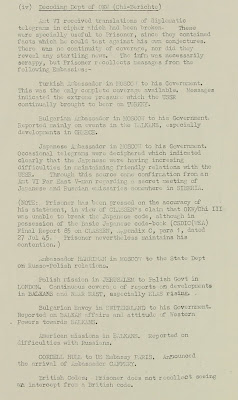
‘When STALIN delivered his famous address on 7 November 1944,
singling JAPAN out as an aggressor nation, WIRSING, in a special report written
at the request of SCHELLENBERG, read into this sentence the accomplished fact
of a fundamental change of Russian policy towards JAPAN. Again SCHELLENBERG
demurred. Then, approximately three weeks later, a report by ambassador SATO to
his government was intercepted in which he related a conversation he had had
with MOLOTOV in connection with a Japanese note expressing concern over
anti-Japanese utterances by a Russian colonel in a public address. MOLOTOV, according
to SATO, availed himself of this opportunity to advise the Japanese Government
not to mistake rhetorical exuberance for an expression of the considered policy
of the Kremlin. However, MOLOTOV added, the time would come when certain outstanding
questions of a more fundamental nature would have to be thrashed out between
the two nations.‘

It is
reasonable to assume that some of these messages were enciphered with the TOKI
system.
Notes:
(2). TICOM
report I-22, p17 and US report ‘The solution of the Japanese transposed
code JBA’, p1 (NARA - RG 457 - Entry 9032
– NR 2828)
(3). US
report ‘The solution of the Japanese transposed code JBA’ (NARA - RG 457 - Entry 9032 – NR 2828)
(4). US
report ‘Master JBA trigraph charts‘ (NARA
- RG 457 - Entry 9032 – NR 2458)
(5). The
procedure as described in ‘The solution of the Japanese transposed code JBA’
was as follows. The cipher clerk would take the stencil, write the numerical
key at the top and then add the letters of the signature of the originator (for
example SATOAMBASS) at the blocks on row 1-column 1, row 2-column 2, row
3-column 3 etc.
The blank
blocks were selected from a key table which identified the columns to be
crossed out for each day of the month.
(6). US
report ‘The solution of the Japanese transposed code JBA’ (NARA - RG 457 - Entry 9032 – NR 2828)
(7). US
reports ‘Report on Japanese diplomatic systems 1944’ (NARA - RG 457 - Entry 9032 – NR 3095) and ‘The solution of the
Japanese transposed code JBA’ (NARA - RG
457 - Entry 9032 – NR 2828)
(8). US
report 'Foreign Cryptographic Systems, 1942-1945' (NARA - RG 457 - Entry 9032 - NR3254)
(9). Breaking
Japanese Diplomatic Codes David Sissons and D Special Section during the Second
World War, chapter 1
(10). Australian
National Archives - NAA: A6923, 1/REFERENCE COPY - (barcode 12127133)
(12). TICOM I-90
‘Interrogation of Herr Reinhard Wagner (OKW/Chi) on Japanese systems’, p3
(13). TICOM
I-22, p18
(14). German
Foreign Ministry’s Political Archive - TICOM collection - files Nr. 2.465-2.471
(15). German
Foreign Ministry’s Political Archive - TICOM collection - file Nr. 2.471 - Japan 1944/45 ‘JB64, 1481-1644’, Diplom. Briefverkehr
(16). British
national archives KV 2/140
‘Giselher WIRSING: Journalist and author’
Sources:
‘European
Axis Signal Intelligence in World War II’ volumes 2,3,6,7 , TICOM reports I-22,
I-25, I-90, I-124, I-150, DF-187B , ‘The Codebreakers’, ‘Breaking
Japanese Diplomatic Codes David Sissons and D Special Section during the Second
World War’, United States Cryptologic History Series IV: World War II
Volume X: ‘West
Wind Clear: Cryptology and the Winds Message Controversy A Documentary History’,
United States Cryptologic History, Special Series, Volume 6, ‘It
Wasn’t All Magic: The Early Struggle to Automate Cryptanalysis, 1930s – 1960s’,
NSA interviews of Frank Rowlett 1974 (National Cryptologic Museum Library), Australian
National archives: ‘Special Intelligence Section report - Japanese Diplomatic
ciphers’, NARA reports: ‘The solution of the Japanese transposed code JBA’, 'Foreign
Cryptographic Systems, 1942-1945', ‘Report on Japanese diplomatic systems 1944’,
‘Master JBA trigraph charts‘, NSA report SRH-361 ‘History
of the Signal Security Agency Volume Two The General Cryptanalytic Problems’
Acknowledgements: I have to thank Rene Stein for
identifying several of the NARA JBA reports.


