In Allen
Dulles and the compromise of OSS codes in WWII I’ve added the information
from the Higgs
memorandum.
Showing posts with label OSS. Show all posts
Showing posts with label OSS. Show all posts
Friday, July 6, 2018


Thursday, July 5, 2018
The Higgs memorandum - Compromise of State Department communications by the Finnish codebreakers in WWII
During WWII
the US State Department used several cryptosystems in order to protect its
radio communications from the Axis powers. For low level messages the
unenciphered Gray and Brown codebooks were used. For important
messages four different codebooks (A1,
B1, C1, D1) enciphered with substitution tables were available.


Their most
modern and (in theory) secure system was the M-138-A
strip cipher. Unfortunately for the Americans this system
was compromised and diplomatic messages were read by the Germans, Finns,
Japanese, Italians and Hungarians. The strip
cipher carried the most important diplomatic traffic of the United States
(at least until mid/late 1944) and by reading these messages the Axis powers
gained insights into global US policy.
Germans,
Finns and Japanese cooperated on the solution of the strip cipher. In 1941
the Japanese gave to the Germans alphabet strips and numerical keys that they
had copied from a US consulate in 1939 and these were passed on by the Germans
to their Finnish allies in 1942. Then in 1943 the Finns started sharing their
results with Japan.
Finnish
solution of State Department cryptosystems
During WWII
the Finnish
signal intelligence service worked mostly on Soviet military and NKVD
cryptosystems however they did have a small diplomatic section located in Mikkeli. This department had
about 38 analysts, with the majority working on US codes.
Head of the
department was Mary Grashorn. Other important people were Pentti Aalto
(effective head of the US section) and the experts on the M-138 strip
cipher Karl
Erik Henriksson and Kalevi Loimaranta.
Their main
wartime success was the solution of the State Department’s M-138-A cipher. The
solution of this high level system gave them access to important diplomatic
messages from US embassies in Europe and around the world.
Apart from
purely diplomatic traffic they were also able to read messages of other US
agencies that used State department cryptosystems, such as the OSS
-Office of Strategic Services Bern station, Military
Attaché in Switzerland, Office
of War Information representative in Switzerland, the
Foreign Economic Administration, War Shipping Administration, Office of
Lend-Lease Administration and the War Refugee Board.
Operation
Stella Polaris
In September
1944 Finland signed an armistice with the Soviet Union. The people in charge of
the Finnish signal intelligence service anticipated this move and fearing a
Soviet takeover of the country had taken measures to relocate the radio service
to Sweden. This operation was called Stella Polaris (Polar Star).
In late
September roughly 700 people, comprising members of the intelligence services
and their families were transported by ship to Sweden. The Finns had come to an
agreement with the Swedish intelligence service that their people would be
allowed to stay and in return the Swedes would get the Finnish crypto archives
and their radio equipment. At the same time colonel Hallamaa, head of the
signals intelligence service, gathered funds for the Stella Polaris group by
selling the solved codes in the Finnish archives to the Americans, British and
Japanese.
The Stella
Polaris operation was dependent on secrecy. However the open market for Soviet
codes made the Swedish government uneasy. In the end most of the Finnish
personnel chose to return to Finland, since the feared Soviet takeover did not
materialize.
The Higgs
memorandum
In September
1944 colonel Hallamaa met
with L. Randolph Higgs, an official of the US embassy in Sweden and told him
about their successes with US diplomatic codes and ciphers.
This
information was summarized in a report prepared by Higgs, dated 30 September
1944.
The report
can be found in the US National Archives - collection RG 84 ‘Records of the
Foreign Service Posts of the Department of State’ - ‘US Legation/Embassy
Stockholm, Sweden’ - ‘Top Secret General Records File: 1944’.


Higgs met
with colonel Hallamaa on September 29 and the OSS officials Tikander and Cole
were also present during their discussion.
Hallamaa
stated that he was an administrator, not a cryptanalyst and about 10-12 of his men
worked on US diplomatic codes.
His unit had
solved the US codes Gray, Brown, M-138-A strip cipher and enciphered codebooks
(probably the A1, B1, C1).
The high
level M-138-A system had been solved mostly by taking advantage of operator
mistakes such as sending strip cipher information on other systems that had already
been broken or sending the same message in different strips one of which had
been broken.
The strip
cipher was considered a strong encryption system and had been adopted by the
Finns for some of their traffic.
Important
diplomatic messages from the US embassies in Switzerland, Sweden and Finland
were read by the Finnish codebreakers.
Regarding Bern, Switzerland most of the
messages dealt with intelligence matters:
‘Replying to my request for information
regarding the contents of the messages from our Legation in Bern to the
Department, Col. Hallamaa said the great bulk of them were intelligence
messages dealing with conditions in Germany, France, Italy and the Balkans. He
spoke in complimentary terms about ‘Harrison’s’ information service’.
Regarding
Helsinki, Finland Hallamaa stated that thanks to the decoded diplomatic traffic
they were always informed of current US policy initiatives:
‘Col. Hallamaa said that they always knew
before McClintock arrived at the Foreign Office what he was coming to talk about’.
Hallamaa
revealed a lot of confidential information to the Americans and volunteered to
have some of his experts interviewed.
The interview was conducted on friendly
terms with Higgs stating; ‘Col. Hallamaa
was most pleasant and seemed to be entirely frank and open regarding the
matters discussed’.
Additional
information: In
November 1944 the US cryptanalysts Paavo Carlson of the Army’s Signal
Security Agency and Paul E. Goldsberry of the State
Department’s cipher unit interviewed Finnish officials regarding their work
on US codes. Their report can be found here.
Monday, January 29, 2018
Staff Study on OSS Cryptographic Plan - January 1945
Another
document that has information on the OSS crypto systems is ‘Staff Study on OSS Cryptographic Plan’,
available from the US National Archives - collection RG457- Entry 9032 - NR 3280 ‘Staff Study on OSS
Cryptographic Plan’.
The report is
also available from the journal ‘Cryptologia’, vol13, no.3:
SECRET
HEADQUARTERS, ARMY SERVICE FORCES
OFFICE OF THE CHIEF SIGNAL OFFICER
WASHINGTON 25, D.C.
SPSIC-6
8
January 1945
MEMORANDUM
for Assistant. Chief of Staff, G-2
Subject:
Staff Study on OSS Cryptographic Plan
The enclosed
staff study is forwarded for your consideration and comment,
For the Chief
Signal Officer:
W, Preston Corderman
Colonel, Signal
Corps
Chiefs Signal Security Branch
1. Incl
Study on OSS
Cryptographic Plan
STAFF
STUDY ON OSS CRYPTOGRAPHIC PLAN
PROBLEM
PRESENTED
1. How may
the need of OSS for a high grade, high speed cryptographic system be satisfied?
FACTS BEARING
ON THE CASE
2. OSS has a
requirement for a high grade, high speed cryptographic system for the encipherment
and decipherment of secret traffic.
3. At the
present time OSS is using the Converter M-134-A (short title SIGMYC) to satisfy
this requirement.
4. Prior to 5
April 1944, eight (8) SIGMYC were issued to OSS.
5. The
Assistant Chief of Staff, G-2, authorized the issue of twenty-six (26) SIGMYC
to OSS by memorandum for Col. Corderman from Col. Clarke dated 5 April 1944, to
meet the expanding needs of that organization.
6. Since 5
April 1944, twenty-one (21) SIGMYC have been delivered to OSS. That
organization now holds twenty-nine (29) machines; five more are available for
issue.
7. In the
past OSS has used one universal set of rotors with SIGMYC. These rotors were
replaced once.
8. In
September 1944 OSS requested two new sets of rotors, one set to be used in
Europe and the other set in the Far East. Thirty-eight (38) sets of rotors
SIGRHAT (for use in the Far East) have been issued in compliance with that
request.
9.
Twenty-five (25) sets of rotors SIGSAAD (for use in Europe) have also been issued.
10.
Instructional documents associated with SIGMYC are "Operating Instructions
for Converter M-134 and M-134-A (Short title SIGKOC and ‘photographs and
Drawings of Converter M-134-A (short title SIGVYJ). No copies of these
publications are available for issue. This situation was caused by the
destruction of the instructional documents when Converters M-134-A were turned
in by Army holders.
11. Requests
are received for spare parts with each request for the issue of a SIGMYC. The
spare parts list always include rotor stepping solenoids. There are no rotor
stepping solenoids on hand in this agency. Three requests for these items have
not been fulfilled.
12. In accordance
with authorization of the Assistant Chief of Staff, G-2, 27 July 1944, one
SIGTOT room circuit was furnished OSS in Washington. Authorization did not
extend to the issuance of tapes for use with this equipment. Additional SIGTOT
circuits have been made available to OSS in Europe. That organization is procuring
additional tape punching equipment to meet the increased demand for tape. OSS
requested the loan of such equipment until they are prepared to fulfill their own
needs for tape. This branch is supplying OSS with sufficient tape until that
organization is self-supporting in this respect.
13. Four (4) SIGCUM
have been issued to OSS with the approval of the Assistant Chief of Staff, G-2,
28 April 1944. These machines were sent to OSS in North Africa to replace four
(4) SlGCUM which were loaned to OSS by NATO and subsequently recalled by the
latter organization.
14. Within
the past six (6) months the communications requirements of OSS have markedly
increased. The cryptographic requirements have expanded proportionately. The
rapid expansion is vividly illustrated by the strip cipher requirements of that
organization. In June 1944 SSA requested OSS to furnish a monthly quota of
desired material in order to adjust production schedules here. The monthly
quota of strip cipher systems needed is now larger than the total number of
strip systems issued to OSS over a period of twenty (20) months.
15. It is
believed that the OSS will request the five (5) remaining SIGMYC of the authorized
allotment of twenty-six (26) machines. Instructional documents are not
available for issue with these converters. The reprinting of these documents
presents a major reproduction job.
16. OSS
encounters an ever present maintenance problem since the machines are
constantly breaking down. It is believed that the time is not far distant when
it will be impossible to maintain the machines adequately,
17. In order
to provide new rotors in the future it will be necessary to have rotors
returned from the field by OSS for rewiring. Thus, a rotation process will be
established to meet new demands for rotors which will result in the wearing out
of the rotors within a relatively short time. It is noted that it would take
between one to two years to procure new rotors.
18. OSS is
now trying out a modification of the standard --text deleted -- device, which utilizes -*- --text deleted--. That organization is contemplating an
increase in the distribution of these --text
deleted – to include the standard --text
deleted – held by OSS, thus, permitting inter-communication between the two
machines. The cryptographic principle involved his been approved by the Signal
Security Agency. OSS plans to utilize the -*-
--text deleted-- for secret radio transmissions.
19. The question arises as to what other means
are available. The following items of equipment are considered:
a. SIGTOT
This system
provides adequate security but the scarcity of equipment and the difficultly of
providing sufficient quantities of one-time tape render its use impracticable.
In addition SIGTOT is not at present adapted to multi-holders of a common
system, which is an operational requirement
b. SIGABA
Under present policy, it would be necessary to
assign a crypt team with each machine in order to make them available to OSS.
This presents a problem of securing sufficient personnel which appears
insurmountable at the present time. Furthermore, the use of SIGABA as a
solution to this problem is not generally regarded with favor.
c. SIGCUM
The
communications and cryptographic problems of OSS are developing rapidly in the Far
East where traffic is transmitted largely by radio. Since SIGCUM may not be
employed for secret traffic transmitted by means of radio the use of this
machine would not provide a solution to the problem, Although SIGCUM would be a
satisfactory substitute for SIGMYC in Europe, a revision of the cryptographic
facilities of OSS in that area is not considered feasible at this time.
d. SIGFOY
This
converter provides adequate security to fulfill the need for a high grade
cryptographic system and is well adapted to multiple holders of a common
system. Since it is not a high speed system, it would not fulfill this
requirement.
e. SIGLASE
This system
would provide adequate security and speed to meet the outlined requirements.
However, since SIGLASE is still in the development stage and the expected date
of issue is unknown it is not the immediate answer to the OSS problem.
20. From the
point of view of this branch the problem could be most acceptably solved by
making Army facilities available to OSS. It is realized that the latter organization
would probably not be favorably disposed toward such a solution,
CONCLUSIONS
21. The
continued use of SIGMYC by OSS in the Far East will present maintenance and
distribution problems which will be virtually impossible to solve.
22. A
replacement for SIGMYC is needed.
23. SIGABA,
SIGCUM and SIGTOT are not completely acceptable substitutes.
24. SIGFOY
and SIGLASE would be a solution to the problem but since it will require from
six to nine months to manufacture the SIGLASE, it cannot be considered an
immediate solution.
25. It
appears that the only immediate solution to the problem is for OSS traffic to
be handled by Army cryptographic facilities.
RECOMMENDATIONS
26. That OSS
be requested to utilize Army cryptographic communications facilities where such
exist.
27. That OSS
use its own cryptographic communications facilities where Army facilities do
not exist.
28. That, at
such time as the equipment referred to in paragraph 27 becomes unserviceable,
service be maintained by those Army cryptographic facilities and/or equipments
as may then be available.

Sunday, January 14, 2018
Joint Chiefs of Staff evaluation of Office of Strategic Services ciphers
In 1943 and
1944 the US Joint Chiefs of Staff evaluated the cryptosystems used by the
various US government agencies.
For example
the report on State Department codes and ciphers for 1943
can be found in the NSA website and the report of 1944 is in the US
national archives, in collection RG 457- Entry 9032- box 1384 - 'JCS Ad
hoc committee report on cryptographic security of government communications'.
The ciphers
of the Office
of Strategic Services were also evaluated and there is some information on
this topic in the US national archives, specifically Record Group 226 - Series: Correspondence
Files, 1942 – 1946 - File Unit: 17) Cryptographic Security:


Unfortunately
there are no detailed reports on the subject but from the information presented
above it seems that even as late as 1944 OSS communications were sent on
vulnerable cryptosystems (double transposition and M-138-A cipher).
Monday, November 23, 2015
Intelligence operations in Switzerland - Hans von Pescatore, Captain Choynacki and General Barnwell R. Legge
In WWII
Poland fought on the side of the Allies and suffered for it since it was the
first country occupied by Nazi Germany. In the period 1940-45 the Polish
Government in Exile and its military forces contributed to the Allied cause by
taking part in multiple campaigns of war. Polish pilots fought for the RAF
during the Battle of Britain, Polish troops fought in N.Africa, Italy and
Western Europe and the Polish intelligence service operated in occupied Europe
and even had agents inside the German High Command.
Although it
is not widely known the Polish intelligence service had spy networks operating
throughout Europe and the Middle East. The Poles established their own spy
networks and also cooperated with foreign agencies such as Britain’s Secret
Intelligence Service and Special Operations Executive, the American Office
of Strategic Services and even the Japanese
intelligence service. During the war the Poles supplied roughly 80.000
reports to the British intelligence services (1), including information on the
German V-weapons (V-1
cruise missile and V-2 rocket) and reports from the German High Command (though
the agent ‘Knopf’) (2). In occupied France the intelligence
department of the Polish Army’s General Staff organized several
resistance/intelligence groups tasked not only with obtaining information on
the German units but also with evacuating Polish men so they could
serve in the Armed Forces (3).
Compromise
of Polish codes
Poland’s role
in WWII is well known, especially the success of Marian Rejewski, Henryk
Zygalski and Jerzy Różycki during the 1930’s in solving the Enigma cipher
machine, used by the German Armed forces. It is important to note that
countries with large cryptologic staffs such as France and Britain had not
managed to solve this device, in that time period.
Although the
Poles were successful in the offence they neglected their defense. Their diplomatic,
military
attaché, resistance
movement and intelligence
service codes were read by the Germans during the war. Especially important
for the Germans was the solution of the cipher used by Major Szczesny Choynacki, Polish deputy
consul in Bern, Switzerland.
The telegrams of Major
Choynacki
Choynacki regularly communicated with the Polish intelligence service in
London and transmitted valuable reports from his agents/contacts in Switzerland
and throughout occupied Europe.
His cryptosystem
consisted of an enciphered codebook. The codebook contained 4-figure groups and
was enciphered with a version of the British Stencil Subtractor Frame. The
codebreakers of the Signal Intelligence Agency of the Supreme Command of the
Armed Forces - OKW/Chi (Oberkommando der Wehrmacht/Chiffrier Abteilung) were
able to solve this system in late 1942-early 1943 and from then on his
voluminous traffic to London was continuously decoded (4).
Details about
the content of these messages are available from the postwar interrogations of
German intelligence officers, specifically Willy Piert and Hans Von Pescatore
(5). They were both members of the German Legation in Bern and they conducted
intelligence operations against the Allied agencies and even the Swiss IS.
The decoded
messages revealed that Choynacki had well placed agents numbered in the 500
series.


According to
the Germans the most damaging agent was No 594, Isidore Koppelmann, a Jewish
banker living in Basel. One of Choynacki’s decoded messages was used to uncover
his identity.

It is up to
historians to research this case further and identify the full extent of the
damage caused to the Polish networks from the compromise of their
communications.
The German
spy in the US embassy and the messages of General Legge
Another
interesting German operation, mentioned in the interrogations of Piert and Pescatore,
was one directed against the US embassy in Bern, Switzerland. In 1941 the
Germans were able to recruit a Swiss national who worked in the US embassy.
This person, named Fuerst, had access to the office of the US military attaché General
Barnwell R. Legge and he was able to take documents plus the used carbon paper
and give it to the Germans. These documents revealed some of Legge’s sources:


Although Fuerst
was apprehended in March 1942 the information he provided, coupled with decodes
of US traffic (6), gave the Germans an insight into the sources and operations
of the US intelligence agencies.
Notes:
(1). Journal
of U.S. Intelligence Studies article: ‘England's Poles in the Game: WWII
Intelligence Cooperation’
(2). War in
History article: ‘Penetrating Hitler's High Command: Anglo-Polish HUMINT,
1939-1945’
(3). ‘War
Secrets in the Ether’, p230-1
(4). Polish
Stencil codes and secret agent ‘’Knopf’’, Major
Choynacki’s Ace: the Solution to an Old Puzzle of Wartime Intelligence, KV
2/1329 ‘Willy
PIERT / Hans Von PESCATORE’
(5). KV
2/1329 ‘Willy
PIERT / Hans Von PESCATORE’
Acknowledgments: The credit for locating the very
interesting Piert/Pescatore report goes to Craig McKay, author of Major
Choynacki’s Ace: the Solution to an Old Puzzle of Wartime Intelligence.
Monday, June 1, 2015
The compromise of the State Department’s strip cipher – Things that don’t add up..
During WWII
the US State Department used several cryptosystems in order to protect its
radio communications from the Axis powers. The main systems used were the unenciphered
Gray and Brown codebooks along with the enciphered codes A1, B1, C1, D1 and the
new M-138 strip cipher.
In the period
1940-1944 German, Japanese and Finnish codebreakers could solve State
Department messages (both low and high level) from
embassies around the world. The M-138-A
strip cipher was the State Department’s high level system and it was used
extensively during that period. Although we still don’t
know the full story the information available points to a serious
compromise both of the circular traffic (Washington to all embassies) and
special traffic (Washington to specific embassy). In this area there was
cooperation between Germany, Japan and Finland. The German success was made
possible thanks to alphabet strips and key lists they received from the
Japanese in 1941 and these were passed on by the Germans to their Finnish
allies in 1942. The Finnish codebreakers solved several diplomatic links in
that year and in 1943 started sharing their findings with the Japanese. German
and Finnish
codebreakers cooperated in the solution of the strips during the war,
with visits of personnel to each country. The Axis codebreakers took advantage
of mistakes
in the use of the strip cipher by the State Department’s cipher unit.
Apart from
purely diplomatic traffic the Axis powers were also able to read some of the
messages of other organizations that were occasionally enciphered with State
Department systems, such as the Office
of Strategic Services, the Office
of War Information and the Military
Intelligence Service.Saturday, May 23, 2015
The OSS Bern station and the compromise of State Department codes in WWII
In the course
of WWII both the Allies and the Axis powers were able to gain information of
great value from reading their enemies secret communications. In Britain the
codebreakers of Bletchley Park solved several enemy systems with the most
important ones being the German Enigma and Tunny cipher
machines and the Italian C-38m.
Codebreaking played a role in the Battle of the Atlantic, the North Africa
Campaign and the Normandy invasion. In the United States the Army and Navy
codebreakers solved many Japanese cryptosystems and used this advantage in
battle. The great victory at Midway would probably not have been
possible if the Americans had not solved the Japanese Navy’s code.


On the other
side of the hill the codebreakers of Germany, Japan, Italy and Finland also
solved many important enemy cryptosystems both military and diplomatic. The
German codebreakers could eavesdrop on the radio-telephone
conversations of Franklin Roosevelt and Winston Churchill, they could
decode the messages
of the British and US Navies during their convoy operations in the Atlantic and
together with the Japanese and Finns they could solve State Department messages
(both low and high level) from
embassies around the world.
The M-138-A
strip cipher was the State Department’s high level system and it was used
extensively in the period 1941-44. Although we still don’t
know the full story the information available points to a serious
compromise both of the circular traffic (Washington to all embassies) and
special traffic (Washington to specific embassy) in the period 1941-44. In this
area there was cooperation between Germany, Japan and Finland. The German
success was made possible thanks to alphabet strips and key lists they received
from the Japanese in 1941 and these were passed on by the Germans to their
Finnish allies in 1942. The Finnish codebreakers solved several diplomatic
links in that year and in 1943 started sharing their findings with the
Japanese. German and Finnish
codebreakers cooperated in the solution of the strips during the war,
with visits of personnel to each country. The Axis codebreakers took advantage
of mistakes
in the use of the strip cipher by the State Department’s cipher unit.
Apart from
diplomatic messages their success against the strip cipher also allowed them to
read some OSS
-Office of Strategic Services messages from the Bern station. The
compromise of OSS traffic did not remain secret for long. In 1943 Allen Dulles
(head of the OSS Bern station) received word from Admiral Canaris and General Schellenberg
that his communications had been compromised and in addition the German officials
Hans Bernd Gisevius
and Fritz Kolbe showed
him actual decoded US messages. It’s not clear what measures the US authorities
took to protect their communications but the diplomatic traffic continued to be
read by the Germans and the Finns in the period 1943-44. It seems that the US
authorities attributed the German success to physical compromise (probably a
spy in the embassy) and thus didn’t realize that their ciphers could be solved cryptanalytically.
They would realize how wrong they were in late 1944 when more information
became available on the compromise of State Department codes and ciphers.
In September
1944 Finland signed an armistice with the Soviet Union. The people in charge of
the Finnish signal intelligence service anticipated this move and fearing a
Soviet takeover of the country had taken measures to relocate the radio service
to Sweden. This operation was called Stella Polaris (Polar Star). In late
September roughly 700 people, comprising members of the intelligence services
and their families were transported by ship to Sweden. The Finns had come to an
agreement with the Swedish intelligence service that their people would be
allowed to stay and in return the Swedes would get the Finnish crypto archives
and their radio equipment. At the same time colonel Hallamaa, head of the
signals intelligence service, gathered funds for the Stella Polaris group by
selling the solved codes in the Finnish archives to the Americans, British and
Japanese.
The Finns
revealed to the American representatives that they had solved several State
Department codes and could read the messages from a number of embassies
including Berne (Carlson-Goldsberry
report). Obviously the OSS leadership was interested in finding out whether
OSS communications passing over diplomatic links were also read.


Unfortunately
the relevant files in the OSS collection do not reveal the final outcome of
this investigation.
It seems that
during the same period the OSS received more concrete evidence regarding the
compromise of the communications of the Bern embassy. In the US National Archives
and Records Administration, RG 226 ‘Records of the Office of Strategic Services’
- Entry 123 there are intelligence reports from Bern received in late 1944.
Some of them contain summaries of decoded US messages of the Bern embassy that
must have come from German reports given to the OSS by members of the German
Resistance (probably Gisevius and Kolbe). For example:

Sources: NARA-RG 226-entry 123-Bern-SI-INT-29
-Box 3-File 34 ‘German intelligence, Hungary’,
‘Hitler, the Allies, and the Jews’
Saturday, May 9, 2015
The compromise of the communications of General Barnwell R. Legge, US military attache to Switzerland
In the course
of WWII both the Allies and the Axis powers were able to gain information of
great value from reading their enemies secret communications. In Britain the
codebreakers of Bletchley Park solved several enemy systems with the most
important ones being the German Enigma and Tunny
cipher machines and the Italian C-38m.
Codebreaking played a role in the Battle of the Atlantic, the North Africa
Campaign and the Normandy invasion. In the United States the Army and Navy
codebreakers solved many Japanese cryptosystems and used this advantage in
battle. The great victory at Midway would probably not have been
possible if the Americans had not solved the Japanese Navy’s code.

On the other
side of the hill the codebreakers of Germany, Japan,
Italy
and Finland
also solved many important enemy cryptosystems both military and diplomatic. The
German codebreakers could eavesdrop on the radio-telephone
conversations of Franklin Roosevelt and Winston Churchill, they could decode
the messages
of the British and US Navies during their convoy operations in the Atlantic
and together with the Japanese and Finns they could solve State Department
messages (both low
and high
level) from embassies around the world.
The State
Department made many
mistakes in the use of its cipher systems and thus compromised not only US
diplomatic communications but also the messages of other organizations that
were occasionally enciphered with State Department systems, such as the Office
of Strategic Services and the Office
of War Information. Another similar case concerns the communications of General Barnwell R. Legge,
US military attache to Switzerland during WWII. 
Sunday, April 5, 2015
Who was source 206?
During WWII the US Office of
Strategic Services station in Bern, Switzerland (headed by Allen Dulles)
recruited agents in occupied Europe and transmitted intelligence reports back
to Washington. Dulles collaborated in intelligence gathering activities with Gerald
Mayer, local representative of the Office
of War Information and General Barnwell Legge,
US military attaché to Switzerland.

Some of these reports were decoded by the Germans and the
Finns and we can see that they mention specific agents.
For example message No. 73 Bern-London of 4/4/1943, by
General Legge lists several German divisions stationed in France and says that
the information came from Source 206. Who was this mysterious
agent? Thursday, January 15, 2015
The wartime adventures of Prince Max Hohenlohe
During WWII
the military forces of the Allies and the Axis battled in Europe and Asia but
behind the scenes there were efforts to negotiate some sort of compromise
peace. These efforts however never amounted to much since both sides distrusted
each other and the military situation made it clear that the Allies could win
the war through military force alone.


Both the German resistance (through Admiral Canaris) and the Sicherheitsdienst (through Schellenberg) had warned Dulles that his communications were compromised but it doesn’t seem like he acted on this information. These efforts for a compromise peace were probably doomed from the start (especially since the Germans seemed to have overestimated the influence of Dulles) but even so without secure communications the talks could not have remained secret for long.
Since the
1930’s a segment of German society that opposed the National-Socialist regime had
tried to establish contact with foreign countries in order to topple Hitler. During
the war the same groups contacted US and British officials in neutral countries
and tried to gain their support in order to remove the NS regime from power.
The Western Allies were aware of these efforts but they did not offer material
support to the members of the German
resistance.
At
the same time elements of the NS regime came to realize that the war was lost and
thus made cautious attempts to contact Allied officials that could promote some
sort of compromise peace. Heinrich Himmler was
leader of the SS security service and thus one of the most powerful men in Nazi
Germany. Yet by 1943 he was beginning to realize that hopes for a successful
conclusion of the war were slim. His subordinate General Walter Schellenberg,
head of the foreign intelligence department of the Sicherheitsdienst,
had many talks with Himmler on the need for a compromise peace and in 1943 he
was able to make the first attempts at contacting Allied officials.
The Germans knew that Allen Dulles was in charge of the OSS-Office of Strategic Services
station in Bern, Switzerland and they chose to contact him through people
associated with the German resistance.
In early 1943 Prince Max
Hohenlohe (working on behalf of the Sicherheitsdienst)
was given permission to travel to Switzerland and meet Dulles. Unfortunately it
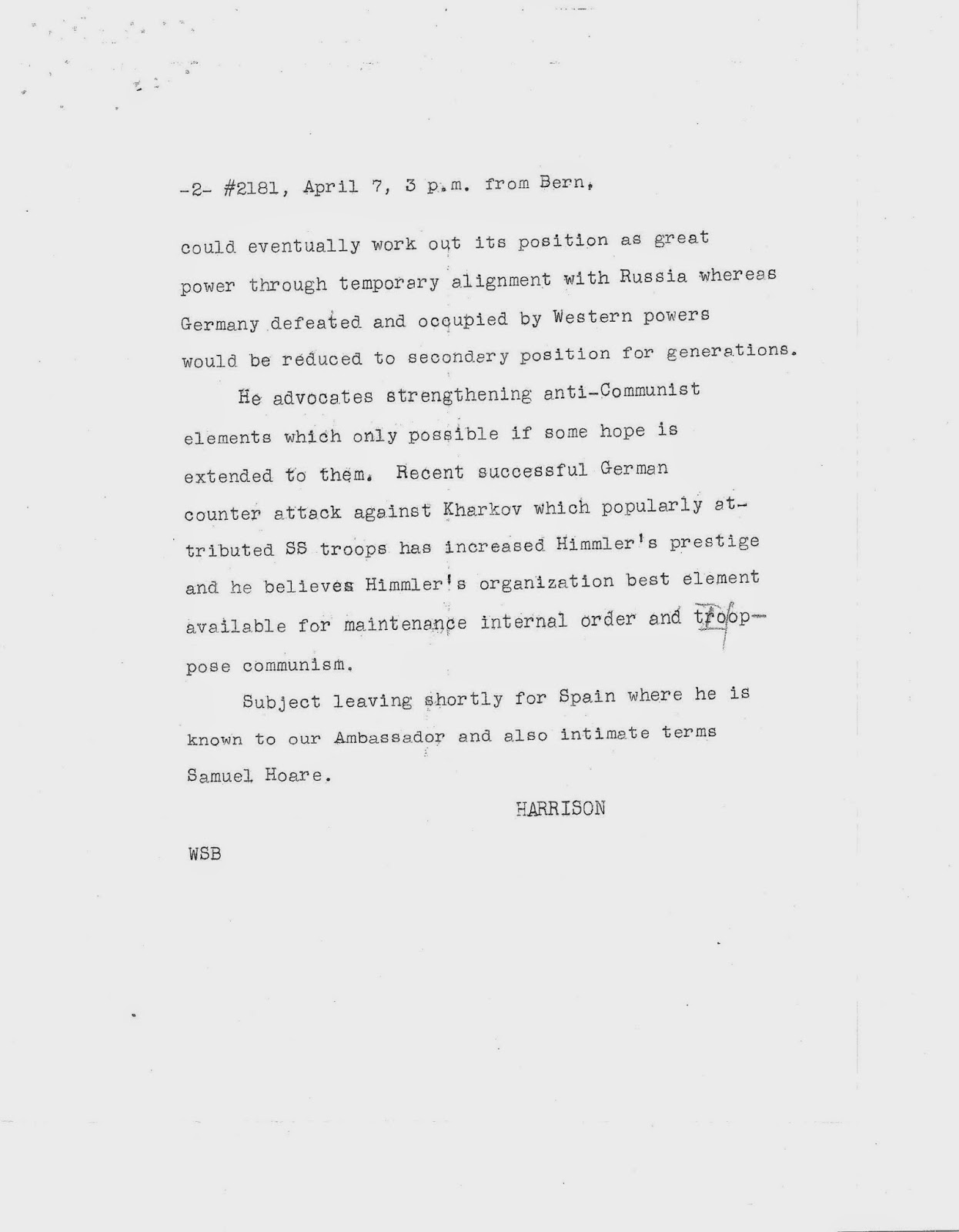
doesn’t seem like their meeting remained a secret for long. In the Finnish
national archives one can find the decoded version of message No 2.181 of April
7, 1943, giving an overview of their discussion. Both the German resistance (through Admiral Canaris) and the Sicherheitsdienst (through Schellenberg) had warned Dulles that his communications were compromised but it doesn’t seem like he acted on this information. These efforts for a compromise peace were probably doomed from the start (especially since the Germans seemed to have overestimated the influence of Dulles) but even so without secure communications the talks could not have remained secret for long.
Subscribe to:
Posts (Atom)