This version
(unlike the copy at the Cryptologic Museum’s Library) is complete!
Showing posts with label Russian FISH. Show all posts
Showing posts with label Russian FISH. Show all posts
Monday, February 19, 2018
Candle in the Dark: COMINT and Soviet Industrial Secrets, 1946-1956
The study ‘Candle in the Dark: COMINT and Soviet Industrial Secrets, 1946-1956’ by Carol B.
Davis is available for download from the NSA website.


Tuesday, July 22, 2014
Compromise of Soviet codes in WWII
Signals intelligence and codebreaking played an important
role in WWII. British and American codebreakers solved many important Axis
crypto systems, such as the German Enigma machine and the Japanese Navy’s code
JN25.
Historians have not only acknowledged these Allied successes
but they’ve probably exaggerated their importance in the actual campaigns of
the war.
Unfortunately the work of the Axis codebreakers hasn’t
received similar attention. As I’ve mentioned in my piece Acknowledging
failures of crypto security all the participants suffered setbacks
from weak/compromised codes and they all had some successes with enemy systems.
Britain, the Soviet Union and the United States did not have
impenetrable codes. In the course of WWII all three suffered setbacks from
their compromised communications.
After having dealt with the United
States and Britain it’s
time to have a look at the Soviet Union and their worst failures.
Move along comrade, nothing to see here
Compromises of communications security are usually difficult
to acknowledge by the countries that suffer them. For example since the 1970’s
countless books have been written about the successes of Bletchley Park, yet
detailed information on the German solution of Allied codes only started to
become available in the 2000’s when TICOM reports and other relevant documents
were released to the public archives by the US and UK authorities.
In Russia the compromise of their codes during WWII has not
yet been officially acknowledged and the archives of the codebreaking
organizations have remained closed to researchers. This is a continuation of
the Soviet policy of secrecy.
The Soviet Union was a secretive society and information was
tightly controlled by the ruling elite. This means that history books avoided
topics that embarrassed the regime and instead presented the officially
sanctioned version of history. Soviet era histories of WWII avoided references
to codes and ciphers and instead talked about ‘radio-electronic combat’ which
dealt with direction finding, traffic analysis and jamming (1).
After the fall of the Soviet Union several important
government archives were opened to researchers and this information has been incorporated
in new books and studies of WWII. However similar advances haven’t taken place
in the fields of signals intelligence and cryptologic history. Unlike the US
and UK that have admitted at least some of their communications security
failures the official line in Russia is that high level Soviet codes were
unbreakable and only unimportant tactical codes could be read by the Germans.
Even new books and studies on cryptology repeat these statements (2).
However various sources such as the TICOM reports, the
war diary of the German Army’s signal intelligence agency Inspectorate 7/VI and the monthly reports of the cryptanalytic
centre in the East Horchleitstelle Ost
clearly show that the Germans could solve even high level Soviet military and
NKVD codes. Friday, August 16, 2013
More information from ‘It Wasn’t All Magic’
The recently
released United States Cryptologic History: ‘It Wasn’t All Magic: The Early
Struggle to Automate Cryptanalysis, 1930s – 1960s’ has some interesting information
in pages 266-7 regarding the Japanese Purple cipher machine and the Soviet
Longfellow cipher teleprinter.
Purple was used by the Japanese Foreign Ministry since the late 1930’s but after the war it seems that it continued to serve the Emperor! Apparently this time it was used to generate random diplomatic one-time pads. According to the report: ‘Somewhat later, Japan's reintroduction of the Purple machine to generate one-time pads for its diplomats proved quite useful to America's SIGINT monitors.’
………………………………………………………………………………………
‘The attack on Longfellow
was thought to be just a prelude to reading the rest of Russia's most valuable
communications. The Cold War, it seemed, was to have its own Ultra.’
If Campaigne is right and Longfellow was introduced in
1943 then it must have been the machine the Soviets called M-101.
Purple was used by the Japanese Foreign Ministry since the late 1930’s but after the war it seems that it continued to serve the Emperor! Apparently this time it was used to generate random diplomatic one-time pads. According to the report: ‘Somewhat later, Japan's reintroduction of the Purple machine to generate one-time pads for its diplomats proved quite useful to America's SIGINT monitors.’
The Soviet Longfellow cipher teleprinter was such an important
target for the American codebreakers that very advanced cryptanalytic equipment
was built to decode its messages:
‘Much more
ambitious was Hiawatha. In late 1947 electronic potentials finally came
together with a cryptanalytic opportunity to force the release of massive
funding for the long-sought Electronic Super Bombe. The elusive electronic
matrix finally seemed ready, and at the same time enough had been learned about
Longfellow to think that a bombe would allow continuous reading of its messages.’
Unfortunately this breakthrough could not be taken
advantage of because the Soviets removed Longfellow from service in 1948!
‘Howard Campaigne,
was furious with the Americans as well as the Soviets. When he learned that
ERA's electronic bombe project
was terminated, he wrote: "If we had complete coverage [of Longfellow]
from the beginning [1943] we probably could have been reading their
communications by 1945. If we had supported this by the analytic machinery
recently planned, we could have broken out most of the available traffic. The entire
story is one of 'too little too late'. This system was in use for five years,
yet we were not ready to read it in quantity until it disappeared."
Tuesday, July 23, 2013
Soviet codebreakers of WWII
WWII
histories of signals intelligence and codebreaking are currently focused on the
theatres where German and Japanese troops fought against the Anglo-Americans.
The influence of ULTRA intelligence on the Battle of the Atlantic, the North
Africa campaign, the Normandy invasion, the battle of Midway etc is mentioned
not only in specialized books but also in the popular histories of the war.

The 8th department concentrated on traffic analysis and direction finding in order to reveal the order of battle of the German units.
Still we do know that through direction finding and traffic analysis the Soviets were able to identify German formations and follow their movements. For example the article ‘Spies, Ciphers and 'Zitadelle': Intelligence and the Battle of Kursk, 1943’ says : ‘a captured intelligence report of the Soviet 1st Tank Army dated 5 July 1943 revealed that radio intelligence had identified the positions of the headquarters and units of II SS Panzer Corps, 6th Panzer and 11th Panzer Divisions before the offensive began. Other captured documents disclosed that 7th Panzer Division, XIII Corps and Second Army headquarters had all been similarly ’fixed’ by Soviet radio intelligence.’
On the contrary the recent article ‘О ВКЛАДЕ СОВЕТСКИХ КРИПТОГРАФОВ В ПОБЕДУ ПОД МОСКВОЙ’, says that in late 1942 the Soviet codebreakers analyzed the Enigma cipher machine and developed ways of solving it. However their efforts failed in January 1943 due to German security measures.
This information
seems to be confirmed by the war diary of the German Army’s Inspectorate 7/VI.
The March 1943 report of Referat 13 (security of German cipher machines) says that based on the published
radio dispatches from Stalingrad Inspectorate 7/VI was asked to give an opinion from the point
of view of decipherment.

Such a failure could be attributed to several factors:
Central Abwehr stations also used a small number of Enigma G machines. The G (Counter) version did not have a plugboard since its security laid in the irregular stepping system of the wheels. Bletchley Park was able to solve this machine in late 1941 and the traffic was regularly read. There is no indication that the Enigma G was solved by the Soviets, although it would be theoretically possible (for example by using reencodements from hand ciphers).
On the other
hand the Eastern
Front is completely neglected in this aspect, despite the fact that
millions of troops fought in countless battles and endured horrendous losses for
several years in the largest land campaign in history.
Codebreaking
and signals intelligence played a major role in the German war effort. We know
that the Army had 3 signal intelligence regiments (KONA
units) assigned to the three Army groups in the East (Army Group North,
South and Centre). In addition from 1942 another one was added to monitor
Partisan traffic. The Luftwaffe had similar units assigned to the 3 Air Fleets
(Luftflotten) providing aerial support
to the Army Groups.
Both the Army and the Luftwaffe also established central cryptanalytic departments
(Horchleitstelle Ost and LN Regt
353) for the Eastern front in East Prussia. So as we can see the Germans
certainly invested significant resources on sigint.
During the
war this effort paid off. We know that the German codebreakers could solve Soviet low, mid and (for a time) high level cryptosystems. We also know that they
intercepted the internal
radio teletype network carrying economic and military traffic. Traffic
analysis and direction finding also played a big role in identifying the Soviet
order of battle.
Having looked
at the German side we need to turn our attention to the Soviets. What were the
successes of the Soviet side in this shadow war?
Unfortunately
there is no clear answer to this question. The Soviet archives relating to
signals intelligence are closed and information on codebreaking is hard to find
and verify. This means that there are limited sources that a researcher can use and
in some cases it will be necessary to resort to deductive reasoning.
Prewar
developments
The Tsarist empire invested
considerable resources in the field of secret intelligence and codebreaking.
The agents of the feared Okhrana
monitored revolutionaries and other enemies of the regime and its ‘Black
Chamber’ (Cherniy Kabinet) could decode the telegrams of foreign ambassadors.
The new
Soviet state took over some of these codebreakers and put them back to work. In
1921 the Spetsial'niy Otdel (Special
Department) was created and it was housed in a building of the People's Commissariat
of Foreign Affairs on Kuznetskiy Most Street, Moscow. In 1935 it was moved to
the NKVD’s Lubyanka office complex. Security measures were draconian with the
personnel being told not to reveal even the location of their offices to their
relatives.
Head of the
department from 1921-37 was Gleb
Ivanovich Bokii, a loyal Bolshevik who had ruthlessly suppressed enemies of
the Soviet state during the Russian civil war. His
deputy was Major Pavel Khrisanfovich Kharkevich.
The Spetsodel
initially employed many former Tsarist codebreakers who were assisted in their
work by compromised cipher material provided by foreign spies. The Soviet
foreign intelligence service was able to recruit personnel with access to
cipher material in many countries during the 1920’s and 30’s.
During this
period the Soviet codebreakers were able to exploit the codes of several
foreign nations including Britain, France, Germany, Italy, Japan, USA, Poland
and many others. The main target was Japan due to the military incidents in the
Far East between the Soviet forces and the Kwantung Army.
The Soviet
codebreakers also took part in the Spanish Civil War,
the Sino-Japanese
war and the battle of Khalkhyn Gol.
Special operational groups of the Spetsodel were sent on these
operations. A small group went to Spain in 1936 were it succeeded in reading
the messages of Franco’s military forces and also of their spy network.
In early 1938 a group was sent to China to assist the Government forces
of Chiang Kai-shek in their fight against Japan. In the course of the following
months 10 Japanese tactical cryptosystems were solved.
In 1939 the
codebreakers were able to assist General Zhukov in the battle of Khalkhyn Gol by reading the code used by the
Kwantung Army.
The purges
of the 1930’s
The many
successes of the Special Department did not shield it from the purges of the
1930’s. During that period people from all aspects of Soviet society suffered
from accusations of spying and sabotage and there were show trials and executions.
The purges
crippled the cryptologic service since many of its workers were executed along
with the top administrators. Bokii was executed in 1937 with most of the
section heads and the Tsarist era personnel suffering the same fate.
These self
inflicted wounds came at the worst possible time since in September 1939
Germany invaded Poland and thus started World War II.
The Great
Patriotic war
In 1941 the
crypto service was redesignated as the 5th Department of the NKVD under the
efficient administrator Major Ivan Grigoryevich Shevelev.
The German
invasion led to the rapid expansion of the department and Shenelev recruited
some of the best mathematicians and technicians in the Soviet Union. According
to Matt Aid ‘By the end of World War II,
the 5th Directorate controlled the single largest concentration of
mathematicians and linguists in the Soviet Union.’
The Red Army
also had its own signal intelligence and codebreaking department under the
Chief Intelligence Directorate - GRU.
In 1930 the GRU decryption department became part of the Spetsodel but was
split off again in 1938.
In 1941 the
radio intelligence service was the 8th department of the Intelligence
Directorate of the Army General Staff. Head of the unit was Engineer 1st Rank
I.N. Artem'ev. The GRU controlled special radio battalions called OSNAZ. At the
start of the war there were 16 of these battalions.
How did the
Soviet radio intelligence organizations perform during the war?
Period
1941-42
We know that
in 1941 they were suffering from the loss of experienced personnel. It also
seems that the numerous GRU radio battalions were primarily tasked with monitoring
their own military forces for breaches of security and thus neglected to keep
foreign units under close observation.
The German
surprise attack caught the entire Soviet military in the process of
mobilization and movement of units. The great defeats of 1941 led to the loss
of equipment, cipher material and personnel. However it seems the Soviets were
also able to win some important victories in the radio war.
In the autumn
of 1941 a group led by NKVD cryptanalyst Sergei Tolstoy was able to solve the PURPLE cipher
machine used by the Japanese Foreign Ministry. The decrypts showed that Japan
would not attack the Soviet Union in support of the Germans. This information
allowed the Soviet leadership to concentrate all available resources against
Germany. Japanese diplomatic traffic continued to be read throughout the war
and provided important insights into the political and military developments in
Axis countries.
In the
military front there is no indication that German cipher machines were solved cryptanalytically
but in late 1941 the Soviets were able to capture Enigma machines and
documentation of the German Second Army. The information obtained might have
played a role in the Battle of Moscow.
Germany’s
Allies were easier targets. According to a recent book on Russian cryptology
the Army codebreakers were able to read messages exchanged between the Romanian
high command and General Manstein in the Ukraine during the period 1941-42.
The Soviet
Stalingrad offensive took advantage of the fact that the sides of the German
front were held by Romanian and Hungarian troops. It is not unreasonable to
assume that some of this information was acquired through signals
intelligence.
A report from
the
GRU to Stalin dated November 29, 1942 says that: ‘Direction finding of German army radio stations provided valuable
information about enemy groupings, their activities and intentions….The
cryptanalytic service of the Chief Intelligence Directorate of the Red Army
identified the main German and Japanese general military, police and diplomatic
ciphers, including 75 systems of German intelligence. More than 220 keys to
them, and more than 50,000 German messages were read…The research group of our
office has revealed the possibility of solving German messages enciphered on
the ‘‘Enigma’’ machine, and started to construct equipment, speeding up the
solution.’
The crypto
systems mentioned must have been the hand ciphers used at low and mid level by
the German military, police and Abwehr.
In 1942 there
was a major reorganization of the NKVD and GRU radio intelligence services. The
5th department took control of the evaluation and distribution of
Soviet crypto systems and also absorbed the GRU cryptanalysts.The 8th department concentrated on traffic analysis and direction finding in order to reveal the order of battle of the German units.
Period
1943-45
In the second
half of the war the German forces were in retreat and the Soviets liberated the
occupied territories and ended the war by capturing Berlin. During this period
the Soviet military had a significant numerical advantage in troops and
equipment against the Germans. This makes it difficult to assess the importance
of signals intelligence in the Soviet victories since many different factors
were at play.Still we do know that through direction finding and traffic analysis the Soviets were able to identify German formations and follow their movements. For example the article ‘Spies, Ciphers and 'Zitadelle': Intelligence and the Battle of Kursk, 1943’ says : ‘a captured intelligence report of the Soviet 1st Tank Army dated 5 July 1943 revealed that radio intelligence had identified the positions of the headquarters and units of II SS Panzer Corps, 6th Panzer and 11th Panzer Divisions before the offensive began. Other captured documents disclosed that 7th Panzer Division, XIII Corps and Second Army headquarters had all been similarly ’fixed’ by Soviet radio intelligence.’
The Soviet
codebreakers were definitely able to solve German hand ciphers and they must
have captured Enigma machines and their keylists when they encircled German
units (especially in the summer of ’44).
Help from
abroad
The Soviets
received assistance from two foreign sources. On the one hand the British
occasionally shared some of the intelligence that they acquired by breaking
German codes. The source was always camouflaged since the Brits did not want to
reveal their cryptologic successes to the Soviet government.
Apart from
general warnings about impending German actions the Brits also sent more
detailed reports. In April ’43 they transmitted a report sent by General von
Weichs to Foreign Armies East that revealed the main points of the German
plan for the battle of Kursk. In October of the same year they informed the
Soviet authorities about the Abwehr’s Klatt network.
Although the
British authorities were careful to hide the source of their reports the
Soviets already knew about Bletchley Park and the Enigma codebreaking through
their spy network. During WWII Kim Philby and Anthony Blunt passed along
information on Abwehr ciphers while John
Cairncross was able to infiltrate Bletchley Park.
According to ‘The Crown Jewels: The British Secrets at the Heart of the
KGB Archives’, p218-9 in 1942 apart from decrypted messages Cairncross was able
to get ‘two volumes of the secret
training manual on deciphering, a guide for the reading of the German Enigma
key codenamed TUNNY and a description of a machine constructed by the British
to read the Luftwaffe's cipher traffic’.
Tunny must refer to the SZ42 teleprinter and not Enigma. The part about
the machine used on the Luftwaffe cipher traffic could refer to the bombes but
it is not clarified in the book.
The information provided by Cairncross could have allowed the Soviet
codebreakers to overcome cipher research problems.
Working
backwards
Since we do not
have details on what systems the Soviets could exploit it might be best to work
backwards. By looking at the cryptosystems used by the Germans we can check if
their security was such that they would have resisted a well organized attack
by a group of mathematicians and linguists.
Overview
of Axis cryptosystems
Germany
Military
The German
military used cipher teleprinters of the SZ42, T52 and T43 types for top level
communications, the Enigma machine from regiment upwards and various hand
ciphers for frontline use.
Lorenz
SZ42
The main
radio-teletype machine used in the East was the Lorenz SZ42. This was
quite a complex machine and regular solution required the use of very advanced
cryptanalytic equipment. The Brits built the Colossus computer in
order to decode this traffic. The Soviets were probably unable to build similar
equipment but they could have decoded messages ‘in depth’ using hand methods.
This was the standard practice at Bletchley Park prior to the introduction of
high speed cryptanalytic equipment.
At this time
there is no information on Soviet analysis of German teleprinters.
Enigma
The plugboard Enigma
was used by the German Army, Navy and Airforce as their main cipher system.
Throughout the war its security
was upgraded with new procedures and modifications. Could the Soviets have
decoded Enigma traffic like Bletchley Park?
The GRU 1942
report says ‘The research group of our
office has revealed the possibility
of solving German messages enciphered on the ‘‘Enigma’’ machine, and started to
construct equipment, speeding up the solution’. However there is no mention
of actually decoding traffic.
This
possibility was examined by Geoff Jukes in a series of articles in the 1980’s.
However both his articles were based on inferential evidence and the responses
by Milner‐Barry and Ralph Erskine effectively
countered Juke’s arguments.
David Kahn who
interviewed KGB General Nicolai Andreev (head of the KGB’s sigint department in the 1970-80's) in
1996 was told that the Soviets knew how to solve the Enigma and although they
didn’t have bombes ‘it might have been possible to organize
people to replicate the mechanisms work’. From Andreev’s statement it is
not clear if this was actually done with real traffic.
The Soviets
definitely captured intact Enigma machines and valid keylists during the war.
Using them they would have been able to decode older traffic. However there is
no indication so far that they were able to recover the settings
cryptanalytically. On the contrary the recent article ‘О ВКЛАДЕ СОВЕТСКИХ КРИПТОГРАФОВ В ПОБЕДУ ПОД МОСКВОЙ’, says that in late 1942 the Soviet codebreakers analyzed the Enigma cipher machine and developed ways of solving it. However their efforts failed in January 1943 due to German security measures.

Schlüsselüberwachung
Auf grund der veröffentlichten
Funksprüche asus Stalingrad wurde In 7/VI um ein allgemeines Gutachten gebeten,
das die Stellungnahme vom Standpunkt der Entzifferung enthält.
Thus it seems
that the Soviet effort to decrypt Enigma messages was identified early and
countered by the Germans.
1). They
started their analysis of the Enigma late in the war and thus could not exploit
the insecure signaling procedures of the period up to May 1940. In the period
1942-45 the Germans introduced many new security measures that would have made
a solution much more difficult than in 1939-40 when Bletchley Park made its
start.
2). Most of
the Enigma traffic in the East would be from Army units that traditionally had
a higher level of security than their Airforce counterparts. Army traffic
routinely caused problems for Bletchley Park, despite their large number of ‘bombes’.
Hand
ciphers
The German
army used hand ciphers at division level and below. For most of the war the
main systems were double Playfair and 3-letter field codes.
The double
Playfair- Doppelkastenverfahren was
a modification of the well known Playfair cipher but
instead of one square it used two. The text was broken up into digraphs and
they were enciphered using the two alphabet squares. According to Dr Fricke, a
German cryptologist who evaluated the security of Army systems, up to 1942 the
digraphs were enciphered only once but from that point on they were enciphered
twice. A report by Allied personnel who worked on this system says that ‘Each German division had its own set of
cipher boxes. It was assigned six different boxes for each day. These were
paired in different combinations for each day's eight three hour periods. In
effect, there were eight keys per day.’
The army also
used 3-letter codes. Initially these were used unreciphered but from 1942 they were enciphered with daily
changing trigraphic substitution tables.
Both these
systems had limited security. It is probably safe to assume that this traffic
was regularly solved by the Soviets and gave them tactical intelligence and OOB
data. However their success with military hand ciphers could not have lasted
for the entire war.
In 1944 the
double Playfair was replaced with the Rasterschlüssel
44, a transposition system using a stencil. The RS 44 had impressive
security for a hand cipher and confounded the analysts of Bletchley Park. The Soviet
codebreakers must have been similarly annoyed that the double Playfair was
replaced by such a secure cipher.
Radio
procedures
According to
German personnel the radio procedures of their units (callsigns, indicator
groups) were insecure and thus simply through traffic analysis and direction
finding the Soviets were able to identify enemy units and concentrate their
attacks at their flanks.
Intelligence services
The military
intelligence service Abwehr infiltrated
spies in the Soviet rear areas through WALLI I, a unit controlled by Major Hermann Baun. The ciphers used
by the Abwehr in the field were mostly transposition systems. The codebreaker
of Bletchley Park were able to solve Abwehr ciphers throughout the war. There
is no reason why these simple systems would resist solution by the Soviets. The
GRU report specifically mentions the Abwehr traffic: ‘….including 75 systems of German intelligence.’
Additional information on Abwehr ciphers was provided by the Cambridge
spy ring.Central Abwehr stations also used a small number of Enigma G machines. The G (Counter) version did not have a plugboard since its security laid in the irregular stepping system of the wheels. Bletchley Park was able to solve this machine in late 1941 and the traffic was regularly read. There is no indication that the Enigma G was solved by the Soviets, although it would be theoretically possible (for example by using reencodements from hand ciphers).
In one case we definitely know that the Soviets exploited the
communications of the Abwehr. In Sofia, Bulgaria the Klatt bureau gathered intelligence
from sources that were supposedly working inside the Soviet Union. The traffic
of the Sofia station was intercepted by the Brits who found the information
valuable. Through their spies inside British intelligence the Soviets learned
of the Klatt bureau and started intercepting the Vienna-Sofia traffic from
autumn 1941. According to ‘The Crown
Jewels: The British Secrets at the Heart of the KGB Archives’, p197 the Soviet
codebreakers were able to solve the cipher in July 1942 and found it to be ‘a letter cipher of a comparatively simple
system’. The same source says that the traffic on the Sofia-Budapest link
was also decoded.
The
intelligence service of the SS – Sicherheitsdienst recruited POW’s
and after a brief period of training and indoctrination sent them to the Soviet
rear on espionage and sabotage missions. This operation was called ‘Zeppelin’
and it was clearly a numbers game. The Germans did not expect their agents to
survive for long. The SD probably used several different cryptosystems, however
just like the Abwehr it seems that the most widely used one was double
transposition. Considering the limited training afforded to the ‘Zeppelin’
agents it is probably safe to assume that they would not be taught complex
cryptosystems. Just like the Abwehr there is no reason to assume that these
messages were secure from Soviet eavesdroppers.
Organisations
in the rear areas
Could the
Soviet radio intelligence services have gotten information on events in the
occupied areas of the Soviet Union? Although the Germans were well supplied
with radios they only used them when landlines were not available. In the East
they quickly built up a ground network using telephone cable and drehkreuz
lines. This means that most traffic in the rear areas would go by landline.
However some
organizations had to use the radio more often and their traffic could
potentially be exploited.
Police
The German
police - Ordnungspolizei
was a militarized organization and during the war several of their units served
as occupation troops in the East. Their radio communications were enciphered with
the simple and double Playfair system and from 1944 the RS44 stencil. According
to Major Schlake, head of communications in the Main office of the Ordnungspolizei, only a small number of Enigma machines (about 20) were used by the police.
According to ‘The history of Hut 6’ the Enigma was introduced in February 1944
for use by higher police officials in occupied Europe. The Brits called this
key ‘Roulette’ and were able to solve it mainly thanks to reencodements from
double Playfair.
There is no reason why the simple and double
Playfair would resist an attack by the Soviet codebreakers. The GRU 1942 report
says that police ciphers were identified and ‘valuable reports were obtained
about the fighting ability of partisans on territory occupied by the Germans.’
This information must have come from police reports.
German railways
The German
railways - Deutsche
Reichsbahn used a small number of rewired commercial
Enigma machines for radio traffic. The key used in Eastern Europe was named ‘Rocket’
by Bletchley Park and was first solved in early 1941.
The commercial Enigma was not as secure
as the military version because it lacked a plugboard. On the other hand the
wheels were wired separately for the Reichsbahn, so a cryptanalytic attack
would need to recover the wirings first.
So far there is no indication that the Soviet
codebreakers were successful with that task but it would be theoretically
possible since no special cryptanalytic equipment was needed.
German Allies
Apart from
German troops there were also Finnish, Romanian, Italian, Slovakian and
Hungarian units fighting in the Eastern front. Their contribution was important
especially in the period 1941-42, with numbers peaking in summer ’42 at roughly
850.000 troops.
These
countries used mainly hand ciphers so in theory their traffic should be
vulnerable to cryptanalysis. As has been mentioned previously the traffic of
the Romanian command was read in 1941-2 by the Soviet codebreakers.
The Germans
were aware of the insecurity of some of their Allies cryptosystems and in 1942
they gave them a number of plugboard Enigmas but still most of the traffic
would go through insecure systems. For example the cipher used by the Romanian
police was found to be very simple and it was a security risk since the police
routinely reported the movement of German units passing through their country.
Additional
research is needed to identify the cryptosystems used by the minor Axis nations
in the East and their exploitation by the Soviets.
Conclusion
The use of
signals intelligence and codebreaking by the Germans and Soviets in the Eastern
front is a subject that has received very little attention by historians so
far. The main reason was probably the lack of adequate sources. That excuse
might have been valid a few years ago but today the newly released TICOM
material allows the researcher to discover many details about the performance
of German sigint in the East.
When it comes
to the Soviet side we know that they performed well prewar but there is limited
information on the codesystems they solved during the war. The Soviet state
invested significant resources in its signal intelligence agencies and the NKVD
crypto department apparently gathered the top mathematicians and linguists in
the country. The collaboration of such a gifted group of individuals must have
led to the solution of numerous foreign cryptosystems.
Unfortunately
the information we have so far is limited and fragmentary. Perhaps more
information will be released in the future.
Sources: ‘The Mitrokhin archive’, ‘The
codebreakers’, ‘The Crown Jewels: The
British Secrets at the Heart of the KGB Archives’, ‘Russian cryptology’, ‘The
History of Information Security: A Comprehensive Handbook’ chapter 17-‘Eavesdroppers
of the Kremlin: KGB sigint during the Cold war’, ‘British intelligence in the
Second World War vol2 and vol4’, ‘Decrypted Secrets: Methods and Maxims of Cryptology’,
‘The history of Hut 6’ vol2, ‘Kursk 1943: A statistical analysis’, FMS
P-038 'German Radio intelligence' , FMS
P-132 ‘Signals Communications in the East - German experiences in Russia’, ‘The Soviet cryptologic service’, NSA report: ‘A World War II German Army Field Cipher and How We Broke It’, Cipher Machines and Cryptology, CryptoCellar Tales,
Various TICOM reports including DF-112, DF-292, I-20, I-91, I-121, I-129.
‘Cryptologia’ articles: ‘Summary Report of the State of the Soviet
Military Sigint in November 1942 Noticing “ENIGMA”’,’ Russian and Soviet
cryptology iv – some incidents in the 1930's’, ‘Soviet comint in the Cold war’
‘Journal of Contemporary History’ articles: ‘Foreign Armies East and
German Military Intelligence in Russia 1941-45’, ‘Spies, Ciphers and
'Zitadelle': Intelligence and the Battle of Kursk, 1943’
‘Intelligence and National Security’ articles: ‘The Soviets and Ultra’, ‘The
Soviets and Ultra: A comment on Jukes’ hypothesis’, ‘More on the Soviets and
Ultra’, ‘The Soviets and naval enigma: Some comments’, ‘Kōzō Izumi and the
Soviet Breach of Imperial Japanese Diplomatic Codes’.
Pics: Soviet flag found through WikipediaWednesday, February 20, 2013
Pseudo and inartistic folk songs
Thanks to
help from Ralph Erskine another interesting file turns up. Now we all know the
evils of communism. Gulag, censorship, propaganda, Party rule etc etc
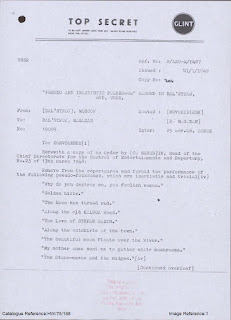
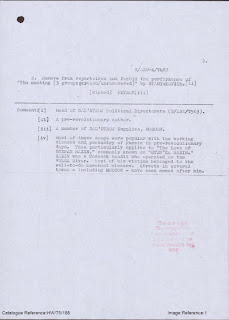
However there
are some things that cannot be tolerated.


‘The love of Stepan Razin’
inartistic? You’ve crossed the line there comrade!
Monday, November 26, 2012
Report on the war industry of the Soviet Union
There is a
file at NARA called SOVIET UNION, SURVEY OF THE RECORDS OF THE BAND I (NR 3708
CBTM13 20293A 19420201).
It is a
German estimate of Soviet industrial production in 1942. I assume that some of
the information on this report comes from monitoring the internal radio and radio-teletype
traffic between industrial centers.
It would be
interesting to compare the data on this report (and others like it) with the
‘official’ numbers from Soviet/Russian sources. Unfortunately I could only copy
the first pages of this large report (~300 pages):


Sunday, November 18, 2012
Russian Fish intelligence – A case of quantity over quality
As I’ve
mentioned before the internal Soviet radioteletype network was intercepted
during the 1930’s and 1940’s by
the Germans and postwar by
the Americans.


The
intercepted plaintext traffic concerned economic and military matters and was
of vital importance in finding out what was happening inside the Soviet Union.
However the
Russian Fish intelligence was definitely a case of quantity over quality. This
is clearly mentioned in several TICOM reports and matches the American
assessment during the early cold war period.
Alexis
Dettmann, head of cryptanalysis at the German Army’s cryptanalytic centre in
the East -Horchleitstelle Ost, says in TICOM DF-112:
‘The monitoring and deciphering of internal
radio traffic was not an assignment of army signal intelligence units but
necessarily messages of internal networks were solved and worked on. Special
offices in the former German army were occupied among other things with the
reception of messages of Baudot circuits, the value of the results however
belonged in a different sector. Even in the years 1938/39 a relatively simple
devise was constructed which made it possible to reproduce directly on
typewriters the Baudot messages which in part ware transmitted by high-speed
transmitters. The results from the point of view of content in no wise
corresponded to the expectations. Of the
entire traffic monitored at great expense at best 10% was useful for economic
leaders while military-political matters constituted hardly 1%.. The major
portion of these messages was like the content of the long distance telephone
messages and contained private or business affairs. It was learned that all
these circuits were not only monitored and controlled by the NKVD but in many
cases were directed by it, and that in all probability the GUP-NKVD was also responsible
in large measure for the issue of cryptographic material for internal radio
traffic.’

Otto
Buggisch, a member of the cipher machine department of the German army’s signal
intelligence agency, gives the same percentage in TICOM I-58:
‘Further on Russian Baudot – B. says
that one Dipl. Ing. Gramberg came to group IV with him from In 7/VI (Army
Signal Intelligence) and was used to translate the intercepted clear text in
Russian Baudot. ‘’ 90% of it was
unimportant’’.
The relative
lack of importance of each individual message was also recognized by the
Americans. According to NSA history ‘The
Invisible Cryptologists: African-Americans, WWII to 1956’:
‘The ASA. effort to exploit Russian
plaintext traffic began in 1946 with the part-time assignment of several
linguists to the target. At that time, however, the Agency's emphasis was on
the translation of encrypted messages, and the employment of scarce Russian
linguists on plain text was judged to be unwarranted. Later, in May 1947, the
effort was revised at the Pentagon. Individuals without security clearances or
with partial clearances would sift through volumes of messages and translate
all or parts of those determined to have intelligence value. Placed in charge
of this group was Jacob Gurin, an ASA Russian linguist who had immigrated to
the U.S. with his parents at the age of three.
……………………………………………………………………………………………………………………………………………
From the Agency's inception under
William Friedman, its business was the breaking of codes and ciphers. Once the
underlying text was revealed, individual messages were translated, and, after a
reporting mission was established, selected ones were published on 3" x 5"
cards. While individual decrypted
messages could be extremely valuable, plaintext messages were most often
preformatted status reports that were insignificant when considered singly.
Jack Gurin was convinced that if these messages were assembled and analyzed in the
aggregate, they could yield valuable information on Soviet defense
capabilities.’

For both the
Germans and Americans the limited value of single messages was leveraged by the
huge intercept volumes.
FMS P-038
‘German Radio intelligence’ says: ‘At the
experimental station the volume of recordings, which were made available to the
cryptanalysis and evaluation sections of the Armed Forces Cryptographic Branch
and the Evaluation Control Center of OKH, averaged ten million transmissions a
day.’
Information on the Anglo-American interception is available in NSA history ‘On
Watch: Profiles from the National Security Agency’s past 40 years’:
‘In addition to manual Morse, the Soviets were using a
good deal of [redacted] among others. The Soviet plaintext problem was a SIGINT
success story from the beginning, from the design of electro-mechanical
processing equipment that could handle each new Soviet development to the
painstaking analysis of the intercepted communications. A joint
American-British effort against these communications in the nineteen-forties
led to high intercept volume and new engineering challenges in the face of
proliferating Soviet [redacted] techniques.
At one time the United States and
Britain together were processing as many
as two million plaintext messages a month, messages containing everything from
money orders to birthday greetings. The production task was awesome, with
analysts manually leafing through mountains of page copy, meticulously
screening millions of messages. [redacted] The investment paid off,
leading, to an encyclopedic knowledge of what was going on in the Soviet Union.
Over 95 percent of what the United States knew about Soviet weaponry in the
nineteen-forties came from analysis of plaintext radioprinter traffic. Almost
everything American policy makers learned about the Soviet nuclear energy and
nuclear weapons programs came from [redacted] radioprinter traffic, the result
of fitting together thousands of tiny, selected pieces of the jig saw puzzle.’

Tuesday, August 21, 2012
Soviet cipher teleprinters of WWII
At the start
of the Soviet-German war the cipher machines used by Soviet authorities were
the K-37 ‘Crystal’ (a modified Hagelin B-211) and the cipher teleprinters B-4
and M-100.
It need only be mentioned here that the 2-channel cipher machine was withdrawn from use a few days after the Forschungsamt succeeded in solving it. When the machine was put into use again some weeks later, the cipher device of the cipher channel had been so altered that solution by the previous method was no longer possible since, when switching the machine from procedure traffic to cipher text and between a pause in transmission and cipher text, the switching became effective at once and the idling period of 7 elements had dropped out. That the same machine was involved was proven only by the receiver device which still broke up the scrambled text into a clear and a cipher text in the same manner as before. Because OKH had great interest in this traffic and its own receivers did not work perfectly, and because further detailed work at this time (Autumn 1943) in the Forschungsamt was not possible, OKH received all new traffic on this machine for processing.
From TICOM I-30 ‘Report on Interrogation of Uffz. Karrenberg at Steeple Claydon on 7th July 1945 at 11.00 am’, p2
Sources: CSDIC (U.K.) SIR 1717, SI-32 ‘Special intelligence report’, ‘European Axis Signal Intelligence in World War II’ vol2 and vol4, TICOM reports I-2, I-64, DF-98, I-30, I-153, I-169, I-173, DF-240, DF-241, ‘The Secret Sentry: The Untold History of the National Security Agency’, Intelligence and National Security article: ‘Behind Venona: American signals intelligence in the early cold war’, Soviet cryptographic service 1920-1940
Few details
about these machines are known. I have covered the K-37 here.
An article in agentura.ru
says that the B-4 was built in the 1930’s and used in Spain during the civil
war, in the Far East border incidents with Japan and in the Russo-Finnish war
of 1940.
A modernized
version of the B-4 called M-100 was built in 1940 and installed in American
busses in order to provide mobility (it weighed 141kg). By the summer of 1941
there were 96 sets of the M-100 in service.
In 1943 a
more compact version of the M-100 was built and given the designation M-101.
The agentura
piece does not give details on the characteristics of these machines.
German
interception of Soviet radio-teletype networks
During the
1930’s the SU started to use radio-teletype. Since 1936 the Germans had
equipment that automatically intercepted and printed this traffic.
From TICOM reports
it seems that the military networks used 2-channel teleprinters while the
economic links used multichannel systems.
The 2-channel
links employing cipher T/P assigned one channel for the cipher traffic and the
other for operator ‘chat’.
There were at
least three agencies that intercepted this traffic.
1). The Army
Ordnance, Development and Testing Group, Signal Branch Group IV C - Wa Pruef 7/IV C at an experimental
station in Hillersleben-Staats.
2). The Forschungsamt, an agency reporting
directly to Hermann Goering.
3). The
Army’s signal intelligence agency OKH/GdNA/In 7/VI (General der Nachrichtenaufklaerung) and its Group VI - OKH/GdNA Group VI.
Forschungsamt
success in 1943
In 1943 the Forschungsamt
informed the Army agency of their success in reconstructing a Soviet cipher
teleprinter used between Moscow and the Fronts. This machine was solved because
during every pause seven characters of pure ‘key’ were transmitted. A meeting
was held in September 1943 between Councilor Paetzel (head of the FA’s cipher
research department), Councilor Kroeger (the FA’s cipher machine specialist)
and the Army agency’s Dr Pietsch (head of the mathematical research department)
and Doering (head of cipher machine research).
The Soviet
machine had 6 wheels. Five enciphered the respective Baudot impulses while the
sixth controlled their movement.
The wheels had
the following positions (pins):
wheel I – 49
wheel II – 47
wheel III –
46
wheel IV – 45
wheel V – 41
wheel VI – 43
The Soviet
scrambler corresponded to the left portion of the German SZ 40/42 cipher attachment.
The Forschungsamt people stated that they would build a copy of this machine in
order to decrypt this traffic more efficiently.
More details
about the Forschungsamt solution of the Soviet cipher teleprinter are given by Bruno
Kröger in TICOM reports DF-240 and DF-241. Kröger was the FA’s cipher machine
expert and during the war he solved not only the Soviet machine but also the
Swiss diplomatic Enigma K.
The Soviet cipher
teleprinter was used on 2-channel networks and the FA’s Technical Division was
able to build equipment that automatically intercepted and printed this radio
traffic. The cipher text was then examined by Kröger’s department and it was
discovered that during transmission pauses the Russian letter П was enciphered
seven times in succession. Messages interrupted by transmission pauses were
examined and their first and last seven characters analyzed in order to uncover
the operating principles of the device.
Through this cryptanalytic
procedure it was possible to find out that the machine had 6 wheels that stepped
regularly, then their pin arrangement was identified and with the daily key
recovered all the day’s traffic could be solved.
This success
however turned out to be short lived since in late 1943 the Soviet cipher
machine was modified and no pure ‘key’ was transmitted during transmission
pauses. It seems that from then on this traffic was only examined by the Army’s
Inspectorate 7/VI.
Efforts of
the Army signal intelligence agency
The Army agency Inspectorate 7/VI assigned its own unit to intercept and evaluate this traffic. This was Group VI
operating during 1942-44 from Loetzen, East Prussia.
Unteroffizier Karrenberg,
the member of that unit assigned to work on the cipher teleprinter said in postwar
interrogations that this traffic was first intercepted in 1940 in Warsaw.
However it was not systematically collected and analyzed till summer 1943. They
called this traffic ‘Bandwurm’ because of the non-repeating cipher.
There were 8
T/P links from the Army Fronts to Moscow plus 2-3 Airforce links and a link to
the Far East command. It was also used by the NKVD. There was no direct T/P
link between the individual Front staffs. Instead messages had to be routed
through Moscow.
According to
Karrenberg the machine had two settings a large and a small. The large setting
gave a simple substitution because the wheels did not turn. This was used for
operator ‘chat’. The small setting gave an endless column substitution since
the wheels moved.
In TICOM
report I-153 he says: ‘In Autumn 1944
both the end of 'adder' and every pause in the cipher proper was preceded by
seven key letters [redacted]. Then the traffic went off the air and reappeared
in December with no external change except that the seven ‘residue' letters had
been reduced to three, suggesting a modification of the machine’. In TICOM
report I-30 he says that the attachment had 5 small wheels driven by a large
one with a period of 43.
These were the
same characteristic observed in the machine analyzed by the Forschungsamt.
However another OKH cryptanalyst named Buggisch says that the FA machine and
the ‘Bandwurm’ were different.
Buggisch was assistant
to Doering in the cipher machine research section of Inspectorate 7/VI. In his interrogation TICOM
I-64 he says that the cycle of one wheel was 37 and the others 30-80. The
machine was analyzed by the mathematics department and a cryptanalyst Troeblicher
or Troebliger played a leading part. Thanks to a ‘compromise’ of 8 messages
enciphered with the same settings 1.400 characters of pure ‘key’ were
recovered. However they were not able to solve the machine because they lacked
the manpower.
Unfortunately
Buggisch left the OKH agency in June 1944 so he did not know anything more.
The Germans
may have failed to solve this machine but they were able to decode messages ‘in
depth’ by anagramming. A machine was built that automatically printed the
Baudot traffic in Hollerith/IBM cards and these were searched for repeats but
with limited success.
The
intercepted messages contained reports on Soviet and German military
dispositions, statements by POW's, signal intelligence reports, reports for
TASS and SOVINFORMBUREAU, letters concerning postings, transfers, promotions, weather
situation reports and supply manifests.
Information
from the War Diary of Inspectorate 7/VI
More details
are available from the monthly reports found in the War Diary of Inspectorate
7/VI.
In July 1943
a report by dr Pietsch says that the examination of Russian Baudot material
revealed cipher teleprinter traffic and an effort was made to copy this traffic
either by LNA (Leitstelle der Nachrichtenaufklärung in Loetzen) or Staats (Wa
Pruef 7/IV C). Processing was to be carried out at Referat 13:
(2) Die eingehende Beobachtung der
Baudot-Aufnahmen ergab, daß neben normalen Klar- und Chitexten auch Material
anfällt, daß als eigentlicher Fernschreibschlüsselverkehr anzusprechen ist. Es
wurden Maßnahmen verabredet, um das Material in einer zur Bearbeitung
geeigneten Form (Lochstreifen, Einbeziehung des Verständigungsverkehrs) nach
Berlin zu bekommen. Eine tiefergehende Bearbeitung dürfte nur an Ort einer
Empfangsstelle (LNA oder Staats) möglich sein. Ob man jedoch beim Fehlen jeder
Geräte-Kenntnis über primitive Feststellungen hinauskommen kann, bleibt
abzuwarten. Über die weitere Entwicklung wird Referat 13 berichten.
In August ’43
the tapes with the Baudot traffic were examined but investigations could not be
carried forwards due to the limited traffic and the many errors due to bad
reception.
In September
’43 dr Pietsch and dr Doering (head of Referat 13) met with their Forschungsamt
counterparts Councilors Paetzel and Kroeger (the FA’s cipher machine
specialist), to discuss the Soviet cipher teleprinter problem.
Investigations
continued and in November ’43 the analysts of Referat 13 succeeded in solving a
long message and recovering the pure ‘key’:
6. Russischer Baudot--‐Verkehr.
Es gelang, für einen längeren Spruch den reinen Schlüssel zu erstellen und
damit den Geheimtext zu lösen. Schlussfolgerungen über den Bau und die
Wirkungsweise der Schlüsselfernschreibmaschine konnten bisher nicht daraus
gezogen werden.
In December
‘43 the departments were renamed, with Referat 13 becoming Referat b2. A second
message was solved and investigations continued:
6. Russischer Baudot--‐Verkehr.
Aus einem zweiten Spruchmaterial wurde stückweise der reine Schlüssel
ermittelt. Weitere Materialen wurden laufend untersucht.
In February
and March ’44 departments b1 (general research into cipher machines) and b2
(former 13) worked on the teleprinter problem, examining the Soviet 4-letter
and 5-letter Baudot traffic and the movement of the cipher wheels of the
device:
Referat b1
3. Russischer Baudot--‐Verkehre:
Neu in Angriff genommen wurde die Untersuchung von russischen 4B--‐
und 5B--‐Sprüchen, die in
Baudot--‐Fernschreibverkehren
auftreten. Die Untersuchungen befinden sich noch im Anfangsstadium.
Referat b2
5. Russischer Baudot--‐Verkehr:
Die Untersuchungen über die gegenseitige Abhängigkeit der einzelnen Impulse des
reinen Schlüssels wurden an weiterem Spruchmaterial fortgesetzt.
In April ’44
department b1 stated that through analysis of the indicator groups the Soviet
Baudot traffic could be subdivided into three distinct groups. The first being
probably a cipher machine unlike the second and the third unclear:
3. Russischer Baudot--‐Verkehre:
Durch Kenngruppenuntersuchungen gelang Trennung des Materials in drei Gruppen,
von denen die erste im Gegensatz zur zweiten möglicherweise von einer Maschine
stammt, während das dritte Verfahren völlig ungeklärt ist.
The report of
department b2 shows that there was a meeting at Wa Prüf 7 to better organize
the interception of this traffic. Investigations on the recovered pure key
continued.
In the
following months investigations continued but no breakthrough was achieved.
There were complaints about the limited traffic intercepted.
In December
’44 four messages in depth were solved and pure key analyzed:
Russische Baudot verkehre
Aus dem anfallenden material könnte
ein kompromiss von 4 phasengleichen sprüchen
gefunden werden, der zum grössten Teil gelöst wurde. Mit Untersuchungen
am reinen schlüssel wurde begonnen.
In January
’45 investigations of the recovered pure key continued and in February more in
depth messages were solved:
Russische Baudot verkehr
An der lösung weiterer phasengleicher
sprüche wurde gearbeitet; ausserdem wurden die untersuchungen am reinen
Schlüssel fortgesetzt.
The last
report, of March ’45 says that investigations continued:
Russische Baudot verkehr
Die untersuchung der russischen
Baudot-verfahren wurde fortgesetzt.
The Poets
series cipher machines
In the
immediate postwar period the Anglo-Americans were able to solve at least two
Soviet cipher teleprinters. These were given the names Coleridge and
Longfellow.
Coleridge was
used on military networks in the European part of the Soviet Union. By March
1946 it had been solved. The Coleridge decrypts provided important intelligence
about the Soviet military’s order of battle, training activities and logistical
matters.
The other
system, Longfellow, was reconstructed by July 1946 and the settings were first retrieved
in February 1947.
It seems both
machines were ‘lost’ in 1948 when the Soviets introduced emergency changes in
their cryptologic systems.
It is not
clear if Coleridge and Longfellow had a connection with the cipher machines
that the Germans attacked during the war.
Coleridge may
have been the system the Germans called ‘Bandwurm’.
Primary
sources:
From TICOM I-2 ‘Interrogation of Dr. Huettenhain and Dr. Fricke at
Flenshurg,21 May 1945’, p2
... they also have another machine„
funkfernschreiber, which encodes during transmission. it uses the international
five impulse teleprinter code.
Q. Did the Russians use this machine
much?
A. It became increasingly important
during the last 1 1/2 years.
Q. What units used it?
A. Only the highest staffs, press and
diplomatic services.
From TICOM DF-240
‘Characteristics, Analysis and security of cryptographic systems’ - Parts III
and IV, p37-39
Both
texts indicated the pauses in transmission by - - - - - etc. The cipher tape has the peculiarity that in
passing from the preliminary call-up to the transmission pause, the Russian
letter Π,
represented in the radio alphabet by + + + + +, occurs seven times.
…………………………………………….
Now
since it was natural to assume that in this transition to and from cipher texts
the same letter Π= +
+ + + + likewise appeared seven times in each case but vas no longer
recognizable due to the encipherment the first and last seven cipher values of
all cipher texts interrupted by transmission pauses were subjected to special
study. Since the machine, once the daily key had been set up, was used very
frequently during the course of the day for sending cipher text with numerous
pauses in transmission without any new daily key being set up, rather numerous
fragments of a length of seven letters were available at known intervals of
greater or lesser lengths.
…………………………………………….
From
this it could be concluded that the first seven and the last seven letters of
each secret text came from enciphering the letter Π= + + + + + seven times and hence these
fragments of cipher text represented pure key text. The following study of
these fragments of pure key text led to a recognition of the fact that the
first impulses show the same repeated picture in the chain of plus and minus
impulses at an interval of 37, the second impulses at an interval of 39, the
third impulses at an interval of 41, the fourth and fifth at an interval of 43
and 45 respectively (the intervals may have been 35, 37, 39, 41, 43). This
showed the length of the five cipher wheels and their cam pattern according to
the day’s setting. Each cam crest caused the inversion of the plain impulse
into its opposite while a cam trough left a plain impulse unchanged. The wheels
regularly moved one step after each cipher letter.
With
this the decipherment of the cipher text had been accomplished. The
reconstruction of the cam pattern of the wheels, which was set up new each day,
was easily accomplished.
From TICOM DF-241
‘The Forschungsamt’- Part I, p25
18.
The Russian radio [2-channel] cipher machine with a channel for plain text and
a channel for cipher text could be studied after the Technical Division had
constructed a receiving device which at the same time removed the scrambling.
The five elements of the radio alphabet [bands] ware enciphered singly through
five wheels which move evenly. The wheels could be set up new each day
corresponding to the daily key; but the period was constant and invariable. It
was possible to solve this completely.
From TICOM DF-241
‘The Forschungsamt’- Part IV, p38
It need only be mentioned here that the 2-channel cipher machine was withdrawn from use a few days after the Forschungsamt succeeded in solving it. When the machine was put into use again some weeks later, the cipher device of the cipher channel had been so altered that solution by the previous method was no longer possible since, when switching the machine from procedure traffic to cipher text and between a pause in transmission and cipher text, the switching became effective at once and the idling period of 7 elements had dropped out. That the same machine was involved was proven only by the receiver device which still broke up the scrambled text into a clear and a cipher text in the same manner as before. Because OKH had great interest in this traffic and its own receivers did not work perfectly, and because further detailed work at this time (Autumn 1943) in the Forschungsamt was not possible, OKH received all new traffic on this machine for processing.
From TICOM I-30 ‘Report on Interrogation of Uffz. Karrenberg at Steeple Claydon on 7th July 1945 at 11.00 am’, p2
The subject of this interrogation was
confined to Karrenberg’s work on Russian Baudot letter ‘strip’, traffic known
to the Germans as ‘BANDWURM’ and not to be confused with Russian 5-letter,
traffic also carried on Baudot lines.
The Germans had not captured any of
the apparatus used but considered that it consisted of two parts: 1) a
Baudot-teleprinter with the letters of the Russian alphabet (excluding q and
'g') and figure and letter shift making 32 characters in all; 2) a cipher
attachment consisting of 5 small wheels driven by one large wheel.
Each of the small wheels had a pattern
of positive and negative impulses and each wheel worked in conjunction with one
of the five impulses produced by pressing a key of the teleprinter, the effect being
to add a positive or negative impulse to each of the five impulses produced by
the letter being sent. This in effect means adding a letter of key to the clear
letter to produce a cipher letter.
Depths were frequent on the traffic
intercepted by the Germans, but they do not seem to have made any attempt to
reconstruct the wheel patterns. In the case of the driving wheel they came to
the tentative conclusion that it had a period of 43. The preambles of messages
were always enciphered which resulted in stereotyped and known beginnings to
messages. The machine setting for a message was indicated by means of a two
figure number which presumably referred to a table of settings; a different
table was used each day.
Before the actual start of a message a
passage of operator's chat was sent enciphered by the addition of a constant
letter to each letter of the clear text. This letter was then sent en clair-
and repeated three times. The object of this was to see that the receiver had
his machine net up correctly.
The system was used by the Army and
Air Force and to a lesser extent by the N.K.W.D.
From TICOM I-153
‘Second Interrogation of Uffz. Karrenberg of OKH on the Baudot-Scrambler
Machine (Bandwurm)’, p2
P.W. stated that he believed the
‘Bandwurm’ traffic was first intercepted in 1940 in Warsaw. As far as he had
been able to make out no interest had then been taken in it. The first actual
knowledge we had of a traffic with the same external features (chat.
indicators, eto.) was in summer 1943 when the first real interest was taken in
it and the traffic was sent to Berlin for analysis. He understood that it went
to a Dr. Pietsch and Doering.
There were a number of links usually
varying according to the number of armies (Frontstaebe). The maximum number was
8. One end of each link was always in Moscow, the other would be mobile, and
move with the armies. There were also one or two Airforce links. There was also
supposed to be a link with the Far East. Traffic was heavier from the
‘outstations’ to Moscow.
and page 3
In Autumn 1944 both the end of 'adder'
and every pause in the cipher proper was preceded by seven key letters
[redacted]. Then the traffic went off the air and reappeared in December with
no external change except that the seven ‘residue' letters had been reduced to
three, suggesting a modification of the machine. In general it is clear that some of the features of the key at
least have not changed in the last nine months.
From TICOM I-64 ‘Answers by Wm. Buggisch of OKH/Chi to Questions sent
by TICOM’ , p2-3
1. Russian Systems
In 1943 B heard that the Forschungsamt
(no individual names given) had claimed some success on a Russian teletype
machine, and had re-created the action of the machine. It was a machine with a
very long cycle being not prime but the product of several smaller cycles--like
the SZ42. B. did not know the cycle of all of the individual wheels or any
other details. He heard this from DOERING, who was then doing his research on
the T-52, but liaison with the FA was bad anyway (Major Mettig was particularly
opposed to the SS taint) and the next he heard was that the traffic found by
the FA had stopped. B. remembered only that the cycle of one wheel was 37; the
others, he thought, varied widely from 30-80.
Late in 1943 and increasingly in 1944
OKH itself began to intercept non-Morse, 5-impulse traffic (called ‘Hughes’ by
B.). The Mathematics Referat went to work on it, with TROEBLICHER playing a
leading part. At the end of 1943 the Russians created a ‘kompromiss’, giving a
depth of about 8 messages with the same setting. With this they were able to
recover 1400 letters of pure key and at the same time to ascertain that the
traffic being passed was the 5-figure code, with regular station chat
enciphered at the same time on the machine (Suggests a machine in constant
motion as described by Karrenberg).Part of the depth was created within the
same long message, so that the machine had a cycle, at least in this one case
of about 1450 letters. The actual number was thought to be very significant by
the Germans, as it was prime and so could not be the product of smaller cycles
in any way that they could imagine. This differentiated it from the machine
which the FA had broken. The Germans postulated either a single tape machine
like the T43 or a machine in which the motions of the wheels influenced each
other,1 and 2 affecting 3, 3 affecting 5, etc. as in the T52. They were never
able to prove one theory or the other. (B. apologized for this. Said they did
not have enough mathematicians to tackle the fascinating problem of determining
what the motion must be to create this cycle. Seemed quite convinced that there
would be a unique solution to the problem.) After this experience they devised
Hollerith machinery to locate depths, but in fact they only found three or four
more cases and none of these gave additional cycle evidence or even furnished
as much pure key as the first one. B. left the section in June 1944. He thinks
the traffic slumped off in the summer of 1944 and LNA took steps to try to
improve the reception, as they believed the traffic was still there.
TROEBLICHER was detailed to this end of the work at this time. B. stressed one
fact which had surprised him, that they had never had information about either
of these machines (he assumed that the one the FA broke was not the same
because of the difference on cycles.) from PW or agent sources.
B. said in passing that their own
security idea on the subject of wheel machines of this sort was that the cycle
should not be the product of smaller periods(as in Hagelin) even if this was
long. Mutual influence of wheels should be used to avoid this, but at the same
time care must be taken that too short a period was not created in the process.
This in fact had apparently been done by the Russians, but the fact that it was
not repeated suggested to him that they might have seen the weakness and
corrected it.
Troeblicher
is mentioned in CSDIC (U.K.) SIR 1717, appendix A as Troebliger (Uffz). He worked in Group IV, Referat 1b as an analyst
on Russian Baudot traffic.
Sources: CSDIC (U.K.) SIR 1717, SI-32 ‘Special intelligence report’, ‘European Axis Signal Intelligence in World War II’ vol2 and vol4, TICOM reports I-2, I-64, DF-98, I-30, I-153, I-169, I-173, DF-240, DF-241, ‘The Secret Sentry: The Untold History of the National Security Agency’, Intelligence and National Security article: ‘Behind Venona: American signals intelligence in the early cold war’, Soviet cryptographic service 1920-1940
TICOM reports I-2, I-64, DF-98, DF-240, DF-241 can be
found in my TICOM
folder, reports I-30, I-153, I-169, I-173 can be downloaded from TICOM Archive.
Acknowledgments: It was Frode Weierud who first
pointed to me the German interest in the Soviet teleprinter and the
characteristics of the machine solved by the Forschungsamt in 1943. Credit also
goes to Randy Rezabek for finding and uploading to the internet the
interrogations of Karrenberg since they contain lots of information on the cipher
machine.
Subscribe to:
Posts (Atom)