
(Note: this review has been cross-posted on Twitch.)
My personal favorite of all the films I viewed at this year’s Tribeca Film Festival, Seung-Jun Yi’s mesmerizing and lovely documentary Planet of Snail slowly and patiently reveals to us the dimensions of the love story at its center. The film explores the daily lives of Young-chan, a deaf and blind man, and his companion Soon-ho, a woman whose growth has been stunted by a spinal disability. As much as we can celebrate Planet of Snail for its myriad exemplary qualities in terms of filmmaking and its sensitive and deeply respectful portrayal of its subjects, it can also be greatly appreciated for what it is not. It most emphatically is not a maudlin, earnest social-problem documentary that dwells on the difficulties of their existence and holds them up as sentimental objects of pity. Instead, with uncommon gifts of close observation and an unhurried, meditative pace, we are taken into their tactile way of perceiving the world, communicating with each other by the Braille they tap out on each other’s hands. They have full and rich lives of both quotidian daily tasks and art creation and appreciation and, on the evidence of this film, are a good deal more in tune with and attentive to the world they live in than most of us so-called able-bodied folks.
“All deaf-blind people have the heart of an astronaut,” Young-chan at one point says in the voiceover that punctuates the film’s episodes, and reveals himself as a poetic observer of both his own condition and of the universe that surrounds him. In addition to being a talented writer who regularly enters literary contests and reads stories with a Braille reader he carries around with him, he is also a sculptor, molding clay into animals and human figures. This latter skill, especially, is indicative of his playful sense of humor; one of the figures he sculpts is a man pissing into a chamber pot. Young-chan’s reference to himself as an “astronaut” ties into the film’s title; he perceives of himself as a visitor to this world who comes from another world of silence, isolation, and darkness, using his sense of touch to make sense of and revel in the natural world. His love of nature manifests itself in such activities and putting his hand out to feel the drops of a spring shower, and literally hugging trees in a public park.
Of course, Young-chan is not alone in this quest to interact with the world. Soon-ho is his nearly inseparable, loving companion each step of the way, assisting him with such daily needs as their meals (tapping out on Braille what and where the food is), as well as other activities as his essay writing and his playwriting (he composes a religious play for his church and is a consultant to another theatre production about deaf-blindness). Their evident love for each other and mutual dependence on each other is such that it makes their friends envious. The symbiotic nature of their relationship is revealed in a remarkable scene in which they work together to change a round fluorescent light bulb, an elaborate operation that they achieve with a satisfied sense of accomplishment. Even though Soon-ho at one point says that it would be ideal if they both died at the same time, she comes to recognize the importance of Young-chan’s developing his own self-sufficiency. Late in the film, Soon-ho nervously watches from a distance as Young-chan attempts to navigate the streets by himself, and later sees him off on a shuttle bus to a facility where others can care for him as well.
Yi shot Planet of Snail over the course of two years, an extended period of time that deepens the intimate feel of the documentary, as well as enhancing the natural beauty of the visuals, which depict the passage of time and the changing of the seasons with a delicacy that is quite affecting. This is an extraordinary work that is one of the most life-affirming viewing experiences I’ve ever had at the movies, and it’s hard to me to conceive of anyone else who’ll disagree with me after seeing it for themselves.
Planet of Snail opens later this summer at Film Forum, from July 25 through August 7. Click here for more information at Film Forum’s website.


.jpg)
.png)
.png)
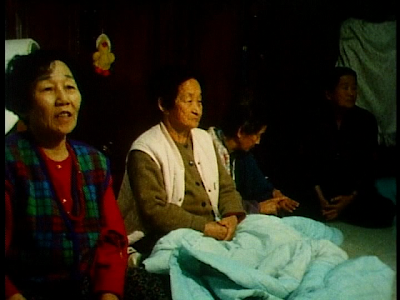
.png) The subtitle of The Murmuring, released in the 50th anniversary year of the end of World War II, is “A Woman-Being in Asia: The Second Report,” signaling that this new film was both a follow-up to and an improvement on her first film. Largely influenced by Japanese
The subtitle of The Murmuring, released in the 50th anniversary year of the end of World War II, is “A Woman-Being in Asia: The Second Report,” signaling that this new film was both a follow-up to and an improvement on her first film. Largely influenced by Japanese .png) Byun also documents the weekly protests organized by
Byun also documents the weekly protests organized by .png)
.png) However, as sad and horrific as the stories these women tell are, this is only one part of Byun’s film. The Murmuring is also a very inspiring portrait of the women’s resiliency in the face of their hardship. They are still able to laugh and enjoy other people’s company, and most importantly, to sing. There are many scenes in the film of the women singing the liberation and love songs of their youth, both in the house and at the weekly protests. This speaks to an inner spirit that the horrors of war cannot extinguish. The women also express themselves through painting, which also gives them an outlet to cope with their memories and to heal their damaged psyches. The Murmuring is a rich and revealing film, quite literally so in the film’s last shot, as the camera pans across the naked torso of one of the women. Byun’s film is a beautifully constructed vessel allowing the “low voices” of these women to speak out fully and tell the collective story of this tragic period of history, a story that has yet to reach a fully satisfying conclusion.
However, as sad and horrific as the stories these women tell are, this is only one part of Byun’s film. The Murmuring is also a very inspiring portrait of the women’s resiliency in the face of their hardship. They are still able to laugh and enjoy other people’s company, and most importantly, to sing. There are many scenes in the film of the women singing the liberation and love songs of their youth, both in the house and at the weekly protests. This speaks to an inner spirit that the horrors of war cannot extinguish. The women also express themselves through painting, which also gives them an outlet to cope with their memories and to heal their damaged psyches. The Murmuring is a rich and revealing film, quite literally so in the film’s last shot, as the camera pans across the naked torso of one of the women. Byun’s film is a beautifully constructed vessel allowing the “low voices” of these women to speak out fully and tell the collective story of this tragic period of history, a story that has yet to reach a fully satisfying conclusion..png) Links for resources and more information:
Links for resources and more information:
 Far from the action, tucked away from all the fighting, is Naoji Kariya, the last living Yasukuni sword-maker, still continuing to practice his craft in isolation. The mythology of Yasukuni is bound up in the sword, which is the spiritual symbol of the shrine. Li constantly prods him for memories of the war, and the long, painful silences that follow Li’s questions tell their own story. Whatever memories he has remain hidden away inside him, and hidden from us. He is a curious figure; a metaphor, perhaps, for the historical memory of Japan. He seems unwilling to confront the past, yet is unable to move forward, stuck in a limbo where everything is reduced to rote, refined physical movement, craft divorced from meaning. The swords he has crafted over the years likely were used to commit some of the worst atrocities visited by Japanese soldiers upon their victims, one example of which is the chilling account of a 100-man beheading competition engaged in by two soldiers who were executed and later enshrined at Yasukuni. But Kariya willfully separates himself from this reality, and his stoic silence in response to Li’s queries about the war represents an unsettling side to vaunted notions of Japanese propriety.
.JPG)


