Showing posts with label Death Wishin'. Show all posts

Sunday, December 6, 2009

Trailer of the Moment: Death Wishin': An Addendum

In honor of my completion of reviewing the entire Death Wish quintology, here are the trailers for the complete series followed by my personal rankings of all five films. 

Death Wish (1974, Michael Winner)

"Enjoy a typical afternoon in New York City."


Death Wish II (1982, Michael Winner)


"It's about to happen again."


Death Wish III (1985, Michael Winner)

"In a world gone made, there's one law, His!"


Death Wish IV: The Crackdown (1987, J. Lee Thompson)

"The trap is set. The fuse is lit. Bronson is unleashed."


Death Wish V: The Face of Death (1994, Allan A. Goldstein)

"This time he is not leaving until his wish is their command."


My top 5 Favorite Death Wish films

1. Death Wish II 

The sleaziest entry in a series of films hardly lacking for sleaze. Michael Winner makes early 80's Los Angeles make mid 70's New York look like mid 50's Minneapolis. What I appreciated about the film is it's the only one to question Kersey's need for vengeance and show how it alienated him from others. (Review)

2. Death Wish IV

J. Lee Thompson takes over the reins from Winner and makes an even more over-the-top sequel than the ridiculous part III. For the first time Kersey is actually taking out the rich people who supply the drugs. (Review)

3. Death Wish

The original that set the template for the rest of the series and a rash of imitators. Suffers when Winner attempts any relevance and politically it's pretty rancid. (Review)

4. Death Wish V

Bronson's final theatrically released film is thankfully not an embarrassment. Follows the change in series tone established in part IV. (Review)

5. Death Wish III

This has become a cult classic in some regard,  but Winner's indifferent work as director coupled with a cheesy even for a mid 80's Cannon action film sensibility left me feeling something's lacking. If you are in Los Angeles, you can actually catch this at the New Beverly on December 20-22nd in a double bill with the unquestionably awesome Rolling Thunder.  (Review) 

Tuesday, December 1, 2009

The Face of Death

As the famous adage goes “all good things must come to their end”, and for the Death Wish series finality came with not a bang, but a whimper as Death Wish V: The Face of Death (directed by Allan A. Goldstein), snuck into theatres seven years after part IV on January 14th, 1994. Opening on a paltry 248 screens (part IV opened on 1,030 screens in 1987) it earned just about half a million dollars in its first weekend on way to a cume of $1.7 million (again for comparison sake, part IV garnered $2.4 in its first weekend alone) before a speedy video release. DWV was produced by 21st Century Films, Menahem Golan's new production company at the time, his prior studio, Cannon, owed it’s success in the 80's to many a Bronson starring vehicle, but his new company title proved to be decidedly non-prophetic as it would be defunct by 1996.

I had two major fears before the film began. The first was that Charles Bronson, who was in his seventies, would be a shell of his former self and be sadly paraded for one last go round as Paul Kersey against everybody’s better judgment. The second fear struck during the opening credits, a bland basic black screen with tense almost operatic, albeit in a second rate sort of way, theme that lead me to believe what would follow would be too self serious and when these films are humorless they often prove tortuous. Luckily, both of my fears were unfounded. Charles Bronson is a little grayer and his skin a little more wrinkled, but he wore it well and honestly he doesn’t look much different then his last Death Wish go round, he had the Clint Eastwood looking more rugged and interesting as he aged thing going on. As for the latter fear, Goldstein thankfully knows exactly what type of film he’s making and though it has that 90’s straight to video erotic thriller vibe and aesthetic, which is something you may be well versed in if as a teenager you, like me, uh, rented, a lot of straight to video erotic thrillers for whatever reason, it actually keeps with the lighter tone the series developed beginning with part III.

Part V begins with Paul Kersey, who is under witness protection under the completely disguising new alias of Paul Stewart and residing back in New York City (here played by Toronto with a few establishing shots of a pre-Giulani Times Square) the location of parts I and III. He's dating a divorced fashion designer whose ex-husband happens to be a demented crime boss played by Michael Parks (Sheriff McGraw from Kill Bill and both movies in Grindhouse) who wants custody of their daughter. Well, you know where this is headed. Literally before she can respond to his marriage proposal, the fiancee-to-be has her face disfigured by one of Park's cross-dressing goons! And of course, after Kersey for once decides to let the police handle it, she is murdered in a home invasion. Kersey decides to go after each hood one by one to get his vengenance and custody of the daughter that he probably has no legal right to. I can't help but find Kersey somewhat culpable in this whole thing, you think he would learn after having his loved ones slaughtered by thugs four times prior, but no, he keeps on falling in love. He's like a person with a venereal disease who continues to have unprotected sex. You need to tell women you date about your past, be open, be honest, let them know that there's a 97% chance that if they date you , it's likely they will be murdered.

Although his performance feels a little reined in, Michael Parks is the best adversary in a Death Wish since Fraker, he of the reverse Mohawk, in part III. He is an egomaniac and often speaks in an incomprehensible mumble, a whirling dervish of evil with no shades of grey. It's a fun performance even though it seems that Goldstein stopped from letting Parks go too over the top, which is a shame. His compatriot gang of thugs are played for laughs, they include the aforementioned sometime drag wearing guy who has a quirky dandruff obsession and two bumbling Italian goombah brothers. Similar to part IV, the villains are represented as being spoiled and upper class, continuing a nice reversal from the first two film's underlining distrust and disgust at the poor and making financial disarray analogous to villainy. Again, like in Part IV, Kersey employs elaborate Home Alone style methods of disposing of his archenemies. Here that includes an explosive remote controlled soccer ball (stop and think about that for a moment, why would you need a remote controlled soccer ball, it's round and self mobile, it's designed to move on its own with a simple kick or toss?), a pool of acid located in the middle of a sweatshop (I guess they get away with this sort of thing in Canada) and a poisoned Canoli, which causes the villain to choke to death in front of his mother, which is pretty harsh. Not cool, Kersey, at least wait until she went out shopping.

The film ends with Kersey telling the police that he'll be around if they need him before walking into the sunset as the frame freezes. It's a nice little good-bye for Bronson, ending the series on a visual callback to a classic Western trope (a genre that Bronson thrived in), it would also be his last moment ever to be seen theatrically, although he performed in a trilogy of made for TV police dramas called A Family of Cops afterwards. Death Wish V is by no conceivable notion a "good" film, but for the Death Wish series it's on par with all the rest and thankfully a little less rank politically. Speaking of which, one interesting note about the series is that all four prior films, all financially successful, were released when a Republican was in the White House, and part V, which made no impact at cinemas, came within Bill Clinton's first term. Coincidence? Or is our nation more susceptible to middle class vengeance fantasies with a swaggering GOP Commander in Chief? It's something that Sylvester Stallone may want to consider if he ever gets his planned Death Wish reboot off the ground.

Friday, November 13, 2009

The Crackdown

Death Wish IV: The Crackdown (1987, J. Lee Thompson)

Death Wish IV opens with a familiar set-up: A lone woman walks through a desolate parking garage looking for her car. Upon reaching the vehicle, which, don't you know, won't start, she sees a threatening looking hoodlum in the distance. She blinks and there is a second hoodlum and then a third. Things look dire for the poor woman, until, hurrah noted scum-blowing-awayer Paul Kersey (Charles Bronson) arrives with his trusty, large, and in no way phallic, revolver to exterminate the anonymous hoods one by one. But as he reaches the last no good punk, and remove his mask to look him in the eye, the face that Kersey sees is his own!!!! Before you can say Holy Luke Skywalker in Empire Strikes Back we cut to Kersey waking up in his home. It was all a dream.

Considering that Kersey didn't wake up masturbating, we can assume that for the first time in the Death Wish series, the character is confronted with a bit of self analysis. Does Kersey see himself as partaking in a role that is cyclical and is his willingness to bend his morals for vengeance's sake eventually going to led to a self destructive prophecy? Okay, no, that will never be mentioned, but the allusion, however tenuous coupled with the illusory nature of the opening scene are the first signs that we are no longer being led by the indifferent hand of parts 1-3 director Michael Winner. J. Lee Thomspson, himself a journeyman with a similar hit and miss oeuvre to Winner takes over the reigns (and yes it's a dream sequence, but based on Winner's directorial display in the first three, he would have not thought to delineate any formal differences between reality and the dream). But alas, if you thought (or feared) that the long standing right wing revenge thriller cum exploitation series would change, or gasp, grow a conscience, your fears are unfounded, the rest of the film hews close to the series' template, although with some appreciated tweaks.

Paul Kersey's urban tour of duty hops back to Los Angeles (as in part II), where he is back to being an architect (his 9 to 5 job) and is living with his fiancee whose daughter is like a daughter to Kersey, we know this because Kersey says to her "you're like a daughter to me", which if you know the history of the guy's offspring is not really the most comforting comparison. Well, you know where this is headed, the step-daughter is led to a life of drug addiction via her Ian Zering look-alike boyfriend and overdoses.

After a bit of platitudes about the dangers of drugs (there is a scene that plays out pretty much like this: Kersey: Drugs are bad and dangerous to our society. Other Person: Bad, you say? Tell me more about this philosophy of yours.), it takes about five minutes for Kersey to rid the world of the punk who sold the cocaine that killed his daughter. Hey, he's an old pro. But then the film changes course and Kersey is offered unlimited money, weapons and resources by a rich dude who claims to have lost his child to drug culture (spoiler: this rich guy is not altruistic but the main bad guy who wants to rid the street of his competition! You would probably get the subtle hints if you've ever seen a movie before) to clean the streets. Kersey takes him up on his offer with a "shit, I've been doing this for free for the last thirteen years" glare. This new plot device allows for a twist in the unfortunate class distinctions that plague the first three films, where upper class bourgeoisie Kersey is consistently at war with criminals from more lower class background, or to but it more bluntly poor unmannered people attack rich mannered people, rich person becomes unmannered, kills poor unammanered people, audience cheers.

While I complained about some of the cartoony aspects in the violence of Death Wish III, I kind of dug the more over the top elements of DWIV, with Bronson going undercover in scenes, including as a waiter in a restaurant where he offers the mobsters an explosive bottle of wine and an epic dummy falling to his death scene. I guess either the Cannon mystique finally rubbed off on me or I was more willing to accept it due to the lack of involvement of dancing children or the elderly. Or perhaps Thompson's better at this sort of thing.
Death Wish IV is more of the same, and I wouldn't recommend it unless you are a diehard Bronson fan or are reviewing all the Death Wish films for your blog or something, but as someone aware of the blueprint, I kind of dug the slight alterations it offers. If you only see four Death Wish films, make sure this is one of them.

Monday, January 12, 2009

Bringing Justice to the Streets

When we last left mild mannered architect turned unmild mannered vigilante Paul Kersey in Death Wish 2, he had withdrawn from his bourgeois society trappings and embraced the underground where he lived amongst the slums of Hollywood to best protect the innocent from the savage punks that run amok, like a modern day Tom Joad with better weaponry. As is their want, the creative team behind Death Wish 3--returning director Michael Winner, star Charles Bronson and producers Menheim Golam and Yoram Globus, completely toss continuity aside and the third film opens with Kersey on a bus returning to the city that he fled at the conclusion of part one, New York.

In my review of DW2 I inferred that the sequel was superior to the original due to its lack of pretense and accepting of the revenge film's true exploitative nature. My thesis gets sullied a bit in part 3 where Winner tilts the scales far too much in the exploitation side. It is a Cannon film through and through and very much a product of it's company's idiom as well as the mid 1980's, where bloodless warfare was seen by many impressionable action cinema/television viewers of all ages via hit products like The A-Team and the cartoon G.I. Joe. Of which DWIII is of the same ilk. There's literally a scene where kids dance next to the dead bodies of the gang members to Jimmy Page's funky score (yes, Led Zeppelin's Jimmy Page!)

In DW3 the impetus that drives Kersey back into the punk blowing away game is the murder of an old war buddy who refuses to take part in the extortion of the dwellers of a downtrodden apartment complex in a never mentioned New York borough (the film was shot both in Brooklyn and London). This provocation that drives the film is a bit of a limp catalyst after having his wife and daughter murdered in the first two films. My only wish is that the hushed voiced narrator would have solemnly intoned something along the lines of "First they killed his wife. Then his daughter. But this time, they have pushed Paul Kersey too far...they have murdered an acquaintance that he kind of liked!" in the film's trailer.

There are three major differences between the third entry and parts 1 & 2. The first two dampen the essence of the Death Wish series for me, while the third makes for the film's main (and almost sole) pleasure. The bad elements first: The captain of an ineffective and indifferent police squad (played by character actor extraordinaire Ed Lauter) gives Kersey carte blanche to kill any goons that would help clean the city, thus robbing a crucial element of Kersey's character by removing the prefix "folk" or "anti" before hero from the equation. It also fully endorses the vigilante actions of the hero, removing whatever trace elements of the questioning of Kersey's motives or sanity the source material and the third acts of the previous two films had built. The film is redeemed slightly by giving Kersey his first true adversarial equal, Manny Fraker, played by Gavan O'Herlihy, a wonderful cross between Gary Busey and Klaus Kinski, sporting a hairstyle due for a fashion rediscovery, a reverse mohawk: the sides are grown out and the middle is completely shaved with red war paint streaked vertically across. Neither of the predecessors featured a worthy main opponent for Bronson, and in the original film, Kersey didn't even have the opportunity to go after the specific perpetrators responsible for his wife's death.

DWIII eventually develops into an all out war between the low income dwellers of the apartment complex and Fraker's gang. Kersey fighting side to side with the city's poorer residents provides some nice counter balance to the first film's depiction of the financially challenged, but by that point the film has became an all-out cartoon featuring elderly couples creating Home Alone style booby traps, convenient store owners tossing handmade bombs and the aforementioned children dancing over corpses. Admittedly, writing this out makes it sound actually pretty awesome. Sadly, the execution is mishandled by Winner and the ridiculousness of the proceedings is never fully embraced.

I understand the need to throw a wrench into a long-running series to stave off repetitiveness, especially something with the narrative limitations of Death Wish, but the essence of the series is completely lost in part III and Kersey is now just a urban Rambo figure. Part Four is next, hopefully we will see some playful shifting of the formula while returning Kersey to his lone avenger and outlaw status.

Wednesday, November 12, 2008

The Movies Go to the Movies: Death Wish 2

In my review of Death Wish 2, I mentioned that one of the pleasures of watching the film today as a Los Angeles resident was to see Hollywood Boulevard of the 1980's in all it's dingy glory now that it's long been Disneyfied. In 1993 I was able to witnessed a little of the tail end of the disparity of the famous avenue when I worked on a film with my uncle that was shot on a theatrical stage that is now demolished. While homelessness still exists on the boulevard, 15 years ago the homeless population outnumbered the residence dwellers by a good three to one margin.  Today you are more likely to be accosted by drunk frat boys from the Valley and Orange County or a Scientologist concerned about your thetan levels than a guy looking for change to buy a bottle of whiskey. That is not change I can believe in! Seriously though, while I recognize the importance of a vital Hollywood Boulevard for both tourism and pride factors, I wish the boulevard renaissance would of had more to do with restoring the classic movie theatres that still lie unoccupied rather than constructing a giant mall.

That's why even a silly exploitation film like Death Wish 2 is of importance, shot on location in 1981, it provides a snapshot of a place that does not really exist anymore. Ironically, director Michael Winner would contend that fact as being a good thing.

This TMGTTM presents a first, unlike True Romance and Ed Wood, the three movie theatres in Death Wish 3 are all incidental location shots that play no role in the story of the film itself.

The first theatre is the only one still operating to this day, and arguably the most famous movie theatre in the world, the Grauman's Chinese Theatre (in the 80's it was retitled the Mann Chinese Theatre).

The movie on the marquee is John Boorman's Excalibur. Did Winner insert this shot as a symbolic nod, making a correlation between his film's hero Paul Kersey (Charles Bronson, natch) as the modern ancestor of the Knights of the Roundtable, keeping alive their endeavors and more importantly, spirit?

Or did Excalibur just happen to have been playing at the Chinese the day they shot this scene? Probably that.

The next one is a little hard to see,  it is the Ritz Theatre, it opened in 1939, became a Pussycat theatre (a chain that showed adult movies--kids, this was before the internet or video for that matter) and closed in 1991. It is currently used as a church. Porn theatre to place of worship, I'll let you decide if that's an evolution or devolution.

If you look very closely you can make out that the title of the film on the marquee is the classic 70's adult hit, The Devil in Miss Jones. And unfortunately my screenshots didn't come out as well as I hoped but crazy diaper-wearing dancing lady is blocking what is the poster for the infamous Linda Lovelace epic, Deep Throat. Apparently, these two films played continuously as a double bill for 8 years at the Ritz. 

 
The third and final theatre that can be seen in Death Wish 2 is the Fox theatre. Built in 1918 as the Iris Theatre, the theatre which originally was an art deco design was renovated in the 50's when it was modernized and retitled the Fox. It too turned out its lights in 1991, though it still stands today and plans are to make it an all purpose live venue, so I am sure you will be seeing this season's American Idol runner-ups performing there regularly by 2011.  

On the marquee is a double bill of the two Clint Eastwood/Orangutan buddy films, Any Which Way You Can and Any Which Way But Loose, studio mandated re-release double bills like that was another fun event that was terminated in the video era. 

In my mind I have invented an imaginary competition between Eastwood and Bronson, as you may or may not know, Sergio Leone initially wanted Bronson for A Fistful of Dollars but settled on Eastwood which in turn launched his career and made him a superstar. When it came time to cast Death Wish, the producers first offered the role of Paul Kersey to Eastwood, who turned it down thinking it mined too familiar territory to his Dirty Harry films. Bronson was eventually cast and played the role for over 20 years.  So in my dreamworld Bronson is having a conversation with the poster of Clint Eastwood: 

"So Clint, what have you been up to lately? Oh starring in hillbilly comedies with a monkey, well that's, uh, cute. (beat) Oh me, yeah, I am just keeping the savage streets of New York and Los Angeles safe for hardworking fellas. Anyway it's kind of busy work, so I should be going. But say hi to the monkey for me? (beat) Oh, orangutan, sorry"

For more info on the theatres, please click on the below links:

Thursday, September 25, 2008

Protect What's Yours

Death Sentence (2007, James Wan)

In my review of the first Death Wish I mentioned that Brian Garfield, the author of the book that inspired the 1973 film, was so upset about its pro-vigilantist interpretation of the source material that he wrote a follow-up in response, Death Sentence. Upon remarking that Saw and Dead Silence director James Wan helmed an adaptation of that novel, I made a dismissive statement of his skill at depicting a subtle ambiguous treaty on the act of vengeance. Well, I was right, there's nothing subtle or ambiguous in Wan's film, but that does not necessarily mean it is without worth.

Both aesthetically and thematically, Saw is anathema to my cinematic predilections. It struck me as the work of an ADD sufferer with a need to prove their "extreme" bonafides, the work of someone who had the plot and moral quandaries of Seven explained to him but never got around to actually watching David Fincher's film past the opening credits montage. Thankfully, much of Wan's stylistic flourishes are toned down in his third film. No strobing editing display, no speeding up the film during the "boring" scenes (although Wan does prove incompetant at expressing seriousness, represented here repeatedly with slow-motion and a bland Coldplay wannabe with a female vocalist ballad on the soundtrack), and I only remembered one time where the film spins around a character's head, and even those were slower paced spins. There's even a nice, dare I say unique, touch here and there, most notably in the action sequences which emphasizes a sloppiness in fighting by Kevin Bacon's vigilante seeking suburban dad which is appreciated since usually these films start with the character transforming instantly from a strict pacifist to an awesomely adept ass kicker.


The action sequences are the highlight of the film, but as I envisioned, and similar to Death Wish director Michael Winner, Wan is woeful at expressing the basic tenant of Garfield's argument, simply put: "an eye for an eye will make us all blind". It appears he is attempting to present an even keeled dichotomy between Bacon and the leader of the gang that is responsible for the death of his son, killed in a hazing ritual. The multicultured gang that lives in dilapidated warehouses is one of those "only exists in movies" types. Had Wan displayed a more realistic poor financial upbringing that pretty much every person who joins gangs originates from or perhaps if the instigating murder was accidental rather than ritualistic, then he could have created a more balanced contrast between the two men. After the first act, Wan does cut between Bacon and the gang leader (Garrett Hedlund) whose brother killed Bacon's son and who subsequently is killed by Bacon after he lies in a disposition and sees the killer go off scott free. Unfortunately, save for Hedlund's relationship to John Goodman's character, his ineffectual father, who has no interest in going to one son's funeral and sells Bacon the guns that he will use to kill his other son-in fairness he does tell Bacon that he will not give him his son's address, so he's not all that bad (side note: a fun game to play while watching the film is to imagine that Goodman's character is actually Walter Sobchak from The Big Lebowski 17 years later)-Wan and screenwriter Ian Jeffers never shade the two characters as anything other than diametrically representing good or evil.

Much like Garfield was upset at Michael Winner and Bronson for misinterpreting his novel to create a pro-vigilante and subsequently anti-poverty message, I imagine he would be less than enthusiastic that Wan never truly dwells on the ultimate irony of the situation, that had Bacon's character accepted a jail sentence for the gang member who killed his son, no matter how small it may seem to him (he was the only eyewitness), instead of letting him go to enact street justice, the situation would never of escalated and (spoiler) it would not have cost him more loved ones and ultimately his own life.

As far as replacing Bronson as a modern vigilante goes, Bacon is ultimately too self aware of an actor to ever wear his (blood stained) shoes.

Monday, August 11, 2008

Bronson's Loose Again

Death Wish II (1982, Michael Winner)

In my review of Death Wish, I complained of director Michael Winner’s half-hearted third act attempt to suddenly position main character Paul Kersey's (Charles Bronson) actions as that of a deluded man who believes he’s living by the ethos of the Wild West after providing no earlier evidence supporting this. Death Wish II* which reunites Winner and Bronson, as well as co-star Vincent Gardenia as the detective on his trail, is a superior film for the fact that it actually utilizes the structure of a Western film and makes less attempts at being a legitimate social study, resulting in a film that is focused on the strengths of the director.

The Western archetype plot of DWII to wit: A reformed gunslinger (architect cum vigilante Paul Kersey) moves to a new town-Los Angeles (apparently having grown tired of the lack of attacks upon his loved ones in Chicago, the city he relocated to at the end of DWI), where he’s thrust back into action against his wishes for a new life when his close ones (specifically maid and daughter) are once again the victim of a brutal assault. If you would like to look at it in a more modern genre prism, you can make the claim it also conforms to the mechanics of a super-hero film; a mild mannered everyman hellbent on personal vengeance arms and disguises himself (his outfit consisting of a beanie and dark workingman clothes befitting a repairman, which in and of itself is a metaphor), to combat villains and keep the streets safe for the helpless.

In the first film, Kersey is not present when his wife and daughter are attacked (which resulted in the death of the wife and the daughter becoming catatonic) but in the sequel he is at home when his maid is raped and killed followed by his catatonia recovering daughter being kidnapped (she too will be…surprise, surprise…raped…and eventually leap to her own death in an escape attempt), so his vigilantism is focused this time around on the specific members of the (very P.C.) multi-cultural gang of hoods responsible (a post Apocalypse Now Laurence Fishburne filling the Jeff Goldblum role of the gang member that would go on to future fame). This helps to alleviate one of the more distressing issues of the original where Kersey never went after the actual gang that attacked his family, and who coincidentally were all Caucasian, instead choosing to randomly bait hoods who happened to be predominately African-American, and murdering them for the sins of the responsible. While I don’t doubt a compelling social study of the irony of Kersey’s action could be made, Michael Winner surely isn’t the director to perform such a subtle critique.

Where the first film strives for legitimacy (people as varied as Clint Eastwood, Paul Newman and even Gregory Peck were mentioned for the role of Paul Kersey) and failed, the sequel has no such allusions. Perhaps due to the change of producer from mainstream schlockmeister Dino DeLaurentiis to low budget schlockmeisters team Yoram Globus and Menaham Golan (founders of Canon, the predominate Action B-Movie distributors of the 1980’s and home to the likes of Bronson, Chuck Norris and Michael Dudikoff) or perhaps due to the repetitive nature of the plot there is very little set-up or character building and within the first fifteen minutes Kersey’s life has been (re-)shook and he's roaming the streets for vengeance, set to Jimmy Page’s score. In my review of the first film I mentioned the laughable nature of the plot-driving rape scene, laughable not because of the severity of the actions obviously, but rather Winner’s inept presentation of the severity of the actions. That very ineptness is far more disturbing here, as the camera leers on the naked flesh of the stripped female victims in the gaze of the attackers.

While his inability to achieve a modicum of gravity reaches it’s nadir here, once we get to what we came to see—namely Bronson mowing down punks—he actually becomes a tight director and dramatically improved from his work on part one. Scenes are imbued with a palpable sense of suspense that was sorely lacking, some choice real location shooting and even some mood inducing lighting and shot compositions. Again, much like the New York of the mid-70’s, Winner paints the Los Angeles (specifically downtown and Hollywood Boulevard) of the early 80’s as being rife with decaying streets of rat-infested abandoned buildings where you can be murdered for looking at the wrong person, which in comparison to what Hollywood Boulevard is today, a corporate mall rife with nightclubs and infested with frat boys, Valley girls and wannabe reality stars actually counts as an improvement. To his credit though, unlike the first film where the poor are all coded as being potential murderers, muggers, rapists, et cetera, he does provide evidence of people in financial dire straits seeking salvation in makeshift storefront churches or just scraping about trying to make a living.

At the end of DWII (spoilers to obviously follow) Kersey has succeeded in eradicating the gang responsible for the attack, however, it comes at a cost, his chance for redemption when his fiancée, who is one of them rehabilitating criminals** believing bleeding heart liberals, leaves him after discovering his little after-hours hobby. Unlike the end of the first film where he was given an ultimatum to leave New York (and after all the shit that went down, why wouldn’t he?), Kersey’s action do have a consequence and he must face what his deeds have reaped. The last scenes show Kersey once again roaming the streets of Los Angeles, rejecting his chance at a legitimate everyman life. One hopes that Michael Winner follows suit and cast aspirations of serious filmmaking aside to play to his strength, exploitation filmmaker extraordinaire. We’ll find out, the duo reunited three years later for Death Wish III.

* I know this is petty but it still gets my goat: the DVD and it's menu lists the film as written with the digit 2, when the film clearly uses the Roman Numeral II

** This film’s view of rehabilitation is as disturbingly narrow minded as the first film’s view of class. This time rehabilitation is represented by a wacky therapist with bug eyes and messy manner of dress who can’t even give directions to the restroom competently.

Monday, July 7, 2008

Vigilante, City Style

Anybody interested in the psychology that has led to an exodus in America of middle and upper class residents out of the cities and into suburbia, starting from the 1970's and through the present day, can catch a glimpse of and sympathetic ear to those very sentiments in Death Wish (1974, Michael Winner). Hell, one needs only look at the film's opening sequences: we open on a picturesque Hawaiian beach where mild-mannered middle aged architect Paul Kersey (Charles Bronson) and his wife (Hope Lange) are on holiday, it's nearing the conclusion of their trip and they lament the end of their visit to paradise CUT TO: New York, rush hour, smog shrouds the city, cars stalled on highways in bumper to bumper traffic and FREEZE FRAME on the title...DEATH WISH.

Director Michael Winner paints New York circa mid-70's as nothing less than hell on earth. Even something as innocuous as a trip to the grocery store results in an accosting by some unruly punks. Those same punks, led by none other than a young Jeff Goldblum, follow Mrs. Kersey and her daughter home where they attack, rape and taunt the women by repeatedly calling them "rich cunts" before committing the ultimate indignity, uh, spray painting their asses(!?!). This attack, which per Winner's directorial deftness is not nearly as harrowing as described, results in the death of the mother and sends the daughter into a catatonic state she will remain throughout the film, thus shaking the very emotional foundation of Kersey, the architect, (hey, symbolism!). See, beforehand, Paul Kersey was a bleeding heart liberal. We know this because of a clever bit of foreshadowing dialogue early that, in the subtle nature of the film, informs the viewer of his character's politics. When a co-worker bitches about the poor and tells Kersey that the underprivileged should be sent to concentration camps, Kersey actually britches at this suggestion! The co-worker says, and I quote: "You're such a bleeding heart liberal!" See, this film isn't totally against poor urban dwellers, the idea of placing the lower class in concentration camp is clearly meant to be seen as a negative thing. Totally fair and balanced.
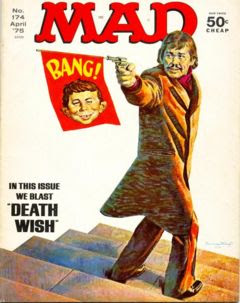
Of course, the police are of no help. And unfortunately for Kersey he doesn't live in San Francisco where surely Detective Harry Callahan would have this case solved within an hour and forty-five minute running time, so instead Kersey is sent by his employer to oversee a housing development in Arizona where he befriends a businessman who extols the virtues of handguns and an old west philosophy of justice which is literally represented in a Ghost Town Old West shootout reenactment. It's worthy of note that the development they are discussing is a community placed in the midst of undeveloped desert that the businessman insist will bring the working class out of the city.

The businessman leaves Kersey a handgun as a going away present. Returning to urban living after a sojourn in the peaceful desert causes Kersey to have an emotional breakdown. He goes out at night, easily tempting hoods by flashing some green, then leading them to a remote location where he turns the table and using that very handgun, blows them away. His vigilantism provides the first satisfaction he's had since the death of his wife, and results in his becoming an instant mysterious celebrity in the city who inspires the other "good citizens" to fight back from the oppressive criminal elements lurking in every alley and subway.

Interestingly he never really attempts to track down the actual three perps responsible for the attack on his family, perhaps this was in fidelity to the source material, the Brian Garfield novel of the same name. If so, it would seem as if it was one of a very few things. Garfield was mortified and felt the adaptation misrepresented ideas in the work, mainly making Kersey into a folk hero. He wrote a follow-up novel to address his concern, Death Sentence (which was itself turned into a film last year starring Kevin Bacon and helmed by Saw director James Wan, that I assume-haven't seen it yet-probably didn't satiate him). Garfield is correct in his assessment, although in fairness I get the distinct sense that screenwriter Wendell Mayes and director Winner tried to bring into question Kersey's motives and sanity, but just didn't posses either the skills or fortitude to pull it off. Conversely, even if you find Dirty Harry "fascist" as Pauline Kael's famous review claimed, you can't question director Don Siegel visual command, the quality of his rhythmic editing style and an embued sense of humor that leaves the film's intent (same goes for his sci-fi/horror classic Invasion of the Body Snatchers) ambiguous and open for a multitude of social and political interpretations. Michael Winner, however, is a flat director, so dismissing subtext for formal skill is not possible. He cannot even manage any tension at Kersey's first, or for that matter any subsequent, urban retaliations. In the third act, when he attempts to paint Kersey as a deluded man who believes he's living in and by the rules of the old west, most notably in a scene at a hospital after being shot and caught by Detective Ochoa (Vicnet Gardenia) who has been tracking him and instructed to handle the situation with minimal possibility for Kersey's martyrdom, requests his leaving town, to which Kersey replies "by sundown?", it's too abrupt and Winner too non-committal to the task to have any effect.

Ultimately, Kersey does leave New York City for the apparently safer confines of Chicago. However, in the ironic denouement it's shown that punks have infested every facet of modern urbania. In the final shot (both literally and metaphorically) Kersey points his finger, aimed as a gun directly at some hooligans in the bus terminal, and by extension of the shot selection, directly at us, the viewer. Inferring our responsibility (for allowing the ascension of crime? Hey, you can't blame me, I was negative two years old!) and heeding a warning...his work has just begun. Cue Death Wish 2! One does wonder if perhaps a better place for his mandatory relocation would be somewhere more fitting of the thematic crux of the film, I don't know, like an Orange County gated community, or if Winner was one for dramatic arcs, perhaps the very Arizona development that he oversaw?

Death Wish, like the Friday the 13th series is junk, but I find it to be fascinating and even enjoyable junk . Feel free to psycho-analyze me, registered Green Party, in the comment section. Originally, the producers wanted Clint Eastwood (other casting probabilities included Steve McQueen and Mr Hardass himself, Jack Lemmon), for the role of Kersey. He wisely turned down the role. In a bit of karmic payback Bronson, who was Sergio Leone's first choice to play The Man With No Name in the Dollars Trilogy that launched Eastwood's career (Bronson and Leone would later work together when he played "The Man with the Harmonica" in Once Upon a Time in the West a role in which Bronson, if you allow me to speak in the nomenclature of a cineaste "kicked ten kinds off ass"), nabbed the part that kept him working (albeit on lower and lower budgets) until a hip replacement in 1998 led to his retirement (he died in 2003). The idea of Eastwood, a tall menacing white Protestant, blowing away the underclass and in turn, minorities, of 1970's New York just feels like too much to an already stacked deck and harder to swallow sociologically. Bronson, of Lithuanian descent, but having played in his career ethnicities as disparate as Polish, Native American, Italian and even Japanese, is more of a cultural chameleon, and coupled with his age at the time (he was in his fifties), the fact that he has less of a foreboding stature as Clint and his history of playing troubled and/or emotionally stunted characters makes his breaking point a bit more understandable, even if it's cinematically fumbled by his director.

The fact is that Bronson truly believed in Kersey's brand of justice. The famous story goes that upon being offered the role, the following conversation took place between Bronson and Michael Winner (source IMDB):


Bronson: What should we do next? (Death Wish being their fourth collaboration)
Winner: The best script I've got is Death Wish, it's about a guy whose wife and
daughter are mugged. And he goes out and shoots muggers.
Bronson: I'd like to do that.
Winner: The film?
Bronson: No...shoot muggers.


His tune changed slightly in 1984 when he spoke out against real-life NYC subway shooter Berhnard Goetz, although it didn't keep him away from starring in three more sequels after that!

In a bit of synergistic irony, I viewed Death Wish on the very day that the Supreme Court upheld a motion of gun ownership in cases of self-defense as being covered by the Second Amendment, thus possibly keeping the streets legally safe for the real life Kerseys of the world, or at least those who have yet to move out of the jungles of city living!

Related Posts with Thumbnails