Posts tonen met het label Operation Ocean Shield. Alle posts tonen

zondag 16 september 2012

NATO counter-piracy task force engages coastal villages

Piracy is being pushed back. Naval presence and measures to prepare and defend merchant ships against attacks seem to pay off. Pirates need to disperse their activities ashore and disguise their operations at sea, for fear of being detected and disrupted prematurely. But we are not there yet. We must continue to seek ways to apply even more pressure on the pirate’s syndicates, turning profits into losses. One of the ways to do that is to make it increasingly difficult for pirates to prepare for their activities and depart to sea.

Coastal village
Ashore is where the pirates find their supplies and attackskiffs with strong outboard engines. Ashore is where the pirates affect community life and prevent development. Close ashore is where the pirates find the dhows they use as mothership. And close ashore is where they hold their hijacked vessels for huge ransoms. To seek more knowledge of and interaction with the coast seems therefore a logical progression of the counter piracy effort.

TF 508 has sought ways to engage with the coastal villages. Starting with visits to fishing skiffs and trading dhows, meetings with elders quickly followed. Those village elders explained us about the shore side view on piracy. About the fact that piracy has made things difficult. The basic needs the villages have. The lack of aid and assistance, the lack of basic healthcare. They also explained the lack of knowledge of the tasks and missions of the warships in front of their coast. Were they there to help, or to prevent illegal fishing, as the original pirates would always claim?

Somali fishermen

In further increasing the pressure on the pirates, the villages and their leaders can become valuable allies. By conducting regular visits, meeting the elders and providing small scale medical assistance, we gain trust, we exchange information and we reassure the people that together we must counter piracy. Now we have to see if we can make this an effective counter piracy measure, by preventing pirates to go to sea and when they do, to catch them well before they can become a danger. To safeguard international shipping, but also ensure safe regional and local trade and fishing. Not just today or tomorrow, but also for the longer term.

Commodore Ben Bekkering,
Commander, NATO Task Force 508
Operation Ocean Shield

(Defensie weblog, 16 september 2012)

vrijdag 24 augustus 2012

Counter-Piracy ‘Big Three’ Meet At Sea

On 24 August 2012 the Force Commanders from the EU Naval Force Somalia – Operation Atalanta (EU NAVFOR), NATO Operation Ocean Shield (TF-508) and Combined Task Force 151 (operated by the Combined Maritime Forces – CMF) met on board the EU NAVFOR flagship ITS San Guisto (Italian Navy) to further enhance the cooperation and coordination in the fight against piracy.

The flagships, ITS San Giusto (EU NAVFOR), HNLMS Rotterdam (NATO) and the ROKS Wang Geon (CTF-151) rendezvoused in the Gulf of Aden to allow the three Force Commanders to meet face to face.

(Left to Right) Rear Admiral Anho Chung,
Rear Admiral Enrico Credendino, Commodore Ben Bekkering
 

Dutch NATO Commander Commodore Ben Bekkering and CTF-151 Commander Rear Admiral Anho Chung from the Republic of Korea were welcomed by Italian EU NAVFOR Force Commander Rear Admiral Enrico Credendino aboard the San Giusto.

The three Counter-Piracy forces coordinate their actions on a daily basis to enhance their capability and effectiveness in deterring, disrupting and counteracting piracy off the Somali coast and in the Gulf of Aden.  Although modern means of communications allow reliable long distance exchanges of information and a continuous flow of communications, face to face meetings are still very important.

This was the second time that the three main Counter-Piracy forces have met at sea; the first time having occurred on 23 July 2012 onboard HNMLS Evertsen (former flagship of Ocean Shield-NATO Commander).

The three Force Commanders discussed the strategic and tactical situation of piracy since the beginning of 2012 and agreed that, whilst the recent downturn in piracy off the Horn is Africa is welcomed, that military forces need to remain vigilant to further attacks by pirates on ships transiting the area.

(EUNAVFOR, 24 August 2012)

dinsdag 14 augustus 2012

NATO Warship HNLMS Rotterdam frees hijacked dhow

In the early morning of the 13th of August, the boarding team of HNLMS Rotterdam disrupted a suspected pirate group before they could launch an attack on a merchant ship. The decisive action was the result of a daylong operation of ships and patrol aircraft from NATO and EUNAVFOR.

The search for the suspected pirates started five days ago, when Bossaaso port authorities reported a possible hijacking of a dhow. Two days later, the EU Naval Force unit Lafayette located the dhow. A visit showed that the suspected pirates had transferred to another vessel, the Bourhan Nour. That dhow was located another day later by another EU Naval Force unit, FGS Sachsen.


Landing vessel of HNLMS Rotterdam between Somali coast
and hijacked dhow
It became clear the suspected pirates were bound for Somalia, apparently ready to give up their plans. Commodore Ben Bekkering, Commander of NATO’s counter piracy mission, Operation Ocean Shield explains what action was taken; “To us it seemed highly unlikely that the pirates would want to return to Bossaaso. The authorities there make no secret of their intentions to eradicate piracy. However, to the east of Bossaaso two hijacked ships are still held by the pirates, who seem to be present in the nearby villages as well. We expected the pirates to go there, possibly asking help from their colleagues. We therefore decided to station Rotterdam off the coast, deploying her landing craft in a number of locations, effectively blocking any retreat from or support of the dhow. As expected, the dhow entered the trap. It was then up to Rotterdam.”
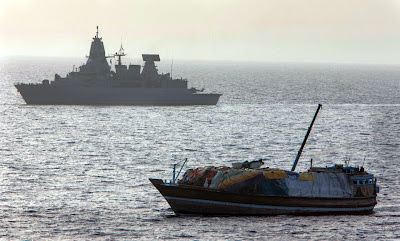
Hijacked dhow and EU-flagship FGS Sachsen
“For the pirates it must have been a strange site. Not just Rotterdam and FGS Sachsen from the EU Naval Force Somalia (EUNAVFOR) following closely, but also a helicopter and few landing craft ahead making the coast almost impossible to approach,” explains Captain Huub Hulsker, Commanding Officer of HNLMS Rotterdam. “There was not really anywhere for them to go. Obviously, the main thought is always for the safety of my crew and that of the crew of the dhow. But the situation was clear and some strict orders and two warning shots later, the suspected pirates surrendered. The boarding team was on board and in control of the vessel within the next 20 minutes. A grateful dhow crew, an impressive first action of my whole team early in my deployment and six suspected pirates detained on board, awaiting further decisions - this is a result that counts.”

Dutch marines arrest suspected pirates


NATO is working alongside EUNAVFOR, Combined Maritime Forces and individual nations to fight piracy. By joining forces, counter piracy efforts are more effective and can achieve more than any one ship, navy,  organisation or country working alone.

(NATO Maritime Command Northwood, 14 August 2012)

donderdag 21 juni 2012

Counter-piracy: EU, NATO commanders meet at sea

On 16 June on board EUNAVFOR French flag ship Marne, Force Commander Rear Admiral Dupuis and his staff hosted the new Dutch Commander of Task Force 508 (NATO – operation Ocean Shield), commodore Ben Bekkering. The flagships, FS Marne and HNLMS frigate Evertsen, had rendezvous north of the Horn of Africa, protected from the effects of the monsoon which currently prevails in the Somali Basin.


Dupuis (l.), Bekkering 
Transferred with part of his staff by a Lynx helicopter, Commodore Ben Bekkering had extensive discussions with Rear Admiral Dupuis. This type of encounters at sea is particularly important to ensure the smooth flow of information and coordination needed in the area of operation. In this case, mutual understanding is made even easier as the new CTF 508 has also been recently the commanding officer of a Dutch ship operating in EUNAVFOR. If both forces act under different commands, their mission remains the same and some nations like the Netherlands also operate within the two forces.

Besides tactical coordination, the main topic of conversation was the evolution of piracy and its significant decrease over the past months. The two forces were able to exchange views and reflect on how best to promote a sustainable improvement of the situation, with the common goal to fight against piracy and restore order off the coasts of Somalia.

(EUNAVFOR, 21 June 2012)