Sartre and Camus: How to deal with a Life without Meaning

23/03/2023

TW: mention of suicide

Jean-Paul Sartre and Albert Camus are two of the greatest philosophers, especially existentialists to exist in history, although the latter has rejected the term on a number of occasions. Camus is generally considered an absurdist which resembles existentialism in several points. Their friendship blossomed when they met in 1943 at the opening of Sartre’s play. However, eventually, their relationship became prickly owing to differences in their philosophical and political ideas, or the application of such ideas.
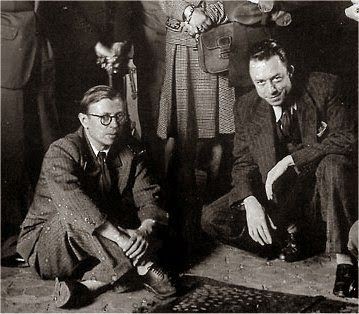
Albert Camus and Jean Paul Sartre in Paris, 1944 Source- Pinterest

Sartre and Camus are both well-known writers. Their books, ‘Nausea’ and ‘The Stranger’ respectively, are of the same temperament since both tackle a world devoid of meaning. The premise is similar, what is different is the way the main characters of the books react to the premise. In this post, let’s dive into these characters and a meaningless world to find the subtle differences in how Sartre and Camus sought to accept and eventually exist in such a world.

‘Nausea’ is in the form of a diary which gives it a flowing nature. Antoine Roquentin, the narrator has a shadowy quality, almost fictional, which ironically he is. Roquentin does not have a past. He speaks of the past in a random, broken manner. At one point, he writes,

The true nature of the present revealed itself: it was that which exists, and all that was not present did not exist. The past did not exist. Not at all. Neither in things nor in my thoughts.

Roquentin is routinely seized by what he calls ‘nausea’. In such episodes, he feels that there is absolutely no reason for living. He is hyper-vigilant about the physical world around him. He is over immersed in the existence of the different organisms and is simultaneously dissociated and overly affected by reality. Words lose meaning and things lose their essence. Reality turns grotesque, it oppresses him.

‘I was just thinking’, I tell him, laughing, ‘that here we are, all of us, eating and drinking to preserve our precious existence, and that there’s nothing, nothing, absoluetly no reason for existing’

At one point, Roquentin realises that he is free, free to do anything. However, that freedom essentially results in responsibility for one’s actions since any fatalistic reasoning cannot be given for such freedom. He also realises that the freedom feels like death because it is not true, since freedom would also mean freedom to do nothing but the randomness of life steals that meaningful choice from him. This is more apparent when Roquentin considers killing himself. He comes to the conclusion that due to the randomness of the world, his death would be superfluous and hence meaningless too. At the end, when Roquentin still chooses art, he makes a meaningful free choice for himself and is ready to take responsibility of the choice.

‘The Stranger’ narrates a period in the life of Mersault, a man completely detached and disconnected from his reality. He doesn’t feel anything when his mother dies or when Marie, his co-worker loves him. Mersault, for apparently no reason shoots at a person and is arrested. The court, more than the crime judges his moral character and calls him a monster owing to the outright lack of any kind of emotion in him. He is sentenced to death. At first he faces difficulty in accepting it. Eventually however, he comes to terms with his belief in a meaningless and purely physical world. He understands that freedom comes from choice, the choice that no one has the right to meddle with. He accepts his indifference which makes him happy.

“Have you no hope at all? And do you really live with the thought that when you die, you die, and nothing remains?” “Yes”, I said.

The premise of the books are the same. The world is meaningless and the characters are hurled into it, oppressed by a reality they feel dissociated with. The differences between Sartre and Camus are most evident in the way the characters deal with the meaninglessness.

Camus argues that life is absurd, in the sense that it has no meaning and any meaning that a person attempts to provide to it shall be false. He thus argues in favour of a rebellious attitude, apparent in the way he considers the question of suicide. He argues that suicide is not acceptable since the absurd person should acknowledge and embrace the absurdity of life.

Sartre, on the other hand accepts that life is meaningless, however concludes that it is possible to reach beyond such meaninglessness and find a meaning for oneself, depicted in the way Roquentin chooses art in the end. For Sartre, ‘existence precedes essence’ meaning that existence is objective, we give meaning and essence to it.

In a sense, both agreed that absolute freedom cannot be attained, however, both were eager propounders of freedom. Both of them also resembled in the impossibility of a solution to the meaninglessness, and the absolute unnecessary nature of existence. Both also emphasize that life must be lived, either by providing a meaning to one’s life as Sartre says or by rebelling against the absurd nature of life.


This was my humble attempt in sharing my experience with two of my favourite authors in trying to deal with a life without meaning. Do share your thoughts with me in the comments. Have a wonderful day ahead!
love vs. waiting

27.09.2022

#5

love is an act of waiting,
eternity unspooling at the fingertips, of which
mother taught me the art,
as if she fed me ache, instead of rice
as if my birth was a testament to her sadness,
a sack of her melancholy, repackaged, extended

she told me how waiting feels, early on-
the gentle caress of loneliness, the sweetness of sorrow,
the mellow hope and doubt, the sickly doubt.
waiting is an open door, flowing water from the tap, the dampness of paint on the walls
and time, like grains of sand falling from the skin,
leaving only scars like remnants of a ruined ship
wrecked at the banks of a terrible sea.

of all the things my mother taught me, waiting comes closest to love.
i remember her

with the loneliness creeping up the floor,
the patches of sadness on my skin
like trophies of a war,
like glory of survival,
waiting, waiting
as if it’s the only thing we shared other than blood

The theme of loss in Never Let Me Go

27/03/2022

I still remember the moment I read the last line- I quietly closed the book, looked up at the empty wall opposite to me, sighed deeply and kept staring for several minutes straight with tears rolling down my cheeks. Honestly, it wouldn’t be a stretch to call this an emotional book, given you are able to take it all in.

I purposefully decided to analyse this singular theme in the book because this spoke to me more than the others like friendship, love, memory and fragility of life. Nevertheless, every theme is quite intricately related to each other due to which, I am sure you will be able to get a satisfactory glimpse at all of them.

Loss. Where do I start from?

To call life a series of losses would not be an exaggeration, in my opinion. Throughout the span of our lifetime, we face different kinds of losses. From losing our pens and socks to losing our loved ones, a sense of loss is something that clearly dictates our lives. The loss of ourselves in the monotony of daily activities, obligations and the desire to fit in is something that is even less talked about.

Ishiguro manages to beautifully craft a book that revolves around three characters- Kathy, Ruth and Tommy. Kathy, now, a thirty-one year-old narrates the story in flashbacks, which in my opinion is brilliant because it highlights the time that is gone forever, that exists only in the fragile memories.

The first kind of loss that we come across in the book is the loss of control of the characters over their own lives. They live and study in a boarding school sort-of place known as Hailsham where they are taught from an early age that their lives are pre-determined. They live pretty normal lives until the age of sixteen, or even eighteen until they are supposed to go down the determined path, the path of being a carer and then a donor. The loss of control over their lives is underscored by the loss of organs in their bodies after each donation. Somehow, it reflects a feeling of losing parts of yourself until you “complete”. Kathy and Tommy also attempt to defer their donations by three years but in vain, which all the more brings out the helplessness of the situation they are in.

Quite spectacularly, Ishiguro depicts an episode where the students learn about the various counties of England. Miss Emily, their teacher had photographs of each of the counties, except Norfolk which she called “something of a lost corner”. Lost corner. The phrase stayed with the students and they considered Norfolk to be the lost corner of England, a place where all the lost property in the country ended up.

The most visible kind of loss is the loss of loved ones, the emotional loss and in many ways, the physical loss of friends. As time marches forward, slowly everyone leaves from the cottages where the students spend around two years before starting their training to be a carer. The actual act of leaving marks a certain sense of emotional loss because the closest friends lose touch. When Kathy moves out of the cottages, she loses touch with both of her closest friends, Tommy and Ruth whom she meets several years later when both of them had become donors. This loss of connection is almost palpable in the way Ishiguro presents it. The profound sorrow of the lives they have not chosen, the disconnection from everyone around them and the loss of touch with once close friends seem jutting out of the pages.

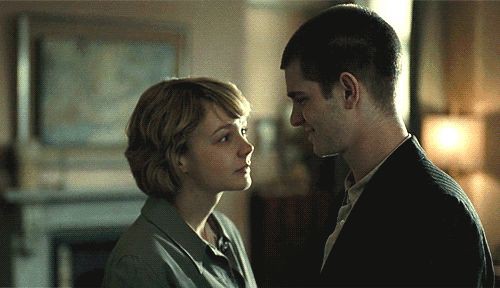
Kathy and Tommy from the 2010 movie, “Never Let Me Go” dir. Mark Romanek.

Kathy also cherishes her time in Hailsham. The loss of childhood is also a significant theme in the book. As she moves out of her school to the cottages, and then to the real world, she constantly keeps her memories of childhood alive. She clutches onto them for support and despite the fragility of memories, she holds her childhood close to her heart. When Hailsham closes, it comes as a definite loss to Kathy, and supposedly all of the students who once stayed there.

A theme of loss that is less clear and is more dependent on interpretation is perhaps the loss of the soul, or the loss of the status of being human. The elders at Hailsham and the mysterious figure of madame, all insist on bringing out the creativity of the students at Hailsham, which comes out later as an attempt to prove that the students, clones as they may be, still have a soul.

Needless to say, the dark and cruel presence of time marching forward is an important theme that plays its part in making the novel so heart-wrenching. Ishiguro builds this world up, a world where Kathy is growing up with her friends, is experiencing childhood, albeit much differently and then he destroys it. That is why I find the name of the novel so fascinating and clever. It outlines the desperation of wanting to keep something from getting lost, the desire to hold on to memories and emotions, prevent time from flowing and yet, in vain.

It is not hard to relate with Kathy and her sense of loss. We grow up similarly, losing our childhood, our favourite pens, books, loved ones and so much more. What makes the book so brilliant is the attention to details. In one of the episodes, Kathy loses her favourite tape of Judy Bridgewater’s album, making her very sad. Years later, she finds a similar tape in one of the shops selling antique objects in Norfolk, the lost corner of England.

Due to that, when Kathy is thirty-one, about to be a donor, has already lost her childhood, Hailsham, her closest friend Ruth and her friend-turned lover Tommy, she returned to Norfolk, tears streaming down her eyes, hoping to find everything that is forever lost to her.

I view this book as a desperate yearning to keep the things one holds dear, to themselves, an attempt to prevent the various kinds of loss we face and a desire to keep the memories alive, if not the actual events or people. It not only speaks of emotional and physical losses but a loss of identity, of belongingness in this society, so much so that the characters live empty, meaningless lives for themselves. However, the emotions they experience, the childhood they have and the losses they face make their lives meaningful, make them who they are.


Don’t forget to share your thoughts with me. If you like to read my content, do consider following me for more. Thank you so much for your support. Lots of love!

Distorted identities and the existential struggle in The White Castle

22/03/2022

Published in 1985, The White Castle is a post-modern tale of ambiguous and murky consciousness, identity and reality. What looks like a novel themed on doppelgรคnger, has been packed by Orhan Pamuk, the recipient of the 2006 Nobel Prize in Literature, with deeply existential questions. Today, let’s dive into some of the major existential themes of the novel that provide it with its rightful fame.

In the seventeenth century, a young Italian scholar sailing from Venice to Naples is captured by Turkish pirates and brought to Constantinople. There, he meets Hoja, his exact double who takes him as a slave.

Pamuk has explored various themes apart from existential ones. The slave-master dynamic that exists between Hoja and the Italian scholar is peculiar. Hoja is self-involved yet self-hating. He makes the Italian narrator, technically his slave, tell him all about himself and his knowledge. He loves the Italian and despises him at the same time. The narrator similarly wants to escape but develops a certain sense of belonging with his master.

Pamuk has used the relationship of Hoja and the Italian as a metaphor for the one of Turkey with the West, which I shall not go into much here, but can testify the brilliance of such a device. In her research article, “The subversion of East and West in Orhan Pamuk’s novel, The White Castle”, Adile Aslan Almond concludes that the characters, one a representative of Turkey and the other, of the West in the end are unable to hold solid positions, learn from one another and merge into each other, hence going against both orientalism and occidentalism. She writes:

In this regard in the novel, it is not important whether the manuscript is written by the Venetian slave or by Hoja, or even whether these two characters exist or not. What is crucial is “the possibility of this transition/crossing, exchange of roles”.

The ambiguity of self is shown in an effortless manner. Hoja and the Italian narrator impersonate each other. At first, they share their knowledge and gradually end up sharing every little thing that made up their past and themselves; their sins, their desires and aspirations, their childhood and so much more. They couldn’t escape each others’ influence to the point that the narrator is not able to discern whose idea is which. In the end, the reader is left with the question of who actually was the narrator from the very beginning, looming over their head.

Connected to this theme is one of the ambiguous or fluid identities of both the characters. Who indeed is writing the book? Has one character made the other up? If there are two characters, who is actually “He” that the narrator refers to, interestingly, with a capitalized pronoun? In the end, has the Italian stayed in Turkey switching places with the Hoja while he has escaped to Italy? If not, then has Hoja written the book from the perspective of the Italian?

There are no clear answers to any of the questions and that is what makes the book so interesting. What I could understand is that there is a vague change of point-of-view in the last chapter of the book. The previous chapters were written from the perspective of the Italian prisoner-slave of Hoja, while the last chapter was written from the perspective of the one who has stayed back in Turkey, whoever that person is. Hence, there is an indication of a switch but what makes it rather brilliant is the way the last chapter has been written: the one who stayed back in Turkey, let’s say Hoja has been writing this book but he claims that he only remembers Italy from “His” descriptions; when an Italian guest talks in that language, Hoja (apparently) stays silent indicating that he doesn’t know the language and while there are plenty indications of an exchange of identity, it is very very subtle making the writing spectacular and believable. The one who stayed behind, remembers Italy as if he has never been there, describes the Sultan “His” childhood memories indicating that he has been writing the book from the perspective of the Italian but the identities have been merged or exchanged to the point that one can easily take the place of other. Pamuk, moreover has depicted their relationship as the one that people have with themselves, a complex relationship of love, obsession, hatred and disgust. In the last, contentious chapter, the one who has stayed back in Turkey, the one who has been writing this book (unless there are two authors, which hasn’t been indicated much) writes:

I loved Him, I loved Him the way I loved that helpless, wretched ghost of my own self I saw in my dreams, as if choking on the shame, rage, sinfulness, and melancholy of that ghost, as if overcome with shame at the sight of a wild animal dying with pain, or enraged by the selfishness of a spoilt son of my own. And perhaps most of all I loved Him with the stupid revulsion and stupid joy of knowing myself; my love for Him resembled the way I has become used to the futile insect-like movements of my hands and arms, the way I understood the thoughts which every day echoed against the walls of my mind and died awat, the way I recignized the unique smell of sweat from my wretched body, my thinning hair, ugly mouth, the pink hand holding my pen: it was for this reason they had not been able to deceive me.

Similarly, reality is distorted as well. Throughout the novel, the memories of Italy moves farther and farther away from the narrator, so much that he wonders if they were even real at some point. Is he abandoning himself? No one knows, except Pamuk of course.

The existential crisis is palpable since the characters seem to be caught in that. Their identities depend upon each other so much that one has easily dissociated from oneself and taken on the other’s consciousness, memories and identity quite smoothly.

Pamuk is an exceptional writer and this book seamlessly fits into my all-time favourite list of existential literature. From the world-building to distorting reality, this novel remains one of Pamuk’s bests, while he remains one of the most popular and revered writers of all time. Despite controversies, he holds his head high and depicts the complex relationship of Turkey with the West, tradition with modernity, religion with secularism, different ethnicities as well as explores existential questions in his melancholic and poetic style like no other.


Do share your thoughts with me in the comment section and check my social media out to keep in contact. If you like reading my thoughts on various types of books and ideas, do follow for more. Lots of love!

The theme of death and acceptance in The Death of Ivan Ilyich

19/03/2022

A few months ago, I posted about death and in it, I mentioned this novella by Leo Tolstoy, which tries to grapple with the idea of death. I’ve been fascinated and troubled with the question of death for a long time now which has resulted in a lot of reading and thinking. Any enquiry about death is bound to take this novella into consideration and hence, here I am talking about how Tolstoy has interpreted and depicted death.

At the outset, I must tell you that this post contains spoilers, however obvious they may be. Either you can come back to this after reading the novella or I am hoping the post catches your attention and makes you read it for yourself.

The Death of Ivan Ilyich, published in 1886 is a must-read, rightly considered the pinnacle of psychological realism, even if you don’t really read philosophical fiction, because it will help you make sense of the dark hand hanging over your throat. The writing is thought-provoking and in the end, it brings a sense of peace. Moreover, if you are thinking of starting with Russian literature and are scared of the big books, you can start with the short stories of either Dostoevsky, Tolstoy or Chekhov. In my opinion, this novella may be a good place to start because of its uniquely Russian style of narrative and the profound topic it tries to deal with.

We co-exist with death and at the same time, we don’t recognize it. We think death is inevitable, that nothing can stop us from falling into the same fate that has befallen our ancestors, however, we can never process it happening to us. We always think about death as a fact existing for others. I am almost forced to reckon that that must be what makes us all scared of it. Ivan Ilyich was the same. He lived a luxurious life, plated with golden veer of ignorance underneath of which lay the ugly emptiness, the meaningless existence.

Ivan comes face to face with death when he finds out that he is terminally ill and would die soon. This wrecks havoc in his life, turning it completely upside down. He immediately moves into denial, like most of us and struggles in vain. He is forced to ponder upon his meaningless life, his achievements and everything else he once held dear, now crumbled to dust. He gazes with horror into his own life, dotted with false mirth.

Gradually, he comes to terms with the fact that he is going to die and that nothing can stop it. He stopped struggling. If we consider the allegory of the black sack Tolstoy himself had used, Ivan had been struggling inside the sack, trying to get out of it, flailing hands, pushing the walls to no avail. Once he stopped, he saw a light. He embraced the meaninglessness his life signified. He embraced love that Gerasim, his servant bestowed on him in his final days and he learnt to forgive and let go.

I am reminded of a film I watched some years ago, Akira Kurosawa’s Ikiru which addressed the same issue. Kurosawa had actually been inspired by this novella to direct this film which is equally gorgeous and thoughtful.

Kurosawa’s Watanabe and Tolstoy’s Ivan Ilyich lived mechanically, followed rules and achieved enormously, or so it seemed, but when they realised that death was looming- the acute pain of struggling with it yet not being able to resist its force and the sudden realisation of the utter meaninglessness of their existence was profound.

The grief was intense. Both of them realised the illusion of the material world and in the final moments, Watanabe selflessly worked to create something to leave behind, and Ilyich surrendered himself to compassion, love and death. It’s as if, death gave meaning to their lives, but more importantly, it was compassion, it was love for others, the drive to help that saved them from the abyss. In my opinion, this difficult depiction is what makes both the novella and the movie so important. It almost gives words to the emotion we all feel but cannot make sense of.

Watanabe and Ilyich live among us, rather, we are them, each one of us but whether we are able to accept and embrace the absurdity of our lives is up to us.


If you like to read about my thoughts on various books and pressing notions, do follow for more. Don’t forget to share your thoughts with me in the comment section and check out my social media. Lots of love!

The Brothers Karamazov: Ivan’s Hypothesis on Morality and Immortality

07/01/2022

Without immortality there can be no virtue.

Fyodor Dostoyevsky, The Brothers Karamazov

Ivan Fyodorovich Karamazov, the intellectual atheist doesn’t believe in God. In a conversation that takes place in a certain hermitage of Elder Zosima, Pyotr Aleksandrovich states Ivan’s hypothesis which he had given expression in a gathering, a few days before.

According to him, virtue flows from one’s belief in immortality. More specifically,

so that were mankind’s belief in its immortality to be destroyed, not only love but also any living power to continue the life of the world would at once dry up in it. Not only that, but then nothing would be immoral any longer, everything would be permitted, even anthropophagy.

Fyodor Dostoyevsky, The Brothers Karamazov

Now, it can be inferred that if virtue flows from one’s belief in immortality, and if that belief is destroyed, then everything would be permitted. It should be noted that whether or not immortality actually exists is irrelevant. If someone believes that God doesn’t exist, nor does immortality which flows from the existence of God, then there can be no virtue. Everything would be permitted and lawful, rather evil-doing would be recognised as the most reasonable thing to do.

Further, parallels can be drawn between Ivan’s view of the world and a nihilistic outlook wherein virtue is overshadowed by the transient and meaningless nature of human existence. Ivan also believes that the end justifies the means. Hence, in the end, if a person is mortal, any evil-doing is reasonable since death justifies everything.

If humans were to be cursed to live for an eternity, do you think there would have been less crime, if not a crimeless society?

The theme of fate in Kafka on the Shore

23/10/2021

Throughout the book, the one thing that screamed loud and clear was the inevitability of fate. Whether or not, this fate truly existed was beyond question, rather, it was irrelevant. What mattered was the faith in fate, the belief that there is a destined path for everyone and whatever one may do, they cannot escape it.

Let us look briefly, into Kafka on the Shore and fate to understand our existence. I won’t spoil the book for you so read on!

Fate can be a way to explain the strange happenings with Kafka Tamura, the protagonist of the novel, though he calls it a prophecy that his father predicted. The latter predicted that Kafka would kill him and sleep with his mother and sister.

Kafka, throughout the book tries to run away, from the prophecy, from his father and from himself. Yet, he finds himself unable to resist the power of fate. The story proceeds in a manner which seems destined. Characters frequently talk about happenings as if they were meant to be.

The brilliance of Murakami lies, in my opinion, in the fact that he didn’t impose his own belief on his readers. Does fate exist? No one knows. Certainly not Murakami. This conversation brings back the debate of determinism and free will, which appear mutually exclusive, however actually might not be so. Free will and fate may exist simultaneously, who knows!

If you ask me, I don’t believe in fate and it’s scary. The knowledge that everything I do depends on me, that I have no heavenly destined path to blame if I fail seems a little too much sometimes. As humans, we look for somewhere else to put blame when we face failure. To take that place away seems colossal. Yet, I think everything comes down to belief, or faith. If you have faith in fate, then it exists for you.

If you haven’t read the book, read it fast. I loved the book. It is ripe with surreal happenings, mysterious characters and absurdity. Some elements might seem a little disturbing but you have to take it for fiction. Whether or not, you believe in fate, you have to believe my word that this book is a treasure mine of brilliance and impeccable craft.

Co-existence

28/09/2021

#4

My exterior weathers
down into a heap of
flaxen-hued shame to
reveal a dishevelled,
broken home.

O mother
tell me, how do we
lie down to sleep, next to
each other, covering our-
selves in resentment,
knowing that tomorrow
won’t be any different?

Our world is smaller than
the kitchen you spend
your days in, soot and grime
bordering your sensibilities,
they tell you, universe has
meaning for us, for the
likes of us, but all meaning is
fractured and hostile,
scattered about us, we live
another’s life.

O mother, tell me, that the
songbird crooning in that
tree sings of hope, not
despair, tell me, that
love is not violence, tell me,
that we will survive.


featured image is from pinterest

the death of you

19/09/2021

#3

strange, how you lie ashen, beneath an archaic river,
the millions of hydrogen & oxygen atoms sharing

your warmth, your decay in mere memory, lending
& taking meaning away, the world still goes on

crooning songs of painful continuity, evermore,
on & on & on, time flowing endlessly, sourness

stored inside shameful mirth of people yet to die
tell me, do you resent them? or do you console

your heart, that all meaning dies with you?
that people are stringed with silver threads,

like two dead stars staring, light-years apart
never to bridge the distance, thread taut

expansion, contraction of the universe it thrives
almost outrageously, it should have ended with

your death. but look, the sun


featured image from pinterest

On Death and Dying

14/09/2021

The one thing constant in the whole lifetime of anyone, is the terrible knowledge of fast approaching death. Death looms large on our consciousness and we spend each day cheating it, trying to find a way to stay alive, even if we don’t want to.

Personally, death scares me and it has a lot to do with existence. If you were to ask me, what exactly it is about death that scares me, I wouldn’t be able to point it out. Perhaps it’s the fact that death is merciless and unpredictable or that it is perhaps just the end.

I am an agnostic atheist and don’t really believe in conventional hell-heaven concept. Though, I’d love to believe in an afterlife, because otherwise where do we go when we die?

I have my own theories.

Theory 1: We die and get reincarnated and forget our past lives. It works in a cycle this way, who knows how many lives we have lived so far. But there are apparent conflicts too, such as what’s your essence then? Does it remain when you get reincarnated? If not, then is it really you, who gets reincarnated?

Theory 2: We die and go back to the point when we were born and live our lives over and over again, stuck in a time loop. It’s similar to Nietzsche’s eternal recurrence. It’s scary because there’s no free will, apparently, it’s fixed, determined. So if you believe in free will, you will probably reject this theory.

Theory 3: We die and we cease to exist, completely. We turn into dust and return to the void for ever. Now, that is horrible.

It’s difficult to make sense of death, of life, of existence. Nothing matters, that’s for sure, but I would love to believe in fleeting meaning, temporary purpose of our lives. If that makes us go though the drudgery of daily life, what’s the harm in it?

Some months ago, I’d read The Death of Ivan Ilych by Leo Tolstoy. He grappled with the idea of death and accepting death. I am sharing a few quotes I loved-

Always the same. Now a spark of hope flashes up, then a sea of despair rages, and always pain; always pain, always despair, and always the same. When alone he had a dreadful and distressing desire to call someone, but he knew beforehand that with others present it would be still worse.

Leo Tolstoy, The Death of Ivan Ilyich

Ivan Iylich saw that he was dying, and was in continual despair. At the bottom of his heart Ivan Ilyich knew that he was dying; but so far from growing used to the idea, he simply did not grasp it – he was utterly unable to grasp it.

Leo Tolstoy, The Death of Ivan Ilyich

featured image-pinterest