Showing posts with label bittern. Show all posts

Friday, August 20, 2010

15th August 2010: Teluk Air Tawar coast and Kg Permatang Nibong

I was back at the roost site in good time for the high tide today, but, to cut a long story short, the waders didn't show up! That was interesting, because it means that yesterday they roosted on the bund simply because they had to - they'd flown there expecting the fishpond to be available, and when it wasn't, they'd been forced to use the bund. However, given the choice, I know they'd prefer a better roost site, and they obviously found one today.

I checked all the other previous roost sites I knew of, and all were empty, which means the birds have another site which I haven't found yet - so back to square one!

I then went to Kampung Permatang Nibong, to check out the place for a mystery duck which has been seen there a couple of times. No luck with that or the openbills, but there were lots of Cinnamon Bitterns flying around - males chasing females in what is presumably part of a courtship ritual.


I also tried to get some shots of Germain's Swiftlets...


Saturday, August 14, 2010

12th August 2010: Think like a wader Part 2!

Today was the second day in a row with a 3m hide tide, so I decided to survey the possible wader roost sites south of the port.

Last month I had found several potential sites which might be suitable as wader roosts, so now it was time to see whether the birds agreed with my assessment!

First stop was the prawn ponds south of Pulau Burung. There are a number of newly created ponds which are still empty, but they were also empty of birds!

Next I checked the landfill at Pulau Burung itself. The top of the disused landfill area is now a plateau covered with red earth and some rainwater pools. It looked perfect as a wader roost...

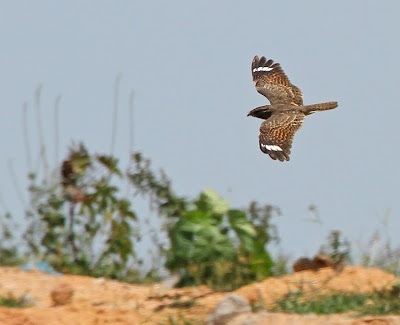


This place is crowded with roosting Savanna Nightjars, and it's impossible to walk across it without disturbing half a dozen or more.


Somewhere I also crossed an invisible line into a pair of Black-winged Stilts' territory, and was told in no uncertain terms to clear off!

Apart from these and a few Wood Sandpipers, Little Ringed Plovers and resident Red-wattled Lapwings, however, there were no waders.

Next stop, Batu Kawan. There's a canal and an area of cleared back-mangroves which runs for several kilometers along the coast here. The trouble is that it is so extensive that birds are widely scattered over it and so only small numbers are visible in any one scan. Initially I bypassed this area, heading for a large area of recently cleared land which will soon become the approach road for the second Penang Bridge. Again, it looks perfect (to me!) for waders - wide open space and lots of freshwater pools - but no birds except a few Black-winged Stilts.

So back I went to the canal, and, thanks to the exceptional height of the tide, most of the area was underwater, concentrating the waders on a few islands still above the water-line.


Space at a premium!

There weren't that many birds - perhaps 400 or so - which bore out my theory that there aren't many rich feeding areas this side of the port. Still, among the Redshanks and other waders, I did spy a lone adult Asian Dowitcher.


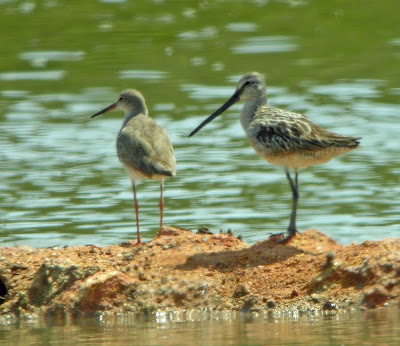


The pics aren't great due to the phenomenal heat haze.

Last stop of the day was the paddyfields at Kampung Permatang Nibong. I was hoping to see the 5 Asian Openbills that have recently returned there, but there was no sign of them.


But what's this flying over at great height? A duck? A goose??


Or just an adventurous Watercock! You don't normally see them flying this high up!
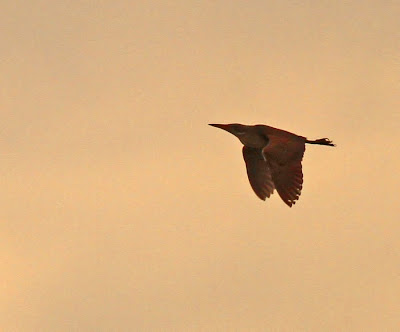


A Cinnamon Bittern against a peachy sunset to end the day.

Friday, April 30, 2010

25-28th April 2010: AWC Training Workshop, Brunei

After having to postpone several times, I finally made it to Brunei to conduct this workshop for Wetlands International. My main concern was that, being the end of April, there would not be any birds left to identify or count - but I needn't have worried!


What IS he going on about? Participants trying not to laugh at my attire - a cross between commando and Englishman-with hanky-on-head-at-the-beach!


Getting good views and notes on a - no, not a green rubbish bin - an Intermediate Egret just beyond the green rubbish bin.


The bird after the egret was a nice surprise - a breeding plumaged Grey-tailed Tattler.


The lagoon near the Billionth Barrel Monument at Seria held a variety of roosting waterbirds, but also showed evidence of degradation. The vegetated fringe had recently been cleared right to the waterline.


The few roosting waders were a little difficult to view in the harsh light, but we were able to grapple with the differences between the Plover and Sandpiper family with these helpful Pacific Golden Plovers and Common Redshank.


This Yellow Bittern was entertaining to watch as it switched its tail from side to side to lure fish within striking distance.


Our second field trip was to Tutong Sewage works, where the presence of about 170 egrets of 4 species and a small number of Oriental Darters gave just about the right level of challenge for first-time counters.


We did it! Another batch of AWC volunteers trained and 'battle-ready' for AWC 2011!


After the end of the workshop and before my flight the following day, I managed to revisit Sg Seria to photograph some of its inhabitants, including two Chinese Egrets in breeding plumage.


The IUCN Red List estimates that there are no more than 3,400 of these stunning birds left in the world.


Breeding on a few islets off the coasts of North and South Korea, Russia and northern China, the majority of the population winters in the Philippines and the north Borneo coast.


Sg Seria is a traditional wintering area for small numbers of Chinese Egret. We saw one here during the Miri workshop too.


There were a few waders on the sandbars at the mouth of the river at low tide. A small group of Greater Sand Plovers included this smart breeding plumaged bird.


The very worn median coverts make it likely this bird is in its 'first summer.'


This video shows the rapid feeding runs typical of Greater Sand Plover, similar to Kentish and White-faced, but not to Lesser Sand Plover, which walks shorter distances and at a much slower rate when seeking food. Did you spot the Sanderlings in the flying flock?!


There was a lone Kentish Plover. The large bill, pale legs and complete breastband all suggest the eastern 'nihonensis' race.


The rivermouth in late afternoon.


And the river itself.


White-breasted Woodswallows were apparently nesting nearby, and mobbed anything that entered their 'space', including me!

My thanks to Pg Shamhari, Shirley, Zah and Dina for ensuring a smooth and successful workshop!