I can hardly believe that this was my first visit to Kapar since
April 12th last year! Fortunately for continuity, Ang has been faithfully visiting and making monthly counts.
Since this weekend was a full moon, with big tides, and as I happened to be in KL for meetings, I couldn't resist the temptation to stay on and make a weekend of it.
No words or photographs can do justice to the spectacle of over 23,000 waterbirds in one place, but here are just a selection of the sights.
 I went to watch the afternoon high tide. The first birds start to arrive about 4 hours before high tide, and it gradually builds up to 'rush hour' from about three and half hours before. Birds come in at enormous speed, with an audible whoosh varying in volume depending on the size of the flock. Each species group knows exactly where to head - the Redshanks come in and turn sharp left; the Greenshanks go sharp right; the plovers, stints and smaller sandpipiers come down plumb centre. The curlews take up the middle ground in the drier area, but arrive much later. The terns congregate in a wheeling flock high over the roost for some time before coming in to land. This shot shows the curlews arriving.

Here's a small part of the plover and calidrid flock. I spent a long time sifting through the 2,500 Red-necked Stints looking for a spatulate bill, without success. It struck me that perhaps I have seen my last Spoon-billed Sandpiper at Kapar - with the species now apparently in real and imminent danger of extinction. A report in
BirdingAsia 12 suggests that the most recent estimate of 150-320 pairs (in 2008) is over-optimistic.
Here's a practical way to give a donation toward preventing extinction of species like Spoon-billed Sandpiper.


 A selection of shots of part of the same flock as they frequently moved around.

 This was the cause on one occasion - an overflying Osprey.
 The Osprey even put the curlew flock up. The full flock was around 5,800 birds!
 This corner was mostly Common Redshank territory, but note the lone Nordmann's Greenshank (topmost bird).
 At first I could see only seven NGs, but then I discovered this little flock, which contained 30 birds! There are 14 in this photo (along with a couple of Common Greenshanks).
 A closer view of seven of them, with a Common Greenshank front centre.
 There was a lone first winter Black-headed Gull in the tern flock. This one seems to be a regular at Kapar.
 I counted 33 Caspian Terns, which is a slightly higher total than last year.
 Watching the birds leave for the mudflats as the tide fell was the best way to pick out Far Eastern Curlews from the curlew flock. They are obviously darker from every angle, as the one in the centre of this pic shows.
 Close up, it shows a heavily barred underwing, in contrast to the glistening white underwing coverts of the 'orientalis' Eurasians. Interestingly, the Far Eastern is still growing its two outermost primaries.
 The Great Knots are already developing fresh breeding plumage.
 A Lesser Adjutant came down to feed on the ashpond. Later it went up into the nearby mangroves.
 Having watched most of the birds leave the main ashpond, I visited the smaller pond, which certain species, notably Bar-tailed Godwits, Whimbrels, Great Knots and Terek Sandpipers, tend to favour. This flock is mainly Bar-tailed Godwits and Great Knots, with a couple of Red Knots.
 As the birds fly in, they have a habit of turning their entire body and wings upside down, while keeping their head in the 'correct' position. It's a technique known as 'whiffling' and it allows the birds to descend rapidly. It also results in some great poses!
 So far, the only Bar-tailed Godwit race seen in Malaysia has been 'menzbieri', which winters in Australia and has a barred white back. I did wonder whether some of the birds I saw today, including the lower of the two in this photo, could be 'baueri', which winters in New Zealand, and has a largely brown back. For a comparison of the two races, see this pic, and for a shot of 'baueri' in the field, see here.
 There were also large numbers of Black-tiled Godwits present on the small ashpond. In flight, they are very easy to distinguish from Bar-tailed, both from above ...
 ...and below.
 Three Chinese Egrets were among the other egrets roosting on this pond.
As the sun was going down I had a go at taking some 'artistic' shots of birds flying in front of the setting sun.

 Great Egrets are transformed into firebirds!
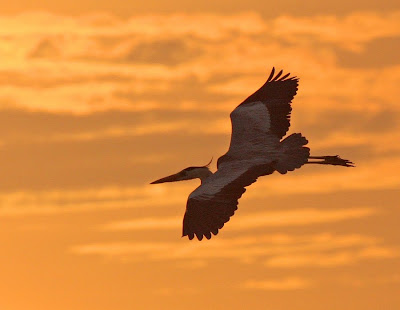

 Grey Herons.
 A lone Whimbrel.


 And a Whimbrel flock with a couple of passenger Bar-tailed Godwits.


