The Great Honor Harrington Read Along is a read along led by me with critical analysis and SPOILER FILLED looks at the Honor Harrington series and related works by David Weber and collaborators. I’ve read the whole main series and the overwhelming majority of the offshoots, but some of these will still be first time reads. However, spoilers will be abundant throughout these posts, including for much later books in the series.
The Honorverse novels are getting so densely packed with side characters that it makes it difficult to summarize Shadow of Freedom. Basically, a bunch of escalations with the Solarian League happen all over the place, and Mesa’s fingerprints can be found all over. Michelle Henke is perhaps the most major character in the story, as she puts out (and lights) fires.
Much of the action takes place in the Verge–a bunch of systems that border the Solarian League but are not officially under its jurisdiction. The League, however, has been quite used to enjoying the privileges of effectively being in charge in the Verge, and having Manticoran interference increasing across the region is most unwelcome.
Battles are fought, battles are avoided, and more political stakes are raised. Mostly, this is a story of a ton of side characters and stories–some of which aren’t really touched anywhere else.
Shadow of Freedomis a novel that rewards those who have paid extremely close attention to the rest of the Honorverse stories. Given how much of the story retreads ground already told in other novels, I think that only fans of the series who really want a deep dive into a lot of side characters and stories need apply here.
Be sure to follow me on Twitter for discussion of posts, links to other pages of interest, random talk about theology/philosophy/apologetics/movies/scifi/sports and more!
Vessel Iris is of the Starlit Order, a monastic-like order of people who help usher the dead back into the infinite Light. The Iron Garden Sutra tells his story.
Iris is sent to investigate a generation ship, the Counsel of Nicaea, which has recently appeared. When he arrives, planning to spend weeks or months simply performing funereal rites, he instead quickly encounters another group whose investigation of the ship is looking for things of technological and archaeological import. The ship is also covered with a quickly creeping mass greenery, and as the violence towards the humans increases, it seems clear there is more to everything than meets the eye.
The novel is one of the few I’ve read recently where my main complaint is that I want it to have less going on. I think I would have enjoyed the novel even more if it had just been following Vessel Iris as he ushered the dead on board the Counsel of Nicaea to the infinite Light. I don’t think the story or characterization really needed the mystery element added, and I also think the mystery element was the weakest part. It was fairly obvious from the moment Iris steps on board the ship where the central mystery would be taking readers. I think there could have easily been enough conflict simply between Iris and the engineering/other team he encounters without the mysterious murders happening.
On the other hand, I wanted there to be more done with the obvious religious references–and there are many. The most obvious one is the name of the generation ship, the Counsel of Nicaea. It’s a cleary reference to the Council of Nicaea, where Christians from around the Roman Empire met and essentially decided various doctrinal issues, paving the way for the later church. There’s almost nothing done with this reference other than it seeming to be a wink and a nod to readers who are aware of the religious reference. The same goes for many other religious references. Here, I think, Sui didn’t explore the religious background of the entire story as much as could have been done.
All of that said, the novel was still quite enjoyable. I love the intersection of faith and science fiction, and Sui does an admirable job showing how faith might evolve in the future, even if it is largely through hints and asides rather than lengthy explanations. I was quite interested in the Starlit Order, and I think Sui makes it an intriguing amalgamation of various beliefs while also giving it a different direction than I might have expected. Ultimately, the novel surprised me by also being part of a series–it seems like it would work quite well as a standalone. Regardless, I anticipate the next novel highly.
The Iron Garden Sutra has transcendent moments. The prose is strong, and Vessel Iris is a strong character. I recommend it to fans of sci-fi who enjoy the kind that is intentionally though-provoking.
I’d had my eye on Time-Marked Warlockfor a while. I finally had the chance to read it on vacation recently, and I admit I was planning to just burn through and move on, eager to get to other books. But this one grabbed me and sucked me in and I found myself setting everything else aside to devour it.
Adair Finch, our protagonist, is a warlock with time powers. He can basically rewind a day, ad infinitum as needed. He used to work as a Private Investigator, until an incident led to his brother’s death. When he’s approached by Bree Blackstone, he finds himself roped back into the world of witches and warlocks, of a dangerous game that he had mostly retired from.
Stovall put a lot of work into the use of time looping to make the narrative compelling. I thought she did a phenomenal job using the same-day narrative both to create a notion of expectation and to let the characters explore a world that’s basically “how do we make this day go right while solving the mystery?” The interplay between Bree and Adair is great, such as when Bree convinces Adair they have to save a dog every single time, even if they’re for sure going to repeat the day anyway.
Now, I will say I think no small part of the premise of the novel starts to break down under scrutiny. First, there’s the question of ethics. Finch keeps talking about how he has infinite time each day. Well, if he does, why isn’t he using each day to do a “Groundhog Day”-esque perfect day? One where he saves everyone possible, learns to do whatever he wants, and get the dreams fulfilled? And, ethically, do you hold someone accountable if they don’t save everyone they possibly can each day? Just spitballing here, but if Finch learns there’s a massive shooting somewhere, wouldn’t it seem the ethical thing to do to rewind the day, go to that place, and save the innocent by stopping the shooting before it happens? And why doesn’t he do that? Exhaustion because too many bad things happen? I mean, that’s a fair point, but surely stopping some of them would be a good idea. Anyway, I don’t want to dwell too much longer on this, but I admit it bothered me the whole time I was reading the novel. If you have consequence-free time travel, why aren’t you using it to the utmost?
Time-Marked Warlockis a great read especially for fans of other urban fantasies with magic. Fans of the Dresden files or Seanan McGuire will eat this up, as I did. I recommend it highly.
The Great Honor Harrington Read Along is a read along led by me with critical analysis and SPOILER FILLED looks at the Honor Harrington series and related works by David Weber and collaborators. I’ve read the whole main series and the overwhelming majority of the offshoots, but some of these will still be first time reads. However, spoilers will be abundant throughout these posts, including for much later books in the series.
Stephanie Harrington, now a provisional Forest Ranger on Sphinx, continues to learn from and bond with Climbs Quickly, her treecat friend. Outsider political and economic interests continue to grow on the planet, as well. Sphinx is a place of frontiers, and some see those frontiers as ripe for exploitation.
Sphinx has its own seasons, one of which brings with it heightened risk of forest fires. These fires, as they are in many forests, help replenish life just as they burn it away. But those outside interests see the upcoming fire season as a way to quietly destroy the native treecat population and clear the way for much greater economic exploitation of the planet.
Climbs Quickly begins hearing the desperate calls of some of his people as the fires spread and are fanned by humans. Eventually, Stephanie and another forest ranger, Karl Zivonik, go to find out what’s wrong. They end up rescuing several treecats, and, by extension, possibly the treecat population and planetary future itself.
The novel is another look at Stephanie Harrington, who provides a coming-of-age narrative that will please fans of “competence porn.” This 14-year-old is about as competent as someone her age could possibly get. I’m not saying this as a critique; this is generally what readers in the Honor Harrington series love about Honor as well. Just be aware going in that that is what you’re signing up for.
Fire Season is a fine read for filling out more background about Stephanie Harrington and the early history of human-treecat relations. However, it definitely feels like a bit of a filler novel where little happens to advance the overarching major plot point. As a character piece, though, it gives plenty of insight.
Be sure to follow me on Twitter for discussion of posts, links to other pages of interest, random talk about theology/philosophy/apologetics/movies/scifi/sports and more!
I’ve finished reading all the Hugo nominees and winners, and decided to add on to that reading by also reading the Nebula winners and nominees, along with several other award categories. The Nebula Awards are given by the Science Fiction Writers of America, which means this is an award given by writers, not just readers. There’s often a different selection than the Hugos had, though there is also significant overlap. I’ll be showing which novel won each year and making my own choice for a winner each time.
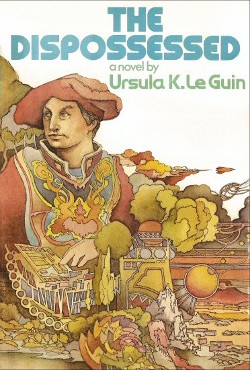
The Dispossessed by Ursula K. Le Guin (Winner, My Winner)- Grade: A+ Ursula K. Le Guin sketches out a remarkably detailed anarchist society, while pitting its pseudo-utopian problems alongside problems with capitalism and socialism. It’s really well done and incredibly deep. At no point does it seem like the society is merely a foil, except perhaps at times when questions of sexual relations is concerned. Even there, though, Le Guin has in-universe reasons for what is happening and ties it all into her detailed world-building. She also explores the question of how much our upbringing can cloud our thoughts regarding being self-critical and analyzing our own views. Why not the highest possible score? Because other than the main character, an intriguing scientist with a good amount of depth, every other character is exactly what you might expect. They’re created purely for the sake of the plot, but the plot is so intriguing that you don’t end up minding it as much as you probably should. So even the somewhat uneven characterization doesn’t take away from the glory of this novel. It certainly must stand as among the best science fiction novels ever written.
334by Thomas M. Disch- Grade: A Ostensibly, this is a collection of stories centered around inhabitants of a low income apartment building in the future (from the perspective of 1974). Such a description is to treat the novel very ill. On the covery, blurbs compared it to Charles Dickens. I think the comparison is apt in some ways–both Disch and Dickens see keenly into the human heart and condition and take a scalpel to that condition to cut away the fat–but in others it is very off. Dickens tended towards a moral and ethical core in his storytelling, and while an in-depth analysis of 334 might yield such a purpose in it, I would be hard pressed at what it might be, having read the novel. The stories here are largely about the everyday lives of these inhabitants of this housing and a future in which careless harm is the norm, whether intended or not. People are only allowed to have children if they score certain numbers on various aptitude tests. Even having a family history of conditions like diabetes can cause someone to lose points, and perhaps put them beneath an arbitrary threshold of having desirable genes. But this is only one of the many backgrounds of the novel. The first story reads like a coming-of-age story as its main character, Birdie, chases the arbitrary number goal by retaking tests and, eventually attempting to write an essay. Classes are taught via video tapes of ancient lectures, most of which are not even understood by the people running the coursework. When Birdie finally goes to a library and discovers Plato, he undergoes an awakening to the world, seeing beauty in everyone and everything… only to give into the most hideous ugliness in the whole novel as his score ultimately does not satisfy him. Other stories range from strange to disturbing. A woman takes a drug that has her oscillate between her “now” and the experience of being a woman during the fall of the Roman Empire. It makes sense in the story–I promise (maybe). A man working at a hospital robs the morgue to sell the bodies for unspeakable uses, only to discover one body he’s sold should have been left well enough alone. A man discovers that he desperately needs to be a mother in order to fulfill his humanity. These are just some of the many stories told here. Every content warning possible should be caveated with this book. Casual use of extreme language, including racist language, is here. Sexual assault, eroticism, and violence of many kinds. If those content warnings don’t turn a reader off, and if one wants to endure–yes, endure–such a novel, this is as intense a look at the casual cruelty and strangeness of human nature I’ve ever read.
Flow My Tears, The Policeman Said by Philip K. Dick- Grade: D Stop me if you’ve heard this one: a person wakes up in a world in which they don’t exist and has to navigate that. Now, granted, PKD might have done that in this novel before so many other iterations existed, but combine that with the extremely obvious and predictable answer to the plot being, once again, drugs, and I found this to be an absolute snoozefest. This is the second time I read it, and when I read it for the Hugo list, I was a little more gracious, scoring it as a C-. However, on a second go-round, hoping to find something that would really make me enjoy it or get it more, I found I liked it even less. The main character is an unlikable mess. The police state is so in the background that whatever alleged foreboding we’re supposed to experience is tangential. And because our main character is such an unsympathetic character, the novel almost makes you as the reader want him to get caught. Having PKD retroactively interpret the novel as a kind of retelling of the Ethiopian Eunuch in the Bible in Acts and seeing it as people in power having to beware of coming judgment is cool, but has absolutely no connection to the actual words on the page. There’s this movement to reinterpret so many of PKD’s works as so much better or more powerful than they actually are and while I think that’s a fun exercise, it honestly just makes me even more annoyed at the works themselves. The story of PKD running with this interpretation of Flow my Tears basically makes me think there is little, if any, thought put into the actual novel itself, and that once again the answer is just “drugs did it” and move on. Okay, we get it, that was the time period and the life he lived. I don’t have to like that or be even remotely interested in it. At least do something interesting with it. I could rant on, but I’m done.
The Godwhaleby T.J. Bass- Grade: B+ The Godwhale is absolutely the kind of novel you finish reading and then set it down and think… What!? Seriously though, what even is this novel. It is so strange and so over-the-top weird, and yet, still very good. The story is vaguely related to Half Past Human but definitely stands alone without it. The setting is a post-apocalyptic Earth. The Godwhale itself is a massive, whale-like ship that was designed to comb the seas for resources. When humans ostensibly disappeared, its functionality came to an end and it awaits a reawakening from humanity’s return. Meanwhile, under the seas, a new humankind arises… It’s a very strange story that balances the oddness of a god-like machine hovering in the distance with Bass’s creation of an entire undersea culture. This story haunts you with its strangeness. I enjoyed it quite a bit.
1974- A strong slate, apart what I saw as another PKD dud (and I do like some of PKD’s works, mind you). 334 and The Godwhale buffet the reader with strangeness. The stories are written in such a way as to almost force readers to reorient their expectations and even concepts on the fly. I love science fiction that does that. Flow My Tears… seems to be an attempt in the same vein, but not nearly as successful. And of course, The Dispossessed is, in my opinion, one of the all-time greatest science fiction novels. It’s a great year, overall.
Links
Nebula Awards- check out my other posts on the Nebula nominees and winners here. (Scroll down for more).
Hugos– I have read every single Hugo-nominated novel. Click here to read through all my posts reviewing them (still in progress).
I embarked on a quest to read every Hugo-winning novel some years ago. I’ve finished that quest and am now reviewing every one of them. I’m also working on reading every Nebula, BSFA, and several other award category winners and nominations. Follow along with my quests and reviews! I’ll post a look back on each year after I’ve posted the reviews.
Little Brotherby Cory Doctorow- Grade: C+ A dystopic vision of the near future in which a group of teenagers involve themselves in events that result in a scorched earth police state policy. It reads about like that description makes it sound. Several plot points and decisions seem a bit immature. They’re like grandiose attempts to re-create some of the more fascinating dystopias while still being, at core, a story about teenagers in high school. I’ve read it twice now for different reasons, and each time I found different things I liked and disliked about it. Doctorow writes somewhat interesting voices, but the characters ultimately feel like tropes. The cyberpunk aspects of it are okay, but occasionally read as tacked on. It’s an average read that I could see having lots of fans because it has strong curb appeal.
Saturn’s Childrenby Charles Stross- Grade: C+ Stross is full of ideas, some of them are good, and some of them are maybe not so great. This book had a ton of those ideas, with a healthy sprinkling of “male gaze” moments in which readers are titillated by the sex robot. To be fair to Stross, I’m not sure that I disagree with the notion that human use of robots will dip into the obscene pretty swiftly, but it was still weird and kind of gross. Dealing with the struggles of interstellar commerce, trade, and exploration was fascinating. I’d love to see books about similar ideas with less of the weirdness.
The Graveyard Bookby Neil Gaiman (Winner)- Grade: C- I think this is a case of not running into this book at the right time of life. It’s certainly not a bad book, and I can see why it won the awards it did. But it just felt like somewhat generic juvenile fiction to me. Honestly, I just haven’t really enjoyed anything by Neil Gaimon very much. To me, he reads like an ideas writer that doesn’t really have much depth behind the coolness of the ideas. The Graveyard Book is another one like that. The setup was great, but it just doesn’t really do much with it. *EDIT* I read the book and wrote this review before the allegations of sexual assault against Neil Gaiman came into the public eye. I’ve kept my policy of reading and reviewing the books whatever the creator says or does. However, Gaiman is absolutely persona non grata in my view.
Anathemby Neal Stephenson (My Winner)- Grade: A- A story of a monk in a future in which the intellectuals have fled from broader society so as not to lead to great wars. I enjoyed the look at the cloistered life, and though it was a slow burn, I felt the plot never really plodded along. The first and third thirds of the book are better than the middle third. The ideas contained in here, as usual with Stephenson’s fare, are exciting, different, strange, and alluring. It’s wacky and off-kilter, but the theme of the book reigns in Stephenson’s voice such that it doesn’t ever feel as zany as, say, Snow Crash. Instead, there is a somberness here that makes the whole book seem even more intense and epic that it may have otherwise. There is a steep learning curve with all the evented lingo, but the payoff is immense. Stephenson delivers yet another work of stunning imaginative achievement.
Zoe’s Tale by John Scalzi- Grade: B+ Scalzi steps back into the world of Old Man’s War with what is basically just a retelling of The Last Colony from the perspective of Zoe. It’s honestly a great read, with a strong lead voice in Zoe, more exploration of her mysterious alien companions, and powerfully written family drama. However, because it is, at its core, a retelling of the previous novel from another perspective, it offers very little by way of revelation or moving the plot forward. It’s the kind of story that huge fans of the series will enjoy–and I did, myself–but that doesn’t move it much in any direction. Yes, there are great scenes, yes Scalzi’s wit is on full display, but no, it doesn’t read like something that adds a lot to the series.
2009- There have been a lot of quite excellent years in a row, but 2009 feels like a bit of a letdown. Anathem is great, but niche in its appeal. That’s in part due to its somewhat excessive length. The Scalzi work is a fun read, but book 4 in a series, which demands reading the earlier novels. The other three are uneven. It’s not a terrible year, but the appeal here is limited. Searching online, I don’t see any egregious misses here. Maybe it was just a rough year for speculative fiction overall.
Links
J.W. Wartick- Always Have a Reason– Check out my “main site” which talks about philosophy of religion, theology, and Christian apologetics (among other random topics). I love science fiction so that comes up integrated with theology fairly frequently as well. I’d love to have you follow there, too!
My Read-Through of the Hugos– Read more posts in this series and follow me on the journey! Let me know your own thoughts on the books.
I want to preface this that when I saw dark fantasy, I mean it. This is not a book for children. Lots of character death, lots of brutality. I say it is for fans of Redwall because I mean adult fans. As someone who grew up devouring Redwall, I’m always looking for another series to scratch that same itch. When I started reading The Last of the Wild Days: Spring, it drew me in quickly with excellent characters and compelling stakes.
The novel is filled with anthropomorphized creatures. Not all animals are the same level of human-like intelligence (again, like Redwall, where some creatures seem to just be animals). The characters features cross a broad range: squirrels, foxes, wildcats, stoats, badgers, etc. There’s not as much a sense of “all badgers are x” as there are in some anthropomorphic stories. Instead, they all seem to have a strong sense of personality and self, reflected in different ways of being and acting in the world.
It’s clear Loney knows how to write characters, and also clear he knows how to make an epic world. The novel is set across vistas of valleys, trees, marshes, and towns. The characters are across a wide range, and even some characters introduced late in the game quickly grew on me as the stakes were raised. One thing done masterfully throughout the novel is making a sense of urgency behind many of the tasks or scenes depicted. That, and the cruelty of some of the antagonists makes readers quickly sympathize with the “good guys.”
There are battles between the flesheaters and foragers; harrowing scenes of escape from what seems certain death, and as a reader I felt myself constantly rooting for the good guys and hoping things would turn out okay. Before I talk about the editing (see below), I do want to say that Loney’s writing, stylistically, is often quite strong. He has a knack for catching the details that matter, and doing so in a way that makes the read compelling. It feels like you’re in the middle of an epic fantasy, one that hearkens to several classics.
I do need to say that the book needs a somewhat heavy-handed round of editing. The use of the word ‘however’ was grammatically all over the board. Several sentences have weird structures. There was at least one sentence that just dangled into nothingness. It’s especially unfortunate because Loney often has this prose style that lends itself to epic descriptions and sweeping scenes that are occasionally derailed by some of the grammatical foibles. I’m recommending this book highly, but want readers to know that yes, there will be some frustrations with the editing.
I truly hope the author is out there, somewhere, finishing the series. I think there’s just one book left (of four). I am reading book two next.
The Last of the Wild Days: Springis an excellent start to a fantasy series that reads like Redwall for grownups. The characters have impactful growth, the enemies are cruel and wily, and the conclusion is a shot to the gut. Highly recommended.
The Great Honor Harrington Read Along is a read along led by me with critical analysis and SPOILER FILLED looks at the Honor Harrington series and related works by David Weber and collaborators. I’ve read the whole main series and the overwhelming majority of the offshoots, but some of these will still be first time reads. However, spoilers will be abundant throughout these posts, including for much later books in the series.
Here it is, the beginning of the end! There’s only one mainline Honor Harrington novel set after A Rising Thunder, though between this novel and Uncompromising Honor there are 8 (!!!) Honorverse books we will read. Some of those set the stage for the broader conflict, several are parts of prequel series, and all of them will be read and reviewed. For now, though, we get to dive into the main series and see the overall story advance massively.
Tensions between the Solarian League and Manticore continue to rise as the Solarian League tries to bluster its way into controlling whatever interests it wants. Meanwhile, the revelation of the Mesan involvement in assassinations and manipulation of war between Haven and Manticore leads to the two forming a remarkable and swift alliance against common enemies. The Solarian League discovers itself in the unfortunate category of “common enemy” when they attempt to launch a decapitation strike against the Manticoran home system.
The attack was prompted by Manticore’s escalation of economic embargos against the League, though it’s clear that that was only in response to repeated provocations from the League. The attack, of course, goes about as well as one would expect an extremely out of date set of military assets and intelligence points set up against the most modern military in the known universe. Despite Honor’s success in her attempt to show the attack is fruitless, another Mesan mind control nano attack sets off the battle, leading to a wholesale slaughter of the Solarian ships. At the end, Haven and Manticore stand united against the growing threat of Mesa and the scaled might of the Solarian League.
Honestly, this book has it all for fans of the Honor Harrington series. It advances the plot quite well, possibly at the briskest pace of any of the mainline novels in a while. It has nods to a bunch of side stories. It advances the treecat story that’s been developing over the course of the series, making them more ubiquitous players on the galactic scale. Battles abound, as do political machinations in the background. It even has some good character moments, though they have to be spread over an enormous number of characters, of course.
A Rising Thunder is a fantastic penultimate mainline entry in the Honor Harrington series. It delivers on characterization, political intrigue, and large scale starship warfare that drew readers into the series.
I’ve been reading all the Hugo Award winners and nominees for years now, and decided to add on to that reading by also reading the Nebula winners and nominees. I was surprised, as I began compiling my list of which I’d already ready and/or owned, at how little overlap there is between the two, depending on the year. The Nebula Awards are given by the Science Fiction Writers of America, which means this is an award given by writers, not just readers. It certainly provides a different selection. I’ll be showing which novel won each year and making my own selection, which will likely be different in many years. There will be SPOILERS for the books discussed.
Rendezvous with Rama by Arthur C. Clarke (Winner, My Winner)- Grade: B It’s not difficult for me to understand why this is a much-beloved classic. But it also is difficult for me to love it. The book’s pacing is the main issue, as it plods along for chapters with hardly anything happening until it suddenly, like a roller coaster cresting its summit, plummets into a series of startling discoveries and action that gets jumbled together with alarming swiftness. The middle of the book is particularly subject to the problem of pace, as it is wholly occupied with lengthy descriptions of people moving from point A to point B without much characterization or plot to go along with it. The conclusion is ambiguous, but not in a bad way. Again, it’s easy for me to see how this won the award and is loved by many. The bigness of the ideas Clarke explores are always fun. But the novel itself just doesn’t make me want to love it forever. It’s fine. And it’s good enough to be my choice for the winner this year given the competition.
Gravity’s Rainbowby Thomas Pynchon- Grade: F I don’t understand how this abominable excuse for a plot managed to get past (presumably) at least one editor without having about 400 pages of its bloated garbage cut off. It then becomes unfathomable to me that it managed to garner not just a Nebula nomination but also consideration for a Pulitzer Prize in literature. Pretention in the highest form, Gravity’s Rainbow somehow manages to be vapid despite running interminably for hundreds of pages past the 200 page mark its paper-thin plotting warranted at the most generous end. If you prefer infantile humor as a substitute for content, and endless descriptions of sexual scenes and innuendo as stand-ins for character development, I highly recommend this piece of putrid crap for your consumption.
Time Enough for Love by Robert A. Heinlein- Grade: F Heinlein went off the deep end. This reads like he just wanted to write an attack on religious sexual mores, but he did so in a way that seemed to combine crudeness, disgust, and a kind of remarkably naive misogyny into one confused, awful mess. Indeed, he basically admits that the book is an attack on any kind of sexual code as he, through the main character, writes that “‘incest’ was a religious concept, not a scientific one… the last twenty years had washed away in his mind almost the last trace of his tribal taboo.” Sin is similarly chalked up not as wrongdoing or evil but as a tired, backward way of looking at the world. Yep, incest is a-ok in Heinlein’s book, or at least that of his protagonist. Not only that, but so is pedophilia and other forms of sexual exploitation by men, specifically. Those silly religious people and their ideas of not having sexual thoughts about very young minors, not sleeping with your sibling/parent, etc. Oh yeah, but let’s not forget that this is all couched in decidedly 1940s/50s concepts of male-female relations, such that it is accompanied by a not-so-subtle male-dominance matrix. Forward thinking? not so much. Heinlein’s vision of sex in the future is that of the unfettered male, free to satisfy himself with anyone he chooses, regardless of whether they’re capable of consenting or not. Women are not included in this reasoning process, because they are simply the subjects of lust, expected to be willingly subservient to the sexual desires of the man, whether that man is their grandchild, brother, or adopted parent. Terrible, terrible book. I hate it.
The Man Who Folded Himselfby David Gerrold- Grade: C- Gerrold wrote a fantastic exploration of the notion of time travel and how that might play out if one person got careless and perhaps a little wild with it. True to when it was written, however, it devolves that somewhat compelling thread into a series of explorations about sex and orgies and more sex and horse racing. What? Yeah, that’s basically how it plays out. It goes from was an initially decent yarn to a totally absurd tale about one’s self-absorption with himself. Actually, the more I think about the main plot, the more it annoys me immensely. I keep thinking I need to adjust the score down, because this book was basically just a narcissist fantasy told with time travel. It reads almost like wish-fulfillment for the most self-absorbed person alive. That said, Gerrold brings forward some genuine questions about time travel and its possibilities. It’s just not one that I can reflect on with much liking.
The People of the Wind by Poul Anderson- Grade: C- I think a lot of science fiction in the 60s-70s could be re-categorized into its own sub-genre of sex, with sci-fi tropes. The People of the Wind would not be easily filed into this made up category, but it teeters on the edge. I think maybe there’s an interesting subtext here about how different societies or peoples can relate with each other. Sex is used as a kind of way to open the conversation–or, more accurately, themselves–to the perceived “other.” But the prose in the novel doesn’t support this higher level reading. Anderson oscillates between matter-of-fact and seedy here, such that as a reader I never could fully buy into the notion that something else might be going on behind the scenes. The best part about the book is that it doesn’t entirely go black and white on the morality of either society. The humans or Ythrians could each be seen as morally superior here. That props up enough interest to have kept me reading. It’s an okay story that in the hands of another writer might have been great.
1974- This was a pretty terrible year for both the Hugo and Nebula Awards. The Hugo Awards swapped Gravity’s Rainbow for Protector, which I thought was a pretty good book. This might be the lowest average score the Nebulas get from me, with an average letter grade of “D+.” Rendezvous is fine, but drags on forever in a middle section that could almost be skipped over. As a winner, it leaves much to be desired. But wow, Gravity’s Rainbow was a shocker for me. I expect Heinlein to be a pervert because he writes either sexual fantasies or okay-ish hard science fiction, sometimes with a combination of the two. He’s a one trick pony who thinks he’s got other tricks (he’s wrong). But I did not expect that Pulitzer-considered book would be so truly horrific. Ugh, just a bad taste in my mouth after reviewing this year’s books. Hopefully 1975 will fare better.
Links
Science Fiction Hub– I have scores of reviews of Hugo nominees, Vintage Sci-Fi, modern sci-fi, TV series, and more! Check out my science fiction related writings here.
Be sure to follow me on Twitter for discussion of posts, links to other pages of interest, random talk about theology/philosophy/apologetics/movies/scifi/sports and more!
I’ll be the first to admit it: I am not reading Warhammer 40K novels for the thought-provoking content. I enjoy the ludicrously over-the-top setting in which a planet full of billions of people is burned by the Inquisition for the possibility of a heresy spreading… and that’s just a Tuesday. I enjoy the in-your-face “ra ra ra” anti-fascist themes. And yes, it is anti-fascist, on purpose. The creators have said so. We as readers are not supposed to think the Imperium of Man are the good guys. There really aren’t any good guys here. Just people–and xenos–trying to make their way in a grim dark future.
Once in a while, though, there are books in the WH40K universe that do provoke further thinking. Denny Flowers has written a pair of them, Outgunnedand Above and Beyond. These two novels follow the Imperial Propagandaist Kile Simlex, whose assignment to record and transmit uplifting propaganda pieces about Lucille von Shard, fighter ace. Initially, Simlex seems to buy into his own–and others’–prop pieces about the way things are on the fringes of the Imperium, but as the stories go on, he becomes aware that the shiny, good guys always win veneer is a carefully constructed facade. One that he is unable to escape due to the churning wheels of Imperial power.
Outgunned follows Simlex as he first meets and documents von Shard’s career. Despite the supposed gloriousness of it all, Simlex discovers that on the outskirts, not everything is going well. Lives are cheap and they are traded, sometimes for nothing. Threats abound, yes, but the internal decay on some parts of the Imperial hierarchy is its own problem. Ultimately, Simlex must watch as, embroiled in conflict, he loses valuable tools and control of his legacy.
Above and Beyond, a direct sequel to Outgunned, opens with Simlex getting summoned to help the von Shard family. He’s disturbed by the use of his propaganda pieces and the distortion of reality he experiences seeing them. Flowers writes this book a bit on-the-nose, but does so in a way that both amuses and draws in the reader. Simlex must travel to a world in rebellion against the Imperium, where the reality of life on the ground meets with the almost ludicrously scrubbed beauty of the propaganda pieces.
Both of these novels serve, somewhat circumspectly, as a critique of propaganda and a caution for how easy it can be to believe what we’d like to believe. Portraying von Shard as a completely different heroine than she is is comfortable and allows viewers in the Imperium a kind of cathartic comfort. But seeing her as she really is brings to light uncomfortable realities about the conflicts the Imperium is embroiled within.
These two novels are well worth your time, and as Warhammer fiction, they remain top notch. They’re full of action scenes, fighting, and well-written conversations. Highly recommended.




 Eclectic Theist