Showing posts with label Science. Show all posts

Thursday, September 17, 2020

The best news on Earth is not on Earth

This year has been one of the worst, and most bizarre, in decades. Certainly of my lifetime. Democracy is crumbling, fascism seems ascendant, climate change is causing catastrophes and of course there's the pandemic, which... well, we all know how bad that is.

Maybe that's why the news that leaked--and then gushed--out earlier this week felt so important. Signs of life on Venus! Right next door! Closer than Mars, even! The details of the announcement, that scientists had found in Venus' atmosphere phosphine, a gas that is only naturally produced by organisms, made it all the more exciting. They had worked hard to rule out other explanations, and made their observations at different times using different equipment. The most likely explanation for what they were seeing, they said, was life.

Venus. Not pictured: atmospheric microbes.

When methane was found on Mars a few years ago, it felt more interesting than exciting. Like phosphine, methane is unstable and most often is produced by living organisms. The amounts detected on Mars shouldn't exist unless it is being continually produced, or released from deep under the planet's surface. The methane still hasn't been explained (or biological origins ruled out) but I guess that caveat felt pretty big.

With the Venus news, the chances that it wasn't a sign of life seem much smaller. It would need to be an observation error, or the phosphine would have to be caused by some undiscovered natural process.

That's cool on its own. But what makes it even more moving, for lack of a better word, is what it says about the universe. Venus is inhospitable in every sense. Heat, pressure, corrosive substances. Like the song says, if you can make it there, you can make it anywhere. Life on Venus, even microorganisms, sure seems to imply that it is likely to exist on some of the other billions of planets in just our galaxy.

Handy neighborhood map.

So while we're wallowing through 2020, it's nice to think that at least we might not be doing it alone.

Thursday, January 10, 2019

Turn up the radio

In recent years, astronomers have discovered new faraway planets, gotten close looks at distant objects like asteroids and comets, and driven lots of robots around Mars.

All of this is in service of exploring the physical universe and learning more about why things are the way they are, basically. That's exciting! But there is also this sort of deeper human need to find out whether we're all there is in terms of intelligent life. Scientists and philosophers argue about the odds--on the one hand, they're infinitesimal because shouldn't we have seen something by now given how old the universe is? On the other hand, they're quite good because the universe is as vast as it is old... that's a lot of planets.

Anyhoo, there's not much evidence to go on in that regard. There's the WOW! signal, which no one ever really figured out. And lately there have been "fast radio bursts," which are also mostly unexplained. This week, more of those bursts were announced, including an unprecedented repeating burst.

“When these bursts happen once only, it’s really hard to figure out what created them,” Cherry Ng, a radio astronomer at the University of Toronto and lead author on the paper about the repeating FRB, tells The Verge. “Now we’re showing, no, at least one other repeats.”

I've always felt like this is the way we'd get evidence of "other life out there"--something pretty inscrutable and outwardly mundane, as opposed to in the movies where detailed messages or even space ships arrive.

what will the aliens' morning drive zoo crews sound like?

To be clear, these bursts are almost certainly caused by natural (if distant) phenomena. That doesn't make them any less fascinating... it's a new physical mystery to unravel.

But it's sure fun to think about the tiny chance they're more than that.

It's been a rough few years for this planet, and finding life on another one would somehow make that feel more bearable.

Friday, March 10, 2017

Let's talk about health care

I'm old enough to remember 10 years ago, when health care was about insurance, and insurance was so valuable it was often reason enough on its own to take a job.

I'm an expat enough that I've been out of the country for most of the time the Affordable Care Act has been in effect.

I'm cynical enough to understand that "access to health care" is basically meaningless when it is shorthand for, "if you can afford it, you can buy it."

A lot of people smarter than I have written on this topic, so I'll keep this short.

Health care is not a luxury (like, say, a new iPhone) America as a country has strong incentives to have a healthy population--there is close correlation between health and economic productivity. All Americans benefit.

So given that, how do we make sure Americans are healthy? For most of my life, the answer was to have a government program that paid for health care for the very poor (Medicaid) and the old (Medicare), and everyone in between was left to fend for themselves. This was fine as long as you could either a) afford to pay your medical bills on your own, b) could afford insurance on your own or c) had a job that offered insurance.

The reality was that the simple expense of medical care and insurance was too much for many, and so millions of Americans went without either. This is an absurd thing to type considering the U.S. has the largest economy in the world by a huge margin, but there we were.

The Affordable Care Act tried to address that by (in simple terms) making health insurance mandatory and creating a system in which it was affordable. The mechanisms for both are of course incredibly complex. The results were pretty easy to see, with the number of uninsured Americans dropping dramatically.

The current plan to replace the ACA, for no real reason other than partisan spite, uproots a lot of what made the ACA work. It promises "access to health care," and its chief proponent, Paul Ryan, said the problem before was that healthy people subsidize sick people, which is both literally true and spectacularly dumb, considering people whose houses don't burn down subsidize firefighters to help those whose houses do.


Anyway. This brings me to Hong Kong, where I live now. Life expectancy and health in general are good in Hong Kong despite occasionally awful pollution. A large part of that is the public health system, which is staffed by well-trained doctors and is free. There is a private health care system too, as well as an insurance market.

First of all, it's important to note that even though the U.S. economy dwarfs that of Hong Kong, the 'Kong has extra money around because it does not fund a military. The current public medical system is largely a legacy of British colonial times but it is funded by current taxes, and Hong Kong, which is terrible at budgeting efficiently, always has money left over anyway.

The public system is effective. What it's not is friendly. You will feel like a number, you often will wait a long time for non-emergency care and you will not feel particularly comforted by your surroundings. You will also pay nothing, or very little, for your care. (Delivering a child and spending a few days in the hospital costs, all-in, about US$30.)

The private system is effective too--and friendlier, although bedside manner isn't really a thing in Hong Kong. What it's not, is cheap... let alone free. Getting a dose of oral vaccine for your kid at a no-frills clinic will run you about US$250 plus a consultation fee.

In my experience, doctors in the United States are more engaged with their patients and think more critically about their cases. A system that gives all Americans access to their expertise would benefit everyone.

You can see where I'm going with this. A system like Hong Kong's that allows private medical businesses to offer services while also guaranteeing free medical care to anyone who needs it--not just the poor or old--would be a huge positive for America. This is not a full-throated endorsement of medical care in Hong Kong, which can be frustrating and demeaning and even ineffective, but of the system that gives everyone access to a doctor.

Replacing the ACA because it was "the other guy's" idea is dumb and harmful. Improving it so every American gets health care, not just access to it is not.

In my experience, the latter can be done. It's a shame the Congressional majority is too focused on negative partisanship to realize that, or even try.

Monday, February 29, 2016

Meet the new stealth bomber, (not quite) the same as the old stealth bomber

Let's talk about the B-21, a.k.a. the Stealth Aircraft Formerly Known as the LRS-B.

LRS-B, of course, was a somewhat tortured initialism for Long-Range Strike Bomber, with a hyphen thrown into the wrong place for good measure. But the label really said it all, or almost all: It is a bomber designed for long-range strike missions. It's also stealthy, which for some reason didn't make it into the name, but whatever. It's the B-21 now.

It's great to finally see--at least, in an artistic sort of way--what the new plane looks like. But first, I'd like to note that this isn't the first B-21. Nossir! The first was the XB-21, designed in the late 1930s as a medium bomber prototype. Designed by North American Rockwell, it lost a fly-off to the apparently much cheaper B-18 Bolo prototype. It looked like this:

A vision of the future, set way in the past.


The latest B-21, meanwhile, looks like this:

A vision of the future, set in the present, but with echoes of the recent past. It's complicated, OK?

It's a slick looking plane that, it goes without saying, closely resembles the B-2, designed in the 1970s and first flown in the 1980s. It's also made by the same company, Northrop Grumman.

So here's the thing. As an aviation dork, I'm a little disappointed it doesn't look more exotic. I'm not sure what "more exotic" would mean here, to be honest, but as Justice Potter Stewart once said (kind of), I'd know it when I saw it. It's a B-2 with longer wing extensions and no saw-tooth trailing edge. Right?

There is, of course, a reason for that. The whole philosophy behind the LRS-B program was to use "mature" technology--that is, stuff we know works. That doesn't necessarily mean it's all stuff that is unclassified or old news, but it's proven. Which explains the shaping. The B-2's planform is aerodynamically efficient and nearly invisible to radar; why mess with success?

We know literally nothing about the B-21's capabilities at this point (or even how big it is, as the illustration doesn't give a sense of scale), but we can at least infer it is meant to be subsonic. The long wings we see up there provide lift and range, but the ain't made for breaking the sound barrier LINK.

That means what we've got here is an aircraft that looks like the previous generation in stealth, and isn't particularly fast. Is this ground for Panicking That We Have Wasted Money on a White Elephant? No. And here's why... I think.

I have pointed out in the past, with some annoyance, that Russia's and China's stealth entries get a lot of attention to their overall shaping without much consideration to the details. A plane can look stealthy without being stealthy, thanks to stuff like engine nozzles, canards, strakes, and so on. And in the end, it's what's under the hood--high-tech radar, efficient engines, datalinks--that makes a plane top of the line anyway.

And this is where I think the B-21 will necessarily take it to the next generation. Better engines will give it longer legs. Defensive systems like solid-state lasers are, publicly, nearly small and light enough to mount on a large airplane. Weapons are "smarter" and can be released from ever-increasing ranges to hit ever-smaller targets. Networking will probably allow the bomber to control, or work in concert with, a fleet of unmanned aircraft. And there is a very good chance the bomber itself will be "optionally manned"; for high-risk missions, it could be flown remotely, or by a computer.

Oh, and by the way, that -21 designation? That stands for 21st Century. What we see, in other words, may not be what we get, and no matter how much I wanted to see a chrome-plated, atmosphere-skipping SuperMegaBomber, that's probably for the best. If nothing else, it will give me plenty to blog about as more details follow the plane out of the shadows.

Tuesday, February 16, 2016

Way ahead of the curve

Many years ago, Mrs. Blog and I attended a music festival in Milwaukee. Don't worry--the story gets better from here.

The band I remember most was on a SummerFest sidestage, with the seating area half-full. "They're a Chicago band," Mrs. Blog told me. I hadn't heard of them. We sat down, beers in hand, as the band took the stage. The lead singer walked up to the mic, plugged in his guitar, waited a beat, then launched into a crunchy rock cover of "Crimson and Clover."

The band was OKGO. I bought a couple of EPs from their merch guy at that show, and their label-produced full-length CD later. It was good stuff! And, of course, you want to support your local artist.

Now, in 2016, [REDACTED] years later, they're not Beyonce famous. But they've made a name for themselves--as you probably know--by virtue of increasingly clever music videos involving stuff like treadmills, Rube Goldberg machines, marching bands and human LED displays.

Their latest video, for a (catchy) song called "Upside Down & Inside Out," takes it to another level, literally, and in a way that really appeals to the aviation nerd in me. First, watch the video:


Yeah, that's right. The entire video is shot in free-fall. Note, this is not zero gravity, although as Einstein would helpfully point out, it feels like the same thing, relatively speaking. The band is being affected by gravity just like everything else on the planet, but they are falling at the same rate as the plane they are flying in, so it feels like they aren't. This can be done in just about any plane by flying a parabolic arc:

Like a roller-coaster, but awesomer.

Neat! This is the same way astronauts train for zero-g environments. And--fun fact--when they're orbiting the Earth, they, too are being affected by gravity: they're in free fall, but are moving so fast they keep missing the ground. It's science!

Note, though, that this process only gets you a minute or so, at most, of free fall to work with at a time. So what OKGO did was do one continuous take, with pauses in the dancing and music (which were edited out later) for the times when the plane was climbing back to the top of the parabolic arc, and they were not in free fall. If you look closely you can see where free fall ends, about every 25 seconds, when all the performers are sitting or standing for a moment.

Here's what it looked like behind the scenes:


And finally, the icing on the nerd cake for me is that the whole thing is shot in a surplus Il-76, a ubiquitous ex-Soviet military transport aircraft. You can find them all over the world now, being used for i̶l̶l̶i̶c̶i̶t̶ private cargo hauling, foreign military operations and of course music videos.

I knew I liked OKGO the first time I saw them. But I never would have guessed they'd inspire an aviation blog post. To paraphrase Claude Debussy, it's not the notes, it's the nerdery between the notes.

Thursday, November 12, 2015

A Tigershark and a Falcon Hawk walk into an arms market....

China is trying very hard to sell its J-31 Falcon Hawk (sometimes referred to at the Gyrfalcon) stealth fighter to other countries. Most recently, it was on display at the Dubai Airshow, where officials with its manufacturer, AVIC, promoted such features as:

-It has two engines
-It has vertical stabilizers (i.e. "tailfins")
-It can carry weapons

If you thought to yourself, "Self... aren't these features that many military aircraft have?" you'd be asking a legitimate question. But lest you think I'm exaggerating, here--watch the promotional video for yourself:


They didn't go into great detail about anything, as you can see. What is arguably the plane's biggest selling point, its stealthiness, is asserted without any quantification. What's the radar cross-section? How far away can it be detected? All open questions.

Another key detail not addressed was how much each plane would cost buyers. And here's the most important bit: there are no customers. A major aerospace company is selling a low-cost (maybe?) stealth fighter to anyone who wants it, but, well... no one wants it. Including the Chinese military, which is focusing on the J-20 and has no plans to buy any J-31s.

It's easy to mock AVIC for this. But this isn't the first time a company invested money in what it thought was a superior product, only to find its plane utterly ignored.

In the mid-1970s, the American defense giant Northrop (now Northrop Grumman, maker of such obscure aircraft as the B-2 stealth bomber) began developing a light fighter for export. The idea was to supply U.S. allies with a high-quality fighter that could defeat front-line Soviet gear, but not sell them top-of-the-line U.S. hardware, like the newly developed F-15.

Thus spawned the F-20 Tigershark. It was basically re-engineered F-5 Tiger II, with its wings and tail tweaked to improve maneuverability and a single engine that generated more than 50 percent more thrust that the F-5s two engines. Overall performance was, in the end, comparable to the more-expensive F-16. It looked like this:


Neat, right? But despite its relatively low cost and relatively high performance, there were no buyers. Well, Bahrain ordered a few, but they were never delivered. The biggest issue was that the U.S. changed its export policies, allowing better equipment--including the F-16--to be sold overseas. Northrop was never even able to sell any to the U.S. government. And so after the better part of a decade, Northrop abandoned the program after spending more than $1 billion on it.

So there are all kinds of factors at work with the J-31. Buyers who are allowed to purchase an F-35 or Eurofighter Typhoon probably will. Buyers who aren't--I'm looking at you here, Pakistan--are probably reluctant to shell out money for a plane that may or may not do any of the stuff its advertised to do. (And a J-31 buy would not generate goodwill with Washington, either.)

In the end, the J-31's problem is that it's probably just a dog, developed for Chinese use but discarded in favor of the superior J-20. AVIC is trying to get something back on its investment. But like Northrop, it might be better served moving on to the next project and leaving the Falcon Hawk alongside the Tigershark as a footnote to aviation history.

Wednesday, May 13, 2015

Homemade jet engines, then and now

True story: as a fifth-grader, I and a classmate built a rudimentary jet engine for a science fair*.

OK, OK... maybe "rudimentary" is being a little complimentary. And in reality, it was more of a motorjet, which was cutting edge in the late 1930s. But still. A jet. I assume the Parents of the Blog have a picture somewhere, but since I don't have one in hand, I'll just describe it to you.

It was a coffee can with both ends removed.

The beginnings of an engine.

Inside the can was mounted a smaller can--I think it once held tuna. The lid was removed and a hole about 1/3 the diameter was cut in the bottom.

The ignition system.

At one end was a two-stroke model airplane engine with a two-bladed propeller.

This would be the "motor" part of a motorjet.

Inside the tuna can was a wad of steel wool mixed with wood putty--the ignitors. I won't even try to find something to illustrate that. But the point was that after experimenting with a bunch of different flammable things, we discovered this mixture would maintain an open flame in high winds... like those generated by a model airplane engine.

Finally, a tiny hole in the top of the coffee can admitted a tiny straw, which was attached to a can of WD-40. This was the fuel system.

You started up the prop in the front, started spraying fuel, and whoosh: a jet. The tuna can compressed the air inside the coffee can enough that, combined with the heat of WD-40, you actually got a little thrust. We never tested it, but I suspect it would have, say, accelerated a skateboard pretty nicely.

What made me think of this? Well, I saw today that GE just produced a rudimentary jet engine of its own. Except this one was more or less 3D-printed. And it's quite a bit more powerful. Check it out:


It's a really cool application of a technology that is still evolving in interesting ways. Just a couple of years ago, 3D printing was basically something you used to make toys or plastic parts. Now you can, in theory, simply command a computer to make a jet engine.

I think even adjusted for inflation, my production costs were much lower. But measured in skateboard thrust units, GE's version of a cheap jet engine blows mine away.

*Our jet came in second, to a "microwave that cools things down." It was a box with a fan in it.

Thursday, December 4, 2014

To the stars, through a̶d̶v̶e̶r̶s̶i̶t̶y̶ budget cuts

A few hours from now, NASA is about to send a brand-new manned spacecraft called Orion into orbit. It's the first time this has happened since 1981, when NASA did this:


I remember watching this with my parents, excited but not fully realizing what a big deal it was (more specifically, I remember holding a plastic model with the vertical stabilizer broken off, sitting on the edge of my parents' bed in front of the TV). I was too young to feel nervous for the two guys strapped into Columbia's cockpit or to feel like there was even any chance of failure. The whole experience got me hooked on space, rockets, and space rockets--much in the same way, I'm sure, that others were mesmerized by Apollo 11.

Over the years, Space Shuttle launches became almost routine, but its first flight was a big moment for NASA. It was, essentially, a brand-new concept. And it was, literally, a manned test flight of a vehicle's maiden trip into space, something the organization had never done before and has never done since.

Indeed, Orion will carry all kinds of things--including a rubber ducky from Sesame Street and a T. rex fossil--but no astronauts. It will blast into high Earth orbit, circle the planet a couple of times, and splash down. The whole exercise will only last a few hours, but it's a huge deal because it marks the first tiny steps of much longer journeys. NASA has its sights set on a manned asteroid landing, and of course eventually Mars.


Neat, right? Everyone these days is focused on space as a source of resources, and that's important. It would be nice to be able to build things without destroying our planet looking for the raw materials. But it's much more important for us as a species to keep exploring, keep looking for questions to answer. Some of what we find might be practically useful, like new technology or materials. Other stuff might be bigger picture, like discovering extraterrestrial organisms. But regardless, it's not healthy for humans to just look around at where we are, shrug, and say, "eh--good enough."

(Orion is also a nice distraction from the awfulness of Ferguson, New York and Cleveland. And I don't just mean the killings or grand jury decisions--the way some have responded to the protests is beyond disheartening.)

So here's to a successful test flight. I hope by the time astronauts are using the craft, perhaps five years from now, Earth will be a better place than it is now, and we'll be well on our way to a new chapter of space exploration... and the Littlest Blog will get to watch astronauts walking on Mars.

Wednesday, October 29, 2014

IT LIVES


Halloween is just around the corner, so it's time to look at a terrifying video. I call it "Day of the Looping J-31." Catchy, right?

(hat tip to Alert 5)

But let's be real. Like any horror movie, if you think about it too much, it stops being scary. The J-31 arrived in Zhuhai today, ostensibly in preparation for the airshow there, which starts on Nov. 11. The maneuver above, a half-Cuban 8, isn't particulalry arduous. It does not show off speed, maneuverability, and certainly not stealth--not that the Chinese military would be eager to put any of those things on display.

What I'm trying to say here is that the J-31 has been flying for a while now, but there remains no confirmable indication that, other than looking awesome, it or the larger J-20 can match or exceed the capabilities of other operational stealth aircraft. (Of which, to be fair, there are just two: the F-22 and F-35, with the retired F-117 flying around Nevada for who knows what reason).

What is "under the hood," specifically, remains questionable. Chinese engine technology is no great shakes, hindering not just military programs, but its commercial aviation industry. Less-obvious systems like low-probability-of-intercept radar, which allows a stealthy aircraft to track targets without its radar emissions giving away its position, are also tricky to develop. Without them or a robust airborne warning and control network, which China does not substantially have, a stealth aircraft's air-to-air capabilities are severely limited.

In the end, this video should be taken solely for what it is: neat footage of a neat-looking plane. It's not a milestone, and it's certainly not an indication of a closing technological gap... even with Jason Voorhees in the cockpit.

Tuesday, September 23, 2014

Blasts from the past

Hey, gang--long time, no see. It's not that I've been ignoring you, it's that life has been a little busy lately (and will soon get busier). But that's the usual blogger excuse. Let's talk about something more interesting, like... rockets.

There has been lots of space in the news lately. NASA's next-generation Orion spacecraft hit some milestones. Boeing was chosen as the lead contractor for a "space taxi" into Earth's orbit. Blue Origin is pitching new engines to use instead of the Russian-made RD-180s. And of course the Maven probe to study Mars' atmosphere arrived safely.

So it's fun to think that all this does indeed point to a real renewal of interest in deep space exploration. Indeed, in the next five or so years, the Orion capsule is planned to be on a spin outside Earth's orbit, just to see what she can do. It will be launched on top of the (unimaginatively named) Space Launch System, which bears some resemblance to the Apollo program's mighty Saturn V:

Tall. White. Rocket-like. Yep, fits the profile.

It should work well! But there were times before we figured out the whole rocketry thing that some really epic plans were on the drawing board. I've written a little about the U.S. proposals for nuclear rockets; here is an fascinating look at Russian plans along the same lines:
By the end of 1967, the Kremlin gave the green light to Vladimir Chelomei to work on the preliminary design of the UR-700 rocket as a backup to the troubled N1. Unlike the N1, Chelomei's rocket would be assembled out of components built in Moscow and transportable by rail. Even more importantly, it would use just 12 engines on its three stages, instead of 42 on the boosters stages of the N1. Finally, the UR-700 could launch 151 tons of payload versus 97 tons carried by the N1 and 127 tons delivered by the American Saturn-5.

In parallel with the development of the UR-700, Chelomei's engineers drafted a much bigger follow-on vehicle, which would be equipped with nuclear engines. (658) Known as Skhema "A" (Configuration "A") engine would feature the solid core nuclear reactor and enable the UR-700 to deliver as much as 250 tons into the Earth orbit. In a more distance future, a nuclear engine with liquid core reactor known as Skhema "B" (Configuration "B") would be developed, followed by an engine with a gaseous core reactor dubbed Skhema "V" (Configuration "V").
In the end, it lost out to the impressive but poorly built N1, which literally never got off the ground. And that was that for Soviet moonshot hopes.

These days everyone seems focused on getting back to the moon, or even Mars, which is great. Rocket technology has become more efficient and reliable in the decades since Apollo, but the basic physics (fuel, oxidizer, ignition) remain little changed. Because of the relative danger of getting a nuclear rocket into space--even using chemical engines--projects like the UR-700 are not likely to be revived. But it's always fascinating to see what technological solutions smart people come up with to solve problems like this... even if they don't always work out.

Wednesday, June 11, 2014

"Wise man"? Really?

The idea that we, as human beings, are inherently rational (see the "sapiens" in homo sapiens) is being stretched to the breaking point lately for me. I say this because a sapient being--or a society of sapient beings--should be able to process tangible, real-world evidence, draw conclusions from it and plan future behavior based on those conclusions. That's how humans came to dominate the planet, after all.

But these days, that doesn't seem to be happening.

For instance, there are mountains of data showing that the Earth's climate is changing in direct correlation with the amount of carbon dioxide we're pumping into the atmosphere. And if that weren't tangible enough, there is also the small fact of Antarctic ice measurably and inexorably sliding into the ocean... which will raise sea levels by amounts ranging from problematic to catastrophic in the next hundred-plus years. Tangible. Real world.

But instead of guiding humanity to action, this stuff has become a political football. I can't think of another area of science that is so settled yet "debated" (note: those are irony quotes) so heavily along political lines. Look it it this way: denying manmade climate change puts you in roughly the same scientific sphere as believing vaccines cause autism and just a notch or two above denying evolution. Is that a good crowd to run with? Is that what we want to base policy on?

Here's another example: guns. I could go on at great length about this, but The Onion, as always, is able to wrap it up in a tight little satirical package:

No need for a caption.

In this case, the real-world, tangible evidence is an ever-larger pile of deadly shootings. It doesn't get much more tangible than that. Yet the U.S. has done basically nothing additional to regulate the instruments of those shootings. To the contrary, public discourse becomes flooded with  sophistic arguments about how the shootings are caused by anything but firearms. (Quick side note here, touching on something that fascinates Friend of the Blog Pete: I do enjoy guns and military hardware. The technology behind them is brilliant and the tactics and strategy in their use on the battlefield is engrossing. Yet, barring a zombie apocalypse, there will never be a gun in my home.)

And so homo sapiens looks at his surroundings and shrugs, figuring it's easier to make up his own reality. This isn't the attitude that made our species strong. But it may be the attitude that lays it low.

Tuesday, April 22, 2014

Return of the Triangle

One of the nice things about going on vacation is being disconnected from current events (even though the hotel Mrs. Blog and I stayed at helpfully provided a U.S.-focused photocopied summary of the day's news each morning). One of the bad things about that, though, is missing stuff like this:

It's a bird! It's a plane! It's... kind of like a Dorito.

Yep. That's another picture of what appears to be the same aircraft photographed here. The picture above was taken in Kansas, by a guy whose name seems really familiar to me for some reason. The other pictures were taken in Texas.

What they both have in common is a pretty clear "pure delta" shape--in other words, a plane that is basically a flying triangle. As far as I know there is no aircraft in the U.S. inventory shaped like that. Even the fanciest new drones--the X-47B, the RQ-170 and the RQ-180, for instance--do not have smooth trailing edges. Neither does the B-2:

Sawtoothed, not smooth.

So this once again appears to be a photograph of a large-ish aircraft of unknown purpose flying at high altitude (as indicated by the contrails) and below the speed of sound (as indicated by the lack of anyone hearing a sonic boom). This is almost certainly a brand-new program, and its flights over populated areas are almost certainly not mistakes.

Interesting side note: More than 20 years ago, the Navy was on the verge of acquiring a stealthy attack aircraft called the A-12 Avenger II. The program was canceled for costing too much and delivering, well, nothing. But guess what the nickname for the Avenger was? The Flying Dorito.

It never flew. But it did look like a snack chip.

Looks a lot like what's in the Texas and Kansas photos, doesn't it? But by all accounts, the program was a dog and, quite literally, never got off the ground. The similarities are probably coincidental.

My guess is that the pictures show the long-planned Long-Range Strike Bomber. But given the frequency of these sightings, it's only a matter of time before we find out for sure.

Tuesday, April 8, 2014

Can tractor beams be far behind?

Just a quick post in the vein of  “science fiction got it right for once.” Laser weapons are on the cusp of being reality, for better or worse. Now, it seems, so are electromagnetic rail guns—(that’s Science Language for “gun what uses magnets to shoot real fast.”)

You might recall the U.S. military rail gun project; I could have sworn I wrote about it here, but apparently not. You might also recall the Guass Rifle from Battletech, if you are a huge dork.
The Navy will fire its electromagnetic railgun from a joint high speed vessel in 2016 as part of a broader effort to develop the long-range, high-energy weapon, service officials said.
The weapon will be placed on display this summer aboard the USNS Millinocket, a Navy JHSV which entered service in March. Following the display, the railgun will then be demonstrated on the same ship in 2016.

"We want to get this out on a ship and understand what lessons there are to learn," said Adm. Bryant Fuller, Chief Navy Engineer.
Mounting this thing on a ship is a big step toward making it operational. It could have a huge impact for the Navy, giving it a “deep magazine” (that’s Military Language for “lots of bullets”) and a much lower cost-to-big-explosion ratio. It’s basically using a bullet going at Ludicrous Speed to create damage without any explosives at all.
The railgun uses electrical energy to create a magnetic field and propel a 23-pound kinetic energy projectile at Mach 7.5 toward a wide range of targets, such as enemy vehicles, or cruise and ballistic missiles.

Due to its ability to reach speeds of up to 5,600 miles per hour, the hypervelocity projectile is engineered as a kinetic energy warhead, meaning no explosives are necessary, said Fuller and Klunder. 

"You have 23 pounds going Mach 7, you don't necessarily need an explosive detonation to create damage," Fuller said.


However, different combinations of high-tech materials called energetics could be used to increase lethality or impact.
And if that doesn’t sound impressive enough, here’s video that shows earlier testing of the two competing designs:


So although the basic idea of a fighting vessel remains similar to what it has always been, a floaty thing that holds sailors and guns, the nature of how it can perform in combat continues to evolve. And that apparently means becoming closer and closer to something William Gibson would have dreamed up.

Tuesday, April 1, 2014

Flexing muscles in the dark

That title is not as weird as it sounds. Let me explain.

So Russia recently invaded Crimea. We know this. We also know that there is a certain amount of diplomatic and strategic brinksmanship going on right now, as both the West (read: the U.S.) and Russia try to make sure there is no shooting but also no backing down.

There isn't much serious doubt that a conventional war--over Ukraine or anything else--between the U.S. and Russia would be bloody but that the outcome would eventually be a U.S. victory. The U.S. military simply has more hardware, better hardware and more resources for keeping it all working. (A nuclear war would, it goes without saying, be devastating for both sides in an "everyone on the whole planet loses" kind of way.)

The advantage the U.S. does not have, however, is much of a presence in Eastern Europe. If Russia moved into the rest of Ukraine, the Western response would necessarily be airpower-based and extremely violent, simply because it would need to buy time to get forces on the ground. That means there exists a plausible chance that the West would opt to do nothing, rather than potentially escalating the conflict.

So how do you deter an attack in that kind of situation? That's where the muscle flexing comes in.

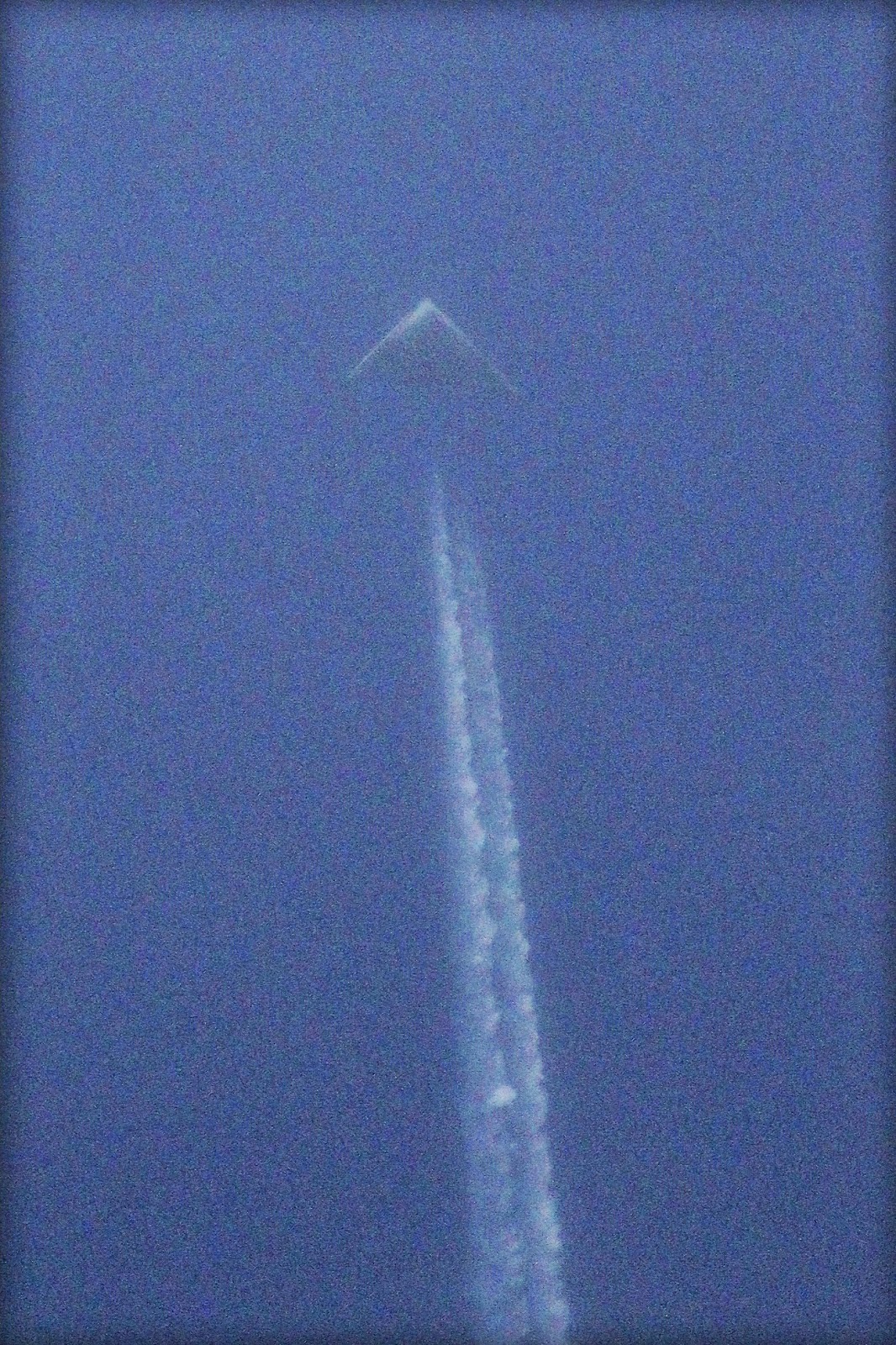
Bill Sweetman, the ace aviation journalist at Aviation Week, reports that a large, manned, and heretofore unknown aircraft was spotted over Texas on March 10. It looked something like this:

The blurriness is not one of its stealth features.

You can read his analysis, but basically it looks different than a B-2, too big to be one of any known drone type, and fills an obvious gap in the U.S. arsenal.

Remarkably, the same guy who first posted the picture above, a well-regarded planespotter and blogger, did some interesting reporting on a bizarre weather event in New Mexico. Here's the nut graf, as we say in the industry:
Early in the evening on March 18th - something strange happened in New Mexico.

A mysterious jet of disturbed air erupted up into the atmosphere near the remote town of Carrizozo, New Mexico.  In minutes this jet of air morphed into a plume, so large it was seen by weather radars across two states and was automatically classified by weather computers as a storm.

But it wasn't a storm and in fact the radar return baffled meteorologists in both New Mexico & Texas because no precipitation had been forecast in the foreseeable future and at the time  the atmosphere was drier than baby powder due to a prolonged period of severe drought that had plagued the region all winter.
Aha, a mystery! I'll leave it to you to read his writeup of how he reported it out, but here is his conclusion:

The USAF has a Directed Energy Laboratory located on North Oscura Peak!  It is managed and headquartered at Kirtland Air Force Base, 140 miles to the north in Albuquerque.
--snip--

Although North Oscura Peak is known more for being a laser weapons laboratory it's quite possible much more exotic weapons are being tested there, running the gamut from microwave, particle beam and plasma weapons all capable of disrupting the atmosphere. They also agreed that SDI had not gone away but had gone black and billions had been pumped into developing exotic weaponry since the mid 1980s.

In May of 2003, an article in the New York Times reported that the facility is part of wide ranging efforts in developing weapons designed to destroy enemy satellites or incoming ICBMs. 

"The Air Force has pursued the secret research for several years but discussed it in new detail in its February budget request. The documents stated that for the 2007 fiscal year, starting in October, the research will seek to "demonstrate fully compensated laser propagation to low earth orbit satellites."

Seven years later, it's probably safe to say they’ve made some technical breakthroughs.
So within a couple of weeks, a ground-based directed-energy weapon--in nerd-speak, that means "science-fiction zap gun"--may have disabled a satellite target in a very conspicuous test, and a classified aircraft may have been spotted in daylight, at contrail altitude, over a populated area.

The explanations linked here could be wrong. The timing could be coincidence. And they could just represent serious, if accidental, lapses in secrecy.

Or it could be a shadowy show of strength.

Sunday, December 15, 2013

Beijing, the Jade Rabbit has landed


It's been a while since Earthlings have sent something to the Moon that hasn't had a hard landing. But over the weekend, China's Yutu rover (Yutu meaning "Jade Rabbit" in Mandarin) set down in the Bay of Rainbows, and did so without making a crater. Here's a CCTV video of it rolling onto the moonscape:


This is, to paraphrase Neil Armstrong, a fairly significant step for the Chinese space program. It takes a lot of technical know-how and organization to pull something like this off. You need a reliable booster--something that China hasn't always had--to go with all the components on top, which need to work nearly perfectly in a harsh environment. And that's not even counting all the calculations needed to get the thing to hit the Moon from the Earth, both of which are moving in relation to each other and to the Sun. (The more cynical, and I mean possessing weapons-grade cynicism, might suggest a Chinese remake of "Capricorn One.")

It appears that the Yutu can do some legitimate science; among other things, it carries ground-penetrating radar that could offer useful insights into the moon's composition. And that's something that everyone should be happy about.

But there are also some concerns about the end game for China. For one thing, the official announcement said "We finally have the right to share the resources on the moon with developed countries." Which isn't exactly starting a war, but it's not coming in peace for all mankind either. For another, the space program closely is intertwined with the military--something that is true in many countries, but especially so in China.

I don't think China has nefarious plans for the Moon, or, at this point, the ability to pull them off. It just sent its first astronaut into space in 2003. But this achievement clearly shows that the China's technical abilities are making strides even as--and perhaps because--space is more accessible now than at any point in history.

How it all shakes out remains to be seen. But perhaps if nothing else it will remind the world that space exploration is, and should be, inspiring.

Monday, September 30, 2013

Not-so-blurred vision

The other day I saw an interesting science- (and business-) related post about how Mercedes is equipping its latest models with something like active suspension: the car senses the road immediately ahead of it and adjusts accordingly. That's interesting in itself, but the story noted that Mercedes' ad campaign centered on how this was modeled on the way a chicken's vision works. The idea is that instead of simply "interpreting out" the chicken's movement from what it sees, the brain instead tells the bird's neck muscles to keep the head completely stationary.


This all came back to me this morning as I was dodging other pedestrians in the North Point train station. Despite my shucking, jiving and waiting for people to cram onto an escalator, my vision was clear. But my head was definitely moving. Our brains are big and complicated enough to not only do important things like invent sliced bread, but filter out our body's movements. That's one reason why you can play sports (and do other active things) without becoming horribly disoriented. Compare that to video shot from a head mounted camera, which obviously does not have the benefit of cranial editing. It can be vertiginous:


So in theory, if you put a chicken in a downhill bike race, the resulting footage would be much smoother. Also, you would have taught a chicken to ride a bike, which is a much bigger achievement, I'd say.

Anyway. Really not much more than a random though about how everyday activities are much more complicated than we give them credit for. And it's impressive that we can think about these things while walking, running, or even bobbing our heads to music.

Monday, May 20, 2013

Calling the ball

A follow-up to my paean to our future automated overbeings: the X-47B has now almost landed on an aircraft carrier without a human pilot:


What you just saw was two simulated wave-offs--when an aircraft setting up for a landing is told to break off the approach and go around for another try--and then two "touch-and-go" landings. Those simulate what is called a "bolter," when an aircraft landing on a carrier misses all of the cables designed to catch its tailhook and bring it to a safe stop.

Yes, it's a beautiful day for flying and calm seas, but note that the X-47 nails the centerline. After watching this, an actual landing seems like just a baby step for robotkind.

Tuesday, May 14, 2013

I, for one, welcome our new robot overlords

Quick aviation dork post. The X-47B, the world's first stealthy, carrier-borne, semi-autonomous drone will make its first catapult launch at sea today. The cat shot is a big deal, and also a first. To date, the only seaborne drones are small and don't operate from aircraft carriers like, say, an F-18.

The key difference between the types is, of course, the pilot. And that's why it's such an impressive milestone. The X-47's processor and software fly it off the catapult and, more important, land it on the carrier... a feat that is arguably the hardest in aviation.


See what I mean?

An airliner's autoland system is proven technology, but there are a lot fewer variables. For example, the runway is bigger... and it's not moving in three dimensions. To date, landing on a carrier deck is something only a highly trained pilot could pull off; instinct plays almost as big a role as processing all the information from instruments and eyes and translating it into control inputs.

And yet. Look at this:


And this:


Granted, these are occurring on dry, unmoving land. But what you see there is a plane launching from a catapult and landing using an arresting wire in a space the size of a carrier deck without a pilot at the controls... onboard or on the ground.

if Northrup-Grumman and the Navy pull this off at sea on Tuesday, it represents a huge leap forward. Or, depending on how you look at it, another step on the way to Skynet.

Wednesday, April 24, 2013

The future (of the past) is now!


Space dorks like me often have a childhood filled with science fiction books. I pawed through a lot of pulp as a kid, including the stuff kids are supposed to read, like Tom Swift; the stuff kids of a different generation were supposed to read, like The Secret of the Marauder Satellite (dunno why that one stuck in my head, but hey, it did); and stuff that blew my mind, like Fahrenheit 451.

Almost everything I read was written before 1980. A lot of the "classic" stuff was from the '50s and '60s. And space travel, in that era, had a common mechanical element: rockets took off and landed tail first (check out what happens about 1:38 or so).


Of course, all that changed in the late '70s, when the Space Shuttle did its now-famous "take off like a rocket, land like an airplane" trick:


And basically from then on, you had spaceships that were either never meant to land at all, and thus could look more or less like a flying radiator…

In space, no one can hear you complain about aerodynamics.

… or like an aircraft of various permutations. Taking off vertically seemed optional, and landing vertically seemed, well, anachronistic.

Well, here we are in the 21st Century. The Space Shuttle is retired, we're hitting "interplanetary holes in one" with Mars rovers and private launch companies are perfecting new vehicles for getting stuff, and people, into Earth orbit and beyond. And what do we see as the latest round of innovation?

Why, a rocket landing tail-first, of course.


And so it was that the tales (and tails, ha, little space dork humor there) of my childhood have become reality. Not just because it looks neat, either: when landing on a planet with a thin atmosphere--like Mars--parachutes and wings become dramatically less effective ways of slowing an object down to non-splat impact speeds. And as computers, robotics and other technology have matured, we have gotten to the point where this can be routinely pulled off.

That's exciting. I just hope the arrival of science fiction past doesn't also include tentacled monsters and mind-control rays.

Monday, February 18, 2013

A quick refresher on the problems with playing God

So by now, we've all read about the meteor that exploded over Russia last week, right? It has been covered extensively, so I won't waste too much time rehashing it. Suffice to say it was an impressive look at what nature can do with a little gravity, velocity, friction and deceleration.

For a few seconds, the meteor--called a "bolide" when it turns into this sort of fireball--shined brighter than the rising sun...


... and its explosion, caused by the intense, uneven heating of its surfaces as it streaked through the atmosphere at about 11 miles per second, released energy equivalent to the detonation of 500,000 tons of TNT. Because the explosion happened several miles above the ground, the blast effects weren't devastating... but were still dramatic:


For comparison's sake, 500 kilotons is roughly 25 times the yield of "Fat Man," the nuclear weapon dropped on Hiroshima, Japan. And it was caused, basically, by a fast-moving rock.

Which brings us to playing God. I thought I had written about this before, but a quick search of The Blog tells me I apparently haven't: the United States has for decades kicked around ideas for a space-based kinetic-energy weapon called Project Thor--and nicknamed "Rods from God." The gist is that orbiting satellites would be armed with long, pointy, semi-guided rods made of super-dense tungsten, roughly the size of telephone poles. Give them a push in the right direction, and these heavy things deorbit and hit something on the ground.

Because it is deorbiting, it literally has to slow down, which means it will only impact at Mach 10--almost six times slower than the Chelyabinsk bolide. The energy released would be the equivalent of a mere 12 or so tons of TNT.

It's easy to see why people might be terrified of a random space rock blowing up over their heads--you can't stop it, and you can't see it coming. And it's exactly why putting weapons in space is not a good idea. It's bad enough that a bad roll of the cosmic dice could wipe out a city. But giving ourselves that power does nothing but increase the odds of unstoppable death falling from the sky.