Showing posts with label Pascha. Show all posts

Tuesday, May 14, 2013

We rejoice with the dead and scatter eggshells.


Grave with exuberant rockrose
Today is Radonitsa or The Day of Rejoicing, Tuesday of Thomas Week in the Russian tradition, though some Orthodox churches visit graves on Thomas Sunday. My parish doesn't have a churchyard (yet) so we don't have a gathering in the church with traditional foods, as is the Old-world custom. But several of us joined nuns from the nearby skete at a cemetery not far away and sang a service of remembrance, alternating with joyful Easter hymns. It was a warm day on a dry hill; the sun was toasting the weeds underfoot and making them smell like cookies in the oven.

The Resurrection icon at top shows several elements that signify the ramifications of Christ's rising from the dead, and every version shows in the center Christ pulling Adam and Eve from their tombs, from Hades. David and Solomon and Abel and John the Baptist and others are featured - we all are raised with Christ, as the church books explain:
Having previously celebrated the radiant feast of Christ's glorious Resurrection, the faithful commemorate the dead today with the pious intent to share the great joy of this Pascha feast with those who have departed this life in the hope of their own resurrection.
This is the same blessed joy with which the dead heard our Lord announce His victory over death when He descended into Hades, thus leading forth by the hand the righteous souls of the Old Covenant into Paradise. This is the same unhoped-for joy the Holy Myrrhbearing Women experienced when discovering the empty tomb and the undisturbed grave clothes. In addition, this is the same bright joy the Holy Apostles encountered in the Upper Room where Christ appeared though the doors were closed. In short, this feast is a kindred joy, to celebrate the luminous Resurrection with our Orthodox forefathers who have fallen asleep.


My own parish comes out of a Russian tradition (though we are presently mostly Americans without Russian ancestry, and part of The Orthodox Church in America.) So we keep this day, which even St. John Chrysostom mentions in the 4th century. After the short service we all walked around scattering eggshells on graves and calling those who have fallen asleep, "Christ is risen!"

Monday, May 13, 2013

Hans Christian Andersen on Greek Easter

Hans Christian Andersen's travel memoirs from the 1840's, when he witnessed both Roman and Greek Easter festivities. He did love the Greek way:

Day and night the church was filled with people. The King, the Queen, and the whole court were there on the midnight before Easter Day: the priests stood praying and mourning around the flower-filled coffin; the whole congregation prayed in silence. The clock struck twelve, and at the same moment the Bishop stepped forth, and said: "Christ is risen!"
"Christ is risen!" burst from every tongue. Kettle-drums and trumpets sent forth their strains; the music played the liveliest dances! The whole people fell on each other’s necks, kissed, and joyously cried, "Christ is risen !" Shot after shot was heard outside; rockets darted into the air, torches were lighted, men and young lads, each with a candle in his hand, danced in a long row through the city. The women kindled fires, slaughtered lambs, and roasted them in the streets. Little children, who had all got new fez and new red shoes, danced in their shirts around the fires, kissed each other, and exclaimed like their parents, “Christ is risen!” O, I could have pressed each of these children to my heart and exulted with them. "Christ is risen!” It was touching, elevating, and beautiful. 

Read the whole thing here.

(In California, as the clock struck twelve.)

Friday, May 10, 2013

little goats now in the spring

The hymns of Pascha and Bright Monday are playing themselves in my mind every day, all day long, like heavenly prayers. Christ is risen indeed! And my house is filled with honeysuckle scent, as a consequence of a long gardening party I've been having with myself.

I've been on my hands and knees in the dirt quite a bit this week. Above you can see one perennial bed I've been thinning and re-planting. Eleven tomato plants have been tucked into various places all over the yard, and in order to make a sunny home for one of them it was necessary to severely prune the honeysuckle vine that was starting to bloom profusely. Beforehand, as I walked past it several times, the sweetness almost made me woozy, and reminded me of the lilies in church on Holy Friday, as at a funeral.

I couldn't bear to throw all the prunings into the yard waste bin, so I cut carefully and put the trimmings in three vases to enjoy indoors. There were still so many left, I filled another jarful to give to a neighbor, but it's still here, too. Even though the petals are drying and starting to fall on the table, all of this flowery flavor is still permeating my days.

A wonderful story was passed on to us on the blog Mystagogy, of the Athonite monk Elder Porphyrios (1906-1991) who on a Bright Tuesday visited his cardiologist, overflowing with Easter brightness and quoting a hymn:

What happiness is in the Resurrection! "And leaping for joy, we celebrate the Cause." Have you ever seen the little goats now in the spring who jump on the grass? They eat a little from their mother and begin to jump again? This is what it means to leap - to jump. This is how we should also jump for unspeakable joy at the Resurrection of our Lord and our own.
It is a sweet and not long anecdote you can read here.

There is this lightness and heavenly singing, but pressing in on all sides, sorrow and pain. In the lives of extended family, and friends near and far, things happen even in Bright Week that reek of death. A husband commits suicide, a child dies suddenly and mysteriously, a sweet woman becomes incapacitated with irrational fears....

How to make sense of it all? How to carry the joy along with the burdens of the people you love? It probably requires a measure of the Holy Spirit I haven't acquired in order to do a good job of it. My joy is often a shallow emotionality, and certainly my burden-bearing is hampered by laziness and the distraction of my own burdens that I needlessly carry.

Or is it needlessly? It was only a short time ago I was ruminating on the yoke of Christ -- and He did say His burden is light. He was exhorting us to take up His yoke. I want to "be there" for people who are hurting, and often the only thing to do, and it's not minor, is to bring them to God's throne in my heart and prayers. If I will just stay there I should be able to hold on to this sweetness and Light as well. 

Christ is risen!


Monday, May 6, 2013

It's a joyful day, whatever day it is.

Pascha goes on and on! So we have Paschal Bright Week services, Monday, Tuesday, Wednesday....

Christ rose on the first day of the week, Sunday. The Church has always considered this to be be the eighth day as well, the beginning of a new order of things. I don't really understand this. But our bishop mentioned it this morning, Bright Monday, when he talked about the grace that extends throughout the week hinting at the newness of life given us in Christ's Resurrection.

We all are feeling the newness. Today we lived in the joy of Christ's presence and celebrated it in many ways, including a loaf of bread. This year it was baked by a young girl with the help of a more experienced baker. It must weigh over five pounds -- I know, because I was honored to carry it in the procession around the church, and then standing on the porch as the gospel for the day was read.

This bread is called the Artos and "symbolizes the physical presence of the resurrected Christ among the disciples." It will remain in the church all week and be carried in procession after Divine Liturgy those days; on Saturday it will be cut into pieces and distributed to the parishioners.

Below is a photo I found online of a Bright Week procession elsewhere.  It seems it might be the only photo available -- maybe everyone wants to actively participate in these blessed processions and not stand apart to be a photographer.


On Pascha night I remembered that I have a piece of last year's Artos in my refrigerator. I'm sure I was saving it for a time when I was ill or afflicted, and I must never have thought that I was terribly bad off at any time during the year. Praise God for that. So I'll have to eat it for joy this week and put a new portion in reserve for any upcoming needs. Having been exposed to the air for a whole week it becomes dry and keeps very well!

The day of our Lord's Resurrection is another case, it seems, of how we live in the present life and at the same time we live in the reality and anticipation of God's coming Kingdom. St. Gregory Palamas wrote in a sermon "On the Sabbath & The Lord's Day":
Whatever is said in praise of the 7th day applies even more to the 8th, for the latter fulfills the former. It was Moses who unwittingly ascribed honor to the 8th day, the Lord's Day. The Jubilee year (Leviticus 25:8ff), which Moses regarded as a year of forgiveness and named accordingly, was not counted among the 'weeks of years' under the law , but came after them all, and was an eighth year proclaimed after the last of these 7 year periods. Moses did the same with regards to periods of 7 weeks.
However, the lawgiver did not only introduce in this hidden way the dignity of the 8th day, which we call the Lord's Day because it is dedicated to the Lord's resurrection, but also on the feast called "Trumpets" referred to the 8th day as 'the final solemn assembly' (cf. Lev.23:36 LXX, Numbers 29:35) meaning the completion and fulfillment of all the feasts. At that point he clearly said that the 8th day would be holy for us, proclaiming in advance how divine, glorious, & august Sunday was to be after everything pertaining to the law had passed away.
But I see that Metropolitan Anthony in a passage I quoted just last week tells us that we are living this present life in the Seventh Day:
...the seventh day will be seen as all the span of time that extends from the last act of creation on the part of God to the last day, the eighth day, the coming of the Lord, when all things will be fulfilled, all things will come to an end, reach their goal, and blossom out in glory. It is within this seventh day, which is the whole span of history, that the creativeness of man is to find its scope and its place.
In this whole span of history we have much work to do, including our bread-baking and flower-arranging to celebrate Christ's rising from the dead. St. Isaac of Syria tells a bit about how the fullness of our Eighth Day is yet to come, and seems to see things somewhat differently from Met. Anthony:
The Lord's Day is a mystery of the knowledge of the truth that is not received by flesh and blood, and it transcends speculations. In this age there is no eighth day, nor is there a true Sabbath. For he who said that `God rested on the seventh day,' signified the rest [of our nature] from the course of this life, since the grave is also of a bodily nature and belongs to this world. Six days are accomplished in the husbandry of life by means of keeping the commandments; the seventh is spent entirely in the grave; and the eighth is the departure from it.
It certainly is a mystery to my small mind, but I am always comforted by these realities of the faith that show how great is our God, and His plans for us, so high as the heavens are above the earth, that they are hard to grasp with our minds. And I'm full of that joy that is not received by flesh and blood, of the glorious risen Savior Christ. He is here every day.


Saturday, May 4, 2013

Tonight's the night!


The victory is in each of us, the victory is in all those of us who believe that death cannot separate us from God....However frightening and dark the world is nowadays, we know that victory has already been won, that God has won and that we who believe in him partake together with him in his victory. And therefore, let us bring, to all around us, this message of life and glory!

-- Metropolitan Anthony Bloom


Friday, April 26, 2013

Lazarus


Tonight was the service of Matins for Lazarus Saturday. It made me so happy. About a week before Pascha we experience this foretaste of Paschal joy, witnessing the raising of Lazarus after he had lain in the tomb for four days. But first, picture the scene when Jesus came into town: Lazarus's sisters were grieving and seemed to blame Jesus for their brother's death, saying, "If you had been here, he wouldn't have died." Jesus wept. The sisters made mention of the fact that their brother's corpse was at the point of stinking. It was kind of a downer all around.

I know Lent is a time of drawing close to God, and learning of His tender love for us, and looking eagerly toward The Resurrection. But it's also characterized as a time of bright sadness. This year I have felt the sadness part more than the bright part, as a burden-bearing, until these last few days.

Since December I'd had bright white lights still up around my kitchen window, and for many weeks I left them on night and day, to help my mood. Sometime in March I unplugged the string, but I was still reluctant to untape and untack them. I pondered leaving them all year, unlit but ready to come to my aid with the next dreary day in the Fall, but it was an idea stemming wholly from weariness.

Suddenly one morning during a short spell of sunshine, I knew I needed to wash the window and the sill, so of course the lights could not stay there. I washed and swept and scrubbed all kinds of things around the house and the yard for two or three days, and prepared myself to be resurrected. I took away the candlesticks and put fresh flowers instead on the windowsill.

And the brightness has taken over. Pascha is so late this year, Spring also in many places, but Lent seems to have passed quickly. Perhaps during Holy Week I can finish my housecleaning and make the place look properly freshened up for Christ's glorious Resurrection.

But first Lazarus will walk -- alive! -- out of the tomb and be unbound. If he can be raised after his body was rotting, so can I be relieved of my burdens and my stinking sins and put on Christ.  As he said,
Come unto Me, all ye that labour and are heavy laden, and I will give you rest. Take My yoke upon you, and learn of Me; for I am meek and lowly in heart: and ye shall find rest unto your souls. For My yoke is easy, and My burden is light.
I will try to pay attention and learn and find that rest through the next week as we are on our way to Calvary, and I'm really looking forward to being there at the empty tomb!


Saturday, January 5, 2013

I'm jumping in with joy.


The Outdoor Water Blessing for Theophany at Little Lehigh Creek in Emmaus
At Little Lehigh Creek in Emmaus PA


It's the Feast of Theophany! How can I not post something on this day when there is blessing abounding to the degree that people want to jump into icy waters over it? I am caught between the impulse to spread the riches around, and the awareness of the extreme limitations of my mind when the meaning of Christ's baptism is set before me. There is a lot to take in and try to absorb at Theophany, regarding the Baptism of Our Lord.

Orthodox Christians celebrate Theophany in various ways around the world. Some release doves as a symbol of the Holy Spirit while others toss crosses into water in remembrance of Christ’s baptism. Young boys or men often dive into the water to retrieve the cross. I know what I'll do -- I'll post a link to Father Stephen Freeman's recent blog on the subject. An excerpt:
St. John himself does not seem to understand the purpose of Christ’s Baptism. He is told that “whomever you see the Holy Spirit rest upon and remain” is the Messiah – but he is given little information beyond that. Witnessing Christ’s Baptism and the Spirit resting upon Him, he hears the voice, “This is my beloved Son in whom I am well pleased” (Matthew, Mark and Luke all bear witness to the voice).  The Church later celebrates this manifestation of the Trinity (Christ in the water, the Spirit descending, the Voice of the Father – hence the title “Theophany”).
But with the text alone, on its literal level, we are left with a mystery, without context or meaning. The Tradition of the Church, however, sees the Baptism of Christ in the context of Pascha (Easter) as it sees everything in the context of Christ’s Pascha. Christ’s Baptism is a foreshadowing (and on more than a literary level) of His crucifixion and descent into Hades (just as our own Baptism is seen by St. Paul as a Baptism into Christ’s “death and resurrection”).
When he goes on to explain that in the workings of God in the world, the literal is not all there is, he quotes Fr. Andrew Louth:
Allegory is a way of entering the 'margin of silence' that surrounds the articulate message of the Scriptures, it is a way of glimpsing the living depths of tradition from the perspective of the letter of the Scriptures.
There is so much to think about, even if you aren't part of the Orthodox Tradition in which we will be participating on the praxis level by blessing urns of water, creeks and lakes and oceans of water. In parishes everywhere priests will be blessing houses as my rector described in our newsletter, so as to bring "the joy of the feast of the manifestation of the Holy Trinity to each and every dwelling. Think of the house blessing as a renewal of God's grace in your home."

How could we not be welcoming of that? I won't be jumping into any frozen streams, I hope ever, but I will certainly have the joy of the feast.

O Christ our God,
 Who hast revealed Thyself,
And enlightened the world,
Glory to Thee.


Friday, April 27, 2012

April Has Nearly Blown Through


April is almost past, but we are still in the Paschal season, thank God, and I say, CHRIST is RISEN! Indeed He is risen!

Since Pascha I have been able to spend time debriefing myself on our trip to Maui that was completed a month ago today, and I'm ready to start sharing with the world some of the highlights of that exalted holiday excursion. The posts will be labeled with "Maui Diary," so that anyone not interested the topic can know to pass on by and wait a couple of weeks for something different.

Yes, I'm afraid I do have about two weeks' worth of posts on this one trip!

So...here we go....

Wednesday, April 25, 2012

You can leave Hell now.


What does The Resurrection mean? So much, so much.

 ...you must know what Jesus Christ, the Saviour, has delivered you from. He has delivered you from a Hell whose Reception Room is on this world right now, in this time and generation, and its atmosphere is stinking up the place. Sin is nothing more that getting addicted to Hell and staying in its environment … and when it comes time to pass on, the sin-addicted soul is so used to the darkness that it doesn’t want to leave.
....
“I have thrown open your prison doors.
“Do not remain in this present darkness. Come out into the Light. Come with Me into the Springtime of your soul. Come back into the Eden where you belong.
“Wake up to My light and grace. Breathe the air of true liberty.
“This is the Day I, the Lord, have made for you. Rejoice and be glad in it.”

Read the rest of this short sermon here.
(Thanks to Anastasia)


Monday, April 16, 2012

Best Monday of the Year

Bright Monday
Christ is risen!
He is risen indeed!

Wednesday, April 11, 2012

Coming into glory for Pascha


Yes, there are still lots of flowers in my life. I'm trying to get the house -- at least the downstairs -- clean in time for Pascha so that I can bring in some flowers and have the whole thing look good and festive together.

It's been raining, and that makes the plants look refreshed and happy. This is the first time the gaudy bearded irises have bloomed. I mostly like them for their color; otherwise they are a bit messy looking for me.


The tulips are still blooming. Every night they close up, and in the daytime they open up more and more. But none of the petals have fallen off yet.


In the Dutch iris bed, these pale yellow-and-lavender flowers dominate the view for a few weeks, and later on when they are spent the cobalt variety open up.


Centranthus ruber
Our friend Art has a nursery in his back yard, and a few months ago he gave me this Centranthus ruber plant that he had propagated. It took forever to recover from being transferred into the pot in which it still lives, but now it is blooming, and coming into its common name of Red Valerian.


It appears that the kale, and arugula in the background, are making their bid for Tallest Blossoms in the Garden. About the time we turn the calendar page to May they'll be out of there and tomato plants will be in their place, so I'm letting them have their days in the sun - and rain.

Forget-me-Nots, calla lilies, cyclamen and daffodils -- I'm so happy to see them, I'm not worried at all about the hours and days of garden work that will need to be done once the rain stops. A lone and miniature red salvia bloom also greeted me this afternoon, and I can't recall even noticing what were surely profuse weeds behind it.

In only a few days the ground may dry up enough for me to dig around, and the joy of the feast will strengthen me to do it -- in every way we'll be in Bright Week!

Friday, March 30, 2012

Pre-feasts Here and There


We Glads just returned from tropical isles where the flowers were a feast for the senses, and an earthly foretaste of the beauty and glory of Pascha soon to be upon us. But when we arrived home the tulips I planted last fall were also out to welcome me, and lend some comfort to the travel-weary.

I hope to send along my Maui Diary blog after our Orthodox Easter, which is a week later than Western Easter this year. Too many blessed preparations to be making until then....

I promise that the following is not unrelated to everything else in this post: Were any of my readers sad and aggravated (as I was) when Longs drugstores were bought and replaced by CVS? To one or two people who write to me on that topic, at the e-mail address on my Blogger profile, I have a useful and whimsical thing I would like to give, if you include your mailing address. I'll tell you what it is before I send it, so there is no risk involved -- only fun. :-)

Those of you who are preparing for the celebration of the Resurrection of our Lord and Savior Jesus Christ, my heart and prayers are with you.

Tuesday, June 7, 2011

Ascensiontide Showers of Blessing

This short season between Ascension and Pentecost -- it just seems natural to call it Ascensiontide, even though, until we get to Pentecost, we are still in Eastertide. These ten days are a subset, maybe. All this is The World According to GJ, and probably not kosher -- oops, I'm getting more faith traditions mixed up in there.

That I am confused is not surprising, considering how wild and unusual my last two weeks have been, with a heavy amount of visiting with several friends and great busyness leading to brain fatigue. Thank God He gave me the strength to enjoy all the extra love and liveliness in the house. So much has been going on, I wanted to give a brief report of highlights.

plants still waiting to go into the ground....


Rain. It kept us from going on the walks I had anticipated, and also relieved everyone of irrigation duties.


blue lake pole beans


Very odd to get so much rain here in California the first week of June. Most plants don't mind it, but the basil looks nigh unto death, waiting for summer. Here are the happy beans instead.
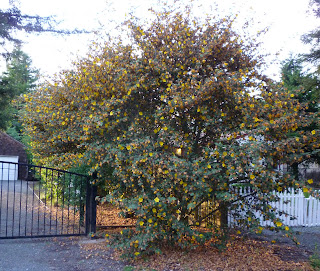
mystery bush


Hard as it is to believe, it appears that the rain has finally ceased. No one dared complain about last week's lack of blue skies, here where an excess of water can can only be counted a blessing, and where tornadoes are rare.

My friend May and I drove over the mountain several times to see our elderly friend Jerry.
close-up of bush


Hail battered my car on one of our trips to his house, but on the way home later on we saw a bush we didn't recognize by the side of the road and stopped to get its picture. Can anyone identify it right off?


Jerry's walnut tree and vineyard
Jerry and his late wife lived all over the world before settling in wine country to try their hand at being vintners, and they brought seeds and plants from many countries to plant here. It's sad, though, to see the garden in disarray, lacking the care of Mrs. Jerry.

Some flowers and trees keep going in spite of neglect, like these orchids, which grow outdoors through the winter.


toasted sesame seeds
I had fun cooking for extra people. We ate Lemon Pudding Cake with Raspberry Sauce, and some Sticky Rice with Mango. Also fresh oatmeal bread, and Duk Guk, a soup whose name does not make you think nice things, but Guk is the word for the odd Korean rice cake ingredient that I like a lot -- so much that I probably should not keep it in the house.

I toasted sesame seeds to make Lemon Sesame Dressing for the piles of green salad everyone consumed. Maybe after Pentecost I can post some recipes.
through the monastery gate

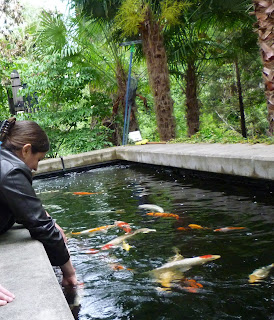
koi pond at monastery
In the evening of the Sunday between Ascension and Pentecost, I went to the Holy Assumption Monastery for a Family and Friends event.

First there was a lecture on "The Power of Bones," referring to all the Bible references to the health that can be in our bones, and to the proper and reverential treatment of human bones. It was a prompting for us to consider in light of Holy Tradition our often irreverent modern funeral practices; I'm sure that in the future I'll have more to say on this general topic that pertains to all of us.

Not long ago Gumbo Lily posted a blog about where her blog name comes from -- it's actually the name of a flower that grows on the prairie. For her I am putting up this picture of the cousin to her gumbo lily, our Mexican Evening Primrose that grows happily in a rocky spot between our driveway and the neighbor's. It gets by in the dry summer with only a couple of waterings, but it didn't mind the good Spring soaking.

Mexican Evening Primrose

I can't tell about Ascensiontide without mention of the rejoicing to my spirit from having the festal hymns playing in my mind ever since last Thursday. In our daily prayers we have left off beginning with, "Christ is risen from the dead, trampling down death by death...," and we aren't yet returning to, "O Heavenly King, the Comforter, the Spirit of Truth...," because we are still looking forward, liturgically, to the descent of the Holy Spirit.

So we are singing, during these ten days, about the event described in this way: "And it came to pass, while He blessed them, he was parted from them and carried up into heaven. And they worshiped him, and returned to Jerusalem with great joy." (Matthew 17) The troparion hymn goes like this (now imagine me waking to it and falling asleep in the same joy!):


Thou hast ascended in glory, O Christ our God,
Having gladdened Thy disciples 
with the promise of the Holy Spirit;
And they were assured by the blessing
That Thou art the Son of God,
the Redeemer of the world!

Saturday, May 28, 2011

Flowing from Easter - The Church Year

I'm preparing for the expected blessing of having three dear and longtime friends as houseguests at different times over the next two weeks. While my home is full of busyness and women's talk, in The Orthodox Church we'll be commemorating some of those events of the church year that are becoming more lovely to me with every cycle of the church calendar. And because I doubt I'll even think of blogging while I am hostessing, I am looking ahead, blogging ahead.

In the years when I was first learning about Orthodoxy, I'm thankful I was able to participate quite a bit in various services throughout the seasons, so that I got a good foundation in how the intellectual knowing is the lesser part of a relationship with God. With every year that passes I see this more, and also feel my inability to convey in words this Reality that is Christ in His Church. Even the most eloquent and holy men and women would communicate by their entire persons, and relatively little by words, the Love that has been shed abroad in their hearts.

Still, their words are more eloquent than mine and express a deeper grasp of the realites by far, so I am depending on them to tell a little of how the day-to-day structure of the Church Year gives the grace of God. It all flows from the Resurrection. From the Orthodox Church in America site:

Although the first of September is considered the start of the Church year, according to the Orthodox Church calendar, the real liturgical center of the annual cycle of Orthodox worship is the feast of the Resurrection of Christ. All elements of Orthodox liturgical piety point to and flow from Easter, the celebration of the New Christian Passover. Even the "fixed feasts" of the Church such as Christmas and Epiphany which are celebrated according to a fixed date on the calendar take their liturgical form and inspiration from the Paschal feast.

Next week we have the Leavetaking of Pascha, which I love very much, because it always seems to me that I haven't been able to sing enough times those exultant hymns of "Christ is risen from the dead, trampling down death by death." Every year I become more familiar with some of the words and tunes, and try to learn a new one. "Why seek ye the living among the dead? Why mourn ye the incorrupt amid corruption?" On Leavetaking of Pascha we'll repeat the Easter service in its entirety - and then won't sing those hymns again until next year.

Even though we will still be in "the time of Easter" for another ten days, until Pentecost, we must say good-bye to the Feast of Feasts, so to speak, because we are coming up to the Ascension! Then we will update our greeting from "Christ is risen!" to "Christ is ascended!" the response to that being, "...from earth to heaven!"

In his book, The Year of Grace of the Lord, Fr. Lev Gillet tells at length the meaning of the Church Year. An excerpt from one paragraph, to which I have added breaks to make it more readable on the screen:

The liturgical year is, in fact, expressed as a calendar, but simply to identify it with a calendar would be totally inadequate. One could also say that the purpose of the liturgical year was to bring to the minds of believers the teachings of the Gospel and the main events of Christian history in a certain order. That is true, but this educational, pedagogical, function does not exhaust the significance of the liturgical year.

Perhaps we could say that its aim is to orient our prayer in a certain direction and also to provide it with an official channel which is objective, and even, in a certain way, artistic. This, too, is true, but the liturgy is more than a way of prayer, and it is more than a magnificent lyric poem.

The liturgy is a body of sacred "signs" which, in the thought and desire of the Church, have a present effect. Each liturgical feast renews and in some sense actualizes the event of which it is the symbol; it takes this event out of the past and makes it immediate; it offers us the appropriate grace, it becomes an "effectual sign," and we experience this efficacy to the extent that we bring to it a corresponding inclination of our soul.

But still, this does not say everything. The liturgical year is, for us, a special means of union with Christ. No doubt every Eucharist unites us intimately with Christ, for in it he is "both he who offers and who is offered," in the same way that every prayer, being the prayer of the members of the mystical body, shares in the prayer of him who is the head of the body and the only one whose prayer is perfect.

But, in the liturgical year, we are called to relive the whole life of Christ: from Christmas to Easter, from Easter to Pentecost, we are exhorted to unite ourselves to Christ in his birth and in his growth, to Christ suffering, to Christ dying, to Christ in triumph and to Christ inspiring his Church. The liturgical year forms Christ in us, from his birth to the full stature of the perfect man. According to a medieval Latin saying, the liturgical year is Christ himself, annus est Christus.

Friday, May 13, 2011

Thinking about work and smiles

If I am feeling scattered, might it help if I got one thing done, like writing one little blog post? I could just make it the Poem of the Week or the Quote of the Day or something like that.

Perhaps a quote about time, like this:

Time is always ahead of us, running down the beach. Barbara Crooker said that. It's an interesting way of looking at it, but not really the way I myself feel.

Today I seem to be leaning more toward Oscar Wilde's policy of I never put off till tomorrow what I can do the day after. 

Because I'm finding that Work expands to fill the time available for its completion, as anyone who has experienced Parkinson's Law knows. (Switching to the Work theme now...)

If, as Bertrand Russell says, One of the symptoms of an approaching nervous breakdown is the belief that one's work is terribly important, then I am showing no sign of a nervous breakdown. Thank God for that.

Nothing is particularly hard if you divide it into small jobs, said Henry Ford, and I know I DO believe that. Since my job description consists of about a thousand large and small tasks already, the small jobs I completed today must count for something. I made an important phone call, threw away lots of junk mail, figured out what to have for dinner and read some poems. Before that I walked two miles and thought a lot about some things I was reading while walking. I prayed a little, and did at least a hundred other little things. So how could I think I'm having a nonproductive day?

It's probably because my list of tasks, which has gotten longer and longer as it also got buried while I was traveling and living in the Bright Reality of Pascha - Christ is risen! by the way - is just too daunting, not having been divided into enough small tasks that in turn could be assigned to more days.

He that despiseth small things will perish little by little, said Emerson. So I resolve to appreciate these little accomplishments, not to mention the huge things God does, such as, today He gave me life and breath and the ability to get out of bed.

I was talking on the phone to a friend who is very ill; she told me that some days she can't walk very well. She also has trouble speaking. I was telling her about lying in the grass on the hilltop last week, and she started to cry out of compassion for people who don't get to see the kind of beauty I was describing.

That reminded me of the movie I watched last night, about Mother Teresa, and how she emphasized the importance of love, and smiling. When destitute, crippled and dying people look into the smiling faces of the Sisters of Charity, they see a beautiful thing indeed, and feel the love. With all the kitschy smiley face stuff going around for decades now, it wasn't until last night that I fully appreciated the power of a smile.

The smiles of the sisters in the movie were so obviously genuine, and flowing from the love of God, I couldn't help laughing and crying all through the movie. A smile is another small thing I could accomplish today. My dear husband will be home soon, and I think I will give him one.

So, it has indeed helped me to write this blog post. As Henry Ford also said, Before everything else, getting ready is the secret of success.

Tuesday, April 26, 2011

Fairy finery, honey and roses

Many people were already in the church when I arrived about 11:00 p.m. on Saturday night. On the carpet in the transept opposite the choir several blankets and children were laid out. I bought a fat candle to have ready for the procession, but it wasn't lit until an hour later, and in the meantime I was getting intoxicated by the honey-warm scent rising to my nose, feeling as though I was already breaking the fast with some rich dessert. It smelled richer than baklava.

Then the Easter lilies came into olfactory focus, blending with the beeswax. By this time my ears were full of the hymns reminding me of Christ's rising from the tomb, in a garden, in a real place on the earth, because He was really a man of flesh and blood as we are. When He rose He must have noticed whatever flowers were blooming in that garden.

Camellia in our church garden during Holy Week
Families were arriving, and while most males were dressed in their "ordinary" best Sunday clothes, the clergy wore white vestments, and many women and girls had put together very springy and bright, often all-white, outfits. A score of little girls had flouncy skirts that would have been fancy enough for a ball, or for acting the role of a fairy in a drama. I was so happy for their being able to commemorate their Lord's Resurrection by being their prettiest.

Even I had found a long and full eyelet skirt at a discount store, to wear with an odd assortment of other white things, and switched from black to flowered purse. There were lots of us, then, adding our white forms to the press of bodies, including the Eritreans who always wear beautiful white gauze. On this day more Eritrean men than usual wore their white gauze, too.

When the deacons and priests started around with censers, it was with the incense that is so heady I want to cry over it, knowing that "Jesus is fairer, Jesus is sweeter...." Is it made from roses? I must find out about this.

When we made our procession around the property -- it was a longer route than merely around the church building -- yes, there was some drizzle, but very fine, and not enough to put out anyone's candle. We were singing our new Paschal processional hymn, which the choir tried to teach the rest of us last week, but I know I didn't get it. Several of us noted as we were trailing along silently, too far behind in the train to hear the choir, that it had taken us ten years to learn the old Paschal hymn; it would have helped to have the choir members scattered along the line, interspersed with the rest of us and leading us.

But I think everyone was content. We were at Pascha! At one point we who were closer to the front of the long line could see across the lawn to a stream of worshipers at the end of the procession, and the view was stunning, their white garments reflecting the flickering candles they were holding up in the dark. There were hundreds of us! I didn't think it seemed that crowded in the building.

Soon we arrived again at the doors of the church, at which the priest knocked, and then, "He is not here! He is risen!" When we went inside we heard as always on this night the Paschal homily of St. John Chrysostom, which he gave about 1600 years ago and which has never sounded sweeter to my ears, full as it is of the love and grace of God. As we float through Bright Week and through the next 50 days, its glad tidings will remind us to keep greeting one another with "Christ is risen!"

This year our Father Michael, who is over 80 years old, read the homily. Somehow his voice never weakens, and retains the strength and authority of a strong spirit. Every time he serves or preaches I am so thankful for the grace that enables him to keep going, because he is so dear. His heart is such that the message of this sermon is of the sort that would flow from his own pen and lips.

At every repetition of the phrase, "Hell [or it] was embittered," Fr. Michael paused so that the congregation could answer with a shout: "It was embittered!" -- a sort of boisterous participation that we all seem to enjoy this one time in the year.

In a hearty baritone, this is what he proclaimed:

If anyone is devout and a lover of God, let him enjoy this beautiful and radiant festival.
If anyone is a grateful servant, let him, rejoicing, enter into the joy of his Lord.
If anyone has wearied himself in fasting, let him now receive recompense.
If anyone has labored from the first hour, let him today receive the just reward.
If anyone has come at the third hour, with thanksgiving let him feast.
If anyone has arrived at the sixth hour, let him have no misgivings; for he shall suffer no loss.
If anyone has delayed until the ninth hour, let him draw near without hesitation.
If anyone has arrived even at the eleventh hour, let him not fear on account of tardiness.
For the Master is gracious and receives the last even as the first; He gives rest to him that comes at the eleventh hour, just as to him who has labored from the first.
He has mercy upon the last and cares for the first; to the one He gives, and to the other He is gracious.
He both honors the work and praises the intention.
Enter all of you, therefore, into the joy of our Lord, and, whether first or last, receive your reward.
O rich and poor, one with another, dance for joy!
O you ascetics and you negligent, celebrate the day!
You that have fasted and you that have disregarded the fast, rejoice today!
The table is rich-laden: feast royally, all of you!
The calf is fatted: let no one go forth hungry!
Let all partake of the feast of faith. Let all receive the riches of goodness.
Let no one lament their poverty, for the universal kingdom has been revealed.
Let no one mourn their transgressions, for pardon has dawned from the grave.
Let no one fear death, for the Saviour's death has set us free.
He that was taken by death has annihilated it!
He descended into Hades and took Hades captive!
He embittered it when it tasted His flesh! And anticipating this, Isaiah exclaimed: "Hades was embittered when it encountered Thee in the lower regions".
It was embittered, for it was abolished!
It was embittered, for it was mocked!
It was embittered, for it was purged!
It was embittered, for it was despoiled!
It was embittered, for it was bound in chains!
It took a body and came upon God!
It took earth and encountered Ηeaven!
It took what it saw, but crumbled before what cannot be seen!
O death, where is thy sting?
O Hades, where is thy victory?
Christ is risen, and you are overthrown!
Christ is risen, and the demons are fallen!
Christ is risen, and the angels rejoice!
Christ is risen, and life reigns!
Christ is risen, and not one dead remains in a tomb!
For Christ, being raised from the dead, has become the first-fruits of them that have slept.
To Him be glory and might unto the ages of ages.
Amen.
As I finish this post, it is Bright Tuesday. I went to church, and the gospel for today was the story of Christ meeting some of His followers on the Road to Emmaus soon after His rising from the dead. The unfolding of the scene, and imagining the Lord walking alongside and hearing them telling about the recent events -- then their eyes being opened, His vanishing from their sight.... They said, "Didn't our hearts burn within us?" And I got chills.

The altar is open all during Bright Week.