Showing posts with label animals. Show all posts

Sunday, March 23, 2014

green and blue coastal views

As I mentioned in my last post, we took a short trip down to California's Central Coast - which we were amused to hear referred to as The North Coast, by those evidently oriented not to the whole state, but to Los Angeles...?

While anticipating the getaway, which was all my dear husband's idea, I started thinking about the edges of the oceans, and how they give us a certain perspective. If you sit or stand on the shore and look seaward, you have all those millions of people behind you, and before you a vastness of water and sky to soothe the eyes and mind, and to make you think. Why don't we all constantly gravitate to the coastlands so that we can be philosophers? It must be because we have so many worthy things we are called to DO.
 
Part of me wants to philosophize in this post, about a score of ideas and realities that are connected in a fascinating way. I could even write a short book for me to read about the ramblings of my mind over the last week, stimulated as it was by books and movies and history and theology that all seemed to relate to our trip.

But I will restrain myself, because I had my time sitting by the shore and now that I'm back inland I need to get on with other things. I won't want to take the time to read that book anyway, so I'll just make this a simple chronological report.


It was at Paso Robles on Hwy 101 that we cut over toward the coast, and the hills began to be greener, with even greener fields of newly-sprouted Something scattered here and there. The farms! Of course we have lots of farms in our county, too, but south of us they grow lots of different things and it does my heart good to see it. Thank you, Lord, for sending the rain to green-up the hills that will soon be golden -- and brown -- again.


Our hotel room in Cambria had a lovely view from the balcony, not just of the ocean, but also of the lush gardens on the property, with some of those favorite plants that I only see when away from home, like proteas and our beloved Pride of Madeira.
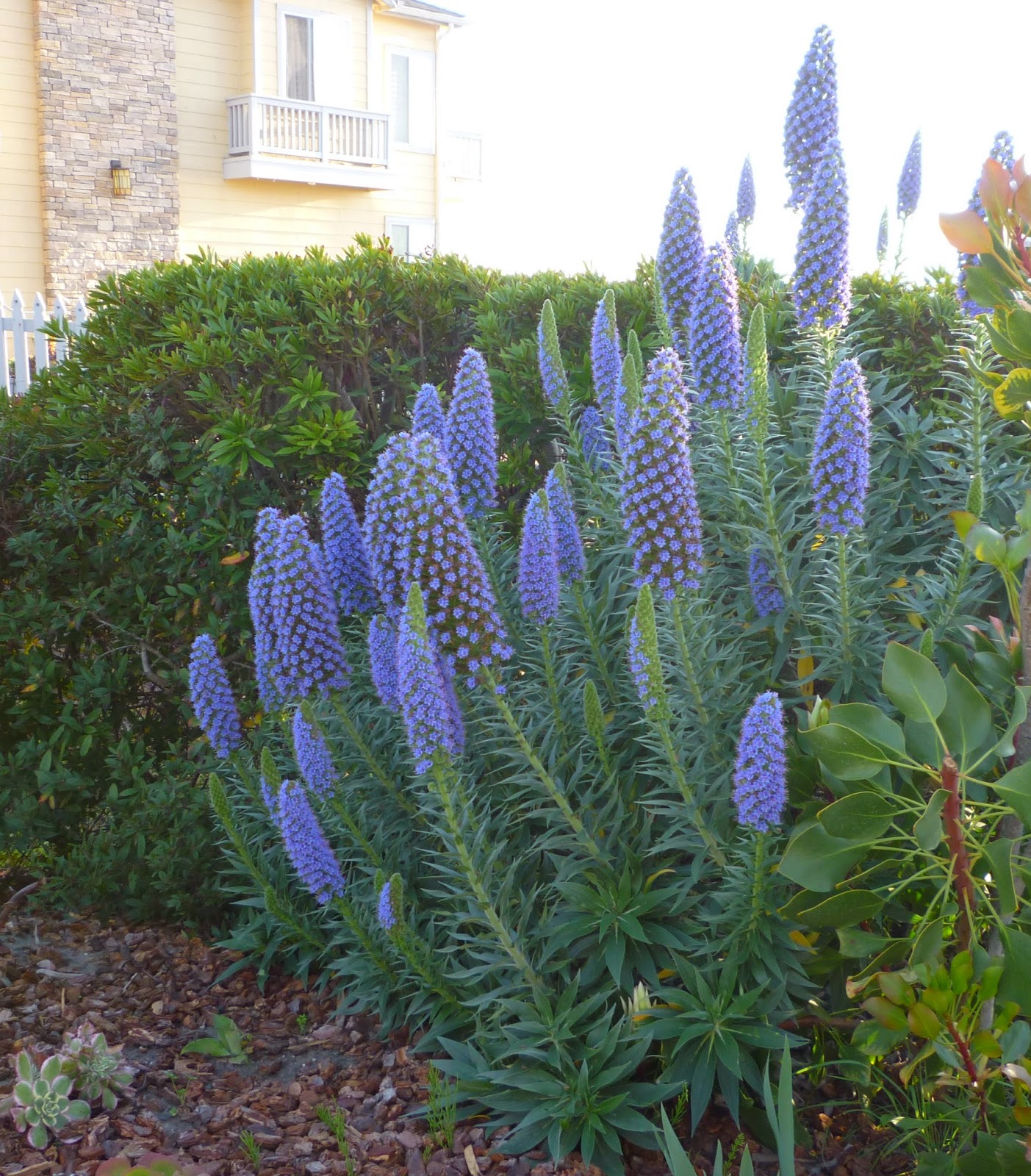
Pride of Madeira


The latter is one that we enjoyed many times on wedding anniversary trips we've taken, because it blooms in March. This time I told Mr. Glad that we might consider it "Our Flower."

a protea
town of Cambria from the boardwalk

As soon as we brought in our bags we set off on the boardwalk along the long strand of Moonstone Beach, which appears to have a population of thousands of ground squirrels living under it. They popped up on one side or another every few feet to say hello and beg demurely.

Many benches sit along the boardwalk, too, providing places for philosophers to gaze out at the great beyond. Some had extra, very personalized signs and plaques, screwed into them.


Down below we scrambled on the rocks and found crabs and snails and seaweed in the cracks and tidepools.

All the salt water stands in stark contrast to the drought that is especially bad on the California coast. At our very nice restaurant in Cambria they charged us for water with dinner! Just 30 cents for a bottle, but enough to draw attention to the problem and prevent the waste of all those glasses of water that diners might ignore.

When we left Cambria we drove south and stopped near the town of Harmony to try out the Harmony Headlands trail that cuts through a swath of farmland to link up with coastal bluffs. We could smell the sagey-beachy scent that let us know the ocean was just over the hill, but we never seemed to be reaching a place from which to get even a distant view of it, so we eventually gave up and turned back. On the way back to the car this snake slithered off the edge of the trail. When I followed him into the field he froze and posed.


Neither of us had ever been to the town of Cayucos, which was our next stop. We liked this place a lot, with its casual and less touristy flavor. It used to be a shipping hub in the late 1800's, and it's close enough to San Luis Opbispo and the college of "Cal Poly" that there were lots of students in town, and surfers to watch as we relaxed on the sand near the old pier.

Cayucos from the pier

At one end of the beach a woman drew in the sand with her foot, to draw attention to a seal pup that was lying like a lump near the shore. I did think it was a lumpy rock, until I saw her circle.

She was also standing guard against dogs who had been bothering the animal that she said was malnourished and waiting for the marine mammal rescue people to come. When a group of school children approached, the pup lifted its head long enough for me to snap a picture.

blue ceanothus, cistus, and CA poppies


Later in the week on our way home I got in more close-up views of some favorite Spring-y color combinations -- at a highway rest area!

My tangible souvenirs were three, two rocks and a piece of sea glass, my material Gifts From the Sea. As to non-material and most valuable things gained....I'll be meditating a long time on that realm of Beauty.

Sunday, February 16, 2014

RFC considers blood and sacrifice.

I owe you something more, however -- something darker -- on the subject of meat: The minor leads inexorably to the monumental. Lamb has set our feet in a large room indeed. Man not only dines: he also kills and sacrifices. The room in which he relishes the animal orders lies between slaughterhouse and temple. There are death's heads at each end of the table of the world.
In The Supper of the Lamb: A Culinary Reflection Robert Farrar Capon introduces what is perhaps the most poetic chapter with this paragraph. He explores our human proclivity to hunting and butchering and the Jewish temple sacrifices in a long poem that I mostly didn't have the patience for, though I liked its division into sections named for the categories of the car game:
Animal, Vegetable, Mineral;
Testing the textures of creation,
     savoring the styles of its coinherence.
After describing the neat and clean Mineral parts of our world, he moves on to the Vegetable, "the kingdom of seed, birth, life....And for the first time,/ the reek of death." But

Onions die quietly,
Cabbages shed no blood;
All plants forgive:
By the waters that comprise them
They wash man's hands
And let him walk away.
Eating vegetables is so innocent. But Capon doesn't want to ignore the reality of our place as carnivores, so he unapologetically moves on to the Animal kingdom
each man owning the honest interchange by which he steals his livelihood; each woman's hand intimate with the crack of wrung neck and severed spine....
It is not possible or even desirable to distill the writer's poem into a fully satisfying theology, but I wanted my readers to know that he does satisfy himself with the mysteries of God's plan of salvation, of which the temple sacrifices were a foreshadowing of Christ's sacrifice on the cross.
The world awaits
The unimaginable union
By which the Lion lifts Himself Lamb slain
And, Priest and Victim,
Brings
The City
Home.


Other posts in this series are:
RFC is the man we need.
RFC begins with the meat.

Thursday, October 24, 2013

I praise Modoc, and question Jefferson.

Surprise Valley, California
It looks to me like some cowboy lost a piece of his shirt on this barbed wire. I took the picture when we were poking around in Modoc County, "where the West still lives."

Ten years ago our family met a cowboy who looked like The Marlboro Man himself, as we stood on a hillside watching him lead a string of horses through the sagebrush and across a creek, with pastel layers of aspens and mountains behind him.


This remote and rugged land is one of the areas that has perpetually been found within the proposed boundaries of The State of Jefferson, a longed-for 51st state that would include several counties in northern California and southern Oregon.
The modern Jefferson includes more counties.


Just last month the supervisors of Modoc and also those of its neighboring Siskiyou County voted to secede from the State of California, as the historic movement revs up again.


The Sacramento Bee reported:
[Mark Baird, one of the prominent activists] insists the State of Jefferson is the answer to revive logging, protect ranching and lure new businesses. He bristles at suggestions that these counties need to subsist on social services.
“It’s absolutely infuriating to people up here, this idea that we’re little children and we must have our hands held out,” Baird said. “Well, we would make our own way. We are intelligent, creative, hardworking people, and without the morass of failed social engineering experiments here, we would do fine.”
Barn in Yreka, in Siskiyou County, California
The Modoc county seat is Alturas, a word that means "valley on top of a mountain." Much of this country is considered High Sage Plateau, with evidently enough water for many cattle ranches and hay fields.

If I hadn't had a traveling companion to restrict my stoppings, I'd never have made it home for trying and trying again to get the perfect picture of black steers grazing on varying shades of green and yellow-green, with dark mountains behind them.

Nothing close to the perfect shot was to be mine. Either I was not high enough above the grassland to get the sweeping view, or the steers clumped up close to see if I were bringing their dinner, or, in the case of those next to our our motel in Alturas, they ran away when I was still 50 yards from the fence.
 
Many of these fine scenes were in Surprise Valley, which is even farther east than Alturas, east of Hwy 395, on the other side of the Warner Mountains. This valley's elevation, if you drive up and down Surprise Valley Road as we did, is above 4,000 feet.

The photo below looks still farther east, toward a band of tan that might be an alkali lake, and up into the Hays Canyon range of mountains that lie mostly in Nevada.

Looking east from Surprise Valley to the Hays Range in Nevada      


Besides your typical mountains, you can find the Glass Mountain Lava Flow on the western edge of Modoc County, though it lies mostly in Siskiyou County. On our previous visit we climbed on parts of that "mountain" and brought home huge pieces of obsidian and pumice. Everyone's shoes no doubt suffered a month's worth of wear on that terrain.

Glad kids scramble on Glass Mountain.

Murals on several buildings in downtown Alturas express aspects of the region that the residents appreciate. Modoc County has mule deer, herds of wild horses, Rocky Mountain elk, pronghorn, and birds galore. We didn't make it up to Goose Lake, but the bird mural makes me think of Goose Lake Valley, rich in all kinds of bird life. The painted fowl look as though they could fly right off into the real sky.

At the bottom of the mural you can see landscape such as we also noticed on our way up to Alturas, when the rich farmland gives way in places to slopes on which the soil is evidently too rocky and poor to support anything more than the occasional juniper tree. But the existence of fencing makes me think that in the springtime they might run livestock on the greened-up grass.

juniper trees


Fisherman
Pronghorn


    more murals


We ate breakfast at the Hotel Niles in Alturas.

I don't know about the Jefferson thing. It's a nice idea....can you believe we have a lot of family who reside in Jefferson counties both in Oregon and California? Probably none of our kin would be found at either of the cultural extremes within the succession movement, but at least one sports a license plate frame on her car declaring "State of Jefferson."
 
Nowadays there is a public radio station that claims the name, and people can attend the Jefferson State Hemp Expo, "...founded on the belief that through awareness, education, and the cooperation and coordination of citizens and public officials, many complex social issues can be solved." Note the emphasis on cooperation, not separation. Separation was formerly the goal of all Jefferson adherents, and a big part of the content of Jefferson as in its nickname "State of Mind." Currently it does seem that many of the people who use the name don't really expect anything to come of it. To at least a few it is probably just a brand they use to sell something.

another Surprise Valley view
At the other end of the spectrum, perhaps, are the hunters and most of the ranchers, and the politically conservative. This segment of the populace might include the woman who was noted in the police report column in the Alturas newspaper, which I perused while sitting on the bed in our motel room. She called the sheriff and said that if someone didn't speedily do something about the dog that was threatening her alpacas, she herself would "dispatch" the dog. I doubt that was the word she used.

Maybe the serious secessionists would include the people who shoot at Belding Squirrels during the Annual Squirrel Roundup. These are a type of ground squirrel that looks like a prairie dog, and their large populations damage the cultivated fields (I'm guessing it's by their holes and tunnels?), so once a year the residents hold a big fundraiser/pest-control event.

The giggling squirrel-shooter in this video I ran across is embarrassing, but you could turn off the sound, try to ignore the squirrels flying into the air, and see some nice footage of Surprise Valley in the background. The Roundup is held in March, so you will see less yellow and brown than in my pictures. If you make it to the very end you'll be rewarded with a view of Mount Shasta, something that would not be possible from down in Surprise Valley. The moviemaker must have driven back over the pass to the west at the close of day.


The likelihood of all these diverse Jefferson people agreeing to secede seems slight to begin with, and that's not the only challenging aspect of the project. Perhaps the nickname The Mythical State of Jefferson is the most appropriate. Whatever you call it, I do love this country.

On Cedar Pass, between Alturas and Surprise Valley

Wednesday, October 16, 2013

They are playing all around.

Happily, there is more talk about playing, and how children's play fits in with the lives of adults -- and that doesn't mean driving them to nursery school or to the soccer field. We are referring to normal play that is not structured or organized or planned by adults.

Jody at Gumbo Lily wrote a wonderfully descriptive post about how her own grandchildren play near her while she works. Of course it makes most of us remember our own childhoods and the kind of fun we had all by ourselves. If you haven't already, I hope you will comment on her post or here with some of your memories along that line.

Of outdoor play, I remember in my own early years making dolls' houses in the dirt under orange trees, and the classic mud pies. If the children are "entertaining themselves," and the adults are taking the opportunity to get some work done, the vast majority of what children do with their time is undocumented, and likely unremembered also. Two more ways we don't control it.

snail toys
And lest someone think that a big ranch is necessary for the kind of play we're talking about, I'm posting the only picture I can find, other than what I put up on my last post, of me or my children playing alone. If they are occupied, and the adult is occupied, why, there is no one to hover with a camera.

This picture was taken just after we moved from the country to the city. When we had a huge garden next to a cow pasture and a blackberry bog, across the road from an abandoned orchard, we had no snails. So when we moved here where we now live, they were a new and fascinating object of play, which I definitely did not introduce as a science topic. I don't know what all went on with those snails, but I had to laugh at the way every little thing can be a toy on what Jody call's God's playground.

Now read her blog, because her examples are nicer. 

Wednesday, September 25, 2013

Bees vs. horrid insects

We have helped our neighbor over the years by pruning her overgrown Asian pear tree, and by picking up the fruit that drops throughout the summer months. Recently she did some of this work herself, and put fifty or so pears into a plastic bag and left it under the tree for a week or two. After a while Mr. Glad couldn't stand it, and he tried to put the whole lot into the trash, but he found it also contained scads of bees, one of which stung him.

I saw one of those fruits on the sidewalk with 60% of the inside gone, in the process of being excavated by six honeybees. I was so surprised -- I didn't know they would eat fruit. Another day I took pictures of some of the pears lying on the grass, full of bees, and wasps too.

yellow-jacket wasp on left
The few wasps were spending as much time acting aggressively toward the bees as they were drinking pear juice, trying to be king of the mountain. I thought of what I'd read from The Bee Lady, who recently instructed us about the difference in species. She also let us in on the fact that yellow jackets are carnivores, and they will eat bees. I think that is horrid - as if bees didn't have enough problems already.

Wasps aren't bees. Pest removal companies perpetuate the confusion by saying they do "bee removal" when they are talking about both insects. Why can't they say "Bee and Wasp Removal"? This one has a good chart showing many wasps and bees, even though the company name is not entomologically precise.

To be fair, even wasps do serve a purpose on the earth, as this page points out. I read that one kind of wasp eats black widows, for which I'm sure I must thank the Lord.

wasp and bee getting along in Australia by C. Frank Starmer via Creative Commons
 I liked this page, too, that delineates some differences between bumblebees and honeybees. Ants, wasps and bees are related species, but they are different species. I am with The Bee Lady on this one -- bees should not have to bear the reproach of their cousins.

Ever since I reviewed all those pictures of the blessing of bees and honey, while telling about the Feast of Transfiguration, my love for bees has grown as has my wonderment at honey and the miracle of it all. I'm even eating more honey, such a beautiful food. Wasps haven't a clue how to make it.

Thursday, September 19, 2013

Mountain Air - Stars and Storms

top of a little fir tree
I've mentioned the smoke from the Rim Fire, and the stinging of eyes and throat. It all was a bit distracting. The discomfort made any mental focusing difficult, and one thought kept coming back to me: Will I have to cut my time short and go home? By the second morning, I knew I would be able to stay.

Naturally the stars were still there where I'd left them in July, and I did spend some time with my friends, but not the first night - I was a little altitude sick, and spent. Just give me a good bed, and I'll leave the window open so the cool mountain air will brush my cheek in the night, gently. The second night I also did not feel great, because of the smoke and the headache it gave me. I could only imagine that the stars were somewhat blocked out anyway.

But - surprise! - I woke at 2:30 in the morning, quite wide awake. It's not very cold, and I feel good. So I dragged a sleeping pad out onto the deck, shook my sleeping bag (brought just for this purpose) out of its stuff bag, and crawled inside. Hmmm....I am not in the best location; the eaves of the roof are blocking part of the show... so I hauled myself out, moved my bed and scooted back down inside.

I lay there looking up at the Milky Way and noticing again how the tall Lodgepole pines make a kind of ruffled edge to the pool of stars. They also hide some constellations I'd like to have seen, like the Little Dipper. Next I found that the umbrella was cutting into my view, so I rearranged myself and my pallet once more, and then stayed put for an hour and a half. During that time I stared a lot, and saw many shooting stars. Stars appear to be so alive, making the sky coldly electric and exciting with their sparkling. And I felt alive, too.

I tried to go back to sleep out on the deck, which is why I stayed so long. But that didn't work, so I went back to the bed by the window, from which I could actually see the stars a little.

One reason to make one's mountain vacation at least four nights long (or should we make that ten?) is so that you can have more possible nights for star-gazing. In the mountains you never know when a thunderstorm will come through for a couple of days, and that's what happened next. My remaining nights at the cabin were rainy, so I was really thankful God woke me up in the wee hours to have my Star Time.

I was sitting on the deck that afternoon, reading or sewing, when I noticed the sky clouding up. I could see that rain was falling in the northeast, and I heard the thunder very loud. Then lightning...but I resisted being driven indoors until an hour or two later when the sky was completely clouded over, and the temperature was dropping.

The kind of fire I'll build next time.
I had moved inside to the dining table by the picture window when I heard the patter of rain, and looked up to see dark spots appearing on the deck boards...what a blessing to have this Mountain Storm experience! It made me very contented. I thought of building a fire in the massive rock fireplace, but the weather didn't really call for it; I still had the doors and windows open as the temperature hadn't dropped that much.

Me sitting by that window in yesteryear

When the rain had stopped, and it was still not dark yet, I went out and stood looking out beyond the deck to the lake. I smelled the earth and the trees -- for the first time! I hadn't even noticed as I was entering the forest on my drive up, or anytime in the first two days, that the mountain air hadn't pressed its heady aromas on my senses. All I could think was that the smoke had been filling those olfactory spaces until the rain washed things up.


As I looked out and soaked up the quiet, and the moist and piney smell, a small doe picked her way through the rocks and little trees right below the cabin, not aware of me. It's the first time I've seen a deer that close to the house, and I counted it one more gift of the mountains.

Sunday, September 15, 2013

Mountain Air - I notice some things.

After reading of John Ruskin last summer, how he recommended that everyone learn to draw as a way of learning to attend to God's creation, I felt it almost my Christian duty to at least make an effort. Normally I don't want to take the time for a new challenge like that, so I had put it off until I knew I would have these uninterrupted hours at the cabin.

An ant visited my sketch pad.
Betty Edwards, in her book Drawing on the Right Side of the Brain, was my instructor. I enjoyed some of the exercises one day on the cabin deck, and the next I walked over to Gumdrop Dome and attempted to draw a very complicated scene.

It was a surprising pleasure, concentrating on all the lines and angles in front of me as I perched on a boulder, soaking up one of my favorite venues in a brand new way, noticing with my hand tranferring what my eyes processed through my mind -- for about an hour. Then suddenly I was done for, too brain weary/bored to finish my impossible drawing.

I picked up my tools and hiked a little farther around the dome where there was a simpler picture in view. This will be easier, I thought. So I sat on another rock and started in on this slope of the dome with a tree growing out of it, photo at right.

But no, granite domes and trees are just way too intricate for this beginner, and I gave that sketch up within a few minutes. It was soothing after my exertions to take out my camera and do instead some more familiar kind of focusing on these natural wonders.

tree bark


My primary goal in taking this little walk was unrelated to my drawing exercises anyway. When we'd hiked here with our friends earlier in the summer, while the other three were on top of the dome with the camera, I'd walked around the side and noticed the dearest little tree growing out of the rock and seeming to lay its "head" down on the stone, in a manner reminiscent of the way we children in First Grade used to lay our head on our desks every day after lunch for Rest Time.


This is how it had looked to me then:
I had tried very hard to concentrate my mental forces and memorize the way that tree looked, so that when I arrived back at the cabin I'd be able to sketch it. The results weren't satisfying, though, and I'd contented myself with the thought that Next Time I would go locate it again, camera in hand. Here was my next time, a mere two months later.

As I walked around a tree I saw that it's not resting on the rock at all. But the poor thing must have had its bones permanently bent by snow as a child. It will always be a hunchback, but with the honorable position of pointing to a beautiful granite dome, showing the climbers, "This way to the top!"
 
Here is another complex arrangement of nature that I didn't even consider taking pencil and paper to, rock, trees, sky and clouds. This one seems to demand colored pencils:

At last, the picture I know you all have been dying to see, the result of my feeble exploration of the mountainside with the Right Side of My Brain: