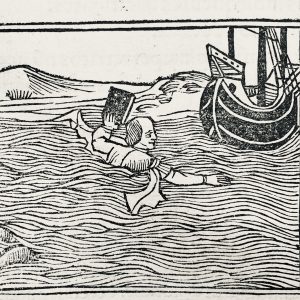

One of the most influential documents in the history of medieval scientific attitudes toward women


911J Henricus Suso, (1295-1366). ed. Elsbeth Stagel (1300-1360) Horologiu[m] eternae sapientiae. Köln Cornelius von Zierickzee 1503 . Price $7,500 Octavo 14 × 10.5 cm. 128 leaves. Signatures: A-Q8 Date in the colophon: M.ccccc.iij. mensis Septembris ipso die Marcelli. With title‐woodcut with four‐part border and... Continue Reading →
Share this: James Gray Bookseller


959J Neuchâtel (Suisse) Jugemens souverains rendus en l'année 1672 par les trois Estats de la Souveraineté de Neuf-Chatel et de Vallengin en Suisse : au profit de Madame la duchesse de Longueville curatrice de Monsieur le duc de Longueville son... Continue Reading →
Share this: James Gray Bookseller


First edition of John Keymors' Observation Made upon the Dutch Fishing (1664), a landmark work of early English political economy. Written around 1601 and published during the Anglo-Dutch commercial rivalry, the tract argues that Dutch prosperity rested upon the fisheries of the British seas and that herring generated more wealth than Spain's American silver. An important Kress 1725 item linking maritime commerce, national wealth, and the origins of mercantilist thought
Share this: James Gray Bookseller

478J Ramsey, William (under the pseudonym "William Seymar") Conjugium Conjurgium: or, Some Serious Considerations on Marriage. Wherein (by way of caution and advice to a friend) its nature, ends, events, concomitant accidents, &c. are examined. London: Printed for John Amery... Continue Reading →
Share this: James Gray Bookseller

744G John Langston 1641-1704 Lusus poeticus Latino-Anglicanus in usum scholarum. Or The more eminent sayings of the Latin poets collected; and for the service of youth in that ancient exercise, commonly called capping of verses, alphabetically digested; and for the greater... Continue Reading →
Share this: James Gray Bookseller


415J #779 . Anon.), Robert Waring, 1614-1658. Translated by John Norris of Bemerton (1657–1711) Effigies amoris in English: or the picture of love unveil’d. Oxford: London : Printed for James Good in Oxford, and sold by J. Nut [i.e. Nutt,... Continue Reading →
Share this: James Gray Bookseller


First Latin edition of Basil the Great’s De legendis antiquorum libris, translated by Leonardo Bruni and printed by Johann Zainer in Ulm, 1478. A foundational text of Christian humanism, exceptionally rare.
Share this: James Gray Bookseller


One of the pleasures of the antiquarian book trade is encountering books whose significance is not immediately apparent. The four volumes illustrated below are not necessarily the most famous books in my stock, nor the most expensive. Yet each represents... Continue Reading →
Share this: James Gray Bookseller


A catalogue of 18 incunabula, Manny annotated, in contemporary bindings, rubricated and two signed by the rubricator in four places!
Share this: James Gray Bookseller

A remarkable 1497 Koberger edition of Juvenal preserving one of the most complete surviving records of early humanist reading. Retaining its original Rhenish binding, the volume was extensively annotated by a German scholar active around 1511, whose notes reveal engagement with Erasmus, Poliziano, Crinito, Reisch, Roman antiquities, and classical literature. Marginalia extending into the gutters demonstrate annotation before binding, while institutional stamps, collector bookplates, and later scholarly notes document more than five centuries of continuous use. Not merely an incunable of Juvenal, but a rare witness to the history of reading itself.

Recent Comments