• Addendum to the Epizeuxis of 2012

    I recently subscribed to my own blog, The Coming of the Toads, curious to see what the email versions of a post look like. A reader can turn the email notifications off and still subscribe, looking for new posts in the WordPress Reader, which is how I read most blogs I follow. And I was aware that the Reader versions will look different than original versions, and WordPress recently improved the Reader by adding a button above the post to allow for one click to the original. But a reader who follows my blog via email recently mentioned I should use footnotes, or give the source of quotes, but I’ve always used footnotes and references and explained sources. Occasionally I might drop in an allusion for the fun of it without further explanation. But I checked a recent post on email and saw that all the references were missing. I don’t want to sound like a stickler or stuck with “Grammatical Pedantry Syndrome” (GPS), but I put the question of missing footnotes to the WordPress AI assistant, and found the situation is worse than I thought. Here is what the WordPress AI had to say:

    “That’s a great observation — email newsletters sent by WordPress.com strip out or don’t render certain formatting, and hyperlinks/references embedded in block quotes or text can sometimes be lost in the email version.

    Email clients often strip out custom font sizes and some block formatting, so the references in a smaller/medium font inside or after a Quote block may not survive the email conversion.

    The most reliable fix is to make sure your references are in a plain Paragraph block (not inside the Quote block) with default font size — would you like to try that for your next post and see if it comes through in the email?

    This is actually a known limitation of how email clients handle rich formatting, not something you did wrong.”

    I wonder how many other known limitations I don’t know. I put the matter to Gemini, the Google AI assistant, and this is what she had to say, elaborating:

    “Email clients are notorious for ‘sanitizing’ HTML to prevent security risks, which often means they discard custom CSS, specific font sizes, and complex nested block structures.

    Why Your Footnotes Are “Vanishing”

    When you put a citation inside a Quote Block or format it as “Small” text, the underlying HTML structure often looks like this:

    HTML

    <blockquote class="wp-block-quote">
    <p>Quote text...</p>
    <small>Citation here</small>
    </blockquote>

    Many email providers treat that <small> tag as a styling suggestion rather than a requirement and will ignore it, or worse, they will discard the entire citation because it is nested within a container (blockquote) that they don’t fully support.

    The solution, as we have long known from our Thoreau readings, is to “Simplify, simplify.” That advice follows his three word epizeuxis rant: “Simplicity, simplicity, simplicity!” (Those are quotes from Thoreau’s “Walden,” 1854.)

    Since I can’t preview the email version of this post, I’ll have to hit the Publish button and wait for the results to arrive in my email. If you are reading this post via email, and something seems amiss, that is, missing, you might look at the original. Or you can simply enjoy the unrelated, unnecessary, and irrelevant cartoon below; I read somewhere that posts with pics attract more readers. Is that a known thing or a blogging myth?

  • Rain

    Rain these past few days, but hot in the forecast. That’s how it is here, the heater one day, the AC the next. The furnace then the freezer.

    Of course folks have their own weather for entertainment, so why read a post about common rain, common rain from a common writer to a common reader.

    But there are different categories of rain, nothing common about any of them. Today we have gentle rain, barely showers:

    “The quality of mercy is not strained;
    It droppeth as the gentle rain from heaven
    Upon the place beneath. It is twice blest;
    It blesseth him that gives and him that takes”

    The Merchant of Venice, Act IV, Scene I

    Not the Bukowski in “Pulp” kind of rain:

    “Blow, winds, and crack your cheeks! Rage! Blow!
    You cataracts and hurricanoes, Spout!”

    King Lear, Act III, Scene 2

    Nor is it the kind of rain that might create loneliness, desperation, or a simple blues, written in a military hut:

    “Rain, midnight rain, nothing but the wild rain
    On this bleak hut, and solitude, and me
    Remembering again that I shall die
    And neither hear the rain nor give it thanks
    For washing me cleaner than I have been
    Since I was born into this solitude.”

    “Rain,” Edward Thomas, 1916

    Which is to say even rain can be subjective, which is to say when it rains on your parade, the poet meteorologists inaccurate as usual, as in Frank O’Hara’s poem titled “Poem”:

    “and suddenly I see a headline
    LANA TURNER HAS COLLAPSED!
    there is no snow in Hollywood
    there is no rain in California
    I have been to lots of parties
    and acted perfectly disgraceful
    but I never actually collapsed
    oh Lana Turner we love you get up

    “Poem” (1962) by Frank O’Hara, from “Lunch Poems” (1964)

    There is rain in California, and White Christmases in Hollywood, but there is no rain in poetry, and Bessie Smith collapsed in the blues of the rains:

    “When it rains five days and the skies turn dark as night
    When it rains five days and the skies turn dark as night
    Then trouble’s takin’ place in the lowlands at night”

    “Back Water Blues” (1926) by Bessie Smith

    Sometimes the rain is such you have to pack it up and go. But that’s not the rain here today. The rain here today is more comic, as rain in June often is, in the sense you were expecting sunshine, and the flowers panic on the floats, and nothing would collapse into a post.

    Dancing in the Rain

  • Prompted

    Where is everybody?

    There are external prompts and internal ones, and sometimes we don’t know which is which. Lately, we’ve been prompted to consider the universe, not for the first time. Where is that prompt coming from? Is there life on other planets? In terms of the universe, we have barely left the childhood home, have not walked around the block yet. We don’t know what life is like in the next village, if it’s thriving, or a ghost town, the only sounds an open door at the bank dragging across a dusty wooden boardwalk, then a pair of saloon-batwing doors swaying in a breeze as you walk down the middle of a deserted Main Street.

    What prompts us?

    Of doors, we think of the now nostalgically cliched childhood house door which was never locked. Cliches are often true, that’s how they become cliches, but we must make them new, that’s every writer’s prompt.

    Windows, floors, walls, ceilings. Basements, attics, closets. Stereo cabinet, turntable, transistor radio. Couch, Christmas tree. Ping pong and pool tables. Wiffle balls falling from trees in the bare backyard.

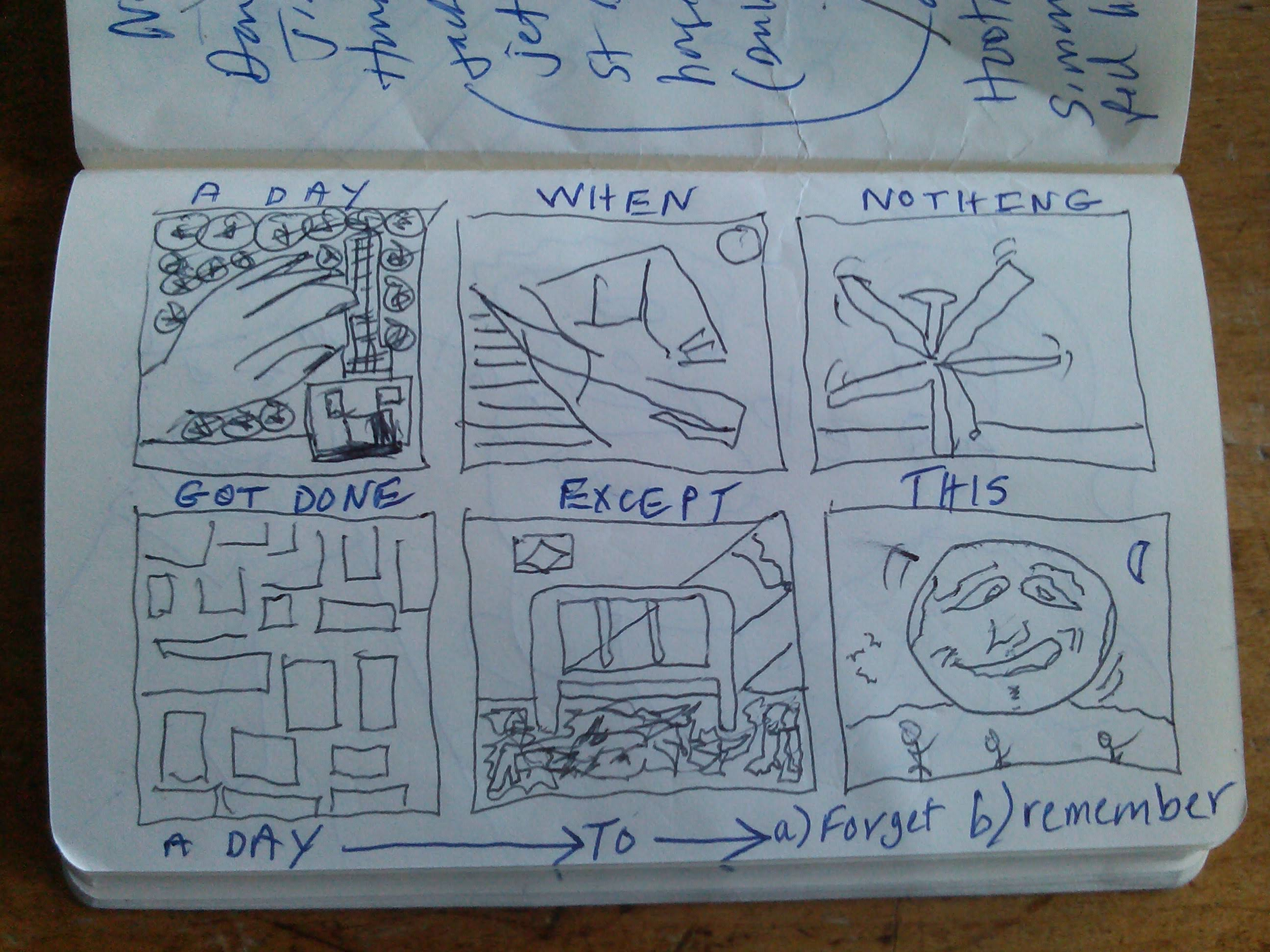
    Here’s a prompt: Do nothing. It’s not as easy as it might sound. While we might feel we’ve not accomplished much, it’s not for lack of doing. Or doodle. Doodling produces good prompts.

    But how is it possible to do nothing? Even asleep we are doing something. In Zen we might spend a lifetime, or more, practicing, not trying to do nothing, but to simply exist in the most possible existential way, outside, or free from, the dichotomy of one or the other, doing something or nothing. Do we ever succeed in reaching that so-called Nirvana? Nirvana is nothing if not something. Can’t seem to escape this loop. Loopiness.

    Doodle Slideshow

  • Rhododendron Cynthia

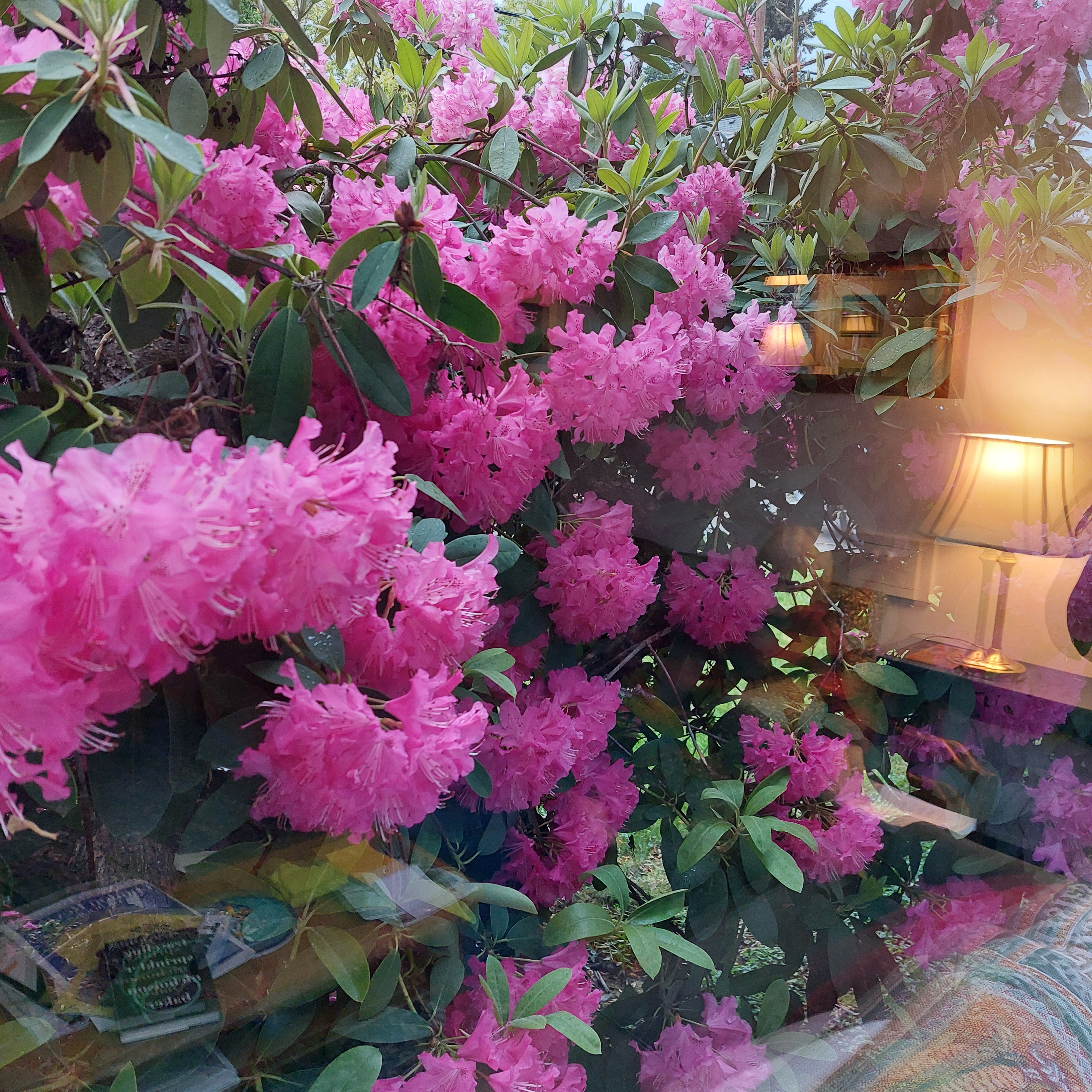
    This Rhododendron Cynthia is over 40 years old. Every year it blooms reliably, faithfully, from late April through late May. It was planted, a frequent mistake, too close to the house, but as several of the photos show, it’s a welcome guest in the living room, and makes for a natural summer shade. When it was smaller, the blooms were deadheaded, but it’s too big now for that kind of fussiness. It shows its age in size and stature, while it shows the gardener’s apparent preference for a romantic cottage exuberance: untamed, overgrown, domestically wild. And a redundancy of photos.

    Do a bit of Googling and you’ll find that Cynthia was originally called by two names, as its British hybrid developers in the mid 1800s split to go their own ways; the other name was Lord Palmerston. We call it the “Raspberry Rhodie,” after its red and pink flavored paints. One can imagine though Lord Palmerston, an ancient camel, stooping to grab a few raspberry blooms to nibble on as he wandered the cinder cones before the Great Missoula Floods, keeping his distance from the dire wolves and saber-toothed cats.

  • Abstract

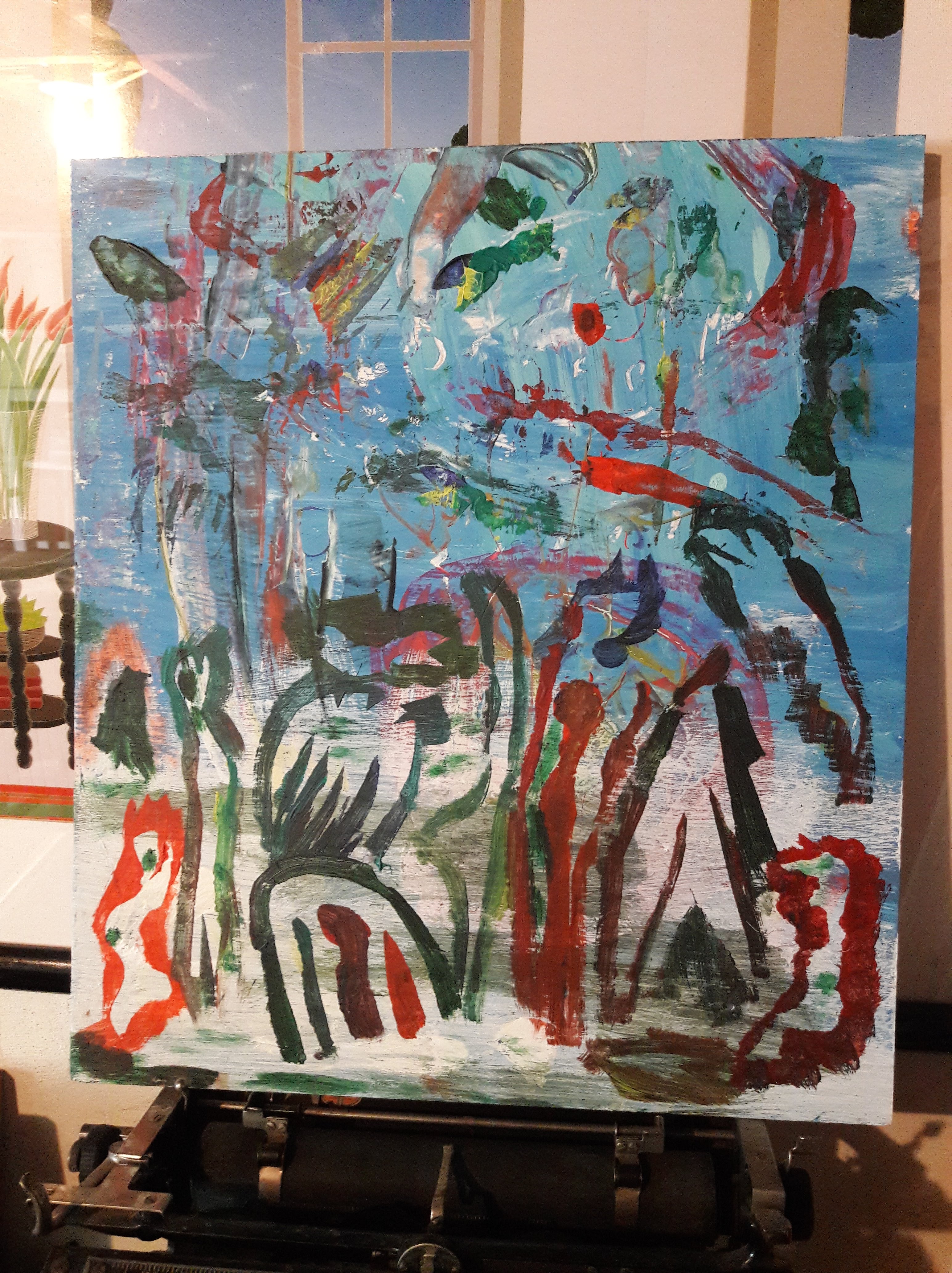
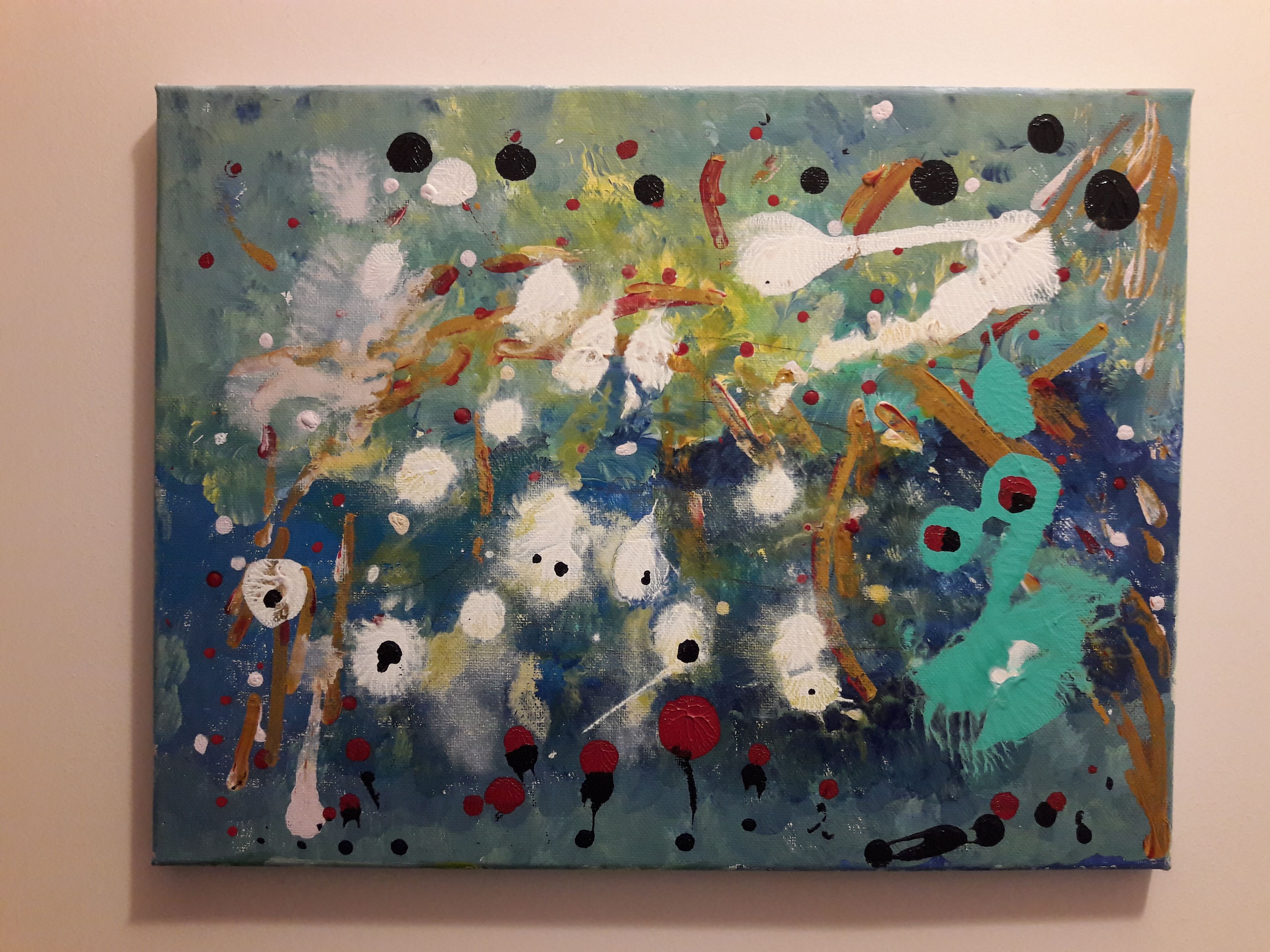
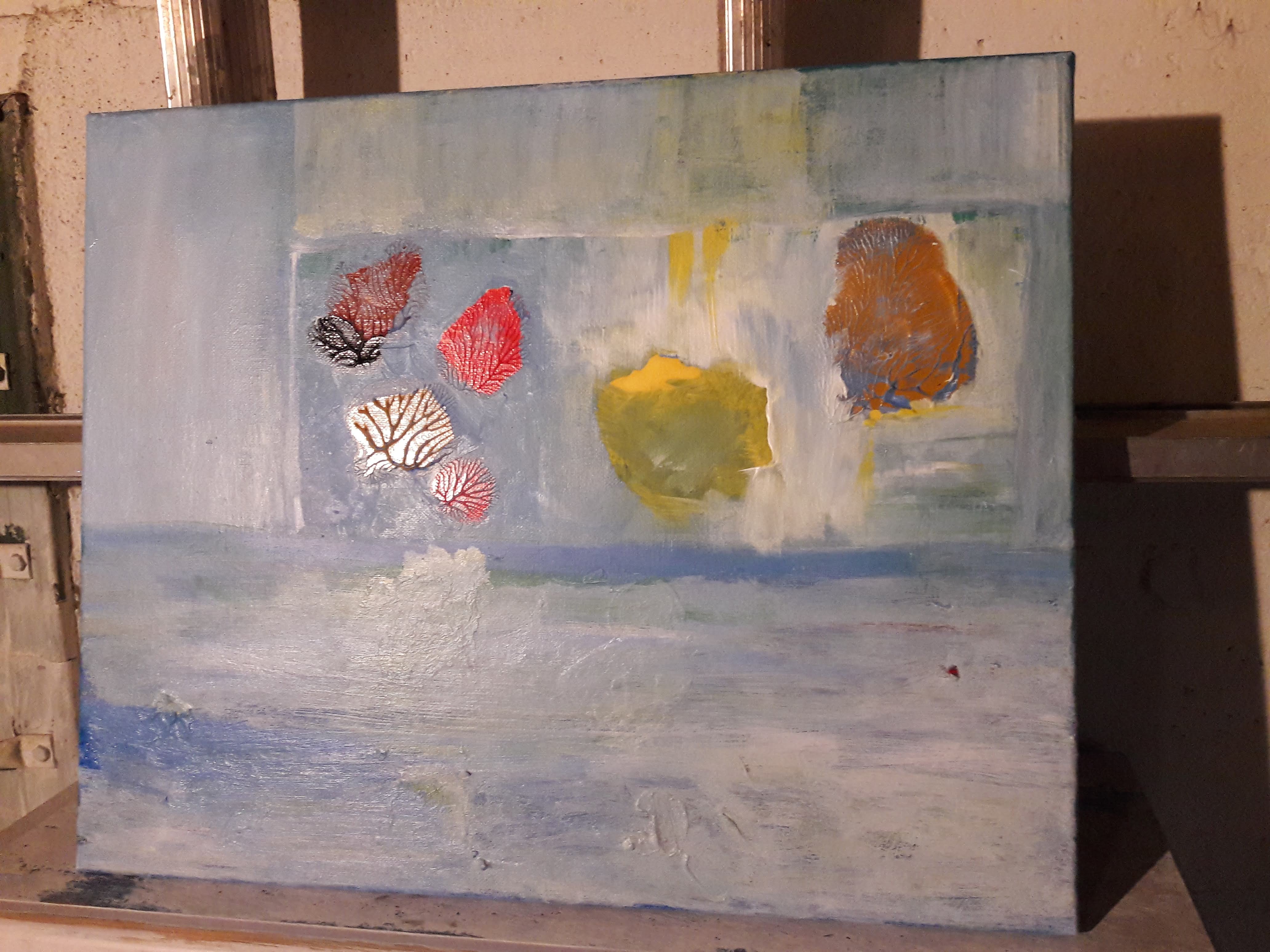
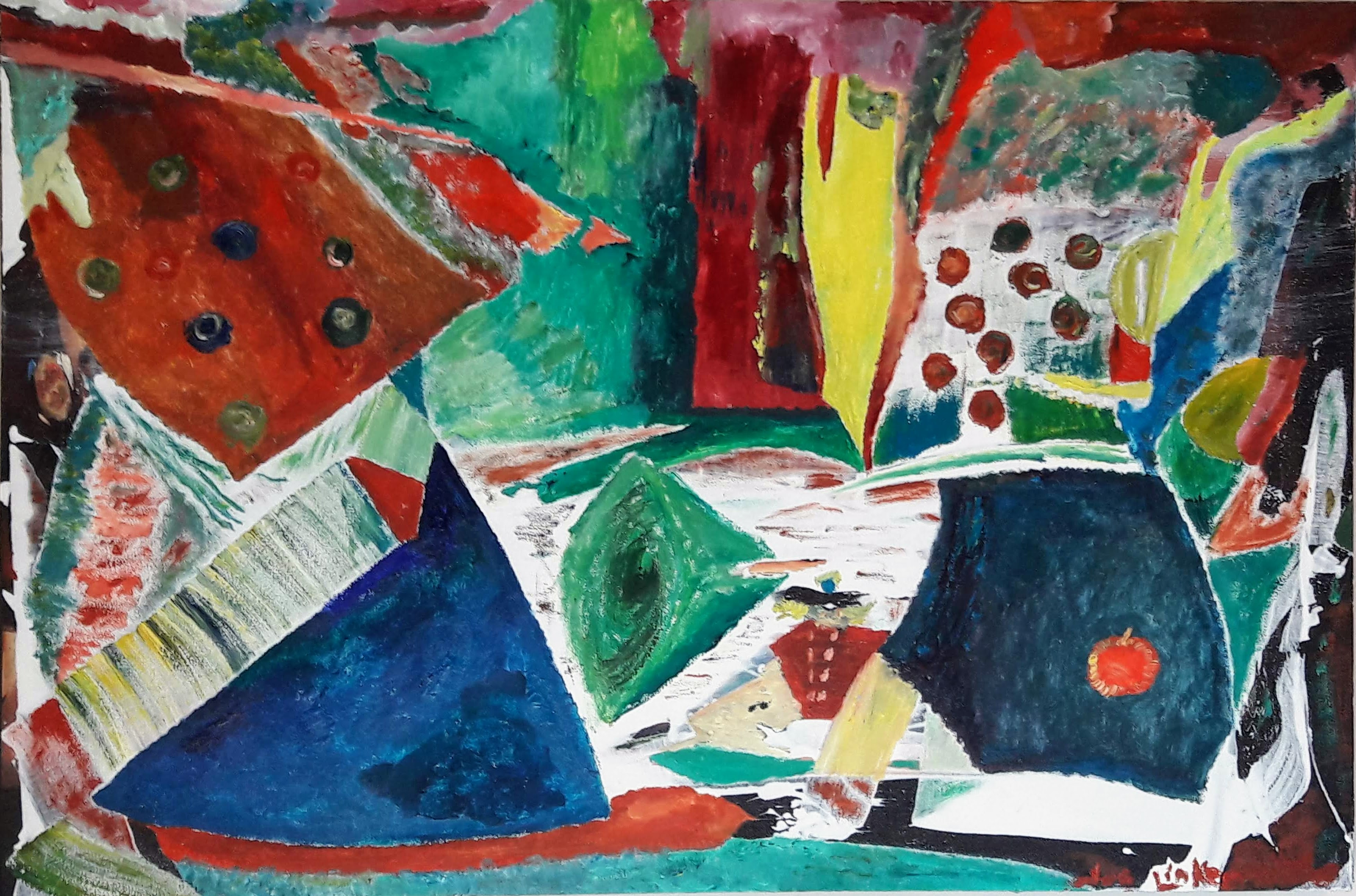
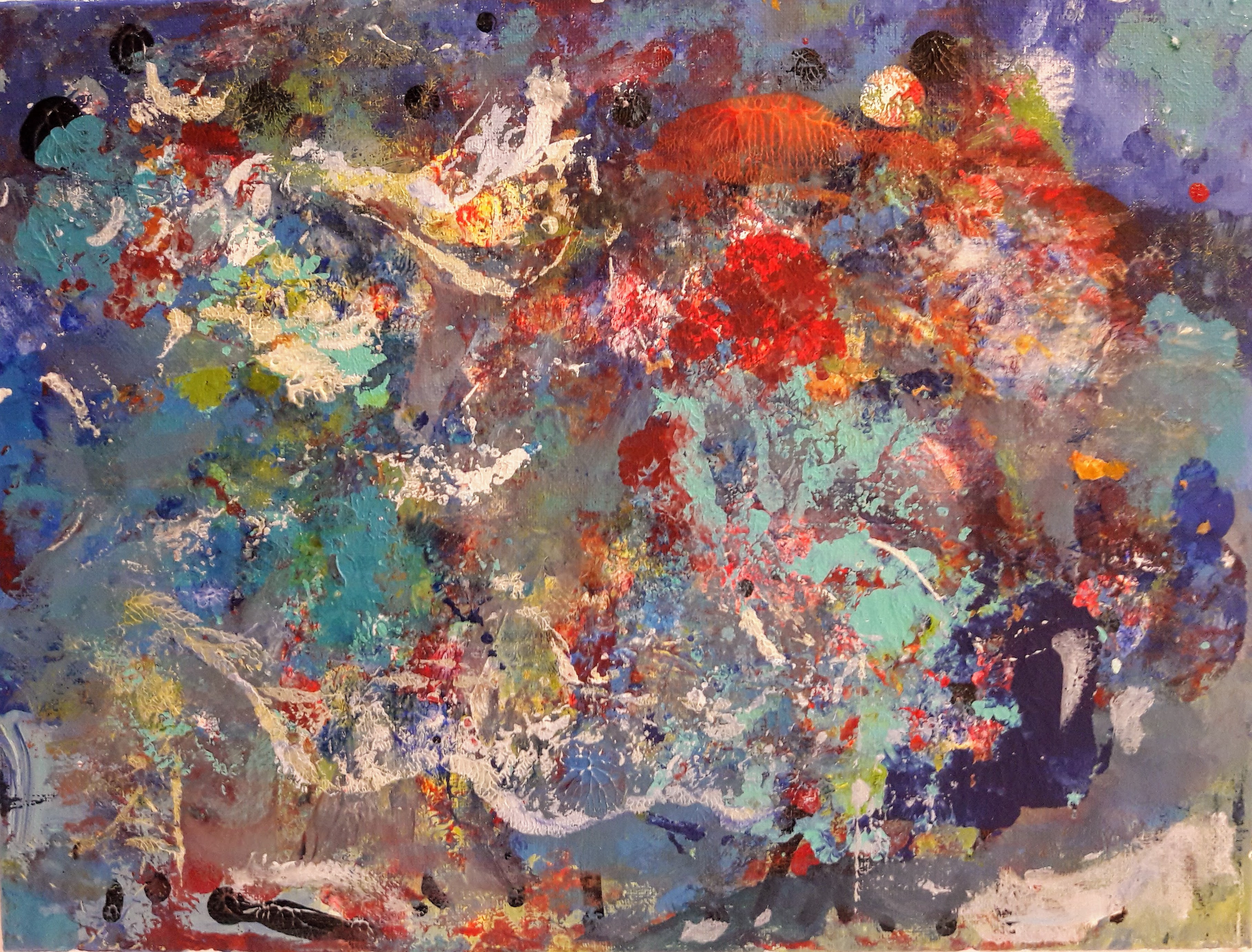
    The abstract is a kind of ness, as in messiness, yes, where something appears unattached, pulled away, while at the same time, to attract, to draw.

    Painting is fun. The ocean becomes blueness, at once an abstraction, the pulling away of the tide mixing white foam and sandy loam with deep cobalts, and what it feels like to dive under a wave.

    As we age we pull away. The artist remembers, puts something together again, repeats, or tries to, the experience. Click any image for carousel.

  • Readers

    We often these days wonder are we inside out or outside in. Upsidedown or sunny-side up. Or scrambled. Thus we got the names for our cats: Scamble and Cramble. Always in a muddle puddle.

    What is outside cannot see in; what is inside longs to get out. Between the two is a facade, thickest and strongest during the Victorian Age, when class distinction was a performance requiring a sticky social glue to hold together. But the stage collapsed during World War I, and the Great Depression emptied the theatre. Yet strangely we now find a reader walking the empty aisles of the Royal Victoria Hall or the Royal Court Theatre with a flashlight, the reader an usher lighting the way, but no audience.

    While cartoon characters like Scamble and Cramble are flat, they often have much to say about the fences over which they jump.

    In E. M. Forster’s “A Room With A View” (1908) the reader walks the fence. In 1908, a reader might have seen her reflection in the prose, but today it’s the reader without a mirror:

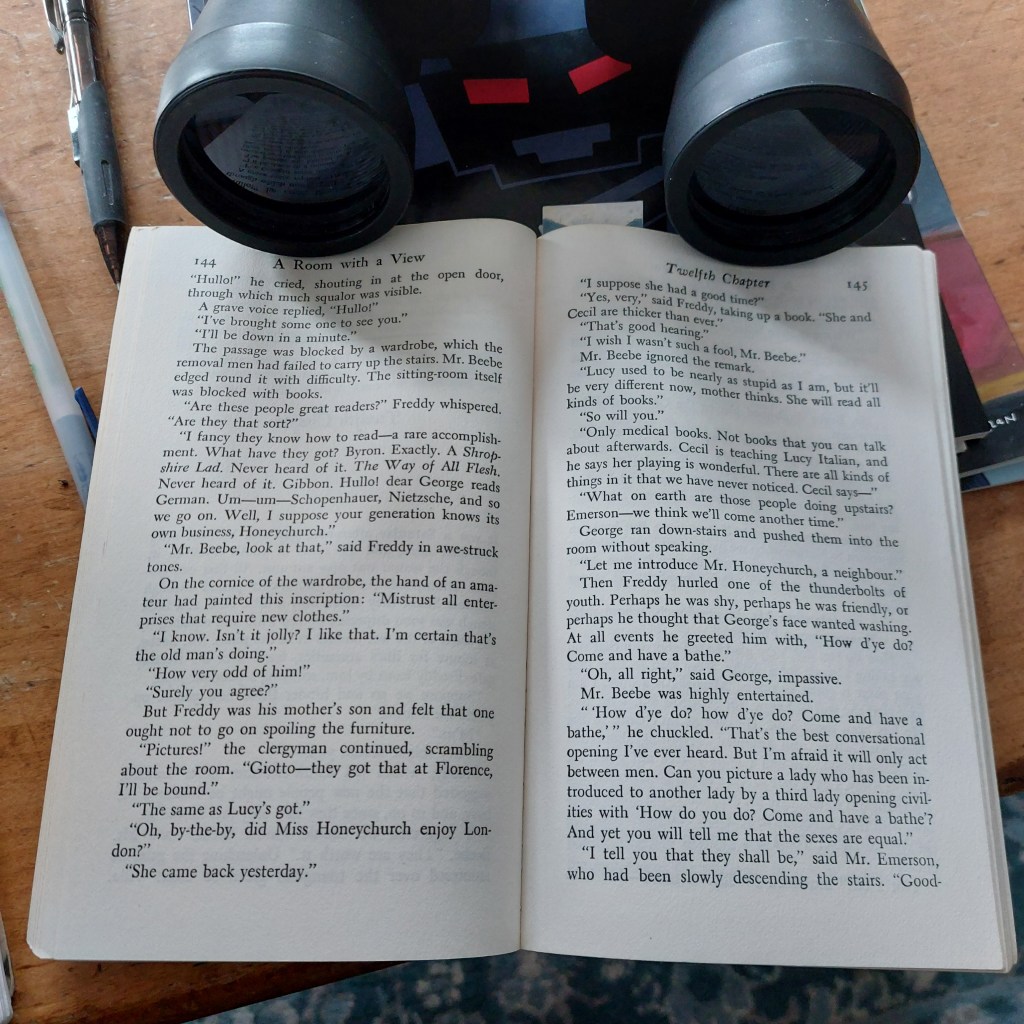
    In Chapter 12, Mr. Beebe and Freddy have come to “hinder” the new neighbors, still moving in and unpacking:

    “The sitting-room itself was blocked with books.
    ‘Are these people great readers?’ Freddy whispered. ‘Are they that sort?’
    ‘I fancy they know how to read – a rare accomplishment. What have they got? Byron. Exactly. A Shropshire Lad. Never heard of it. The Way of All Flesh. Never heard of it. Gibbon. Hullo! dear George reads German. Um-um-Schopenhauer, Nietzsche, and so we go on. Well, I suppose your generation knows its own business, Honeychurch.’
    ‘Mr. Beebe, look at that,’ said Freddy in awe-struck tones.” 144

    The title of Chapter 12 is just that: “Twelfth Chapter,” the only chapter title without a word clue to what’s inside. And it’s easily the funniest chapter in the book. It might have been titled, “The Bathe.” And why was it not?

    So there’s no misunderstanding regarding the Emersons, Forster makes clear their antecedents, in this example, what Freddy was so “awe-struck” about:

    “On the corner of the wardrobe, the hand of an amateur had painted this inscription: ‘Mistrust all enterprises that require new clothes.’” 144

    But the quote is from Thoreau’s “Walden,” not from that esteemed fellow’s good buddy Emerson.

    As for outside in or inside out, we get the young Freddy’s coming of age with this – Mr. Beebe says:

    “‘I know. Isn’t it jolly? I like that. I’m certain that’s the old man’s doing.’
    ‘How very odd of him!’
    ‘Surely you agree?’
    But Freddy was his mother’s son and felt that one ought not to go on spoiling the furniture.” 144

    Copy of the book by E. M. Forster, "A Room with a View," sitting on a blue background. A Vintage Book V-187. $1.25. The title is at top, with a pen and ink drawing in the middle of an open window through which can be seen a church basilica.

    Our copy of “A Room with a View” is an old Vintage paperback, cheap but indestructible, still had to glue part of the binding to the pages before this reading, but the pages are thick and white and the Electra Linotype a pleasure to read. We watched the film again recently (1985, screenplay by Ruth Prawer Jhabvala) and went back to the book for a fresh reading.

  • The AI Cat Poem

    How to know an AI cat poem when you read one? Since AI steals poems, it’s impossible to say for sure, but one clue might be that if house and mouse are located in the same poem, it is almost assuredly AI produced. Especially if house and mouse are used as end rhymes. Why? Because house/mouse comes as no surprise – it’s cliched, hackneyed, everyday, stale. How to make it new again?

    The AI requested poem misses the value of poetry, which is to compose, not necessarily to have one written. A great poem comes from a singularity. Poems are like dandelions; if you don’t see any, a critic with a bottle of poison has been spraying the area. Imagine the point at which Artificial Intelligence becomes human, a hypostatic union. Consider the irony: “Write your own dang poem!”

    Artificial Intelligence discussions flickering like photopsia, flashing points of lights out of the corner of the eye, neon over the tavern lure, a cat in the alley out back cruising the cans for scraps. We try to look straight ahead, but one wants to invite a wide angle field of vision, acknowledge the big picture.

    The house of poetry needs not one more cat poem, this we have confirmed with Scamble & Cramble, our two hep cats. Let alone an AI cat poem.

    We might admit at this juncture falling into cliche with every step, including the word juncture just now. Juncture? A pivotal moment. Well, that too is cliche. But maybe cliche is what is wanted, and what satisfies want is good? But what if what we want is bad for us, like a good AI poem?

    And maybe our own intelligence is artificial. After all, artificial compared to what? It’s like the difference between organic and inorganic – both are degradable.

    In Don Marquis’s “archy and mehitabel” (1927), we find the modern prototype of the cat and mouse game, the cat poem, except that we get no mouse, instead, a cockroach. That’s original. Though the place may be crawling with cockroaches, AI does not pair one with a cat, looking instead for the mouse of the house.

    Four books sitting on the edge of a counter next to the stove top: Scamble and Cramble: Two Hep Cats and Other Tall Tales, The Guest Cat, archy and mehitabel, Old Possum's Book of Practical Cats, and an oven mitt showing the line "Do you like green eggs and ham?" next to the cartoon drawing of Sam-I-am.
    Cat Books
  • What’s Playing “At Freddie’s”

    We are behind the scenes at Freddie’s, a school for child actors. London, 1963, implacable music fills the air, fog rolling down the aisles of an old theatre as the lights dim and the audience readies to perform its roles. It would be wonderful to meet a Beatle on his way to the musicians’ pit built under the wooden stage, hair as long as a Megalosaurus bouncing with the beat.

    On the marquee:

    Might be farce if it didn’t feel so faithful. Across the river from the Old Vic, please please them, the Palladium, as the old theatre empties, and the child actors head to the studios to star in TV commercials.

    Hannah goes backstage, what she’s been waiting for, why she signed up to teach at Freddie’s to begin with, to experience the theatre from the rear, made possible because part of her job is to continue the children’s lessons according to the general education requirements for child actors, and the dialogue sounds ever more like conversations from the Alice books, Hannah among the actors backstage. 108, Fitzgerald1

    Where did Penelope get the inspiration for “At Freddies”? She had taught briefly at such a school, saved up the memories and notes, and wrote about the experience a couple of decades later. Of particular interest regarding Penelope, born in 1916, is that her first novel, “The Golden Child,” was not published until 1977. “At Freddie’s” (1982) was her fifth novel, and recalls her days teaching Gen Ed at the drama stage school:

    “I had to help give the pupils what was then called their ‘education,’ and they did not disguise their lack of interest in it….They wanted not education but ‘work.’” 188, Lee2

    The egos (or lack of, like in the unarmoured Pierce) and personalities of the actors and teachers wax fantastical, and the farcical director similarly seems typecast. Has enough been written about the life of the working child actor? And why does it take so long for a publisher to put a book out, even today, in the age of speed, and what’s the use? Lead time for marketing and seasonality, theatre seasons. Then, as now, one wonders:

    “Dear Richard,” Penelope wrote, August of 1981, wanting to get ‘At Freddie’s’ out in the summer, “I’m sure it would make no difference to Collins because as you said to me hardbacks can’t be sold anyway, I just feel I shall lose heart if it’s got to wait till next Autumn.” 388, Fitzgerald, “Letters”3

    But then once it’s out, the reviews that might cause one to “lose heart.”

    “I admit I was upset by Paul B. in the Standard as there seemed to be so much personal dislike in it…I do feel rather daunted and wonder if it’s a good idea to go on, if the going is to be quite so hard” 391, Fitzgerald, “Letters”

    Who would have Hannah may not, the kids know, this and other woes of scraping by in 1963 London, but we won’t give the plot away. What Beatles fans there might be in the audience beat it to the exits as the band strikes up the first notes of “God Save the Queen.” The book ends with snow falling on one of Freddie’s students.

    “1963 snowbound winter and spring. Beatles ‘Please Please Me’ No. 1, in March 1963. Papers took up Beatlemania as Profumo scandal had come to an end.” 203, Lee, quoting from the papers of Penelope Fitzgerald


    1. “At Freddie’s,” by Penelope Fitzgerald. First U. S. edition published in 1985 by David R. Godine, Boston (214 pages). Originally published by Collins, London, 1982. ↩︎
    2. “Penelope Fitzgerald: A Life,” by Hermione Lee, A Borzoi Book, Knopf, 2013 (488 pages). ↩︎
    3. So I Have Thought of You: The Letters of Penelope Fitzgerald,” Preface by A. S. Byatt, Edited by Terence Dooley. Fourth Estate, HarperCollins, London, paperback edition 2009 (530 pages). ↩︎
    A brightly colored cartoon shows three large, exaggerated figures in costume on stage, a director standing out of the pit, musicians, below, and in the foreground a full house.
    On Stage Theater
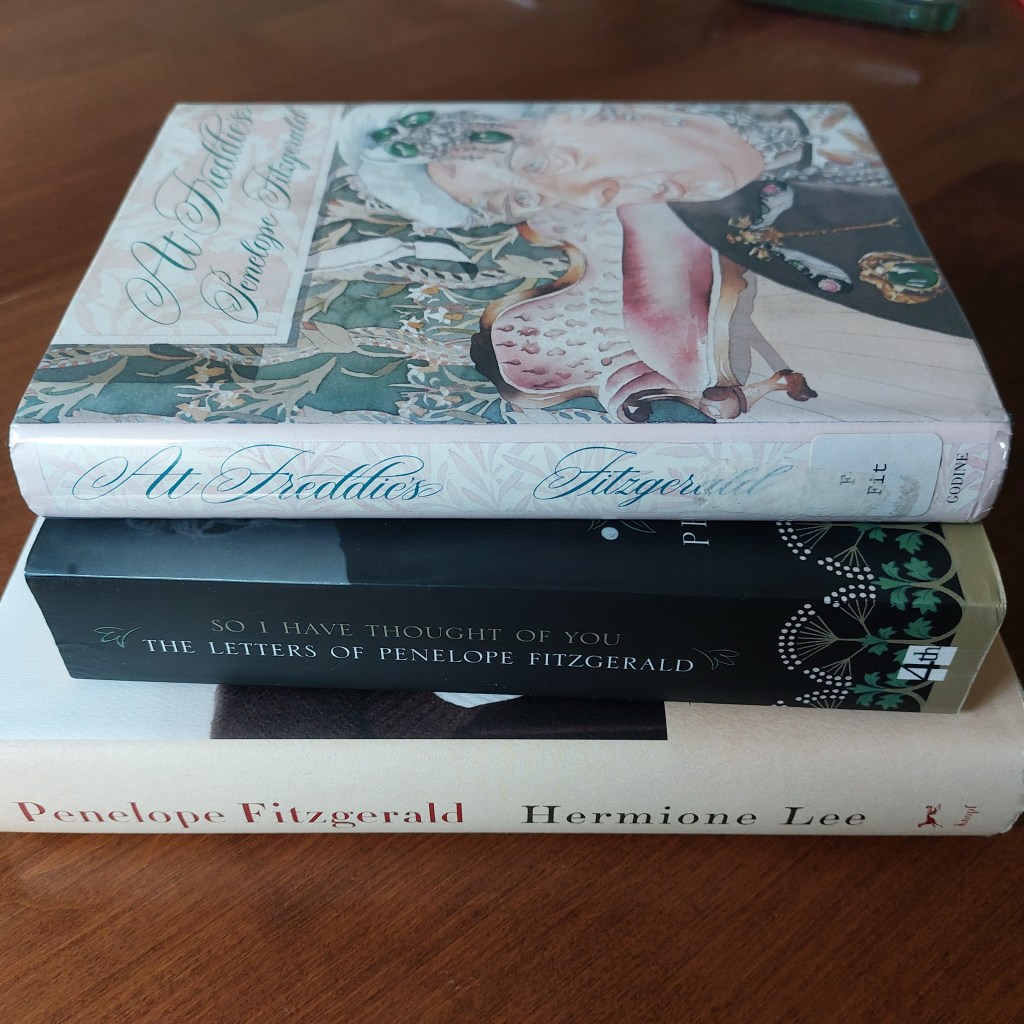
    Three books in a stack: Hermione Lee's Biography of Penelope, Penelope's Letters, and "At Freddie's (library discard from Willow Grove, PA).
    Hermione Lee’s Biography of Penelope, Penelope’s Letters, and “At Freddie’s” (library discard from Willow Grove)
  • A Summer of Love

    As perambulating and circuitous and prolix is Daanje’s “The Remembered Soldier,” J. L. Carr’s “A Month in the Country” is clear, concise, and straightforward. At 562 pages, Daanje’s book is a prose freighter sitting low in the water, while at 135 pages, Carr’s is not a speedboat but a liveaboard.

    Tom Birkin, a World War One veteran, works the summer of 1920 in the north of England, uncovering a medieval church mural, and recovering from shell shock and spousal betrayal, a face twitch from one, a stutter from the other. He lives aboard the church, in the bell tower, and everyday works on the wall from a scaffold, slowly revealing in the peaceful surrounds of the countryside the anonymous painter’s masterpiece of the Apocalypse.

    Birkin insists he isn’t himself an artist. He has however a certificate from the London College of Art, earned prior to his war experience, and while he’s a specialist in architectural and restoration detail, it’s working with his hands that he enjoys, as well as structures and appliances of all sorts, a heater, for example, or a church music organ.

    He’s also a specialist at reading others. Here he is talking with Alice Keach, the minister’s young wife, about the latest suitor his wife had run off with:

    “I don’t know how you can laugh at it, Mr. Birkin,” she said.
    “Two months ago I wouldn’t have laughed,” I answered. “That’s what Oxgodby’s done for me. If going off with him is what she needed, then why not! I’m not her jailer. We didn’t really know each other when we married. Who does? For that matter, who knows all that much about anyone even after twenty years in the same house? We only show what we care to and so it’s a bit of a guessing game, isn’t it? And if the other person doesn’t care to answer ‘Right’ or ‘Wrong’ guessing it stays.” 114

    What he means by “what Oxgodby’s done for me,” is his stay at the church, the work on the mural, and the relationships with the locals he’s become part of, a lovely summer surrounded by country, and, as it happens, falling in love:

    “Summertime! And summertime in my early twenties! And in love! No, better than that – secretly in love, coddling it up in myself.” 113

    The story takes place in 1920, except that the narrator reveals the writing takes place 50 years later:

    “We can ask and ask but we can’t have again what once seemed ours for ever – the way things looked, that church alone in the fields, a bed on a belfry floor, a remembered voice, the touch of a hand, a loved face. They’ve gone and you can only wait for the pain to pass.” 135

    It is love after all that saves us, nothing else. I know you’re not supposed to do this, but I found myself thinking of my own summer of love, 50 years or so ago, love of the sun and the beach and the salt water, living with Susan in a rented apartment a mile or so up from the beach, just over the dunes, bicycle and surfboard in the yard, a VW bug to work on parked on the street, family near, the Guard passed. Save us from what?

    “Do you believe in hell, Mr. Birkin?” 95

    It’s true of course the apple blossoms of spring don’t last forever, or for long at all, but they do become the apples of fall.


    J. L. Carr, A Month in the Country (1980). New York Review Books Classics (2000), with an Introduction by Michael Holroyd. 

    A Large painting leaning against bookshelves, cloudy sky above, hills with sun setting behind in the distance, green fields rolling down to water spouts in the forefront.
    “City on a Hill,” large painting by Joe Linker, 2018.

  • Notes on Anjet Daanje’s “The Remembered Soldier”

    And the writing flows a river full of war debris rusted and mute but on the banks dogs run and flowers spread and lovers lay their heads on one another’s laps and lie about who they are where they come from and where they’re going and the lies while self-serving and might sting antiseptically clean and heal at least for a time carry the possibility of being true.

    And they talk about the war now closed but not yet about a new one the war effects strewn everywhere infiltrating past present and future families businesses and churches and all about wander widows looking for their lost soldiers waiting for word from somewhere news information findings photographs posed or improvised letters particularly the one written and stuffed in their uniform pocket should someone find their poor dogsbody adrift adirt now on the still dug tide pull it out and mail it for them.

    And they get up and light the coal burner and make chicory coffee and no one calls it ersatz and the children are off to school and play as if there never was a war nor any worries outside the sounds they might hear in the middle of the night suggesting something is near some memory being ground up in noir dogged dreams and the writing becomes a horror story the war is a horror and the memory of it if there is one even if all you got was a whiff of it is a horrible stench and touch of a trench full of the unspeakable yet again it doesn’t take long and the flowers begin their cover scent and one is thankful for a period or two and a rest however brief.

    And one need not go to war to forget nor need to be reminded one might read a book or listen to a story or a sermon from some mountain high pulpit the only ammo words from the ambo the proclamation of peace forgetting and forgiving and beginning anew anow anext nonesuch a short war nor sudden but a long time coming but quickly a long time gone. And one can still be happy and make love frequently all the niceties of holding back of undressing in the dark of politeness even one might call it politics the gradual coming together of sides to reach some mutually beneficial conclusion.

    And some can’t don’t won’t forget keep a coal burning in their chest and must shave a head or two of vulnerable conspirators in the middle of a street amid the ruins of buildings and trains come and go and one dreams of being on one travelling light toward a new light and a new city indeed a new country far far away maybe meet one’s spouse not yet discovered and a new life away meantime every day one scrounges for food and fabric and spends time mending and fixing and forgetting and remembering while new debts pile up it’s necessary to forge alliances with one’s leftover friends and share space.

    And of course the plot thickens as it is slowly stirred the scarcity of punctuation the beginning of all those paragraphs beginning with And and how long can this go on like this 562 pages of course not nearly as long as four years fighting and four more on top of that trying to remember you might begin to realize the relation-canoe a dory for two not even close to a ship the pauses for a bite of anger to unfold into an argument and a fight and as it simmers to remember it doesn’t have to be like this and the remonstrances of invisible fearful ghosts you know when they’ve come into the room it might be the middle of the night or in bright daylight some passing pause and then the blank stare and up and down the stairs they go the kids in tow and begin again to care and find hope even to sew new clothes and pose and take and develop photos and eat chocolate and dance.

    And how do they survive a war of such magnitude left on their own to forage memory create what did not happen remember what did and did not reinvent and as the great lies unfold they too grow into truces and truths anew told as only a survivor could tell with lies and truths intermingled in a slough stew. And it is an existential mystery novel as essence of life is denied an effect of war on everyone and all so affected must now decide who and what they are or want to be and how to carry on.


    Three exceptional novels with soldiers returning home from WWI:

    Anjet Daanje, The Remembered Soldier (2019). Translated from the Dutch by David McKay, New Vessel Press, 2025. 562 pages. In my post above, I’ve tried to stylistically mirror Daanje’s technique in her book of polysyndetic stream – in lieu of a traditional book review. Anjet’s flow of prose feels at times restless but invites treading water while going with the tide.

    Rebecca West, The Return of the Soldier (1918). 100 years before Daanje’s book, like Daanje’s book, it also features a soldier returning home with amnesia, or is he simply on leave, his return both a coming and leaving. West wrote her book in 1916, the war still on and in some of its darkest days. Penguin Classics (1998). 90 pages.

    J. L. Carr, A Month in the Country (1980). New York Review Books Classics (2000), with an Introduction by Michael Holroyd. Here the soldier would like to forget, but can’t, and takes a job in a country church for a summer working from a scaffold uncovering what appears to be an old mural, while another veteran works nearby but underground. 135 pages.

    I briefly mentioned those last two books in a prior post here.

    Three Novels of WWI stacked with spines forward resting on a short shelf of unrelated books.
  • A Complete Thought

    Inching along now, word by word, not a complete thought in sight. Did have one once, a complete clause, gave me pause, didn’t last long, a mere utterance. Must move along, a kind of proposition neither true nor false. Paddled through the kelp around the point. Each wave a fragment of fancy, a figment of you know what. Nothing here, nothing there, may a touch of wit be with you.

    Cartooned, too, motionless, almost, like a cartoon, barely enough. Threads. And beads. Even dismissal doubtful. Traveling light, stuff in storage, if you can call a household holding an industrial trial. Like paddling, nautical, head above water. Jarred, not stirrage, as in shaken, not stirred. Vespers as what light there is fades. Etymology: the evening star. Vespertine. And after night, matutinal.

    Dawn and songbirds. Bees swarm the morning glory gold trumpets. Swallows and swifts dash the morning cup of black bitter coffee the paper cup. From vespers to bitters. While still cool. Morning lasts until noon. Why morning works best: allows for song to carry along no distortion from wind or the noise of other animals. Work and the sounds of work opening, the pulling on of gloves, the squeak of toolbox hasps, the last of the dew spots on the sidewalk and the rolling out of the blueprints on the makeshift table on the sawhorses.

    A wet sidewalk and street closeup with letters in the cement curb that read "Work Projects," and an "A," so part of "Works Projects Administration," from the Great Depression years.
    SE Belmont, 16 Jan 2016