Useful stones

Following on from the previous tools based post, this one is about stones useful as tools to a flintknapper: hammerstones and abrading stones

Last week we were in Pembrokeshire, in south Wales on a family holiday. It is no coincidence that Pembrokeshire has some lovely pebble beaches and that we were on holiday there. Karen loves travel, I love flintknapping and so pebble beaches are one of the areas where our family holiday Venn diagram overlaps. And to reiterate from the previous post, obtaining equipment shouldn’t be a limiting factor if you want to learn how to make stone tools. Just go on holiday! And as you can see below, you may not even have to go to on holiday! but I digress…

Hammerstones first. Not all beach pebbles are born equal. For an ideal hammerstone I look for three things. Firstly, its hardness. The black stone pictured below is an exemplar. I picked it up because it had a shiny smooth surface which suggested it was formed from a compact and dense material, and when handled it felt heavy for its size. I tested it out on the beach and it worked well on other materials and showed minimal damage. Within a few seconds I had identified it was a suitable hard stone.

Feeling heavy for its size is the second factor that is useful. As well as the actual material it is formed from, its shape also contributes to this quality. It is approximately globe shaped, and this provides the greatest mass of material for the minimum surface area. In other words, globe shaped pebbles cram in the most material for their shape and therefore size. So, bringing together a globular shape and a hard material means you are optimising the qualities you want from your hammerstone.

The third factor is more personal to me, how it fits and feels in my hand. Different size hammerstones are needed for different tasks. A small hard hammerstone is useful for tidying up bottle bases after they have been removed from the bottle. A large hard hammerstone is useful for breaking down large flint nodules into more useable flakes. I think this hammerstone sits somewhere in between and will be ideal for transforming large flint flakes into handaxes.

Next up, abrading stones. Most flintknappers will tell you that abrading a platform is very important. For me there are two important reasons: shaping the platform; and getting rid of sticky out bits. To achieve these outcomes I look for two main qualities in an abrading stone. Again, how it fits in the hand, but primarily it needs to have an abrasive surface. The one pictured below I have found ideal for shaping and abrading platforms on flint flakes.

Again, to reiterate from the previous post, it’s not complicated, that is more or less it. Once you start playing with the hammerstones and abrading stones collected you will develop your own criteria and ways of working with them, and that is the really interesting bit.

Making your own copper pressure flakers

I have been told off for posting too many pictures of stone tools on social media, and so in response to that feedback here are some pictures of the tools I use to make the stone tools I post on social media. I start from the premise that flintknapping is a practice, and to practice you need both materials to work, and a range of tools to do the work.

In a previous post I discussed how I found quite a lot of copper pipe in a crawl space under our floor. Using that material, this morning I used a hacksaw to cut the lengths into about eight pieces, as above.

I then took a hammer and a doorstep and flattened the cut end of each piece.

That is more or less it. These copper pressure flakers do blunt and wear more quickly than ‘real’ pressure flakers that use thick gauge copper wire, and so a while back I bought this grinder for both antler hammer rejuvenation and pressure flaker sharpening.

As you can see, I have a lot, of now sharp different gauge pressure flakers. I also have a Bronze Age arrowhead workshop next week with ten people, hence doing this today.

These pressure flakers work, and different gauges work well for different stages of the making process. Obtaining equipment shouldn’t be a limiting factor if you want to learn how to make stone tools.

Having a sort out

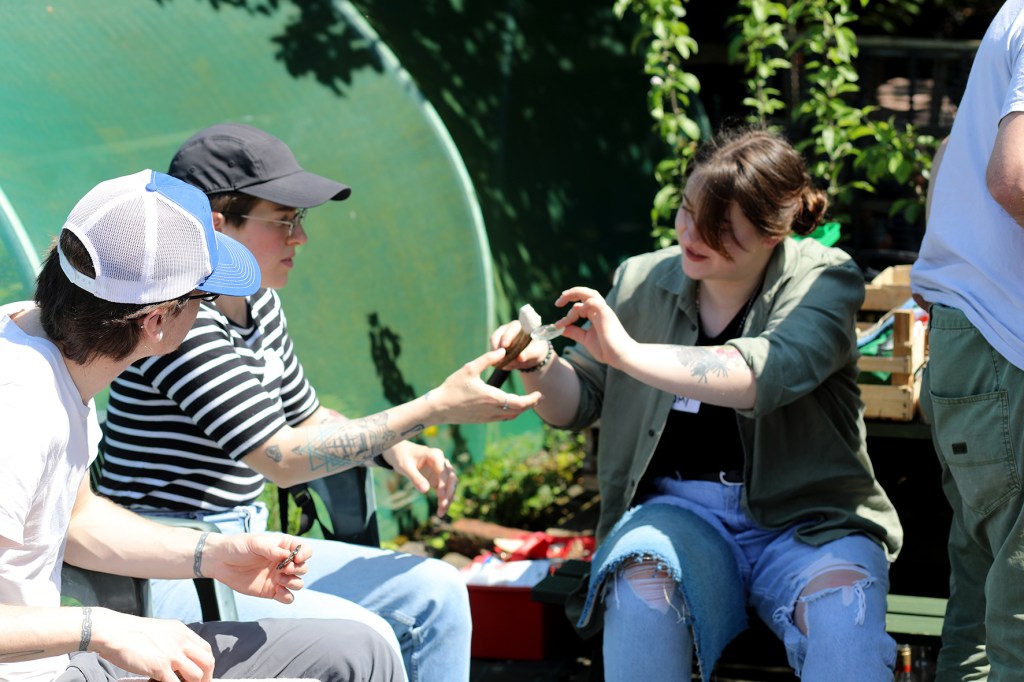
Since coming back from fieldwork I have slowly been sorting out stuff at home and in the labs. In doing so I came across this box given to me by Pete Yankowski at the Chorlton Arts Festival knapping session (see previous post).

As you can see it is full of treasure, however the thing that caught my immediate attention was the modern broken vase base, languishing at the bottom of the pile.

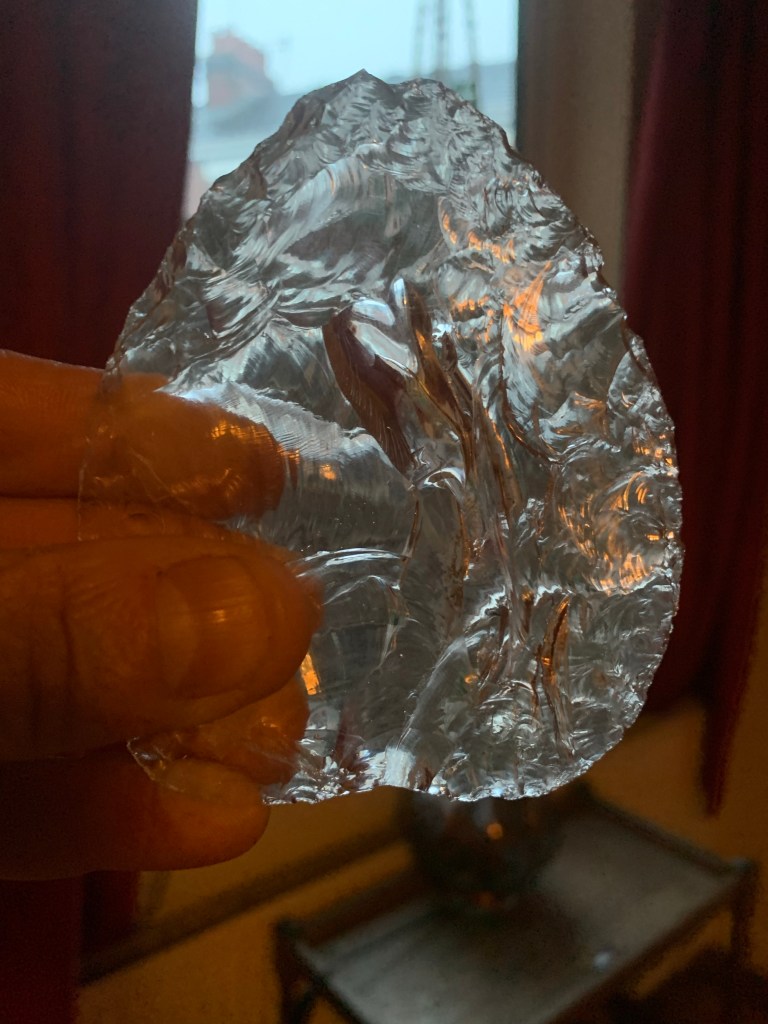
As you can see, it is both thick and has a way in, and so I spent a little time with this yesterday. A day earlier I had worked on another glass base, but hadn’t prepared the edges as well as necessary. Consequently I ended up with an artefact with a ‘step fracture island’ on one face, and some original surface left on the other. Most unsatisfactory! Consequently, I spent quite a lot of time on this one, turning the edges as well as possible.

This particular flake has a story. The reflective bit is a section of original surface that was sitting at the centre of one face, and it needed to go. Because I had spent time creating well prepared edges and platforms I was able to remove it with one accurate and hard blow of the antler hammer. This meant both faces were fully bifacially worked. Most satisfactory!

Anyway, the result is a small and wonky cordate handaxe. There are a couple of small step fractures that I could get rid of, but that would mean losing width, so I am going to live with them. Or should I say, Pete is going to live with them, as the handaxe and flake are now winging their way to him, as a thank you for the original box of treasure.

The Blue Handaxe part two: an unsuccessful melting experiment

Last week Nacho, Howard and Jex made some time to record the smashing and melting processes for the glass collected from the bottle tip. Above you can see a birds eye view of Nacho’s home made kiln that we were using for the experiment.

In total we had six clay moulds lined with aluminium takeaway containers. The take away containers function was to stop the melting glass adhering to the clay mould. In relation to the kiln we had an upper and lower section, and were interested to know if location within the kiln was going to be a factor. As you can see, we also had glass of different colours and Nacho thought the milk glass, based upon its density, would be the most difficult to melt.

The above photograph shows the kiln just as it reached 1000 degrees. I was told in Spain that glass melts at around 850 degrees, and so in theory 1000 degrees would be more than enough. However, it was possible to see into the kiln, and although the glass had adopted a sheen, it clearly had not yet liquified. So we carried on upping the temperature.

Above is the sample Nacho had made so that we could pull it out and see how things were progressing. When he pulled this out the glass was red hot, however, as it cooled it became apparent that the clear glass fragments had liquified whilst those of milk glass were still recognisable as fragments. The differing colours were indeed behaving differently.

I had to be in university by 5pm and so at 4pm Nacho switched off the heat source and allowed the kiln to start the cooling process naturally. We could see that some of the glass had indeed melted, whilst other glass hadn’t. The mix above of clear and milk glass had the texture of a rice cake, rather than the smooth and solid block we were looking for. On the plus side, it did release from the clay mould easily, in spite of the fact that the aluminium tray had melted.

This blue example was perhaps exactly the opposite. It seemed to have melted well, although upon close inspection a crack could be see running diagonally across the block.

Because this looked like a promising candidate we tried to release it from the clay mould, but this one had attached itself to the clay, and you can see the results of our attempts.

This blackcurrant glass also looked promising, but the thing to note here is the bubbles. This must have cooled very (too) rapidly to capture the bubbles like this. Perhaps, if we don’t want bubbles then the heat should be turned down rather than turned off in order to make the cooling process more gradual.

This second blue one looked similar to the blackcurrant glass on the surface, however, when I tried to release it from the mould the internal structure was revealed, and that also contained bubbles. None of the six slabs were suitable for Knapping, so what did we do wrong?

I think we should have kept increasing the temperature to above the maximum of 1018 degrees that we got to on the day, in order to identify when the most difficult milk glass will melt. A second thing is to slow the cooling process so that bubbles have the chance to settle before the glass starts to solidify. We also need to consider alternative mould methods, as the aluminium takeaways, whilst not the main issue, didn’t help by melting.

We didn’t get what we wanted, but we did get plenty to think about!

Saturday night’s alright for knapping

I have said before I don’t like destroying things to make my stone tools. Well, I am not really sticking to my principles.

The ovate below is not my best as I had issues with step fracturing, and the shape is ‘quirky’. Plus still some original on one surface. However, I enjoyed the two hours in the lab, and stayed fully engaged throughout.

With glass blocks like this I need to improve the early stage turning of the edges, as that is what later leads to the step fractures. Still, not complaining as I am at a stage I am very happy with. I could improve this but lose size, so I think for now it is fine as it is.

Saturday night’s alright for knapping!

Large glass arrowhead

I have been collecting glass from the bottle tip for our melting experiment, and along the way found some nice thick pieces.

I was in the lab Saturday working on flint, and so today (Monday) I had an hour or so working on this brown glass base.

It took a while to get into it, and once in I had to sacrifice size in order to get rid of some horrible step fractures.

I used stone, antler and finally a copper pressure flaker to finish it off. It flaked really well and I am happy with it. I also have a nice green piece so let’s see if I can find the time tomorrow as well.

In the lab

Second Saturday in the lab. I made some more large flakes from an older nodule of different flint. This was harder and chalkier than the new material. Consequently, it took me a while to get it right, hence the small size. However, I like it. I should also say at this point I had about five goes, destroying three flakes before coming away with two handaxes. The others would have worked as tools but they weren’t ‘right’, so I carried on with consequences.

This is the second handaxe, and last go I had. It is of the same flint as the large handaxe last week, and this is slightly larger. It is mainly flake, with thinning going on at the proximal or bulbar end. Karl Lee told me that handaxe edges were worked so that they didn’t break and leave bits of flint in the meat.

Approximately two thirds of the cutting edge is worked, and the final third simply the feathered edge of the original flake. I think this would have worked fine as each edge type would have had different qualities.

Anyway, the inadvertent soundtrack is ‘Senorita’ by James.

The Blue Handaxe – Materials

Yesterday we did some filming. Howard (film maker) and Jex (sound person) at the bottle tip. I had brought some props with me to explain the overall idea. Enter, my current favourite large handaxe (above) to illustrate where I want to go with things.

Next up was my best glass handaxe made from the base of a vase. This was to illustrate the limitation of size of materials, with this being exceptional, but still not very big.

Third up was this (presumably) 1950s Vicks bottle of amazing blue glass. This was to illustrate the rare blue material I wanted to collect in order to then work with Nacho to produce a blue glass block.

Anyway, after the above introduction and some bottle tip footage Howard wanted some live action blue glass finding moments. This was going to be difficult as over many visits I had picked the area clean, or so I thought. I found quite a lot, mainly a pale or lighter blue, but nevertheless illustrating the material gathering process authentically, which is what we both wanted. Let’s see what Howard makes of phase one.