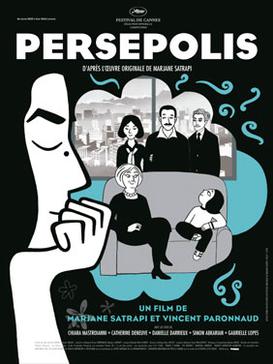
I was sorry to hear of the death of Marjane Satrapi, the Iranian artist, author and filmmaker. In my twenties I loved the Persepolis graphic novels that illustrated her coming of age under a repressive regime.
We meet in London. She can’t stand Britain because of the smoking ban. She suggests that we talk in her hotel room because at least she will be able to smoke there. She lives for her cigs, and is quite happy to die for them, she says. ‘For me smoking is like looking at your soul,’ she says in a rasping hybrid accent. […] She has no truck with the kill-joys who want to stop us doing all the things that we enjoy – simply because it might prolong our life. ‘Anything that has a relationship with pleasure we reject it. Eating, they talk about cholesterol; making love, they talk about Aids; you talk about smoking, they talk about cancer. It’s a very sick society that rejects pleasure.’
The right to smoke in public buildings is a trivial issue, particularly compared to Satrapi’s subject matter in Persepolis, growing up under a regime that made Gilead look like Disneyland. But it’s not nothing and I loved that interview because it revealed her as a genuine freethinker. Not many of those these days.
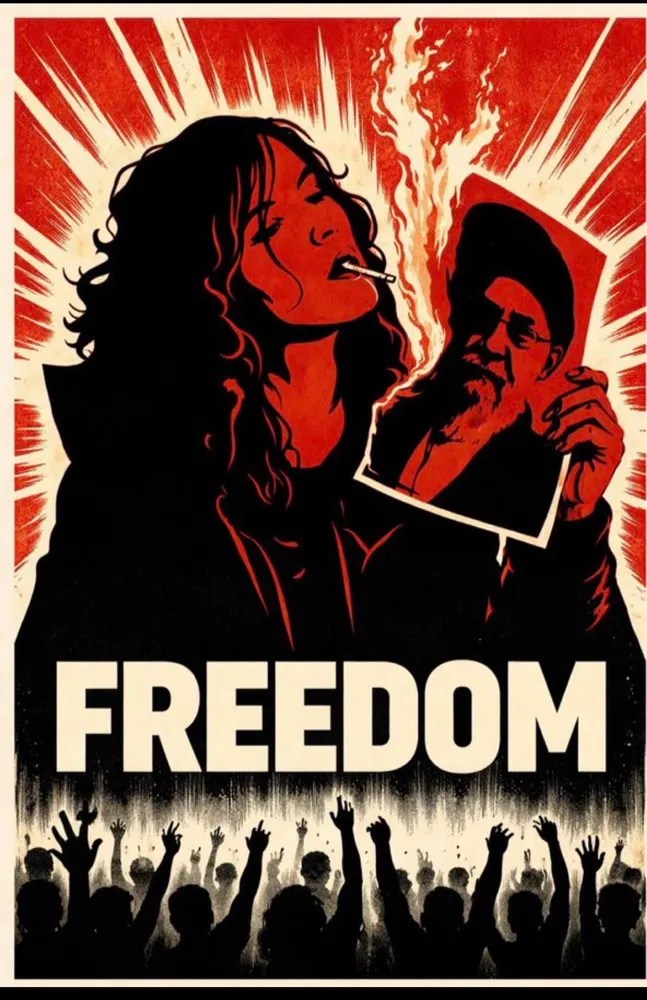
Satrapi escaped Iran and published Persepolis in 2000. The Iranian regime carried on as a modern-day theocracy, pretty much the same as it was portrayed in her books. Every now and again, there’d be some brief hopeful eruption. People would take to the streets, women tore off their hijabs, city crowds demonstrated for freedom. And then the regime would start killing people in the street. The regime arrested and tortured and executed. Then things would quiet down. The odd name is still remembered – Neda Soltan, Mahsa Amini – but otherwise it was as if the protests had never happened.
This time there were demonstrations everywhere, not only in the liberal cities but more conservative rural towns. Everyone on the streets in the early days of 2026 knew exactly what the risks were. The regime duly massacred thousands of protestors. In the time period of January 8-9 it is said to have killed as many as 40,000 people. Again, the world watched this with folded arms. It wasn’t our war, even though the Islamic Republic is very much a global facing regime with spies and terrorists operating all over Europe. British Iranians complained that journalists weren’t covering the story. It’s hard for journalists to work in hostile countries, but I saw their point. Some Iranian Londoners, protesting against the regime, were met with far left thugs waving Khameini flags.
In retrospect it seems crazy to hope Trump’s war would remove the Islamic Republic. It was great to see senior regime leaders and military targets being totalled by American bombers. But the regime couldn’t be destroyed just with an air war, under a morally and cognitively compromised Commander-in-Chief. All too soon everything got tangled up in the strait of Hormuz. And that’s when the rest of the world finally began to pay attention. These days when you see news of Iran, it is focused on the strait – whether it’s open or closed, the price of a barrel of oil, the implications for pump prices and holidays. In a dark way it’s fascinating how completely the market has captured our thinking on Iran. The slogan ‘no blood for oil’ has never seemed more apt. The Iran war is treated as a kind of global Brexit with everyone yearning for the status quo. The status quo of Iranians, generation after generation, living and dying under this regime. Neoliberalism at its worst. Human rights have left the building.
We have come quite a way from the art of Marjane Satrapi, and I would also recommended this tribute by Siyavash Shahabi, fortunate to know Satrapi in life. I am just sorry that the regime didn’t fall before Satrapi died. I hope that one day the Islamic Republic does fall and its remaining leaders are held accountable for their crimes.
Listed like that from top to bottom gives you a sense of Neil Jordan’s novel, written in short, elegiac paragraphs that sometimes spurl into longer paras, again full of significant words:
He opened it and saw sketches of apses and architraves, friezes and facades, minarets and mullions, naves, niches and oculi. There was no logic to the progression of illustrated pages, to the profusion of symbols, angular delineations that seemed to grow into three dimensions, even as he perused them.
Words of power – words of architecture, engineering, geology, design, medicine, words of stone and brick, that recur over and over in this novel, giving it a prose-poetry effect. You see it in the chapter titles and Jordan’s characters too are preoccupied with words, particularly those with a silent p – pterodactyl, ptarmigan, ptosis? – and there are also staggering portmanteaus, like ‘hereditogametogenesis’. Is it meant to be a prose poem? Or is Jordan trying to ground his story into some kind of authority that he hasn’t provided in the characters, the world and the story itself?
For it’s a strange thin world you’re reading about here, like the odd faint places said to exist between different realities. The year is 2084 but you can’t tell. The book comes with a world map showing a reconstituted globe of different nations and empires, but it’s unclear why we need the map because most of the action takes place on a rural Irish peninsula. Here most people travel by bicycle, there are all the local amenities you’d see today, most people work in farming and fishing and it’s clear that the old landed interests have very much shaped this landscape. Perhaps that is indeed what the distant future will look like, once you strip out the technological bells and whistles.
Even the Institute is based on a mansion two hundred years old, though it is dedicated to the arts of divining through time. There is an odd link between the 2084 setting and a historical story about a man named Montague Cartwright who originally built the mansion. In the Institute you can study people’s memories and dreams, though the storytelling possibilities of this are barely explored. The exception to this is the Clairvoyant programme that recruits teenage girls from the Traveller community and monitors their dreams. The novel’s most well realised character is Sorcha, a survivor of the Clairvoyant programme who now runs a local animal sanctuary. There is some gorgeous imagery – Isolde’s anamnesis spray, which can freeze bugs and birds momentarily in flight. The contrast between the Institute’s tech-based skulduggery and the rough nature community in the peninsula is striking, when Jordan can bother to make it work.
Presumably the Institute employs lots of people but we only see Christian, Montague’s descendant, and his bosses. Christian wants to use the Institute’s power to communicate with his lover Isolde, recently killed in a car accident. The lovers talk with each other through the veil that separates life and death, and their dialogues form the more tender and affecting parts of the novel. The tenderness is real. The eroticism is real. You long to see them ride the Harley together through the Irish countryside.
Yet we never get a sense of them as people. Reading this book is like looking at a classical painting, some kind of codex, full of shadows and detail but, nevertheless, something that is motionless.
And this is the problem – everything in The Library of Traumatic Memory, the dialogue, the descriptive paras, every line seems freighted with meaning. The paradoxical effect is to make the whole thing seem meaningless. Even the most fantastical science fiction must have something of the quotidian and the ordinary.
It came after a New York Times reader flagged similarities between the paper’s January review of Watching Over Her by Jean-Baptiste Andrea, written by author and journalist Alex Preston, and an August review of the same book written by Christobel Kent in the Guardian.
The New York Times launched an investigation, during which Preston admitted that he had used AI to assist writing the review and did not spot the sections that were pulled from the Guardian before submitting it. In a statement to the Guardian on Tuesday, Preston said that he was ‘hugely embarrassed’ and had ‘made a serious mistake’.
Allow me to be the first person to talk about artificial intelligence without having conniptions.
It seems to me that the very sensible objections to AI are mixed up with alarmism and a superstitious horror.
It’s natural to be wary of new technology, particularly any kind of artificial life. We have been wary of this since Mary Shelley wrote Frankenstein, the ‘Modern Prometheus’, about a scientist who created a new person out of spare parts to disastrous effect. (Prometheus of course was the mythical hero who stole fire from the gods and was punished by being chained to a rock where an eagle visited daily to eat his liver.)
AI may not attack you physically or eat your organs. But from The Terminator on we get the message: if you make technology that is too smart it will become smarter than you and take over. Some of AI’s crazier critics imply this has happened already.
Indeed Alex Preston, if he didn’t want to come clean, could perhaps have argued that the AI algorithm overpowered him and forced him to do its evil bidding.
Like I say there are sensible reasons to be worried about AI. I don’t want to read fiction and news reports written by machinery. I don’t want creatives to be forced out of work or have their art harvested for machine learning, with no renumeration given to the artists involved.
But I agree with Marie le Conte – she argued that ‘of course, AI can now write dogshit PR emails, because too many modern PR jobs involve little more than writing some dogshit emails.’ She goes on to say that ‘we’re spending too much time going ‘oh noooo AI is getting everywhere’ and not enough thinking ‘hang on, how is it that AI can so easily replace all these things”.
And she’s right. A lot of functional writing such as press releases, job descriptions, person specs, corporate policies, political manifestos and speeches could easily be written by AI. The world of entertainment and literature isn’t always as original as it could be. You don’t have to go far from Christopher Booker’s claim that there are only seven basic stories in the world to the prize list filled with average literary novels or the supermarket stand of samey crime thrillers. Times change, but the threat remains the same: received knowledge, overvalued beliefs, cliches of thought, an incuriosity about the world and our fellow creatures… these things will sleepwalk us into obsolescense.
I can assure you that this post was written without machine learning and originated entirely from my organic human brain… for what that’s worth.
In Fear and Loathing in Las Vegas, Hunter S Thompson wrote: ‘Strange memories on this nervous night in Las Vegas. Five years later? Six? It seems like a lifetime, or at least a Main Era—the kind of peak that never comes again.’ He remembers that ‘we were riding the crest of a high and beautiful wave… So now, less than five years later, you can go up on a steep hill in Las Vegas and look West, and with the right kind of eyes you can almost see the high-water mark – that place where the wave finally broke and rolled back.’
But Thompson’s druggy adventure took place in the wreckage of that broken wave. By 1971 the hopes and energies of the last decade had washed out. Polly Chalmers, a character in Stephen King’s Needful Things, escapes to San Francisco in that year because ‘summertime was supposed to be a love-in there.’ But her apartment building ‘was full of jimmied mailboxes and junkies who wore the peace-sign around their necks and, more often than not, kept switchblades in their scuffed and dirty motorcycle boots.’ Police offer no protection: ‘the cops had also missed the love-in, and were pissed about it.’
In Sophie Ward’s 1971 her character Andrea breaks into an Amsterdam theatre where two intellectual giants are debating: Michel Foucault and Noam Chomsky. Andrea not only gets to watch the debate but enters into a long dialogue with them after the show. Andrea’s post-debate argument with these two heavy hitters is the only part of Our Better Naturesthat feels like a drag. It’s a drag for Andrea even, and she begins with rapt intentions: ‘She wanted to see these men who used their minds and bodies against the war in Vietnam. She wanted to craft her world with the immaculate language of rebellion. But on stage, she saw only the formal disagreements of academic semantics; Foucault’s talk of grids, Chomsky’s schemata.’
Even Foucault ripping off his clothes and donning a red nose can’t liven this up. The line of dialogue that resonated from these debate scenes (and don’t worry, the debate will end and Andrea’s story will get a lot more exciting) is Andrea saying: ‘So, I will tell you about wise men. What they do is important, those individual moments. Those moments are, really they are, all that is important about the wise men.’
Fiction made up of just the moment is hard going. Anyone can describe at length the life of one moment but it takes real skill to capture the rush of things happening, one after another, the rush of life.
Which brings us to the chapters about Phyllis Patterson, a housewife in rural Illinois. Andrea and the book’s other protagonist, the poet Muriel, are city people with a cause – fighting the war in Vietnam. Muriel, struggling with diabetes and a history of strokes, is even willing to go to prison after the march in Washington DC.
For Phyllis there are no abstractions, not a lot of passion, just duty and hard work, beginning with her childhood on a chicken farm. The only break from homeworking came during the Second World War, when Phyllis worked at a quarry: ‘she had been too busy to socialise after work, but in the break the girls got together with their paper-bag lunches. One of them had been a croupier in Las Vegas when the dam was being built. She taught Phyllis and the others what she knew about blackjack and poker, and it had been cards every day for a while. Only for pennies, but she had such memories of her heart racing and her head full of the trick of it all.’
It’s a real sadness to think that playing cards on lunch break could be the highlight of a person’s life but Phyllis’s story is compelling rather than gloomy. Her life too is haunted by war, in the more quotidian way that she has lost relatives to it. Her son is a Korea vet who marries and starts a family there. In the small community of White Plains Phyllis is stuck in the homespun web of old compromises, resentments, anecdotes and core beliefs.
But from unpromising circumstances Ward allows her characters to change, in the way of life, when you don’t know you’re changing or waking up. As Lara Feigel notes: ‘Certainly, the reverberations of revolution are felt by Phyllis, as she sees ‘how her life was part of these lives, that she existed in all these moments’, and learns to be both more powerful and more just.’ To more poignant effect, Ward charts the subtle deterioration of Muriel who fights against her body’s decline in the cause of art and peace. The light weave of all this is what makes Our Better Natures brilliant.
Greg Palast said that sometimes the protests that liberate us are quieter. Among other amazing things Our Better Natures demonstrates this to perfection.
Rooney spoke to something called ‘The Hague Group’ which according to Novara ‘has committed to ending arms shipments to Israel and pursuing justice against Israeli war criminals.’
For me this was not a typical Free Palestine, anti Israel speech.
Rooney says: ‘I would like to ask my fellow writers and artists, if I may, not to dwell too exclusively on what we stand to lose.’ She urges us to look on the bright side of the dark twilight struggle against Zionism.
To join in something greater than ourselves, to participate in some small way, in a struggle for human liberation, to stand for what we know in our hearts is right, and try not to be complicit in what we know is wrong. What else can make our lives endurable in times as dark as these? What else, in the face of such horror, can give us a reason to go on, to fend off despair, and to fight for our future no matter the consequences. For those of us living at the heart of empire… it is the honour of our lives to stand with Palestine.
These are powerful words and I keep coming back to the word ‘endurable’.
Is Sally Rooney saying that her life would be unendurable if there was no cause of Palestine to fight for?
I don’t think so, I think that Rooney says that campaigning for a free Palestine gives modern life meaning.
I read Rooney’s novel Beautiful World, Where Are You last summer. It’s a fascinating book. Alice and Eileen have been best friends since university. They live apart but still email each other, while trying to build successful private lives. Alice and Eileen are smart and self aware but they have some extraordinary opinions. This is Eileen writing to Alice:
My theory is that human beings lost their instinct for beauty in 1976, when plastics became the most widespread material in existence. You can actually see the change in process if you look at street photography from before and after 1976.
To which Alice replies:
I think you’re wrong about the instinct for beauty. Human beings lost that when the Berlin Wall came down. I’m not going to get into another argument with you about the Soviet Union, but when it died so did history. I think of the twentieth century as one long question, and in the end we got the answer wrong. Aren’t we unfortunate babies to be born when the world ended? After that there was no chance for the planet, and no chance for us. Or maybe it was just the end of one civilisation, ours, and at some time in the future another will take its place. In that case we are standing in the last lighted room before the darkness, bearing witness to something.
There we have it. But Beautiful World, WhereAre You is not simply a novel of ideas. Rooney has a wealth of empathy and understanding for people in her books. Alice and Eileen talk in wide-historical terms but there’s a sense that their lives and cares matter in their here and now. One thing about Rooney’s characters is that they don’t throw themselves out there. At any party, Alice and Eileen are the first to leave.
Pascal wants people to remain aware of ultimate things: the huge empty spaces, God, death. Yet few of us find it possible to maintain such thoughts for long. We get distracted; the mind drifts back to concrete and personal matters. Pascal found this infuriating: ‘what does the world think about? Never about that! But about dancing, playing the lute, singing, tilting at the ring…’ Montaigne liked asking big questions too, but he preferred to explore life through his reading, the animals in his household, incidents he had witnessed on his travels, or a neighbour’s problems with his children. Pascal wrote: ‘Human sensitivity to little things and insensitivity to the greatest things: sign of a strange disorder.’ Montaigne would have put it exactly the other way round.
Undoubtedly there’s a pleasure in the great cause, in fighting and campaign, the rush of ideology and pure belief. But if you pursue this high above all else, you’re betraying yourself – and, ultimately, betraying those you are fighting for.
Even if one thinks – as I do – that we have obligations as human beings to others in grave need, difficulty or danger, to demand of people that they give all of their time and attention to such things amounts to demanding of them that they sacrifice the whole part of their lives which might otherwise be given to pursuing their own enjoyments and their own happiness. That would be an exorbitant expectation.
Football matters to those to whom it does matter just in the way that, for others, ballet, music, walking in the countryside, literature, movies and gardening matter – in the way, indeed, that life, liberty, and the pursuit of happiness matter. And those other things that, so to say, really matter often matter because they are about situations where life and liberty and the pursuit of happiness are being denied to others.
The university experience is a risky business in fiction. Generally, the feelings are intense, but the stakes are low; it’s all very formative for the individual character, but it can feel a bit trivial to anyone else…. So my heart initially sank at Heart the Lover’s cover promise that our main character would soon be ‘swept into an intoxicating world of academic fervour, rapid-fire banter and raucous card games’ – good grief, save me from the raucous card games!
Wait adds that ‘a good writer will make it matter’ and where Lily King makes it matter is in the brevity of her prose. Heart the Lover weighs in at 248 pages but there’s a wealth of intensity in that brief count. This is a campus novel but King has spared us the oh-so-tricksy dual time scheme, the palpitating narration of callow youth. Her main character Casey (aka ‘Jordan’) comes from a difficult background but we get to know this over time rather than having the backstory dumped on us in introductory chapters. Casey has been let down by people before, she works at laundries and restaurants to pay for her education, there’s a no-nonsense quality about her.
I was interested in the sense of place and time in this first half of the novel. The lads call Casey ‘Jordan’ because she is at university on a golf scholarship that she crashed out of in the first week and apparently there was a famous golfer called ‘Jordan’ around that time. We don’t know precisely where the university is in America but it rings true – the locales, the bars, the Bubble Time laundromat where Casey does shift work, her house where eleven students live and huddle around the stovepipe in winters. The time period is harder to place – it felt nineties to me at first but then Casey mentions that ‘The elections in Poland are a source of contention on Pye Street. Solidarity is poised to defeat the Communist Party and possibly leave the Eastern Bloc’ – which puts Jordan’s youth at around 1989.
Over at The Writes of Womxn Naomi Frisby grew exasperated with the character: ‘I’d been screaming at the book for pages wondering what the hell she was doing’ and writes that ‘Sam, Yash and their friend Ivan’s pontificating on various white, male canonical works was tedious, while Casey made terrible decision after terrible decision.’ For all Casey’s practical nature and hard living, she is still young and the young make mistakes. There’s a phrase old people use: ‘If only I knew then what I know now!’ The fact is that we did not know.
The budget-plan student world gives way to something lighter and intoxicating when Casey and Yash get together. It’s genuinely heart pounding as they meet up in Paris and travel around Europe. They go to the Swedish countryside and have sex in a field and swim in a rockpool. It doesn’t feel cheesy – it feels amazing and vital and alive. It doesn’t seem unrealistic that these two people would finish out their projects in various countries then meet in Newark airport and be together forever. Of course that doesn’t happen… and it’s caution, rather than recklessness, that ruins things for them. Yash seems lively and sociable but there’s a core of him that just wants to be alone and that’s what wrecks him. Part of him just wouldn’t grow up.
‘And to be able to finish this thoroughly enjoyable book with a big cry,’ said book blogger Kate W. I don’t want to talk about the novel’s second half at all, where the characters are well into middle age – I’m not saying it made me cry (one manly tear, perhaps?) but as with all extraordinary novels I don’t want to spoil the story. But this is a paragraph from a hospital scene, where Casey meets some junior doctors:
On the other side of the room the residents strain to stay focused. They flex their jaw muscles, shift their weight. Their eyes travel around the room but never to our faces. I study theirs, one at a time. I wonder what dramas have played out among them. I can feel their youth in the room, a forcefield of energy and fear and longing and confusion. I can feel it so strongly. And I know they sense nothing about us, two men and a woman in our late forties, none of our old entanglements or the freakishness of the three of us being in this room together now.
Such a distillation of time and fate it is rare to find.
If the doors to the Cheers bar stand always open, and everyone inside knows your name, then the gateway to the successor show is a little harder to navigate. This dialogue is from the first episode, where we meet Niles for the first time, having a coffee with Frasier. Niles is talking:
So I said to the gardener: Yoshi. I do not want a Zen garden in my backyard. If I want to rake gravel every 10 minutes to maintain my inner harmony I’ll move to Yokohama. Well this offends him, so he starts pulling up Maris’s prized Camellia’s by the handful. Well, I couldn’t stand for that, so, I marched right in the morning room and locked the door till he cooled down.
We fade in and it’s just Niles talking. He’s prolix, pompous and cowardly, and he seems detached from his older brother, who indeed seems bored by the anecdote. There’s a further exchange between them:
Niles: You know what I think about pop psychiatry.
Frasier: Yes, I know what you think about everything. When was the last time you had an unexpressed thought?
Niles: I’m having one now.
Perfect. But it could be a witty conversation from Wilde or Maupassant. It doesn’t feel like sitcom dialogue. Frasier isn’t going to talk down to you, nor make it easy for you. The title cards for this first episode – ‘The Job’, ‘The Brother’ – are all the orientation we’re getting. Longterm Cranians can amuse each other with the classic lines. Romping through the fens and spinnies. The Cranes of Maine have got your living brain. Catherine-of-Aragon! You are so that other one! And I’m keeping the jewellery!
First-timers are confronted with the bewildering world of upscale Seattle. Everything is unique, bespoke, hand-tailored. Opera, chamber music, the wine club, the Empire Club, Coco Chanel sofas, staffed homes, Henry VII tea sets, goatskin shoes, Le Cigare Volant, Chez Henri. People wear evening dress even if they are only going over to Frasier’s apartment. Even Martin puts on a shirt even though he’s only going to sit in his chair all day. The Drs Crane seem spookily in sync with one another – ‘Do I hear cathedral bells?’ Niles says to Frasier, when Frasier has taken delivery of a pair of Italian shoes so exclusive that the bells of the shoemaker’s Italian village ring on the occasion that he finishes a pair.
And yet – beginning with the intrusion of Martin’s chintzy chair into Frasier’s carefully curated apartment – this world is constantly being punctured and interrupted by reality. Throughout the series Frasier must battle his grown-up school bullies, messy tradesmen, noisy neighbours, radio pranksters, rival celebrities, unscrupulous businessmen, incompetent staff, and what he considers a rude and uneducated public. (It’s interesting that Frasier’s radio show is most popular not with Seattle’s elites but ordinary folks – sous chefs, secretaries, security guards, even prison inmates.) Frasier and Niles throw enormous grand society events but most of them end in disaster – the venue erupting in flames, or the Crane brothers being arrested for murder. The rest of America is always threatening to cramp Frasier’s style. The Atlantic‘s TV writers hit on the show’s democratic genius:
I also think it’s powerful that the butt of the jokes are the protagonists. Rewatching Seinfeld or Friends, those shows also have their own constrained universes, but I don’t love that they tend to make the people outside the universe the butt of the jokes. You’ve got the core people. And then you have the side characters and dating interests who cycle through their lives. And typically, it’s those outsiders who get the brunt of the jokes. They’re expendable and therefore the most mockable, which is not a great dynamic.
But on Frasier, the butt of the jokes is almost always Frasier or Niles themselves. It’s making fun of the protagonist, and there’s something kind of lovely about that in its way. The show is always punching up, you know, and so it doesn’t have a lot of the uncomfortable dynamics of insiders and outsiders and making the fundamental assumption that some sitcoms do, which is that the outsiders are always the ones who should be mocked.
Quite so. But we also never get the sense that the Crane brothers are just pretentious fops to laugh at (though they certainly are that) nor elitists out of touch with ordinary America (though they certainly can be). I don’t know whether Frasier could be made today. So much of twenty-first century politics is based around rage against this or that elite. It’s a nice little cottage industry for people who are angry because they think the wrong wing of the elite is in charge. Or angry because they feel they’re stuck on the outside looking in.
Frasier and Niles are absurd but never less than human. The genius of the show is that it allowed the characters to change. Norm and Cliff will be sitting on their barstools until they die, but in Frasier’s world you’re allowed to pursue a happy ending, though there’s no guarantee you’ll get one. Martin’s arc is the most rewarding to watch. His wife is dead, his career ended by a robber’s bullet, he is catapulted into the charity of his son and now a hostage in Frasier’s incomprehensible world. In one particularly affecting scene, he attends a parole hearing for David Hicks, the convenience-store bandit who shot him in the hip. He doesn’t condemn the shooter but cannot bring himself to forgive either. ‘I have nothing to say,’ Martin tells the panel. We zoom in on his anguished face, a man stuck in a miserable lacuna, seeing the way through but not able to take it.
(One macabre diversion for me, rewatching Frasier, was that I had read Caroline Fraser’s Murderland, her study of serial killers in the Pacific Northwest from which the Cranes hail, and it got me noticing all the dark little details in Frasier itself: the Weeping Lotus mystery, the confession that gets mixed up with Martin’s song lyrics, Roz finds a detached ear while litter picking on community service… and at the end of the show Maris kills her lover with a crossbow, a bizarre storyline that somehow seems fitting for her character and the series.)
Frasier and Martin are at each other’s throats many times in the early seasons. The show focuses on the sheer difficulty of maintaining relationships. The difficulty of ending relationships. The end of Niles’s marriage takes place over three intense seasons. He leaves her, he goes back to her, she sleeps around on him, she tries to reconcile, he’s divorcing her – it takes forever, a long-drawn out process, not a simple cutting off. The flashback episode ‘You Can Go Home Again’ gives us Frasier’s early days in Seattle, where he is more or less estranged from his father and brother. Their interactions in the present day show us that he now has a good relationship with both, even though it doesn’t feel that way a lot of the time.
Change is slow. Incremental. It happens and you don’t notice it. Until you do. When we first meet Niles he is always immaculately dressed, three-piece suit and tie, he is literally a belt-and-braces man. When he gets together with Daphne we can see him relax into ordinary sweaters and jeans. Frasier does wonders with costume. The near-end episode ‘Crock Tales’ takes us backwards in increments, through the last eleven years of the show. The changing styles as we go from 2004 to 1993 underscored for me what I’d believed about this show and Cheers – the two together form a kind of social novel.
While Niles, Martin and Daphne ride off into the sunset of their happy endings, Frasier finds himself ageing, alone and running out of time in Seattle. In his way he’s always tried to help people, and becomes a catalyst for happiness in others, not a happy and completed man in himself. Frasier’s saving grace is that he is always open to change and risk, he’s happy to keep moving, keep living, dedicated to the pursuit. At the end he quotes Tennyson’s ‘Ulysses’: to strive, to seek, to find, and not to yield.
Much has been written about our love for true crime, most of this framed as a modern morbidity. True crime documentaries proliferate on streaming. Perfectly normal people get home from their ordinary jobs and settle in for an evening watching representations of assault and gore and the slaughter of the innocent.
I don’t look down on this at all because I, too, love shows about murderers, no matter how badly produced. I have a ton of true crime books at home. But I only knew Ed Gein as a name in the murder books – a name included in a string of others, Ted Bundy, Richard Speck, and on – until I watched the Netflix drama about him.
So I have no idea whether the Netflix portrayal of Ed Gein’s life is truthful, or if the reality was sacrificed to an auteur vision of twentieth century America. The eight episodes are heavy on gore with acts of violence rendered in loving detail. To many people Monster: The Ed Gein Story will just feel gratuitous, its themes swinging wildly in the air.
But there were elements of this drama that, for me, touched on an understanding of the attraction of violence to the spectator. First it reminds us that we were not always spectators. Ed Gein was born in 1906, so he lived through the First and Second World Wars. He sees a newspaper in 1945 that details the horrors of the Nazi death camps, but the vendor doesn’t believe a word. Because the Allies had so exaggerated German crimes in the first war, civilians grew sceptical of what they saw as propaganda from the second. They dismissed the very real industrial killing process as lies.
But Ed Gein is fascinated with the camps. He reads pulp WW2 books featuring Ilse Koch, the wife of the commander at Buchenwald concentration camp. I don’t know how big this pulp magazine culture was, but I believe it existed because it comes up in a 1982 novella by Stephen King, ‘Apt Pupil’. In this story a teenage boy, Todd Bowden, finds a stash of true war magazines in a friend’s house and loses himself in them.
Here was Ilse Koch. Here were crematoriums with their doors standing open on their soot-clotted hinges… The smell of the old pulp magazines was like the smell of the brush-fires burning out of control on the east of Santo Donato, and he could feel the old paper crumbling against the pads of his fingers, and he turned the pages, no longer in Foxy’s garage but caught somewhere crosswise in time, trying to cope with the idea that they had really done those things, that someone had really done those things, and that somebody had let them do those things […]
When Todd recognises a genuine Nazi war criminal in his neighbourhood, he doesn’t turn the old man in but goes straight to him for the details he can’t get out of magazines. Among his first questions is: ‘Did you ever meet Ilse Koch?’
‘Ilse Koch?’ Almost inaudibly, Dussander said: ‘Yes. I met her.’
‘Was she beautiful?’ Todd asked eagerly. ‘I mean…’ His hands described an hourglass in the air.
To which Dussander snaps: ‘She was fat and dumpy and she had bad skin.’
Todd doesn’t care about the wars of his own time – ‘the stupid one going on now, where the Americans had gotten the shit kicked out of them by a bunch of gooks in black pyjamas’. Monster devotes hours of screen time to Ilse Koch – her life in the Third Reich, and the conversations Ed Gein hallucinates with her when both monsters have been locked up for life.
Vietnam doesn’t interest him. The only time I remember it mentioned – I could be wrong – is when the director of the Texas Chainsaw Massacre says that Vietnam is inadequate as a war because it never had that totalising effect on society that the world wars did. The director was outraged by the war crimes committed in Vietnam and wanted to make horror movies as a way of bringing the violence home to America. And this is a good point. The distancing of violence from the civilian over time.
In Our Own Worst Enemy, Tom Nichols recalls the years immediately after 9/11:
For all the talk of ‘war weariness’ among Americans, citizens who are not in the military or who are not part of a military family or community have not had to endure even minor inconveniences due to U.S. military activity and commitments, much less shoulder major burdens such as a draft, a war tax, or resource shortages. Aside from the occasional indignities at the airport, most people would be hard-pressed to describe themselves as living in a country under threat. Little wonder that the soldiers who served overseas in those first years of major operations soon felt forgotten. ‘America’s not at war,’ went a common complaint among the troops. ‘The military’s at war. America’s at the mall.’
And that surely is as it should be. The distancing of violence from everyday life is a good thing and should be celebrated, while we pay our respects and tributes to those who volunteer to face it on the front line – soldiers, paramedics, and detectives chasing the twenty-first century counterparts of Ed Gein and Ted Bundy. The decline of even banal, quotidian violence has been palpable. An essay by Twlldun explains this – an essay I’ve never forgotten:
It changed slowly. Visibly. The black eyes and bruises became less common-place. You can track the change culturally, in how we talk of these things – what in the 60s and 70s what would be a ‘fiery celebrity relationship’ had within a few decades become ‘abusive’. The ‘hellraisers’ became what they were all along, no longer shielded by language, abusive drunks (of course, how much of this is now hidden, and how much a problem there still remains is a matter of discussion, and I’m not for one moment suggesting that we should rest on our laurels, but the feeling that this is normal, how the world should be, that has changed). But I saw the change in real time.
The only point missing from Twlldun’s essay is what remains in our hearts when the violence has gone – and that, even in a safer world, lives can go off the rails. In his novel No Good Deed John Niven writes that ‘As children we think adults walk in a sunlit grove of reason and sanity. At some point we come to realise just how narrow that grove is, how easy it can be for some people to stumble off it and into the shadows beyond.’
As the war crimes investigator of ‘Apt Pupil’ theorises that ‘Maybe part of our dread and horror comes from a secret knowledge that under the right – or wrong – set of circumstances, we ourselves would be willing to build such places and staff them’, then maybe part of our fascination with crime is from the versions of ourselves that want to find those paths in the shadows and walk them. Beyond the walls that keep morbid symptoms from becoming fevers.
ID cards are a bad idea that never goes away. Back in the late 2000s I had a lot of fun attack blogging, not always coherently, the then Labour government’s plans to make everybody carry them. Now, with the inevitability of death and taxes, the current Labour government is bringing them back.
The feeling in Whitehall is that ‘the national mood has moved on since Tony Blair’s plans for ID cards were abandoned in the 2000s.’ They have a point – you can’t imagine a massive opposition campaign like No2ID rising against Starmer today.
Oppose ID cards on principle and the smart people will have some fun with you. English liberty! Ho-ho! John Bull! Freeborn Englishmen! Ha-ha! They will tell you that, in fact, the British tend naturally toward authoritarianism and will accept pretty much any inconvenience in the name of law and order, national security, or public health. And they too have a point: a poll done in July 2021, at the tail end of the pandemic, showed 25% of respondents wanted nightclubs to be closed permanently; a further 19% wanted a permanent 10pm curfew.
I can accept that English libertarianism is a minority culture in the UK, akin to the Lions Club or the Humanist Society. I also accept that ID cards do not constitute a major infringement of our liberties. I can live with compulsory ID. We will not wake up in Keir Starmer’s woke dystopia.
But I do think compulsory ID constitutes some infringement of liberty. I am not convinced that we need to know how many people are living in this country at a given time, and in the best possible world some people will be working illegally. The forms get longer every year, the state makes you jump through more hoops, and nothing tangible changes.
I am also struck by how weak and uncompelling the arguments for ID cards are.
It will be just like using a passport! So we might as well just use passports.
Other countries are doing it! Different countries are different. What works somewhere doesn’t always work everywhere.
It will address the concerns people have about illegal immigration. No it won’t. The usual suspects will complain whatever happens.
Of course this whole post may be strictly academic – our record of long term grand projects indicates that there will not be a national rollout of ID cards in my lifetime. The whole project will go the way of HS2 and the Northern Powerhouse.
I am still against ID cards in principle though. Maybe it’s more a cranky instinct than a principle, but it is there.
Edward Hopper’s famous painting Nighthawks appears to have had a recent makeover. Using an AI programme (I don’t understand the science, so don’t ask) you can revolve your view of the painting and see what’s going on outside the famous frame – mainly, it seems, lampposts and shadowy houses. A Washington Post writer commented on this: ‘You know that classic Edward Hopper painting evoking isolation and despair? We used AI to make it look terrible for no reason’.
But I never thought the picture was sad. The customers in Nighthawks looked safe, and free, if they weren’t exactly happy. The painting works because it’s a world you can imagine yourself in.
I had the same reaction when I watched Cheers as a young man. Back then I drank enough to maybe keep up with Norm Peterson himself. I’d get in at midnight, open a bottle of wine and watch Cheers on freeview for a couple of hours. Two decades later, I have moderated my drinking but could not resist rewatching Cheers in its entirety when I found it on streaming. And I found the same sense of a comfortable world you could step into.
Perhaps that’s the happy predictability of great sitcoms. The bar feels like home because for some characters it practically is home. Norm and Cliff seem to get to Cheers when it opens at ten, they sit and chat and order lunch from the restaurant upstairs and they won’t leave until the place shuts at two. One morning they organise a stag night for Frasier (when he is about to marry Lilith) and Frasier goes home to rest and shower and change and he arrives back in the bar that evening to find that nobody else has left in the meantime. It’s nice to think of staying in the bar all day and night and running your life from there. As Al Swearengen says: ‘As far as a base of operations goes, you cannot beat a fucking saloon.’
Reviewing Cheers, which he was watching along with contemporary show The Bear, Padraig Reidy writes: ‘There was something intangibly great about both shows, but Stephanie Boland – one of the smartest culture writers out there – has made it perfectly tangible: in a world where we are used to laughing at silly or weird characters, the Bear offers characters – especially Richie – who actually are funny themselves, who tell good jokes, rather than are good jokes. Likewise Cheers! would have soon become unbearable if it was about a bar full of social inadequates. The point of Cheers! Is that at least half the characters are exactly the kind of wisecracking clever genial people you want to have a beer with.’
Were we watching different programmes? Or am I drinking to excess again? The Cheers regulars were certainly social inadequates: Cliff Clavin lived with his mother for most of his life, and despite his bombast had little to no experience with women. (The writers walked a fine line with Cliff: he thinks the world of himself and never stops talking, but there was no real wickedness in him and the show managed to make him endearing rather than annoying to us – even if he drove Carla up the wall.) Norm was a lazy and predictable man who seemed to find it impossible to spend time with his wife Vera – who, like Maris Crane, we never see. But Norm had the self awareness Cliff lacked and we get the sense that deep down he adored Vera, to whom he remained faithful if not present in her world.
The bar helped them be the best version of themselves. An early episode features a strange Englishman who walks into Cheers claiming to be a spy. The waitress Diane seeks to expose him but her boss Sam, a sober man who acts as a counsellor to the others, tells her not to: ‘Look, listen, why do you suppose people come to bars in the first place? They come here to shoot off their mouths and get away with it. Listen, in this bar everybody gets to be a hero. Now, what’s the harm?’ Watching the show in the mid 2020s this resonated for me. Cheers has dated, but in a way that makes it seem legendary. The styles, talk and decor of this 1980s Boston seems as strange to us now as the baroque portraits of the show’s opening titles must have been then.
Perhaps it’s better to say that the bar makes you more yourself. I’m haunted by the lines in Joseph Moncure March’s long poem The Wild Party when near the end of the night, ‘a white-faced youth, with a battered hat’ and ‘eyes that saw no wall at all’ listens to a song on the Victrola, tears streaming down his face, and then when the song was done: ‘Carefully, With a face of pain, He would start the same tune over again.’
And that brings us the show’s real theme. No matter how much fun you have nothing stops the dawn from coming, or the cops from rushing in, and in the cold light these are lives of disappointment and sadness. Frasier says in the 2023 reboot that ‘I left Boston with my tail between my legs’ and Kelsey Grammer expanded on that: ‘Frasier is going back to Boston to put himself back in a place where he didn’t feel like he had quite made it, where he left with his tail between his legs a little bit. He wants to feel like he’s conquered it again. He had such high hopes for Boston in his life. Fell in love, fell in love again, got divorced, had a child.’
Erudite to the point of pretentious, Diane dreams of literary fame but when an opportunity falls through she weeps in the bar, saying: ‘A waitress. A waitress. A waitress’ – because she’s convinced that’s all she’ll ever be. Bar manager Rebecca Howe spends her life chasing wealthy men but eventually marries the guy who fixes the bar taps. Sam is famed for his womanising, but womanising is all he can do – he can’t drink, can’t play baseball any more, and as he grows older he only looks more ridiculous. When he criticises Rebecca’s choice of husband, Rebecca hits back at him, calling him a cliche and a joke. Only then does she realises Sam’s genuine unhappiness, and quickly backpedals, saying ‘You’re great, you’ll find someone…’ and it’s an awful, tender moment because we know her earlier words were the truth. (Not that settling did Rebecca any good: when Sam catches up with Frasier in Seattle, we learn that her husband dumped her after getting rich from a trade invention, leaving Rebecca back at the bar… but not working.)
So the bar was where everyone knows your name, where you could be the best version of yourself, where friendship made life easier and more interesting. And one of the greatest sitcoms because it’s a world you can imagine yourself in.


 Max Dunbar