Sorry for the long absence. It's been a rather brutal month on the day job, with both a draft of my chapter for the school's self-study and midterm grades due. Unfortunately, when I turned in my chapter draft, I was informed that it was too long and needs to be cut in half (and I wasn't even completely finished yet!). So I am still chained to that task.
It's spring break this week, and yesterday our family took a little jaunt to Memphis, TN, to look at a college our son is interested in attending (if he can get enough scholarship money). While we were on the campus, he wanted to ditch us so he could look around on his own without parents and a younger sister tagging along (how uncool!). So my husband, my daughter, and I made a stop at the library, where I made a stop in the Special Collections department, thinking I might pick up some tidbit of research to help me in writing my novel. The attendant quickly produced two books in response to my vague request for "anything about the history of Nashville or Memphis in the early 1820s."
One of those books was quite useful in the brief time I had to spend looking. It had a chapter on the Tennessee frontier (although "frontier" was about 25 years earlier than my story). One of the pieces of information I found was that at house or barn raisings, the men would pile together all the scraps and branches from the trees used to make the building. Then they set it on fire, and the light was enough to illuminate the area for dancing.
Ooops....in the first chapter of my book, I have a barn raising and a dance, but I had always mentally pictured the dance as happening inside the new barn. After reading the book in Special Collections, though, it makes perfect sense to me that the dance would be outside the barn. For one thing, there would be more room, and for another, there really wouldn't be any good way to have light in the barn (I don't think the people in this story would have money enough to illuminate the barn with lanterns; I guess I was assuming they would use torches or something, which I now realize would be very dangerous inside a small space with lots of people, including a number who had been drinking....) Ok, so I move the dance outside, right?
The problem is, there is a key plot point that involves the main character leaving the barn to get away from someone, and a whole scene that happens outside where other people won't observe it. It's very important that it happen away from other people. If the dance is outside, how on earth could that scene happen without someone seeing it?
Since discovering that discrepancy, I've gone back and forth about what to do. I thought I was at the point where I didn't need to make any more edits (really, though, will that point EVER come?!!), so part of me says, "Just forget it--your readers will never notice." Another part of me says that's just sheer laziness, and I need to rewrite because someone will notice, and even if no one does, I will know it's wrong, and I'll never be happy with it again. I know which side will win...I'm going right now to wash some dishes and see if I can figure a plausible way to have both the dancing and the important scene outside......wish me luck (or better yet, give me advice, ha ha!).
Showing posts with label writing. Show all posts
Showing posts with label writing. Show all posts
Tuesday, March 20, 2012


Friday, January 13, 2012
All's Well that Ends Well
Forgive me a second post on Shakespeare in Love. I watched the bonus materials the other day, and when I saw the deleted scene that would have been the ending of the movie, I knew I had to do a post about why the director made exactly the right choice by deleting that scene and using the one that actually ended up in the film.
First, a brief synopsis of each scene.
Deleted Ending: We see Will alone in the theatre, and Viola comes in to bring him the money he won in the bet with Lord Wessex. From across the room, she says, "The Queen bids me say goodbye," and tells him the queen also wants his next play to be a comedy, to which he replies, "I'm done with comedy." She then crosses the room and they have their brief, tearful goodbye kiss. She leaves and he starts after her, but Burbage stops him with a meaningful look. Burbage then looks at the money bag and says, "A hired player no longer. Welcome to the Chamberlain's Men" (which had been Shakespeare's goal at the beginning of the movie). Will looks after Viola, but then smiles ruefully at Burbage (as a sign he's accepted his fate, I suppose). The next scene shows the two of them walking down the street with Burbage telling Will the Queen wants a comedy for Twelfth Night, and then the scene changes to Will beginning the script for Twelfth Night, leading into the final scene in which Viola is walking across a beach (which is also in the final version of the movie in slightly shortened form).
Final Version of the Ending: The first thing I noticed is that the camera shots are closer and the lighting is more intimate, which immediately sets a different mood. Viola brings the money to the backstage area, and Will says, "My Lady Wessex," both as a greeting and a question. She acknowledges it without a word, then gives him the money and says, "A hired player no longer." They reflect a little on what happened between them, she encourages him to keep writing, and she tells him the Queen wants a comedy. He replies, "A comedy? What would my hero be? The saddest wretch in all the kingdom, sick with love?" She says, "It's a beginning," and then together they begin to lay the foundation for a plot. She uses Henslowe's running gag from the movie ("It's a mystery...") and then they have their tearful goodbye. She pulls away and says, "Write me well." The scene then picks up the same basic ending as the deleted scene, to have Viola on the beach.
As a viewer of the movie, I know the second scene was infinitely more satisfying as a way to end the story. As a writer, I can look at the two scenes and see why. The version that made it into the movie allowed for the emotional threads to all be pulled together; the deleted scene, on the other hand, was a bit detached. Hey, you should find yourself tearing up at the end of the relationship between these two characters we've come to know and love. Introducing Burbage into the final scene takes us away from that.
I also thought the scene that was kept contributed to the development of these characters. What, at the end of the movie??? You wouldn't think there's anything else we need to know about them, especially since their story is over. But the scene added even more strength of character to Viola. She's now stuck with this pompous jerk of a husband, stuck going to an uncivilized country half a world away, and yet in the scene, she's not bitter or despairing. Will actually seems more bitter and torn up about it. Viola reassures him, "all ends well," even though she doesn't know how. And she understands (and helps him understand) that even though their relationship is now ended physically, through the power of his writing, they can always be who they were, together forever.
Wow. The first scene brings the plot to a close; the one they kept brings a depth that really helps elevate this movie above being just another movie with a love affair and lots of kissing. Even at the end the characters are growing. The scene gives the story (which is pretty sad, basically) that element of hope that I believe is so important.
(And I love the fact that even in that scene, when he is an actor and a lover first, we can still see the inkstains on Shakespeare's fingers. He is always a writer.)
I couldn't find the entire scene as one piece, but here is the last part.
First, a brief synopsis of each scene.
Deleted Ending: We see Will alone in the theatre, and Viola comes in to bring him the money he won in the bet with Lord Wessex. From across the room, she says, "The Queen bids me say goodbye," and tells him the queen also wants his next play to be a comedy, to which he replies, "I'm done with comedy." She then crosses the room and they have their brief, tearful goodbye kiss. She leaves and he starts after her, but Burbage stops him with a meaningful look. Burbage then looks at the money bag and says, "A hired player no longer. Welcome to the Chamberlain's Men" (which had been Shakespeare's goal at the beginning of the movie). Will looks after Viola, but then smiles ruefully at Burbage (as a sign he's accepted his fate, I suppose). The next scene shows the two of them walking down the street with Burbage telling Will the Queen wants a comedy for Twelfth Night, and then the scene changes to Will beginning the script for Twelfth Night, leading into the final scene in which Viola is walking across a beach (which is also in the final version of the movie in slightly shortened form).
Final Version of the Ending: The first thing I noticed is that the camera shots are closer and the lighting is more intimate, which immediately sets a different mood. Viola brings the money to the backstage area, and Will says, "My Lady Wessex," both as a greeting and a question. She acknowledges it without a word, then gives him the money and says, "A hired player no longer." They reflect a little on what happened between them, she encourages him to keep writing, and she tells him the Queen wants a comedy. He replies, "A comedy? What would my hero be? The saddest wretch in all the kingdom, sick with love?" She says, "It's a beginning," and then together they begin to lay the foundation for a plot. She uses Henslowe's running gag from the movie ("It's a mystery...") and then they have their tearful goodbye. She pulls away and says, "Write me well." The scene then picks up the same basic ending as the deleted scene, to have Viola on the beach.
As a viewer of the movie, I know the second scene was infinitely more satisfying as a way to end the story. As a writer, I can look at the two scenes and see why. The version that made it into the movie allowed for the emotional threads to all be pulled together; the deleted scene, on the other hand, was a bit detached. Hey, you should find yourself tearing up at the end of the relationship between these two characters we've come to know and love. Introducing Burbage into the final scene takes us away from that.
I also thought the scene that was kept contributed to the development of these characters. What, at the end of the movie??? You wouldn't think there's anything else we need to know about them, especially since their story is over. But the scene added even more strength of character to Viola. She's now stuck with this pompous jerk of a husband, stuck going to an uncivilized country half a world away, and yet in the scene, she's not bitter or despairing. Will actually seems more bitter and torn up about it. Viola reassures him, "all ends well," even though she doesn't know how. And she understands (and helps him understand) that even though their relationship is now ended physically, through the power of his writing, they can always be who they were, together forever.
Wow. The first scene brings the plot to a close; the one they kept brings a depth that really helps elevate this movie above being just another movie with a love affair and lots of kissing. Even at the end the characters are growing. The scene gives the story (which is pretty sad, basically) that element of hope that I believe is so important.
(And I love the fact that even in that scene, when he is an actor and a lover first, we can still see the inkstains on Shakespeare's fingers. He is always a writer.)
I couldn't find the entire scene as one piece, but here is the last part.
Monday, January 9, 2012
Getting My (Literature) Nerd On
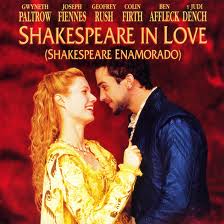
This movie has some of the same glaring errors as Elizabeth (which I watched last week, see previous post), most notably disregard for historical fact when it got in the way of the story. The biggest error was having tobacco plantations in Virginia as a major point in the plot. The movie is set in 1594; I know from our family's vacation to the Outer Banks of North Carolina this past summer that the English were struggling to get a colony established in the New World at that time. Actually, 1594 would be only a few years after John White found the English colony at Roanoke deserted. It would be another 10 years before the Jamestown colony was established. So the threat of having the heroine of the story about to be married off and shipped to Viriginia was completely bogus.
Saturday, November 19, 2011
A Quick Study in Creating Empathy
I was thinking some more about my post of the other day, and I wondered if perhaps I wasn't over-reacting a bit in thinking I was so disappointed by the ending of Page from a Tennessee Journal. I decided to do some examination of the area that seemed to be the major problem: my lack of investment in the characters' emotional lives. To do this, I thought it would be most appropriate to compare a scene from Page to a scene in a book with characters I did care about. I chose Ann Turnbull's Alice in Love and War, comparing Alice Newcombe and Page's Eula Mae McNaughton. There is a scene in each book in which each woman suspects that the man she loves and has devoted herself to may be less than faithful. Of course, it's not a perfect comparison; Eula Mae is the wife who is being wronged, while Alice is the "other woman." But I thought it would be as close as anything I could find, and I want to be fair.
Warning: This is going to be a LONG post because I need to quote some passages from the books to make the comparison.
Warning: This is going to be a LONG post because I need to quote some passages from the books to make the comparison.
Saturday, September 17, 2011
A Case Study in "Feeling"
Agent Mary Kole had an interesting post over at Kidlit.com this week in which she talked about a writer's number one objective: To make your reader feel. Her post made me think of a song I'm really liking right now exactly because I think it does such a good job of conveying feelings without hammering us over the head and telling us how the song's persona feels. We have to fill in the gaps - to feel it ourselves.
The song is Nothing by The Script, and I think it is the best song at portraying misery that I've heard in a long time - maybe ever. (Of course, The Script is an Irish band, and I joke that no one knows how to be miserable like the Irish.) (That is a joke - I love you, Irish!) Here's the video for the song:
The gist of the song is that a guy has broken up with his girlfriend (or been dumped, more likely) and his friends decide to "help" him by taking him out for drinks. After one too many, he decides he will call her and say he still loves her, which will solve everything, right? Except...all he hears on the other end of the line is nothing.
Cool enough as a setup for a song. But since I am excessively high in need for cognition (that's a joke for my Persuasion Theory students, should any of them be happening to read this), I couldn't leave it at that.
The song is Nothing by The Script, and I think it is the best song at portraying misery that I've heard in a long time - maybe ever. (Of course, The Script is an Irish band, and I joke that no one knows how to be miserable like the Irish.) (That is a joke - I love you, Irish!) Here's the video for the song:
The gist of the song is that a guy has broken up with his girlfriend (or been dumped, more likely) and his friends decide to "help" him by taking him out for drinks. After one too many, he decides he will call her and say he still loves her, which will solve everything, right? Except...all he hears on the other end of the line is nothing.
Cool enough as a setup for a song. But since I am excessively high in need for cognition (that's a joke for my Persuasion Theory students, should any of them be happening to read this), I couldn't leave it at that.
Thursday, September 8, 2011
A Sense of Intimidation
After finishing the final draft of Book One (which is called Dancing in the Checkered Shade, by the way), I was forced by the day job to take a couple of days off. Today I started reading the first draft of the followup, most of which was written while I was on sabbatical from the day job, from January-May 2010. I haven't allowed myself to look at that draft since that time, although I've thought about it quite a bit. As I remembered it, I had done a pretty darn good job, if I do say so myself.
Well....let's say there are some pretty darn good spots mixed in with some pretty mediocre spots. One thing I noticed immediately is the amount of "telling" -- yes! After all my grumping about that writing style on this blog! Fortunately, this is a first draft and I can fix that problem. But, wow, that will take some thinking and some real writing work. I also never completely finished the story, so I have to write the first draft of the last few chapters.
Overall, I am pleased with it as a beginning. It's really sort of funny - there are so many differences to DitCS (see, I even have an acronym!). For one thing, it was a lengthy struggle to cut DitCS down to a reasonable length; so far, this second book has 15 chapters (of probably 18) and fewer than 50,000 words. That's too short, really. I hope the conversion from "telling" to "showing" will help. I know it's going to be some work, but as one friend put it, it's "lovely" work.
To be honest, there is something else that intimidates me. The same friend asked me, "So what's next for DitCS?" Well....I don't know...... This friend has self-published two books, and she has encouraged me to do the same. That route does have some appeal, although I know I don't have the time to do the promotion needed to give the book a decent chance in the world. And a little part of me still would like to have an agent think it's good enough to request the full manuscript to read (although the mainstream publishing world has some disadvantages, like a short window of opportunity to "make it," that don't appeal to me at all). I don't know....I don't want to be famous, and I don't want to quit my day job (at least not today!). But...it would be kind of cool to have people reading about these characters and loving them as much as I love Will and Susanna, Kit and Nat, Laura and Almanzo, Hannah and Tice.....
Tuesday, September 6, 2011
A Sense of Accomplishment
I may have mentioned at some point that I've been writing a novel. : ) This past Saturday morning, my husband and daughter went spelunking with a friend, and my son was sleeping in after a hard week of high school. So I decided to forego the work I brought home from school to spoil myself by a day of working on the edits for my book instead. Well, I became consumed with the task and ended up spending the entire Labor Day weekend editing (I did go to church, do laundry, and keep the family fed!). Last night around 10:00, I finally typed "The End" and closed the file with a sense that the book was finally finished
It's been a long process. I first had the idea for these characters about 25 years ago, but it wasn't until about seven years ago that I actually started writing. My first draft was 169,000 words, which is down to about 92,000 in the final draft. For a while I was stuck in the middle of the story, unable to explain why some of the scenes were included. But after "killing a few babies" (as the agent blogs call it), I feel satisfied that everything finally ties together into a tight plot package. For the first time, there's nothing I think I need to change.
Of course, I've heard authors say there is always something to change, even after the book is published. But at this moment, I feel pretty happy. And excited, because now I'm going to dive right back in to the first draft of the sequel to this book. That will be fun!
 A quick update on "Try It Out Tuesday": We didn't try anything new for the main dish tonight because the kids had a practice meet for their cross country teams and weren't going to be home to eat. But I did try a new cookie recipe. It's called Orange Chocolate Drops. The story of how I got this recipe is kind of funny. You may remember I said I was going to let my daughter pick the new dish for this week since she didn't like the dishes the other two weeks. So Thursday evening of last week I mentioned to her that she needed to pick something out so I could get the ingredients needed. On Friday, she went to the school library and checked out a big, old cookbook. Then she and one of her friends looked through the book and picked out four recipes, including Five-Cheese Pasta (FIVE cheeses!!!????) made from scratch, not from a jar. This is a cookbook for REAL cooks. Yikes....
One of the four recipes was this cookie recipe. I'm not sure I like it much. I haven't eaten one of them yet (don't want to eat too close to bedtime), but they are sort of small and there weren't really very many (only 2 1/2 dozen) and they seem like they may be sort of dry. My son did try one, and he announced they are "not poisoned" (family joke - someone always has to try the cookies fresh out of the oven to be sure they are safe for everyone else). I'm not sure if that was an endorsement, ha ha.
It's been a long process. I first had the idea for these characters about 25 years ago, but it wasn't until about seven years ago that I actually started writing. My first draft was 169,000 words, which is down to about 92,000 in the final draft. For a while I was stuck in the middle of the story, unable to explain why some of the scenes were included. But after "killing a few babies" (as the agent blogs call it), I feel satisfied that everything finally ties together into a tight plot package. For the first time, there's nothing I think I need to change.
Of course, I've heard authors say there is always something to change, even after the book is published. But at this moment, I feel pretty happy. And excited, because now I'm going to dive right back in to the first draft of the sequel to this book. That will be fun!
One of the four recipes was this cookie recipe. I'm not sure I like it much. I haven't eaten one of them yet (don't want to eat too close to bedtime), but they are sort of small and there weren't really very many (only 2 1/2 dozen) and they seem like they may be sort of dry. My son did try one, and he announced they are "not poisoned" (family joke - someone always has to try the cookies fresh out of the oven to be sure they are safe for everyone else). I'm not sure if that was an endorsement, ha ha.
Sunday, June 12, 2011
June or JK?
Somehow today, the family conversation turned to my writing. (Honest, I wasn't the one who brought it up!) My husband and daughter wanted to hear the synopsis for a middle-grade novel idea that I've mentioned in the past. My husband thinks (and I agree) that it is an idea that is quite possibly marketable, much more likely to be published than the novel I've been working on for the past seven (!) years. He said I ought to start working on it, and that if I could get interest in it, then I might be more likely to get the first one published too.
The problem is, it's going to take a LOT of research before I can start any writing. This idea is another historical, and as you probably would guess from previous posts, I am a hard-liner about historical accuracy. Plus, this story involves actual historical figures quite prominently, which means it's even more important to be accurate. I love doing the research, but....it takes a LOT of time. A lot.
Which brings me to the subject of this post. When I brought up the amount of time needed to do the research and then the writing and the revision and how hard it is to find any time to write, my husband said, "You can't be June Cleaver and Gilbert Parks and JK Rowling all at once." (Gilbert Parks is one of my teaching colleagues who has been teaching for nearly 50 - yes, you read that right - years. For all his years in the business, he is still one of the most energetic and involved teachers I've ever known.) I understood what he was saying - a person can do one thing really well, or a person can stress over trying to do everything well.
I posted his advice on my Facebook page, and very quickly a number of my friends jumped on to say things like "Yes you can!" and "Why not?" I guess they think Jeff is being a male chauvinist, but realistically, he's right. People who are really successful at something tend to devote the lion's share of their time and energy to that one thing. As just one example, how many hours a day did Michael Phelps spend in the swimming pool?
I think my friends are still buying in to the "Superwoman" concept when they say it's possible to be the perfect wife/mother, the perfect employee, the uber-successful writer at the same time. I guess it depends on what your standard for "perfect" is, but in my life, there's just not enough time in the day to be "perfect" in all those roles. This past school year has been super-stressful -- and all I found time to do was be an employee and a mother/housewife, and I was definitely less than "perfect"! Writing fell by the wayside completely. I did some substantial revision when I chaperoned my son on a trip to Chicago in early March; the next time I was able to do any work on my book was late May. I had to go back and re-read the whole thing just so I could remember who the characters are!
What this boils down to, I guess, is that I really appreciate that my husband understands single-minded pursuit of "perfection" and has given me permission, no, encouraged me to go for it. Now whether he still buys into it when there are no clean socks in the drawers.....ha, ha. The two things I always manage to do are keep the family fed and in clean underwear. Dust bunnies off the floor....well.....they'll just have to wait. I have some research to do....
The problem is, it's going to take a LOT of research before I can start any writing. This idea is another historical, and as you probably would guess from previous posts, I am a hard-liner about historical accuracy. Plus, this story involves actual historical figures quite prominently, which means it's even more important to be accurate. I love doing the research, but....it takes a LOT of time. A lot.
Which brings me to the subject of this post. When I brought up the amount of time needed to do the research and then the writing and the revision and how hard it is to find any time to write, my husband said, "You can't be June Cleaver and Gilbert Parks and JK Rowling all at once." (Gilbert Parks is one of my teaching colleagues who has been teaching for nearly 50 - yes, you read that right - years. For all his years in the business, he is still one of the most energetic and involved teachers I've ever known.) I understood what he was saying - a person can do one thing really well, or a person can stress over trying to do everything well.
I posted his advice on my Facebook page, and very quickly a number of my friends jumped on to say things like "Yes you can!" and "Why not?" I guess they think Jeff is being a male chauvinist, but realistically, he's right. People who are really successful at something tend to devote the lion's share of their time and energy to that one thing. As just one example, how many hours a day did Michael Phelps spend in the swimming pool?
I think my friends are still buying in to the "Superwoman" concept when they say it's possible to be the perfect wife/mother, the perfect employee, the uber-successful writer at the same time. I guess it depends on what your standard for "perfect" is, but in my life, there's just not enough time in the day to be "perfect" in all those roles. This past school year has been super-stressful -- and all I found time to do was be an employee and a mother/housewife, and I was definitely less than "perfect"! Writing fell by the wayside completely. I did some substantial revision when I chaperoned my son on a trip to Chicago in early March; the next time I was able to do any work on my book was late May. I had to go back and re-read the whole thing just so I could remember who the characters are!
What this boils down to, I guess, is that I really appreciate that my husband understands single-minded pursuit of "perfection" and has given me permission, no, encouraged me to go for it. Now whether he still buys into it when there are no clean socks in the drawers.....ha, ha. The two things I always manage to do are keep the family fed and in clean underwear. Dust bunnies off the floor....well.....they'll just have to wait. I have some research to do....
Tuesday, June 7, 2011
I Want to Write Like Her!!!

I read differently this time than I did as a teen, having studied the art of fiction writing over the years (I had never heard of "show, don't tell" back then!). One of the things I found myself appreciating this time around was the way Speare developed the romantic relationship between Kit and Nat (oops, sorry for the spoiler if there's actually anyone out there who hasn't read this book). Not until the last chapter, like four pages from the end of the book, does Kit realize what she feels for Nat is love. The reader is aware of how good they are for each other long before Kit is. And maybe it's just me, but there's something so satisfying about watching it develop instead of being told it is developing. For example, I found this section amusing:
"She expected that when they reached South Road Nat would turn back, but to her consternation he strode along beside her, and even when she hesitated at Broad Street he did not take the hint. The happy mood of the afternoon was rapidly dissolving in apprehension. Why on earth had Nat persisted in coming too?"Well, we know why!
Later, in what would I suppose be the climax of the story (when Kit is at a hearing to determined if she should be tried as a witch), I got the same thrill reading the following passage that I had the first time I read it:
"Every voice was suddenly stilled. Almost paralyzed with dread, Kit turned slowly to face a new accuser. On the threshold of the room stood Nat Eaton, slim, straight-shouldered, without a trace of mockery in his level blue eyes"...(skip a couple of pages)..."In the warm rush of pride that well up in her, Kit forgot her fear. For the first time she dared to look back at Nat Eaton where he stood near the door. Across the room their eyes met, and suddenly it was as though he had thrown a line straight into her reaching hands. She could feel the pull of it, and over its taut span strength flowed into her, warm and sustaining."She doesn't call it love yet, but as a reader, I'm saying "Yes!" It's just right, in every way.
That's the reaction I want to bring my readers to. They say a person ought to write what he/she would like to read. In that case, I think I need to spend less time on agent blogs and more time really studying what Speare has done, and Janice Holt Giles, and Ann Turnbull, and Lisa Klein. Those are the literary footsteps I want to follow. If I can come close, I'll be happy, even if my work is never published.
(And Ann, if you read this, I'm not sucking up - I mean it!)
Thursday, April 28, 2011
Another Negative Review - And I Hate That
You may think, from reading my posts on this blog for the past months, that I am a negative and difficult-to-please reader. I hope that is not the case, and if it is true, it's not something I've been trying to cultivate. It just seems that several of the books I've read lately have some pretty significant problems in terms of what I've come to view as "good" writing, a view that is learned not only from my years as an English major but through following several blogs by successful literary agents and editors over the past few years. And believe me, I'm disappointed, not satisfied, to be noticing these issues.
My latest disappointment is especially sharp, because it comes from a writer with a top-notch reputation. Scott O'Dell is a HUGE figure in historical fiction, the writer of 20 or more books, the winner of the Hans Christian Anderson Award and the Newberry Award. Heck, he even has an award named after him - the Scott O'Dell Award for Historical Fiction, for the best work of historical fiction for young adults in a given year. I was downright tickled to find a copy of his book The Serpent Never Sleeps at my favorite used bookstore. Colonial America! Jamestown! Pocahontas! What could be better?!
Well....to be honest...this book could be better. The story follows a young woman named Serena Lynn who leaves England to go to the Jamestown settlement with the young man she's madly in love with (even though he has murdered a man and is running from the king). They suffer through a terrible hurricane and spend a very long time stranded on an island in Bermuda before actually making it to Jamestown. Well, Serena makes it - her crushee is lost at sea. Once in Jamestown, Serena takes it on herself to find Pocahontas, since she's the only one who can save the starving colony by convincing her father to give the settlers corn and hold off his attacks. She befriends Pocahontas, survives an attack by unfriendly Indians, and finally marries one of the settlers and stays in the new colony.
Although I might have changed a few things, I'm not arguing with the plot. The story is fine. But the telling of the story seems simply soul-less to me. I honestly didn't care about any of the characters (which I believe to be one of the most fatal flaws a book can make). I found certain plot points (like Serena's first meeting with Pocahontas) to be a little too hard to swallow - the "willing suspension of disbelief" was strained just a bit too far. Even though I finished the book about a day ago and have been mulling it over ever since, I can't identify any overarching theme - the universal truth the readers should be able to take away from the story.
And you know why I think some of these problems plague this book? Once again, it's a matter of "telling" versus "showing." (Yep, here I go again on that!) Here's an example:
Secondly, don't tell us "It was a terrible moment." Give us details that will make us say, "Gosh, that's a terrible moment" in the back of our minds as we are reading. Now, I don't pretend to be a Newberry-Award-winning writer of prose, but think how much more engaging that scene would be if it had gone something like this:
That could be improved with editing, I'm sure, but already I think it's more interesting and builds a sense of character and of what's at stake for those characters better than the original does. Why? Because it shows details that let us surmise what's going on in the characters' heads instead of taking all the fun away by simply telling us.
Some arrogance, eh, rewriting for a Newberry winner? Sometimes lately I've thought I'd like to do that with several of these books that have disappointed me - take the plot line and the basic framework of characters and rewrite the book to show instead of tell. I first had that thought about Pioneer Breed. Now it's this one. You can't copyright ideas, right, only the expression of ideas. So what if I wrote my own book showing the way a girl who runs away to follow her lover to Jamestown is changed by the experience......
My latest disappointment is especially sharp, because it comes from a writer with a top-notch reputation. Scott O'Dell is a HUGE figure in historical fiction, the writer of 20 or more books, the winner of the Hans Christian Anderson Award and the Newberry Award. Heck, he even has an award named after him - the Scott O'Dell Award for Historical Fiction, for the best work of historical fiction for young adults in a given year. I was downright tickled to find a copy of his book The Serpent Never Sleeps at my favorite used bookstore. Colonial America! Jamestown! Pocahontas! What could be better?!
Well....to be honest...this book could be better. The story follows a young woman named Serena Lynn who leaves England to go to the Jamestown settlement with the young man she's madly in love with (even though he has murdered a man and is running from the king). They suffer through a terrible hurricane and spend a very long time stranded on an island in Bermuda before actually making it to Jamestown. Well, Serena makes it - her crushee is lost at sea. Once in Jamestown, Serena takes it on herself to find Pocahontas, since she's the only one who can save the starving colony by convincing her father to give the settlers corn and hold off his attacks. She befriends Pocahontas, survives an attack by unfriendly Indians, and finally marries one of the settlers and stays in the new colony.
Although I might have changed a few things, I'm not arguing with the plot. The story is fine. But the telling of the story seems simply soul-less to me. I honestly didn't care about any of the characters (which I believe to be one of the most fatal flaws a book can make). I found certain plot points (like Serena's first meeting with Pocahontas) to be a little too hard to swallow - the "willing suspension of disbelief" was strained just a bit too far. Even though I finished the book about a day ago and have been mulling it over ever since, I can't identify any overarching theme - the universal truth the readers should be able to take away from the story.
And you know why I think some of these problems plague this book? Once again, it's a matter of "telling" versus "showing." (Yep, here I go again on that!) Here's an example:
(the king's guard has just come on the ship to arrest the man she loves, Anthony Foxcroft) "Anthony and I were standing at the rail, close to the Great Cabin, but someone shut the door and we heard nothing else. It was a terrible moment. If Admiral Somers decided to turn back, Anthony would be given over to the captain of the guards and taken off the ship. Anthony always carried a dagger. He had his hand on it now. But what could he do with it? If the ship turned back, it would be of no use to him. There was no way he could ever withstand a dozen armed guards."First of all, Anthony Foxcroft has to be the most underdeveloped character in this book. I can't for the life of me understand why Serena is attracted to him. He's a spoiled brat who quarrels with one of the king's favorite young gentlemen and who murders a servant in a fit of rage. There's nothing that explains the attraction Serena feels for him that makes her willing to run away from home and risk a scandal and take on the challenges of an unknown, dangerous life. (Maybe he's just really hot...)
Secondly, don't tell us "It was a terrible moment." Give us details that will make us say, "Gosh, that's a terrible moment" in the back of our minds as we are reading. Now, I don't pretend to be a Newberry-Award-winning writer of prose, but think how much more engaging that scene would be if it had gone something like this:
Anthony edged along the rail toward the Great Cabin, and I followed, keeping my hand on the back of his arm as if he might be pulled away from me just by getting closer to the captain of the guards. Just as we came close enough to hear their raised voices, someone shut the door, and I could no longer make out words, only the sounds of argument. I pressed closer to Anthony. My heart was pounding.
"If Admiral Somers agrees to turn back, you'll be given to the captain of the guard," I whispered. "They'll take you off the ship."
I felt his arm stiffen and saw his hand move toward his belt, where I knew he always kept his dagger.
"I'll not go," he said. "They'll not take me."
That could be improved with editing, I'm sure, but already I think it's more interesting and builds a sense of character and of what's at stake for those characters better than the original does. Why? Because it shows details that let us surmise what's going on in the characters' heads instead of taking all the fun away by simply telling us.
Some arrogance, eh, rewriting for a Newberry winner? Sometimes lately I've thought I'd like to do that with several of these books that have disappointed me - take the plot line and the basic framework of characters and rewrite the book to show instead of tell. I first had that thought about Pioneer Breed. Now it's this one. You can't copyright ideas, right, only the expression of ideas. So what if I wrote my own book showing the way a girl who runs away to follow her lover to Jamestown is changed by the experience......
Saturday, December 4, 2010
The Problem of Description

I've read in numerous agent blogs that novels need to be trimmed so that nothing unnecessary to the plot is included. For example, agent Mary Kole gives the following things that should be cut from a manuscript:
- Anything that does not advance our understanding of a character
- Anything that does not advance the plot or raise tension
- Anything that doesn't reveal something new
- Things that are just witty and clever, with no other purpose.
"Hidden in dusty-blue shadows, Elijah sat beneath a fragrant pine, watching a doe drink at the river's lapping edge. Fat-bellied with unborn fawn, she gazed warily around in the twilight and then dipped her muzzle into the water. He stared at the sunset and thought how much Cindy would enjoy the beauty of the sky awash with coral reflected on the rippling water."Or this:
(this comes when they've broken the news to Granny that her son has been killed by Yankee bushwhackers) "Granny took two steps forward. Her voice shook. 'I kept shut fer Caleb's sake. But he's gone now. And thank God you can't hurt him no more!' Ned took her arm as she turned and sat back down. The bedroom door slammed when Viola rushed from the room. Into the silence came the distant hoot of an owl. (my emphasis) 'I'm fine, Ned,' assured Granny through tight lips."It seems to me in both of those cases, the description has nothing to do with accomplishing any of those things Mary Kole outlined. In fact, the hoot of the owl is almost comical thrown into such a dramatically tense moment (actually, there's another one I can't find now that made me laugh out loud because it was so incongruous).
That's not to say every piece of description is meaningless. For example, this description helps establish the desperation of the situation when Cindy discovers her baby has been kidnapped:
"Cindy's heart pounded. She called and called. When she stopped to listen, a drumming woodpecker was the only sound echoing from the hills."So, based on what I've learned by reading the blogs, most description should be left out of a book, unless it is directly contributing to plot or character. But then I argue back with myself that my husband says he likes books that have a lot of description so he can picture the world where the story is taking place. He gives the example of the Shanara books by Terry Brooks (which I haven't read); he jokingly says the first two pages of the first Shanara book is all description.
I know that's what Nancy Dane is doing, trying to establish for readers the character of the world her characters live in. It's a beautiful part of the world, too, and I understand wanting to capture some of that beauty and work it into the story. But it doesn't help with character, and it doesn't help with plot. Does "world-building" give enough justification to put so much in there?
That phrase, "world-building," made me think of Harry Potter, in which Rowling definitely built an alternative world to the one we are so familiar with. So I decided to check out what she did with Harry's first introduction to Hogwarts. Here's her first description of the castle:
"And the fleet of little boats moved off all at once, gliding across the lake, which was a smooth as glass. Everyone was silent, staring up at the great castle overhead. It towered over them as they sailed nearer and nearer to the cliff on which it stood."That's all. She doesn't tell us if the castle is covered with moss, or if it has ten turrets, or if the stones are gray or brown. In the next chapter, she gives us a little more detail:
"She pulled the door wide. The entrance hall was so big you could have fit the whole of the Dursleys' house in it. The stone walls were lit with flaming torches like the ones at Gringotts, the ceiling was too high to make out, and a magnificent marble staircase facing them led to the upper floors."More detail, but still accomplished in two sentences. Three pages later is the longest descriptive passage:
"Harry had never even imagined such a strange and splendid place. It was lit by thousands and thousands of candles that were floating in midair over four long tables, where the rest of the students were sitting. These tables were laid with glittering golden plates and goblets. At the top of the hall was another long table where the teachers were sitting....The hundreds of faces staring at them looked like pale lanterns in the flickering candlelight. Dotted here and there among the students, the ghosts shone misty silver. Mainly to avoid all the staring eyes, Harry looked upward and saw a velvety black ceiling dotted with stars...It was hard to believe there was a ceiling there at all, and that the Great Hall didn't simply open on to the heavens."To me, that feels right. So how's an aspiring writer to know how much description is too much? I like a couple of lines from Kole's post.
"Some things have very little happen in them but they're readable. That's okay, I guess. In the same way that elevator muzak technically counts as a composition. "Readability' is not what we're striving for, though...fill [your manuscript] with important, varied, nuanced and truthful stuff! Because if what you're writing isn't any of that...those are dead words anyway."What do you think? How much description should a book have? Do you like description in books?
Tuesday, November 9, 2010
This is not the Taylor Swift Fan Club, Really
I feel rather self-conscious about writing another post about Taylor Swift, but I discovered her latest song, "Mine," last week (it's only been #1 for nine weeks now, ha ha), and I just really admire the writing in that song. In the course of two verses, three choruses, and a bridge, Swift manages to tell an entire story that conveys plot, backstory, character, and theme. Oh, and it's pretty catchy to sing along to.
In terms of plot, there's nothing especially original about the song - girl meets boy, girl gets boy, girl nearly loses boy, girl keeps boy. But there's an economy to what Swift includes in the story that keeps only the details needed to move the story along to its conclusion. Although she doesn't specifically say what the demons in the backstory are, she gives us enough that we can guess ("Brace myself for the goodbye, cause it's all I've ever known") what are her "parents' mistakes."
Ok, maybe the main reason I like the song is the line in the chorus, "You made a rebel of a careless man's careful daughter." I just think that phrase is put together so well. It has the antithesis thing going for it, but it also seems to me to capture a real sense of the character who is narrating the story. And there's nothing wasted in it - every word contributes.
If only I could write that well....
In terms of plot, there's nothing especially original about the song - girl meets boy, girl gets boy, girl nearly loses boy, girl keeps boy. But there's an economy to what Swift includes in the story that keeps only the details needed to move the story along to its conclusion. Although she doesn't specifically say what the demons in the backstory are, she gives us enough that we can guess ("Brace myself for the goodbye, cause it's all I've ever known") what are her "parents' mistakes."
Ok, maybe the main reason I like the song is the line in the chorus, "You made a rebel of a careless man's careful daughter." I just think that phrase is put together so well. It has the antithesis thing going for it, but it also seems to me to capture a real sense of the character who is narrating the story. And there's nothing wasted in it - every word contributes.
If only I could write that well....
Friday, October 29, 2010
November's Just Around the Corner.....
For some of my friends, November means one thing - NaNoWriMo (for those of you who never heard of it, that's National Novel Writing Month). I've always thought it might be kind of fun to join them in trying to crank out a 50,000 word novel in just a month, but realistically, that's not going to happen while I'm teaching. I've been toying with the idea of trying to finish the last two chapters of my second WiP during the month, but .... inertia is hard to overcome!
Today, though, I came across a link to a different project for November - NaNoReaMo. YA author Natalie Whipple is going to read 3 books a week for a total of 12 during November. Depending on what the books are, that could be just as unrealistic for me as trying to write a novel during the month. I was doing really well on my A-to-Z reading challenge until school started, but now I've stalled. I just finished the "P" book, which leaves me only two months to try to get through 10 books (one of which was supposed to be Undaunted Courage - yikes!).
To write or to read???
Today, though, I came across a link to a different project for November - NaNoReaMo. YA author Natalie Whipple is going to read 3 books a week for a total of 12 during November. Depending on what the books are, that could be just as unrealistic for me as trying to write a novel during the month. I was doing really well on my A-to-Z reading challenge until school started, but now I've stalled. I just finished the "P" book, which leaves me only two months to try to get through 10 books (one of which was supposed to be Undaunted Courage - yikes!).
To write or to read???
Tuesday, October 19, 2010
No Wonder She's So Popular
 As I was washing the dishes tonight and listening to the mp3 player, Taylor Swift's song Fifteen came around in the shuffle. Listening to the lyrics, I thought, "Now THERE'S someone who understands her target audience!" Even though it's been many, many years since I was fifteen, I can still remember the awkward mix of uncertainty and bravado that she sings about. Granted, she's not that far removed from that age, but to be able to verbalize the feelings the way she did is, I think, pretty remarkable. How does a writer go back and remember what was important back then? I wish now I hadn't been so zealous about destroying all the evidence of my teen-aged dorkiness once I got into my twenties - it might have come in handy now that I'd like to write for young adults, ha ha.
Wednesday, October 13, 2010
Another Reason I Love My Kindle
I'm stuck in a seemingly non-ending cycle of grading papers and prepping for classes (with an occasional meeting thrown into the mix), which leaves me no time to work on my own writing. One day I had the brainstorm that I could use the text-to-speech feature of my Kindle to read my book to me during the only time when I'm not doing something else - on the drive back and forth to work, or when I'm on the road to pick up the kids from school or to go to a football game.
I had already taken advantage of the ability to have Amazon convert my Word file so I could put the most recent draft of my manuscript on my Kindle (which is cool enough in and of itself). Listening to it on text-to-speech is a good tool, since I'm noticing some phrases I use too frequently that I never picked up on while reading. It also seems to be helping me think through some continuity problems I thought I might have.
There are some humorous moments, too. For instance, I noticed the robotic female voice referring to one character as what sounded like "Stupid." I listened more closely and realized that was the closest approximation the computer could come up with for the character's real name - "Stewpot." The funniest thing, though, is when the computer encounters a sentence that ends with the word "Pa." Every time, it reads that as "Pennsylvania." It makes for some pretty amusing passages, believe me!
I had already taken advantage of the ability to have Amazon convert my Word file so I could put the most recent draft of my manuscript on my Kindle (which is cool enough in and of itself). Listening to it on text-to-speech is a good tool, since I'm noticing some phrases I use too frequently that I never picked up on while reading. It also seems to be helping me think through some continuity problems I thought I might have.
There are some humorous moments, too. For instance, I noticed the robotic female voice referring to one character as what sounded like "Stupid." I listened more closely and realized that was the closest approximation the computer could come up with for the character's real name - "Stewpot." The funniest thing, though, is when the computer encounters a sentence that ends with the word "Pa." Every time, it reads that as "Pennsylvania." It makes for some pretty amusing passages, believe me!
Friday, September 3, 2010
It's Hard to Follow the Original

Klein did well, in my opinion, of taking the sketchy character of Ophelia from Shakespeare's play and putting credible flesh on her. Ophelia's tale blended reasonably well with Hamlet's tale, although at times I found myself thinking the timeline seemed sort of bizarre. Of course, it's hard to tell from Hamlet what amount of time expired between Hamlet's encounter with the ghost and the eventual gory fencing match. In re-reading the play, I thought it might have been a period of even weeks, which would be one reason Hamlet berates himself so for failing to carry out the revenge his father's ghost demands. In Klein's book, everything seems to happen in a matter of days, or at most, a couple of weeks. It strained my suspension of disbelief a little that all those events - from Shakespeare's original and from Klein's story - could have been compacted into such a brief time.
The thing that bothered me most, though, was the character of Hamlet in Klein's work. He was faithful to Shakespeare's conception of the character, no doubt. But it seemed to me that he was missing some soul. He just seemed sort of flat in Klein's re-telling. In Shakespeare's play, I found Hamlet quite appealing (does that make me weird?) - he's witty, with a sharp and wicked sense of sarcasm that depends on word play and nuance of language (I guess I am weird, if that's what I found appealing!). He's passionate, and yet he's detached; he's paralyzed by indecision, and yet he acts forcefully. He's disdainful of women, and yet that disdain seems to spring from a deep sense of being let down by a woman who mattered. I'm still not convinced he was mad; not to get into Shakespearan criticism here, but Hamlet seems to be the poster boy for what happens when one is re-active rather than proactive. Anyway, his character was very much alive and vital in the play, in every sense of that word.
In Klein's book, Ophelia naturally was the strongest character, since we're seeing the story from her viewpoint. I'm ok with that. I liked what Klein did with her. But I was disappointed in Klein's Hamlet. He just didn't seem exciting enough to inspire Ophelia to be so caught up in him. Maybe that's part of the point. Maybe Ophelia didn't really love Hamlet, but the idea of Hamlet - the handsome, witty prince who is forbidden to her. Lots of girls fall for the equivalent of Hamlet and overlook the Horatios who would be infinitely better for them. I suppose since Hamlet was going to be killed anyway - and we all knew THAT was going to happen - Klein didn't want to waste a lot of narrative energy on him. Or maybe she was hesistant to develop him too much beyond what we already knew from Shakespeare - the perils of using someone else's well-known character.
Another peril exists in trying to speculate beyond the bounds of the original story. Klein's method of having Ophelia escape was definitely in keeping with the spirit of Shakespeare's works. Once Ophelia was safely lodged in the nunnery, though, the story seemed to me to take a weird turn and sort of amble off on a side road filled with deep psychological and religious brambles that try to explicate the sources of all Ophelia's perceived failings at Elsinore. Although it turned out ok, it was just "ok."
To get back to my original premise, it must be hard to take someone else's work and expand it (as Klein did) or link to it in your own story (as Donnelly did with A Northern Light). On the one hand (Klein), there's a risk that audiences won't agree with your interpretations of the original events and characters, and that they won't like your additions. On the other hand (Donnelly), there's the possibility that the original story will seem sort of "tacked on" without enough relevance to the story at hand (I really felt Donnelly could have told the story of A Northern Light without trying to drag Grace Brown back in every few chapters - the link seemed really contrived to me). It must be much harder than trying to create an original story, where you have complete control over everything.
Wednesday, June 16, 2010
Writing and Golf (or, What to Do, What to Do)
(This should be read in a matter-of-fact, non-whiny voice. It is not a pity party.)
I am about this close to calling it quits with trying to get published. And probably not for the reasons you would anticipate. I've been reading some agent blogs lately, and yeah, the numbers are staggeringly discouraging. One agent said he gets about 15,000 queries per year and takes on 3-5 new clients. But that's not what has discouraged me. One agent answered my question about the future of historical fiction honestly by saying, "I won't lie. It's tough." I appreciate her straight answer, and although it's a discouraging answer for me, both as a writer and as a reader, that's not what has discouraged me.
Here's the discouraging part: I've been reading the comments left on those blogs, too, most of which are left by aspiring writers. And there are three attitudes that I'm picking up on that, if they are representative of "the game," just turn me off. First, some people are just rude. It makes me think of what I learned about life in elementary school - some people try to make themselves look good (or in the case of these comments, clever or "with it" or saavy about the world of publishing) by belittling others in replies to those others' comments. I don't know why I'm surprised by that; aspiring writers are a microcosm of the rest of society, and there's a percentage of people in any field who are that way.
Second, I don't like the constant self-promotion (or promotion of one's work, I guess). I know in this competitive environment it's really important to get the word out. And I know that if you don't toot your own horn, no one else is going to do it. But some commentors manage to work in a discussion of their plot or characters no matter what the original topic of the post is.
Finally, and this one bothers me most, no one seems to be listening to anyone else. There may be 100+ comments, but most of them are discrete responses to the original post. Only occasionally does something like a conversation get going. Maybe I misunderstand the purpose of comments and am thinking of something that is more like a forum or discussion board. But I sometimes think the internet has made it all too easy for each of us to have our say without paying any attention to what someone else is saying.
So....back to my original contention, that I think I might quit. I'm not a competitive person. I don't want to have to engage in those sorts of behaviors to "succeed." I don't want to be famous. The only reason I started writing was because I wanted to tell the story. Somewhere along the way, I began to think writing was only worthwhile if it "paid off." I felt too guilty about spending time at the computer instead of playing with my kids or washing dishes if there wasn't going to be a product that could bring in something as return on investment. But you know something? I bet there are millions of golfers who spend lots of time on the golf course but never expect to play professionally. They do it because it is relaxing and enjoyable. Why can't I feel the same way about my writing?
Maybe I should put my story on the Kindle store for 99 cents and be done with it!
(The thing that makes me reluctant to do that, though, is that I might lose the drive to improve the story. If I had put my book out there when I first finished it two/three years ago, it would have been flabby compared to what it is today, when I'm trying to edit it into a form strong enough to attract an agent's attention. But then again, maybe I'm editing the thing to death. I just know that when I go back after a couple of weeks and read the chapters I've trimmed 500 words out of, I realize those chapters are MUCH better than before. It's pretty amazing how virile the language can be when every word is forced to carry a major load!)
I am about this close to calling it quits with trying to get published. And probably not for the reasons you would anticipate. I've been reading some agent blogs lately, and yeah, the numbers are staggeringly discouraging. One agent said he gets about 15,000 queries per year and takes on 3-5 new clients. But that's not what has discouraged me. One agent answered my question about the future of historical fiction honestly by saying, "I won't lie. It's tough." I appreciate her straight answer, and although it's a discouraging answer for me, both as a writer and as a reader, that's not what has discouraged me.
Here's the discouraging part: I've been reading the comments left on those blogs, too, most of which are left by aspiring writers. And there are three attitudes that I'm picking up on that, if they are representative of "the game," just turn me off. First, some people are just rude. It makes me think of what I learned about life in elementary school - some people try to make themselves look good (or in the case of these comments, clever or "with it" or saavy about the world of publishing) by belittling others in replies to those others' comments. I don't know why I'm surprised by that; aspiring writers are a microcosm of the rest of society, and there's a percentage of people in any field who are that way.
Second, I don't like the constant self-promotion (or promotion of one's work, I guess). I know in this competitive environment it's really important to get the word out. And I know that if you don't toot your own horn, no one else is going to do it. But some commentors manage to work in a discussion of their plot or characters no matter what the original topic of the post is.
Finally, and this one bothers me most, no one seems to be listening to anyone else. There may be 100+ comments, but most of them are discrete responses to the original post. Only occasionally does something like a conversation get going. Maybe I misunderstand the purpose of comments and am thinking of something that is more like a forum or discussion board. But I sometimes think the internet has made it all too easy for each of us to have our say without paying any attention to what someone else is saying.
So....back to my original contention, that I think I might quit. I'm not a competitive person. I don't want to have to engage in those sorts of behaviors to "succeed." I don't want to be famous. The only reason I started writing was because I wanted to tell the story. Somewhere along the way, I began to think writing was only worthwhile if it "paid off." I felt too guilty about spending time at the computer instead of playing with my kids or washing dishes if there wasn't going to be a product that could bring in something as return on investment. But you know something? I bet there are millions of golfers who spend lots of time on the golf course but never expect to play professionally. They do it because it is relaxing and enjoyable. Why can't I feel the same way about my writing?
Maybe I should put my story on the Kindle store for 99 cents and be done with it!
(The thing that makes me reluctant to do that, though, is that I might lose the drive to improve the story. If I had put my book out there when I first finished it two/three years ago, it would have been flabby compared to what it is today, when I'm trying to edit it into a form strong enough to attract an agent's attention. But then again, maybe I'm editing the thing to death. I just know that when I go back after a couple of weeks and read the chapters I've trimmed 500 words out of, I realize those chapters are MUCH better than before. It's pretty amazing how virile the language can be when every word is forced to carry a major load!)
Friday, April 30, 2010
The Trouble with Taglines
(February 25, 2010)
I've been reading some blogs lately that have been talking about marketing your novel. The most recent one I read was about having a "tagline", which as I understand it, is sort of like an advertising slogan. I decided I really ought to get cracking and come up with something for my tagline.
The problem is, I am terrible at coming up with pithy sayings that express the heart of what I've written!
First of all, I'm really reluctant to use the word "romance" in a tagline, because in relation to novels, I think that word has become associated with things that simply aren't in my books, although there is definitely romance in them. So how do I tip people off that this is a love story without setting up expectations that won't be met?
Here are some of the ideas I've had and have shot down:
I've been reading some blogs lately that have been talking about marketing your novel. The most recent one I read was about having a "tagline", which as I understand it, is sort of like an advertising slogan. I decided I really ought to get cracking and come up with something for my tagline.
The problem is, I am terrible at coming up with pithy sayings that express the heart of what I've written!
First of all, I'm really reluctant to use the word "romance" in a tagline, because in relation to novels, I think that word has become associated with things that simply aren't in my books, although there is definitely romance in them. So how do I tip people off that this is a love story without setting up expectations that won't be met?
Here are some of the ideas I've had and have shot down:
- "Old-Fashioned Love Stories Never Go Out of Style" - well, there's a quick way to kill interest in the story! Yeah, label it as "old-fashioned".....
- You know, it's good to use an "antithesis" approach, but "Regular people, unusual love" just brings up some pretty bad connotations, ha ha....
- "Romance and History on the American Frontier" - ok, that works for the current projects (except I used that "romance" word), but the next project I have in mind is not a love story and isn't set on the frontier. I don't want to have to be coming up with a new tagline to "brand" myself with every new book (ugh)!
- "Character-driven historical fiction" - yawn...
- "Books you'll like, I promise!" - Ok, I think I'm getting desperate....
A Motivation Problem
(May 24, 2009)
No, it's not my motivation that's the problem this time...I'm trying to understand what would make one of my characters act the way he does, and I would welcome any help.
This is from my second book, in which the protagonist was illegally squatting on Indian land and was evicted by the U.S. Army. He's currently living in a town on the side of the river the government gave to whites. The standard of living he and his family are experiencing is considerably higher than the one he had on his illegal farm. Yet he's pining for that piece of land.
What would make someone be so fixated on something like the land? I'm having some trouble understanding the character because I am much more practical than that, living by a sort of "get over it" mantra. Some of the possible motivations I've offered to myself include 1) he likes the landscape better than that south of the river (but it's not THAT different!), or 2) it reminds him of home (but again, it's not THAT different). So why can't he just get over it and say, "It's not that different, I'll just find a spot south of the river?" It's important to the plot of my story that he be fixated on living north of the river, because that's where the main conflict comes in. White people coveted this land the government had given to the Cherokees, and they put pressure on the politicians to move the Cherokees out--something that didn't take a tremendous amount of pressure, I might add.
Anyone have any thoughts? I greatly appreciate any help!
No, it's not my motivation that's the problem this time...I'm trying to understand what would make one of my characters act the way he does, and I would welcome any help.
This is from my second book, in which the protagonist was illegally squatting on Indian land and was evicted by the U.S. Army. He's currently living in a town on the side of the river the government gave to whites. The standard of living he and his family are experiencing is considerably higher than the one he had on his illegal farm. Yet he's pining for that piece of land.
What would make someone be so fixated on something like the land? I'm having some trouble understanding the character because I am much more practical than that, living by a sort of "get over it" mantra. Some of the possible motivations I've offered to myself include 1) he likes the landscape better than that south of the river (but it's not THAT different!), or 2) it reminds him of home (but again, it's not THAT different). So why can't he just get over it and say, "It's not that different, I'll just find a spot south of the river?" It's important to the plot of my story that he be fixated on living north of the river, because that's where the main conflict comes in. White people coveted this land the government had given to the Cherokees, and they put pressure on the politicians to move the Cherokees out--something that didn't take a tremendous amount of pressure, I might add.
Anyone have any thoughts? I greatly appreciate any help!
The Problem of History
(May 6, 2009)
There's been debate recently in some of the blogs I follow over the issue of accuracy in historical fiction. Since I've said before that realism and historical accuracy are important to me in my writing, I'm not going to rehash that debate. My purpose in this post is to discuss the difficulty entailed in achieving that historical realism.
The catalyst that got me thinking about this comes from my work on my second book. The protagonist has been kicked off the land where he was squatting illegally, and now he needs work of some kind so he can support his family. I've been trying to reason through what type of work for hire would be available for a man on the frontier in the early 19th century. I decided it would be helpful to know more about the town where this story is supposed to take place (it's an actual place). So I went by the "local history" section of the public library.
The trip proved to be an exercise in frustration. Granted, I didn't have a lot of time to look (had to pick up the kids after school), but all I found were two articles in the state's historical quarterly and two books written in the 1940s and 1950s by the same man. The thing that was frustrating about those sources was that they were written in such a subjective manner that I'm not sure I can trust the information in them to be true. The standards of academic research that I've had drilled into my head through my profession were nowhere to be seen in these articles; there was no citation of sources and little effort to corroborate stories that were given. I found one story that I thought was probably of dubious origin (kind of a "wise old Indian" fable) that was repeated in a later article - I'm guessing the original article was the source.
Beyond the lack of objectivity in the sources, I had another problem - the content was all rather vague. There were some tantalizing tidbits about a store owned by a man named Saugain, and mention of twin villages on opposite sides of the river (Indians on the north, whites on the south), but none of it gave anything specific that I could tie my narrative horse to.
Fortunately, my sister dabbles in genealogy. She and I had been talking about my writing over lunch (bless her, she always lets me talk about it and acts like it is SOOOO interesting!). When I got home in the afternoon, she had sent me a link to the Government Land Office website, which had surveys dating back to 1820. It was a wonderful site! It doesn't tell me everything I need to know, but it did solve one plot problem I was anticipating.
The thing is, I guess I will have to piece together a picture of the history of the area from sources like the old surveys, census records, the records of the territorial government, and accounts from the one newspaper in the territory. There are apparently no surviving diaries or personal letters. I guess the people on the frontier were too preoccupied with trying to live to worry about leaving a record behind for later generations. I know that I don't consciously leave "records" for future generations; I don't really think of the time I'm living in as "history." I'm sure it was the same for those early pioneers. Thank goodness for government red tape, or there wouldn't be anything to give us insight into their lives!
There's been debate recently in some of the blogs I follow over the issue of accuracy in historical fiction. Since I've said before that realism and historical accuracy are important to me in my writing, I'm not going to rehash that debate. My purpose in this post is to discuss the difficulty entailed in achieving that historical realism.
The catalyst that got me thinking about this comes from my work on my second book. The protagonist has been kicked off the land where he was squatting illegally, and now he needs work of some kind so he can support his family. I've been trying to reason through what type of work for hire would be available for a man on the frontier in the early 19th century. I decided it would be helpful to know more about the town where this story is supposed to take place (it's an actual place). So I went by the "local history" section of the public library.
The trip proved to be an exercise in frustration. Granted, I didn't have a lot of time to look (had to pick up the kids after school), but all I found were two articles in the state's historical quarterly and two books written in the 1940s and 1950s by the same man. The thing that was frustrating about those sources was that they were written in such a subjective manner that I'm not sure I can trust the information in them to be true. The standards of academic research that I've had drilled into my head through my profession were nowhere to be seen in these articles; there was no citation of sources and little effort to corroborate stories that were given. I found one story that I thought was probably of dubious origin (kind of a "wise old Indian" fable) that was repeated in a later article - I'm guessing the original article was the source.
Beyond the lack of objectivity in the sources, I had another problem - the content was all rather vague. There were some tantalizing tidbits about a store owned by a man named Saugain, and mention of twin villages on opposite sides of the river (Indians on the north, whites on the south), but none of it gave anything specific that I could tie my narrative horse to.
Fortunately, my sister dabbles in genealogy. She and I had been talking about my writing over lunch (bless her, she always lets me talk about it and acts like it is SOOOO interesting!). When I got home in the afternoon, she had sent me a link to the Government Land Office website, which had surveys dating back to 1820. It was a wonderful site! It doesn't tell me everything I need to know, but it did solve one plot problem I was anticipating.
The thing is, I guess I will have to piece together a picture of the history of the area from sources like the old surveys, census records, the records of the territorial government, and accounts from the one newspaper in the territory. There are apparently no surviving diaries or personal letters. I guess the people on the frontier were too preoccupied with trying to live to worry about leaving a record behind for later generations. I know that I don't consciously leave "records" for future generations; I don't really think of the time I'm living in as "history." I'm sure it was the same for those early pioneers. Thank goodness for government red tape, or there wouldn't be anything to give us insight into their lives!
Subscribe to:
Posts (Atom)