The future of water is black - Black as coal.
Longwall Mining under rivers and aquifers is totally unsustainable, and against the best interests of society as we know it.Humans have not evolved to drink coal – we need water.
What is Longwall Mining?
Longwall Mining is an underground mining technique using a huge rotary cutter (“shearer”), on a rail system, which extracts coal from a seam in continuous “faces” up to 300 metres wide. Each “panel” of removed coal may be as long as 2 kilometres. The height of the “shearer” is adjusted to the coal seam being extracted, but in the Illawarra region it averages approximately 2-3 metres high.
Longwall Mining machine, with "shearer" and rails.
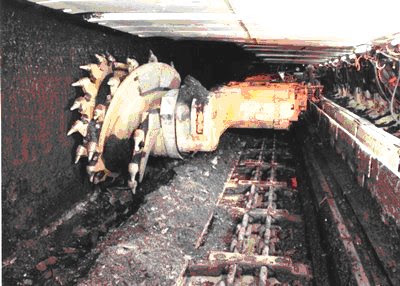
In effect it cuts out an underground “room” as wide as 3 football fields are long, and extending for 2 kilometres in length. That is for each single panel. Panels are normally laid out in series, separated by walls of coal, known as “chain pillars”, which vary in thickness from 20 to 50 metres wide.
As mining progresses, the roof of the excavated area is allowed to collapse into the void (known as a “goaf”) behind where the shearer has been working. A collapse zone is formed above the extracted area. Above the collapse zone is a fractured zone where the permeability is increased to a lesser extent than in the collapse zone. Above this level, the surface strata will crack as a result of bending strains, with the cracks varying in size according to the level of strain, thickness of the overlying rock stratum and frequency of natural joints or planes of weakness the strata (Holla and Barclay 2000). The principal surface impact of underground coal mining is subsidence (lowering of the surface above areas that are mined).
Diagram of Longwall Mining - BHP.
(Click to enlarge - there is a tiny figure of a miner there - for scale).
 The following notes have been extracted from the NSW Scientific Committee’s declaration of Longwall Mining as a Key Threatening Process under Schedule 3 of the NSW Threatened Species Conservation Act 1995.
1. Longwall mining occurs in the Northern, Southern and Western Coalfields of NSW. The Northern Coalfields are centred on the Newcastle-Hunter region. The Southern Coalfield lies principally beneath the Woronora, Nepean and Georges River catchments approximately 80-120 km SSW of Sydney. Coalmines in the Western Coalfield occur along the western margin of the Sydney Basin. Virtually all coal mining in the Southern and Western Coalfields is underground mining.
2. Longwall mining involves removing a panel of coal by working a face of up to 300 m in width and up to two km long. Longwall panels are laid side by side with coal pillars, referred to as "chain pillars" separating the adjacent panels. Chain pillars generally vary in width from 20-50 m wide (Holla and Barclay 2000). The roof of the working face is temporarily held up by supports that are repositioned as the mine face advances (Karaman et al. 2001). The roof immediately above the coal seam then collapses into the void (also known as the goaf) and a collapse zone is formed above the extracted area. This zone is highly fractured and permeable and normally extends above the seam to a height of five times the extracted seam thickness (typical extracted seam thickness is approximately 2-3.5 m) (ACARP 2002). Above the collapse zone is a fractured zone where the permeability is increased to a lesser extent than in the collapse zone. The fractured zone extends to a height above the seam of approximately 20 times the seam thickness, though in weaker strata this can be as high as 30 times the seam thickness (ACARP 2002). Above this level, the surface strata will crack as a result of bending strains, with the cracks varying in size according to the level of strain, thickness of the overlying rock stratum and frequency of natural joints or planes of weakness in the strata (Holla and Barclay 2000).
3. The principal surface impact of underground coal mining is subsidence (lowering of the surface above areas that are mined)
Damage to some creek systems in the Hunter Valley has been associated with subsidence due to longwall mining. Affected creeks include Eui Creek, Wambo Creek, Bowmans Creek, Fishery Creek and Black Creek. Damage has occurred as a result of loss of stability, with consequent release of sediment into the downstream environment, loss of stream flow, death of fringing vegetation, and release of iron rich and occasionally highly acidic leachate. In the Southern Coalfields substantial surface cracking has occurred in watercourses within the Upper Nepean, Avon, Cordeaux, Cataract, Bargo, Georges and Woronora catchments, including Flying Fox Creek, Wongawilli Creek, Native Dog Creek and Waratah Rivulet. The usual sequence of events has been subsidence-induced cracking within the streambed, followed by significant dewatering of permanent pools and in some cases complete absence of surface flow.
Subsidence associated with longwall mining has contributed to adverse effects (see below) on upland swamps. These effects have been examined in most detail on the Woronora Plateau (e.g. Young 1982, Gibbins 2003, Sydney Catchment Authority, in lit.), although functionally similar swamps exist in the Blue Mountains and on Newnes Plateau and are likely to be affected by the same processes. These swamps occur in the headwaters of the Woronora River and O'Hares Creek, both major tributaries of the Georges River, as well as major tributaries of the Nepean River, including the Cataract and Cordeaux Rivers. The swamps are exceptionally species rich with up to 70 plant species in 15 m2 (Keith and Myerscough 1993) and are habitats of particular conservation significance for their biota.
Flora and fauna may also be affected by activities associated with longwall mining in addition to the direct impacts of subsidence. These activities include clearing of native vegetation and removal of bush rock for surface facilities such as roads and coal wash emplacement and discharge of mine water into swamps and streams. Weed invasion, erosion and siltation may occur following vegetation clearing or enrichment by mine water.
Source: “Alteration of habitat following subsidence due to longwall mining as a KEY THREATENING PROCESS” NSW Scientific Committee
http://www.nationalparks.nsw.gov.au/npws.nsf/Content/longwall_mining_ktp
*** *** *** *** ***
What has happened since this declaration was published in 2005? Business as usual, in the mining industry, that's what.
The Dept of Environment and Climate Change (formerly DEC) has done the right thing (in making this declaration), but it is an appalling indictment of the decision makers in the NSW Government, and particularly the Mining Department and the Department of Planning, that they have allowed, indeed promoted, the use of these disastrous mining techniques under the Rivers which are the catchment for Sydney's water supply.
When the estimated 91% of the Illawarra Catchment has been undermined (estimated at some 20 years), what will Sydney do for water, then?
 This map shows coal leases under the Illawarra Catchment 5 dams and rivers (Source: NSW Dept of Planning)
The DECC as a "Toothless Tiger".
Don't get me wrong, I support what they have written. But have they really exercised their full powers under the Threatened Species Act to actually prevent damage being incurred? Or have they just issued a "determination" - and left it at that?
*****
These are just some of the powers available to be exercised by DECC:
Interim Protection Order: Minister for the Environment may make an interim protection order for a period of up to two years over an area of land that has natural, scientific or cultural significance. The Minister may also make an interim protection order on land where the DEC Director-General intends to exercise functions relating to threatened species, critical habitat, or declared critical habitat under the NP&W or TSC Acts.
Stop Work Order: The Director-General of DEC may make a stop work order for a period of 40 days if an action is being, or is about to be carried out that would harm a threatened species, population or ecological community or it’s habitat. These orders can be renewed for 40-day periods as required.
*****
I haven't heard of any such powers being used to stop Longwall Mining by BHP Billiton (or their subsidiaries) or their international mining conglomerate allies, such as Metropolitan (Peabody Pacific Pty Ltd) or Gujarat NRE.
Have you?


 Here is a group photo of the Rivers SOS meeting, taken after our meeting adjourned.
 After dinner (and a very fine dinner it was), we were entertained by two very fine musicians, Mirabai Peart (who has been a member of the Rivers SOS group for some time) and Mahesh Radhakrishnan. They play together in "Tapestries of Sound"
 Here Mahesh is playing a Thamboura.
 After the music, we had an informal party.

 Next morning, the resident Swamp Wallaby was up nice and early
 After breakfast (his and ours) we went out to explore the local area.
 Here is a zoom shot showing the river flowing below.
 While walking back I noticed this plant, which I think is a Crowea exalata.
 Then we drove over to the West Cliff Colliery.
 While walking back I noticed this plant, which I think is a Crowea exalata.
 Then we drove over to the West Cliff Colliery.
 Then we went to "Marhnyes Hole", below Appin.
 Here, Julie is explaining the damage which occurred after subsidence caused by BHP longwall mines. There has been much "remediation" work in this area. And, after a week of rain, the river was flowing reasonably well. Neville and Amanda are looking on.
 We hope to meet again, next time, at Stroud, to find out more about the efforts of the locals to save Mammy Johnson's River.


