Christmas Bells

Christmas Bells
Christmas Bells - Blandfordia nobilis
Showing posts with label Cloud_Farm. Show all posts

Saturday, November 02, 2013

"A place called Robertson" film has been released on Video

The video of Tony and Anna Williams movie "A place called Robertson" has been released.
You can watch the trailer on the following link.
http://vimeo.com/52603151


Tony and Anna Williams filming
at the Robbo Show
This is a Blog post I made about the Movie being made.
And here is a brief post about the launch of the Movie, on 25 March 2013.

And now you can purchase the Video on line.


Knight's Hill morning cloud formation
a shot taken from Steve and Celeste's place
"Cloud Farm"
This image was incorporated in Tony and Anna's film.
My full set of these images are on my Blog.
I thoroughly recommend it (even though I do feature in the movie, a bit).

New-comers to Robertson, and anyone who has family here will enjoy the movie, and remember, folks, Christmas is coming.
(End of my blatant plug for Tony and Anna's excellent film).

Monday, April 29, 2013

Local Lilly Pilly tree, flowers, fruit

The local Lilly Pilly was known as Acmena smithii when I moved to Robertson. Unfortunately, it is now back with the difficult-to-spell Syzygium tribe, so it is now Syzygium smithii (though PlantNET does not seem to realise it).

The local plants normally have creamy white fruit, but some (few) have pale pinkish/purple fruit. None of the local plants have the strongly coloured Lilly Pilly fruit typical of most of the other members of that genus.

Here is a shot of a single tree, at my friends' property Cloud Farm. There is a large Eucalypt behind the Lilly Pilly. The dense, dark green leaves and white buds and flowers are the give-away.


Syzygium smithiitree at Cloud Farm
 Here are the flowers (taken in December 2011).
Syzygium smithii Buds and open flowers.
These small flowers show some structural similarity
to Eucalypt flowers.
But they lack the distinctive "cap" of Eucalypts.

Typical creamy-white fruit of the local Lilly Pilly plants
Fresh fruit (taken two days ago)
Syzygium smithiiThese fruit are on the same tree as the buds and flowers
But the photos are two years apart.
But the months are characteristic
December for flowering
Late April/May for fruiting.
There is just a bit of pinkish spotting on these fruit.

This tree, being overlooking the escarpment, and hence warmer than Robertson proper, fruits just a little earlier than the best stands of local Lilly Pilly trees on Fountaindale Road, and at Tony and Anna's place.
Leaves of Syzygium smithii


Thursday, January 19, 2012

Nature at work, making new things

The Oriental Liliums in my front garden bed are back in flower. It happens every year, regular as clockwork, it seems. Checking my previous posts it is apparent that I have written about them on 17 January 2010, and then again on 15 January 2011, and now today, 19 January 2012.  There are two colour forms (cultivars, or hybrids) growing together. The pink one opens first, and the white several days later.

White Oriental Lilium "Casablanca"

Pink Oriental Lilium

This is a young plant, growing between the other two varieties. It is its first year of flowering, and, it is a naturally occurring hybrid between the other two. It is a delicate blush pink. This is noted as Part 1 of my theme for today - "making new things".
Hybrid Oriental Lilium (naturally pollinated, and self-sown)


This Grey Fantail is on the lookout for insects (which are plentiful in Robertson at present).
You can see a photo of one of these birds in the hand
from a previous post from a bird banding trip to West Wyalong.
It shows the fan-shaped tail from which they get their name.
The fan tail and round wings give these birds amazing agility in the air
which they need in order to catch their insect prey.
Grey Fantail on a bare branch, on lookout for insects

Back to the theme of today's post - "making new things".

There is a pair of Grey Fantails with a nest at my friends' house, Cloud Farm.
Celeste and I saw them go to the nest several weeks ago, 
and so I went back today to monitor their progress.
Both birds are sharing nesting duties of sheltering tiny young, 
and alternately feeding them.
Grey Fantail on nest duty, sheltering its newly hatched chicks
This bird is the male, judging by his clearly marked eyebrows and dark colour.
I love Grey Fantails nests, for they are so neat.
Made mostly of cobwebs (for binding strength)
with an inner structure of grass.
They always seem to make a "tail" under the nest, 
which gives the nest its "wine-glass" appearance.
Quite why they do that is a mystery to me.
Male Grey Fantail on "wine-glass"shaped nest.
I also have a theory that Grey Fantails use cobwebs in nest construction, to match their own grey colour, for the closely related Rufous Fantail builds a similar nest, using brownish plant fibres (and some cobwebs). But the overall nest colour matches the birds brownish body colours when on the nest.

You can see two photos of a Rufous Fantail's brown nest on a post from several years ago. I apologise for the poor quality of one of those images, but together, they serve to illustrate my point.

Monday, December 26, 2011

Verreaux's Tree Frog

I found this little guy on the kitchen floor in Steve and Celeste's kitchen.
Because Frogs have moist skin, they are not good at living in houses. This little guy had caught up a bit of dust and some wind-blown seeds, which were trailing along behind it, making it barely able to move.

As soon as I realised the nature of its predicament, I grabbed a glass of water, and dumped it in there.

Verreaux's Tree Frog - in a glass, and seen from above.

It took a moment of two to recover then immediately tried to climb out.
Some level of success, therefore, in my plan.
Also that told me it was a Tree Frog (as they have much better pads than swimming frogs).

I covered the glass so I could hobble away to grab my camera, and turn down the flash so it would not get blinded.

There are two Frog sites which cover this species of Frog.
I have used these two sites to conclude that my Frog is the Whistling Tree Frog, Verreaux's Tree Frog
(Litoria verreauxii)
http://frogsaustralia.net.au/frogs/display.cfm?frog_id=190
http://frogs.org.au/frogs/species/Litoria/verreauxi/


Note the small pads on the toes,


Note the reddish pink colour inside the legs (not yellow)
Verreaux's Tree Frog making its way back home

The call made by this frog is quite familiar to me, even though I have never seen this species before.
You can listen to it by clicking on the link at this page. 
http://frogs.org.au/frogs/species/Litoria/verreauxi/
Click on the hear it now link on that page.
The calls are copyrighted, so I am directing you to that site.
It is very quick to open, and just lasts about 7 seconds to play through.

Sunday, December 18, 2011

More photos from Cloud Farm

While still recovering, at Cloud Farm I witnessed yet another stunning sunrise effect
of early morning light on the flanks of Knights Hill.
Taken at 5:51 AM on Saturday morning.
Sunrise lighting the Illawarra Escarpment below Knights Hill
I went and checked the progress of the nestlings
of the Superb Fairy Wrens.
At least 3 nestlings all bunched up
with wing feathers developing. 
Superb Fairy Wren nestlings - in nest.

While I was out and about, taking photographs, an Australian Land Leech 
presumably Gnatbobdellida libbata))
managed to attach itself to me.
As usual, I was not aware it was attached until it dropped off.
I heard it hit the floor - with a thump.
I was sufficiently impressed with its size that I took several images, before I released it.
Leech - bloated after feeding on my wrist. Felt-tip pen cap for scale
Presumably it felt that I had needed some "medicinal bleeding" to aid in my recovery.
I actually don't agree, but it was only "doing what comes naturally", 
so I could hardly hold a grudge against it, could I?
Leech making its escape, over bricks


Friday, December 16, 2011

RECOVERY AT CLOUD FARM

My friends Steve and Celeste are caring, healing people.
Prior to my recent Hip Replacement operation, they invited me to come to stay with them at Cloud Farm, on the edge of the escarpment, east of Robertson, to help me in my recovery. I accepted their gracious offer with alacrity. Today you will see why.
Cloud Farm - the residence

Knights Hill seen from Cloud Farm
Zoomed view of Knights Hill - from Cloud Farm

My favourite aspect of the view - the "brows" of the escarpment.
Detailed view of the cliffs on the escarpment


Hydrangeas and my favourite statue, of Aegeus looking out to sea, awaiting his son's return.
Aegeus


Female Superb Fairy Wren leaving nest bush

Male Superb Fairy Wren, looking gorgeous!

Male SFW approaching nest


A brilliant tall blue Salvia


Solanum tuberosum flowers (Potato)

morning light over Knights Hill

Echoes of William Blake's "Ancient of Days"
Hibbertia scandens
Hibbertia scandens

Monday, December 07, 2009

Swamp Wallaby and Hawk Moth

Here is a lovely Swamp Wallaby I found enjoying a feed in the long grass up on Mt Murray on Saturday afternoon. This was in the paddock adjacent to Celeste and Steve's studio at Cloud Farm.
It has a lovely warm red colour on on the back of its head and between its ears.This is a wider view to give you a sense of the lush grasses on which it was feeding.I am posting this as my brother brendan sent me an email a few nights ago about Hawk Moths. I replied that I had not seen any this year.

And lo and behold, tonight's batch of moths included this fine specimen.
They always remind me of Art Deco designed toy aeroplanes or even sleek 1930s race cars. It is a very fat Hawk Moth, but I am unable to determine which species it might be. The "Pale Brown Hawk Moth" does not appear to have the facial markings this one shows in the second image.
Here is a close-up view of the head.
The Moth is clinging on to my jacket. The antennae are clearly visible protruding from the top of the head, and the front feet are pointing forward.
I like the two prominent white lines starting at the front of the head and diverging up and over the eyes.
The mousy brown "fur" looks very soft.
I just cannot help admiring Hawk Moths when they turn up here.

Tuesday, December 01, 2009

Cloud Farm views (of Knights Hill)

My friends Steve and Celeste live on Mount Murray at a property poetically named "Cloud Farm". From their hilltop one can look south towards Knights Hill, where the telecommunications towers for the Illawarra region are located.

Afternoon light shining on Knights Hill.
This was taken on the Winter Solstice.
The ocean is just visible in the background,
but it blends into the line of clouds out to sea.
The clifflines of the Illawarra Escarpment are highlighted
by the afternoon light.
Several weeks ago I went and had dinner at their house, after a big day out Orchid hunting with ANOS. Anyway, in a state of near-exhaustion I stayed over at their house, after dinner.

Next morning I woke just on sunrise - because they get so much light into their house.

I stumbled out of bed and looked outside and found them out and about already - rejoicing in the wonderful cloud and light effects of fog on the plateau near Carrington Falls and just topping Knights Hill.
This image was taken from the same place as the first image.
Its hard to imagine.
Check the trees on the left and foreground.
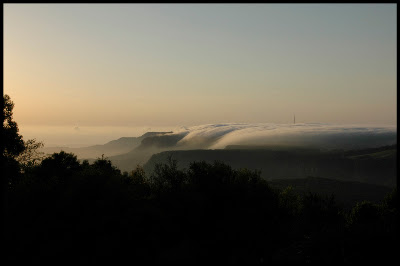
The TV towers are clearly visible protruding from the seemingly "flat" cloud of fog. In fact this hill is quite high, over the Illawarra Escarpment to the east (left) and it also drops away quite sharply (but nothing like as as severely) to the west (right) onto a sandstone plateau around Carrington Falls. One cannot see any of these details below the thick fog.

This image appears to me as something from Antarctica.
Two separate TV Towers (not quite in line - from this direction).
They are probably about 1 km apart, on top of Knights Hill.
Taken with the 300mm lens.
More interesting, to me, was the way in which the fog was behaving at the eastern edge of the escarpment.
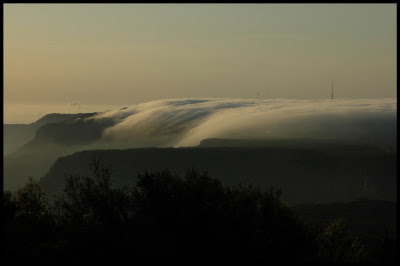
The cloud was behaving as a glacier does, only with far greater fluidity. You can see the cloud breaking down (disintegrating), after it tumbles down off the cliffline.
Click to enlarge to see the full effect.

At the end of the plateau/cliff line, the cool mountain air was falling down over the edge, as the air on the coastal escarpment started to rise.

The circumstances created an almost circular pattern of air movement (the hot air rising, sucking the cold air (above it) down to fill the pressure imbalance thus created).

As the sun rose higher in the sky, it created this lovely effect of lighty behind the large Brown Barrel Eucalypt.
You will all be pleased to know that I then went back to bed for another hour, to "wake" at a more civilised hour. That comment is just for "Mick's" benefit, as she is always up and about early - looking for waders at "Sandy Straits and beyond". She knows that I am a night person. We often nearly cross over with our comments - me before I go to bed, and she as she starts the day.

EDIT:
Thanks to Mosura of Nature of Tasmania for a comment, in which he provided the technical name of the cloud behavour I was reporting.
Orographic Clouds
I knew there was a specific name for these louds, but could not remember it. The following extract - in red - describes the cloud movement I was able to witness.
.
"Orographic clouds develop in response to the forced lifting of air by the earth's topography (mountains for example).
"Air passing over a mountain oscillates up and down as it moves downstream. If the air lifts upward and cools through expansion as it rises to its saturation temperature during this process, the water vapour within condenses and becomes visible as a cloud.
"Upon reaching the mountain top, the air is heavier than the environment and will sink down the other side, warming as it descends. Once the air returns to its original height, it has the same buoyancy as the surrounding air. However, the air does not stop immediately because it still has momentum carrying it downward. With continued descent, the air becomes warmer than the surroundings and begins to accelerate back upward towards its original height. It is during the upper-most ascent phase of this cycle that clouds develop. In regions where air is descending, skies are clear."
Source: Cloud Structures: "Orographic Clouds"

Saturday, December 27, 2008

More flowers from Cloud Farm

Here are some photos I took on Christmas Day, when at "Cloud Farm". Several are of garden plants, but several are of weeds (such as the Dandelion seed head from yesterday). I do not mean to create the wrong impression by showing lots of weeds, but several of these images are of weeds which just happen to be remarkably beautiful flowers.

Blue Convolvulus - a popular garden plant.
Pink Marguerite Daisy - with a strange combination of pink and orange colours. This serves to remind us that Nature can make up its own "rules" for colour combinations, and get away with it.
See what I mean? This is the "Eye" of the Marguerite. This is a larger image than I normally upload - so click to enlarge it, to see the finer details of the flowers.

Yes, I meant to say "flowers", for the "centre" of all "daisies" is actually a composite flower, made up of many individual flowers. If you enlarge the image you will clearly see the see regular 5-sided flowers around the edge of the orange centre of the "flower". The orange "buttons" are simply "as-yet-unopened" buds of even more flowers.
Here is a Scotch Thistle, yet another "composite flower". It is a truly beautiful flower, despite being a terrible weed in Australia.
And there is also a remarkable creature - a Stick Insect, which is a "pet" (called "Celine"). But it warrants examination for its strange details. The Existentialist reader will be asking: "Strange" - compared to what? Have a look - I think you will get my point.

This Stick Insect is quite different from two other Stick Insects which I have written about previously - both Australian, but only one was a local "wild" individual. It seems these Insects are popular for study in schools and universities.

This insect is Carausius morosus - the "Indian or laboratory stick insect". (*** PLEASE SEE CORRECTION UPDATE BELOW) The body is arched up and forward, (though it does not carry itself that way when "relaxed". The body of this insect seemingly bends in the opposite manner to the way a Prawn might be "folded". As it has no "stinger", this is not the same purpose as a Scorpion's favourite body position when arming itself for attack, although the angle is superficially similar.
Note also the small wings, which are just forming - above the front legs.I was particularly intrigued with the head form, especially where the neck enters the head. Of course, being a vertebrate myself, I assume that all creatures ought be designed around a "spinal cord". This creature is an invertebrate. Maybe that makes a difference in the way in which this insect's head can be "wired up".
This insect looks to me as if it is designed by the people who designed those toys called "Transformers" Check out the details of the leg shape, seeming to aid its leaf camouflage.
The feet are interesting "V shaped" claspers. No doubt very effective in helping the insect to hang on to vegetation high in a tree, under windy conditions.

CORRECTION AND UPDATE
I have been advised by Martin Lagerwey that this insect is a "Spiny Leaf Insect" (Extatosoma tiaratum). It is a native Stick Insect.

"It is covered in sharp spines and the legs have flattened leaf-like projections. The head has an odd pointed cone shape and looks like it is on back to front. Males have much slimmer bodies, and two pairs of fully developed wings and can fly. Females have stout abdomens, a single pair of tiny wings and cannot fly. They rely on camouflage to avoid predators, looking like a stick with leaves. When disturbed they can strike out with their spiny legs. They often curl the end of their abdomen over their back like a scorpion. The Spiny Leaf Insect is a popular insect pet."
Other Names

"Giant Prickly Stick Insect, "Macleay's Spectre"

"It is found in coastal regions of Queensland and northern New South Wales."

Thanks to Martin Lagerwey for providing the correct information.
He has a private website with information on many Stick Insects and other creatures.

As regular readers would know, I do the best I can to correctly identify any creatures I find. 
I am always happy to get correct information, when my insect ID is incorrect.

Denis Wilson.
I may be contacted via the "comments" facility, or via email, from the My Profile page.