Christmas Bells

Christmas Bells
Christmas Bells - Blandfordia nobilis
Showing posts with label Fire_Survival. Show all posts

Friday, January 28, 2011

Corunastylis sagittifera at Medway.

I have seen these plants previously, but their identity has been disputed somewhat. I had previously identified this species as "C. oligantha (probably)". These plants look a lot like some other Corunastylis species e.g., C. oligantha (the true species) from Mongarlowe (east from Braidwood); C. sp. aff oligantha - from Vincentia; and C. cornuta (from the ACT).


The problem with these Corunastylis species is that they look so alike - at least in photographs. No doubt if laid out side by side on a laboratory bench one could be satisfied that there are differences between them. Maybe.


Anyway, after consultation with Colin and Mischa Rowan, I have decided to stick with the name Corunastylis sagittifera - until someone can prove to me that they are NOT that species. C. sagittifera is reported to be found usually in the Blue Mountains (higher portions). These plants come from Medway, just west of Berrima, but it is an area which has many plants typical of Blue Mountains flora. Geographically, the "Lower Blue Mountains" is contiguous with the "Upper Blue Mountains". The soil in this area is a yellow clay, over sandstone - very similar to where I have also seen this plant, in a small section of Tourist Road, Kangaloon (also with Lower Blue Mountains flora). So I am satisfied that this record is legitimate (botanically).

These plants are significantly taller than the tiny little C. densa I showed two weeks ago.  Here is my hand, with my fingers touching the ground, and my thumb stuck out at right angles, just higher than the flower stem. That makes the stem 17 cm tall (seven inches) now that I have just measured my hand.


Corunastylis sagittifera flower spike.
Here are the flowers close-up.
You can see from the top flower why this plant is known as 
the "Horned Midge Orchid".
Corunastylis sagittifera
Another flower of the same species. Previously I have seen many of these plants in this site, but there has been a "burn-off" conducted here, and this year there are few Orchids visible. I am confident that they will re-appear in future seasons, as the plants would have been dormant when the burn-off was conducted.

This is a cropped image - from the photo above.
The image shows the dorsal sepal bent back against the stem.
The petal is lightly coloured, with some red stripes. 
It is pointing directly downwards.
The dark red, hairy organ is the "labellum".
It is flexible, being hinged. It flutters in the breeze.
The light green lateral sepals are the "horns". 
In this image, they are horizontal.
Click on the image to enlarge it, to see the details.
Cropped image of Corunastylis sagittifera.
This is an old image, from 2008. 
It shows the dorsal sepal of this same species of plant.
 The dorsal sepal has no significant hairs on its margins.
That fact separates this species from many other Corunastylis species.
The reddish hairs are, I believe part of the "column wings".
As such they are structurally separate from the Dorsal Sepal, but within it.
the red striped organs are the petals. One each side of the flower.
Taking photos at this level of detail, is hard work. Sorting through them all to get the best images to try to be able to show the diagnostic features of the species is even more time consuming. I hope you think it is worth while.

Tuesday, February 26, 2008

The Variable Midge Orchid located (maybe)

I wrote about the so-called Variable Midge Orchid (Corunastylis fimbriata) several days ago. Today, I know more than I did then, and I know less. Confused? Welcome to the world of tiny Australian Native Ground Orchids.

I now believe*** I have found the true species - with fringed labellum and fringes on the dorsal sepal and petals as well (as it should have, according to the books).
*** I no longer believe that to be correct. This species is too dark to match the descriptions. Yet it has a fringed labellum and fringed dorsal sepal, but the purple colour is not right. I am still working on identifying this plant. DJW 6/3/08

Corunastylis simulans
A species formerly not known to occur
south from the Blue Mountains.
Now known to occur here (Kangaloon) and
in the Shoalhaven region (Cambewarra Mountain)
Incidentally, the "experts" do not agree on a name for this genus of plants. Some who have made a special study of these plants, consider they should be called Corunastylis. The traditionalists at the Royal Botanic Gardens, Sydney, prefer to stick with the name Genoplesium. The international Orchid community seems to have accepted Jones and Clements revision of these plants into Corunastylis.Here is David Young's image of the critical detail of the flower - the fringed edge of the boat-shaped Dorsal Sepal. The hairs are clearly visible in silhouette on the right hand side of that organ. It has a green exterior, as the tip narrows to a fine point. The edges are all fimbriated (fringed with fine hairs).This is my own photo, which is nice and clear from direct on, but the labellum, which is pointing directly in front of and above the dorsal sepal, is out of focus, and almost invisible, unfortunately. These tiny flower really are hard to photograph well. The yellow pollinia (sticky grains of pollen) are really clearly visible. The photo below has also been provided by David Young. Thanks. (Click on the image to enlarge it). David has captured the flower cluster on the stem, nicely. The crooked and hairy labellum is visible, waving in the breeze to the left of the main flower (centre left), while the dorsal sepal is clearly visible underneath the labellum, shaped like a little boat, with the yellow pollinia clearly evident in the centre.
Contrast David's photo of today's plant (above)
Corunastylis sagittifera
(Identified since this was first located here).
with my photo of the first plant, from two days ago (below) .OK, so what is this plant? I honestly do not know (yet).

It definitely is in the same genus. But the plants are green with red stripes, not mostly purple as today's plants were. The individual flowers are even smaller (only 8mm across) than the one found today, which itself is tiny 9.5mm across (smaller than my fingernail on my little finger). Most significantly, it lack the hairy edges of the Dorsal Sepal - see below.

Today's flower is on the left. And the other plant, lacking the obvious hairs, is on the right.I like this image, for it looks like the horns of a Billy Goat about to charge me. It is in fact the wide-spread petals which open up when the weather is right for these flowers to open their labellum out, to allow pollination to occur. The flower is still curved over The curved "labellum" is not yet fully open, (we are looking at the top of the labellum here). When the time is right, the labellum can be lifted (reflexed) right back out of the way. But it only does that for a very short period of time, it seems, and perhaps only on a single day. Today was warm and humid, and that seemed to suit these plants.

My friend David helped me photograph the minute distinguishing features of this plant. I promised him I would put up a link to an amazing photograph he took a few days ago, of the green eyes of a Robber Fly. The reason this subject came up is because while I was out in the field tracking down various specimens of these Orchids, today, I saw A Robber Fly carrying a relatively large insect. I tried to photograph it, but it would not let me get close enough. Then while I had a special macro-lens-adapter on the camera (for ultra-close-up work on these Orchids) I suddenly realised I had come across the Robber Fly again - still with its precious "Take-Away" meal of a Bee, firmly in its grasp, while sitting on the leaf of a narrow sedge-like plant. I managed to get a photo of it on my second encounter with it. Unfortunately, owing to depth of field problems caused by having the specialist lens adapters fitted, and my urgent desire to complete the shot before the Fly took off again, the photograph is poorly composed. Only the legs of the Robber Fly are in sharp focus (Click to enlarge the photo and check out the complex claws or pads on its feet).

I decided to publish the photo for the interesting event it records - a Robber Fly which is eating (sucking dry) a Bee. They fly with the victim held firmly (and safely) from above, where the Bee cannot sting the Fly. Still, a photograph to document what I saw is better than nothing. Although this is a poor photograph technically, it is a perfect companion to the story David published the other day, about how these Flies hunt, and carry their prey.

You ought to visit David's blog site to see his stunning photos of his Robber Fly. The details of the Fly's eyes, and hairy face and mouth are amazing.

These powerful insects remind me of the design of the Sikorsky "SkyCrane" Helicopter which was designed to lift and carry huge loads. If you are not familiar with the image of these helicopters, click here. You probably have heard of the Water-bombing Helicopter called "Elvis", used in Australia every summer to help fight bushfires. It is a variant of these planes.

Sunday, June 25, 2006

The Nature of Fire - Part 2 - survival strategies of plants

I promised yesterday that I would talk about how different types of plants survive fires. In truth, it should be how different types of plants "deal with" fires.

This is regarded as an evolutionary issue, in that many of the plants with good fire survival strategies are "modern" plants which are understood to have evolved as Australia drifted further north, and progressively dried out, to become the fire-ravaged "sunburnt country" which it is today.
*****

I mentioned yesterday that the Eucalypts survived these cold burns, with little or no damage. That is due to their thick bark. But we all are familiar with the fact that even after a devastating fire, most Eucalypts can re-shoot from dormant buds hidden under their bark. So, even though the leaves get totally burnt, the stem is scorched, but not killed (usually). Within weeks of a fire, new shoots appear all over the plant. After a few years, the plant settles down to normal growth.

Acacias have very hard seeds which fall as their seed capsules ripen, every year. But the seeds can remain viable on the forest floor for years. After a fire, these seeds will germinate, as the hard coating on the seed will have been cracked by the heat of the fire, allowing the seed inside the coating to absorb water, and start to grow.

Some plants have thick bark on their trunks, which protect the living tissue of the plant from the heat of the fire, and, although the leaves may be burnt, they can regenerate quickly, after a fire. Surprisingly, the Rough Tree Fern, Cyathea australis, is such a plant. It is rainforest plant, primarily, yet it has a good fire survival strategy. That is an unusual combination, as many rainforest plants are notoriously weak at surviving fire.

Indeed that point is the flip side of my opening comments on modern plants having evolved to suit Australia's increasingly dry climate. That adaptation involved surviving fire. Many of the local rainforest plants are of ancient lineage, having evolved when Australia had a wetter, colder climate than it does today. That is why they are plants which tend to grow in remnant pockets of rainforest, in wet patches (such as Robertson), which is not very susceptible to bush fires.
*****

Within the Eucalypt forests of which I was talking yesterday, the most obvious fire survival strategies are: flaky bark, to protect the trunk; suckering from a root stock protected under the soil and storage of seeds, which open after the fire has passed.

Persoonia linearis - flaky bark.
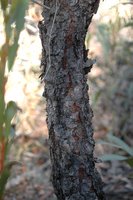

Several of the local Persoonias (Geebungs), Persoonia linearis and P. levis, both have thick flaky bark, which gets singed in a fire, but which protects the living layer of tissue in the trunk (the cambium).


Persoonia linearis - singed by fire.
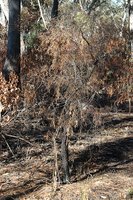

This shrub has been singed by fire, but it will probably re-shoot successfully, because of its protective bark. The leaves will have been killed, but new growth will occur.


Persoonia linearis produces lots of fleshy fruit.
These plants also produce an excess of fruit, which are often seen lying all over the ground, under the shrub.

Persoonia seeds are notoriously hard to germinate in cultivation, but seedlings are commonly found in the bush. One explanation is that birds and animals eat the seeds, and in so doing "treat" the seeds in their digestive systems, in a way that favours germination.

However, there are also reports that some species of Persoonia are found to have good germination after fire. So, presumably some of these seeds, (which appear to have a very long germination period), might remain viable in the soil, and then germinate, in post-fire conditions.

Waratahs, Lomatias and at least one of the local Persoonias (P. laurina) all are obviously suckerers. A quick walk through this forest will show you that. Look at your local Waratah - if there is one plant growing, there will often be a series of smaller plants close by. Often you will find a taller dead plant (burnt) with regenerating plants around it, in a circle. The Lomatias and the little Persoonia are less obvious plants, but their strategy is the same.
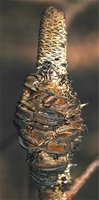
Then there are the Banksias and Hakeas. These plants have a sacrifical strategy when it comes to fire. The adult plants have little or no resistance to fire, and simply die when a fire occurs.

But they have woody capsules in which their seeds remain viable for many, many years. Then, when the fire is raging, the seeds are protected inside these hard woody capsules. But within days of the fire passing, the old woody capsules slowly open (like oysters), and the seeds fall out, onto the ash layer on top of the soil. That ash contains chemicals from the burnt wood which has been found to promote germination of these seeds. Indeed, many native plant nurseries use "smoke treatment" for the same reason, to greatly promote the germination of native plant seedlings.


Old Native Plant books used recommend growers heat treat seed capsules of Hakeas and Banksias, in order to get the capsules to open and release their seeds. The usual method recommended was to put them in the oven, after someone had been cooking, and the oven was cooling down. That technique misses out on the "smoke" effect, but one can buy "smoke water" to soak seeds in, from many native plant specialists.

Pairs of curved seeds may be seen emerging from some of these woody capsules on the burnt seed cone of Banksia cunninghamiana.


These Banksia cones might be regarded as "time capsules", holding the seeds in virtual suspended animation, waiting for a fire to come and open the capsules with its heat, before the seeds can be safely released. In a few months time, there will be lots of young seedling growing near where the old plant died. That is why I refer to it as a "sacrificial strategy" - even though fire kills the main plant, the species will go on.

*****

I mentioned yesterday, how dangerous it is if fires occur too often.

Some species, such as the Banksias, and Acacias, rely on seed in order to survive a fire, as the plant itself is killed by fire. So, in order for the species to survive, it needs to have set seed.

Many plants take a number of years to reach maturity. They need to have reached flowering age, been pollinated, and then to have set seed, before they are able to survive a second fire. So, if, for example, this area was burnt off now, and then, in 3, 4 or 5 years, it was re-burnt, it is entirely possible that Banksias would be eliminated from that patch of forest. For some plants, this maturity cycle might be as long as 8 years.

So, repeated burning, as a forest management strategy can result in producing a "forest" with a live canopy of Eucalypts, but little of no understorey of shrubbery. That is not a real forest - it is a "treed desert" - with few species of plants, and even fewer birds and animals.

Unless the people who set fires like these ones, understand that, they risk permanently damaging the living forest, if they burn it too often.

Indeed, even if they do understand it, who is to say that any subsequent fire might not be a major bush fire which might occur naturally, in circumstances totally beyond the control of humans? If such a devastating fire occurs within that 8 year time period, the damage can be permanent.

Even if the subsequent fire is not lit by people, but is entirely natural, the result is the same.

Saturday, June 24, 2006

The Nature of Fire - friend, foe or an act of ignorance?

Burning the bush is a long-standing tradition of "forest management" in Australia. I believe it shows a deep seated misunderstanding of the Nature of forests.

People who burn forests in this manner seem to regard the forest as an alien element. By burning it like this, they are seeking to "dominate and control" it - instead of learning to love it for what it is.


Indeed I think this kind of burning is part of a primitive "fear response" to living in the Australian bush - something left over from our colonial heritage.

It seems to me that we have not yet learn how to live with the Australian bush.

*****

Recently there have been some "cool burns" conducted in the local Robertson area, presumably as a way of minimising the risk of a later " serious bush fire". I am not sure if these fires have been set by private land holders, the SCA, or some other Government agency. One of the fires of which I am thinking has been burnt along Kirkland Road, in East Kangaloon (just on the eastern side of the road). The other was a patch of forest along Tourist Road, in Kangaloon, past Maloney's Road, when heading towards Glenquarry. It is on the opposite side to the main "SCA Special Area", but perhaps it is SCA forest, I am not sure.

This burning has prompted me to write about fire survival strategies of different local plants. (There will be more tomorrow.)

Firstly, the tall Eucalypts have not been damaged by the fire, except for some older trees, with hollowed out bases, which burnt up through their empty centres, and then fell over. Healthy trees were not affected. By controllling the timing the fire to the cooler months, it does not "flare" into a major bush fire (it does not burn the canopy of the forest). Hence the term a "cool burn".

However, the shrubbery is badly damaged (of course). This is my main problem with Foresters (and fire fighters), who regard the undergrowth of the forest as a nuisance.
They view it as "fuel" which, if not burnt off regularly, will greatly increase the intensity of a fire in summer.

By itself, that is a true statement. But it misses the point of what a forest really is.

*****

From an environmental point of view, the shrubbery and the undergrowth is where the greatest number of plants and animals live. The forest is not just the trees which make up the canopy. I wrote about this previously, regarding the Bodalla State Forest - where rare plants were being threatened by excessive burning.

This kind of fire can be quite devastating, in its impact, especially if it is repeated too frequently - within about 8 years. I will explain that timing tomorrow.

The only good word I can say for this kind of forestry practice is that these fires have been successfully controlled to certain areas, and have not burnt a whole forest.

I will write again tomorrow about how different plants in the lower levels of the forest survive fires, (or do not). It is an interesting example of evolution at work, where different plants have taken different strategies with regard to fires.

Wednesday, May 31, 2006

The Nature of more odd Australian plants

Hakea laurina - flower just opening
Following up on the earlier Blog about Grevillea flowers, I thought I would show you a photo of the supremely weird, wonderful and lovely Hakea laurina. For Leo's benefit, the entire "flower" is roughly the size of your beloved golf balls.


This plant starts out with a rounded bud, tightly encased in sheaths of a silky-covered papery substance. The sheaths fall off, as the "flower" opens. That reveals a tightly packed composite head of many hundreds of flowers.


Each flower has the same basic structure as the Grevilleas discussed yesterday. the main point of comparison is the dominant styles (white with green tips) which start out bent like a hairpin, but which, as they mature, open outward to form this "sea urchin like" flower.


In the photo above, the individual flowers on the right have matured, and the styles have all opened out. The ones in the centre are just opening, and the ones on the left are still developing.

Detail of Hakea laurina flowers

This shot (not as sharp as I would like, sorry), does at least show the intimate details of the flower structure. In the centre, you can see some flowers where the stigma has just opened out, leaving the four segments of the original outer casing of the flower still "exposed". Those dark pink patches are where the pollen is formed, before the style opens out, taking the pollen with it. It is not clear in this photo whether these particular flowers have any pollen on them, but that is how the mechanism is meant to work.

You can clearly see many flowers with the style still "in position" inside the flower "tube", before they open out. Some are just opening.

Grevilleas have a seed casing which is leathery, and which opens along one side, to release two seeds. They drop their seeds every year, generally. By contrast, Hakeas have a hard woody seed casing, which splits to release two papery winged seeds. But the seed casings might stay on the bush for many years, in anticipation of a fire, after which the seeds are released, to germinate on the freshly potash-enriched ash soil. Fire survival and fertiliser strategy, all in one.

Monday, May 22, 2006

The Nature of Wild Fire and Drought

The edges of Canberra and much of the Snowy Mountains (in both Victoria and New South Wales) were subjected to a huge and devastating Wild Fire in January 2003. For Canberra it was a specific day, January 18th, but the fire had been burning for several weeks in a contained area west of Canberra before then. Then, another branch of the fire spread south, through the Tidbinbilla Nature Reserve, and burnt up into the Snowy Mountains. At the same time, equally devastating fires were burning similar country in the Victorian Alps.


The foothills of the mountains were planted with Pinus radiata, which were totally destroyed, and hopefully will not be allowed to regrow.


There is a mythology in Australia, that it always rains after a big bushfire. I am here to tell you that it is not true.

After a fire, native trees recover according to their own methods of survival, which have developed according to patterns of evolution, over geological periods of time. Generally Eucalypts experience a total burrning of their oil-filled leaves, during a fire, but new growth occurs from dormant buds under the thick, protective bark of the tree. Generally! The tallest of the wet mountain Eucalypts, the "Mountain Ash", have lost this genetic survival strategy. They tend to die in fires. That is possibly because when a fire takes hold in their territory, of tall timber, and dense forest, the intensity of the fire is such that even the sap-wood of these huge trees is dried out and killed. Anyway, Mountain Ash generally rely on seedling regrowth after the fires.

The news is better for most other Eucalypt trees. They experience a sudden burst of new growth, and the forest quickly greens up again. Normally! This is where the presence of rain is important after a fire. Since the 2003 fires, the entire alpine region has continued in drought, so the burst of regrowth which followed the fires, dried out, and many trees died entirely. Those trees which did survive, have struggled on, severely damaged. And they are still waiting for rain.


The Baroomba Rocks at Tidbinbilla are a small cluster of huge granite boulders, each several times the size of a normal house. Big rocks, or a small mountain, you decide.


The thing is how bare they are now. These rocks are clearly visible from Canberra, some 40 Km away. The main reason is how bald they now are. There were forest trees all around them, and the rocks were moss-covered. Now the trees are barely alive, and the rock faces are bare. So, from Canberra, these rocks stand out as a pyramid shaped mountain, in front of the much larger Tidbinbilla Range in the background.


These rocks bear tribute to the need for rain in South-east Australia.


Today 62 % of NSW is declared in drought condition. And this very week, the Federal Government, (and I am ashamed to say - the NSW Government is supporting this idea) is proposing to sell the Snowy Mountains Hydro-Electric Scheme to private interests. God help this country run by Free Market Idealogues. One day we will remember that there is such a thing as an over-riding National Interest.