Christmas Bells

Christmas Bells
Christmas Bells - Blandfordia nobilis
Showing posts with label Fitzroy_Falls. Show all posts

Wednesday, January 29, 2014

NSW Christmas Bush on edge of Barrengarry Mountain

The NSW Christmas Bush Ceratopetalum gummiferum is not rare, but it is certainly not common in this Southern Highlands district. I have seen a dense stand of these trees out on Meryla Pass Road, way out along that road, some 8 kms beyond "Manchester Square". But this season I have seen these NSW Christmas Bushes flowering at the top of the Barrengarry Mountain pass (on the Nowra to Fitzroy Falls road). These plants are growing on each side of the council border, between Wingecarribee Shire and Shoalhaven Shire. So, some of them are clearly within the Southern Highlands region.

NSW Christmas bush in full colour
on the top edge of Barrengarry Mountain
Most of the Barrengarry climb takes you through dense, wet rainforest. There the dominant trees (the noticeable ones in flower at present, anyway, are Coachwoods. Their reddish-brown "flowers" (bracts actually) make these huge trees clearly visible at present. However, as one approaches the top of the hill, one gets to a shelf, where you are above the rainforest, and starting to enter the drier Eucalypt and Hakea forest. And there is a power line easement where the larger Eucalypts have been removed, but the mid-sized Christmas Bushes have not been removed. So they are receiving full sun, which they obviously love, and they are in full colour at present.
A low growing branch of NSW Christmas Bush
at eye height.
The 6 to 9 inch thick trunk is visible behind the "flowers".
So, by my reckoning these would be classed as small trees.

Their fruiting bodies (the calyx and the nut which forms once the flowers have finished) are bright red. Their calyxes are considerable redder than the closely related Coachwood trees, growing at a lower level in the wet forest. The area where these Christmas Bushes are growing has large sandstone rocky outcrops. But the edge of the sandstone escarpment is blunted here. It is not a cliff line (that is below). So the simplest way to describe where they are growing is to refer to it as a shelf, just above the Kangaroo Valley (Barrengarry) escarpment. 

Sepals and the nut of NSW Christmas Bush
showing its true, bright colour.
This shows small whispy "petals"
surrounding the "nut"
- a feature missing in the
related plant - the Coachwood.

The leaf of the NSW Christmas Bush is trifoliate.
Each leaflet has a prominent rib
which is set in a channel.
Leaflet edges are finely toothed.
By contrast, the Coachwood is classed as 1-foliate.
It has a much larger, longer single-bladed leaf.

The under-side of the NSW Christmas Bush leaf.
It shows distinct, fine venations
with a central rib clearly prominent on each leaflet.
The leaf edges are finely toothed.

Wednesday, December 04, 2013

Not often I can show Alan Stephenson a new Orchid species (for him).

It is not often I can show Alan Stephenson a new species of Orchid (for him).
So, please allow me some indulgence.
Alan photographing his first
Thelymitra circumsepta
Sorry about the background. It was Alan's back-pack.

Thelymitra circumsepta (in this region)
has a pinkish post anther lobe.
Photos from Victoria and Tasmania
do not show that colour.
I wrote a full report about this species back in 2010 when I first found and identified this plant, locally.
That was in Kangaloon, but the time was very similar. It is obviously a late blooming species of Sun Orchid.

Monday, September 16, 2013

Petalochilus curtisepalus (Caladenia curtisepala)

Petalochilus curtisepalus (Caladenia curtisepala if you prefer).

Petalochilus curtisepalus
These plants were identified last year, by Dr. Mark Clements, as they had a few of us puzzled. The specimens he examined were twin-flowered ones, but coming from the same group of plants, from the same area (Fitzroy Falls and Manning Lookout road). This year, I have tried harder to get close-up shots.


Petalochilus curtisepalus
(PlantNET)

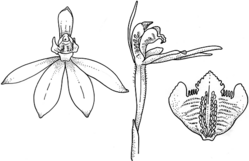
According to the botanical illustration, on PlantNET, these are correct for P. curtisepalus. The labellum has "teeth" on the edges of the midlobe, but lacks the teeth on the front of the side panels of the labellum (unlike P. carneus).

The labellum shape is distinct from P. carneus. P. carneus also is later to flower.
Petalochilus carneus
(PlantNET)


Petalochilus curtisepalus
"dorsal sepal weakly erect
to curving over column,
narrower and up to 3 mm shorter
than the broadening lateral sepals"
(PlantNET)

Petalochilus curtisepalus
"dorsal sepal weakly erect
to curving over column,
narrower and up to 3 mm shorter
than the broadening lateral sepals"
(PlantNET)
 
Petalochilus curtisepalus
Note the teeth on the edge of the labellum
do not go up on the sides of the labellum
(refer back to illustration of P. carneus above)

Petalochilus curtisepalus

Monday, April 08, 2013

Surprises where one least expects them

Alan Stephenson sent me a message that a friend of his had pulled their car off the road, on the way back form Moss Vale to Nowra and found some red Greenhood Orchids. Alan identified them as Diplodium coccinum. More to the point, he wanted to know where these plants were, exactly, as these plants are not often seen, and were not known to grow in that area.

I got a message (several actually) suggesting that they were along what is known locally as the Nowra Road, west from Fitzroy Falls. There was a distinctive letterbox nearby.

Armed with that information, it took no time at all to find the plants, once I had driven to the right place.

Scarlet Greenhood - Diplodium coccinum
What was startling to me was that once I started to look, there were literally hundreds of flowers and far more plants (leaf rosettes) than that amongst the grass. They were everywhere in just one hundred metre section of the road. Across the road they were not seen. Further down they were not seen either.

A good example of Orchids growing where they love to grow.

two flowers amongst the grass.

Another nice specimen
The point of my Blog title today is that this road is one which I drive along occasionally, going to look at Orchids elsewhere. Alan has driven this section of road hundreds of times over the years, as his daughter lived in the Highlands at one stage, I understand, and also, it is on his route to just about everywhere from Canberra or points west, as well as the Southern Highlands. It just goes to show that one cannot assume there is nothing to see, just because one doesn't stop to look. In this case, we owe this discovery to an observant traveller's unexpected need to adjust the load on a  trailer.
In deep shade under the pine trees
there were many plants of Acianthus exsertus
 One surprise for me was to find this small "Coastal Greenhood" Diplodium alveatum
Diplodium alveatum
is similar to Diplodium obtusum
The labellum is clearly visible and dark
it has a strongly rolled edge to the "sinus".

Habitat shot

Diplodium coccinum leaf rosettes amongst thistle weeds.
These rosettes had large leaves,
and were quite plastic-looking,
with a deep vein along the mid-line.

Tuesday, January 10, 2012

Elbow Orchid - a first for me.

This insignificant-looking Orchid (as in hard to see amongst the grass) was growing beside a track at Fitzroy Falls. NSW. That is part of the Morton National Park, so naturally I have taken steps to report it to the staff.
I have never seen this Orchid, before, but because it is so distinctive in its shape, I knew roughly what I was looking at, when I got down close to peer closely at it.

At first I thought it was a kind of Sundew with some dead insects hanging off the sticky bits.
But no, it is an Orchid.
As I first saw Thynninorchis huntianus - Elbow Orchid

"Common Elbow Orchid" Arthrochilus huntianus (re-named by Clements and Jones as Thynninorchis huntianus). "Thynninorchis D.L.Jones et M.A.Clem., Orchadian 13(10): 457 (Feb. 2002)". Originally it was in the genus Drakea, the related Hammer Orchids.

David Jones, in his Orchid book, says it is amongst the most specialised of all Orchids.
It is classed as a "leafless saprophyte", and as the new generic name suggests, it is pollinated by males of the Thynnine Wasp genus. The "elbow" structure allows the flower to move when a male wasp lands on it and tries to mate with the flower. That movement takes the wasp over to the pollen-housing, which is on the right hand side (of this flower), where the wasp would get a dob of sticky pollen on its head or back.
***** See note below, re the Tasmanian sister species.

You can see a video of this process in the related Hammer Orchids from West Australia. You can see how the hinged arm works, with the natural movement of the wasp. In this case (the Elbow Orchid), the Orchid flower is upside down, but that doesn't worry insects.

Thynninorchis huntianus - Elbow Orchid

Thynninorchis huntianus - Elbow Orchid

Full stem of flowers of Thynninorchis huntianus - Elbow Orchid

Another view of Thynninorchis huntianus - Elbow Orchid

Camera bag to give neutral background Thynninorchis huntianus - Elbow Orchid

My Orchid-chasing colleagues, Colin and Mischa have some wonderful photos of this species on their Retired Aussies site.

*****
Notes re the Tasmanian sister species explain the pollination process better than I can: 
"Male thynnine wasps (which give rise to the generic name), attracted to the flowers by a scent resembling that released by their flightless females, attempt to carry off the labellum (believing it to be a female wasp - DJW) for mating. In doing so, the labellum pivots on its hinged stalk, with the insect picking up or depositing pollen."
Source: Listing Statement for Thynninorchis nothofagicola (myrtle elbow orchid)

Monday, October 10, 2011

Robertson Railway Festival and then some unusual Diuris variations,

Yesterday the good burghers of Robertson turned out in numbers for the annual Robertson Heritage Railway Station spring festival.
Of course, the gentlemen from the 
Berrima District Old Machinery Club Inc turned up. 
It wouldn't be a major event in Robbo without them.


Berrima District Old Machinery Club members (many from Robbo)

Miniature Steam Train riders.
And the band played on too.

And what would a Robertson Railway Fair be without Waratahs?
An unusual Waratah cultivar. Possibly "Fire and Brimstone".
After having a Roast Beef Roll, provided buy the RHRS volunteers, using freshly cooked beef from Mauger's Meats at Burrawang, I headed out to Fitzroy Falls, to check on some unusual Diuris which Alan Stephenson and I had found the previous day. 

They turned out to be Diuris chryseopsis, 
the so-called "Small Snake Orchid" 
(a fairly unfortunate name for a beautiful little Orchid). 
The flower has large "side lobes" on the labellum 
(click on the image to enlarge it)
pointed outwards, flanking the column.
Classic Diuris chryseopsis with fine black line markings
But what about this one?
A relatively tall, heavy flower.
The first of these Diuris plants we found.
 Here it is in close-up.
The "side lobes" on the labellum 
are very different to the previous flower.
They are held vertically, flanking the column.
Diuris with no black markings and really thick callus ridges.
And this one?
Kindly ignore the spots of rain on the petals.
It is a lovely, fresh, clear lemon yellow colour.
Tiny Diuris - without marks, and small "side-lobes", with dark edges.

I have no doubt that all these plants are related.
They are in an isolated community, 
well away from any other known colony of this Diuris.
So logic has it that we are simply looking at individual variations
between plants of the same species.

I conclude they are all Diuris chryseopsis.
I just wish they would not vary from the classic species description
(as per the first Diuris flower shown). 
It makes it hard for the Orchid chasers 
when plants don't follow the "rules".

Friday, October 07, 2011

Strange tiny Fungi

I have refrained from calling this Fungus "weird" as I have used that adjective too many times - I think.

Septobasidium clelandii on Tea Tree stem.
The first thing I noticed was not the dark "stems" of the fruiting body of the fungus, but rather, the black stained bark of the Tea Tree Branch. It reminded me immediately of the kind of "mold" one sees in the corner of a very old bathroom.
Black stains on the Tea Tree bush - and Fungal fruiting bodies
In this photo you can see a grey tip of the fruiting body - presumably the spores.
The fruiting bodies - the little black spikes - are about 12 mm long.
Septobasidium clelandii with spores showing
This fungus has an interesting lifestyle, somewhat reminding me of the lifestyle of the Cordyceps group of Fungi. According to the usual sources, these fungi are not related in any way to the Cordyceps (Basidiomycetes versus Ascomycetes). Both fungi parasitise the body of a larval insect - in this case a gall-forming Coccid bug called Callococcus leptospermi. That insect is a relative of the Scale insects, so I have sent the photos and notes to Dr Penny Gullan of the ANU in Canberra, a specialist in Scale insects (and their relatives).

As you can tell from the name, the insect favours Leptospermum shrubs. This was the case with my fungus/gall-forming insect. I confess to not being sure of the plant species, yet, as it was not in flower.I collected a small branch to show to my friend Joan Freere who is very experienced with Fungi. We found it in Bruce Fuhrer's book "Field Guide to Australian Fungi". That book told us that the fungus attacks a coccid bug, which forms galls on the host Leptospermum plant. Sure enough there were lumps wherever the fungi were appearing. I had not noticed them at first, until we read Fuhrer's book.
Tea Tree branch swelling where the fungus is.
The swellings are caused by a bug which has burrowed into the shrub

A good example of the gall forming (on the right of the stem)

Leaves of the Tea Tree (Leptospermum) host plant
close-up of the Leptospermum leaves.

Saturday, December 18, 2010

Fitzroy Falls - in late afternoon light

This afternoon, after a series of harsh squalls had passed through, I suggested to Brendan that, as we had stopped work, but the weather had suddenly cleared off, we might as well go for a bit of a drive.


It turned out that he had never been to Fitzroy Falls. As it our most famous local waterfall, it was an easy decision to make, to show Brendan Fitzroy Falls.


The late afternoon light was fantastic. Rain storms can have the effect of clearing the dust and haze.
Fitzroy Falls
From "Jersey Lookout" 
(added in response to Hazel's question)
(click to see larger image)
As we have had plenty of rain recently, the creek was flowing well. And from this distant vantage point one gets a perfect view of the main drop of the falls.

The wall of rock is stained black in parts, but there is one section, to our left of the falls, and half-way down, where the wall of rock is coloured bright orange. This is a patch of a local algae, which is often found on rocks or even old trees, But seldom have I seen such a large and prominent patch. It probably indicates an area on the rock wall where there is a permanent "soak" coming through to sustain the algal growth. That theory is confirmed by the masses of ferns growing on the rock face in that area, and below it.

Fitzroy Falls is far and away the most visited place in the Southern Highlands. It is on the main road from Moss Vale to Kangaroo Valley (and hence on to Nowra). It is maintained by the National Parks and Wildlife Service (NSW) and is the show-case point of the Morton National Park.

Sunday, November 21, 2010

Flying Duck Orchids at Meryla Pass

Several days ago I went down the Meryla Pass road, in the Meryla State Forest. I stopped when I got to the Morton National Park - simply because I was going to run out of time and light, if I had kept going. It is great country. However, I did take a single shot of the spectacular Bluff opposite Meryla Pass. You can see why this country is regarded as "Blue Mountains" habitat, albeit lower and further south. Still sandstone, and still spectacular.
This Bluff must be close to the end of "Red Hills Road",
near Fitzroy Falls.
It is overlooking part of the Morton National Park,
with the Shoalhaven River Gorge beyond it.
This country, which I am yearning to access
is inaccessible to most human beings.
Indeed, even the road I was on (which is accessible)
leads to a locked gate.
That is the start of the Northern Section of the Ettrema
Wilderness Area.
The road to Meryla Pass leaves the Nowra Road (the road from Moss Vale to Fitzroy Falls and down through Kangaroo Valley and on to Nowra). There is a small sign saying Meryla Road, and Manchester Square. The first 5 Km take you down a winding road, dropping off the fertile red basalt soil farmlands of Avoca and Werai districts, down into the moist rich farm lands of "Manchester Square". (A most unlikely name for a farming district in Australia - but that's what the district is called. There is no township, just a "locality").

Passing on from Manchester Square two things happen, you leave the bitumen and you enter the Meryla State Forest. You have also driven down onto the Sandstone. That's what I am interested, for its rich flora and fauna habitat.

Nothing says "Classic Sandstone Flora" to me
more than Boronia bushes.
Boronia thujona - close up.
(Edit: In retrospect, I realise the leaflets are smaller
and more rounded
than B. thujona.
It may in fact be
B. microphylla.)
B. thujona is very common at the Barren Grounds.
I have not identified B. microphylla previously.
These plants are growing just on top of rocky outcrops.We are overtopping Bundanoon Creek,
on a small sandstone outcrop.


This is what the small rocky outcrop looks like.
Another of the "typical" shrubs here is the large-flowered pink
Tea-tree - Leptospermum rotundifolium.

Here is a close-up shot of the lovely "Round-leaved Tea-tree"
While I was there, I saw this male Gang-gang Cockatoo
"watching me, watching him".

Click to get a better view of him.
And here are the Flying Duck Orchids (Caleana major)
A veritable flock of them.
They are relatively tall (30 cm on average).
But small flowqers, on thin stems, so at first glance they look
more like a swarm of flying insects than Flying Ducks.
Here is another view.
Two flowers on a single stem (which is a common arrangement).
Now you can see how they earn their name.
Another view.
The bud on top is just unfurling.
the top parts will fold back, as wings.
The lower section, which is green, will turn red
as the flower matures, becoming the "body" of the Flying Duck.
The "head" is the "labellum" of the Orchid,
which at this stage is still inside the flower.
Now we come to the "pointy end" of the story.
The top flower is fully open.
The second (lower) flower has been triggered by an insect
(or stray movement).
The "head" (labellum) snaps shut over the body (column)
hopefully trapping any stray insect inside until it
collects a dob of sticky pollinia on its head or back
(or deposits one from another plant)
thus achieving pollination.
On the lower flower
The head is completely folded down over the Duck's "stomach".
(Click to see it better.)
Here is the "head" and the all important "neck".
The "lamina" (neck) is flexible
and when triggered by the sensation of movement in the flower
the "lamina" snaps shut.
The head bends right down,
closing off the previously open "body" of the flower.
Here is the front on view of the "body" of the Flying Duck Orchid.
The lowest section shows the anther where the pollen is stored.
The head snaps over to completely close off this "body".
The round shape allows room for an insect pollinator
to move around inside the flower,
even when the head snaps closed.