Helicia glabriflora is yet another plant which has its southern-most range in the Illawarra. In fact, this tree is reported to be the most southerly member of the species - growing here by itself here in Robertson. A loner.
I photographed this tree when in flower, in February last year, which is more or less its normal time, it seems. But when I was checking
Tangle-root Orchids the other day, I noticed that this tree was in flower - which surprised me, as I remember it as flowering in high summer, normally.
It also has some fruit on it, which are not yet ripe, as they turn bright blue when ripe. But the fact that it successfully set fruit last year is encouraging.
This plant is in the Proteaceae tribe, but it does not look at all like its normal southern relatives. It is a rainforest tree and in Robertson is hard to distinguish from the neighbouring Sassafras trees, which have similarly bright green, shiny leaves. Its flowers (inflorescences) look nothing like the Waratahs or Grevilleas which we tend to think of as "typical Proteaceae" plants. But in truth, there is no such thing.

Here are the unopened buds on a flowering stem (inflorescence).

In fact the flowers and fruit of the Helicia most closely resemble (in structure) the
Persoonia family. Many members of the Proteaceae tribe are tropical plants, which look very different from our most familiar members of the tribe. If you remember that the nut-bearing plant, the Macadamia, is a tropical Proteaceae plant, that will give you some idea of the diversity of this tribe of plants.
Opened flowers on the full inflorescence (stem)
Compare this with the photo of the
Macadamia
Here are two (paired) flowers arising beside eachother on the flower stem.
This is typical of many members of the
Grevilleoideae.
I have shown this same feature in
Grevillea flowers

This pair of flowers has pollen dusted onto their Stigmas.
These plants use the Stigma, (the female part of the flower) to act as
the "pollen presenter" as in this case. The pollen is ready to be picked up by a bird or an insect, to be taken to another flower.

Here is a single flower (removed from its paired flower - to simplify the image). The outer skin of the perianth (seen fully closed in the bud image at top) splits, as the flower matures, and the perianth segments (tepals) roll back, down along the stem. This is referred to as being "revolute".
"Perianth tubular; tepals revolute at anthesis."
(PlantNET)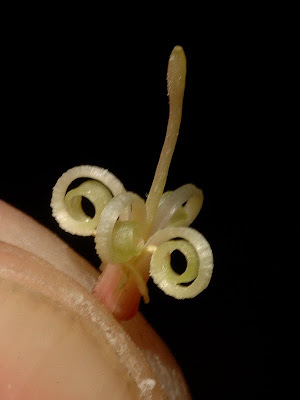
After maturing, the tepals drop off the flower, leaving only the style (which had the stigma at its tip, and leads down to the Ovary at the base). In this case, you can see the ovaries of these flowers are starting to develop. They are the orange-cloured swellings at the base of each style.

Here is an unripened fruit (still green, not blue). But you can see the "persistent style" protruding below the fruit (on the right). The fruit is, of course, developing where the "ovary" (the orange swelling - above) is located in the original flower.

This fruit, with the style protruding, looks very similar to a
Persoonia fruit.


