Christmas Bells

Christmas Bells
Christmas Bells - Blandfordia nobilis
Showing posts with label Mt_Murray. Show all posts

Tuesday, January 26, 2010

Body found in burnt-out car - off Mt Murray Road

Body found in burnt-out car.
January 26, 2010 - 12:10PM

A body has been found in a burnt-out car south of Sydney, police say.

Emergency crews were called to a vehicle on fire in bushland off Mount Murray Road at Mount Murray, in the NSW Southern Highlands, about 7am yesterday. (DJW Note: This is just out of Robertson, above Macquarie Pass).

An old "file photo" from the Powerline Take-off Point

above Macquarie Pass - which is accessed "off Mt Murray Road".

I have made no attempt to take actuality shots of this incident.

"Fire services attended and extinguished the fire and upon closer inspection a badly burnt body was found inside the vehicle," police said in a statement.

The body is yet to be identified.

Detectives have appealed for information. Reports should be made by phoning Crime Stoppers on 1800 333 000.

Source: Sydney Morning Herald Website 26 January 2010

DJW Update:

Photo courtesy of SMH and Southern Highlands News

Police at Crime Scene

Police have now opened a Murder Inquiry into the incident. (Read the story at that link.)

The report refers to it as a "remote highlands spot". That's a bit of journalistic flourish. It is down a country road, and obviously near a train line. It cannot be more than 1 Km from the Illawarra Highway. There are far more remote spots than that in the Southern Highlands.

***** Further Update: 1/2/10 from Sydney Morning Herald website:

"Police believe a man whose remains were found in a burnt-out car near Macquarie Pass was murdered.

"Lake Illawarra commander Superintendent Mick Willing named the man as Matthew Digby, 35, of Wollongong. Mr Digby had recently moved to the region from Cronulla.

"His remains were found inside a burning Mazda 626 station wagon on Mount Murray Road, next to a disused railway crossing, last Monday."

Read the full story in the Paper.


Tuesday, December 01, 2009

Cloud Farm views (of Knights Hill)

My friends Steve and Celeste live on Mount Murray at a property poetically named "Cloud Farm". From their hilltop one can look south towards Knights Hill, where the telecommunications towers for the Illawarra region are located.

Afternoon light shining on Knights Hill.
This was taken on the Winter Solstice.
The ocean is just visible in the background,
but it blends into the line of clouds out to sea.
The clifflines of the Illawarra Escarpment are highlighted
by the afternoon light.
Several weeks ago I went and had dinner at their house, after a big day out Orchid hunting with ANOS. Anyway, in a state of near-exhaustion I stayed over at their house, after dinner.

Next morning I woke just on sunrise - because they get so much light into their house.

I stumbled out of bed and looked outside and found them out and about already - rejoicing in the wonderful cloud and light effects of fog on the plateau near Carrington Falls and just topping Knights Hill.
This image was taken from the same place as the first image.
Its hard to imagine.
Check the trees on the left and foreground.
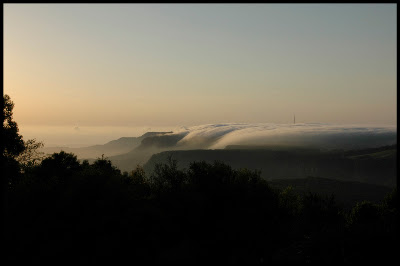
The TV towers are clearly visible protruding from the seemingly "flat" cloud of fog. In fact this hill is quite high, over the Illawarra Escarpment to the east (left) and it also drops away quite sharply (but nothing like as as severely) to the west (right) onto a sandstone plateau around Carrington Falls. One cannot see any of these details below the thick fog.

This image appears to me as something from Antarctica.
Two separate TV Towers (not quite in line - from this direction).
They are probably about 1 km apart, on top of Knights Hill.
Taken with the 300mm lens.
More interesting, to me, was the way in which the fog was behaving at the eastern edge of the escarpment.
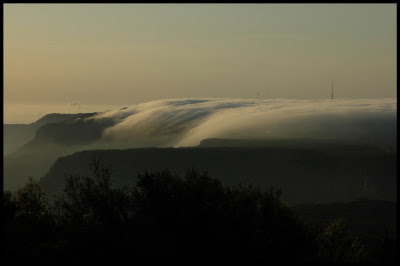
The cloud was behaving as a glacier does, only with far greater fluidity. You can see the cloud breaking down (disintegrating), after it tumbles down off the cliffline.
Click to enlarge to see the full effect.

At the end of the plateau/cliff line, the cool mountain air was falling down over the edge, as the air on the coastal escarpment started to rise.

The circumstances created an almost circular pattern of air movement (the hot air rising, sucking the cold air (above it) down to fill the pressure imbalance thus created).

As the sun rose higher in the sky, it created this lovely effect of lighty behind the large Brown Barrel Eucalypt.
You will all be pleased to know that I then went back to bed for another hour, to "wake" at a more civilised hour. That comment is just for "Mick's" benefit, as she is always up and about early - looking for waders at "Sandy Straits and beyond". She knows that I am a night person. We often nearly cross over with our comments - me before I go to bed, and she as she starts the day.

EDIT:
Thanks to Mosura of Nature of Tasmania for a comment, in which he provided the technical name of the cloud behavour I was reporting.
Orographic Clouds
I knew there was a specific name for these louds, but could not remember it. The following extract - in red - describes the cloud movement I was able to witness.
.
"Orographic clouds develop in response to the forced lifting of air by the earth's topography (mountains for example).
"Air passing over a mountain oscillates up and down as it moves downstream. If the air lifts upward and cools through expansion as it rises to its saturation temperature during this process, the water vapour within condenses and becomes visible as a cloud.
"Upon reaching the mountain top, the air is heavier than the environment and will sink down the other side, warming as it descends. Once the air returns to its original height, it has the same buoyancy as the surrounding air. However, the air does not stop immediately because it still has momentum carrying it downward. With continued descent, the air becomes warmer than the surroundings and begins to accelerate back upward towards its original height. It is during the upper-most ascent phase of this cycle that clouds develop. In regions where air is descending, skies are clear."
Source: Cloud Structures: "Orographic Clouds"

Sunday, August 23, 2009

Leucopogon flowering on Mt. Murray

Tonight I drove my friend Celeste back to her house, after a successful screening of two movies at the Robertson CTC.

On the way back, we talked about the amazing flowering of scented plants around Robertson at present.
  1. First of all is the Sassafras, which is the dominant tree in our local rainforests. At night these trees appear silvery, or even snowy, depending upon how heavily they are in flower. It has been an amazing flowering season for the Sassafras trees this year. Their sweet floral scent hangs on the warm evening air.
  2. Next, we talked about the Tree Violet, about which I wrote last night. That plant has a delicious scent of violets.
  3. And then there are the Blackwood Wattles, which is our next most dominant tree. Their flowers are only pale yellow, but they are large rounded trees, and carry huge numbers of flowers. They have a light sweet perfume.
  4. And as we drove up the long hill, approaching Celeste's house, she told me about a Native Heath plant which is growing in the forest beside her road. We stopped to collect a specimen, which I have photographed tonight. This plant has a sweet scent, reminscent of vanilla. A lovely light perfume. This plant is Leucopogon lanceolatus - the Lance-leaved Beard-heath.
The 40mm long leaves have prominent veins
which run the length of the leaves.
The flowers are held in sprays which protrude beyond the leaves.
Here are some more of the flower sprays.
This image shows why the plant genus has the name Leuco-pogon
White (or silver); and Bearded.
In botanical language, the corolla lobes are "densely bearded"
I have written about a related species previously.
And here it is in closer detail.
This is a lateral view of the flower
It shows its bell-like shape.
A medium shrub (up to 2 metres) which grows commonly on the sandstone cliffs and forests of the Illawarra Escarpment, but is not found in Robertson proper. But at Mt Murray, a mere 4 Km away to the east, and just above the escarpment, it is growing in the Sassafras forests on red basalt soil. Normally it is restricted to sandstone soils.

Saturday, December 27, 2008

More flowers from Cloud Farm

Here are some photos I took on Christmas Day, when at "Cloud Farm". Several are of garden plants, but several are of weeds (such as the Dandelion seed head from yesterday). I do not mean to create the wrong impression by showing lots of weeds, but several of these images are of weeds which just happen to be remarkably beautiful flowers.

Blue Convolvulus - a popular garden plant.
Pink Marguerite Daisy - with a strange combination of pink and orange colours. This serves to remind us that Nature can make up its own "rules" for colour combinations, and get away with it.
See what I mean? This is the "Eye" of the Marguerite. This is a larger image than I normally upload - so click to enlarge it, to see the finer details of the flowers.

Yes, I meant to say "flowers", for the "centre" of all "daisies" is actually a composite flower, made up of many individual flowers. If you enlarge the image you will clearly see the see regular 5-sided flowers around the edge of the orange centre of the "flower". The orange "buttons" are simply "as-yet-unopened" buds of even more flowers.
Here is a Scotch Thistle, yet another "composite flower". It is a truly beautiful flower, despite being a terrible weed in Australia.
And there is also a remarkable creature - a Stick Insect, which is a "pet" (called "Celine"). But it warrants examination for its strange details. The Existentialist reader will be asking: "Strange" - compared to what? Have a look - I think you will get my point.

This Stick Insect is quite different from two other Stick Insects which I have written about previously - both Australian, but only one was a local "wild" individual. It seems these Insects are popular for study in schools and universities.

This insect is Carausius morosus - the "Indian or laboratory stick insect". (*** PLEASE SEE CORRECTION UPDATE BELOW) The body is arched up and forward, (though it does not carry itself that way when "relaxed". The body of this insect seemingly bends in the opposite manner to the way a Prawn might be "folded". As it has no "stinger", this is not the same purpose as a Scorpion's favourite body position when arming itself for attack, although the angle is superficially similar.
Note also the small wings, which are just forming - above the front legs.I was particularly intrigued with the head form, especially where the neck enters the head. Of course, being a vertebrate myself, I assume that all creatures ought be designed around a "spinal cord". This creature is an invertebrate. Maybe that makes a difference in the way in which this insect's head can be "wired up".
This insect looks to me as if it is designed by the people who designed those toys called "Transformers" Check out the details of the leg shape, seeming to aid its leaf camouflage.
The feet are interesting "V shaped" claspers. No doubt very effective in helping the insect to hang on to vegetation high in a tree, under windy conditions.

CORRECTION AND UPDATE
I have been advised by Martin Lagerwey that this insect is a "Spiny Leaf Insect" (Extatosoma tiaratum). It is a native Stick Insect.

"It is covered in sharp spines and the legs have flattened leaf-like projections. The head has an odd pointed cone shape and looks like it is on back to front. Males have much slimmer bodies, and two pairs of fully developed wings and can fly. Females have stout abdomens, a single pair of tiny wings and cannot fly. They rely on camouflage to avoid predators, looking like a stick with leaves. When disturbed they can strike out with their spiny legs. They often curl the end of their abdomen over their back like a scorpion. The Spiny Leaf Insect is a popular insect pet."
Other Names

"Giant Prickly Stick Insect, "Macleay's Spectre"

"It is found in coastal regions of Queensland and northern New South Wales."

Thanks to Martin Lagerwey for providing the correct information.
He has a private website with information on many Stick Insects and other creatures.

As regular readers would know, I do the best I can to correctly identify any creatures I find. 
I am always happy to get correct information, when my insect ID is incorrect.

Denis Wilson.
I may be contacted via the "comments" facility, or via email, from the My Profile page.

Friday, December 26, 2008

Christmas in Robertson.

I spent Christmas Day with my friends Steve and Celeste, and Jasper, as well as their nephew Tegyn. We had a very pleasant lunch, and afternoon, followed by dinner, and a couple of movies well into the evening. A very relaxing day indeed. My thanks to Steve and Celeste.

Lunch included these Green-lipped Mussels which were so striking that they just demanded being photographed.While up on their hill, I took a few photos of some of the flowers, including this image of a Dandelion seed head. I love the near-perfect architecture of this seed head (even though it is a weed). It is a beautiful thing. (Click on the image to enlarge it.)
During the afternoon, Steve suddenly found a huge black "Ground Beetle" crawling over his neck. We have no idea where it came from. It was flicked off his neck, in a reflex move, and I then tried to capture it in a food container, in order to take it safely outside. The crumbs from the food container have resulted in the Beetle looking "sandy". In truth it was shiny black, with deeply furrowed elytra (wing covers) which you can see more clearly in this second image. I have not been successful in tracking down exctly what species of Beetle this is, but my blogging colleague Mosura, from Tasmania has a photo of an almost identical Ground Beetle in his photo albums - Nature of Tasmania. Mosura's photo is clearer, and his specimen clearly is not walking around in a food container.
My Beetle was safely released outside, as soon as these images were taken.

Sunday, April 13, 2008

A big day in Robbo. Crowds, trains, cars and mist.

Today, the Robertson Heritage Railway Station (RHRS) hosted a vintage car display (on the "Robertson Common"). There were crowds of people all over the place.The RHRS also hosted a visit by the Historic Rail Motor CPH 18, which ran 6 short trips, back and forth to Mt Murray Station (to the east of Robertson) and to Calwalla (to the west). In addition, the regular "Cockatoo Run" train visit to Robertson is now linked to a bus connection to Knights Hill, for persons wishing to make the trip from Sydney via train, and to include a visit to the Illawarra Fly.

The Robertson Markets were also on, at the School of Arts building. So there were people all over Robertson today. There were traffic jams, even! A rare event for our little village.After clear weather in the middle of the day, in the late afternoon the sky darkened out over the Macquarie Pass escarpment. I decided to go and shoot the threatening clouds.

As a matter of interest, this photo is taken at exactly the same place as the "morning light" photo on the mast-head of my blog. In this photo am looking just slightly further north from the mast-head photo, which naturally was taken looking east, to catch the rising sun.Out on the Mt Murray Road there is a little-known place where there is an amazing perspective on the cliffs over the top of the Macquarie Pass. You can literally see the clouds forming, as the moist afternoon air rose over the rocks, just in front of my camera. And the late afternoon skies were even more dramatic as the lights came on down in Albion Park, way below me. More mist-forming is evident in this image, too.My favourite shot of the very top of Macquarie Pass. The trees on these cliffs overlook the last stretch of the Pass (the Illawarra Highway passes directly below that point). A steep and somewhat dangerous place to visit, but it looked very striking with the threatening clouds.I love the way the changing light makes the whole world look different, minute by minute. Here I was in a different place, a different world even, from the hurly-burly of the afternoon. But I was just 5 kilometres away from Robertson.

Thursday, January 31, 2008

Storm which hit Sydney started at Macquarie Pass.

I watched an amazing storm developing this afternoon. I drove out to the edge of Robertson, overlooking Macquarie Pass, to get a good look at it, before it really burst. Here is a link to the views from this same position, early in the evening, and at dawn. The views are amazingly different from tonight's storm.

Mt Macquarie, overlooking the Macquarie Pass, looks very imposing with a tiny patch of sunlight showing up the forest just underneath the cliff face. The white cloud was being whipped up and over the escarpment face. There were strong lightning bursts, every 3 or 4 minutes.
On the way back into Robbo, I listened to reports of water over the Princes Highway at Albion Park, then heavy downpours at Bellambi (northern Wollongong), and then it moved north, towards Sydney, 100 kilometres away. It took a little over an hour to get there.

This image shows a wall of water being dumped out of this thunderhead, over Albion Park and Dapto, just south of Wollongong. This was the peak intensity of the storm, from what I could see.
According to the Weather Bureau's website, tonight, Huntley Colliery (the other side of that bluff, at Mt Macquarie) reported 35 mm tonight, and Bellambi scored 46 mm of rain. Both from this single storm. Tonight the news reports are carrying stories of 100 Km per hour winds at Holdsworthy (southern edge of Sydney) and then it went to Blacktown, where people are still waiting to have their roofs repaired after the last big storm, in early December.

This is a panoramic image. Click to enlarge it, to see the "full picture" of this storm - it spans from Albion Park (under the clouds, far right) back to Mt Murray at the very far left of the picture. Wollongong is under the storm, in the middle of this image.
And this is what the local birds thought of it all. Yellow-tailed Black Cockatoos (Calyptorhynchus funereus) flew up out of the forests below the escarpment, heading north and west, away from the storm. Like the "Harpies" from a Greek tragedy, these birds were giving their full, drawn-out wailing cry. Very atmospheric.No sooner has these 3 birds flown past than a full flock (of 27 birds) flew up out from the valley below, also putting a lot of distance between themselves and the storm.

If you have ever seen these birds, you can possibly image how loud and ominous their combined 27 calls were. You can listen to the call by clicking here! Thanks to the "Birds in Backyards" website - from the Australian Museum (Sydney). The main site to the BiBY Bird Finder is permanently linked from the side bar of my blog.A very impressive ending to a very impressive storm.

POST-SCRIPT: The Illawarra Mercury has reported that the storm which I have witnessed here was caused by 3 separate storm cells merging.
  • A merger of three storm cells south-west of Wollongong led to the extreme weather conditions across the Illawarra on Thursday afternoon.
  • Bureau of Meteorology forecaster Chris Webb said that at 3pm on Thursday separate storm cells were recorded north of Nowra, south-west of Robertson and over Kiama.
  • About 4pm the three cells came together around the Dapto area, resulting in strong winds, heavy rain and hail as the storm made its way north.
So there it is. You now know why this particular storm was so powerful. You can read the full report here.

Thursday, August 23, 2007

Rubbishing the Country

What is it with some people in the Southern Highlands? They live surrounded by beautiful scenery, creeks, clifflines, and waterfalls - places which we are so lucky to live near to. The first shot is of the wild coastal escarpment as viewed from the Powerlines at Mount Murray, overlooking Macquarie Pass - a mere 5 Kilometres from Robertson. Wild and wonderful country.

A few metres away, underneath the Powerline stanchion - this is the situation. Some people choose to use these natural features as rubbish dumps.
Do you recognise any of the furniture in this pile? (click on the image to enlarge it).
Two red chairs, a white chair, a blue sofa, a floral divan bed, and a wooden framed bed and mattress, two loud speaker boxes, a box of assorted cutlery, piles of clothes and then bottles and general rubbish as well.

Someone must know who went out of their way to dump this material in this remote spot, over a very rough bush track, rather than take it to the Council's waste management facility. People who treat the bush like this do not deserve to live in such beautiful surroundings.

Wake up, Australia. This is a disgrace.

It will take a mind-shift before our fellow Australians learn to do better than this. Clean Up Australia is on the right track, but when you see evidence like this, you realise just how far we still have to go.
*****
Post-script:

The above story was published today in the Southern Highland News. I received a call this morning, from the Wingecarribee Shire Council's clean-up officer*** Vince Emmerick. He had read the story and gone out to the site to inspect it. He started by checking through the dumped furniture and goods looking for any identifying details. Presumably his next task will be to arrange to get the rubbish cleared away. Let's hope so - though with the access being as difficult as it is, at that spot, he will have a big job.


Anyway, it is good to know that Vince is on the case.

*** Regional Illegal Dumping Squad - though I am not sure that Vince has many members in his "squad".

Illegal dumping of rubbish can be reported to the Council on 4868 0504

Tuesday, July 31, 2007

Orange Moon for Celeste

Tonight was Celeste's actual birthday, and after dark an amazing orange-red moon rose through a pall of smoke over the ocean beyond Shellharbour - as visible from the top of Mount Murray, where she lives.


It is eerie looking down over the moon, rising through what I assume was a line of smoke from a bushfire, or a "burn-off". It was truly wonderful but unfortunately, although I had my camera with me, I failed to get a good shot. But these snaps will give you some idea of the colour.

The moon rose clearly enough, but it does not stay still. So, after it rose, it went through a line of cloud, which blocked it; then it reappeared, higher in the sky and a little clearer. But, of course, it had lost most of the wonderful colour, by then. In general, one has less than a minute to get a good shot of the moon, if there is a special light effect, or some other feature of the moon against a tree or hill, or other natural feature.

It was two days past the full moon (by my reckoning) so it is seen against a black sky, but slightly deformed, showing the shadow of darkness in its upper quadrant.

Anyway, Happy Birthday, Celeste.

Friday, June 29, 2007

Kangaloon Aquifer pumping halted - at present

Idle Pump Outlet, reveals
the amount of iron
contamination left by
4 months of pumping.
The SCA has temporarily stopped pumping from the Kangaloon Aquifer. They did this last last Wednesday 20 June 2007. We have not commented on this up until now, as we did not know quite what the SCA was "up to". Here is a photo taken by a "research assistant", showing pump outlet no longer running. The rust staining is clearly evident. It is iron contamination from the water in the Aquifer.
We have now heard that the SCA responded to a question from a journalist, with advice that they have turned off the pumps "to monitor how the Kangaloon aquifer recharges after the recent heavy rainfall and to observe water level recovery patterns across the area".
What a crock ...???
First day of pumping.

The reality is that the Nepean Dam is full, (confirmed by SCA's Bulk Water Supply website reports). Therefore, to continue to pump water down the Nepean River would be to waste precious Groundwater.

The Nepean River was in flood over the weekend of 16, 17 June 2007, but the SCA was still pumping water from the Kangaloon Aquifer.


Nepean River running high,

after the flood peak had passed.

Bernard Eddy protested this scandalous waste, directly to the SCA's Bulk Water Manager, Mr Ian Tanner. He also raised this scandalous waste of precious water in public (via radio in Sydney and the Illawarra and Southern Highlands) on Monday 18 January. Finally they stopped the pumping on the Wednesday, (20 June).

For them to claim that they have stopped pumping "to monitor how the Kangaloon Aquifer recharges" is purely Public Relations "spin". As I mentioned above, to use the vernacular: What a crock....???


David Thompson, of the Save Water Alliance committee, has spoken (in the last few days) with the SCA and has been told that the Aquifer is recharging fast. This is hardly surprising, given that they have been pumping along the coarse fractured zone known as the Mt Murray monocline (or fault). Everyone acknowledges that these coarse fracture zones would likely recharge much more readily than Aquifer zones under the main sandstone plateau.

My point is simply to forewarn you that the SCA will doubtless claim (in the near future) that there has been no long-term effect on the Aquifer.

Let us not forget that the whole testing program was held off deliberately by the SCA until after the major rainfall event in February. John Ross (Project Manager) and Graeme Head (CEO of the SCA) told Bernard Eddy and myself, at a site meeting in January, that they were hoping to get a "rainfall event". That event happened over 10 and 11 February, with some 322 mm of rain in 36 hours. Within days they had written to the Federal Environment Department proposing that they commence "test pumping" (letters of 20 and 22 February from Mr Tony Collins).

We argued at the time that testing in such extreme circumstances would not be representative of a borefield designed to operate as a water supply system "in drought conditions".
Nepean River
Robertson has had huge amounts of rain in June (as has most of the Sydney Catchment). In fact we had 318 mm of rain over the long weekend of 9 -11 June. Subsequently, a further 55 mm fell in several hours on 16 June. That rainfall caused the Nepean River to flood (not the earlier larger rainfall event) - because the countryside was saturated by the huge rain of the previous week. So the run-off was immediate.

We have had subsequent rain. The point is, we are now approaching a record rainfall event, the last such rainfall was in 1950 (a record year).

It would be totally non-sensical for the SCA to use the rainfall events of this year as a gauge of anything which might tell you about how "safe" it is to pump from the Kangaloon Aquifer, under severe drought conditions.

Let us not forget that the whole project is known by the SCA as: "Groundwater - Investigations for drought water supply".

If the SCA could guarantee to get two "one in ten year" rainfall events, as we have had this season, then, hardly anyone would object to limited pumping of the Kangaloon Aquifer. But, to use this year's rainfall events (and any recharge figures they might produce as a result) as justification for pumping to be "safe" would be totally meaningless.

Accordingly, in accordance with their management of the Upper Nepean Borefield project, so far, I expect that they will make exactly such a claim in the near future.

Tuesday, January 09, 2007

Buff-banded Rail - on McGuinness Drive

This afternoon, I visited Wollongong (ooh, it is stinky to my nose, so used to the pure highland air!). Anyway, I escaped back up Macquarie Pass. As I drove through Albion Park, I saw my friend Dave, and we drove back up the pass in tandem.

As Dave lives on McGuinness Drive (just at the top of the Pass) I called in and had a cuppa with Pip and Dave, and their kids Steele and Malaika. Pip is pregnant, and I had not seen her in a while.

They seem to be keeping well, out there at Mt Murray. Pip had taken the kids swimming at Minnamurra River. She reported that the water was very cold - which confirms something I had heard on the radio in the last few days.

As I recall, warm currents do come down the coast - but not until late January (about the time the kids go back to school).
*****
Photo: L. Hansch
COG Website
Anyway, as I left McGuinness Drive I noticed a bird walking along the edge of the road, just opposite the last property on the right, where there are two ponds. I stopped in time to see this bird wiggle itself into the cover provided by some long grass and rush-like plants in an informal gutter which clearly is wet much of the time (judging by the way the plants were growing).

Anyway, I had a good enough look to realise that this bird was a Buff-banded Rail (Gallirallus philippensis). This is a shy, skulking bird which normally hangs out on the edge of ponds, in rushes and reeds. Of course, with two ponds, with rushes and reeds in the ponds just opposite, this was a pretty good habitat for this bird. But it is the first time I had ever seen this species in Robertson.

According to the Canberra Ornithologists Group website, it is classed as an uncommon summer "breeding" migrant (which means it breeds in Australia), unlike some summer migrants, such as the Latham's Snipe, which breeds in Japan and comes here in its non-breeding season, (the northern winter, which is our summer).