Christmas Bells

Christmas Bells
Christmas Bells - Blandfordia nobilis
Showing posts with label Nature_Reserve. Show all posts

Wednesday, January 22, 2014

Yellow-throated Scrubwren nesting record

Several days ago I was with Allan Styles in the Robertson Nature Reserve. We were photographing ferns and Allan was helping me with correct IDs for them. He is very experienced with Ferns, and more generally with the plants of the Robertson Rainforest. He was one of the lead authors in compiling the "A Guide to the Yarrawa Brush".

Anyway, while we were looking there for ferns I happened to notice a pendant nest, which I knew to be a nest of one of the Scrubwren species. I actually thought it was likely to be the nest of the Large-billed Scrubwren, which I have seen nesting high in a pendant Dagger Orchid plant, growing on a tall Coachwood tree. I have seen nests of the Yellow-throated Scrubwren before, but usually in wet gullies, often suspended over a creek.

Anyway, I resolved to go back today, in the hope that, with the cool moist weather, I might find the parent birds at home. I got lucky.

It turned out to be a Yellow-throated Scrubwren. Sericornis citreogularis
Yellow-throated Scrubwren
in her pendant nest.
It surprised me, as I have not seen that species up here in Robertson. I have found nests of that species lower down in the wet forest close to Tourist Road, in East Kangaloon. But not up here in Robertson - until today. This species is commonly found in the wet coastal forests. As far as I know, this is a first record for the Robertson Nature Reserve. I would welcome any advice of other records from birdwatchers.

I have reported this find to the Robertson Environment Protection Society, as their Journal "Eucryphia" is a journal of record, as far as reports of such items.

Friday, June 14, 2013

Ring-tailed Possum in Robertson Nature Reserve

Unfortunately I have no photos to accompany this story.

I live just 400 metres from the Robertson Nature Reserve. I know I have Brush-tailed Possums in my yard (and occasionally on my roof), but I have never seen in my yard any signs of the nests (drays) which Ring-tailed Possums build. I do recall seeing one dead (electrocuted) on a power line across the road from my house, shortly after I moved here, about 10 years ago. The drays which Ring-tailed Possums build are a common sight in the Melaleuca thickets along the Belmore Falls Road, but that is very different habitat, although only 5 kilometres away.

Tonight as I drove past the Nature Reserve, to go to a REPS meeting I saw (and had to stop to avoid) a fat Ring-tailed Possum on the road. It was quite likely a pregnant female. She was walking slowly, with body held close to the ground. She stopped, turned around and crawled back into the low growth on the Nature Reserve side of the road (whence she had come).

Later on in the evening, as I returned home I saw a healthy Fox run very quickly across the road, from private property. It leapt over the low foliage around the road verge and disappeared into the Nature Reserve. This was less than 100 metres from where I had earlier seen the little Ring-tailed Possum.

Given the relative agility of these two animals, and with the Fox's strong ability to scent out prey, I just hope that the Possum was well and truly up in the trees.

I am recording this as a "sighting record". I saw the animal from my car, but at very short range (less than 5 metres). The Possum was clearly illuminated by my car lights.

Saturday, November 17, 2012

Denis the Dinosaur?

Am I meant to be "Denis the Dinosaur" - from the Robertson Nature Reserve?
I can take that.


Here is the image (which I really like, by the way) courtesy of the Illawarra Mercury staff photographer,

Photo by Greg Totman
Domain.com.au
Illawarra Mercury supplement
17 November 2012
For the record, I did not grow up amongst "open sub-tropical forests" as is suggested. I had tried to compare the Robertson Rainforest with the "open forests" I had grown up with in Canberra. I had also tried to distinguish our "cool temperate rainforests" from the "sub-tropical rainforests" of the Illawarra region (where the paper is published). Somehow the wires got a little crossed.

Apart from that, I am happy with the article by Michelle Tydd.She did ring me to clear the text, over the phone, but I missed the subtlety of that description of the forest type.

Tuesday, May 29, 2012

Some Ferns of the Robertson Nature Reserve


THIS WILL BE ONE OF A SERIES OF POSTS ON FERNS IN THE ROBERTSON NATURE RESERVE (over time).

Arthropteris tenella   Rhizome very long-creeping, rigid, to 6 mm diam., densely covered with brown scales. Sori ± circular, indusium absent. 

Arthropteris tenella growing
on Sassafras trunk in
Robertson Nature Reserve.
Click on close-up images to see structural details of structure of the fronds of these ferns, the venation and sporangia.

Some Fern terminology from the PlantNET Glossary:
sporangium: a structure in which spores are formed. pl. sporangia.
sorus: a discrete aggregate of sporangia in ferns. pl. sori

stipe: the petiole of a fern frond.
lamina: an expanded portion of a leaf or petal. pl. laminas.

pinna: a primary segment of the lamina of a compound leaf. pl. pinnae.
pinnule: a leaflet of a bipinnate leaf. pl. pinnules.
rachis: the axis of a pinnate leaf, 
                         or of a pinna in a bipinnate leaf.
petiole: the stalk of a leaf. adj. petiolate. 
alternate: of leaves or flowers, inserted singly at different levels
along the branches
opposite: inserted at the same level, 

(as in, leaves on the opposite side of the stem).  

Arthropteris tenella

Upper view of leaf frond
Arthropteris tenella

Note: each pinnule ("leaflet) is on its own petiole (stem).


Underneath of leaf front.
Spore sori clearly visible
(click to enlarge image)
Arthropteris tenella

Botanical illustration courtesy of PlantNET
Arthropteris tenella
 

NOTE:
Illustration appears to show the pinnae as "opposite"
In fact they are not arranged that way, but are "alternate".


http://plantnet.rbgsyd.nsw.gov.au/cgi-bin/NSWfl.pl?page=nswfl&lvl=sp&name=Arthropteris~tenella

Sunday, May 20, 2012

Quiet times inside the Robertson Nature Reserve

Yesterday afternoon I took a half-hour (or so) to capture some images within the Robertson Nature Reserve, as the light was favourable.

Lovely shafts of bright light penetrate the dense Rainforest Canopy, in places, and then might illuminate just one feature, such as a clump of moss growing on a vine, heading up through the trees. 
Moss on Vine stem, illuminated by a shaft of light
When a single shaft of light illuminates an otherwise seemingly insignificant feature on Nature, like this, you can then realise how beautiful the entire Reserve is, IF ONLY WE COULD ALL LEARN TO APPRECIATE ITS FEATURES.

Entrance to the Robertson Nature Reserve

One of the useful explanatory signs
To the best of my knowledge, this is the first report of
the Tangle Orchid, (Plectorrhiza tridentata) growing in the Robertson Nature Reserve,
although it is reported elsewhere in the district.
It is classed as a "Twig Epiphyte"
usually growing on small branches or low to medium shrubs.

Defying Gravity?
Here you can see it hanging from its roots
which have grown into the bark of the tree above.
These flimsy attachments are in fact quite sturdy
and their flexibility gives them surprising resilience.

Defying Gravity?
Tangle-root Orchid (Plectorrhiza tridentata)


Open ground, covered with ferns.
Young vines scrambling up towards the light
The dark brown, fibrous Tree Fern trunk, embedded in the trunk of the Possumwood is all that remains to reveal the origins of the Possumwood. 
A Tree Fern trunk once formed a "seed bed" for a seedling of a Possumwood.
Quintinia sieberi
The Possumwood roots then grew down to the ground and having arrived at a rich nutrient source, then grow strong, and eventually took over and out-competed the Tree Fern.

The Possumwood bark is distinctively knobbly and is a blue-green colour.
That distinctive colour comes from algae which like to grow on certain rainforest tree trunks.
Dark brown trunk of a dead Tree Fern
reveals the origins of the Possumwood Tree.
Another epiphytic Orchid, Dockrillia pugioniformis
Dagger Orchid (named for the shape of the leaves)
Kangaroo Ferns growing up along
a leaning trunk of a tree.
A colony of small Fungi growing out of
a moss-covered log, on the ground.

Even small trees like this can have hollows
which are habitat for native animals.
One evening I came face to face with
a "Bush Rat" inside this hollow tree trunk.


Wednesday, April 18, 2012

Stick Insects "Doing what comes natur'lly"

When I was a youngster, in Melbourne, I remember this song as 
the "naughtiest" thing I had ever heard.


"Folks are dumb where I come from,
They ain't had any learning.
Still they're happy as can be
Doin' what comes naturally (doin' what comes naturally).
Folks like us could never fuss
With schools and books and learning.
Still we've gone from A to Z,
Doin' what comes naturally (doin' what comes naturally)
You don't have to know how to read or write
When you're out with a feller in the pale moonlight.
You don't have to look in a book to find out
What he thinks of the moon and what is on his mind.
That comes naturally (that comes naturally)."

For some reason, given the strict Catholic background of my family, we were allowed to sing this song around the house, seemingly without giving offence. Strange that. My Mother was tone deaf (seriously so) and maybe she liked Ethel Merman's slightly atonal singing? Who knows?
I fondly remember hearing that George Gershwin "made her promise never to work with a singing teacher" Good advice, that! If your voice has a unique tone, and style, exploit it, don't let someone train it out of you.

Anyway, what's all this about?
 .
This.
(Click on the images to enlarge them)
A mating pair of Robinson's Stick-insects
Note the dramatic size difference between
the small male and the large female.
That size difference between the sexes
is quite a common factor
in many species of Stick-insects.
(but not as obvious in

the Lord Howe Island Phasmids)

These Stick-insects (Phasmids) were mating on my friends Matt and Cat's front door last night, when I came to pick Matt up to go to our Tuesday night Trivia Session at Three Creeks Cafe. To explain, the glass door served to silhouette these Stick-insects, so although they are only quite small, they were clearly visible, even in the dark  (with the light on in the house behind them).

I noticed these insects when I knocked on the door, and as they were still "engaged" several hours later, when we came back from Trivia Night, I sought permission to get some shots. As that involved using the Flash outside their front door, I knew I needed to seek permission, lest I alarm Cat and the kiddies. Anyway, it was all pretty discrete, and no concern was expressed. Certainly, no harm was done to the Stick-insects. They were still "engaged" when I left.
Head and antennae of the female
Robinson's Stick-insect.
Note the orange mouth parts
and the long antennae
 
(with light bands across them)

This is a male which I had seen on my own front porch, earlier on during the day.
Male Robinson's Stick-insect
I would never have dared to ID this fellow from the poor quality photo I had of it. About the only detail I had been able to make out was the long antennae with faint banding evident. (In the picture, the two antennae are held together, between the two front legs. It makes it seem like it has 3 front legs, but that's never going to be right, is it?)

But with the much larger female turning up in the evening (three doors up the road) I had a bit more to work with.

I got out my copy of "The Complete Field Guide to Stick and Leaf Insects of Australia" by Paul D Brock and Jack W Hasenpusch and started to track through looking firstly at the illustrations and then the distribution maps (many tropical or West Australian species can easily be ruled out).
 
The Field Guide is also available in an eBook version.
You can even read a review of this Field Guide by "Snail" (my Blogging colleague) at her Blog site.

I was fortunate that after I had written about the Lord Howe Island Stick-insects, a few months ago, I had been contacted directly by Paul Brock. Paul works as a Scientific Associate at the Natural History Museum in London, and is a world authority on Stick and Leaf Insects. Anyway, with my mating pair I decided to follow up a comment Paul had made in his email to me, that he had visited Robertson several years ago and had found a number of specimens of Candovia robinsoni (which seem to have ended up in the Australian Museum). These (confusingly named - in the circumstances) - Robinson's Stick-insects in and around Robertson. He commented that they were "common" in the local Robertson Nature Reserve (which is just down the end of my street) and at the Barren Grounds Nature Reserve. He also commented that these insects could easily be found at night. (Yet another entomologist who swears that night time is the best time to chase insects!).
 
Anyway, I fired off a quick email this morning to Paul, in London, with two of these images, and got a reply back several hours later, confirming my tentative ID of my pair of Stick-insects as Candovia robinsoni.  

Yeah! Its always good to have got the ID right, and then to get it confirmed by an expert.

He also confirmed that this species does not have wings (for my pair are presumably both "mature" and yet neither has wings), unlike some Phasmids which have dramatic wings.
 
It is always appreciated when serious entomologists and other specialists are prepared to assist the likes of myself, an amateur naturalist, doing my best to get a decent ID (but I sometimes get it wrong). In this case, my thanks go to Paul Brock for his advice.


Incidentally, it seems to be a season for Stick-insects as Joy, another Blogger, (from the north coast of NSW) has just reported on finding a much larger Stick-insect than mine. And so has my Facebook friend Murray, from the South Coast of NSW.

Monday, March 05, 2012

Barking up the Wrong Tree?

I went bush with Bob Mesibov, a Millipede expert from Tasmania, yesterday. Bob visited Robertson 3 years ago, in search of another "long-lost Millipede". 

This visit, we went down to Barrengarry Nature Reserve, initially, to have a quick look, because Bob was chasing a particular Millipede which had originally been recorded from "Barrengarry". That name could refer to anywhere between Robertson (where the Barrengarry Creek rises), to Kangaroo Valley (where it drops into the lower level of the Valley); or if one goes by the road names, anywhere from Fitzroy Falls road down to Kangaroo Valley. So I opted to show Bob around the various bits of the "Barrengarry area", and let him tell me which areas were most likely to suit his Millipede friends.

Then, seeing as he was here, all the way from Tasmania, I wanted to show him a few other places which, because they were such good areas of wet forest, might also suit other Millipedes. So after we had scouted out a few likely locations within the general Barrengarry area, we went to Leebold Hill Road, on Cambewarra Mountain.

We got wet, wet, wet. 

Bob found a fair number of Millipedes - "wild, native Millipedes" not the annoying feral ones. Many of these are tiny things living in the guts of old fallen trees - rotting logs on the ground. They play an important part in breaking down the vegetation.

Some of these things, Bob explained to me, like to live under leaf litter, and during the day, they will hide under rolls of shed Eucalypt bark, or even under bark on a fallen trunk or branch.

In fact it was so wet, on top of Cambewarra Mountain, that he discovered the best locations were off the ground, on a dead or dying tree. As the tree dies, the bark separates from the stem or trunk, creating hidey-holes for Millipedes.

While we were searching likely spots, I came across these "critters", hiding out under the bark of a branch of a Blackwood Wattle (Acacia melanoxylon).

It was dark, under the heavy tree canopy, and my glasses were not functioning, as they were covered in steam and drops of water. So I could not see very well when I lifted back a piece of loose bark.
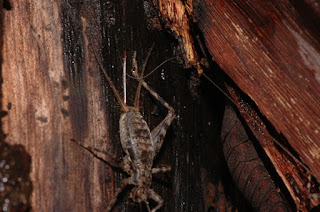
I saw movement,  a kind of horizontal shuffling movement. I assume they were Spiders, but they turned out to be a flat kind of Cricket - clearly designed to live under the limited spaces between loose bark and the tree trunk - just where they were.

I gently lowered the bark back where it was, and went to get the Camera out of the car (as it had been way too wet for me to carry the camera about all day). Ten minutes later, Bob lifted the bark for me, and I fired off a few shots, and this is what was going on in under that loose sheet of bark.

The male (on the right) has really long, fine antennae.
In the original image, I can just make out that
the antennae of the male reaches up to 
beyond the tail of the female.
It must be about three times the length of his body.

Click these images to enlarge them, 
to see the insects in full detail
Female "Bark Cricket", left (Tathra oligoneura)
in middle is a "Bark Cockroach" Laxta sp
on right is a male Bark Cricket (with small wings).
 Click these images to enlarge them, 
to see the insects in full detail.
Head of the female Bark Cricket (Tathra oligoneura)

Strange creatures. Brown, and mottled. 
The female has a really long ovipositor (its egg-laying tube).
The tip of the antenna of the male (out of picture, to the right)
can be seen bent across the tail of the female,
behind her back leg.
Amazing, because he is out of frame, yet his antennae is
clearly visible.
Relative to his body length his Antennae are really long.

 Click these images to enlarge them, 
to see the insects in full detail
Rear end of female Bark Cricket (Tathra oligoneura)
note the long, spiny "ovipositor" in middle
between the two wide-spread "cerci"
She has lost a leg, something which had occurred naturally.
  
The male has two half-formed wings*** (see comment below). 
There's clearly not a lot of flying going on where they live, under the bark.
 
Click these images to enlarge them,
 to see the insects in full detail
Looking at the male Bark Cricket (on the right)
Tathra oligoneura - note the very long antennae
and the flattened body.
Distinctive blotched appearance on legs.


Strangely (to my eyes) the male has really long antennae. 
About three times as long as its body. 

There is an E-Book "Australian Crickets"
by Otte and Alexander.
On P. 255 it lists Tathra oligoneura, as being recorded 
in central coast and northern NSW
 and notes it as a "Wet Forest" Cricket.

Dave Rentz has subsequently confirmed my ID of this Cricket
and has told me that in his experience 
it is "common at Bawley Point"
that is south, between Nowra and Batemans Bay.
So my Crickets were "in range". Good news.

***************

Post Script:Cricket chasing by torch light.
Tonight I went into the 
Robertson Nature Reserve with Bob Mesibov
looking for various arthropods which he assured me 
"would be out and about after dark"
How right he was.

We found lots of Millipedes, 
and some of this same species of Cricket.

Much to my amazement,
the male Crickets use their wings for display purposes.
*** (Referring back to comment above)
They hold them upright in the middle of their backs,
It totally changes their appearance and profile.
They no longer look "flat" when their back is
made to stand out by having two cross-ways flaps extended
which is the effect when the wings are held vertically.
They look quite impressive, really, even to my eyes.

We also found some Flat Worms and a number of Semi-Slugs
(which I have seen and photographed before).
They are lichen and fungi eaters 
so they cruise around at night on the
trunks of trees, devouring any moss or lichen growth 
and on occasions they will browse on some fungi.
They are really snails with a reduced shell
like a casually dressed Frenchman might wear his beret, 
on a slight angle.

Sunday, November 27, 2011

A small forest of Potato Orchids.

This morning I showed my friend Kirsten a few plants of the Cinnamon Bells (Potato Orchid), Gastrodia sesamoides. These plants are regularly seen growing in the Robertson Nature Reserve, where they grow around the base of several huge old Pinus radiata trees. These particular plants are the only ground Orchids of which I know, growing in the Robertson Nature Reserve. (There are some epiphytic Orchids growing in there, but not very many).
I have written about these particular plants last year, with comments on how to tell this species from the other local species of Potato Orchid. The other species is known as the Tall Potato Orchid (Gastrodia procera).
I reported three weeks ago on finding them again this year.
This species is fairly consistent in flowering about 3 weeks later than the related species.


Cinnamon Bells, Gastrodia sesamoides
Gastrodia sesamoides growing in the Robertson Nature Reserve.
Gastrodia sesamoides - note how "chunky" the flower is.
note the plump bulb at "base" (top end) of Gastrodia sesamoides flower.
Anyway, I was keen to show these plants to Kirsten, as I had shown her the other species a few weeks ago. So much so that I even warned her of the risk of attack by Leeches, but "trust me, it will be worth it".

Several minutes later, Kirsten was not so sure.
The Leeches were coming out of the forest everywhere.
That is despite the fact that we had both sprayed 
our shoes, socks and ankles with Insect Repellant.
For the record, the Leeches were less than keen on the taste on our boots
and we both escaped without a "bite" - 
but only by repeatedly flicking them off our boots.

Note the orange stripe along the side of the Leech.
Two leeches on Kirsten's shoes at once.
As we left, Kirsten gave out one last squeak, 
as she found this Leech catching a lift on her Camera.
A pretty inventive way of getting to the target person.
It was only a small Leech, but a highly adventurous one.
Australian Land Leech - probably Gnatbobdellida libbata
***************
Anyway, Kirsten and I left Robertson, to go down the hill to Kangaloon.
As I was driving along I got a call from Kirsten telling me to turn around.
She would not tell me what it was she wanted me to see.

She had found a veritable forest of Potato Orchids.
The "Mother Lode" of Potato Orchids which Kirsten found.
This colony of Potato Orchids was so large that 
Kirsten spotted them while driving along the road.
Normally they are hard to see.

Here is a second group in this colony.
They were growing amongst a stand of "Brown Barrell" Eucalypts.
There is deep leaf litter here, which is important to note
as Potato Orchids grow in relation with fungi living in decomposing organic matter.
Note how dense this colony of Potato Orchids is.
These potato Orchids were very large, and strong growing
Perhaps the three inches (75 mm of rain)
in the last week helped boost them.
Some as yet unopened buds of Gastrodia sesamoides.
A particularly strong specimen, growing by itself, 
close to the rest of the colony of Potato Orchids.
A strong specimen of Gastrodia sesamoides
This plant was photographed from about 10 metres away.
I cannot exactly count how many flowers there are
but it seems to be about 25 opened flowers
with a further 10 buds yet to open.
Pretty impressive. 

PlantNET says 
this species normally 2 to 20 flowers.
I have never seen anything like as many flowers on a single stem.
Magnificent head of Gastrodia sesamoides

Even more Potato Orchids, growing at the base of Brown Barrels.
This surely is 
the Mother Lode of Potato Orchids 
in East Kangaloon.