Christmas Bells

Christmas Bells
Christmas Bells - Blandfordia nobilis
Showing posts with label Southern_Highlands. Show all posts

Saturday, November 30, 2013

Martine Rolff donates her golden tresses for Cancer Connect

Martine Rolff, a local woman, a great singer, and the friendly assistant (the one with the previously famously long hair) at the Robertson Village Pharmacy has taken the plunge and donated her hair to be used for wigs for people being treated for Cancer.

"I am cutting off my famous locks
and donating it all
to make wigs for those suffering from cancer.

The money raised will go to the
Southern Highlands branch of CAN ASSIST."

Martine is a renowned jazz singer, and she bravely entertained us with a few songs from Hoagey Carmichael, and other jazz legends. 


And I suspect, in the process, she was preparing herself
to have the necessary courage,
to agree to Carole, from Cafe Pirouette
to be the person to cut her hair for her.

Carole making the cut,
with Martine's hand ensuring it is not too short.
The fateful cut
As it happened>
What looks like a Pom-Pom
appeared on Martine's head.
But we ought not have worried.

Here is Martine carrying the cut hair
She will donate it to be prepared as a Wig
for someone being treated for Cancer.
Her husband Gerry is looking on.
Congratulations to Martine.
I am sure she will still accept donations in any of the tins around Robertson which bear her name, for passing on to the Cancer Connections people. Or you can make an on line donation at her "MY CAUSE" page.

Monday, August 01, 2011

Winter Orchids starting to flower in the Southern Highlands

Ask not when do particular Orchids flower - ask what is in flower where I am  now? In winter, it all depends on altitude and temperature.

In the cold Southern Highlands of NSW, there is always a hiatus between the flowering times of Orchids here and the flowering times of the same species of Orchids down on the coastal plain in the Illawarra and Shoalhaven regions (which are less than an hours driving time away). And there is also an intermediate area, along the side of the Illawarra Escarpment, namely half way up Macquarie Pass.

So, it is difficult to be dogmatic about flowering times for a particular species of Orchid (especially in winter). Basically, it depends on where you are looking.
For example, I have seen one (only) "Tall Greenhood" (Bunochilus longifolius) in flower at Gibraltar Falls (south from Nowra) in early April. Alan Stephenson showed the ANOS group many of this species in flower in the Shoalhaven in late May. But, by contrast this species has just started to flower here in the Highlands. They have been in flower for several weeks, half way up Macquarie Pass. They have just started along the Belmore Falls Road, and along Kirkland Road, Kangaloon.
Bunochilus longifolius - the "Tall Greenhood"
A related species, Bunochilus tunstallii, is also just starting to flower along the road to Belmore Falls. Sorry about the image quality - it was growing in a flooded creek bed and I didn't want to get wetter than I was already. The dark labellum is the diagnostic feature. I refuse to kneel in water to get a better shot.
Bad photo of Bunochilus tunstallii.
Similarly, the Nodding Greenhood (Pterostylis nutans) is just starting to flower along the edge of Kirkland Road, Kangaloon. They have been in flower since mid May at Thirlmere Lakes.
Pterostylis nutans - the "Nodding Greenhood"
The Rainforest Greenhood (Pterosylis hildae) has just started to flower in suitable patches (clearings and roadside edges) on Macquarie Pass.
The red backdrop is from a piece of bark - sorry about that.
Pterostylis hildae - the Rainforest Greenhood, on Macquarie Pass
For comparison, here is the closely related Pterostylis curta, the "Blunt Greenhood" with its characteristic twisted labellum. They have been in flower on the coast for several weeks, but just starting on Macquarie Pass.
Pterostylis curta - note the labellum twisted to the side.
The "Maroonhood" (Pterostylis pedunculata) is now in coming into flower along the coastal plain in the Shoalhaven and Illawarra. These images were taken at Blackbutt Forest Reserve, (in the Shellharbour Council area). with Kirsten, several days ago. I know where they grow up here on the Highlands, and there are no signs of flowers yet (up here).
Pterostylis pedunculata - front view

Pterostylis pedunculata - rear view - note the rounded "bottom"

At this stage, I say, roll on Spring for more Orchids to admire, puzzle over and to photograph.

Monday, March 08, 2010

Robertson Big Spud Face on YouTube

Well, this story is bigger than Ben Hur!

Today I was interviewed about it on the local ABC Radio by Nick Rheinberger, (which by reports went well). I was also contacted by the local Newspaper (Southern Highland News). We shall see how that comes out on Wednesday.

The SHN reporter, who it seems is new to the Paper, and to the Southern Highlands, asked me if the Council had taken down the "Big Spud Face"?
My brother and a friend who was with me at the time said that I blurted out an unprintable comment, along the lines that it has nothing to do with the Council, and "besides they wouldn't f....'ing-well know where Robertson is.....". Something like that, anyway.
I wouldn't have said that --- surely not?

The artists who put up the Big Spud Face were keen to monitor the public reaction to it, so they set up a time-elapsed video in a strategic location where they could monitor visitors and their reaction to it.

Here is a link to the video which is now available on YouTube.

I am pleased to say that my little blue Daihatsu Feroza 4WD vehicle is in frame for the first 8 seconds of the video. But just look at the number of people who swarmed all around the Big Spud, and took photos of themselves in front of the Face.

This is very gratifying to see, and is great evidence of the popularity of the Big Spud Face.

The artists are considering revealing their identity to the Southern Highlands News, if the story is treated sympathetically this week. Lets hope it is.

Monday, October 26, 2009

Lyperanthus - both brown and yellow forms

Several days ago I received a phone call from a friend of mine, Jenny, from the Australian Plant Society - Southern Highlands Branch. She said she had seen an unusual Orchid near the Berrima Weir, and wanted to know if I was interested.
Was I?

Jenny sent me a photo taken by a friend of hers, and I was able to identify the plant as a yellow form of Lyperanthus suaveolens, known generally as "Brown Beaks". The yellow form is well documented, but it is apparently not common, except on the NSW North Coast.

We arranged to meet on Saturday afternoon, and Jenny took me along a track, to find the plants she had seen several days before.

Yellow form of Lyperanthus suaveolens
As she had seen them growing near some Diuris sulphurea, that helped us locate these yellow Lyperanthus, as the Donkey Orchids are really obvious.
Here is a cropped image of a single flower.
Well, not quite, but as the flowers grow closely together on a stem,
it is hard to separate them.
Click to enlarge the image.
The strongly pointed dorsal sepal
and the prominent downward curved labellum
are clearly visible when seen in profile.
***** ***** *****
Having found these yellow flowered forms of Lyperanthus, we decided to look around (it was a nice afternoon for a walk). I was actually hoping to find some "Caladenias" in flower, but there were none to be seen.

Anyway, we had only gone about another 200 metres when I spotted a bunch of the classic brown form of Lyperanthus suaveolens.

You can see the strong leaves of these two plants (growing side by side)
We were both tickled pink to have "completed the set".

This shot shows the front view and the more distinctive side-on view.
Front-on view of the brown form.
Here is a cropped image of the column and the warty-looking labellum.
The technical description is "labellum covered in small, sessile calli".
Here is the flower view in profile.
The dorsal sepal is narrowly hooded,
and distinctly upward sweeping.
Click to enlarge the image.
It seems this species is not "common" in the Southern Highlands. I have seen one, once before, several years after I moved to Robbo, but before I had a proper camera. Jenny had not seen this species for many years, and that was in the Heathcote area, apparently. Neither of us had seen the yellow form before.

All together a pleasant afternoon walk. It is always fun to find a new species, or at least an uncommon variant thereof.

Thursday, June 04, 2009

Farmers hopes dashed by acts of political spite

Farmers from across New South Wales today gathered outside what passes in this State for a Parliament.
They came in their hundreds believing that their representatives might consider their stories, their experiences and their views (if not their votes).No-one thought it would be easy. These people know that - they are farmers. "Easy" is not what farmers ever expect from their lot in life.
They assembled outside the Parliament building at 10:30 am, having left the Liverpool Plains at 3:30am. Many of them are in their seventies - life-long farming families. They take the threat to their livelihoods, and to their lifestyle, seriously.For them this is a battle for preserving family heritage. In many cases we are talking about three generations of family farming, sometimes more. Why would they not take that threat seriously?And then there is the economic issue - based around short term profits for foreign multinational companies (including the once great "Big Australian" - BHP Billiton, now primarily a South African controlled and administered mining conglomerate (their "Headquarters" in Melbourne is managed primarily by South African executives) - and the Chinese Mining company Shenhua and its proposed "Watermark" mine. The people from the Gloucester-Stroud area were also well represented, as well as people from the Mudgee district, the Central Coast, Illawarra and the Southern Highlands.All these groups of affected farmers posed the same economic question - Coal versus Food?
It is a short term versus long-term issue - short term profits (and short-term royalties for Government) versus rural communities providing sustainable income - in perpetuity.
Ultimately the farmers can grow food and rural produce worth infinitely more than the coal.
But not if their land is destroyed, either by the truly disastrous Open Cut mining (as proposed by Shenhua and Gloucester Coal) or by longwall mining, as proposed by BHP, which will drain the aquifers upon which the farmers depend. Either way they will be "stuffed".
IMAGE: The Hunter Region's Lemington coalmine - thanks to Hunter Valley Gliding Instructor Morgan Sandercock of www.sandercock.com (Image found at Project SafeCom website)

The rally was quite good natured, and there were even a few light-hearted moments, such as when Kim and Bernie from the Australian Water Network were "arrested" by Constable Mal from the Wilderness Society (in fancy dress).Here is the "Wanted" poster for Minister Ian Macdonald, Minister for Mineral Resources.Well, with the rally over, we went into the Parliament, to find that our presence, outside and inside the building was treated with suspicion (initially) and then disdain, and ultimately, with disrespect.

Firstly, prior to the resumption of the debate on the Bill, as scheduled as per the Orders of the Day, the Government attempted to introduce a condolence motion for a soldier killed in Afghanistan. This was clearly a stalling tactic, for the Condolence Motion had been on the Notice Paper for some 13 days. Suddenly it was brought forward as a matter of urgency. One Member, quite rightly berated the Government for attempting to use the death of a soldier as a stalling tactic to prevent the debate on another matter (the coal mining bill). As he said, he is the only Vietnam Veteran in any Parliament in Australia, and he felt sure all Vietnam Veterans and serving Soldiers would feel disgust that a soldier's death could be abused in such a callous and politically expedient manner. Duncan Gay, Deputy Leader of the National Party has put out a Press Release along these lines.

The bid to bring forward the debate on the Condolence Motion was withdrawn, but not before some precious time had been lost. The Government had simply wanted to avoid the substantive debate being brought on in front of an audience of farmers and environmental campaigners. The debate eventually started, with just one speaker, and was then adjourned when Question Time was called at 12:00 noon. Round one to the Government's delaying tactic.

During Question Time, Minister Macdonald answered a "Dorothy Dixer" (a friendly question on the subject from one of his own back-benchers). He spoke lovingly of being both the Minister for Agriculture and Minister for Mining - ignoring the obvious conflict of interest, as portrayed in the aerial picture above of a Hunter Valley Coal mine. Round two to the Government.
Mining wins over Agriculture, every time, when the miners do that to the earth.

We went to lunch at this point.

Tonight, when we came home to the Southern Highlands we heard on the radio that the bill had been defeated by a single vote.

Reverend the Hon Fred Nile, MLC, Assistant President of the Legislative Council of New South Wales voted against the Bill, because, as he is reported (by the ABC) to have said (Hansard reports are not yet available as I write this): "I can not support this bill. It's not because of the content, it is because if the bill is allowed (it) will give a great ability for the Green party to blow their trumpets," he said.

Did you get that, folks? The Reverend Fred Nile voted the Bill down, not because of the content of the Bill, but out of spite - because he cannot bear the thought of the Greens having a win.

I would dearly love to ask the Reverend Fred (a member of the "Christan Democrats Party") upon which Christian or Democratic principles he made that decision? The majority of the persons affected by the Bill which he voted down are old-fashioned "God Fearing Folks", from the country - some even as old as himself. Do they not have the right to some consideration? What about the future livelihoods of their families, about whom his Party would surely profess concern?

No doubt the vote by the Reverend Gentleman is based upon other issues, such as the Right to Life debate, and his well-known views against homosexuality. Neither of those issues bears any relevance to the debate. His vote would appear to be based not upon the arguments themselves (he said as much himself) as upon hatred of certain views of the proponents of the Bill. I conclude that, in all probability, he voted it down out of pure spite.

The words "Old Bastard" and "Hypocrite" spring to my mind, but I could not possibly use them to refer to the Reverend Gentleman, and Honourable Member of the NSW Legislative Council.

Fred Nile was joined in opposing the Bill by the two members of the Shooters Party (in the NSW Upper House). It is well known that the Greens party opposed the contruction of a large Rifle Range and Shooting Complex at Hill Top (near Mittagong), in the Southern Highlands. So their opposition to this Bill is presumably a "pay back" against the Greens for that issue - even though they won their case for the Shooting Range, with the support of the Gopvernment.

Ironic that - for the Shooters Party people claim to have many members who are farmers. Certainly many farmers are shooters. Yet they voted down a bill which would have advantaged their own class of constituents. Yet another example of voting according to spite, not principle, nor on the arguments of the case, nor on the economics of the case, nor even according to natural political sympathies nor presumed shared interests.
***** ***** *****
There is a salutary lesson to be learnt here.
Be careful who you choose as your friends, in Politics.

The farmers of NSW who were threatened by coal mining had little choice in going with the Greens - even though they might not be regarded as natural Greens constituents. Many would surely be more naturally regarded as either "old-money Liberals" or Nationals supporters (remember when they were the Country Party?). However, only Lee Rhiannon (the sponsor of this Bill) and the other Greens had shown much interest at all in opposing coal mining under prime agricultural land. When the Greens proposed this Bill, it seemed the farmers' only hope of gaining Legislative support. So, naturally they supported the Bill.

But the Bill was defeated precisely because it was sponsored by The Greens.

UPDATE: Hansard Extract - part of Speech by Rev'd the Hon Fred Nile, MLC:
"That is why I cannot support this bill. It is not because of the content; it is because the bill will give the Greens greater ability to blow their trumpets and claim a great victory in this State, and give them further political oxygen. During my time in this Parliament I have been working hard to deny political oxygen to the Greens." Fred Nile - 4 May 2009.
You may go to the Hansard link above to read the full debate.


***** ***** *****
The National Party member for the Upper Hunter, Mr George Souris has a track record of promoting coal mining, although he spoke to the crowd today of his support for this Bill. That speech brought tears to the eyes of the well-loved and well-respected member of the Liverpool Plains community, Mrs Duddy who said: "I have waited three long years for George Souris to say what he has said, here, today".
Front and Centre - Mrs Duddy
Photo: (AAP: Dean Lewins)
From the ABC report of the defeat of the Bill.

The decent farming folk of New South Wales do not deserve to be treated in the disgraceful manner in which they were treated today. In fact - nobody does.

At the very least we expect in a Parliamentary Democracy for debates to be treated upon the merits of the argument. We hope for nothing more. We got much, much less than that today. As a debate, it was a disgrace.
***** ***** *****

There is an up-side to this, however, for if I know these people, as I believe I do, they will not take it lying down. In fact, in all likelihood they will be stirred to a spirit akin the famous uprising at the Eureka Stockade:
  • "The Eureka rebellion, which is often referred to as the 'Eureka Stockade' is a key event in the development of Australian democracy and Australian identity, with some people arguing that ‘Australian democracy was born at Eureka’.
  • In my opinion, what passes for Democracy in NSW, died today in Macquarie Street, Sydney.
  • Let us hope that it arises afresh, in the spirits of the people who were so disrespectfully treated today - people from Caroona, Liverpool Plains, the Upper Hunter and the Mudgee region, the Lower Hunter, the Gloucester, Stroud and Barrington Tops region, the central Coast, the Illawarra and the Southern Highlands.
Authorised by Denis Wilson, Robertson, NSW.

Wednesday, April 16, 2008

Wingecarribee Shire Council - Extraordinary General Meeting

An Extra-ordinary General meeting of Wingecarribee Shire Council was held this afternoon, in the Bowral Memorial Hall. And extraordinary it certainly was.

Photo courtesy of Cam. Ford - "Save the Highlands"

The public was invited to attend, but we were not allowed to say anything (well, nearly). We did have "NO" signs, which could conveniently be reversed to read "ON". And these were frequently held up, "en masse". It made it resemble a silent movie scene, perhaps a Charlie Chaplin movie?

To read more about the background of this event, read the Save the Highlands website.

It was a closely scripted event. Clr. Larry Whipper proposed and moved an amendment, but from the outset it was obvious that the Campbell-Jones group had caucused. They were "all singing from the same song sheet", and had no intention of wavering from their position. Numerous innuendos were delivered about "elections in the air".

The most ludicrous moment was when Clr Penny George included in her speech elaborate references to a speech by Martin Luther King about distinguishing between things which were right, good or populist. Oh, please, Penny! The audience started to giggle, and we earned our first Mayoral rebuke.

That's the wrong Martin Luther King speech to quote. Try the "I have a dream" speech.
Except Penny, however nice, and well-meaning, just isn't that kind of Councillor.

Much was made about certain Councillors coming to the debate with "pre-conceived philosophical positions" (as if it was only the ones opposed to selling Public Park lands who have a "philosophical" position). Wasn't "Gordon Gekko" driven by a "philosophy". As I recall it was "greed is good". But Clr. Nick Campell-Jones and Clr. Malcolm Murray seem to think that having a view about not selling Public Parks is a "philosophy" (and that's something one ought be ashamed of, apparently); but having a firmly held view on privatisation of Public Parks is "good public policy", and nothing to do with a conservative economic "philosophy". Did you get that?

Wake up, Malcolm and Nick. You may have the balance of power in Council, but you do not have right on your side.This was an exercise in futility, from the start, to the finish.
*****

I must commend Clr Yeo for proposing an important motion to include a parcel of land on Oxley Drive, Bowral (on Mt. Gibraltar) into the Mt. Gibraltar Reserve. Then the Councillors voted on the most important motion, to consolidate all the various parcels of land which make up the current Mt. Gibraltar Reserve into a single parcel of land. That is most important, for it will make it exceedingly difficult for a future Council to remove small parcels of land from the Reserve (as this Council has been trying to do with small parcels of Public Parks land so recently).

Tuesday, April 15, 2008

Midge Orchids - reviewing my Corunastylis finds.

For the amateur Orchid enthusiast, the greatest problem is finding "oddities" - flowers which do not seem to "fit" the description of any known species. A variant of this is slightly worse. It involves finding something which appears to fit exactly with a plant which is not supposed to be where you found it. That one raises questions of one's "credibility" as an Orchid enthusiast. Not one's personal veracity, I stress, just one's reliability to identify "rare" finds.

The best example of this is the group of plants known as Midge Orchids: "Corunastylis" (formerly classed as Genoplesium). These tiny flowers are very difficult to identify, and the published texts have photographs which are frequently inadequate (mostly because of the small flower size) and the fact that the distinguishing characteristics are frequently microscopic. The PlantNET website offers botanical drawings, which are drawn by botanists who have dissected the flower, and have examined it with a laboratory microscope. I do not have those facilities.

The digital camera is the best asset for the likes of myself. However, you still need to have taken about 10 photos from all the right angles, to get the full details of the plant, including the leaves. And that assumes that your photos are perfect (they seldom are, when taken out in the field).

Exhibit A: - a dark Corunastylis, with hairy labellum and fringed dorsal sepal. In consultation with fellow Orchid enthusiast Colin Rowan, I concluded the best "fit" I could find was Corunastylis morrisii. His response was: "If I found them in Victoria I would certainly call them C. morrisii". One of Colin's photos of this species in Victoria may be found by using this link.
As you will realise if you visit Colin and Mischa's Retired Aussies website, these people are greatly experienced Orchadians, and I value their advice greatly. According to PlantNET, this species is only known in NSW from Braidwood and Nerriga area. My plant was found at Tourist Road, Kangaloon - 150 Km out of the known range for that species. See my difficulty?

Corunastylis morrisii
Exhibit B: Corunastylis species, probably C. oligantha. This species is newly classified, and the name does not appear on PlantNET, and a Google image search draws a blank. That makes it hard. The only reference I have, so far, is David Jones's book. Tony Bishop's book had good photos of this plant, but the species had not been named when his book was published. Good as the Jones book is, the photos are not really enough for me to make an absolute identification. I hope to print these images, and show them to some Orchid experts shortly.

Corunastylis oligantha (probably)
C. oligantha is recorded as occurring in the Braidwood/Mongarlowe area, 200 Km south from here. Again, I am faced with the same difficulty as with the previous species - it looks right. It fits the descriptions, except for the location. I found this species at Medway village, and Tourist Road, Kangaloon. Below is a closer photo of the same species, with the flower tilted back slightly, to reveal the dorsal sepal (at the bottom of the flower). The lateral sepals (above the flower) are very obviously rounded in their shape - in contrast to the next species, below.

Corunastylis oligantha (probably)

Here is a comparison photo of the dorsal sepal of the two species mentioned above. The Medway plant C. oligantha (?) is on the right. Clearly the dorsal sepal does not have fringed edges. Whereas the other plant does. The reason I stress this is that I was told, originally, that based upon the locality, the flowers I had found were likely to be C. fimbriata. Clearly the plant on the right is not "fringed " on the dorsal sepal (which is a definite feature for that species). So, that rules out C. fimbriata. The next best "fit" is C. oligantha, but it is not recorded from anywhere near here. See my problem?

Comparison of dorsal sepals of two species.
Corunastylis morrisii (left) and Corunastylis oligantha (right)
I subsequently went with Alan Stephenson, to Tallong, in search of C. plumosa, a geographically restricted (endemic) species. We did not find that species, but we did find this next plant (below).

Exhibit C:
This plant differs from C. oligantha in the shaping (angle) of the lateral sepals. These ones look like a goat's horns, held out prominently either side of the top of the flower. The labellum (pointing straight forward , towards the lens, and slightly out of focus in this image) is extremely hairy (fringed) as is the dorsal sepal. The dorsal sepal lacks the purple stripes of C. oligantha (?) above. I conclude that this plant is likely to be the true species C. fimbriata which I had been told to expect to find at Tourist Road. I found it at Tallong, but of course, it might occur at Kangaloon (as well). The close-up photo of the Medway plant (second image above) shows significant differences in the angle of the lateral sepals, and the fringed vs not-fringed dorsal sepals, between these two species. Their colours are basically similar, but this one is more "muddy" in its green/yellow colour, and lacks the purple stripes of the other plant.
Corunastylis fimbriata

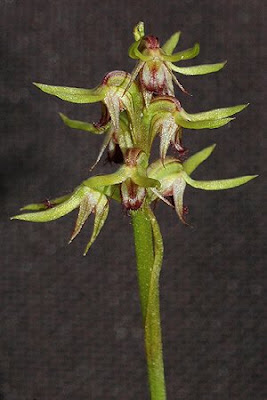
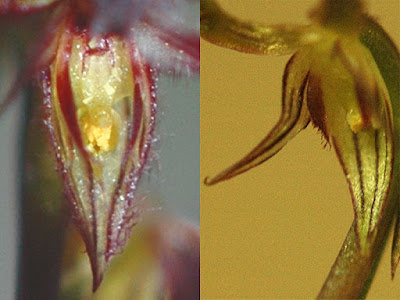
Exhibit D: And here is my most interesting photo of this group of plants. This is C. apostasioides. I would have to say it is a very unattractive flower, aesthetically. For a member of this genus, it is a relatively tall flower (on a tall stem, at least 30cm high, usually). However, the flowers themselves are tiny. The lateral sepals, on all the other species above, are held widely set, and often reflexed. By contrast, on this plant, the lateral sepals are drooping down, either side of the labellum which is very strongly reflexed. The dorsal sepal is very small, and very narrow, and is held closely between the low-set lateral sepals. Both the labellum (the upward-lifted part of the flower) and the dorsal sepal, are both extremely "furry". "Fringed" does not begin to describe it, compared to the other species. It really is an oddity compared to the other Corunastylis species shown. The other feature is simply the small size of the flowers, compared to the other species. The stem is relatively tall, as I mentioned, and the ovary (the green part below the flower proper) is relatively large and bulbous, but the sepals and petals are very small. Even the prominent reflexed labellum is only 3 or 4 mm long. In the field, it looks like the tiny flower of a wild grass, sticking out from a small Orchid. Honestly, unless you knew it was an Orchid, you would hardly recognise it as such.

Corunastylis apostasioides
These flowers seldom open. The books refer to it as self-pollinating. I happened to find a few open flowers late on several warm afternoons, in early March. There were many "Crane Flies" (quite a large fly, which looks like an awkward, long-legged mosquito) around. Perhaps they pollinate this flower, when the weather is right. Who knows? Most of the members of this species of Midge Orchid which one finds are closed. I published a photo of this plant, closed, last year. Their little flowers look odd, with the green bulbous ovary prominently set on the stem but the closed flowers themselves bent downwards. This species is, in fact, very common on Tourist Road, Kangaloon, despite what I was initially told (by a well-meaning friend).

This report of mine is intended to record what I have found in the Southern Highlands region of NSW this year. It also tends to demonstrate how little is actually known about the actual distribution of these plants. What is recorded in the books tells us where the botanists have found these plants, rather than where the plants are actually located.

Tuesday, April 08, 2008

Southern Highlands Tourism Ambassador Program

Well, Steve Rosa or somebody over at Southern Highlands Tourism read yesterday's blog posting (thanks guys). I thought you might see it.

Today I got an email from Steve Rosa, Executive Manager, Tourism, with full details of the Southern Highlands Tourism Ambassador Program which Mr Matt Brown, NSW Minister for Tourism, launched yesterday.

You can check out this Program for yourself.

In essence it is a basic discounts package, with different business houses choosing their preferred form of discount package. These discounts are listed in the brochure. Frequent mention is made in the brochure of discounts for accommodation (especially) "when booked by a local". This is good sense, for it is along-established fact that the most important tourists for regional tourism destinations (like the Southern Highlands) are those who are "visiting friends and relatives".

Robertson residents (and other highlands residents) are familiar with this pattern, with people from Sydney or Canberra or other places dropping in for the weekend, and then going out to visit the attractions of the region.

It seems all Wingecarribee residents will (might) receive their "passports" from Southern Highlands Tourism in the next few weeks. The "might" qualification refers to the fact that Steve and the Southern Highlands Tourism Crew are relying on Australia Post to deliver these. As as rural resident, with no roadside mail delivery, and a PO Box in the village, I do not receive unaddressed mail (i.e., no "Junk Mail"). So I will not receive the Passport. But at least I do know about it, via email.

And now, dear reader, so do you.

Monday, April 07, 2008

Tourism Southern Highlands - launch

This morning, Matt Brown, the NSW Minister for Tourism donned a blue T-shirt for the sake of Tourism Southern Highlands. He even stood between Wingecarribee Shire Council Mayor Gordon Lewis (right) and the TSH General Manager Steve Rosa (left), and a horse.This was a launch for a Tourism Ambassador program for the Southern Highlands. I have studied the Press Release put out by Mr Rosa, and confess I am none the wiser as to how this program is meant to work.

As the Press Release says: "Further details of the program is (sic) available from the Mittagong Visitor Information Centre on Telephone 4871 2888".

Am I the only person who dislikes badly written Press Releases?

At least the Horse was happy.

Wednesday, March 19, 2008

Green "Tiny Greenhoods" different from the brown form.

Here are some photographs of an Orchid which I have never photographed before. The photos are not great, but as with my practice of documenting new plants with the best photos I have yet obtained, I will publish these. If I get new photos which are better I will publish them, later on. But in this uncertain world, one can never be sure. For example, the SCA might go and burn these plants, or drive a truck over them, before I get back to photograph them again. I am not joking!
I was sent a photo by Colin Rowan last week, of a green form of the Tiny Greenhood. As regular readers will recall, I showed Colin and Mischa the Orchids of Robertson and Kangaloon two weeks ago. But they went off towards Sydney, and promptly found and photographed a green form of this little Speculantha parviflora, elsewhere in the Southern Highlands, the day after I showed him around. I have only seen this plant once before, but I was on a very long bushwalk, and was not carrying a camera with me. So, it is typical of my luck (or theirs) that Colin and Mischa, came up from Victoria, and following some suggestions of mine as to places worth looking at on their way through to Sydney, and found the green form. Don't you just hate that?

Experienced Orchid people are like that - they seem to have an instinct for where to look. I have privately congratulated them. Don't worry, I am not being nasty! But I am none-the-less happy to have found these plants myself.Anyway, my own luck was in yesterday. I also found the green form of the Tiny Greenhood. These plants were growing along Tourist Road, Kangaloon, in a slightly different area from where I normally look. (There is a lesson there, I suppose.)
I have previously shown the brown form of a related species of Tiny Greenhood. That plant is not yet described, but it will be named in due course, as a separate species - when the Orchid experts get around to describing their next batch of new species.Here is a nice group of these brown Speculantha flowers (3 plants together). Technically they are known as "Speculantha sp. nova affine parviflora" which means a "new species of Tiny Greenhood, similar to Speculantha parviflora".
A closer view of nice pair of these brown Tiny Greenhoods. The top flower, the newer flower, is dark brown on the front section of the flower. They fade to reddish brown as they age (check out the lower flower).Here is a close-up of one of those flowers. If you compare it with the green flowers above, you can see that this plant has a deeply curved-over "hood" (or "galea" as it is known). The green plant (see the photos above) has an open front, with the hood flaring open in a way which is quite different from this plant. The green plant also has a little bump at the front of the flower (the "sinus"), whereas these plants are close to being flat in the front. Compare the close-up shots of the green form, and this plant. So, this brown plant has different form, as well being of a different colour. That is good evidence for it to warrant its own species name.I have not been able to compare and contrast these related but different plants until today, so this is pretty exciting for me.