Some of the birds of Robertson have the habit of flying into windows, particularly in the early morning when the sun is low and reflections make windows look like open space. It is a shame, but there appears to be little one can do about it. This is what happened ot this little bird, a young and inexperienced bird. It flew into a window of a friend's house. She saved the specimen by wrapping it in soft paper, and putting it in a box in the freezer, till I could collect it. The bird was still soft and warm when she found it, so she knew it was totally fresh.
Birds, having given their lives in such manner, the least I can do is record some of the less obvious details of such birds (as with the
Frogmouth, in the previous post), and show the world what these birds look like, up close. Its all justified in the cause of scientific knowledge. It is always worth examining a fresh bird, carefully and in detail. You can learn an awful lot about birds from the beak shape, their claws, and their wings.
Today we start with a juvenile Eastern Spinebill. It has a uniformly fawn chest and throat, whereas the adults have a white throat and a "V" marking on the chest. This bird also has a slight pinkish yellow base of the bill, typical of young birds of many species.
The long bill is used to feed on tubular flowers which produce nectar.
In this regard, ti is very similar to a Hummingbird (North American and Central American birds - geographically speaking) . But that is a case of "parallel evolution", where
unrelated creatures have evolved to utilise a particular feed source - tubular flowers. Our Spinebills love Grevilleas, Waratahs, etc, but they have adapted to feeding on Salvias and Fuchsias, both of which are the natural food of Hummingbirds, (in their own countries of origin). As such Spinebills love old-fashioned cottage gardens and regularly come into gardens in search of a variety of native and exotic food sources.
Another similarity is that Spinebills can hover in front of tubular flowers and use their long beak to probe a flower and sip the nectar inside it.

This shows the underneath side.
Note the coloured throat, and the four white-edged feathers in the tail.
(Two feathers on each side of the tail are white towards the end)
Those white feathers are really obvious as Spinebills flit past you.

The "primary" wing feathers ("flight feathers") of the Spinebill are really stiff, and this gives the bird a distinctive sound as it flies past.
You really can hear them go "flit, flit" as they flap their wings. For such a small bird, it always seems strange to me, that you can hear them fly. One tends to expect it from Magpies and Ravens, but the Spinebill is relatively noisy in flight, too. It is a diagnostic sound - one can identify a Spinebill by hearing it fly past, without even seeing the bird.
Their ability to hover in front of a flower (which not many Australian birds tend to do) may be attributed to their stiff wing "primaries" - the feathers which are exposed in this "open wing" shot.

Here are the delicate feet.
Strong claws, with needle-like claws, enable this bird to perch
on the tiniest branches or flowers, in search of nectar.

This female Satin Bowerbird
(Ptilonorhynchus violaceus) is getting more accustomed to human presence on the back deck, as my brother and I have been working steadily out there.
This one was clearly looking for food - in the form of a pear,
which I put out on those little spikes I use to fix the food on the bird table.
Note the stunning violet-purple eye colour of the Bowerbird.
(Click image to enlarge it).

This Lewin's Honeyeater
(Meliphaga lewinii) had more luck than the Bowerbird.

Each pear lasts about 4 hours, on average, but up to 4 Bowerbirds at a time can knock a pear over pretty fast. Bowerbirds tend to take up to 6 pecks at the fruit before flying off with a very full beak, to digest the food. The Lewin's Honeyeater is more gentle, with its finer beak. It tends to take about 4 big pecks, then flies off.
Down below the deck, in the grass, there were three
Grey Shrike-thrushes
(Colluricincla harmonica) looking for insects.
This one is a juvenile, with the rusty marks on its eyebrow and wings.

This juvenile Grey Fantail
Rhipidura albiscapa came through in a mixed feeding flock, and posed for a moment for a shot.

That bird is marked with fawn and brown, which is typical of juvenile birds in this family (the
Corvidae - which includes, locally, Magpies, Butcherbirds, as well as Whipbirds, Shrike-thrushes, Whistlers and Fantails).
Technically, this next bird came from Bankstown, in Sydney, but the species does exist in Robertson, but thankfully not at my house. It is a mummified skeleton of a nestling Common Myna. which died when it fell down inside the wall cavity of my house. That event may have occurred ten or twenty or more years ago. I cannot tell. I know it was long before my house was moved to Robertson. The skeleton was perfectly preserved, but with little or no flesh or feathers present any longer. Presumably the flies and ants of Sydney had done their work in removing all edible material. This young bird presumably clambered out of the nest, and fell down inside the wall cavity. It was unable to climb back out, and has simply died of starvation just below its nest (in the rafters).
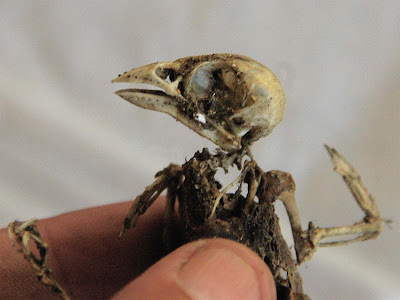
As my roof has been totally rebuilt after the relocation of the house, I am confident that no birds can get inside my new roof. In fact, I have done absolutley everything I can do to prevent that happening. It is also one reason why I do not feed seed and other mixed food to the native birds, as the last thing I wish to attract is the Common Myna. They are noisy, aggressive and dirty birds.
As Ned Kelly was given to say, on such occasions,
"Such is life".
I have recorded the skull and beak shape of the Myna, once again out of scientific interest. This
linked image of a live Myna shows the same beak shape (it is quite deep and strong). The only other birds likely to nest in suburban Sydney roof spaces are Sparrows (which have a seed-eater's beak - deep and short) and the Starling, which, although related to the Myna, has a much shallower beak shape - more an insectivore's beak. The Myna's beak shape is strong, but versatile, allowing them to eat just about anything from fruit, berries, insects or flesh (such as dog food). They are natural scavengers around human habitation. A good reason for not leaving dog and cat food out in the open around a house.


