Christmas Bells

Christmas Bells
Christmas Bells - Blandfordia nobilis
Showing posts with label friends. Show all posts

Monday, July 07, 2008

Bits and Pieces

Kindly wish me happy 700th posting, please. Thanks for following along for the ride. If it were not for the feedback from the readers, this would not be worth doing.

Last week I took Lena for one of her occasional visits to Mr Darcy. In fact I was visiting my friends Lyndon and Maria, but don't tell Lena that.

The grass was almost unbelievably bright green in the morning light. But the colour is real. Lena loves a romp around on this field of neatly trimmed grass, and checking out the sniffs from the resident Goat, the local Wombats and Wallabies, and occasional Rabbits.
Mr Darcy is very ornamental, statuesque one could say. He is suitably handsome, as any Jane Austen fan would agree. Colin Firth fans - eat your hearts out!
The dogs, Lena and her friend Mr Darcy were not shy. They never are.

And from the sublime to the mundane, I noticed a small, dull, but beautifully shaped fungus growing from a dry piece of wood, at Lyndon and Maria's house. A perfect parasol shape.
Underneath this little brown parasol is a startlingly beautiful structure of widely spaced gills. These gills are interesting in that they alternate between complete gills (going from the stem to the cap), and short, incomplete gills. The gills are also relatively widely spaced, compared to the more familiar "field mushrooms" which many people consume regularly, purchased from Greengrocers (or supermarkets - if you have forgotten that "Greengrocers" still exist).

I have not been able to track down what this fungus is, but it bears some resemblances to this Mycena stipata (from an European website).
Any advice would be welcomed, folks.

And, as with everything I like to do in this Blog, there is a tiny surprise waiting for you. Yes a minute insect (or an "arthropod" if you prefer). I have no idea what class, or order of creature this tiny creature is. I wondered if it might be a "proturan". I do not know. I certainly would welcome any advice from fellow bloggers. If you scroll back up to the image two above, you may now notice this creature, wandering around inside the gills of the fungus, on the top left side.
All I can make out for sure is that it has several dark grey protrusions which I assume are antennae, (on the far right hand side) and what appears to be two pairs of legs towards the front of the body, and other tiny feet, or other structures, but I cannot count how many pairs of legs this little creature has. As often happens, I was not even aware that this creature was present, until I developed the photograph. I might have checked its fine details with a 10x magnifying glass, otherwise.

Distressingly, an extended search of the Internet tonight brought little joy in trying to work out what "insects" (for want of a better word) live within fungi. I have seen these creatures before (several times), but I cannot not track down what they are. The fungi people concentrate on the types of fungi, but it seems that they seldom stray into discussing whatever creatures live on and within fungi. Apart from "Springtails", (Collembola), I have found little mention of creatures which feed on fungi. But they appear not to have a larval stage, and adults have a different body shape to this, with 6 body segments. This creature seems to have more segments than that.

As I have indicated, any help would be welcomed in identifying (above), and also the type of fungus the tiny little creature for which this little fungus is its entire "world".

Thursday, December 06, 2007

Vale John McKee - a good friend

This is not a local Robertson posting, but a Canberra bulletin.

I had to go to Canberra today, to farewell my friend John McKee. John was killed in a Ride-On Mower accident on his property at Brogo, on the far south coast. We do not know the details. It is possible John had a stroke, while operating the mower. There is little value in speculating.

The important thing is that whatever happened, John was happy doing what he wanted to do, at his bush property. John was a good plumber (well, a bit rough, perhaps, but always co-operative) and, mostly a cheerful person to work with.

He was a good friend, and really was a "bushie" at heart. He loved raising chooks, and growing vegetables and "mucking about". Although he transferred to the Public Service late in his career, John never was a "Public Servant" at heart. He took his responsibilities, far too seriously, and was frustrated by those "time-servers" he found himself surrounded by. I for one was greatly relieved (for his sake) to see John move to Brogo.

John came up here to Robertson on several occasions, to help out with the plumbing of my cottage. I enjoyed seeing him, and talking to him, while he was here, it was obvious he enjoyed his life in Brogo.

John managed to liberate himself - to a happy life on his farm. Therefore, what is there to not be satisfied with? We will miss John. But he made the most of what he had.

Sunday, September 23, 2007

A new Orchid - for me.

My friend Lucy and her son George drove past, when David Young and I were out taking photographs of Ground Orchids this morning. The sight of two grown men lying on the ground, beside the road, caused some comment from Lucy. For the record, we were taking photographs, separately, of different plants, at the time. But that did not stop Lucy from raising an eyebrow. Oh dear, how we photographers and plant enthusiasts are misunderstood!

Well, Lucy knows full well what we were doing, but she could not resist teasing us. Fair enough. I tease her, from time to time, too.
Today I found a rare Orchid which I have been on the lookout for. It is called the Wollongong Bird Orchid, Simpliglottis chlorantha. This plant is known to grow on the Budderoo Plateau, but that is a very large area, adjacent to the Barren Grounds. Anyway, today I got lucky, and found the distinctive paired leaves of these plants, and one of the plants (one only, mind you) was in flower. It is quite a thrill to find a plant, in these circumstances, when you have been given a bit of a clue as to where to look, but not much more than that. I think it was the fourth time I have gone out to this area, looking for these plants. As I said, today I was lucky enough to find them (or it).
*****
That plant is related to the far more common "Ant Orchids" which feature below. If you compare these photos (above and below) the first impression is that the plants are very different, and indeed they are. One is wide, and green, the others narrow and dark reddish. However, if you concentrate on the structure of the flowers you will notice some obvious similarities. Note the "column" like a broad tube held above the labellum, with the pollinia prominently positioned above the scent producing glands. Unlike the Ant Orchids, which have glands resembling an insect in appearance, this Bird Orchid has some red, and one prominent green scent gland, of what looks like a soft jelly-like substance.

Until very recently, all these plants were classed in the same genus, Chiloglottis. The Botanic Gardens website has not yet formally recognised these new names, so the link above takes you to "Bird Orchids" and Wasp and Ant Orchids - all under the same genus name.
*****
Earlier in the day, I had gone out with David to try to photograph some of the little Ant Orchids which are found out in the tall Eucalypt forests (on sandy soil) in the Kangaloon area. These tiny little plants are very hard to see on the forest floor, for they are perfectly camouflaged, amongst the leaf litter.

This one is the "Diamond Ant Orchid" (Myrmechila trapeziformis)- a reference to the diamond shaped blade or "labellum" of the Orchid flower. Their lateral sepals are held wide and flat, beside the labellum. They arc back, as can be clearly seen in this photo.
This second plant, growing in a small colony, just about 20 metres away from the other plants, is of a different, but closely related species. This is the "Common Ant Orchid", Myrmechila formicifera, which means "ant-bearing" - a reference to the structure on its "labellum". In this case, there is a line of small glands behind the "pseudo-insect", which glands reach down in a line to the furthest edge of the labellum. How far these glands extend on the labellum is the easiest way to distinguish these species. These differences in the two species were quite consistent amongst the individual plants in each group. In other words, all the plants in one group were basically the same. And the other group were all basically consistent too. These plants have a series of glands on the labellum which have the appearance of an insect. It is referred to as a "pseudo-insect" by Orchid experts and those few entomologists who study this process. In fact these plants emit a scent which mimics the pheromone of a female wasp, prompting male wasps to seek to mate with this "s.x-toy" on the Orchid's labellum. In so doing the male wasp might end up with a dob of the Orchid's sticky pollen stuck onto his back, which, hopefully, he will take off to another flower, and will accidentally pollinate it, as he once again attempts to mate with the other flower. This is the process known as "pseudo-copulation".

I went out in the bush with David, who has a very good camera, which allows far closer camera positioning than mine does. Here you can see how low the dedicated photographer has to get down, in order to take photos of these plants. I have placed a ring of light around the flower which David's camera is focussing on - just to highlight exactly what it is that David is photographing on the forest floor.
You can see some of the results of David's handiwork over on his blog, where he has photos of some other plants and some amazing photos of the Hover Flies which were buzzing around the flowers of the Hardenbergia violacea, the so-called "Native Sarsaparilla". David's blog is called "Focus on Nature", which is exactly what he was doing in this shot.

Sunday, June 24, 2007

Helping hands.

Today Kim and Peter Martin, and Bernard Eddy, came over and gave me hand in the garden. Peter and Kim brought a load of delicious looking compost, which Peter spread over the front garden bed, where the Peonies are.

Kim did the fine weeding, and delicate pruning, while Peter regaled us with stories of his experience as a pruner, starting with the time he pruned an old, and really tall Lemon tree, by shaving off the side branches, up as far as he could reach. Seemingly he ended up with a very nicely trimmed Lollipop shaped Lemon Tree (with all the fruit completely out of reach). I can understand Kim's reaction, when she saw the result. In Peter's defence, it was a long time ago, and he claims that he has learnt a lot about pruning since then. It seemed to come down to a debate between whether the Lemon Tree episode was "a learning experience - for Peter", or whether he had shown, early on, his true nature as a pruner (one who ought never be given anything sharper than a nail file). Anyway, I decided that the Lemon Tree episode was a long time ago. And Peter's help was much appreciated today. He did a great job, but I did keep a close eye on his trimming activities, none-the-less.

On the other hand, Kim kept noticing interesting little plants around the garden, such as the tips of Bluebells popping up, and Cyclamen hederifolium, which are only just showing a few leaves at present. So, I figured she knows her plants pretty well. So I was happy to trust her judgement, while doing the weeding. (Having seen Kim's garden, I know she is an excellent gardener.)

Bernie and Peter did a lot of cutting of broken branches of wattle trees (owing to the recent wild weather). We also managed to remove a large Plumbago, which I had planted in the wrong place, several years ago, and which was beginning to overcrowd many other plants. I like that plant, but this one was definitely in the wrong place. Bernie claimed the "scalp", after Peter and I had had a go at digging it out, without quite managing it. The guys took a number of loads of branches, and shrub-prunings down into the bottom paddock, onto the bonfire pile, where it will be allowed to dry out, before being burn off, at some stage, when the weather is suitable.

Bernie assures me that Melba, the Welsh Mountain Pony, is a lovely little horse, with a sweet nature. Clearly Bernie understands something about horses, which I do not. The only time Melba is ever nice to me is if I bring her an apple.

This was a very generous act on everybody's part, and I really appreciate it. We had a lamb roast, for a late lunch, after a few hours of work, and everybody enjoyed the meal.

Friends like these are a special gift.

Tuesday, June 19, 2007

Owen's forest and waterfall

Down in the steep valley, beside Upper Fountaindale Road there is a little creek which flows permanently.


After rain it makes a very significant flow, complete with several small cascades. For artistic licence, let us call them waterfalls.


The rainforest in this deep gorge has wonderful large vines (lianas), which are covered with mosses, lichens and in many cases, fungi as well.


The waterfalls are over head-height, but they are not great leaps of water, of course. Still the sound of running water, the spray, the light, is all that one would want in your own back yard.

Blessed is he with this waterfall to call his own.
(As usual, click on the images, for a better look.)


Of course, this waterfall and forest comes with its own Forest Sprite, in a yellow rain jacket and trousers. You would be disappointed, if that was not the case, would you not?
Wikipedia assures me that I ought not refer to this character as a Leprechaun, as that would risk being an offensive stereotype. Perish the thought.
I am grateful to this cheery character for permission to visit his waterfalls, and forest.

Saturday, June 16, 2007

More of the Fungal Queen's loyal subjects

Well, I managed to get Penny upset, with my comment about a "none-too flattering" portrait of myself - the other day, at the Queen's Birthday picnic at Lucy's place.

Today she sent me a few "sweeter" photos of the group at Lucy's place. These are indeed somewhat sweeter. Thanks, Penny.

Anni, Andy and Steve

Steve cannot resist blowing the photographer a kiss.
Nice Camellias in a vase, by the way!
Anni is concentrating on what Emma, beside her, is reading out loud to the group.


Emma, looking very natural, is reading through one of George's creative writing projects.

George, Lucy's eldest, has a very natural writing style, and Emma was reading sections of his story out loud.


Here is George (in front, doing a "boy thing" with his fingers), pictured on his birthday, back in February.

He doesn't always look like a talented writer, but looks can be deceiving - especially at one's own Eleventh Birthday.


Lucy and Meg
Lucy is looking very relaxed, which itself is a triumph, seeing she was our hostess, at the party.


And finally, the photographer, Penny, herself, with a grandson, Luca.

Penny, in a photo taken by her grandson, Jeht.

Persons who managed to avoid Penny's lens were Celeste, Sarah, Brita and Jeht.

Thursday, June 14, 2007

Fungal Queen of Kangaloon

Queen's Birthday celebrations
Last Monday, Lucy, being a "loyal Pom" held a Queen's Birthday Party at her place. I did not take any photos of Her Majesty's loyal subjects, however, Penny sent me this none-too-flattering photo of myself (in the foreground, in blue tennis hat, eating a piece of Royal Birthday cake) with some friends, James, Steve and Andy (partly visible). Other friends, such as Sarah, Larry, Celeste and Emma (and Lucy herself) seem to manage to avoid the scrutiny of Penny's lens. (Ooops, I left Anni off the list - how could I? Now corrected. Apologies. DJW)

A very nice day was had, and Lucy deserves congratulations for arranging the weather to break, just for that Monday afternoon. It is raining and hailing again, as I write, and of course, we had 5 inches of rain prior to this event.
Largest Fly Agarics
I have ever seen.
The piece de resistance, was the way Lucy had arranged some very nice "Fly Agaric" toadstools to appear just near the gate, to welcome visitors. They were spectacular, and although Robertson is well supplied with this type of "Fairy Mushrooms" (under the very large Pine Trees here, mostly), these were the largest, and most tightly clumped I had ever seen.

My camera bag is posed there, for scale purposes. It is quite bulky, large enough to hold a camera with 3 lenses. The old toadstool on the left is about as large as they normally grow. The big one in front is huge - twice as large as normal.
Immature Fly Agarics
with the "covering" still
intact.
The immature toadstools of this genus arise from inside a covering which then ruptures, as the Toadstools expand. This is the source of the little white dots, or flecks, which are normal on these Toadstools, and which give them their distinctive appearance.
I have previously posted a series of photos which shows the entire range of development of these fungi - from covering just cracking, through to fully mature fungi.
Fly Agaric is known technically as Amanita muscaria, but is often referred to as the "Fairy Mushroom", or Fairytale Toadstool, because its popularity in children's picture books, illustrated with fairies sitting on these fungi.
Cracking of
outer covering.
Here you can see the red coloured skin just peeking through.

So, in honour of the Queen's Birthday event, and these spectacular Fairy Mushrooms, I propose that Lucy be dubbed the "Fungal Queen of Kangaloon".

My lawyers insist that no other implications , nor interpretations are to read into this title, which is entirely good natured. Also, it has been "cleared" with Her Majesty's personal Legal Counsel.

Sunday, May 13, 2007

Lena and her buddy, Buddy

Lena, with Buddy's "toy"
Lena has a boyfriend, a buddy, called Buddy.
She has taken to visiting Buddy as often as possible, either at his house in Bowral, or at his Mum's shop in Robertson, where Buddy hangs out frequently.

Buddy is quite a bit older than Lena, and he is normally pretty staid and he sleeps a lot. But when Lena turns up, Buddy gets quite "young" again.

Lena shaking the "rope"
and wagging her tail.
They wrestle, they tease eachother by playing with various "rope" toys, and mostly Buddy just tries to nip Lena near her mouth and ears, and around her neck, and on her legs, and just about everywhere.

She loves it, and constantly comes back for more.
She spends most of these "fights" lying on her side or back, because Lena is about twice Buddy's size.

Lena on her back, playing
with the rope toy
Because Buddy lives in a house, when he tries something a bit more "interesting", he gets scolded, till he stops that idea. Sometimes it is Lena who does the scolding, and sometimes it is his people who shout at him. Either way, he gets the idea, and forgets his other plan.
Above all, they are really good friends, and like eachother's company enormously.


Lena is tired, now!
*****


"Buddy"
Buddy has an issue with storms. He hates thunder and lightning, which is why there is only one photo here of Buddy. What?
Well, Buddy thinks camera flashes are lightning, and therefore, one flash means there is a Thunderstorm coming. Right?
So, as soon as a camera is produced, Buddy heads for his bed, climbs under the blanket, and hides there till everything is calm again. Poor Buddy. It is a shame, as he is actually quite photogenic, but he is ridiculously "camera shy" - because of the "lightning machine".

That's why there is only one photo of Buddy here. If you look, Buddy is checking out the evil "Lightning machine" (camera), prior to making for his bed.

Sunday, November 19, 2006

The Nature of Nature - at the microscopic level

Yesterday, I had the great pleasure of watching 2 fully grown adults discover the beauty of the inner world of flowers.

My friends Jim and Songsri and I went into the Carrington Falls Nature Reserve, near the restored quarry (not close to the falls). This is an easy area to access, with a variety of habitats. You start near the road in open forest, with grass and herbs as undergrowth. Then you pass to an area of almost bare sandstone rock, with typical sandstone forest scrub, with dense undergrowth of Tea Trees (Leptospermum sp.) and the endemic Carrington Falls Grevillea, Grevillea rivularis. (Click to go to a good photo of the flower from Plantnet - the Royal Botanic Gardens plant identification website.)

This plant is one of Jim's favourites. It has long flowers, arranged in a "toothbrush" structure. The flowers are varied in colour, in part, white, then green, then purple (in parts). Also, the seed pods are fascinating. They are hairy, and when fresh, they are green with dark patches, almost resembling a caricature of an eye drawn on each side of the fruiting capsule.

Jim has bought himself a 10 power magnifying glass, and he was revelling in introducing Songsri to the inner world of flowers.

I was enjoying myself too, explaing the convoluted pollination system of the Grevilleas (and the related Waratah too). With the lens, one could see the pollen sacs inside the flower, and how the pollen is transferred onto the end of the "pollen presenter", which subsequently develops into its female stage. Some flowers had been successfully pollinated and we could see the ovary starting to swell. Other seed capsules were well developed - those hairy things described previously.

We also examined some Melaleuca squarrosa flowers, and noticed their sweet scent on the warm afternoon air.

The simplest structure of the flowers which we examined was the Leptospermum rotundifolium, which had large (3 cm wide) lilac flowers, with a very clear structure of a ring of 5 petals, an inner ring of stamens, around a prominent central disc with an obvious green colour. Have a look at the ANBG website photo on the preceding link, or this link for the Royal Botanic Gardens, Sydney, Plantnet site for this Tea Tree.

The best part for me was watching Jim explaining to his wife how to use the lens. Songsri clearly had not ever looked at a flower through a magnifying lens before. It was very satisfying listening to her squeals of delight, as she "got it right" with the lens.

And then she just fell in love with the inner delights of flowers. This is where a novice can develop her sense of wonder about Nature. All power to Jim, the educator.

Saturday, August 19, 2006

Clarity of Vision

My friends, Steve and Celeste have great clarity of vision.

Not only do they live on the best hill top in the district (Mount Murray). They have views to the end of the earth (Sydney lights are visible at night). But in addition, they have great clarity of personal vision!

I was discussing personal matters with them both, this afternoon, and I feel encouraged, emboldened, and enlivened. I am ready to go forth to meet the future, whatever it may hold. And Steve is preparing the soundtrack to accompany my spiritual journey.

All this from a cup of Tea? Yes and no. All this comes from their clarity of vision.


To top it off, this was the clear view which was awaiting me as I drove back past the top of Macquarie Pass, looking down over the glass-like surface of Lake Illawarra, with Port Kembla beyond, and then the Pacific Ocean.

Actual clarity of vision, to match the emotional clarity of vision.

Saturday, August 12, 2006

A Plant version of Anni's Literary "meme"

Anni, who Blogs at Mayday 34°35'S 150°36'E sent me a literary challenge, which I am not sure that I am ready to handle. In the past I have been a very enthusiastic reader. In recent years, I have found myself reading plant books - reference books about native plants, Orchids, Peonies. I love these books. But I am sure these books are not what Anni was asking about.

Anyway, Anni suggested that I vary the "meme", to make it centred around plants - plants I have always grown, plants I have never managed to grow, plants that I wish nobody would ever grow, etc. You can see where this is heading. So, I am up for this challenge. I will stick as closely as I can to Anni's original literary questions.

*****

One plant which changed your life:
I can answer this question in a very literal (not "literary") way. The plant in question is the Madagascan Periwinkle. As that link explains, it is the source of two extremely potent drugs used in Chemotherapy treatments - Vincristine and Vinblastine. The old Latin name for this plant is "Vinca", (which means a chain). That "latin root" (Vin...) appears in the names of the two drugs mentioned. The botanists have now revised the name, and it is officially called catharanthus roseus.

Anyway, as you have doubtless guessed by now, this was the source of one of the drugs with which I was treated last year, in my first round of Chemotherapy treatments for Non-Hodgkins Lymphoma. So, in a very physical way, this plant changed my life!

One plant you've grown more than once:
Well, there are many plants which meet that definition - such as Lawn Grasses. But speaking of plants which I value more that. The Rose "Just Joey" would be the best example. I love this plant, and always find myself planting it in any garden I have something to do with. I have donated one to the CTC in Robertson, where it is growing beside the main door. "Just Joey" is a "good doer", ("healthy as...." in the modern vernacular).

It is a large flowered modern Rose, with shades of pink and apricot in its flower. It has a slight tea scent, so one tends not to grow it for its perfume. I have a pair of "grafted standards" planted either side of my front door, so that it has enough stem height to give me flowers at eye height. Last year, when I was in hospital in Canberra, Anni posted this photo of one of my own "Just Joey" flowers, on her blog - which was very sweet of her.

I love the old fashioned roses, The Gallicas, the Damasks (especially Isphahan and Kazanlik) and the tough, but lovely Rugosas, from Japan, for their wonderful elegant, true "Rose perfume". "Just Joey" has none of that perfume (it has Tea Rose ancestry, alas). It also has a stupid name. However, despite these fundamental deficiencies, I still rate this plant as my favourite Rose.

One plant which made you giddy:
In this case, I would go for a perfumed plant. I am very responsive to the scents and odours emitted by plants. My personal preference is for the heavier, muskier odours. Light fragrances, such as Violets emit are unfortunately lost on me. I know they are very powerful for some people.

Currently, my favourite aromatic plant is a Mint Bush - Prostanthera sieberii. There are many Mint Bushes (Prostantheras) in cultivation - P. seiberii, ovalifolia, and melissifolia are species which are all nice. But I find the perfume of the leaves in P. seiberii to be
most to my liking - a combination of sweet and musky odours.

The
Sydney Botanic Gardens "plantnet" site for this species, describes it as being "strongly and unpleasantly aromatic".

As my old Latin teacher used say: "De gustibus, non est disputandum" - (Regarding tastes, there can be no argument.)

I have this plant growing beside the path to my front door - deliberately planted too close to the path, so that one has to brush past it, as you enter the house, and you get enveloped in its perfume as you walk past it. It is also known as Prostanthera incisa var sieberi.

One plant which wracked you with sobs:
(This question makes more sense in the "literary" version of this "meme")

I will take the "literary" (dare I say it - the "girlie") interpretation of this question. I take it to mean a plant which is so beautiful that it almost does not deserve to exist.

This plant takes my
my breath away.

Here is Tree Peony "Shimane Hakugan". (please click to enlarge the image and study the centre of the flower, and then the purity of the white petals).


One plant which you wish had been bred:
Many people would say a "blue rose". I will not. I like plants to do what they do best. Roses do pinks and reds, and even yellows to perfection. Why ask them to do that which they cannot manage, genetically? If you want blue, grow one of the Forget-me-not family, or a Pansy, or the stunning sky blue Himalayan Poppy (Meconopsis sp.).

I would like to see a disease resistent Meconopsis, to follow up that particular flower. I have had great difficulty growing this plant, but I have a friend in Canberra who was successful with them, by growing them in full sun, in a half Oak Barrel, filled with a blend of rich leaf litter and sand. Perfect drainage is required, it seems. Even though Robbo soils are well drained, it seems they are not well drained enough for this most stunning blue flower.

One plant which you wish had never been bred:
Well, obviously I would list weeds - like the Blackberry, as being a terribly invasive pest. But it is a natural plant, more or less.

But again to take the "romantic" interpretation, I would say a Red Rose, with no perfume. In my mind, a Red Rose deserves to have perfume. It cries out for perfume, it demands perfume.

Some French couturiers (who tend to market perfumes as well) have specified that any Rose named in their honour must not have a perfume - it would clash with their "brand" perfumes. An example of a nearly scentless, but beautiful red rose is Rosa "Christian Dior" (see image at left). An affront to nature, in my mind.


One plant which I am currently growing:
Well, Peonies are my particular "favourites", one might say, my obsession. Of these, I rate the Tree Peonies very highly indeed. But the Herbaceous Peony Hybrid called "Coral Charm" is an extraordinary plant. This plant (surely a "female plant") is so lovely in bud, when freshly opened, at fully mature stage, and at her "blowsy best" when fading ("like an old courtesan", as my friends Steve and Celeste like to say).

I would rate her as my most special plant, and she is "currently growing" in the precise meaning of making growth, right outside my front door, today - with buds about 10 cms high now.


Two weeks ago, Coral Charm was getting ready for Spring!

Anticipation, at its feminine best!


One plant I’ve been meaning to grow:

There is one Magnolia which I have seen growing (overseas), which is a white Magnolia with a dark strawberry-red coloured centre. It is called Magnolia sieboldii.


A truly lovely plant, which I would dearly love to grow - one day, maybe, perhaps. This photo was originally sourced from the Dutch Botanic Garden Collections Foundation.

What is about white flowers with dark centres?


Now tag some "Bloggers":
Well, I have to start with Anni, of course, whose suggestion led to this modification of the original "literary meme". I hope you think it worked, Anni. I must admit I have had fun with it, even if it has taken me hours to compile my list.

Then Miss Eagle (who rang me hours ago, to ask how I was going with my book list). She was so enthused by the "literary meme" that she broke the task into 2 separate postings. Her second post is here.

At the severe risk of losing a good email friend, I shall tag Leo, my Peony-growing pal in Canada. Leo's Blog is called "Peonies - and the rest". If it is raining in Nova Scotia, and too wet for digging Peonies, or for cycling up and down the steep hills of that region, Leo might get around to responding, in his own way to this "meme" on his blog. I do hope so.

Anni, would you please pass on a notice to your fellow Finnish ex-patriot (in Sweden), namely Jaska that I would dearly like to see his list of favourite plants, and least favourites, etc. You might also tell him please, that I liked his insect photos on his recent posting. Typical late summer scenes - butterlies and Dragonflies. Lovely.


Monday, August 07, 2006

The Basic Rule of Photography

The basic Rule of Photography which I have learnt today is: Never leave your camera at home.

I went to have coffee with George, and being conscious that the last time I had gone there, I spent ages taking photographs of birds, I thought it would have been rude of me to do the same today.

Damn this politeness which my parents tried to instill in me.

*****

Brown Cuckoo-Dove
When I got to George's place, I had to gently walk past the feeding table while 4 "Brown Pigeons" sat there - within metres of me.

No Camera!

George took pity on me, and loaned me his camera, and I took a few photos. Thanks George.


Incidentally, the Brown Pigeon is officially called the Brown Cuckoo-dove (Macropygia phasianella) these days - a truly stupid name. They do have a dove-like long tail, I accept that. But the Cuckoo part is totally misleading. Indeed the Latin specific name would refer to it being "pheasant like" - even more misleading. I suspect the "Cuckoo-dove" name is is due to the internationalistion of bird names - presumably there are related birds in South-east Asia, with the same generic name. (That guess has been confirmed via a later Google search - birds of the same genus are indeed found in Indonesia, Malaysia, etc.) DJW
To explain further, under the rules of nomenclature, the first "valid name" has priority, so however the bird was first described - in a formal taxonomic paper (usually published in scientific Latin, in a European scientific journal), that name sticks, unless some later, smarter taxonomist can prove that the bird is fundamentally different from others which were once all named in the same group. Then, the smart taxonomist can then invent a new name. In the case of Australian birds, early explorers named birds as they found them. Later on, internationalisation came in, and taxonomists said: This bird which you call a Brown Pigeon" is actually in the same genus as these other Asian birds, and their "earlier" name then becomes applied. Of course, in the case of a clunky English name like "Cuckoo-dove" is not likely to be the name by which these birds are known in Asia - it is how they are known in English books of Asian birds. So, it is almost certainly an old name given by a European explorer, or (worse) a taxonomist working away, deep in the bowels of a dusty European Museum looking - at a stuffed specimen sent back to Europe, from Asia. At least the "dove" part of the name is appropriate, but forget the "Cuckoo", (or the "pheasant" - for you Latin speakers). Such is the Nature of Science. DJW.

Satin Bowerbird - female
There were many Satin Bowerbirds - mostly the ones in the green plumage, which might be females, or immature males. This is a female - you can tell by the dark beak colour. (Photo by George)

This explains why one sees far more "green" birds than "blue" - half of the green birds are likely to be immature males, up to the age of about 4 or 5 years old, apparently.

Satin Bowerbird - Male

Then, a male Satin Bowerbird (the "Blue Bird" as locals call it), flew down to the feeder. Damn! (Photo by George)

This bird is the absolute jewel of the local forest. He is so dark blue that, from front on, he looks totally black, except where the light glistens off his head, or wings. He has a real high gloss finish on his feathers. Amazing!

To top it all off, Bowerbirds have this most amazing blue eye, with a tinge of red in it.
Male

female

Immature Male (note beak colour)


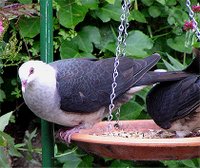
White-headed Pigeon
George also gave me some photos which he had taken previously - this shot of a White-headed Pigeon, and the great shots of the male Satin Bower Bird, and of a female.

So I am sharing these with you today, courtesy of George.