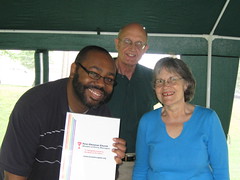
When I started seminary 15 years ago, I had come to accept that I would never pastor a church. I just wasn’t a people person. Maybe I’d be a seminary professor or something. I didn’t know it back then, but I was basically acknowledging my Aspergers limitations.
Of course, as you can tell, I didn’t end up as a seminary prof. Instead, I’ve been the Associate Pastor at a church for nearly five years. And somehow, I’ve managed to not mess things up, praise be to God.
Keep Reading How a Clockwork Pastor is Becoming Human
Showing posts with label inclusion. Show all posts
Friday, April 12, 2013
Thursday, June 21, 2012
I Miss the Old Mel White
I recently read an interview with Rev. Mel White. Most of you know him as someone who grew up as an evangelical, was a ghostwriter for many big evangelical stars and then came out as gay. I remember hearing about him in the mid-to-late 90s and back then he was kind of the SpongeBob Squarepants of the gay community. I mean that SpongeBob thing as a compliment, because he just seemed so darned positive, when it seems like most gay men were known for snark and bitterness. He was kind of a breath of fresh air to me and I was amazed and applauded his attempts to meet and even persuade his some of the people he used to work for. Yes, it might have been hopeless, but there was something wonderful about how he really tried to do that whole “love your enemies” thing that Jesus talked about. This leads me back to the article I read. The positive Mel White of old is long gone. What’s left is a man that’s pretty pissed off at the church and when I say church, I mean the whole church.
Continue reading...
Continue reading...
Labels:
church,
church life,
civility,
culture,
culture wars,
frustrated pastor,
gay,
gay ministers,
gay rights,
homosexuality,
inclusion,
LGBT,
liberal christianity,
lutherans,
mainline churches,
Methodist,
Presbyterians
Thursday, April 26, 2012
Making a Case for Being Open and Affirming
The church where I'm the Associate Pastor (First Christian Church in Minneapolis) is considering becoming an official Open and Affirming Congregation in the Christian Church (Disciples of Christ). The congregation has a long history of welcoming gay and lesbian folk into the life of the congregation, so in many ways they have been a living example of being Open and Affirming. I wrote this for the church newsletter sharing why the church should take this next step. My one frustration is that I really didn't do as good a job on making a theological case. The text is below.
So, What’s the Big Deal?
At the April board meeting, a proposal was put forward to have First Christian become officially an Open and Affirming congregation. For those who are unaware, Open and Affirming is a network of churches within the Christian Church (Disciples of Christ) that openly welcome gays and lesbians.
This isn’t the first time First Christian has considered this. Whenever the issue has been brought up, there is a common refrain that I hear: “we already welcome gays and lesbians. Why do we need make this step?”
I understand this because I’ve seen how you have lived out your welcome to everyone that enters the door of the church. You have welcomed gay and lesbians to not only worship and participate in the life of the congregation, but you have also supported having LBGT persons in positions of leadership. Speaking as an openly gay man, I am ever thankful for your acceptance of me and allowing me to be one of your ministers. So, I don’t doubt for a moment that you while you might not wear the name “Open and Affirming” on your sleeves, you live it out in your daily walk. You truly believe that God welcomes everyone to the Table and you put that faith into action.
So, why should First Christian take this step?
I have two reasons: one is more practical and the other more theological.
People wonder why we need to publicly welcome gay people in a way that we don’t do when it comes to other groups such as African Americans or Hispanics. The difference though is that being gay is somewhat different that being African American. You all know that I’m African American by looking at me. But you can’t tell by looking at me that I’m also gay. Being gay can be somewhat of a “hidden” difference. You can’t really tell someone is gay until they say they are gay. Because it is hidden, this leads to a lot of assumptions. If a young woman comes to church, people might assume she either has a boyfriend or husband instead of thinking she might have a girlfriend. Also because there has been a history of churches not being so friendly to homosexuals which causes gays and lesbians to assume that a church is not friendly towards them- unless there is a visible sign that says they are welcomed.
The second reason is theological. The ministry of Jesus and later the ministry of the church was one that tended to cross various boundaries. Jesus engaged people who were outside of the Jewish community he was born into. He talked to Samaritans and Romans and always brought salvation to those who crossed his path. The early church also was led by the Holy Spirit to minister to the wider Roman world, which was a melting pot of various ethinicities. The church of the 21st century is also a diverse place, and the Spirit calls us again to go out and minister to various cultures, preaching the message of salvation in Christ. Welcoming gay and lesbians publicly is a way of stating that the gospel is for them as much as it is for anyone else. The apostles of the early church were witnesses to the saving acts of Christ, and two millenia later, we are still called to be witness to the Jesus we encounter.
In the words of the design of the Christian Church, First Christian really has “In Christ's name and by his grace we accept our mission of witness and service to all people.” We have lived our inclusive witness of the Gospel of Jesus Christ. I think it might be something we want to tell the whole world about.
Monday, January 09, 2012
Repost: The Church, Autism and a place of Welcome
When I was a kid , I spent several years on the junior usher board at church. Of course, back in the 70s, neither I nor my parents knew I was autistic, but they knew things were a bit off with me.
Anyway, being an usher in the African American church is an artform. You wear certain uniforms and there were certain hand signals that you would use to indicate a certain need. When the time came for prayer, you were supposed to cross your arms over your chest and bow your head. I can remember the feeling of cocooning myself into this little ball and it felt good. Once I was in that position, I would start twisting or rocking my torso, to the left and then to right. Back and forth, back and forth. It felt good to me, but it must have looked damn weird to the people in the pews. I can distinctly remember one day being in my happy place and rocking back and forth until a pair of hands touched my shoulders indicating that it was time to stop. Looking back 30 years later, that was a vivid example of kid with autism in the church. I don't know if what the person did was correct or not, but I do wonder if people were disturbed at what I was doing. Now that I am a pastor and someone with autism, I have started to wonder how those with autism are treated in the church. In talking with a good friend who has two children on the spectrum, I have found out that churches have a long way to go in welcoming people and families where one or more persons are on the spectrum. I stumbled upon this blog post by a special-ed teacher in Georgia, who shares the struggles he and his wife have faced when it comes to the church accomodating his son who is autistic:One would think that the safest place in the world for children with disabilities would be in houses of worship, among people dedicated to God, love, mercy, grace, compassion, faith, and forgiveness. But this is not true at all. The worship service itself, with constant demands for compliance and conformity, is hostile for those who are inherently different from everyone else. Anyone who is unable to conform to the structures of the service is not welcome and asked to leave. The larger the church, the more true this will be. I may editorialize more on my feelings toward church and those with disabilities later, but I want to talk a bit about how churches attempt to deal with this unique and growing population. In this particular church spoken about above, they attempted to recruit helpers in order to help Thomas participate in the same activities as his peers. I think the intent of the program was excellent, and it started out well enough. But without diligence by a committed coordinator, it becomes just another chore to dread like ushering, parking lot duty, being a greeter or assorted other mundane tasks and ministries in the church. Yes, we are the boy’s parents and he is our responsibility which we take seriously. But no one was caring much about our own spiritual growth or struggles. Staying home is a more Holy, peaceful and rejuvenating experience for many families that have children with disabilities. Church is often a hostile, hellish experience where families are segregated or ostracized. I don’t think Jesus would approve.
Ouch.
Thursday, December 29, 2011
Inclusion and Discipleship
A post by Methodist blogger Alan Bevere has stayed with me since it was originally published back in June of this year. The post, "So, Just How Inclusive Was Jesus?" muses on the modern value of inclusion and how it does and doesn't square with Jesus.
I agree with Tom Wright that modern notions of inclusiveness are too broad and too shallow. Of course there is an inclusive aspect of the Gospel; it is, after all, offered to everyone. But one cannot avoid that along with the inclusive nature of the Gospel in the New Testament, there is also an exclusive character as well. One simply cannot read Jesus or Paul and conclude otherwise.The fact that many Christians in the twenty-first century church do not understand this is revealed in the recent hoopla over Rob Bell's book, Love Wins. Bell rightly believes that the question "Is Gandhi in hell?" should not necessarily be answered in the affirmative, and those who confidently think otherwise need to remember that God is quite unconcerned over what they think about the eternal destiny of others. At the same time, those who have been so quick to hop on the universalism bandwagon need to remember that there is another question that should be asked as well: "Is Hitler in heaven?"But the purpose of this post is not to focus only on the hereafter, but to highlight what Bockmuehl and Michael are rightly saying about our present situation. Current accounts of inclusiveness are indebted much more to modernity than they are to the New Testament. Richard Hays words need to be heard: Jesus is not only the friend of sinners but he is the nemesis of the wicked. The issue is not the truly inclusive nature of the Gospel, but the imposition of a broad and shallow modern inclusivism that does indeed come at a high moral price. Bishop William Willimon reminds us that during his ministry Jesus drove away more people than he attracted.
The issue of inclusiveness is one that is near and dear to my heart. As a gay man, I know that the church has at times been too exclusive, keeping folks like myself out of the church. I've worked towards helping churches become more welcoming of LGBT persons.
But I wonder at times is if being welcoming is enough for Christians. Yes, it's good to be inclusive, but as Bevere notes, Jesus also tended to drive people away from him as much as he drew people to him. Jesus called people to a life of discipleship, which is not always well recieved by people.
My fear more often than not is that our talk of inclusion is as Alan says, too shallow. It's an inclusion that doesn't talk about sin or confession, let alone discipleship. When it comes to the inclusion of LGBT persons, the talk is one of grace, a message that we need to hear. But a grace that doesn't change the person or asks nothing of that person is a cheap grace indeed. Here's what I wrote in response to Alan's post:
Alan, thanks for the post. As usual, it was thought-provoking and something I've been thinking about for a while.That said, I want to put some flesh and bone on the issue of inclusiveness.As a gay man, I do understand and appreciate the call to be inclusive and welcoming. There are a lot of folks who have felt left out of the church because of their sexuality. But as someone who is also an ordained minister (in the Disciples of Christ), heck as a Christian, I know that we are called to be more than simply inclusive. As much as I find some parts of Christianity too quick to draw boundaries that I believe is up to God, I tend to find the drive towards inclusion at all costs kind of shallow. I mean, inclusion is a wonderful thing, but if there is no talk of the cross, or faith, or sin or forgiveness, then what you have is a very thin theology indeed.What I long for is something you said in a previous comment, a balance between inclusion and repentance. People need to know that they are loved by God, but they also need to have room for repentance as well.
Inclusion alone works in the wider society. It's valuable and needed. But in the life of the church, we are also called to repentance. I know that's a scary word for LGBT folks because it's been used to call our sexuality sin. But even though it has been used in less than ideal ways, the message is still there: we are called to repent. Not of being gay, but of the ways we hurt each other, the whole of creation and God. If all we have is just inclusion, what we have done is nothing more than bolster someone's self esteem. That's not a bad thing, but it's not what following Jesus is all about.
Saturday, December 03, 2011
"Welcoming Every Member of the Body"
As many of you know, besides my duties as the Associate Pastor at First Christian in Minneapolis, I also work as the Communications Specialist for the Presbytery of the Twin Cities Area. I worked with the Presbytery's Disabilities Concerns Taskforce to put together a special issue ofInPrint, the bimonthly newsmagazine I put out. There are several good stories in this issue including one by me on being a pastor with autism. I wanted to share it with others and feel free to share. It's great to work with others who are trying to make sure that all really are welcomed at Christ's Table.
[scribd id=71335540 key=key-hqywe4q75ftmuihh4f mode=list]
Wednesday, September 07, 2011
Lillian Daniel, Adam Copeland and the SBNRs
My last post created a lot of comments on Facebook. A colleague of mine disagreed with the article and me for the attitude against those who consider themselves "spiritual but not religious." Actually, I was agreeing to a short article written by UCC pastor Lillian Daniel and her comments have received a bit of criticism themselves. Here's what Presbyterian pastor Adam Copeland had to say:
Copeland does have some points to make, but I can't help but agree more with Daniel's original snarky response, than with Copeland's defense of the SBNRs. Maybe part of it comes from being in ministry a bit longer than Copeland. Just a few weeks from my 42nd birthday, I'm not the angry young man I used to be. Things that I thought were just the bees knees are now seen as sheer foolishness. I'm not whining as much about how unfair the world is and more willing to say that we need to develop a spiritual toughness against the harshness of life. The people inside the church are not as stupid and backward as we thought they were. The folks outside the church are not the fonts of wisdom we once thought they were.
- Really? An airplane? Would that be first-class or coach? I meet with people (young adults, mostly) every week who call themselves “spiritual but not religious.” They tend to be underemployed, live month-to-month, and are doing their best to find meaning in their tumultuous lives. Sure, the phrase “spiritual but not religious” needs some unpacking for pastors whose livelihoods depend on people’s public religiosity, but I’ve never heard it as “rebellion against the religious status quo.” Rather, the phrase is more a humble testimony that they just don’t seem to connect with fancy churches. And who can blame them?
- As opposed to what Daniel suggests, the “spiritual but not religious” folks I talk to yearn for community. I have not found one who wants simply to have “deep thoughts all by oneself” as Daniel accuses. What might be true, however, is that the community they seek isn’t offered at most mainline churches with our endowment funds and dress codes and judgmental matriarchs and patriarchs. You see, some “spiritual but not religious” folks sense a certain righteous attitude from these institutions (go figure?). Many were once burned by hugely negative experiences with the church and it’ll take the church reaching out — in love, not in snark — for healing to begin.
- God is working in the lives of the “spiritual but not religious.” I happen to believe they have a huge amount to teach the church about connecting to God, supporting true community, sustaining spiritual practices, and living out St. Augustine’s call for a “faith seeking understanding.” Daniel asks, “Can I spend my time talking to someone brave enough to encounter God in a real human community?” I say, Yes, feel free to do that in your church. But also be brave enough to listen to those encountering God in ways you don’t fully understand. Learn from them.
Copeland does have some points to make, but I can't help but agree more with Daniel's original snarky response, than with Copeland's defense of the SBNRs. Maybe part of it comes from being in ministry a bit longer than Copeland. Just a few weeks from my 42nd birthday, I'm not the angry young man I used to be. Things that I thought were just the bees knees are now seen as sheer foolishness. I'm not whining as much about how unfair the world is and more willing to say that we need to develop a spiritual toughness against the harshness of life. The people inside the church are not as stupid and backward as we thought they were. The folks outside the church are not the fonts of wisdom we once thought they were.
Monday, October 18, 2010
Another Way to Grow or This Little Light of Mine
One of the things you hear about when a church is in decline is how to grow the church.
Of course, when people talk about growing the church they mean, to put in crudely, butts in the pews. Church members and clergy all want to find some magic formula to make people enter the doors of the church and fill the pews again (not to mention, the church coffers).
But over the course of my time at First Christian, I've noticed that another growth is taking place. It's not as visually impressive as getting more butts in the pews, but I tend to think it's more important: the growth among church members.
I've seen more interest in Christian Education and Mission. I've seen a willingness to try new things. I've heard new music that has filled the congregation with energy.
As Bob the Senior Pastor has said, "it's starting to feel like church."
I think that the inward growth of a congregation, it's willingness to listen to God's Spirit is essential in allowing a church to grow numerically. I mean, who wants to go to a church where nothing's happening?
Maybe the coolest sign of growth is seeing acolytes being used again in worship. From what I've gathered, the church hasn't had kids coming up and bringing in the light of Christ in a long time.
Deb, the Spiritual Formation Director tells this story best. This is what she wrote for our church newsletter:
It truly is a wonder to see these little ones carrying the Light in and taking it out into the world.
Don't tell me this church ain't growing.
Of course, when people talk about growing the church they mean, to put in crudely, butts in the pews. Church members and clergy all want to find some magic formula to make people enter the doors of the church and fill the pews again (not to mention, the church coffers).
But over the course of my time at First Christian, I've noticed that another growth is taking place. It's not as visually impressive as getting more butts in the pews, but I tend to think it's more important: the growth among church members.
I've seen more interest in Christian Education and Mission. I've seen a willingness to try new things. I've heard new music that has filled the congregation with energy.
As Bob the Senior Pastor has said, "it's starting to feel like church."
I think that the inward growth of a congregation, it's willingness to listen to God's Spirit is essential in allowing a church to grow numerically. I mean, who wants to go to a church where nothing's happening?
Maybe the coolest sign of growth is seeing acolytes being used again in worship. From what I've gathered, the church hasn't had kids coming up and bringing in the light of Christ in a long time.
Deb, the Spiritual Formation Director tells this story best. This is what she wrote for our church newsletter:
Those of you who have been able to be at worship this fall have surely noticed an addition to our service - acolytes! Now if these acolytes seem a little younger and a little smaller than you remember them being previously, it is because, well, they are. It has been quite a while since we have had acolytes, but the Art of the Covenant kids have very enthusiastically agreed to help us re-ignite this part of our worship service. This is something that holds meaning for them and that they look forward to.
Since none of the Covenant kids had ever seen what acolytes do (yes, it has been that long since we have had acolytes), I have been walking with them to make sure that all goes well. For example, we found out on the first Sunday that the candles that are normally on the communion table are too tall, so we have been using a Trinity Candle on a lower stand while the Worship Committee looks for other options to use as well. We want this to be an empowering experience for them.
Having the Covenant kids participate in the liturgy of the worship service has given me the opportunity to talk about worship, the Light of Christ, and the Trinity in class. Ask Fletcher some time what the three wicks in the current candle stand for - he can tell you. And I’m willing to bet that Mason can get two out of three.
Assisting these children to carry Christ’s light has been a truly awesome privilege. Seeing the smiles on the faces of the congregation at the start of worship as we return to the narthex has also been a privilege. Starting worship with the Light of Christ and joy on our faces is truly remarkable. May we all carry Christ’s Light as enthusiastically as the Covenant kids do.
It truly is a wonder to see these little ones carrying the Light in and taking it out into the world.
Don't tell me this church ain't growing.
Thursday, September 30, 2010
Random Musings on Anti-Gay Bullying and Suicide
I might get in trouble for some of these words, but here goes:
Discuss.
- I'm a little bit confused about how we look at today's youth. On the one hand, we are told that young kids are far more tolerant of gays than older groups. On the other hand, we see a lot of young gay teens committing suicide. So what does that mean?
- I am reminded that being a teenager sucks. As adults, our memories start to get cloudy and we start to remove all the bad parts of being a teen. But the fact is, it still sucks. It sucked back in the 1980s and it still does.
- Where are the gay adults? Yes, I know there is a lot being done by Dan Savage's "It Gets Better" project, but besides expressing our anger on blogs, why aren't we volunteering at some center for gay youth? They do exist in many big cities. Yes, schools should do more, but what are gay men and lesbians doing?
- Why aren't we teaching kids how they can stand up to the bullies and remind themselves that they are beautiful and worth it?
- While I'm not opposed to anti-bullying laws, I don't think they will stop kids from being teased or from being bullied. It's not simply because schools are doing bad job, but because kids can be cruel and they will find ways to hurt each other.
- I think churches need to do a better job of teaching their youth not to make fun of each other and to do what Jesus did: love the outcasts.
- Suicide was an issue as a teen growing up in the 1980s. It wasn't specifically about being gay, though that was probably one of many reasons.
Discuss.
Wednesday, September 29, 2010
For Gay Youth...
Since there has been a lot of talk about a lot of gay teens committing suicide, I wanted to share something that the church I am at is doing starting October 8.We are starting a program geared towards gay teens where they can come together in a safe space and maybe learn that God loves them just as they are.
You can find out more by reading this post at the church website.
Friday, September 24, 2010
It Gets Better
It's never easy being a teen, and it's harder if you are gay or dealing with autism. In junior high and in high school, I was dealing with both. At the time, I didn't know I had Aspergers and was working hard to deny being gay.
I remember being picked on and told I was gay and the teasing was bad in my junior high years. I can remeber especially when I was maybe 14 or 15 being picked on in church. There was one particular guy that would always call me gay or insinuate in various ways that I was different.
Long story short, I didn't fit in and while there was a lot of good things that happened to me back then, I also felt very lonely and very afraid at times.
Back in the summer, our Christian Educator, Deb told us about what was happening in the Anoka-Hennepin district, a suburban school district north of Minneapolis. A number of teens have committed suicide after being bullied and most if not all of those kids were gay. After hearing some of the issues from a friend and teacher in the district, Deb was spurred to action and our church helped put together a fundraiser for the teacher, Jefferson who is walking in the American Foundations for Suicide Prevention's annual walk this Saturday. Deb even went farther to create a program for gay youth where they can come and talk and have safe space at a choatic time in their lives.
Columnist Dan Savage was spurred to action because of teen suicides in his area and put together a project called, "It Gets Better." In the video below, he and his partner help young gay teens know that life does get better after high school. I was touched by Dan's story of seeing Paris at dawn with his five-year-old sun. My partner Daniel and I went to Paris in 2008 for our honeymoon. I had been to Paris 10 year earlier, by myself, but I will forever remember this trip because I was with my love. I remember eating pastries with Daniel from bakery right near Notre Dame. What a wonderful memories.
The fact is, it does get better. Hey, I got to be a pastor! And I got to travel to Buenos Aires! My parents have come to accept me as being gay and they love Daniel as the white-Norwegian son-in-law they never had.
I should add that kids with autism should also know that it will get better. You will find people who accept you for who you are and will love you. People will come to love and accept you, even with your quirks.
I guess the thing I want to say is that things can get better. If you are a young gay teen or a kid with autism that is having a hard time at school and church...know that it does get better. The bullies will only last a time. And know that there are caring communities out there. Seek them out. You will find out that life really is worth it if you just stick around.
Tuesday, September 21, 2010
The Church, Autism and a place of Welcome
I wrote this post originally back in July of this year. I've added a few things and expanded upon it.
When I was a kid , I spent several years on the junior usher board at church. Of course, back in the 70s, neither I nor my parents knew I was autistic, but they knew things were a bit off with me.
Anyway, being an usher in the African American church is an artform. You wear certain uniforms and there were certain hand signals that you would use to indicate a certain need. When the time came for prayer, you were supposed to cross your arms over your chest and bow your head. I can remember the feeling of cocooning myself into this little ball and it felt good. Once I was in that position, I would start twisting or rocking my torso, to the left and then to right. Back and forth, back and forth. It felt good to me, but it must have looked damn weird to the people in the pews. I can distinctly remember one day being in my happy place and rocking back and forth until a pair of hands touched my shoulders indicating that it was time to stop.
Looking back 30 years later, that was a vivid example of kid with autism in the church. I don't know if what the person did was correct or not, but I do wonder if people were disturbed at what I was doing.
Now that I am a pastor and someone with autism, I have started to wonder how those with autism are treated in the church. In talking with a good friend who has two children on the spectrum, I have found out that churches have a long way to go in welcoming people and families where one or more persons are on the spectrum.
I stumbled upon this blog post by a special-ed teacher in Georgia, who shares the struggles he and his wife have faced when it comes to the church accomodating his son who is autistic:
Ouch.
The thing is, a lot of this rings true. There are many churches where the worship service is meant to be a time of silence and decorum. God help you if a kid gets cranky. But it's one thing if grown people are talking out of turn; it's another if a kid with autism is having a meltdown.
Churches have to be more aware and willing to find ways to welcome special needs persons. Of course, being a pastor I also know that isn't so easy to do, especially when it comes autism. Sometimes a person with autism could be very disruptive in a worship service and dealing with a person with autism can be difficult. There isn't a one-size-fits-all solution. That said, no one ever said being church was easy.
When it comes to this family, I wonder what would have happened had the pastor worked with family and other leaders to make church a more welcome place, not only for the kid, but for the parents. It is interesting that in all of this, it seems that the Senior Pastor was absent.
Raising a kid with autism can be challenging for parents. They love their kids and will do what it takes to make sure they are well-cared for. But it can also be draining for them as well and it seems like in this case, no one seemed to care about the spiritual and emotional health of Thomas' parents.
Maybe the problem here is that church is so formal. We treat it like we are watching the symphony. We want to hear the music and the choir, but we don't want to hear babies crying; that just ruins everything.
I'm not saying that church needs to be a rock concert, but what it we allowed a bit more informality?
Lesile Phillips, a blogger from Houston is more pointed in how churches treat persons with autism and other behavior disorders:
I don't know what I can do to make church more welcoming to my fellow aspies, but I will try. I want church to be a place where freaks are welcomed.
When I was a kid , I spent several years on the junior usher board at church. Of course, back in the 70s, neither I nor my parents knew I was autistic, but they knew things were a bit off with me.
Anyway, being an usher in the African American church is an artform. You wear certain uniforms and there were certain hand signals that you would use to indicate a certain need. When the time came for prayer, you were supposed to cross your arms over your chest and bow your head. I can remember the feeling of cocooning myself into this little ball and it felt good. Once I was in that position, I would start twisting or rocking my torso, to the left and then to right. Back and forth, back and forth. It felt good to me, but it must have looked damn weird to the people in the pews. I can distinctly remember one day being in my happy place and rocking back and forth until a pair of hands touched my shoulders indicating that it was time to stop.
Looking back 30 years later, that was a vivid example of kid with autism in the church. I don't know if what the person did was correct or not, but I do wonder if people were disturbed at what I was doing.
Now that I am a pastor and someone with autism, I have started to wonder how those with autism are treated in the church. In talking with a good friend who has two children on the spectrum, I have found out that churches have a long way to go in welcoming people and families where one or more persons are on the spectrum.
I stumbled upon this blog post by a special-ed teacher in Georgia, who shares the struggles he and his wife have faced when it comes to the church accomodating his son who is autistic:
One would think that the safest place in the world for children with disabilities would be in houses of worship, among people dedicated to God, love, mercy, grace, compassion, faith, and forgiveness. But this is not true at all. The worship service itself, with constant demands for compliance and conformity, is hostile for those who are inherently different from everyone else. Anyone who is unable to conform to the structures of the service is not welcome and asked to leave. The larger the church, the more true this will be.
I may editorialize more on my feelings toward church and those with disabilities later, but I want to talk a bit about how churches attempt to deal with this unique and growing population. In this particular church spoken about above, they attempted to recruit helpers in order to help Thomas participate in the same activities as his peers. I think the intent of the program was excellent, and it started out well enough. But without diligence by a committed coordinator, it becomes just another chore to dread like ushering, parking lot duty, being a greeter or assorted other mundane tasks and ministries in the church. Yes, we are the boy’s parents and he is our responsibility which we take seriously. But no one was caring much about our own spiritual growth or struggles. Staying home is a more Holy, peaceful and rejuvenating experience for many families that have children with disabilities. Church is often a hostile, hellish experience where families are segregated or ostracized. I don’t think Jesus would approve.
Ouch.
The thing is, a lot of this rings true. There are many churches where the worship service is meant to be a time of silence and decorum. God help you if a kid gets cranky. But it's one thing if grown people are talking out of turn; it's another if a kid with autism is having a meltdown.
Churches have to be more aware and willing to find ways to welcome special needs persons. Of course, being a pastor I also know that isn't so easy to do, especially when it comes autism. Sometimes a person with autism could be very disruptive in a worship service and dealing with a person with autism can be difficult. There isn't a one-size-fits-all solution. That said, no one ever said being church was easy.
When it comes to this family, I wonder what would have happened had the pastor worked with family and other leaders to make church a more welcome place, not only for the kid, but for the parents. It is interesting that in all of this, it seems that the Senior Pastor was absent.
Raising a kid with autism can be challenging for parents. They love their kids and will do what it takes to make sure they are well-cared for. But it can also be draining for them as well and it seems like in this case, no one seemed to care about the spiritual and emotional health of Thomas' parents.
Maybe the problem here is that church is so formal. We treat it like we are watching the symphony. We want to hear the music and the choir, but we don't want to hear babies crying; that just ruins everything.
I'm not saying that church needs to be a rock concert, but what it we allowed a bit more informality?
Lesile Phillips, a blogger from Houston is more pointed in how churches treat persons with autism and other behavior disorders:
What I find fascinating (and by that I mean infuriating) is that often the people who claim to be most understanding, most inclusive and most loving are often actually the most judgmental, UN-welcoming people out there. Sure, many faith communities have taken the trouble to build ramps or make accommodations for people with physical disabilities. Sorry to say folks, but that's the easy stuff. When are we going to get to the hard stuff?
The hard stuff is making successful inclusion happen for people whose disabilities have behavioral manifestations, like autism, bipolar disorder, Tourette Syndrome. Many people can understand that children with autism may have behavior challenges, but they seem to think that because a place of worship should be quiet and reverent that a child can somehow leave their disability "at the door". If walking into a place of worship cured my son's autism, I'd live in one. It doesn't work that way. His disability follows him right inside the door, past ornate statues, alongside people in fancy-colored robes, among people praying and singing - you name it, it's there.
I was raised as a Christian. Christians are fond of asking "What would Jesus do?" (In fact, they are so fond of asking it, they sometimes sport bracelets that simply say "WWJD?") Would he turn my son away? What about your faith, whatever it may be? Is it consistent with your beliefs that people with challenges and their families, who likely need supportive fellowship more than anyone on the planet, should be excluded from worship?
I don't know what I can do to make church more welcoming to my fellow aspies, but I will try. I want church to be a place where freaks are welcomed.
Subscribe to:
Posts (Atom)