Sunday, August 09, 2009

70's CINEMA: GRIT AND VENGEANCE

Bill Lustig (director of notable genre films, Maniac, Vigilante, Maniac Cop and owner of Blue Underground) is an exploitation film maven. Last year at Anthology Film Archives Lustig put together a series of vigilante films (which I missed unfortunately). This year he's back with "The Seventies - Buried Treasures," a series of gritty genre films, none of which are available on DVD. The series opened on Friday and I made a beeline to catch THE STONE KILLER, Charles Bronson and director Michael Winner's transitional teaming between THE MECHANIC and DEATH WISH, and THE OUTFIT, an adaptation of a Richard Stark/Donald Westlake novel, featuring Robert Duvall and Joe Don Baker. Before THE STONE KILLER, Jed of Anthology brought Bill Lustig out and they called up director Michael Winner in London on a cell phone. Bill put the phone in front of a mic and did a little q & a / intro with the director. Winner said he and Bronson were in a car on their way to JFK after wrapping STONE KILLER when he said to Bronson, "I have a script about a man who's wife and daughter are mugged so he goes out and starts shooting muggers," to which Bronson said, "I'd like to do that. I'd like to shoot muggers." Brand new print of THE STONE KILLER, which could be described as a good Dirty Harry knockoff. It's based on a novel called A Complete State of Death. According to Winner the producers didn't like that title, but they kept it as a line in the script. Not the greatest Bronson movie, but hard boiled and violent fun as expected. Stuart Margolin was great as the ex-army soldier hired by the mob to run an elaborate revenge scheme. I'm sure you all remember him as Angel in The Rockford Files. Towards the end of the film a big POP was heard when the projector bulb blew. They switched the reel to the other projector in five minutes, during which time Lustig said something like - 'this is part of the old 42nd St experience' and then started reminiscing with other folks in the audience about the grindhouses
back in the day ('guards with steel-toed boots' etc.). Since that bulb blew they had to move THE OUTFIT to the downstairs theatre. It was packed. Paul Giamatti sat behind me. THE OUTFIT was great. Same director as ROLLING THUNDER, John Flynn. Robert Duvall starred as the badass out of prison going after money he felt the mob owed him. It's from another Richard Stark novel, so similar plot to POINT BLANK. Joe Don Baker was Duvall's buddy / partner.
Cool cast also featured Karen Black, Timothy Carey, Robert Ryan, Sheree North and some other characters. Violent and mean spirited. Cinematically Flynn is very matter of fact, not stylized, tells stories well and gets good performances. One thing is that you'd think the mob would have more muscle at some of their undergournd casinos and so forth. It's kind of easy for Duvall and Baker to take what they want. Still, lots of fun, I recommend it.


ROLLING THUNDER is one of the top revenge movies. Dig the voice over in this great trailer.

Sunday, June 28, 2009

LAMENT FOR STRAY CAT ROCK AND PUSHIN' TOO HARD.

PART 1

The dissonance accompanying the passing of the so-called King of Pop includes obituaries that have gone by all but unnoticed. On Monday June 22nd Yasuharu Hasebe died at age 77. Hasebe was a journeyman director of Japanese action and genre pictures, with a long career that included several inspired films, among them a few brutally transgressive and offensive pieces of exploitation. On his ascent through the ranks of the film industry, Hasebe worked as an assistant to Seijun Suzuki. Hasebe is well known internationally for his biker girl films, (a precursor to the pinky violence genre) the Stray Cat Rock series starring Meiko Kaji.


He will also be remembered for the ridiculous pop kitsch Black Tight Killers featuring a team of go-go booted ninja girls equipped with lethal bubble gum and deadly 45 rpm records! When Nikkatsu studios went exclusively 'roman-porno' in the 70's, Hasebe turned out some shocking roughies, like Assault! Jack the Ripper. Hasebe also helmed the fourth Scorpion movie (the last one featuring Kaji Meiko) Grudge Song. The great Nikkatsu action series at Japan Society featured Hasebe's 4th picture, the inspired Nikkatsu Action 'fun with dynamite' yakuza romp Roughneck (Arakure). Hasebe kept working up until his death (pneumonia).


PART 2


Sky Saxon, legendary vocalist, bassist and songwriter of The Seeds, passed away on June 25th. A fateful day indeed. The story goes that Saxon wrote the proto-punk masterpiece "Pushin' Too Hard" on a 15 minute break during a recording session. You might not know the band name, but you've most likely heard this indelible 2 minutes of pulsing vitriol. The Seeds first album also featured another classic, the haunting "Can't Seem to Make You Mine." Saxon and the Seeds personified the image and sound of snotty, gritty psychedelic garage punk. Their far spread influence proves the unruly power of two chord rock. Saxon sounded like a weird, acid casualty, unstable and unpredictable. Freaky stories surround the man, perhaps mostly myth, but whatever the case, his music often proves compelling and inspired.

Wednesday, May 27, 2009

I AIN'T AFRAID OF NO GHOST!


I got wind of the news that GHOSTBUSTERS III is in production. The Ghostbusters franchise is great. I'm afraid I can't say the same for this poster though. Now that really is kind of scary. I just saw Ernie Hudson in a Broadway production of August Wilson's Joe Turner's Come and Gone. And he co-starred with Chad L. Coleman, who played one of my favorite characters on The Wire, Cutty (the ex-con turned boxing coach). Back to Ghostbusters, you can't really go wrong with Bill Murray. I just saw him in Limits of Control. I actually like Jim Jarmusch, but his last bunch of films have been lost in pretension and this script is no exception. I will say that he made excellent choices in production: cinematographer Christoper Doyle captures the beauty of Seville Spain and renders a fascinatingly modern universe - the envornments are more interesting than the script itself, like the industrial landscape they pass by on the train ride or all those ultra-modern airports. Plus he gets to shoot a great cast: Tilda Swinton, Gael Garcia Bernal, John Hurt, Kudo Yuki, an incredibly interesting face in Isaach De Bankolé, and an incredible ass (whole package actually) in Paz de la Huerta. Jarmusch is very much about homage and his use of de la Huerta reminded me a little bit of Bardot in Contempt. Anyway, it's been 20 years since the last Ghostbusters film. A lot of the audience for the new film were barely alive when the first two films were released. The nature of media is different now. I'm just imagining what it would have been like if they had released an Easy Rider part 2 in 1988. And the "I ain't afraid of no ghost" refrain reminds me of that comic genius Mantan Moreland. He was almost one of the Three Stooges! amazing for a black comedian in the 50's. He was in those Charlie Chan movies and East Side Kid pictures and he ended his career in the incredible Spider Baby:

One of my favorite Moreland performances is how I menatlly connected him to Ghostbuster - his show stealing turn in King of the Zombies:

Tuesday, May 26, 2009

MORE MONKEY ROCK

Speaking of monkeys and rock and roll (the previous post), I remembered that great sub-genre Japanese GS (group Sounds): Japanese 60's garage and psych music. The Spiders largely spearheaded the sound of Japanese GS. Check out this opening of one of their many rock and roll movies: The Song is "Akai Dress no onna no ko wa" - The Girl in the Red Dress. A great prototype of psych/garage/powerpop with distinctly Japanese nasal vocals. The crazy thing about this clip is that the title "Road to Bali" comes up. Hey wait a minute! That was a Hope and Crosby vehicle! How uncanny that The Spiders had a single (pictured above) of a song called "Monkey Dance" b/w the dance floor mover "Furi Furi" (Shake Shake). There's actually a more frenetic version of Furi Furi than the one on the single. Notice the two lead singers on the cover aping the movements (couldn't resist) of primates to perform the monkey dance. In the 70's the more clownish of the two singers (the one slightly more upright on the record cover) Masaaki Sakai, would star in the super popular Monkey TV show, based on the Chinese classic Journey to the West about the mischievous monkey king Sun Wu Kong. Monkey was broadcast in Australia and the U.K. where it enjoyed almost as much popularity as it did in Japan. Meanwhile the states got Ultraman and Tesujim 28 (Gigantor).

Sunday, May 24, 2009

MONKEY ROCKS


When I started up this little cyberspot I just gave it the first name that came to mind: Rockin' Monkey. I've always liked monkeys and rock and roll - the two go together so well. And we're talking real rock and roll - that means from Louis Jordan, Big Joe Turner and Bo Diddley to The MC5, The Sonics and The Mummies, NOT Huey Lewis and the News (although I love that story about how their sound truck picked up the hardcore band Impulse Manslaughter, who were hitching with guitars in tow after their van broke down). WFMU dj Dave the Spazz is a great testament to how real rock and roll and primates of all sorts (especially chimps) are a perfect combination. I remember being at Dave's house for a party attended by the late great soul singer supreme Nathaniel Mayer and he dug all the various monkey icons and decorations Dave had in his place. And I met Clarence "Gatemouth" Brown who saw the monkey cover art for a Dave the Spazz compilation tape (Monkey Fever volume 1 - volume 3 is pictured here and was his latest dj premium) and he started laughing hysterically and uttered something about a cartoon with monkeys in it. But the name "Rockin' Monkey" is a bit lame. Maybe it's the apostrophe, or just the crudity, or both. So I figured I'd switch it around, at least for the time being, to Monkey Rocks. I like that this configuration of the words is more ambiguous. And I also recall the early Australian punk band Rocks that I first heard on the "Feel Lucky Punk?" compilation. I showed it to my friend Mick from The Space Juniors and he laughed because he used to play shows with Rocks and made funny impressions of them, telling me how they had handlebar mustaches and were awkwardly macho. But while Rocks might be a great choice of words, the blog name is still kind of lame. Feel free to comment with suggestions, or hate mail, or whatever...

Monday, May 18, 2009

STICK IT TO THE MAN

The first folks I saw when i got to the Born Loose show the other night were the blogmasters of Ivanlandia and The Otto Mannix Report. They told me about their spanking brand new blog collaboration on biker movies: BIKER MOVIE BLOWOUT. The ensuing conversation was a litany of title-dropping. "Did you mention Werewolves on Wheels"; "What about the one with Joe Namath?" (CC & Company - featuring a performance by Wayne Cochran); "The Wild Angels is the cream of the crop"; "That one with Harry Dean, The Rebel Rousers, was such a bore; "Is this one a biker movie?" (e.g. Mad Max - answer: no, it's a post-apocalyptic cop revenge movie. The outlaw bikers are only villains, and not the main characters); "Some of the best are actually hybrids" (Hells Angels 69 is a biker-cum-heist movie). I didn't even realize that the master of Ivanlandia had actually curated a biker series at Anthology in 1990. I'm sorry I missed it. I feel like such a dolt.

Sunday, May 17, 2009

THE DEVIL'S WORK


The moment I met Michael Lucas I felt a brotherly kinship to him. He's one of the funniest people I've ever met, which puts him alongside Miss Vaginal Creme Davis. Their style of humor is somewhat different, but they share an innate ability to amuse off the cuff, never affected, but seldom out of character. Of course in Miss Davis' case, the characters are multiple. I haven't seen Mike for a few years, but you can imagine my excitement when I discovered he had published a novel via the display at St. Mark's Bookshop. I've known he was a writer since I met him, and used to read him in Maximum Rock and Roll, but this was the first I'd heard of him authoring a full tome. Topping it off was the wonderfully crude retro cover art that references luche libre wrestling. Mike's sardonic sense of humor and incredibly astute social insights are intact in this thoroughly enjoyable read. The tale is set in the 90's and concerns a film school grad who gets a job delivering modern furniture to a mostly insufferable shi shi clientele. His boss is a clueless queen and his partner in schlepping is a daft Englishman. I know that Mike was (might still be) a furniture mover, and wonder how much of the autobiographical bits extend to the extraneous characters. One choice moment is when our protagonist encounters a young coed from school, now a committed junkie. She pretentiously name-drops Burroughs, to which the main character asks "Edgar Rice?" It's a 'can't put it down' sort of read, with a dark overtone and depressing ending. Overall, it's a hilarious and biting commentary on how inane life can be. I know Mike is rather obsessed with South American garage music and pop culture in general, so the allusions to Mexican wrestling made perfect sense. The wry descriptions of San Fransisco in the 90's, especially the 'hipster' scene, brought on euphoric laughter. Mike published this on his own press, Rudos and Rubes. Rudos are the bad guys in Mexican wrestling. I believe Black Shadow and Blue Demon were both rudos, although Blue Demon might have switched sides at some point. A rube is defined as an "Awkward and unsophisticated' person. That of course maintains Mike's scathing sense of irony, since obviously us Rudos and Rubes readers are highly sophisticated.

BORN LOOSE?

The Candy Snatchers are one of my all-time favorite bands. Desperate, insane, balls out punk rock; they put on some of the greatest live shows I've ever seen. Just under a year ago we lost Snatcher's legendary guitarist Matthew Odietus. Now the Snatcher's just as legendary front man Larry May is back where he was born to be - on stage leading a raging band. They are Born Loose, though I wonder if they ever considered being The Born Loose. I wonder if there is a band called The Born Losers, named after the Tom "Billy Jack" Laughlin biker movie. Digressions aside, the band was part of Dean Rispler's latest great rock show at The Trash Bar in Williamsburg, Brooklyn. Unfortunately I missed The Mess Around, who friends said were tight and rocked the power chords. I went in as Larry was taking the stage with band beers in hand. The band includes Suke, a great guitarist who played second guitar with the Snatchers at some point, not sure how many gigs. He is a confident player and must have listened to lots of hard rock and metal judging by his screaming solos. The rhythm section were in a band called Nova Express that I'm not familiar with, but based on their heavy hammer style of playing they're obviously right for the part. They both looked pretty jovial. The drummer sported a Two Thousand Manics t-shirt and the bass player's hair sort of reminded me of Pedro Ramone's - in a good way. As the band finished tuning up and making the appropriate pre-set instrument noises Larry started to tell this story about his old friend Chris Kuchar (sp? I don't think the guy's name is really the same as that of the incredible Kuchar Brothers). Seems ol' pessimistic Chris once retorted to Larry's casual 'What a nice day' comment by saying 'Larry, if it's so nice, why don't you fuck the day.' Larry told the story in the way that only Larry can. He had a few drinks but was rather lucid at this point, yet still managed to elongate the simple tale in an amusing manner. At one point Dean yelled from the sound booth 'Hey Larry, that's really interesting. Tell us more.' A frustrated Larry responded to Dean by inserting the words god damn and fucking into a phrase of gratitude, then they launched into a great, straight-ahead uptempo number. The first song was a good indication that Born Loose retains the Candy Snatchers penchant for high octane music, but also showed a little more influence of 70's rock. I suppose The Faces are the source of some inspiration. They don't sound like Stewart and co. per se but did have plenty of breakdown parts that allowed songs to coast for a while with some guitar licks and calmer vocals and then explode once again in a rave-up ending. Not nearly as wild as a vintage Snatchers show of course, but they did keep the energy high and did too well picked Snatchers songs: I'm a Bastard, and Doin' Time (With you). As the show went on Larry's between song banter became more and more like that of James Brown. Apparently down in Larry's home town of Virginia Beach, when you're fucked-up and rambling on uninteligibly they call it 'speaking mayonnaise.' In any case, Larry Mayo rules. After the show I found out they'd only practiced five times before this impressive first gig. I look forward to more Born Loose.

Monday, January 19, 2009

The Brooklyn Rail on Asian film and more...

Below are links to most (if not all) the film pieces I've published in the Brooklyn rail. Enjoy...
  1. Apoorva Lakhia with David Wilentz
  2. Gauze, Manga and Delinquency, Tadanobu Asano with David Wilentz
  3. Alex Cox with David Wilentz
  4. WATERMELON TIME! The Plastic Fantastic Universe of Tsai Ming Liang
  5. Brute Force
  6. More Freedom and More Shocking
  7. How Pink Got So Violent: A guide to Japanese female exploitation films of the 70’s on DVD
  8. DVD Culture: JIGOKU
  9. Dream So Real - An Interview with Miwa Nishikawa
  10. New York Asian Film Festival 2008
  11. Japan Cuts
  12. Johnnie To In Charge
  13. Pretty Poison
  14. Imamura Retrospective at BAM
  15. Elephants & Ass-Kicking: Tony Jaa & Jet Li
  16. Languid Winds and Daring Kimonos
  17. Dawn of Japanese Animation
  18. The Unseen and the Unspoken: The Films of Lee Chang Dong
  19. Silent Ozu & Late Ozu box sets
  20. Roman-Porno to Desu Noto - The Odyssey of Shusuke Kaneko
  21. KAWAII Unchained: Sailor Suit & Machine Gun
  22. French Noir and Flying Swordsmen
  23. Two Lane Blacktop
  24. Tatsuya Nakadai Retrospective
  25. Mavericks from the East and Last of the Independents
  26. Noir At the Film Forum
  27. Princes and Assassins
  28. The Absolute Cool of Death and Horses
  29. SAMURAI FLASHBACK
  30. DVD CULTURE SAMURAIs
  31. The Turntable Is The Cosmos: Asian Summer in New York
  32. Old Fashioned Gore and Familiar Tropes: The 2006 NYC Horror Film Festival
  33. Monsters and Madmen box
  34. Yojimbo/Sanjuro: Two Films by Akira Kurosawa
  35. Yakuza Films at the Asia Society
  36. Burst City
  37. Takashi Miike Takes New York
  38. Hausu Party (HOUSE from Japan is THE CRAZIEST MOVIE EVER)
  39. In League with Satan (House of the Devil)
  40. 10% True, 90% Lies interview with Sion Sono
  41. The Naked Heroes with David Wilentz
  42. Japan Cuts 2010
  43. WILD BOARS RUN AMOK: THE 2010 NY ASIAN FILM FESTIVAL

Monday, November 24, 2008

TATTOOED HITMEN ONLINE


In the wake of Bruce Lee's worldwide success came the x-rated violence of Sonny Chiba and more stateside exploitation of Asian action (e.g. Shogun Assassin). It seems there was only one low-brow attempt to cash-in on yakuza films (Schrader's The Yakuza don't count) : TATTOOED HIT MAN! That's Bunta Sugawara brandishing the smoking gun. The original film is the 1974 modern yakuza yarn Yamaguchi-gumi gaiden: Kyushu shinko-sakusen - a mouthfull of a title which as far as I can suss out is along the lines of 'Yamaguchi Gang tale: Invasion of Kyushu.' New Line dubbed it in English and re-named Bunta 'Bud.' It's available on VHS only but you can watch it widescreen on Netflix.The skinny from Patrick Macias is that New Line was actually trying to start a boom off of the Schrader penned film. Sydney Pollack is a respected director but his films were often wincingly trite and stylistically constipated. You'd hope a team of writers like Paul and Leonard Scrader (both deeply invested in yakuza-eiga) and Robert Towne would ensure a compelling film but my memory of it was ho-hum at best. Anyhow, New Line figured they'd go the easy route - what they sort of did with Sonny Chiba's Street Fighter - dub an existing movie in English. This time they got Jack Sholder (who would go on to direct The Hidden and Nightmare on Elm Street 2) to re-write and edit. Apparently they just ditched the whole last reel in which Kyushu is invade. What you do get is a transgressive caricature of a gangster potboiler. Those dubbed voices sound familiar. It's got to be same team that did Street Fighter. Does the guy doing Bunta actually talk like that or is he trying to sound Japanese? Or does he think this is a spaghetti western and he's playing a Mexican revolutionary? The original film itself was a cash-in on Fukasaku's 'true-document' masterpiece Battles Without Honor And Humanity, which is notorious for it's crude foul mouth characters. The dubbing is perfectly primed for the deuce with all the 'motherfuckers' and other insults worthy of a Dolemite game of the dozens. And the way this film looks now (slightly worn, replete with a few jumpy edits, etc.) is exactly what those guys tried to do with that grind house double movie. In essence it's an (unintentional) action comedy that features anarchic thugs, loose women, a VD gag (again, unintentional), misogyny, gunfights, moral bankruptcy, and barely a thread of plot. Nevertheless, most of the Netflix customers who commented gave it bad reviews...And following the previous video nostalgia post, this was released on VHS by Wizard Video.

Saturday, November 22, 2008

SLEAZY SEGUE EXTRA: VIDEO NOSTALGIA

The stream of consciousness continues to flow. The previous post's reminiscence of film flotsam such as Firecracker brought back a flood of video rental memories. For instance, speaking of Firecracker, mention must be made of Raw Force, the zombie martial arts movie made in tandem with the former, also featuring the alluring Kesner in the cast alongside B-movie vet Cameron Mitchell (who might deserve his own post) and a bunch of kung fu no names. This one actually had TV commercials! This brings to mind a film that came out around the same time that never made it on video here and remains shrouded in obscurity, despite its incredible title: Karate Killers on Wheels. This was in New York area theaters circa 1980 or 82 and Joe Bob Briggs raved about it. Still, no one else seems to remember it and it doesn't seem easy to find. From what I've sussed out it's a violent biker~martial arts movie made in 1976 by none other than Shaw Brothers, also released as simply Killers on Wheels. The only sign of any video ever being available seems to be in German (sans subs). The Chinese title is "Wu Fa Wu Tian" which means something along the lines of "Totally Unlawful." Celestial Pictures, who now own the Shaw library, have it listed on their website. Wouldn't it be nice if some DVD distributor picks it up? Apparently it features actress Liu Hui Ru, who played 'Princess Dragon Mom' in the incredible Inframan. Back when Sneak Previews was still on channel 13 (public television) and Siskel and Ebert made snarky comments at each other, they did a great 'guilty pleasures' episode on which they featured Van Peebles seminal blaxploitation outcry Sweet Sweetback's Baadasssss Song and the Shaw Brothers cash-in on Ultraman, featuring Bruce Lee imitator Bruce Li (Ho Chung Dao) as the titular Inframan. Anyway, the advent of home video in the 80's was the first death knell for grindhouse exploitation pictures. A ripe catalog of juicy taboo-defying genre films made there way into homes. I remember looking at an early video catalog that featured provocative titles such as The 7 Brothers Meet Dracula and The Torture Chamber of Dr. Sadism. The avatars of distribution included major and indie labels, both mirroring the sleazy marketing tactics of exploitation days of yore. Paragon Video remains endearingly carved in the memory for their copious and diverse low-budget fare, big boxes and close to 15 minutes of lurid trailers on every tape. Titles included the gloriously shameless One Armed Executioner, about an Interpol agent on a Death Wish styled mission of vengeance; Lucio Fulci's gratuitously gory The Gates of Hell; Weird run-of-the-mill b-movie fare like Hotwire, a southern fried potboiler about car thieves. Check out this incredible online gallery of vintage VHS box art.

Sunday, November 16, 2008

SLEAZY SEGUE

Following the stream of consciousness from the previous post about Kiss of Death, the mention of Swedish sexpot Christina Lindberg brings us to Sex and Fury, a pinky violence co-opt of the popular Red Peony female gambler series. Sex and Fury (the original title is something like 'Story of delinquent elder sister Ocho') features voluptuous (and shameless) Reiko Ike as the sexy Ocho who is an expert card sharp, pickpocket and kicks ass at nude swordfighting. Speaking of fighting in the nude, does anyone remember Cirio H. Santiago's Firecracker (aka Naked Fist) starring Jillian Kesner? It features a memorable scene in which Kesner's character, a martial arts expert searching for her sister, is assaulted and ends up defending herself while each item of clothing is cut off her body, one by one. Apparently Santiago (a journeyman director of Filipino exploitation cinema who just passed away September 26th) knew this was a good idea when he tried it the first time in TNT Jackson, featuring Jeannie Bell, one of the first African American playmates of the month. Actually, I think Firecracker is a remake of Jackson. ANYWAY, Lindberg appears in SEX & FURY as a foreign gambler put in more than one compromising position during the course of the film's lurid action/comedy/sex combo. S & F is a low-brow good time helmed by legendary Japanese exploitation auteur Norifumi Suzuki. I thought it was a funny coincidence that there's a character with the same name in Japan's domestic blockbuster of a few years back, (the insufferably saccharine) Always: Sunset on Third. To its merit Always does feature a nice recreation of postwar Tokyo, an interesting inversion: artificial design of a setting associated with neo-realism. Nostalgic indeed. Anyway, enough with the digressions. In the 'Japanese Cult, Pulp and Exploitation Cinema' class I've been co-teaching we just screened School of the Holy Beast, a rousing nunsploitation film by Mr. Suzuki. Here's some of the info I provided the students:

School of the Holy Beast (Seiju Gakuen) (1974) director Norifumi Suzuki was a screenwriter first who worked on yakuza, chanbara, karate, exploitation, sexploitation and such genre films. Suzuki wrote some of the Red Peony scripts and directed the second installment, Gambler's Obligation. His niece is none other than Oryu herself Junko Fuji. Suzuki directed his fare share of pinky violence ( a lot of sukeban) films and Sonny Chiba movies. He also directed the popular Truck Yaro (Truck Rascals) series about renegade truck drivers, featuring yakuza eiga stalwart Bunta Sugawara. Suzuki's serial killer film Star of David: Beauty Hunting is even more infamous (and shocking) than his foray into nunsploitation. Suzuki also claims credit for introducing the term 'porno' to Japan (an alternative to the common expression 'pinku').


Holy Beast featured the debut of lovely lead Yumi Takigawa. Takigawa was scouted off the streets of the Shinjuku district of Tokyo. She went on to appear in other genre films such as Graveyard of Honor (yakuza film by Kinji Fukasaku), Bullet Train (Sonny Chiba has to rescue a hijacked bullet train from bomber Ken Takakura), and Karate Bear Fighter. Takigawa also had the honor of reviving the role of scorpion in 1976's New Female Prisoner Scorpion: #701 after Meiko Kaji departed the series. She went on to a successful TV career and forged an image antithetical to that of a pinky violence starlet, enhancing the cult value of Holy Beast (because of her rare risqué performance).


Monday, November 03, 2008

SLEAZE REPORT: POISON WOMAN FROM HONG KONG

At the beginning of the millennium Celestial Pictures acquired the Shaw Brothers film library, or at least a good chunk of it, including lots of classic kung fu, wu xia, and other cool genre stuff. There has since been revival series and foreign region DVD releases as well as Shaw Brothers documentaries on cable TV. In the past few years various titles have been licensed to Dragon Dynasty, Image Entertainment and Media Blasters, allowing a slew of Shaw Brothers titles to pepper the DVD shelves. Image recently released Kiss of Death, a tawdry exploitation film, offering a curious counter to all the standard martial arts fare. Granted this one has martial arts too, but that's not really the focal point of this gruesome venture.

SPOILERS AHEAD - though in this kind of film you pretty much know what's going to happen before it starts...

Kiss of Death is a rape-revenge movie. Ling is a young, attractive and pure factory worker. On her way home from work she is brutally violated by 5 slothering low-life criminals. She makes her way home to the silhouettes of her guardians (not sure if they're her actual parents or aunt and uncle). We only see their shadow through a paper screen as they admonish her for coming home late and say she should work as a bar girl to make more money. Poor traumatized and stigmatized Ling has no one to turn to. The original Chinese title is Du Nu, or "Poison Woman" and it's a double entendre. Soon Ling discovers she's contracted Vietnam Rose, a notorious strain of syphilis (apparently it's also the name of a Phillipino soap opera). For the rest of the movie she suffers occasional attacks of the disease, feeling pain down there and treating it by popping some mysterious pills. It's very random and nonsensical, only adding to the gleefully sleazy exploitative thrills. Without giving the whole thing away (wait, what's there to give away?) Ling ends up working as a bar hostess (just as her uncaring caregivers suggested) in order to seek out her attackers and extract revenge. The gimp but badass bar owner, played by Kung Fu movie stalwart Lo Lieh, becomes her martial arts mentor. The training scenes are pretty entertaining because at first he shows little of that "I don't hit women" attitude, simply knocking her down until she's fierce enough to counter his attacks. Kiss of Death glides along by the numbers at a typically fervent but deliberate Shaw pace. The melodramatic tones are amped-up : lurid colors shrouded in shadows, super-groovy canned music, and last but not least overwrought emotions Chinese style. The villains, plucked from central casting (meaning Hong Kong alleyways), are hopelessly sleazy and evil, chewing up the scenery. There's a great psychedelic club scene where the baddies drug a couple of young co-eds and frame them into being sex workers, while our heroine infiltrates the party on her mission of vengeance. Completely ridiculous and devoid of any metaphorical value, Kiss of Death simultaneously delivers on its promise of (unintentional) high camp and disturbing gritty action. Kiss is not as imaginative as some of those pinky violence films, but in some ways it's actually better than the legendary They Call Her One Eye because that Swedish exploiter is a little too far fetched. It doesn't make sense that the titular One-Eye, played by lovely Lolita Christina Lindberg, is supposed to be an enslaved prostitute, yet is allowed free time (and salary) to go out and hire men to train her in guns and martial arts to wreak vengeance. It dilutes the tension big time. The fascinating thing about They Call Her One Eye though, is that the director, like H.G. Lewis and Dave Friedman did with the gore film, deliberately set out to cash in on a low-budget, taboo-breaking twisted twist on a fairy-tale. And it worked. Seen in its original 42nd street grindhouse context, the impact must've been ten fold more shocking and entertaining. As for Kiss of Death, its tawdriness is di riguer for Hong Kong cinema, particularly at that time. Now I have to get my hands on a DVD of Sexy Killer, the sleazy Hong Kong remake of the Jack Hill helmed Pam Grier vehicle, Coffy. Chen Ping, star of both Kiss of Death and Sexy Killer, boasts a filmography chock full of genre and exploitation titles, from the kung fu spaghetti western The Stranger and the Gunfighter (starring Lee Van Cleef and Lo Lieh) to The Mighty Peking Man.

Friday, October 31, 2008

TURKISH DEATH WISH!?!

After all those posts on revenge movies look what I find...

Saturday, June 14, 2008

TRAILER FLASH

Here is the trailer for the new Japanese low budget indie Bakabakance. The title roughly means stupid dance. Baka (stupid) is a great overused Japanese word. Apparently the movie's about a road trip a guy takes with his co-worker and the ex-girlfriend who left him for another guy. Read about it at Nippon Cinema.


And here's one with English subtitles for The Good The Bad and the Weird. I mentioned it earlier here.


More trailers here.

Saturday, June 07, 2008

MORE REVENGE: CHOP SOCKEY VINDICATION

Kung fu film's wholesale use of vengeance as a plot device borders on self-parody. When the boom first went global in the early 70's vengeance was to wrong the evil doings of greedy oppressors. The Japanese were often targets, painted as the devilish scourge of modern China. Eventually films with higher production values, slightly more complex structures and less racially inspired themes would emerge, largely from the famed Shaw Brothers studios. Vengeance still ran rampant but style and choreography improved hand in hand. Directors like Liu Chia Liang, Chang Che and Chu Yuan defined the sensibilities of the kung fu film goldmine that came out of the 70's and 80's.

The 36th Chamber of Shaolin (1978): This is the quintessential kung fu film. Its aboutness is the meaning of kung fu itself. The bare bones political plot was inspired by what would become a preferred storyline in the films of Chang Che and other kung fu period directors: the struggle of native Chinese rebelling against the evil Manchus that ruled over them during the Qing dynasty. The Manchu's kill young would be rebel San Te's father. San Te, on a vengeance fueled quest to depose the Manchu's, escapes to the Shaolin temple to learn martial arts. But the film concentrates on what it means to gain high martial skills and the ideal way those skills should be used. Vengeance is a given, but is superseded by greater principles. The idea of fighting for the good of society as a whole ends up taking precedence over individualistic motives and desires.

5 Superfighters (1978): This enjoyable kung fu yarn is stripped down to its bare elements. An evil kung fu expert comes to town challenging anyone he deems to be of lesser skill. His mission, he claims, is to 'correct bad kung fu.' He beats the hell out of an elder teacher. The teacher's 3 young disciples each find another teacher and learn new techniques to teach the evil kung fu guy a lesson and serve retribution to their master. Minimizing the structures of an already formulaic genre renders 5 Superfighters a trope-driven comic book. Yet it also, believe it or not, offers one of the most existentialist kung fu movies ever made. Every character in this films exists by and for kung fu only. This of course allows for a lot of fun and interesting displays of martial arts. Some highlights include the female kung fu master and the exhibitions of monkey kung fu. The archetypical villain is excellent and defined completely by his pure, immoral, yet principled quest for 'perfect kung fu.'

Monday, May 26, 2008

AN EYE FOR AN EYE: REVENGE FILMS

Vengeance is a primal instinct as well as a philosophically rich source of visceral drama. Revenge works in so many varied milieus, from kung fu and spaghetti westerns to corporate espionage and so on. Part of what makes revenge so fascinating is that it is ultimately futile; a vicious circle that may lead to catharsis, but does not necessarily bring about redemption or justice. Nevertheless, retribution fuels countless thrills throughout cinema. Below is the start of a list of various revenge movies. Think of this as a potential syllabus for a class on revenge cinema or maybe worthy of discussion in a book. Please suggest some of your favorite revenge movies.

Rolling Thunder (1977): This tough film slowly boils over in outrage towards suffering, injustice and the American establishment in the Vietnam era. William Devane plays Major Rane, a returned POW who is honored as a hero by his hometown. However, soon after his homecoming Rane faces horrific tragedy in the face of a gang of greedy lowlifes. Paul Schrader's hardboiled script and John Flyn's taut direction translate angst and anomie into visceral mayhem. Tis a pity there's not an official U.S. DVD available.

Massacre at Central High (1976): This very strange low budget exploitation exercise concerns the dire consequences of bullying in high school. The universe of the film is self contained and detached; adults are never seen for the most part, while the cast appear to be more in their early 20's then actual teenagers. This isolation adds a stirring sense of claustrophobia. The whole production is off kilter and stilted in a way that makes it effectively disturbing. Director Renee Daalder was a protege of Russ Meyer and through Meyer came to work with The Sex Pistols. Daalder designed the "My Way" sequence of The Great Rock And Roll Swindle. Massacre At Central High is definitely a punk rock movie, if not musically both in spirit and aesthetic.


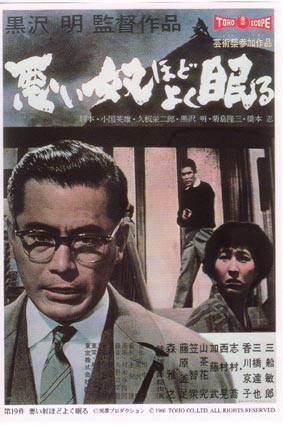
The Bad Sleep Well (1960) is Akira Kurosawa's take on Hamlet. Set in contemporary Japan with a backdrop of corporate intrigue, the story of a man's climb up the executive ladder unravels a quest for retribution. The links to Hamlet would seem to be patricide, conspiracy, introspection and doom. Kurosawa's always complex construction incorporates some heady social commentary. Apparently some inspiration came from headlines contemporaneous with the production. Kurosawa hits an intensely stirring, bleak tone. Mifune is excellent as always in the vengeance seeking Hamlet role. Kurosawa's sensitivity to human feelings raises complex moral issues. By weaving a tale that transcends the usual physical modes of revenge Kurosawa also defies expectations. The result is a philosophically provocative and cinematically striking thriller.


Do you think director Enzo G. Castellari saw the above Kurosawa film before he made the cheekily inspired spaghetti western Johnny Hamlet (1968)? Apparently it was Sergio Corbucci's idea but he was to busy to realize it into fruition. Therefore Corbucci bequeathed the project onto Castellari. Johnny comes home after fighting in the civil war to find that his father was murdered and his mother married his Uncle Claudio. This is an exploitation film so it is very much about the physical modes of revenge. But so much of the source material is intact, including Hamlet's tortured soul, and, if I remember correctly, he does get visited by his father's ghost. There's an added Gothic tone to the production, wild colors and the like, plus some rowdy fist fights thrown in for macho good measure. The trailer is pretty psychedelic.

Probably the most influential spaghetti western with a revenge plot-line is the Leone masterpiece Once Upon a Time in the West (1968). Haunting theme music enforces the mythical mystique of Charles Bronson's vengeance seeking loner known as 'Harmonica.' And of course Bronson went on to become the icon of revenge for his star turn in the Death Wish films. He publicly denounced the vigilantism of his Death Wish character in the wake of the Bernhard Goetz incident. Death wish director Michael Winner had worked with Bronson 2 years earlier on the revenge tinged action film The Mechanic (1972). The laconic hitman Bronson plays helped seal his on-screen persona of a no-nonsense anti-heroic badass. So the question arises: What is the most identifiable face of revenge floating in our collective consciousness? From the Bronson perspective it would seem to be someone at piece with themselves; someone who understands the meaning of restraint. But circumstances beyond their control exhaust that restraint. In the Mechanic the concept of vengeance is played out more existentially. For Bronson and Jan Michael Vincent's character revenge becomes a game of cat and mouse that defines their lives. Winning the game somehow supersedes the moral and emotional impetus de riguer for the path of vindication.

Perhaps one of the most iconic and beautiful faces of vengeance belongs to the strikingly stoic visage of Kaji Meiko. After establishing herself as an action star in films like Wandering Ginza Butterfly and Nikkatsu's juvenile delinquent Stray Cat Rock series, Ms. Kaji starred in several influential revenge films during the 70's. Lady Snowblood (1973) is an ultra-violent samurai action tale based on an even more violent manga (and was the template for Kill Bill). Perhaps even more impressive (and also based on a manga - Japan has really cultivated comic book ultra-violence) is the Female Convict Scorpion series. These breakthrough women in prison films follow the blood-soaked path of Nami, a woman wronged by the evil and greed of others. They feature some of the wildest, over the top set pieces ever.

Many more coming soon...

Sunday, May 18, 2008

GOLDEN NIGHTS

Friday night out on the town. Well, Williamsburg that is, home of the affected hipster. Dean and I went to Snacky. Jimbo from Uncle Morty's Dub Shack was sitting in the same seat as last time I was there. Maybe he has a share in the place. They were showing the Jackie Chan classic Young Master. We had the Zatoichi special: $4 sake shot with a Tsingtao chaser. Dean, who is the mayor of coolsville ran into about 5 people he knew while we drank and chomped down on fried rice and shoyu ramen. Then we made our way down the street to Trash Bar. We got there just in time for the Imaginary Icons, Tom and Ted's band (I don't know the other two guys). They are reviving a genre that barely ever existed: neo British post punk. Think heavy influences of Wire, Swell Maps, etc. Maybe Mission of Burma was influenced by some of that stuff or had similar sensibilities but they remained fairly original. That was the thing with the first wave of post punk bands: the originality in an era of stale music. By stripping things down those early British bands allowed other complexities to emerge. Imaginary Icons are pretty good, and have interesting parts but I'm still waiting for that one hit song. It does seem like their almost putting on English accents. Maybe it's the familiar phrasing of their vocal lines and arrangements, I'm not sure. The Big Boys "Heartbeat" popped up on my ipod the following day and I realized that they were also playing with weird staccato rhythms while mixing musical genres, though their influences seemed more disparate, namely punk rock and funk/r & b. Next up was The Golden Boys from Austin (pictured above). Don't know how to describe them exactly, somewhere between underground rock, country and a little bit of singer songwriter in a very disheveled sense (that's a good thing). They had a great, chaotic energy but managed to keep everything together despite the lead guitar struggling with his strap through the first two numbers. They had a keyboard player with a curly mustache and all four of the upright musicians assaulted the front of the stage in a happy melee of flailing limbs and twangy sounds while the drummer slammed hard and thrilled the audience at one point with a one armed passage, brandishing a beer in the other hand. I left early so I missed The Spider Bags, who Dean said were great, and the self-proclaimed country rock of Puddin' Tang. So much for me and the scene.

Thursday, May 15, 2008

X VERSUS ZERO

When I first heard about this brand new kaiju Monster X Strikes Back I immediately thought of one of my favorite kaiju movies Invasion of the Astro Monster (1965). In Astro Monster a Japanese and an American astronaut travel to Planet X. The Planet X-ians (caled Xiliens) explain how they want to pit some earth monsters against their own planet's Monster Zero. The space scenes, like the underground chasm where the Planet X folks live, are colorfully psychedelic and totally kitsch mod cool. The monsters are pretty awesome too. Monster Zero is that three headed beast also known as King Gidorah and he ends up fighting Godzilla and Rodan (thus the Japanese title that translates to Kaiju Big Battle or the great monster war). Monster X Strikes Back is directed by Minoru Kawasaki, the man behind Calamari Wrestler and Executive Koala. Wait there's more: the subtitle is "Attack the G Summit" and it also features none other than Beat Takeshi. Monster X's Japanese name is Girara, apparently a 3rd rate monster who was in The X From Outer Space (1967). Guirara looks like a mutant bird crossed with a robot and I imagine was to Kaiju what Sartana was to spaghetti westerns. Hey I love that first Sartana movie but by the time he came along to the genre with his James Bondian gadgetry and other anti-hero cliches it was bordering on self-parody. No wonder when Leone and friends heard the title If you Meet Sartana Pray for your Death they mockingly retorted "If you see Sartana tell him he's an asshole."

Wednesday, May 07, 2008

SEX, VIOLENCE AND WEIRDNESS!

There appears to be exponential irony rampant within the current crop of neo- exploitation films (post-deuce). This is no more evident than in a few recent self-referentially tongue in cheek pre-fab cult films from Asia.

Machine Girl grabbed a lot of attention when its trailer hit Youtube. Did director Noboru Iguchi willfully rip off Rodriguez' potluck pastiche offered up in the Planet Terror half of Grindhouse? Or perhaps the deadly disfigured badass hottie with a gun fever dream has been floating in the ether since the days when They Call Her One Eye enjoyed extended runs in Times Square? This looks like an homage cum send-up of everything from Sukeban Deka to Master of the Flying Guillotine and a barrel of mindless monkey fun at that. Tokyo Shock is releasing the DVD in June. Too bad these sort of films don't get wide theatrical releases anymore. I still have fond memories of seeing a midnight show of Demons.

The team behind Machine Girl already have a new gross-out action epic, Tokyo Gore Police. It's directed by Yoshihiro Nishimura, the effects man from Machine Girl , and stars Eihi Shiina, the sexy sadist from Audition.

Sex as a mantle for ultra-violence can get exhaustive so it's a breath of fresh air to hear about a new neo-spaghetti western by way of Korea. Kim Ji Woon, the director of the excellent modern noir/Hong Kong action homage A Bittersweet Life, the creepy artsy horror Tale of Two Sisters and the wacky cult wrestling comedy The Foul King is behind this one: The Good, The Bad and The Weird!

It takes place in 1930's Manchuria and involves bandits, militants, and a treasure map. Heartthrob Lee Byung Hun from A Bittersweet Life plays the good, Jung Woo Sung from Musa plays the bad, and that funny pudgy underdog from The Host Song Kang Ho plays the weird.