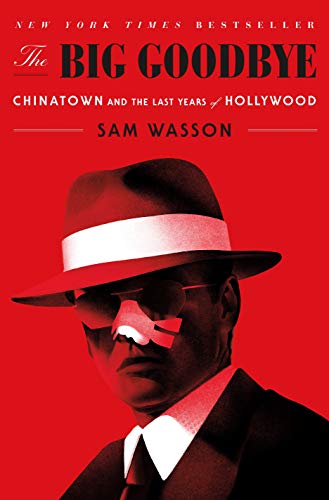
Book Review: THE BIG GOODBYE: CHINATOWN AND THE LAST YEARS OF HOLLYWOOD by Sam Wasson

Most of us have no idea about the years and agonizing changes a film script goes through to produce a really great movie. The person whose name you see on the screen as “Written By” is by far not the sole author. In the case of Chinatown, Robert Towne’s “darlings” were murdered left and right, mostly by Polansky. But the end result looked effortless and resplendent.

As a writer of fiction, I got into the habit of reading only fiction. Great fiction. So I could learn from my betters. But I am also a film buff, and when I saw that this book was about the making of Chinatown (for me, the greatest film noir ever made) I got on Book Finders and found a used hardcover copy for about $4.00. The shipping was more than that.

Mr. Wasson did his homework all right. The acknowledgements section at the end comprises fully a tenth of the pages.

Not only does he provide intimate portraits of the main players: Writer Robert Towne, director Roman Polansky, producer Robert Evans, and stars: Jack Nicholson and, to a lesser degree, Faye Dunaway, he also paints a vivid portrait of Hollywood in the mid-seventies and the changes the movie business underwent; from the demise of the studio system to the flowering of a new generation of Hollywood independent directors unfettered by big studio control (Polansky, Scorsese, Cupola, Lucas, Bogdanovich, and more), to the present-day Hollywood output, mostly based on comic book superheroes, and made for an audience with the mind of a twelve-year-old.

The writing is exceptionally good and kept me riveted throughout. As implied earlier, this book is for cinephiles. If you’re not one, maybe you won’t be as excited about it as I am. But, if you are, READ THIS BOOK. I remember the seventies renaissance of indie films because I lived through it. We went and saw these movies in the theater regularly. I even tried my hand at screenwriting, but with no tangible success. My 30-year-old son works in the camera department of a film production company. He has no such memories, so I gave him this book. It’s important to have an historical overview of your profession. So, for you oldsters, read it and pass it on to the next generation. It may be the only way American cinema can be resurrected.

Book Review: MY EVIL MOTHER by Margaret Atwood

I started this book (which turned out to be a short story), but then jumped to MAX by Howard Fast, which was very entertaining for me, being a cinefile. Then back to this one (which accounts for the abnormally long reading time.

As a devoted fan of Margaret Atwood, I was not surprised to be in her thrall once again.

This is a story of a teenage girl who rebels against her mother, who always seems to be right about everything. Nothing new about that plot, but the twist is that the narrator’s mother is, in fact, a witch. To the reader, she’s not evil at all–and she is always right. Very amusing and entertaining, as Ms. Atwood’s wit is as sharp as ever.

Book Review: MAX by Howard Fast

I quite enjoyed this historical novel about the evolution of the motion picture business. At the end of the nineteenth century, Max Britsky lives in a small tenement apartment on New York’s lower east side. His father dies when he is twelve. The eldest of five siblings, he takes on the burden of supporting his family. He is clever and manipulative, and ultimately he becomes more and more successful in the entertainment business, which, in his world, consists of vaudeville houses and ten-minute silent moving pictures, viewed in nickelodeons. He always seems to see the next big thing with uneducated prescience. By the time he is in his twenties, he is a millionaire. After conquering the theater scene in New York, he ventures out to California, to an unpaved dirt road town called Hollywood. There, along with a handful of other budding moguls, he starts a major studio.

Howard Fast was a very prolific novelist and wrote, much like I do, in common, unadorned English. I did not learn any writing craft from Fast, but thoroughly enjoyed this entertaining yarn. Highly recommended for cinephiles like myself and those seeking a historically accurate peek into the past.

Book Review: FRANKISSSTEIN by Jeanette Winterson

I’m sure many of you are sitting on the edge of your seats wondering when I’m going to finish this book already. Here is my list of excuses:

  1. In spite of being a quick study, I’m a slow reader. Slow and careful wins the race.
  2. I can’t sit and read for long periods of time. I get restless and want to watch the news or a movie on TV.
  3. I had to proofread a copy of my upcoming book of short stories, a galley of which arrived while I was reading Frankkissstein.

So here is my takeaway: Frankkissstein is essentially two parallel narratives, one in the present day by a man who was born a girl who calls himself Ry. Some of the other characters think this is short for Ryan, but it’s actually Mary. And one by Mary Shelley, the author of Frankenstein, written in the early-to-mid nineteenth century.

Ry is trans and a medical doctor. They have had their breasts removed, but has kept their vagina intact. (Boy, it’s hard to write clearly about new gender pronouns!) This is important to know, because Ry has an affair with Dr. Victor Stein, a research scientist who is trying to find a way to download the data from a human brain to a computer. And then upload it into another vessel (a body that could be a super human, or even have wings).

The Mary Shelley of 1816 writes the Frankenstein story, partly on a challenge from her housemates and partly out of the boredom of being cooped up during a long, unceasing period of rain in a large house on Lake Geneva with her husband Percy, Percy’s pal George Gordon Lord Byron, Claire, Mary’s half-sister and Byron’s mistress, and a Dr. Polidori. The two narratives alternate chapters and keep the story moving along.

The story―if there is one―is both a love story and one that posits many speculations about robotics, keeping consciousness alive (maybe forever), and gender identity. Although it may sound dry and boring, it’s not.

Ms. Winterson’s brain is a miraculous mechanism in its own right, and she plays with visions of the future evolution of humans in ways that are both arcane and entertaining. In short, this was a fun, fascinating read.

Book Review: Simple Passion by Annie Ernaux

Simple Passion by Annie Ernaux

My rating: 3 of 5 stars


I ordered this after reading a popular blog that praised Annie Ernaux to the skies, but before she won the Nobel Prize. When I received the book, she had already won, so I patted myself on the back as being “prescient.” Those great expectations perhaps made me judge the book too harshly. It was good enough for me to read it through, but at 80 pages that’s not saying much. The writing was certainly competent, but I find with translations the word-craft often gets lost. If it was ever there, I will chalk that up to mediocre translation. My biggest complaint, however, was the lack of plot and through line. She just kept talking about her obsession with this man, but it did not give the relationship a dramatic arc.


View all my reviews

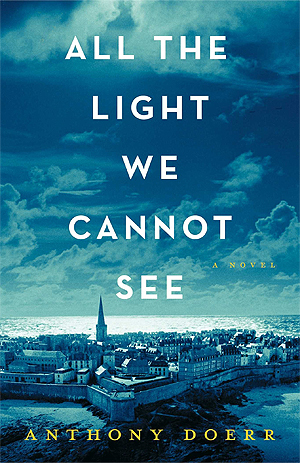
Book Review: ALL THE LIGHT WE CANNOT SEE by Anthony Doerr

A superb work of historical fiction. I’m sure there are plenty of reviews of this Pulitzer Prize-winning novel on Amazon and Goodreads, so I won’t dwell too much on plot. Suffice it to say the story takes place during World War II and tracks a blind French girl and a German boy, both in their teens, on their separate trajectories which we know will inevitably end in their meeting. There’s even a macguffin, but I’ll let you discover that mystery for yourself.

A lot of hard work, research, and a staggeringly profuse word pallet went into this book. It’s authors like Mr. Doerr with his high artistry and craft honed over years of dedicated learning who made me quit trying to write the Great American Novel (if this isn’t it, I don’t know what is). At the same time, the story is so engrossing and emotionally moving that I tore through it at record speed, all the while not wanting it to end.

Highly recommended for fans of fine historical fiction and great writing.

Book Review: ASHES IN VENICE by Gojan Nikolich

I haven’t read many crime thrillers. I guess I thought of them as pulp, and I wanted to fill my limited reading time with “great literature,” literature that would teach me something about writing, since writing fiction had become my new avocation.

But someone recommended Ashes in Venice as being exceptional, and so I added it to my Kindle queue. It grabbed me immediately in the way that some of the really well-made crime series on Netflix did (“Ozark,” “Narcos,” “Giri/Haji,” “Ratched,” “White Lines”). These I watched purely for entertainment value, not to hone my writing skills. But Ashes did both. I was bowled over, not just by the story, but also the writing craft and careful research that made the book so very authentic and enjoyable.

This is Gojan Nikolich’s second novel. I read his first one and it was very good; funny and charming in a slightly twisted way. But Ashes in Venice is a step up, his crowning achievement, so far.

I won’t say much about the plot for fear of accidentally letting slip any spoilers, but I will say that the “braided plot”―starting each chapter with a focus on a different major character―and tying it all up ever so neatly at the end was most satisfying. As it says right on the cover, this is a “vengeance thriller” and it features some very, very bad people―and a couple of good ones: one representing retribution, the other justice. I can say no more, except get it and read it!

Book Review: CUTTING FOR STONE by Abraham Verghese

I’m sure you’ve all been sitting on the edge of your chairs, especially my friends at Goodreads, wondering when is he going to finish this novel already? Well, I just finished it, and I suppose you deserve an explanation. Here is my list of excuses: 1) It’s very long (almost 700 pages); 2) My ability to focus and concentrate my attention on any one thing is not what it used to be; 3) Therefore, I read this in short bursts, maybe a half-hour at a time, but almost every day. This was also partially due to my not wanting it to end. It was that good.

My doctor recommended this book to me, and I had it with me when I went to see another doc, and he knew it and raved about it too. Not too surprising, as this book is really a paean to the noble art of healing.

Mr. Verghese is in fact a surgeon, and if his surgery is as good as his writing, he can operate on me anytime. Cutting reads very much like an autobiography, and I read it believing that it was a hybrid memoir-and-novel. But, in the epilogue, Verghese insists that it is all fiction, all made up. Still, I have my doubts. The narrator tells the tale with such authority, such authenticity, one can hardly imagine it not being mostly true. It centers around twin boys, conjoined at the heads at birth, then growing up as identical twins. Their biological parents are an English surgeon and a carmelite nun from India who meet and work together in a small hospital in Addis Abba, Ethiopia. I won’t go into any more of the story for fear I might let a spoiler slip, as did one review I read when I was still just starting the book.

All I will say is the characters are so beautifully drawn and believable and the writing in general so superb I was transported to Verghese’s world throughout this long and wonderful reading experience. Highly recommended!

And speaking of vaccines…

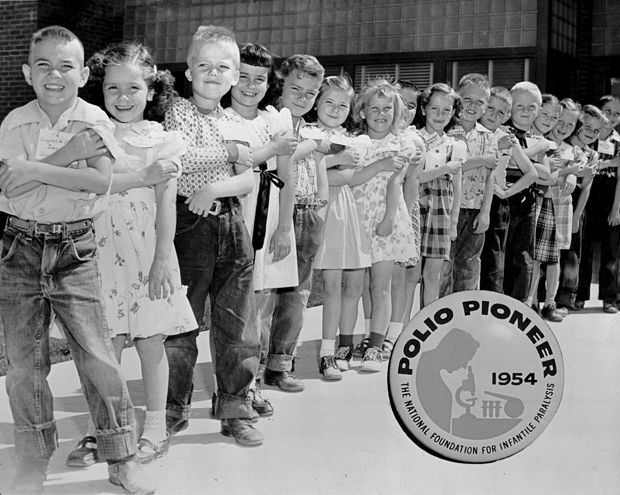
In 1954 I was nine years old, and my entire fourth grade class at P.S. 40 in Manhattan was chosen to be the original guinea pigs for Jonas Salk’s new polio vaccine. We all got the shot and a little button that proclaimed us “Polio Pioneers.” Then, a week or two later, a blood test to see if it had worked. The results of my blood test showed that the vaccine didn’t work on me. What followed over the next few months was an agonizing series of more inoculations and blood tests. I felt like a human pin cushion. No one knew why the Salk vaccine didn’t work on me. Maybe six months later, my mother told me they had figured it out: I was immune to polio all the time, naturally immune, a very rare occurrence. I was really pissed; I had to go through all those shots for nothing! #getvaccinated