Showing posts with label mr. peabody and sherman. Show all posts

Sunday, June 8, 2014

Time travel conundrums for kids


As in any type of movie, certain themes in children's movies seem to show up regularly around the same time.

First it was movies where teams of zoo animals band together to go on great adventures (The Wild, Madagascar). Then it was movies about penguins (Happy Feet, Surf's Up). Then it was movies about competitive racing (Cars, Cars 2, Turbo). And I'm sure a dozen others thrown in there as well.

Now we seem to be living through an era where animated characters travel through time.

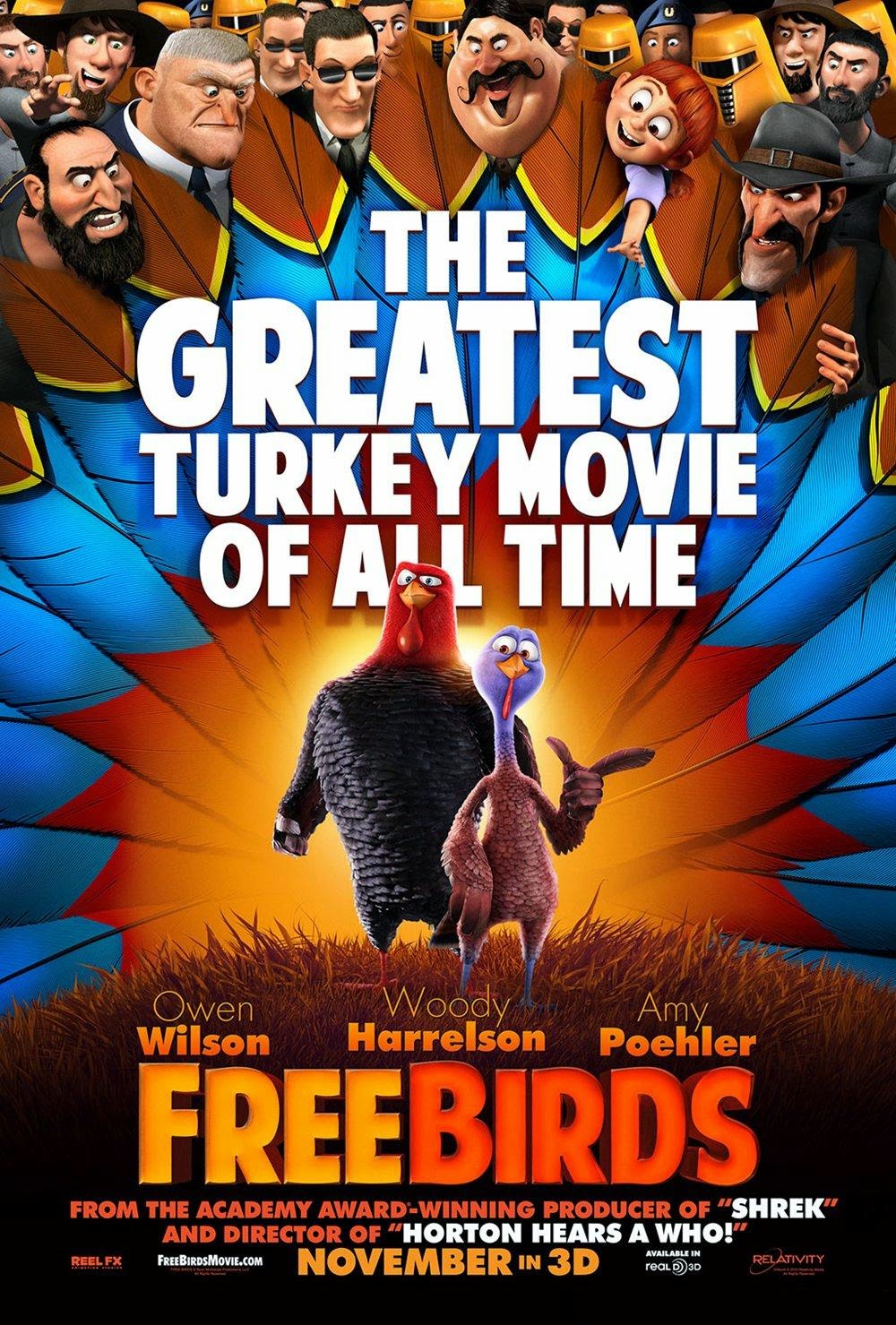
I watched Free Birds yesterday afternoon on Netflix while both my sons were sick, marking the second time in a month I've seen a movie about time travel aimed at children. The first was Mr. Peabody and Sherman back on Mother's Day. 

My younger son is only five months old, and was not even really watching the movie (though he was fussing so much that I admit to hoping all the pretty colors would hold his attention). Quite obviously, I don't expect him to understand what's going on in a movie like Free Birds. However, my older son will be four in August. I'd think he should be able to grapple with the basic concepts these movies present.

Time travel is not such an easy concept to understand -- and the conundrums that result from time travel even less so.

First I should probably answer the question I hear many of you out there asking right now, even if only silently in your heads: Free Birds is about time travel? That was something I didn't know either. But yes, it deals with a pair of turkeys who board a government-built time machine with the express intention of preventing turkey from being on the original Thanksgiving menu. And yes, the movie itself is a bit of a turkey. Sorry Free Birds, you just made that one too easy.

It was clear to me that my son had no idea what those turkeys were actually doing, just as he had no idea what the dog and his boy were doing in the far more competent Mr. Peabody and Sherman.

Both movies kind of make it seem like the characters travel through outer space to another place on Earth. Because there's no way that my nearly four-year-old looks at Ancient Egypt or the Italy of Leonardo da Vinci or a pilgrim settlement in 1621 Massachusetts and thinks of it as "the past."

It got me wondering when children even start to understand the concept of "the past," when they understand that there were people here hundreds and thousands of years before they were born. If even the concept of a year is a bit tricky, the concept of hundreds of years is far more so. Then try to explain that there's a machine you can use to travel back to times that have already happened ... well, noodle fried, I would say. Or, more likely, noodle simply disengaged. They just wouldn't get it.

Now throw in, as both movies do, two of the central tropes of time travel movies: 1) multiple incarnations of the same character appearing in the same place, and 2) a character effecting a change in the timeline by causing a chain of events for which he shouldn't have been present. If you can explain that to a four-year-old, you win a medal. Heck, if you can explain that to an eight-year-old, you win a medal.

I think the difficulty in determining how old a person has to be to grasp this stuff arises from the lack of a good corollary in my own childhood. They just didn't play around with time travel all that much when people my generation were young. Few movies at all dealt with the subject, and even fewer of those (probably none) were movies aimed at kids. Back to the Future was certainly the first time I was confronted with the conundrums of time travel, and I was 11 when I saw it. I didn't have any trouble understanding it at the time, and in fact, it blew my mind. My Keanu Reeves "Whoa" reaction is probably one of the reasons it still rests near the top of my all-time rankings (#2). 

Today, though, you could argue that popular entertainment is super-saturated with time travel. There might be as many as half a dozen movies a year in which characters travel through time. I'm wondering if the mere presence of this in the zeitgeist allows children to grasp it much sooner than they would have when I was young. You know, kind of like how children are born these days understanding how to use a smart phone.

What I can tell you for sure, though, is that my nearly four-year-old doesn't get it. He didn't ask me why there were two Mr. Peabodys and two Shermans on screen when were watching Mr. Peabody and Sherman, in part because he actually has a pretty good idea about theater etiquette for a kid his age. When four versions of the main turkey, Reggie, showed up in Free Birds, he just kind of looked at me and laughed. If I had been able to translate that laugh into words, those words would have been "That's silly." As in, "They're just breaking the rules and I have no idea why."

Of course, I can't make an argument about why movies aimed at my son should do a better job of presenting things he can understand without getting a bit introspective. The real crime here may be that we parents are trying to find cinematic babysitters for our children at younger and younger ages, and that these movies really aren't meant to be comprehended by a child who isn't even four. When I was my son's age, I had probably only just seen Star Wars, which was the first movie I ever saw. There simply wasn't a way for me to see every Pixar movie, ever Pixar knockoff and every knockoff of every Pixar knockoff at home on my very own TV.

Still ... time-traveling turkeys? Rips in the space-time continuum? Talking dogs running around Ancient Egypt?

Forgive me if I find myself longing for a princess, an evil queen and a bunch of singing dwarfs. 

Monday, May 12, 2014

That fraud William Shakespeare


One of the things I enjoyed most about Roland Emmerich's Anonymous, which was one of my top ten films of the year it came out, was how it made me really reconsider the authorship of Shakespeare's works. I had known there were theories that the Bard was not actually the Bard, but that some other figure living at the same time (obviously) was the one who actually put pen to paper and wrote Shakespeare's peerless body of work. Several candidates had always been considered, and Anonymous takes the position (spoiler alert!) that it was Edward de Vere, the 17th Earl of Oxford, who couldn't reveal his identity because playwriting was considered one of the basest activities a member of the aristocracy could ever pursue.

But what really sold me on the fact that someone other than Shakespeare wrote Shakespeare's works was an interview I heard with Anonymous screenwriter John Orloff on the podcast The Q & A with Jeff Goldsmith. Orloff presented a truckload of evidence, both actual and circumstantial, about why it simply could not have been Shakespeare. Here's just one: Shakespeare never traveled outside England, yet a dozen of his plays describe Italy with a level of detail that indicates he had been there not once, but multiple times.

The conversation among academics about whether Shakespeare was a brilliant genius or a total impostor has always tended to fall on "brilliant genius" side of the scale. Academics, especially those who have devoted their careers to studying Shakespeare, have seemed unwilling to admit that they have been lionizing a reprobate, and have therefore cast the Shakespeare deniers as no better than whack jobs who might just as soon start telling you about UFOs.

I'm wondering if that conversation is starting to change, though.

In the space of a week's time on my viewing schedule, two new movies have renewed the charge -- albeit in a cheeky manner -- that Shakespeare was just an opportunist. I'm starting to wonder if that position is becoming steadily more mainstream.

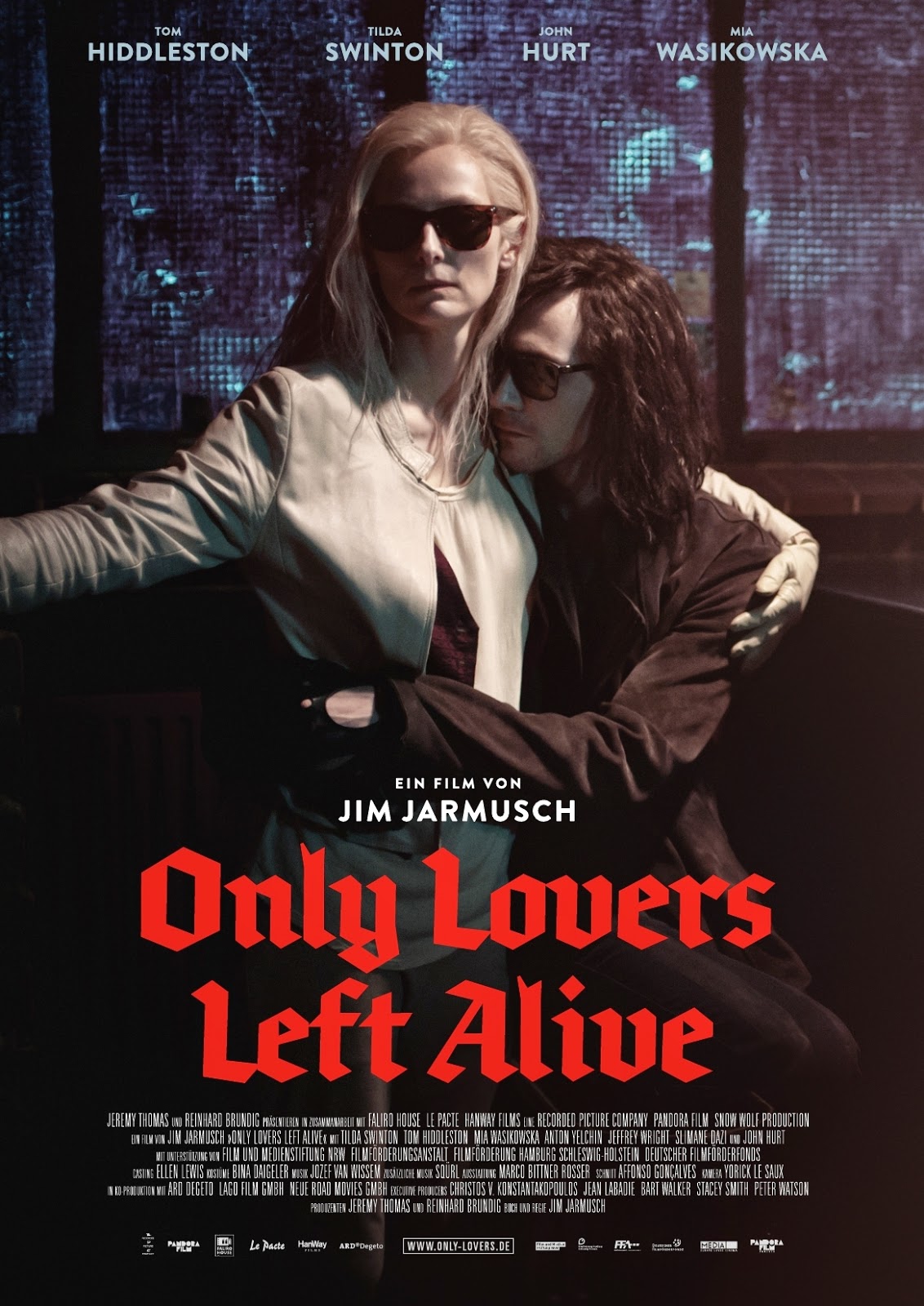
First it was the movie I saw last Monday, Only Lovers Left Alive. "What is Shakespeare doing in a Jim Jarmusch vampire movie?" you might wonder, if you haven't seen it. Well, I'll tell you, but only after the requisite SPOILER ALERT to clear anyone out of the room who doesn't want to be here.

In addition to being hundreds (thousands? that's an altogether different discussion) of years old, the vampires in Jarmusch's film have also hobnobbed with some of history's most influential cultural contributors. In fact, the two main vampires (played by Tom Hiddleston and Tilda Swinton) are still hobnobbing with one now: Kit Marlowe (John Hurt), one of the others who was suspected of having written Shakespeare's works. See, Marlowe never died back in the late 16th century. He faked his own death and went underground as a vampire who's still living to this day. (He never died in the traditional sense, anyway.)

The movie is not content merely to make the connection to Shakespeare. It's quite clear, from several references, that Marlowe definitely did write Shakespeare's works, at least in this movie's universe. At one point Hurt muses (paraphrasing here) "I wish I had met him [Hiddleston's character] before I wrote Hamlet ... he would have made the absolute perfect model for the character."

Quite by coincidence, I then saw Mr. Peabody & Sherman yesterday with my three-year-old, one of several gestures toward removing him from his mother's presence on Mother's Day. (My son displayed his best behavior yet in a film, and I quite enjoyed the movie.)

The Shakespearean reference here is just a throwaway, rather than a major character, but in one of the title characters' jaunts back through time, they are seen in a room, handing a manuscript to a man who can only be Shakespeare. Shakespeare then signs his name to it and cackles maliciously. So Mr. Peabody & Sherman doesn't follow any of the standard schools of thought about who might have written Shakespeare's words -- it ascribes the responsibility to a time-traveling dog and his adopted human son.

Of course, I do realize that it was just dumb luck that I saw both of these movies in one week -- especially since no two movies might attract more different audiences. I also realize that 98 out of 100 films that hit theaters make no reference to Shakespeare at all, and the two that do are unlikely to tackle the authorship of his works.

Still, I have to wonder -- are we all finally starting to agree that this Shakespeare guy might have been a total fraud?

I'd say the idea is gaining momentum, in any case, and these two movies make for especially interesting examples. One of them goes to the trouble of having a major character take on the role of the man who ghost-wrote Shakespeare. At one point he even struggles with the fact that he wasn't recognized for these efforts, and reserves a couple choice epithets for the man who actually got the credit. The other film contains just a throwaway two-second joke, but it also goes to more trouble than it need to, making the man cackle, as though his taking credit were an act of intentional mischief and bad faith, not just cowardice.

If there is anything so identifiable as a "trend," I'd like to hope Anonymous gets some of the credit. Like whoever that man (or woman???) was whose deeds have gone unrecognized, Anonymous itself did not receive its proper due when it was released. I hope both injustices are something that time, and a choice application of some basic logic, will correct.