Monday, 5 September 2011

Night Terrors


I had been so looking forward to “Night Terrors”.  It looked terrific, scary and funny.  And it was funny.  And bits were sort of scary.  But terrific?

Sadly, as happens on much of this new series of Doctor Who, the ideas are excellent but they fall short at the last hurdle, something which I personally blame on the running time.  In the good old days, a story would unfold over weeks, rather than minutes.  Whilst the episodes ran for a shorter time (excluding much of the Colin Baker era), each story was set over 3-6 weeks, with some monumental serials taking between 10 and 12 weeks.  Now, however, a story takes 45 minutes.  Whilst there is the over-thought story arcs which transpire over the course of a series, most serials are not connected by plot – each episode works as a stand-alone, with connecting threads of plot.  Whilst the occasional two-parter does sometimes occur, they are a rarity.  And that is the biggest flaw with New-Who.

Don’t get me wrong – it was a good episode.  It just wasn’t great.  A reimagining of “Fear Her” from series 2, but much better written and directed, it held great promise.  Mark Gatiss is a great writer, and the ideas behind this latest episode held great promise – finding terror in the ordinary, everyday things we have lying around the house.  It just all felt a little too rushed in the 45-minute running time, with ideas being thrown out too quickly for the audience to fully digest them.  There was none of the story arc in this episode, possibly due to its movement from episode 3 to episode 8 in the running order, but that certainly helped with the pacing – As the Ponds wandered around the doll’s house of nightmares, there was no mention of Melody or River – or of their ‘best friend’ Mels either. 

The pacing lent itself nicely to the plot – exposition wasn’t high on the list here, rather preferring the old fashioned horror moments typical of much of the horror movies of the 60s and 70s.  There was very little CGI, instead using excellent set, costume and lighting to create a claustrophobic feeling of genuine terror.  As the shadows danced across the walls, and lights flickered ominously, it genuinely was edge-of-the-seat stuff, reminiscent of “The Mind Robber” and like a good version of “The Celestial Toymaker”, with dolls creeping around in a fictional world come real, childish giggles and nursery rhymes audible during truly tense moments.  Director Richard Clark has been gifted, this series, with the two strongest scripts, both stand-alone episodes with no arcs to hinder them.  Unlike his earlier stories, “Gridlock” and “The Lazarus Experiment”, the focus is entirely on the ordinary.  This one wasn’t sci-fi, in any way, really – it was simply a horror story in the gothic mould. 

(As a side-note, it seems like the entire crew have gone Stanley Kubrick crazy – last week was the jump cut of the TARDIS reminiscent of 2001: A Space Odyssey, and this week was the twin girls who looked straight out of The Shining.)

As I have now said a couple of times, the issue with this episode was time – the excellent ideas on show from the crew and writer couldn’t be done justice in the time allocated to it.  The progression of characters, and the characterisation that it could have afforded, was sadly drawn too quickly, in too-broad strokes.  And that isn’t a fault of the writer or director.  I’d argue that it’s the schedulers fault – them, and Moff, forcing excellent premises like this into single episodes so that the arcs with which people have quickly lost patience can be given more episodes upon which to encroach.

George, the young boy suffering from nightmares, was excellent – young Jamie Oram was adorable, with his slight speech impediment and weak physical appearance highlighting the inherent fears in this poor defenceless child.  Daniel Mays, as his father Alex, was pretty strong too, although again much of his character was lacking – I personally find it difficult to believe that simply because a child is scared of things, the family would call social services.  Leila Hoffman, as Mrs Rossiter, was sadly under-used – she is amazing when given the chance to give comic turns, as seen in How Not to Live Your Life.  Unfortunately, she spent the majority of her screen time mumbling to herself, before being eaten by bin bags and wandering aimlessly down corridors.  The stand-out performance of the episode, however, was Matt Smith.

Last week, I mentioned how much I like Matt Smith.  Hell, how much I love Matt Smith.  When he’s given material that allows him to take his time, and ponder, he’s simply outstanding.  The comedy here, for the most part, comes from the very alienness of Smith’s Doctor, stuck in a world of high-rise flats and disgruntled pensioners.  He got most of the good lines too, after being cheated out of them by Arthur Darvill as Rory last week.  The scene in which he was making a cup of tea was brilliant, faced with the disgruntled father, but carrying on as though nothing were wrong, adding “monsters are real” before requesting more jammie dodgers.  Similarly, the comment “I can’t just plump for Brian like I normally do” raised a good chuckle from me.  What was refreshing about this week’s episode was the lack of focus upon Amy and Rory – while they were both integral to the plot, they didn’t distract from the story, or Smith’s performance.  Unlike the past series has been Doctor-lite, this was definitely Companion-lite.  And thank goodness for that.

A major flaw with this episode for me was that the episode was so predictable.  It was essentially The Twilight Zone for 2011.  And that isn’t necessarily a bad thing – if it isn’t transparent from the very beginning.  Within minutes of starting, it was obvious that George wasn’t a normal boy.  It was also clear that the outcome of the episode would be resolved through paternal love.  Yawn.  Whilst Gatiss had penned a creepy idea, the resolution was decidedly average.  A child with ESP, manifesting his fears somehow, would have been interesting and exciting and possibly creepy.  Instead, moments before the climax, we discovered that George is actually an abandoned orphan alien creature, a Tensa apparently?, who assimilates into the lifestyle of those who find it, fulfilling their needs – in this case, a sterile wife and her husband desperate for a kid of their own.

The concept of locking all of your fears in a cupboard was an interesting one, although again not particularly realistic given that the child must then sleep in the same room as all of the things which he was most terrified of – indeed, in the sequences in which he shone the torch around his room, watching huge looming shadows appear, I couldn’t help wondering why on earth he had so many creepy toys lying around in the first place?

Of course, the last scene had to remind us of the arc, with the Doctor once more looking at the date of his death with a pensive stare, followed by the comment about all being back together “in the flesh...” – A clue, no doubt, to the theory that the flesh Doctor and the real Doctor have at some point gotten mixed up again...

Friday, 2 September 2011

Torchwood – Episode 8 – End of the Road


It’s a Miracle!  A Blessing! Torchwood has finally begun to get somewhere, 8 episodes into its 10 episode run.  And it was actually quite good.  Whilst I try, on these blogs, to be as impartial as I can, my Torchwood blogs have been filled with disdain as, other than episodes 5 and 7, they have for the most part been formulaic in their approach, looking at only the surface of the situation, and not delving into the nitty-gritty as I’d hoped they would.  This week, however, everything was ramped up a notch, and it made some pretty good television.

Nana Visitor’s character, Olivia Colasanti, last week promised “I can take you to the one man who knows how the Miracle began...  Angelo,” and that was the hook not only for Jack to go willingly, but for the audience to continue watching.  Much has been made of this new series not progressing, and reviewers, bloggers, and fan-sites on Facebook have been filled with riled viewers – myself included – claiming that for too long now, Macguffin after Macguffin have been dealt to us, with distractions thrown in for good measure, whilst the Torchwood team potter around, not actually achieving anything.  Terminology like “The Soulless” and “Dead is Dead!” have been bandied around, with nothing coming to any kind of conclusion.  Another of these phrases with was thrown out there was morphic field.

Jack first mentioned morphic fields back in episode 2, on the plane.  It was then touched upon in episode 3, and has since been forgotten about.  But finally, in this episode, we are informed that Captain Jack was right all along!  It is a morphic field that’s responsible, at least in part, for the Miracle.  The discovery of the morphic field below Angelo Collasanti’s bed provided the crux of this episode, allowing the team to get a better understanding of what they are dealing with – but only vaguely.  And this is where I start to pick holes – Jack has, until this series, never been so bloody useless.  Even in Children of Earth, Jack had some clue – it took a very brief flashback, and he knew exactly what he was dealing with.  Yet here, in Miracle Day, he continues to wander about aimlessly with little or no clue as to what he needs to do.  The best he can come up with is to take part of the morphic field... and leave.

Angelo’s granddaughter, Olivia, informed us that Angelo was the one man who knew how the Miracle began – which is a lie.  A gigantic plain-faced lie.  Olivia spouts some nice exposition about jellyfish, and their ability to regenerate eternally, tells Jack that Angelo was watching him for years, and points out the ‘families’ who we saw last week, and that every single person watching had figured out were responsible.  But that’s all.  She doesn’t mention morphic fields, or alien technology, or anything else.  And that, to me, feels like a massive cheat.  We all knew that it was the families, despite the teaser at the end of the last episode which suggested Angelo was really responsible.  By turning that on its head so soon, it feels like Torchwood is doing a great disservice to the fans who have so far invested eight hours into watching the new series.  Along with all of the other empty plots and dead ends, we’re now being lied to directly.

When Jack says his goodbyes to Angelo, it should be a sweet scene.  It should be.  Instead, it feels like Jack, as always, is simply a gloating gay guy boasting about his conquests.  The mention of Ianto made my skin crawl.  And then Angelo dies.  In a world where that should be impossible.  Watching Jack screaming at heart monitors and IV drips was verging on ludicrous.  Barrowman hammed it up to the best of his ability, but it was ultimately an unbelievable scene which came to nothing.  His tender kiss goodbye to the “old man” was the one gentle touch of this scene – and what seems to have ultimately led to Angelo’s death.  Following the reveal of the morphic field below his bed, my idea is that, by entering the morphic field, Jack returned to his immortal state whilst Angelo was able to resume his mortality and fritter away into the ether.  This would also help to explain Jack’s apparent absence in next week’s episode, going by the teaser trailer.  With the alpha plate in his pocket, will this increase his longevity again, ensuring that whilst he has sustained a life-threatening gunshot wound to the stomach, he will die, as he always does, before coming back to life?  Also, the guy in the balaclava shooting at the CCTV cameras next week...?  I reckon that’s Jack...

The guest cast list is impressive, as I’ve stated before, but it does at times hinder the progress of the story – enlisting Nana Visitor last week, Wayne Knight at the beginning and reappearing here, and now John De Lancie is like a who’s who in Sci-Fi.  But the characters are such pointless additions to the story that two of the three were killed off near the head of the episode – by killing off Visitor’s Olivia moments before Angelo died, it ensures that we will be getting nothing more in the way of information from the Colasantis.  Similarly, following the reveal that Knight’s Friedkin was a mole for the Families, whilst working for the CIA, you can’t help but think that they’d have kept a better eye on him, rather than letting him blow himself up like that.  Also, why did he wait until he was in the car?  He could have detonated the explosives in Colasanti’s bedroom and gotten rid of ‘those pesky meddling kids’...  I mean, the Torchwood team.

John De Lancie was something of a revelation though.  He clearly relished the role, and stole every scene he was in, with a gusto that was beyond impressive.  He was all bravado, shouting orders, decommissioning Torchwood and deporting Gwen at the click of his fingers.  I loved the deportation of Gwen most of all – simply because she annoyed him.  He threatened to do it, but was dissuaded, and then did it anyway – fantastic! 

The stand-out performance from De Lancie only further shows the weaknesses of our main cast, however.  Eve Myles’ Gwen did nothing but bluster, say “bollocks!” and cry.  A lot.  Myles, last week, was brilliant with a very under-stated performance – although again she did cry an awful lot.  In episode 8, though, she was redundant.  Sat in the wings for most of the story, and then bundled off by the CIA for being an annoying Welsh girl, seemed apt for this new side to the character that we were forced to endure for her thirty minutes of screen time.

Rex and Esther continue with the ‘dumb and dumber’ routine, although this week at least we got to see a slightly more human side to Rex – rather than the utter tool he has been for the last few weeks, we can now understand that his bravado is a mask to cover the fear he feels about his impending death, once the Miracle stops.  Esther, however, has become even more irritating and dislikeable.  She gave away the morphic field under the bed, and spent more time on the phone talking to her crazy sister...  and I just couldn’t have cared less.  The characterisation of Esther has been so generally sloppy that it’s difficult to give two hoots about her, or her sister, or her nieces. 

Speaking of ridiculous things, the negated space around the morphic field in Angelo’s house was a ridiculous waste of time – how could CIA operatives, watching Captain Jack and co under house arrest, not have noticed their muted gabbling, made even more conspicuous by Rex the Tool wandering away while Esther mouthed numbers at them?  While the three conversed within the null field, where sound could not escape, and chatted for about five minutes whilst making themselves “look busy” was beyond me, and truly did stretch my credulity to breaking point!  It was adding insult to injury that the two CIA men also didn’t notice – and then the Director of the CIA walked in, and also didn’t notice anything – and these people think they can solve the problems of Miracle Day without Torchwood?!

It was nice to see Bill Pullman and Lauren Ambrose return to the screens this week.  They have been a noticeable absence for the last two episodes, and I, for one, have sorely missed them.  Whilst they certainly haven’t been integral to the plot up to now, they have made a nice relief, and there have been some genuinely unsettling moments.  This episode was no different, as we first had to endure Oswald’s horrendous and bile-inducing dancing, and then he informed Jilly that he wants ‘a girl’.  When he looked her up and down, informing her that he wanted one of legal age, with red hair, my toes curled – as did Jilly’s, judging by the expression on her face.  Ambrose’s has been a restrained performance from the start, barely concealing her disgust at her ‘client’.  What did go some way to undermine this performance was that she willingly signed up to work for ‘The Families’ after she saw her intern, a CIA mole in reality, shot three times by the handsome stranger from the Miracle Rally.  Whilst I understand that she is eager to further herself in the world of PR, following a murderer, however gorgeous he may be, seems a little false to me.

Pullman’s performance was creepy, yet with a gentleness that, worryingly, made me feel for him.  Of course, I am not justifying his actions, but this man genuinely seems eager to find some redemption.  He is disgusting, and a criminal, but his conversation with the red-headed lady of the night was quite moving.  When he discovered that the government were putting through legislation to create a new category, Category Zero, which meant that criminals who should be dead would be cremated in the gigantic ovens first seen in episode 5, the rage was palpable, as he rooted through Jilly’s belongings before punching her square in the face.  What a guy.

Other side-plots involve the emergence of yet another mole in the CIA – conveniently, since their other mole died at the beginning of the episode – and more mystery surrounding a morphic field large enough to encapsulate the entire planet.  Added to this is the suggestion that Jack’s blood is somehow involved – an idea that I postulated upon last week, as I’m sure many fans did, but one which has been pooh-poohed by Jack himself.

So, with only two episodes, and still so much to discover about the Families responsible, the purpose of the alien technology recovered from the destroyed Torchwood hub in Children of Earth, and Gwen’s relocation to Wales for next week’s episode involving a mysterious man looking through cellars with a torch, searching for her father, we’re sure to have an action-packed penultimate episode.  I only hope it keeps up the momentum achieved by this week’s episode, and delivers some answers to the questions which it keeps throwing at us.  As Rhys said: “Where’s it all heading?”  Well, Rhys, we’ll soon see...

Sunday, 28 August 2011

Let's Kill Hitler


After such hype, the newest episode of Doctor Who had a lot to live up to.  Personally, “Let’s Kill Hitler” didn’t live up to the hype.  It was entertaining, that much is true.  But with so many loose ends hanging around, it needed to do a little more than this episode managed.  To an extent, this episode worked as a stand-alone instalment, with an interesting, if ridiculous, premise.  The Teselecta was preposterous, but good fun all the same.  The teaser about Hitler was redundant within 5 minutes, but again, was rather good fun.

But there was simply too much to fault.  I realise by saying this that the Moffatt Fangirls will no doubt want to hunt me down and kill me.  Honestly, they’re becoming as bad as the RTD Fangirls, or even worse – the Tennant Fangirls.  The Grand Moff has been given too much freedom.  This episode was the 12th which the show runner has written himself – the trouble is, he’s too fascinated with these multi-season long story arcs to actually provide us with answers.  Instead, as editor-in-chief, he focuses on these red herrings and clues too heavily in not only his own scripts, but those of everyone else, and ends up frustrating the long-time fans and newcomers alike.  I genuinely can’t believe that anyone who happened to pop the episode on by chance, but hadn’t seen the last few series’, would have a bloody clue what was going on.  This was fan-wank of the highest order, as well as the most inappropriate title for any episode, ever.   The Moff frequently lies – this we know for a fact.  But misleading the entire fan base during the three month hiatus between episodes 7 and 8 is a bit of a low blow for all involved.

This was ultimately The River Song Show.  After 20 episodes of The Amy Pond Show (Guest starring Rory Williams, and also featuring the Doctor), with very little for the Doctor to do himself – “The Doctor’s Wife” and “A Christmas Carol” not withstanding – the trailers for this looked set to finally put the Doctor back in the spotlight, where he belongs.  Matt Smith is an outstanding character actor, who has taken the role of the Doctor and made it utterly his own.  Reminiscent of Patrick Troughton’s Two, with the comedy flair of Four, the moral compass of Three, the vulnerability of Five, the temper of Six and the slapstick of Seven, he somehow manages to combine all of these elements into one outrageously good performance.  He is easily the best Doctor since the regeneration of the series in 2005, and if he had better material, could quickly become the best Doctor ever.  Unfortunately, all he is given is a supporting role in his own show, hugely overshadowed by The Ponds. 

So, River – whilst I’m not her biggest fan, and the storyline has frustrated me ever since her first appearance in “Silence in the Library” / “Forest of the Dead”, Alex Kingston has brought a certain charm to the stories within which she has featured since Moffatt took the reins for series 5.  The character has been an enigma from the outset, and one which Kingston has obviously relished.  Here, though, we get to meet River for the very first time – and Kingston simply thrives off of the material she’s been given.  She delivers one of the quickest one-liners in the show’s history – “So I was on my way to this gay gypsy bar-mitzvah for the disabled, then I thought ‘the Third Reich’s a bit rubbish’...” – which had me genuinely laugh out loud.  However, witty one-liners do not a plot make. 

The plot, such as it was, revolved around two things – the Teselecta, a Justice Police of miniature people who go around through time and give bad people ‘hell’ for the wrongs that they cause, and River’s origins.  I’ll start with the Teselecta, as that was by far the most interesting part.

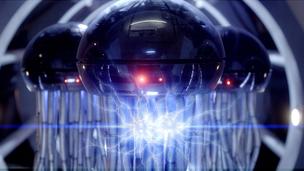
The Teselecta was an incredibly interesting concept, one which should rightly have been given an entire stand-alone episode to discuss.  The ramifications of time travel are an idea that the show touches on frequently, but hasn’t been discussed in any detail since the reboot in 2005.  Here, Moff created the perfect means to analyse the repercussions of the responsibilities afforded any race able to alter history, through any means, and of course discuss the potential for changing the future by altering the past.  If you could go back in time, and kill Hitler before he had the chance to commit any of the despicable deeds he had inflicted upon the world, then would you?  Could you?  These are the questions that Moffatt didn’t discuss.  Instead, he gave us the most inept force for good since Dad’s Army.  That such a hi-tech creation would balls up their mission, turning up before the Second World War wasn’t just ridiculous; it was offensive.  Despite their technological know-how, and the fact that they can travel through time, they arrived in 1938, and it’s only because one of the little workers looked at the date, seconds before killing Hitler, that they realised that they weren’t in the right year.  The special effects of the Teselecta were incredible, and reminiscent of The Terminator, but again, when the plot is as paper thin and filled with loop-holes as this story was, it is impossible to be overly wowed by any of it.  When they catch up with River Song, realising that she is the greatest war criminal of all time – because she kills the Doctor – they proceed to ‘give her hell’ - The hell simply being a bit of electro-shock therapy.  On a side note, the Teselecta reminded me of The Numbskulls, the comic strip in The Beano from when I was a kid...  which was nice.

Had this episode heavily featured the Teselecta, and focused fully on the potential of this idea, it would have made a fascinating opening episode to this half of the series. 

Unfortunately, it didn’t.  What it did instead was rush the Teselecta sequences, with about a 45-minute long episode’s worth of ideas, into about ten minutes, instead focussing on River.  Bloody River.  While I hadn’t expected an entire episode about Adolf Hitler – that’s a bit much for a kid’s show, right? – I had hoped at least for a little more focus on those darker ideas.  Instead, the opening five minutes of the episode were bloody awful, introducing a new character, someone that had apparently been the best friend of Amy and Rory all along – one that we had never met before, nor even heard the slightest mention of.  If the character had appeared before, it may have been easier to swallow – perhaps she could have appeared in “The Eleventh Hour”, helping Amy and the Doctor defeat Prisoner Zero.  Or maybe she could have been there in “Amy’s Choice”, their best friend next door in the ‘fictional’ world of Leadworth.  Or even in previous episodes, we could have had flashbacks which involved her being told all about the ‘raggedy man’ by a young Amelia Pond.  Anything would have sufficed.  Instead, we get the appearance of someone whose name was conveniently an abbreviation of the name of Amy’s daughter, and a twist which the Hubble telescope could have seen coming from outer space.  In fact, had the line about naming Melody after Mels come a little earlier in the episode, then it may still have kept some people guessing.  And whilst it was followed by the very amusing “you named your daughter – after your daughter?” it still felt like a kick in the nuts for any viewers with half a brain cell.

So, Mels – the unlikeable ‘rogue’ friend, who we see through flashbacks, acting exactly like River Song.  I mean, exactly like her, with her disdain for authority figures, her penchant for getting into trouble...  even her entrance was reminiscent of River.  All that was missing was “Hello, Sweetie”, and we’d have been there!  Instead of an interesting character arc, we were spoon-fed the blindingly obvious, once again, as Moffatt informed us we’d never see it coming.  Much like the ‘question’ which hides in plain sight, every last one of Moffatt’s twists so far has been so simple a five-year-old could figure them out.  Which they have been.

Alex Kingston’s performance as the ‘young’ River Song was inspired, I must admit – this brain-washed child, desperate to murder the man that she believes is a war criminal.  Whilst she was unpredictable and fiery, the Doctor had apparently already worked out her every move – in a scene that would have been perfectly at home in a Moff-penned episode of Sherlock.  As the camera cut back and forth with little flashy touches, showing the Doctor hiding guns, removing bullets, and placing bananas in odd places – as we’ve seen before in “The Doctor Dances” to Captain Jack – I felt my anger flaring. 

Rory Williams was something of a revelation in this episode.  I have said for a while now that he is an excellent companion, or would be were it not for the Pond.  He shone in “The Rebel Flesh” / “The Almost People”, bringing a heart-felt touch of humanity to the proceedings, showing care and compassion to Jenny, and her Flesh doppelganger.  Throughout that episode, Amy was a judgemental, cruel girl, refusing to accept the flesh-Doctor as her true friend.  Arthur Darvill plays the role with conviction, and with scripts like this he truly shines – he is able to deliver some of the best lines in the show, including the amazing “Shut up, Hitler”, punches the most evil man in the world, and then locks him up in a cupboard, where the Fuhrer remains for the rest of the episode.

Matt Smith’s performance was, as always, eclectic, a rollercoaster of emotions.  It did throw up a number of irritations for me though – why did he change into the tuxedo with so comparatively short to live?  Why was he unable to regenerate?  The little people in the Teselecta said that his death was a fixed point in April 2011 – so how could he have died anyway?  If River has now passed all of her remaining regenerations on to the Doctor, does the Doctor now have more than the 12 regenerations set out by Robert Holmes during the original run?  Is this a loophole created by Moffatt to increase the longevity of the series, much as RTD tried to do with his throw-away line in The Sarah Jane Adventures?  The scenes with the TARDIS interface were nice, and well performed from Smith, but as we rolled through the holograms of Rose Tyler, Martha Jones and Donna Noble, I couldn’t help longing for an earlier companion to appear.  And then, to have settled on a young Amelia Pond, was downright cheating – couldn’t it have been Suranne Jones as Idris again?   That would have been perfect.

I couldn’t help giggling at the scene in which the Teselecta informs the Doctor that the Silence are not a race of aliens, but rather a religious order – not because it amused me, or for any reason to do with the plot of the show, but rather that the BBC merchandising people must now be howling that every one of their products with the Silence on are now incorrectly named.  Whilst we do not yet know the species’ true identity, the fact that they are simply workers of a cult is quite an interesting twist, and one that I confess I didn’t see coming.  Then again, I wasn’t looking for that, since it was one of the few loose ends from series’ 5 and 6 which hadn’t struck me as needing an answer.

So some questions were answered – but more were asked in their place.  River has always said she kills a man.  The best man she ever knew.  The commander of the Teselecta said that she killed the Doctor.  He also said that the Doctor’s death is a fixed point in time, on the beach of Lake Silencio.  So she was never going to have killed the Doctor there, right?  Or was she?  And if she was, is that what she’s in prison for?  And if so, how does that make sense, as he didn’t die?  It makes the mind hurt to think about it too much.  River had said that she learnt to fly the TARDIS from the best, when the Doctor wasn’t available – so the TARDIS taught her.  I get that.  But how?  How quickly?!  The Doctor only had 32 minutes to live, as Holo-Amelia kept on informing us.  In those 32 minutes, the Doctor also got changed into his tux and did a bit of physical comedy as his legs went to sleep.  Also, we had always been led to believe that the timelines of the Doctor and River were going in directly opposite directions – their first meeting, as we saw it, was in The Library, although it was the final meeting for River.  As such, this first meeting between River and the Doctor must be their last, as it is the first time River has ever met the Doctor.  Are you following this?  No, me neither...