
What would your life look like if you prioritized your pleasure?
I have some thoughts in a new poem at the Journal of Multimodal Rhetorics.
Thank you to all of the editors for this edition <3.

What would your life look like if you prioritized your pleasure?
I have some thoughts in a new poem at the Journal of Multimodal Rhetorics.
Thank you to all of the editors for this edition <3.

Join us on Friday, May 24 for the launch of DREAMING OF RAMADI IN DETROIT, the new essay collection from @graywolfpress by Aisha Sabatini Sloan! @aishasabslo and I will be reading from our respective books and be in conversation at North Fig Bookshop. EVENT LINK HERE!
Friday, May 24, 7:00 PM – 09:00 PM
North Figueroa Bookshop
6040 N Figueroa St, LA
A free event.

Read the poem and listen to the author reading it, here!
Tues., Oct. 17, 2023
From October’s Poem-a-Day curator, #VanessaAngelicaVillarreal:
“I’m so proud that @vickievertiz brought conjunto, a subaltern Tex-Mex music popular in the RGV, with all its botas and accordions, to contribute to the Academy of American poets archive. That is the importance of her work—as record of working class Chicanx life, beauty, language. […] her poems are odes to us, animated with the surfaces of our neighborhoods, populated with our voices, not working, not migrating, but at a party.”
Gracias, Vanessa and thank you Academy of American Poets!
https://poets.org/poem/under-spell-conjunto


If you listened to Juan Gabriel’s music growing up as your mom angrily cleaned the house or sing his songs to curse out your ex, you’re in for a treat!
Journalist Maria Garcia at Futuro Studios, “Anything for Selenas” Podcast creator, has a new project out and I got to be a part of it!
I spoke about JuanGa being his gay-ass self no matter what people said, maintaining his femme glory on stage at Bellas Artes, and how queerness is as timelessly present in Mexico as anything else that defines us.
The “My Divo” podcast “explores Juan Gabriel’s personal life and public persona, discovering new important details about his life, including how his sexuality was perceived and the impact it had on his legacy” (Apple Originals).
There’s amazing chisme about Juan Gabriel being a naturalist, about his messiness with the Mexican government, and intense heartbreak about the details of him growing up houseless.
But it’s also about being queer and finding places to belong as a femme and Mexican woman. Check out the podcast at the link below!
I’m taking my new-ish book, Auto/Body out for a spin! The book had its one-year birthday last month, so help me celebrate and say hello.
Register for Wendy Ortiz’s amazing new project, “Mommy’s El Camino,” complete with interviews and writing advice to get the Zoom link for our talk: https://buttondown.email/wendycortiz
Thursday, April 25, 2024 at 3 – 4:00pm PST. Click below to register and attend
https://calendar.syracuse.edu/events/2024-apr-25/cruel-april-vickie-vertiz/
I’ll be reading and sharing new poems from my future collection!
Get a copy of Auto/body below or at a bookstore near you!

NEWS- August, 3, 2023, Thursday on Zoom @arteamericas in Fresno, join me as I review Jose Montoya’s college papers, a day-glow illustration from his UCSB archives, and share my homage to Celia Herrera Rodriguez, a Royal Chicano Art Front member and my forever maestra.
Join Zoom Meeting
https://us06web.zoom.us/j/92975081390
Meeting ID: 929 7508 1390
One tap mobile
+16694449171,,92975081390# US
+12532050468,,92975081390# US
_ _ _
I first met Jose Montoya at Amherst College in 1995. It was my first year of college and I both missed the way I fit in at home, and was beyond grateful to have my own room.
He read his poems to a room full of BIPOC students, but what I remember most is him reminding us that people at home were proud of us, that we were missed, and we were loved.
That’s what I needed to hear, and he’s been saying things like that and more my whole life.
Thank you Joseph Rios for inviting me!!
Vickie talked to fellow poet Dr. Ashaki Jackson about the origins and poems from Auto/Body (University of Notre Dame Press, 2023).
From the Youtube Offing channel text: “The Offing previously published her essay, “Kissing.” Publisher Ashaki M. Jackson conducted the Q&A. Our Patreon supporters received exclusive access to the video interview with The Offing contributor Vickie Vértiz and receive other perks as well. The Offing pays our contributors, and we appreciate the help of all of our supporters in sustaining our work.”
Donate to The Offing journal here! https://www.patreon.com/theoffing

Book launch week
Wednesday, March 22, 7-9 PM, Skylight Books, with Angela Peñaredondo and Cynthia Dewi Oka
Sunday, March 26, 5-7 PM, Stories Books and Cafe (outdoors), with Angela Peñaredondo, Heidi Restrepo Rhodes, and Erin Mizrahi.
Spring reading dates
Sunday, April 2, 11 AM-12PM, Thinking Its Presence conference, Pomona College, with Carribean Fragoza, Jimmy Vega, and Heidi Restrepo Rhodes
Tuesday, April 4 , 6-8 PM, Altadena Main Public Library, with Angela Peñaredondo
Saturday, April 29, 4-6PM, LibroMobile, Santa Ana (outdoors), with Heidi Restrepo Rhodes
Saturday, May 6, 12:30pm-1:30pm, Pasadena LitFest, “Queer Writers Tracing Literary Ancestries,” with Angela Peñaredondo, Heidi Restrepo Rhodes, and Cynthia Dewi Oka
Saturday, May 20, 4 PM, Re/Arte Centro Literario Boyle Heights, with Manuel Paul Lopez
Auto/Body (A/B) was reviewed at so many great journals this late Winter and Spring.
At the Poetry Foundation, DIEGO BÁEZ wrote:
“Auto/Body by Vickie Vértiz draws on the ostentatious beauty and raw power of Los Angeles car culture to interrogate constructions of gender and family dynamics within a Latinx context. Several maximalist poems appear spread across the page, great swathes of text with jags and stripes excised. “Desfile,” shaped like a shield with a diagonal banner of whitespace drawn across it, depicts East L.A.’s Mexican Independence Day Parade, a celebration of contradictions, in a blend of English and Spanish[.]” Read the rest of the review here.
At Alta, David Ullin wrote “Where We Are Now,” that includes A/B:
Like Taylor, Vickie Vértiz is writing from the crossing point of history, where the individual and the landscape intersect. “Have you / noticed,” she asks in “Anther,” a poem in her second full-length collection, Auto/Body (she is also the author of the chapbook Swallows), “how the / strobe light is also / a searchlight. The same / way we are surveilled is how we / celebrate.”
And for the most automotively incisive and detailed review yet, “‘AUTO/BODY’: DRIVING FORCE,” by GUS BERG
“Transmission presents a final question: Given a finite amount of energy, where should we channel our outrage, and how should we conserve our resources? When our bodies begin to fall apart, how can we keep going before reaching our final destination?”
Thank you, Alta, Poetry Foundation, and Zyzzyva!
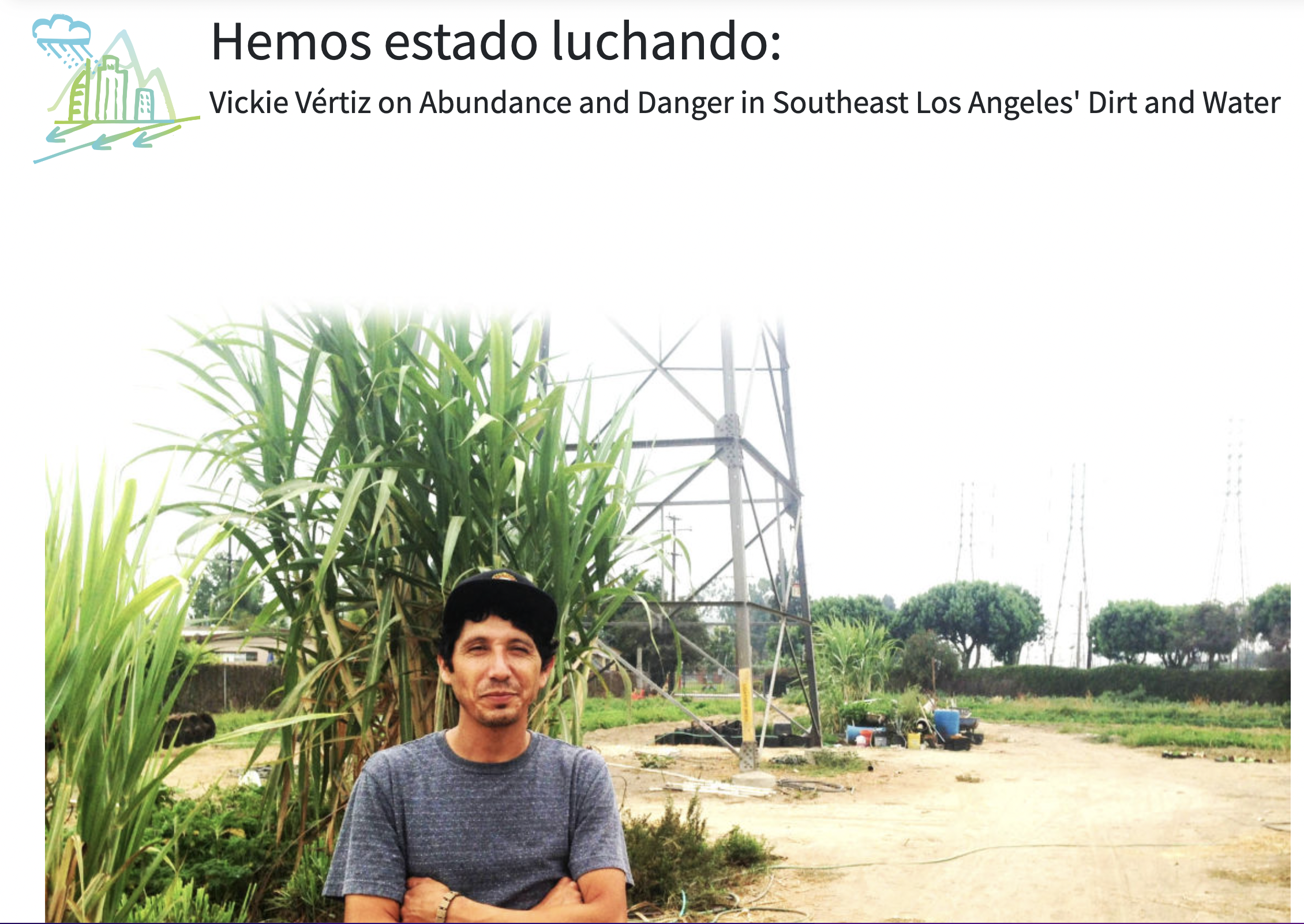
“Y el agua, Chabelita?” I asked. “How do you use it in your home?”
“Yo la cuido,” she said. “La conservo. Estamos en una sequía.”
Excited to share my latest essay on #southeastla, featuring Jose Ornelas and his son Edgar (pictured in the cover image) of Ornelas Produce, the last farmer in Bell Gardens, and on Maywood environmentalist, mother to @aida_writes and her 6 siblings, Isabel Salazar Viramontes, que en paz descanse.
An excerpt:
“The 710 Freeway exit for Atlantic/Bandini Boulevard takes you past huge warehouses and railroad tracks between the City of Commerce and Vernon, just a few blocks from Boyle Heights and East Los Angeles. The semis and eighteen-wheelers snake their way past small cars and into the broad streets. […] A few hundred feet past these giants are tens of thousands of children, mothers, grandparents, business owners, politicians, artists, and environmentalists. Isabel Salazar Viramontes can say she has been and is, many of these things. People call her Señora Chabelita.”
Check out the farmer’s market schedule for Ornelas Produce in the article. And although the piece was written a couple of years ago, all the information is still somehow timely and relevant.
Qué viva Chabelita!
Thank you to the Rivers and Mountains Conservancy and to Jane Tsong at the watershedconservationauthority for working with me.

You have to read Carribean Fragoza’s debut short story collection, Eat the Mouth That Feeds You.
Here’s a photo from that adventure. Stay tuned for the whole interview coming soon on Libros’ Youtube channel. Get a copy of his book from City Lights Booksellers & Publishers. This stunningly original collection of stories, published by City Lights Publishers, illuminates a spectrum of Latinx, Chicanx, and immigrant women’s voices. In confrontations with fraught matrilineal lines, absent or abusive fathers, and the effects of historical violence, these women and girls navigate a male-dominated world where they rely on a resilient mujer network to get them through sometimes supernatural obstacles
Thrilled to have a first feature in the LA TIMES for their literary issue and praise @avenue50studio 💗. For over twenty years, artists and writers have been supported through shows, book launches and readings. Now @jessica.ceballos @alternativefield offers publishing, advice and partnerships across LA. Like Jessica said, Poets think about problems differently. Literature and the arts are by and for everyone.
Shout outs here include @blackmanofhappiness @gloriaenedinalvarez @saenzwriter and La Palabra reading series. Read the story here.

In the summer of 2021, I interviewed Juan Felipe Herrera AKA the US Poet Laureate from 2015-17, AKA barrio forest faerie for #LibrosSchmibros in #BoyleHeights about his new book #EveryDayWeGetMoreIllegal.
Here’s a photo from that adventure. Watch to the whole interview on Libros’ Youtube channel HERE. Get a copy of his book from City Lights Booksellers & Publishers.

After months of conversations with multiple stakeholders, my article on the SELA Cultural Center is now up on KCET’s website. I am grateful to everyone who I spoke with. I hope the ideas, concerns, and hopes of the Southeast LA community come across clearly and help shape the way forward with this ambitious project.
Excerpt:
If it comes to fruition, the Southeast Los Angeles Cultural Arts Center will be located off Imperial Highway at the Lynwood/South Gate border, near the confluence of the Rio Hondo and the Los Angeles Rivers in South Gate. Its website claims that it will be “a multi-arts facility that weaves together world-class design and high-caliber programming from across Los Angeles County with the vibrant culture of the surrounding community.” This project, designed by renowned architect Frank Gehry and his firm, will have to raise at least $150 million to reach its completion goal for 2024.
The Center is actually a complex, not a single building. In an email, architect and partner Sam Gehry said the project is “envisioned as a series of buildings of various size[s].”The environmental agency leading the project is the San Gabriel and Lower Los Angeles Rivers and Mountains Conservancy (the Conservancy), specifically Mark Stanley, its Executive Officer and his staff. The project is currently in its programming and tenant selection phase. Stanley wants to hear input from residents who are just learning about the Center to get as many additional artists, community members and especially young people involved in shaping it. Decisions regarding who will own the building are also on the agenda, though Stanley noted that the ideal scenario would be a county-owned park structure, like the Ford Amphitheater.
It all sounds like a great idea: couple the talent and drive of Southeast L.A.’s artist communities with the clear need for more green space and the opportunity to capture more rainwater to build a community asset, but residents are sounding the gentrification alarm. They’re concerned that the Center will open the floodgates for additional development, including the Rio Hondo Confluence Area’s multiple, park projects, some of which are also suggested in the LA River Master Plan and in its website, which residents fear will displace everyone these projects are for. The stakes are high for Southeast L.A. cities, already plagued with high COVID cases, climbing rents, overcrowding and some of the most polluted land in the country.
Watch my short interview with Cara Santa Maria of SoCal Update to get a synopsis of the article at the link below:

The American Legion Hall Post #465 has been a gathering place for decades.
Read about the Hall’s history, the music, and the people who keep it alive here at KCET!
In the 1950s, Eddie Cochran wrote the song “Summertime Blues” while he lived in Bell Gardens on Priory Street. Revelers from all backgrounds have danced at the Hall to legendary Wanda Jackson. They’ve screamed lyrics back to iconic punk band The Zeros. Most recently, they bopped and strolled at the rockabilly party Fuss ‘n’ Holler and to songs by and the Crown City Bombers.
And if you have an event coming up, you can rent the hall from feisty Hall Manager Rita Sykes if you live in the area for less than $1000. Huge thank you to Shizu Saldamando, Commerce historian and archivist Joseph Calderon, the Cochran Club organizers, especially cartoonist and writer Rafael Navarro, Max Espinoza, Ruben Gerard, and Robert Fernandez. Que viva Bell Gardens!

Saturday, April 24, 5-6pm PST, Fundraiser reading for poet and writer Dr. Natalie Ann Martinez
With Cave Canem Fellows Maya Marshall, Kundiman Fellow Angela Peñaredondo, Bakar Wilson, CantoMundo’s Paul Hlava Ceballos, and special guests. Register below to get a link (registration is required): https://tinyurl.com/yhby4b9v
Donate below to help pay for our community member’s medical bills: https://www.facebook.com/events/3697984310256120/
Wednesday April 21, 6:30pm PST, Book release for Why to These Rocks: 50 Years of Poems from the Community of Writers by Lisa Alvarez (Editor) and Bob Hass (Foreword).
A Crowdcast event! Register here to attend live or watch the replay: https://www.crowdcast.io/e/skylit-community
Friday April 16, NACCS Conference Panel, “Queer Corazones y Palabras: Dream the Poetic Heart”
A National Association of Chicano Studies reading with Clarissa Durazo Rojas, Karina Muniz-Pagan, Cathy Arellano, and Olga Garcia. Register here for the conference: https://www.naccs.org/assnfe/ev.asp?ID=59

Join us virtually at the Association of Writers and Writing Programs annual conference!
Friday, March 5, 2021, 10 am to 11:20 am PST
Official title: F128. The Woven Verse: An Exploration of the Latinx Verse Novel in Kidlit.
Although it is a prerecorded conversation, Vickie and Aida will be present during the question and answer. AWP states that: “After the premiere, the video will be available on-demand for the duration of the conference, including one month’s post-conference access until April 3, 2021.” You must register on the AWP website for this event: awp.org
“The Woven Verse: An Exploration of the Latinx Verse Novel in Kidlit,” is a panel on Latinx novels in verse which have burst the children’s and young adult literary world open with award-winning and groundbreaking books. Join celebrated authors as they delve into the craft of writing a novel through the art of poetry as well as how their unique Latinx identity and experiences inform and nourish their work.
Moderator: Vickie Vertiz
David Bowles is an award-winning Mexican-American author, translator, and university professor from the Río Grande Valley of South Texas. His most recent books are They Call Me Güero and The Chupacabras of the Río Grande.
Aida Salazar is an author whose work explores identity and social justice. Her books include the middle grade verse novels, The Moon Within and The Land of the Cranes; plus bio picture book Jovita Wore Pants: The Story of a Revolutionary Fighter.
Guadalupe García McCall is the author of four award-winning, YA novels. She is the recipient of the prestigious Pura Belpré Author Award, a Westchester Young Adult Fiction Award, and the Tomás Rivera Mexican-American Children’s Book Award. She teaches English at George Fox University in Newberg, OR.
Elizabeth Acevedo was not able to join us, but check out her wonderful award-winning writing!

Spring 2021
Check out my essay as tribute to working class art, to those of us who didn’t see ourselves as artists because we had to earn a living otherwise. To those of us who are artists despite what anyone says. Follow @flan_jm Jaime Muñoz to witness all different kinds of apparitions of faith, memory, and beauty. Big thank you to Shizu Saldamando @saldamando who’s Instagram page introduced me to this work! And if you’re looking to write about art in ways that are not generally seen in main stream art criticism, I highly recommend you send a pitch over to Carribean Fragoza at Vicious Ladies, her new arts and culture magazine. Here’s to centering our communities, always. Support the arts and check out the “La Commute” blanket Muñoz collaborated with Fred Segal to produce. Finally, thanks to my brother @jessepaintsnow who helped me with this piece. #toyota #toyoteria #pomona #construction #rseries #toyotaminitruck #laart #chicanoart
Read the essay here, or visit:

“Sometimes, I catch myself wondering if that roll I felt under my feet is the beginning of the end. I look up from my computer and notice how my fear nearly wishes the Big One into life. I go back to writing, that other job that doesn’t end. I hope the Big One is a lie—a way to scare ourselves into being ready for the worst. Maybe the worst has already happened. I can’t tell you what that is yet.”
Read the rest at USC’s new journal AIR/LIGHT magazine.

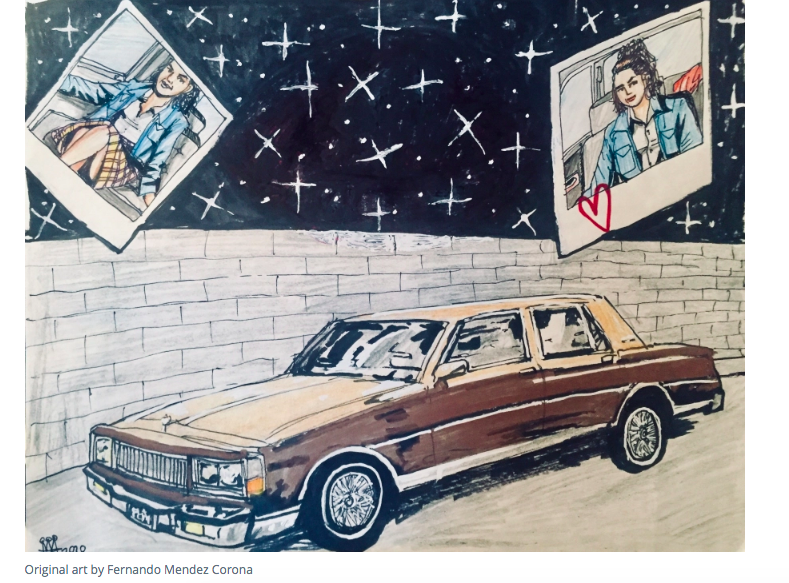
“Is it talking dirty if you’re just listening? What you see in the picture is me. Passenger Front seat. Cinder block wall behind me. I mailed it to my Romanian pen pal, me making a sexy face in my friend’s Falcon. To my right is the dustless dashboard. In the backseat is my older friend Junior. Give me a sexy look, he says. He’s taking a picture for my pen pal but it’s really for him. It’s also for me. For my other friend who’s driving. My sexy hair looks like this: a ponytail on top of my head, wavy brown cascading over to the side of my face. In my denim jacket and white button up, the other thing that sizzles is my plaid flannel skirt, one my mother made. Her hands lined my hem. The driver rolls carefully down my alley. Me, trying out my sexy look and he’s looking too. We enjoy it, watching me try. And I enjoy trying.”
Read the whole poem at BOOM:
Shout out to editors Carribean Fragoza and Romeo Guzman! And gracias to the illustrator Fernando Mendez Corona.

Where else are you going to see a Latinx Bob Ross in huaraches this weekend? And naturally, Beto RosSela (see what he did there?) will be painting pajaritos on a virtual riverbed. You can join Beto and dozens of other residents and artists as they perform this weekend for the third-annual Southeast L.A. River Arts Festival held entirely online.
The first art walk I covered in the Southeast was in 2014. On the corner of Atlantic and Gage in the City of Bell, the main stage stood proud in front of a spray-painted mural. The participating businesses included used car lots, a vintage thrift shop and a paleteria, among others. They featured grassroots organizations like Chicas Rockeras, visual art and DJs who could be seen up Atlantic all the way to Slauson. In the last three years, it’s moved from the street into the actual floor of the L.A. riverbed in South Gate, and last year, attracted nearly 8,000 visitors. Due to the pandemic, festival attendants will have to “walk around” and view art, watch modern dance and hear spoken word poetry via pre-recorded performances on the web instead.
Read the rest of the story below:
Watch the festival here!
https://www.selaartsfest.org/
Educators who are going online: this is a must read! Thank you, Icess and Jasmine for these tools.
Dear Reader,
For this morning’s post, I am addressing it to my fellow academics. My fellow friends in arms who have suddenly been told they will have to take their class online.
And they are in panic mode.
So for them, I have thoughts and ideas. Also some advice. So Reader, all of you, if you wanted to read something bookish I will have something soon. I’m working on something from AWP. But for today, let us sooth the panic.
Dear Professors, Instructors, and other Academics who have to put an online class together almost overnight,
Let me start off by saying your panic is warranted. This sucks. OMG! But, trust me when I say this, it will be okay. Completely okay. Some background:
It was 2017 and the fall semester was days away from starting. Off the coast of Texas Hurricane Harvey brewed like a tumor. When it came…
View original post 2,407 more words
Join Vickie in San Antonio at these events!
Thursday, March 5, 2020, 6pm to 7:30 pm, One Poem Festival Reading: Canto Mundo, Letras Latinas, Macondo. Where: Latino Collection of the San Antonio Public Library
A poetry reading with: Edyka Chilomé, Vickie Vertiz, Tammy Melody Gomez, Juanita E. Mantz, Kay Ulanday Barrett, John Pluecker, Sarah A. Chavez
That time when Yesika Salgado and I read two poems and talked: about how we became writers, who we’re in conversation with, and who we wish to become, and what L.A. means to us.
Shout out to the 2019 LitLit Conference sponsored by the Los Angeles Review of Books. Thanks again to Kyle Fitzpatrick for organizing our panel!


To Collage, To Carry: A Fragmented Essay Writing Workshop, Sat. 8/24, 10am-12pm
ACE Hotel, $40 per person, limited full scholarships available. Register below:
Join Vickie Vértiz and Muriel Leung in a generative writing workshop that explores collage and fragments to illustrate the unreliability of memory in the personal essay.
Memory is only as reliable as anything else, that is, not very. What does it mean to remember something in pieces? What does it mean to tell a story in pieces? For many of our communities of color, queer, femme, women, and working class people, linear narratives do not serve our stories in the best form. We are constantly bombarded by efforts to erase our histories, our most intimate bodily knowledge, and the wisdom we carry through generations of survival. If our current political moment means we are left with fragments, then how can we use fragmentation to help us put our narratives back together again?
In this workshop Muriel and Vickie will lead participants through writing exercises to help generate or shape narratives that are nonlinear, in fragments, or as some might say, broken. No prior writing experience is necessary. Join these two award-winning writers and scholars as we figure out how to tell our stories in these broken times.
Join us! All are free events.
Friday, April 19, 2019, Skylight Books, 7pm. Book release parties for Kenji Liu‘s _Monsters I Have Been_ (Alice James Books) and Heidi Andrea Restrepo Rhodes‘ _The Inheritance of Haunting_, winner of the 2019 Andres Montoya Poetry Prize.
LIBRO MOBILE. Saturday, April 20, 2019, 5-7pm. A reading celebrating Heidi Restrepo Rhodes’ The Inheritance of Haunting and Kenji Liu’s Monsters I Have Been. 220 E. 4th Street, Ste. 107, Santa Ana, Ca.
VERSES & VINO. Friday, March 1, 2019, 8pm-10pm, at Stokely’s Café and Social House, 3500 W. Pico Blvd. LA 90019
Join Vickie for a book signing and cumbia dance party pop-up with poet Heidi Restrepo Rhodes, author of The Inheritance of Haunting at AWP.
Date and time: Friday, March 29, 2019, 3-4pm
Location: AWP book fair booth 6042: The University of Arizona Press/Latinx Caucus
*
Come through for a second event! The reading is called “The Literary Citizen: SW X NW” with fabulous writers like TC Tolbert, Elizabeth Alvarado, and more to be announced.
Date and time: Saturday, March 30, 2019, 3-5pm, FREE
Location: Rev. Nat’s Hard Cidery and Taproom, Portland, just across the river from the Convention Center. Rev. Nat’s is brewing a Literary Citizen Cider in honor of the event.
Thanks to the poet and teacher TC Tolbert, my poem “Only We Make Beautiful Things Just to Destroy Them” is up at the Academy of American Poets! Click here to listen, read, and share.
It’s important for us to remember what we’ve survived, like the Bracero Program and past anti-immigrant violence, so that even in the midst of more trauma from racism, sexism, and rising fascism, we can persist and resist.
To bring me to your campus in person, or virtually, visit this page to learn more.
An excerpt:
“What’s a layer of confetti and candy compared to DDT The kind you sprayed over all our naked bodies/ We’re diamonds: hard, shiny, and we/ Get processed to go through We don’t infest, pendejo. We invest/ There goes your friend again, diving toward/ The paleta, which has to be pineapple flavor”
Recently, PEN America announced the winners of the 2018 PEN America Literary Awards for books of note for writers living west of the Mississippi River. With much excitement, I’d like to share that my collection Palm Frond with its Throat Cut was selected for the poetry award! I’m extremely moved since the book is a collection of many voices: brothers, mothers, our freeways, the land we work and live on, loves comes and gone, all of them working-class, resilient, and beautiful.
LA, this book is for all of us who make this place what it is.
The PEN America Literary Awards are juried by panels of award-winning writers, editors, booksellers, and critics. PEN America has honored many outstanding writers in literature across genre, such as children’s literature, drama, essays, fiction, poetry, science writing, and sports writing. To learn more about Pen America, visit their website.
This year, the shortlist included amazing works by:
Mary Jo Bang, A Doll for Throwing (Graywolf Press)
Henry Wei Leung, Goddess of Democracy (Omnidawn Publishing)
Danez Smith, Don’t Call Us Dead (Graywolf Press)
Thank you to judges Ari Banias, Sarah Manguso, and Ocean Vuong.
Our books will be celebrated at the 2018 LitFest Gala on November 2nd, 2018 at the Beverly Wilshire Hotel in Beverly Hills, CA. To read more about the winners, visit PEN America here.
Treat your ears and listen to some stories I have on how we can use writing to be self-determined, to be free.
I spoke to writer and creative writing professor from the UTEP MFA, Daniel Chacon this summer about how to make room and art that’s about joy and survival.
Here’s the interview from the podcast Words on a Wire, with its home base at the University of Texas, El Paso.
Disfruten and share, porfas.

Gracias KXCI 91.3 FM, public radio in #Tucson where you can listen to me and Daniel Olivas read stories about our exes, our fathers, and our neighbors on the Tucson Festival of Books panel, “Borderlands New Wave Poetry.” The discussion began with an introduction by the amazing social justice activist and consultant Sarita Gonzales.
Listen here! Con la Virginia Grise and Prof. Michelle Tellez at the Tucson Festival of Books, 2018.
Photo: Michelle Tellez.

Photo: Kency Cornejo
After dozens of amazing artists had performed, and following LA bands Quetzal and La Victoria, I got to share two poems and an excerpt from “Vete a la Chingada Party” at the first-ever South East Los Angeles River Arts Festival in South Gate, CA.
Over 2,000 people attended: babies, bike riders, punk bands, a tortoise, grandmas, my younger brother, and so many more beautiful beings.
To support the people making this work happen, visit them at @proyectovecindad on IG or at https://www.facebook.com/ProyectoVecindad/
Gracias Xitlalic Guijosa and Eric Contreras and all the SELA gang for your amazing work!!!

Photo: Oscar Magana
Absolutely beautiful review of Palm Frond by the LA Review of Books via Isabel Gomez from Umass Boston. Thank you, Isabel and LARB!!


At Entropy, Palm Frond also made the list of best poetry collections this year! This list is FIRE, gracias ENTROPY.
At Remezcla, Dr. Ruben Quesada lists Palm Frond with other titles on youth and Latinx identity in the US. The list also includes Javier Zamora, Christopher Soto (Loma), and Veronica Reyes, Reyna Grande, David Tomas Martinez, and Willie Perdomo. What an honor to be included!
Read the entire list here!
“Latinx stories add to our ongoing understanding of the human experience. Latinx culture embodies a connection to and from the Caribbean islands, Mexico, Central and South America. We live in a world that would be poorer without these complex identities.”
A story about illusion and iluciones after college graduation. “Vete a la Chingada Party“:
“I close my eyes and I’m a pair of legs in a brown satin skirt. I’m finally a college graduate, and this is my welcome home party, but my friends don’t know it yet. Yes, they’ve forgotten to call or invite me to look for records in Whittier. Yes, they hang out with Beto my ex who cheated on me, but they haven’t seen me in a miniskirt.”
Now at Rabid Oak Journal, from Cal State Bakersfield. Thank you, CSUB!
Selected by National Book Award winner Terrance Hayes for the New York Times Magazine.
“I do not know the language of that place” underscores this poem’s striking balance of ambiguity and mystery. Much is said in the white spaces, caesuras, breaks. The unpunctuated five lines of the first stanza unspool suggestively creepily. The hands in car guts have a visceral intensity. The halting final couplet prompts a pause, a silence, a reread.
Thank you Terrance and thank you New York Times. Special shout out to Matthew Zapruder for his encouragement.
From the Harriet Blog, via the Poetry Foundation:
At Bitch Magazine: In “Fierce as Fuck: The Future of Poetry Is Brown & Queer,” Soraya Membreno talks with Vickie Vértiz, author of Palm Frond With Its Throat Cut (University of Arizona Press, 2017); and Vanessa Angélica Villarreal, author of Beast Meridian (Noemi Press, 2017).
Click here to read the full interview.

From my latest article on Artbound KCET:
“The week of November 14, 2016, nearly 4,000 students from about 18 schools in the Los Angeles Unified School District participated in walkouts against the president elect’s selection. As in the 1960s and ‘70s, students gathered at landmarks like Mariachi Plaza, Lincoln Park and city hall for rallies. In photos circulated across news and social media, one student was seen holding a sign that said, ‘I can’t make my parents proud if they’re not here.'”
Read the rest of the story here. Gracias a Rafael Cardenas, Tim Toyama, Xela de la X, and Melody Soto, and of course, the curators and staff at the Vincent Price Art Museum at East Los Angeles College. Check out: Tastemakers & Earthshakers: Notes from Los Angeles Youth Culture, 1943 – 2016. The show is on view at the Vincent Price Art Museum through February 25, 2017.
Below, the Bell Gardens High School Lancer Scroll documents walkouts against the first Iraw War. (From the Vertiz family archives).


I’m gonna get right to the list in a second here, but I just want to tell you all how excited I am that all these writers are out there creating their amazing art and that publishers like Topside Press, Arsenal Pulp Press, Kegedonce Press, and Metonymy Press are putting it out into the world. […]
via Six Canadian Trans Women Writers You Should Know — Casey the Canadian Lesbrarian

Image from Anthropoid website.
A tia gives limpias and embroiders magic. A short play published in late December, “Ruda,” an experimental play inside a litany of remedios.
Many thanks to Melissa Sipin-Gabon for this opportunity.
Excerpt:
TÍA: Someone gave you mal de ojo.
CHATA: A cabron. Why?
TÍA: Why else? Because they’re jealous.
CHATA: Of what?
TÍA: Ay mija. Everything. Your godmother especially.
CHATA: (Disappointed, but not surprised) So what do I do?
TÍA: Come. [Tía walks out to her small, raised bed garden. Chata follows as Tía picks rosemary and rue stems. The light outside is bright. They walk back inside.]
We’re gonna pray.
RaceCraft: A Symposium: A[…]* genealogy to the contemporary craft movement
Barbara And Art Culver Center Of Arts, 3834 Main St., Riverside, California 92501
Free and open to the public. Limited seating. To reserve a seat, navigate to: <https://artsblock.ucr.edu/Performance/RaceCraft-symposium
Slow. Sustainable. DIY. Green. Local. Anti-mainstream. These are some of the keywords associated with the contemporary craft movement. Enabled by technology and new media, craft culture has been described as a combination of traditional artisanal craftsmanship, punk culture, and a DIY sensibility. It often positions itself as a response to the problems of globalization, hyper-consumerism and environmental degradation. Crafting is now, in the words of the maker-activist Betsy Greer, “craftivism,” a politically active site of social change.
12 – 12:10 Welcome by Sarita See
12:15 – 1 Presentation by Aram Han Sifuentes
1:15 – 2 Presentation by Marie Lo
2 – 2:30 Coffee Break
2:30 – 3:15 Hybrid reading/lecture/presentation by Vickie Vertiz
3:30 – 4:15 Presentation by Bovey Lee
4:30 – 5:30 Roundtable with all speakers and
Clare Counihan and Jan Christian Bernabe
But has “green” become the new white?
Despite its activist and inclusive ethos, the contemporary craft movement has been dominated by a neoliberal model of middle-class whiteness. Localism and lifestyle choices have become valorized as the primary modes of social change. People of color are often invisible in the craft movement, except as victims of globalization and exploitative labor practices who need to be saved by first world crafters.
RaceCraft explores crafting not as a lifestyle choice but as an effect and response to systemic forms of discrimination. In this context, being “crafty” is not just a DIY attitude and aptitude; it is an enabling subterfuge that doubles as critique, in which the constraints of production are not just aesthetic but also racial. RaceCraft seeks to situate craft within global and local histories of exclusion, colonialism, dispossession and subjugation. We have invited speakers who explore the tensions and fissures of “craft” discourse and that expose its neoliberal underpinnings. Finally, RaceCraft seeks to deepen our current conversations about craft so as to generate new frameworks for thinking about the transformative possibilities of craft, one that takes into consideration, racial justice in relation to “green” modes of sustainability, political activism and community building.
The work of the symposium speakers is featured in the affiliated online exhibition hosted by the Center for Art and Thought, co-curated by Marie Lo and Sarita See and assisted by intern Martina Dorff. To explore the exhibition, navigate to: <http://centerforartandthought.org/work/project/racecraft
Sponsored by: UCR Department of Media and Cultural Studies, Center for Art and Thought, UCR College of Humanities, Arts and Social Sciences (CHASS), the City of Riverside, & UCR Department of Ethnic Studies. Special thanks to the The Andy Warhol Foundation for the Visual Arts and the California Institute of Contemporary Arts ; and Martina Dorff.
*Deletion is the author’s. To fully claim this knowledge around resourcefulness, I insist we affirm these ways of knowing as “geneology” and not “alternative.”

Avenue 50 Studio together with Writ Large Press and
and Litmus Press present:
Writing (US)Americ(k)a(s)
October 15th | 8pm
at Avenue 50 Studio
131 N Avenue 50 | Highland Park CA 90042
Litmus Press, in celebration of two recent releases—Restless Continent by Aja Couchois Duncan and Anti-Humboldt by Hugo García Manríquez—is curating a number of readings around writing (us)americ(k)a(s).
Aja Couchois Duncan
Hugo García Manríquez
Jen Hofer
Amarnath Ravva
Vickie Vértiz
The country is a fiction, a narrative of legalese, piety, and slaughter.
The country is a positioning, its geographic bounty.
The country is a fingering of continents, a cordillera stitching the western expanse.
The country is the slip of skin on which we write ourselves: the warriors and wounded, the chained and transported, the subsequent generations of, those who cling to its mythos as if a sail.
In Friday’s print edition of HOY magazine in Los ANgeles, reaching thousands of hispanohablantes, I discussed how our working-class immigrant families loved their queer children and neighbors in a way that would not have been possible without Juan Gabriel. Read the whole story in Spanish here, page 13!
A HUGE “gracias” to translators Roman Lujan and Jen Hofer for their help in making the article sparkle like a bead on JuanGa’s Bellas Artes jacket. And to Aida Salazar for her mother’s story.
Excerpt from, “Ayudo a familias aceptar a sus hijos”
En tiempos de violencia y pérdida, hay que reconocer que Juan Gabriel hizo posible el ser gay, auténtico y amado. El poeta Eduardo C. Corral contó en Facebook cómo su papá lo aceptó cuando se enteró de que su hijo era gay: “Con los años, Juan Gabriel se convirtió en parte de muchas familias mexicanas. Sí, se burlaron de él. Pero allí estaba. En nuestros hogares. […] Se convirtió en una presencia […]. En mi casa. Esta familiaridad con ser gay ayudó que mi padre siguiera amando a su hijo.”
Su presencia en nuestros hogares se debe a nuestras madres u otros familiares, a quienes las canciones de Juan Gabriel les partía el corazón. Con letras como estas, no hay duda del porqué: “Sé que tú no puedes, aunque intentes olvidarme. Siempre volverás, una y otra vez.” Mujeres como mi mamá llamaron llorando a sus hijas e hijos, a sus hermanas y vecinas, cuando anunciaron la muerte del Divo de Juárez. “Lo voy a ir a alcanzar”, me dijo mi madre. “Lo tengo que conocer, chata.” Y así, millones de nosotros todavía lo quieren conocer. Otras llevamos flores a la funeraria de Santa Mónica donde llegó su cuerpo, a su estrella en el paseo de la fama de Hollywood, a su estatua en el Distrito Federal, pero más que nada, ponemos su música. “Háblame de ti. Cuéntame de tu vida.”
Con su tema “Te lo pido por favor” nos enseñó a ser amigos y a apoyar quienes tienen alguna necesidad. La letra dice: “¿Cómo te puedo pagar todo lo que haces por mí? ¿Todo lo feliz que soy? ¿Todo este inmenso amor? Solamente con mi vida.” La presencia de Juan Gabriel también acompañó a la gente gay que ha sido rechazada por su familia de sangre y ha tenido que que construir familias de corazón. Por ejemplo, la comerciante Chavelita, originaria de Jalpa, Jalisco, vivía en la ciudad de Maywood en los ochentas, y se hizo amiga de hombres gay y trans que conocía a través de su tienda de decoraciones. Sus reuniones eran fiestas en la sala de su casa, en la que seis hijas e hijos esperaban ansiosamente el show drag. Abundaban las boas, el lápiz de labios rojo, los tacones dorados y los aplausos. Los intérpretes se movían y bailaban igual que sus artistas favoritos, como Amanda Miguel, Donna Summer y, sí, Juan Gabriel. Las canciones de el Divo eran algo de todos los días, tanto que todos estos amigos se decían “querida”. “Ay, querida, no me digas.” “Sí, querida.” El traje de lentejuelas que Juan Gabriel estrenó en Bellas Artes y la manera en que giraba hicieron posible que un drag show ocurriera en la sala de una familia. Al mismo tiempo la existencia de gente gay y trans hizo posible que Juan Gabriel fuera siempre efervescente y luchador.

Everyone should visit the generous, lovely staff at the University of Arizona, Tucson’s Poetry Center. A tremendous thank you to: Tyler, Wendy, Laura, Julie, Renee, the two Sarahs, Aisha, generous docents Marc and Tony, and of course, the inimitable, Hannah Ensor.
Here are my selections from the stacks at the Poetry Center during my recent residency!
The Wind Shifts: New Latino Poetry edited by Francisco Aragón
A Beautiful Marsupial Afternoon by CAConrad
Troubling the Line: Trans & Genderqueer Poetry & Poetics edited by TCTolbert and Tim Trace Peterson
What I Say: Innovative Poetry by Black Writers in America edited by Aldon Lynn Nielsen and Lauri Ramey
The Poetry of Arab Women: A Contemporary Anthology edited by Nathalie Handal
The Poetics of Space by Gaston Bachelard
The Complete Poems of Jean Genet by ManRoot Magazine
Catalog of Unabashed Gratitude by Ross Gay
Night Sky With Exit Wounds by Ocean Vuong
The Service Porch by Fred Moten
The Taxidermist’s Cut by Rajiv Mohabir
Off-Season City Pipe by Hedge Coke
How the End Begins by Cynthia Cruz
Other People’s Comfort Keeps Me Up At Night by Morgan Parker
A Third Instance by Rosa Alcalá, Graig Watson, and Elizabeth Whitehead
The Lust of Unsentimental Waters by Rosa Alcalá
Undocumentaries by Rosa Alcalá
187 Reasons Mexicanos Can’t Cross the Border by Juan Felipe Herrera
Sing by Hedge Coke
Thanks to Joseph Rios, here is a sample of the open mic at Macondo Writers’ Workshop 2016 in San Antonio. It starts with Carribean Fragoza and ends with yours truly reading the MOZ fans tribute poem, “Lover’s Letter.” Much love to Laurie Ann Guerrero for all her hard work, and to Alex Espinoza and Tim Z. Hernandez for their teachings.
And of course, the beautiful Joe Jimenez writes about teaching the young writers at this link.
“I’d be lying if I said I never am starstruck, which is a wonderful idea in and of itself, that a star might strike our bodies, touch our muscles and bones, an impact on the red flesh of heart, skin and eyes that look upon the world. Scientifically, being struck by a star isn’t such a beautiful event or perhaps it is. Incineration. Going back into the nobility of the universe, its gases, its dark mass, its heat, each a possibility of scientific beauty and God. And that’s some of the wonder of Macondo – possibility. Both can exist, more. All at once.”
Photo by Macondista Xochitl Julissa Bermejo: clockwise: liz gonzalez, Tischa Reichle, Carribean Fragoza.

“Susi stopped being my best friend once she got bangs and a hickey.
Because I’ve heard her say it, I can hear her thinking: Ugh, what a wetter.
Are all your outfits from the swap meet?”
Today at Entropy, read about drama at the bus stop with a girl’s momma. Maybe it was me. You’ll never know. Big shout out to Gina Abelkopf for the chance to share.
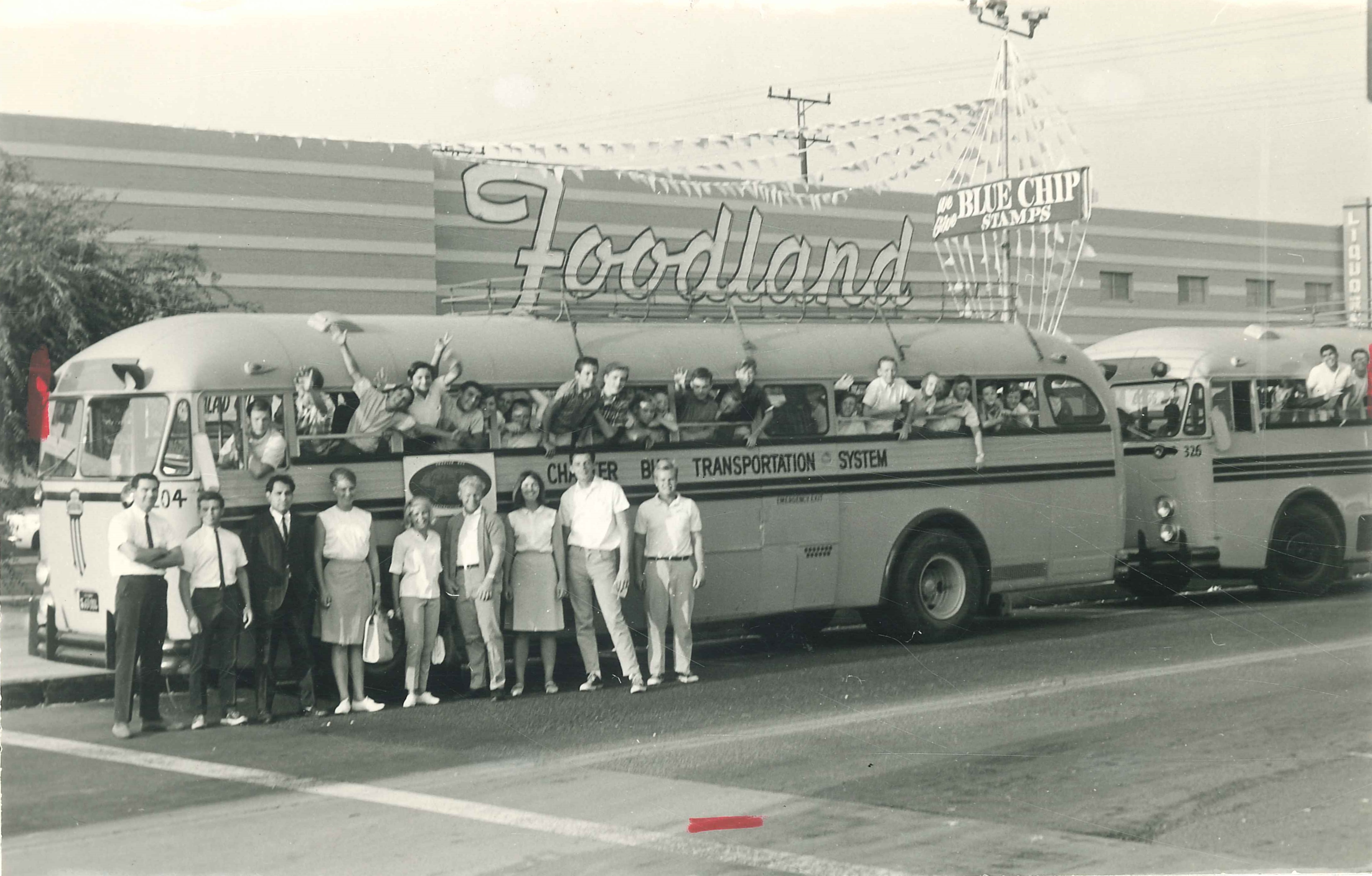
(Photo: Han Link, 1970. Corner of Florence and Eastern in Bell Gardens.The Foodland parking lot where Toys R us stands now. From the City of Bell Gardens archive.)
“— ninety thousand children crossing the border in the last three years what thirst what listening what refuge what desert harbor what desert keeps at bay what keens what dims what signals we cannot read what enforcement what filament what unmoved substrata what bleeds unregulated despite the body what will not bend will not sleep will not touch lightly with fingertip or tongue tip what we carry in a pocket radiating thudding what we lose in neglect what we lose in death what accidents build while we look the other way”
From Jen Hofer’s, “Conditions”
Read Jen Hofer ‘s poems, “Conditions” at PEN America here. I was honored to work with the wonderful Mexican poet Román Luján to translate it into Spanish as “Condiciones,” in consultation with Jen. Thank you to PEN America and TC Tolbert for publishing this work.


 Vickie Vértiz