A LIVING HISTORY BLOG.

18TH CENTURY LIVING HISTORY IN AUSTRALIA.
Showing posts with label Rangers. Show all posts

Thursday, 30 January 2020

Priming Horn Documentation Found!


Priming Horn Information.
“The priming-horn is intended to be filled with Pistol Powder, and the Ranger always to prime from it in time of action, by which method he will not be near so subject to burn priming or miss fire as He would by priming from a Cartridge, as the grain of the powder will be small and a very great fault which Men are subject to in time of action will be prevented, Vizt. That of spilling one half of their Cartridge of powder and sometimes more in priming and shutting their Pans, and when they have loaded and discharg’d their Pieces after the common method, it often happens that the Ball is not sent with half the force it is intended or anything near the distance it ought to go, which mistake will (I imagine) be avoided by the handiness of the Priming-horn, as the Men will have nothing more to do with the Cartridge than bite off the top, put it in the barrel at once and ram it down, and if the Cartridge is fill’d with Cannon powder it will have just the same effect I conceive as if fill’d with Pistol powder which will get into the touch-hole and catch fire as quick as can be wished…..” 21


End Note 21 from page 366: HL, LO6927, 13 Feb. 1758 Captain/Major George Scott, ranger captain:
Small Arms of the British Forces in America, 1664-1815, by Dr. De Witt Bailey.
My thanks to Gus for this information.
Keith.


Friday, 14 October 2016

School of the Ranger Event.


The 2017 School of the Ranger focus is "The 18th C Reconnoitering Party." The weekend event will involve a mix of lecture, hands-on, and simulated patrolling exercises designed to familiarize the participants with the skills necessary to understand all facets of the historic military specialization, as well as lend insight to future research and portrayals. Lodging in the fort, firewood and meals will be included. Registration is $60.00 and will be limited to the first 30 paid applicants.

The SOR is being co-sponsored by Jaeger's Battalion of Rogers' Rangers and the Friends of Fort Frederick. All proceeds benefit the Friends of Fort Frederick. For more information email 2017SOR@oaksedge.net or visit our website: www.rogersrangers.com

Monday, 2 December 2013

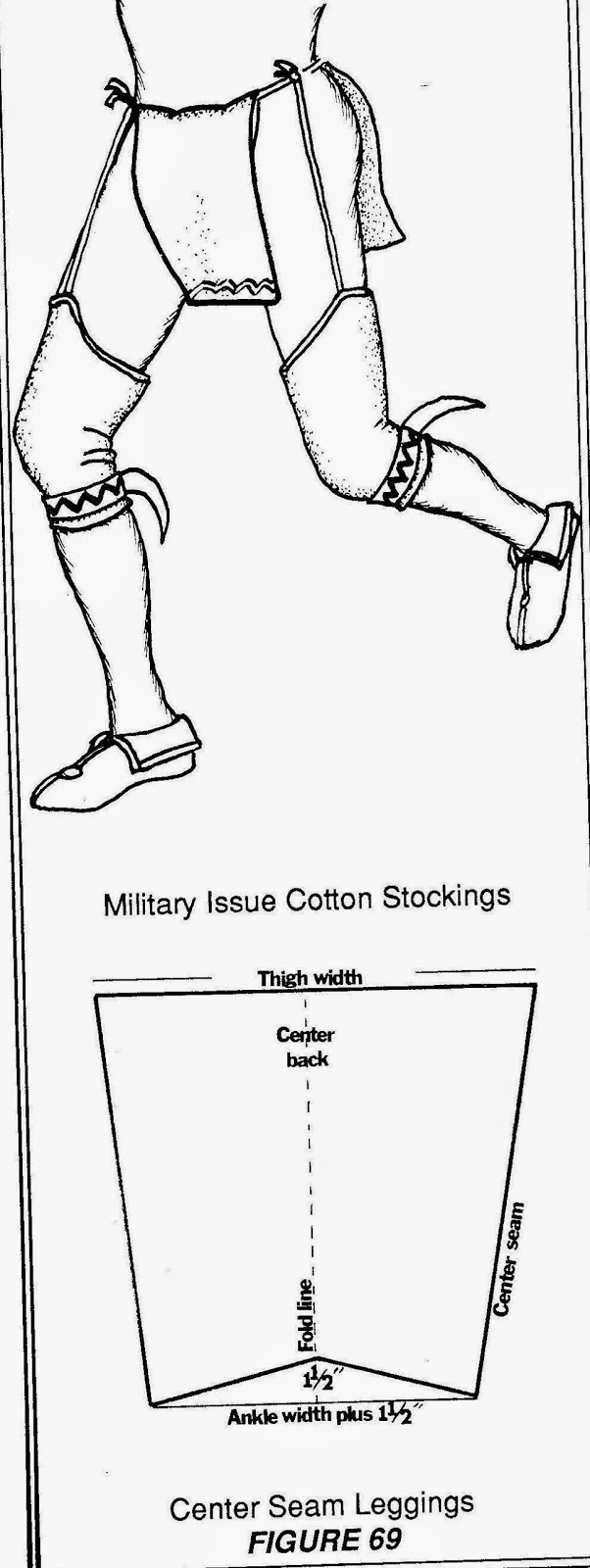
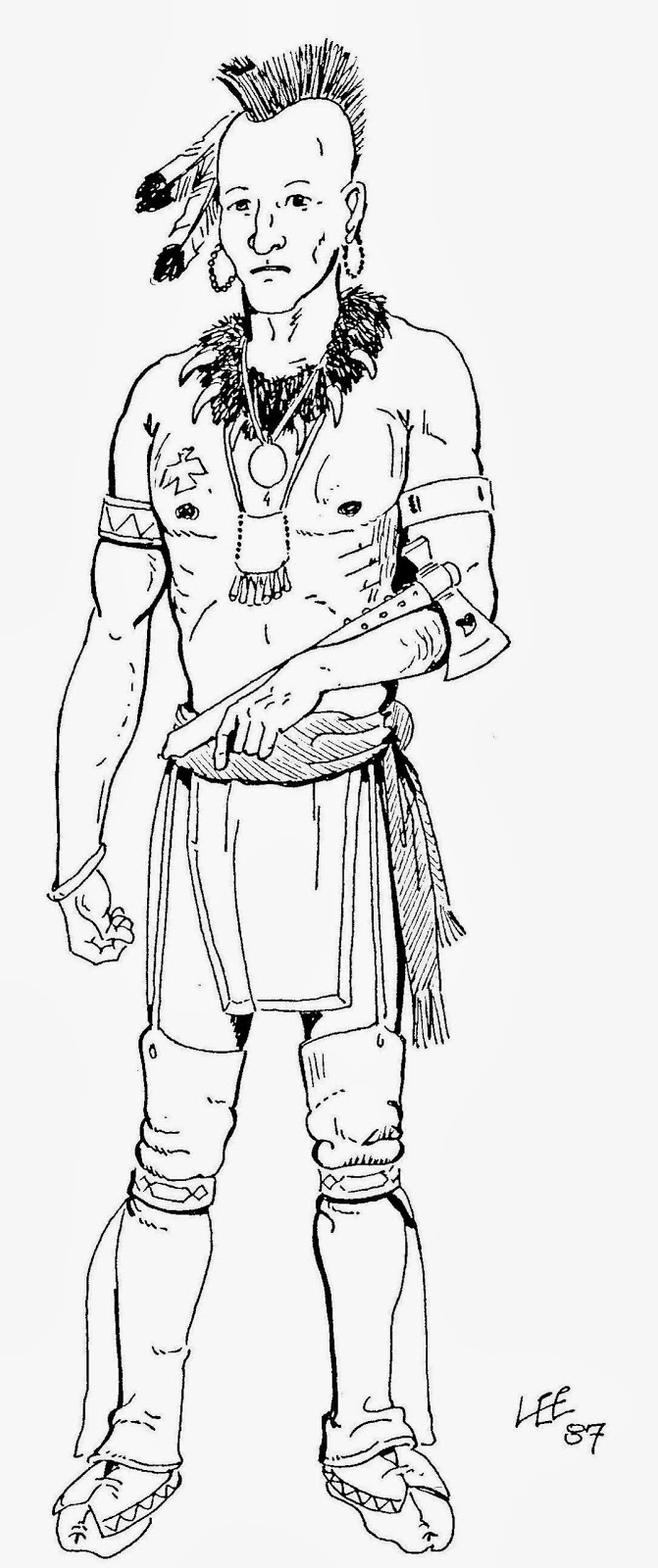
Woodland Indian Leggings By Sheryl Hartman.

I did write several reviews on this book many years ago. My copy is now an old one. The new version I believe has a new cover image. I did try many times to contact Ms Hartman, but recieved no reply, so I cannot say if this book is still available or not.
These leggings were also worn by white colonials, woodsrunners, scouts, spies & Rangers.


Author's finger woven wool garters.

Loom woven wool garters.

Author's legging garters tied at the back by the fringe.

When I made my leather leggings, I simply wrapped the leather round my leg & marked where they needed to be sewn. Then I added a little more to allow for the flap. All stitching was done with linen thread.
I finger wove and beaded my own garters. They are a plain olive green wool.

Thursday, 13 June 2013

Equipment Requirements For Our Group's Trained Band.

NEW ENGLAND COLONIAL LIVING HISTORY GROUP TRAINED-BAND.
Victuals Well Dressed By Pamela Patrick White.

Rules, regulations, & clothing & equipment requirements. 19-6-08/update 7-5-09


Rules and regulations guide.

(1)   Each train to have at least 2 archers (each archer to carry at least 1lb of gunpowder, & 1lb of lead on extended ranging expeditions).
(2)   When ranging, each column to have one archer accompanying the lead scout.
(3)   Each column to use: lead scout with archer, a rear guard, & at least one scout on each flank.
(4)   Each member to maintain a space before of at least 3 paces.
(5)   Lead scout to lead by at least 60 paces (Dependant on environment).
(6)   Rear guard to trail at 20 paces.
(7)   Flank scouts to keep column in sight at all times if possible.
(8)   Guards to be posted at all stops.
(9)   Packs are not to be removed at stops except for toilet.
(10)                       No person shall leave the column alone and must always remain in sight of the column.
Equipment for extended ranger duties in wilderness areas.

(1)   Cartridge box containing a minimum of 8 cartridges. (Fusils & muskets only).
(2)   Shot pouch & required contents.
(3)   Powder horn.
(4)   Functional firelock with hammer stall & lock cover.
(5)   Gunpowder wallet.
(6)   At least 4 lbs of gunpowder.
(7)   At least 4 lbs of lead in ball, buckshot & birdshot.
(8)   At least 12 flints.
(9)   A tomahawk/axe.
(10)                       A good hunting/butcher knife.
(11)                       A clasp knife.
(12)                       A knapsack, snapsack or rucksack.
(13)                       A haversack or market wallet.
(14)                       A good wool blanket.
(15)                       An oilcloth of suitable size to shelter one person.
(16)                       A water bottle, canteen or costrel to hold at least 1 quart (You may need to carry more than one, depending on the area you are travelling in).
(17)                       Sufficient tow or wads.
(18)                       Patch material ditto.
(19)                       Fishing kit with at least 6 hooks & 2 lines.
(20)                       Tinderbox, flint, steel & prepared tinder.
(21)                       Trade kettle or other.
(22)                       Leather inner-soles & repair leather for moccasins.
(23)                       Leather thong or cordage ties.
(24)                       Food bags.
(25)                       Sewing kit.
(26)                       Awl

(27)                       Soap & hair comb.
(28)                       Medical supplies.
Optional Equipment.
(1)   Short hunting sword.
(2)   Half-axe or felling axe
(3)   Auger

Clothing Requirements.

(1)   Felt hat.
(2)   Shirt ( plus spare wool shirt in bedroll).
(3)   Weskit (plus wool weskit ditto)
(4)   Monmouth cap ditto.
(5)   Wool mittens.
(6)   Half-blanket or capote.
(7)   Breeches or breechclout.
(8)   Neckcloth.
(9)   Stockings or socks (wool recommended for winter).
(10)                       Leather leggings with garters.
(11)                       Moccasins with extra sewn on sole plus a spare pair.
(12)                       Frock or other.


Trail Foods.
Each person to carry as much dried foods as possible. Recommended foods are:
·         Oats
·         Beans
·         Pease
·         Corn
·         Rice
·         Cornmeal
·         Flour
·         Meat (dried)
·         Sausage
·         Fruit
·         Hardtack
·         Bread
·         Biscuit
·         Hard cheese
·         Boiled beef

Optional.
Teas
Coffee
Chocolate
Spirits

NOTE: Unless otherwise requested, we will carry 6 pounds of dried food, which should last approx 6 days (you may carry more if you wish, but remember; there must be some compromise between minimum weight & maximum self-reliance).

Wednesday, 8 August 2012

Ranger Equipment & Food Rations.

"Frosts were falling
When the ranger's horn was calling,
Through the woods to Canada.

"Straggling rangers, worn with dangers,
Homeward faring, weary strangers,
Pass the farm-gate on their way.
Tidings of the dead and living,
Forest march and ambush giving,
Till the maidens leave their weaving,
And the lads forget their play."
Whittier.
 
Ranger Information 1757 as of 9/8/12
Rangers who were in uniform which consisted of a grey duffle coat and vest,
and buckskin breeches and leggings. Arms consisted of individually owned
flintlock fusils in the Rogers's Companies as well as privately owned scalping
knives and tomahawks Hobb's and Speakman's carried regulation muskets,
cartouche boxes, and wore regulation shoes from the King's stores, and were
supplied with hatchets by a contractor. Unlike the Rogers's Companies, they did not all have the Corps' most prolific weapon, the scalping knife. p.116

The Rogers's Company officers carried compasses in the large end of their
powder horns. This excellent practice was later imitated by all the officers of
Rogers' Rangers. Ammunition per man consisted of 60 rounds of powder and ball.
Provisions consisted of two weeks' supply of dried beef, sugar, rice and dried peas
and corn meal. The food rations were carried in a knapsack strapped over the
shoulder.
Rogers had allowed small fires to be built in the heavy part of the woods, in
pits about three feet deep. The coals were now rekindled and the Rangers quickly
made themselves gruel of cornmeal, which was washed down with rum from their wooden canteens.
 Transcribed by Janice Farnsworth. (Edited for script mistakes by Keith H. Burgess.)


Tuesday, 31 January 2012

A Ranger's Shot Pouch.

This shot pouch belonged to a very dear and close family and personal friend. When he died some years ago he left me his shot pouch and my youngest son adopted it. It is larger than the average rifle pouch because it seviced a Brown Bess musket. Now it is used with my .32 calibre flintlock Mountain rifle.


Tuesday, 20 December 2011

French & Indian War Goodies.

"Thirdly. That four or five hundred pairs of good Indian shoes be made ready, fit for the service for the English and Indians, that must improve the whale boats and birch canoes; for they will be very proper and safe for that service. And let there be a good store of cow hides well tanned, for a supply of such shoes, and hemp to make thread, and wax to mend and make more such shoes when wanted, and a good store of awls."
More good info at the site below:


Saturday, 12 November 2011

Carrying The Tomahawk[trade axe].

My thanks to Elmo for asking about the carrying and safety aspects of tomahawks. As far as the covering of blades is concerned, I think it was a personal choice based on experience. I told Elmo about the trapper who slipped on ice and fell on his tomahawk which had no blade cover and was carried under his belt. The blade cut his hand off as he tried to break his fall.

The typical and most common way for a woodsrunner to carry a tomahawk. This woodsman has removed the blade cover because he is using his tomahawk to construct a shelter.

Again, you can see the tomahawk through the back of my belt with a linen cloth cover on the blade. My half-axe is secured under the ties on my blanket roll.

This tomahawk frog belonged to a close friend of mine who went under some years ago. His persona was that of an ex Ranger and no longer needing to carry a bayonet for his Brown Bess musket, he ellected to make this frog to just carry his tomahawk. This shows my wife's belt axe in the frog.

This is the type of frog carried by some Rangers and light infantry.


This mid 18th century carrier is home made and designed to carry under the arm with the strap over the shoulder.

This I believe is a copy of an original late 18th century tomahawk blade cover. I would not take this to be one of common usage.