A LIVING HISTORY BLOG.

18TH CENTURY LIVING HISTORY IN AUSTRALIA.
Showing posts with label bags. Show all posts

Wednesday, 22 January 2020

Belt Bag, Shot Pouch & Cartridge Box Primary Documentation.

Bag, pouch, belt bag, belt pouch.

Shot pouch, shot bag.

Cartouche box or cartridge box.
Shot bag or shot pouch for goose shot.

Large shot pouch or shot bag for bird shot.

Ball bag or ball pouch for ball.

Small shot bag or shot pouch for bird shot.


For those of you who may be confused with the different names used to describe a pouch or bag, the simple fact is that in the 18th century they used these terms interchangeably, just as we do now, so you could have a shot pouch, or a shot bag, or even a ball bag or a ball pouch & they may or may not be all the same thing!


Shot Pouch Documentation.

SHOT [fcfcot, Du.] the going out or reach of a Bow, Gun, Jjr. as far as it can carry ; all Sorts of Bullets for Fire t Arms.
CARTOOSE  [ Cartouche, F. ] CARTOUCH , CARTRIDGE ] A charge of powder put into a Paper Cafe, exactly fitted to the Muzzel of the Gun, O"c.
BAG [Bcljje, Sa\. En>^a, L.] a Sack oc Pouch.
POUCH [Pocca, Sax. Pochette, ?.] Bag or Purie.
BELT [Belt, S**.] a Girt to hang i Sword by : A Ho a Difcafc in Sheep.
BOX [Boxe, SaK.} a wooden Cheft or )ffcr. BOX [of Bofejieop, Sax.] the Wood of the Box-tree.
CASE  a little Box, or Covering to put any thing in.
\ BALL fjl&al, Beln."] any round thing.
18th century dictionary.

Belt Bag or Belt Pouch Documentation.

BAG.
16th century term for the girdle pouch.
The Dictionary of Fashion History
By Valerie Cumming, C. W. Cunnington, P. E. Cunnington

BAGS AND PURSES IN 16TH CENTURY GERMANY
Tasche or Beutel are the German words for bag or purse, and when looking at artwork from 16th c Germany there are lots of purses to be seen on men, women and children. Small ones, big ones, hanging low from belts, others securely fastened to the belt.
BAG  a Sack or Pouch.
POUCH  Bag or Purse.
BELT [Belt, S**.] a Girt to hang a Sword by : Also a Difeafe in Sheep.


Thursday, 11 July 2019

Trail food bags & containers.


Trail Food Bags & Containers.
 "I have travelled with neere 200. of them at once, neere 100. miles through the woods, every man carrying a little Basket of this [Nokehick] at his back, and sometimes in a hollow Leather Girdle about his middle, sufficient for a man three or foure daies. With this readie provision, and their Bow and Arrowes, are they ready for War, and tra∣vell at an houres warning. With a spoonfull of this meale and a spoonfullof water from the Brooke, have I made many a good dinner and supper."

A KEY into the LANGUAGE OF AMERICA By Roger Williams  1643. 
https://quod.lib.umich.edu/e/eebo/A66450.0001.001?rgn=main;view=fulltext

 If their imperious occasions cause them to travell, the best of their victuals for their journey is Nocake, (as they call it) which is nothing but Indian Corne parched in the hot ashes; the ashes being sifted from it, it is afterward beaten to powder, and put into a long leatherne bag, trussed at their backe like a knapsacke; out of which they take thrice three spoonefulls a day, dividing it into three meales. If it be in Winter, and Snow be on the ground, they can eate when they please, stopping Snow after their dusty victuals, which otherwise would feed them little better than a Tiburne halter. In Summer they must stay till they meete with a Spring or Brooke, where they may have water to prevent the imminent danger of choaking. With this strange viaticum they will travell foure or five daies together, with loads fitter for Elephants than men. But though they can fare so hardly abroad, at home their chaps must walke night and day as long as they have it. They keepe no set meales, their store being spent, they champe on the bit, till they meete with fresh supplies, either from their owne endeavours, or their wives industry, who trudge to the Clam-bankes when all other meanes faile. Though they be sometimes scanted, yet are they as free as Emperours, both to their Country-men and English, be he stranger, or neare acquaintance; counting it a great discourtesie, not to eate of their high-conceited delicates, and sup of their un-oat-meal'd broth, made thicke with Fishes, Fowles, and Beasts boyled all together; some remaining raw, the rest converted by over-much seething to a loathed mash, not halfe so good as Irish Boniclapper.
Chap. VI.
Of their dyet, cookery, meale-times, and hospitality at their Kettles.
The Project Gutenberg EBook of New Englands Prospect, by William Wood Wood's New England's Prospects 1634.

Sunday, 19 March 2017

Havresack/Snapsack. More Images.

Jacques Lagniet (French, 1620–1672)
Tel fait la faute qu'un autre boit [One makes the mistake, another drinks it]
Etching bound in a collection of proverb etchings published by Lagniet, ca. 1660
Print Collection, Kennedy Fund.


French soldiers near the town of Grey in Franche Comte, during the Dutch War. 1690 after Van Der Meulen.


Sortie de la garnison de Gand, le 12 mars 1678.

By Vernet, 1754.

I have no info on this one but looks to be 17th century.


Travelers By The Well By Andries Booth, 1635-41.


Netherlands. 17th century. War-Scene By Sebastian-Vrancx.


Sebastian Vrancx - Plünderung eines Dorfes. 17th century Netherlands.


I find these images very interesting as they show the snapsack being used in conjunction with a backpack.
A Village Kermesse, Netherlands 17th century By Sebastian Vrancx.

Unknown artist 1745-46

Author's linen snapsack with the strap sewn to the bag at both ends. Closer is achieved using a leather tie.

The snapsack from what I can see in period paintings comes in a variety of sizes and the carry strap can either be sewn to the bag both ends, or it can be attached with some form of tie such as cordage or leather.


Wednesday, 27 April 2016

More on Food Packaging.

A Firkin.


In the 18th century bottles, jars & cloth bags were popular items for containing a variety of foods, spices & drinks. Bottles in particular have been found at many historical sites, & it is known that they were reused for containing a variety of liquids. 
It seems that commercial sales of foods stuffs was in bulk form, suggesting that the retail purchaser would supply their own containers for the amount they wished to purchase, but also money was offered by some businesses for bottles, suggesting that some retailers offered these bottles to customers.
Some of the author's items for repackaging food & drink products.

Below is a record of commercial 18th century food & drink containers. This information is from a PDF, the link to which I have supplied. This PDF contains much more information, including containers from the 19th century, & images of original containers.

Food & Drink Packaging.
Olive oil sold in flasks and jars is an example of this product/package link.
mustard in quarter-pound bottles, pickles in quart bottles, olive oil by the jar or chest.
Kegs were used for dried goods such as split peas, barley, crackers, oatmeal, raisins, and rice; for butter, lard, or paint oils; for pickled meats and other pickles; sometimes for alcohol and sometimes for other packaging:
Hogs Lard in small kegs from 20 to 28 lbs. each (QG 26 May 1785:Richard Dalton).
Barley in 50 and 25 lb cags (New-York Mercury [NYM] 26 Jan. 1761:John Alexander and Company).
Best Nantz Brandy in 8 and 4 Gallon Kegs (NYM 3 Aug. 1761 :Dirck Brinckerhoff).
Choice French Brandy in Kegs of 5 and 6 Gallons, at five Shillings Halifax per Gallon (QG 20 Dec. 1770:John Lees). Linseed oyl in 10 gallon cags (NYM 12 Jan. 1761:Isaac Man).
 7 Kegs Mustard in 1-4 lb. bottles (Montreal Herald [MH] 22 Jan. 1820:Macnider, Aird, & Whyte).
Chocolate by the Box or Dozen (NYM 1 June 1761:John Morton). A few boxes fresh Durham flour mustard, (NSG&WC 30 June 1789:s. Hart).
 lb. bottles A very fresh, excellent Kind of Poland Starch and Hair Powder in Boxes of Cwt. each in Pound papers (NSG&WC 24 May 1785:David Fergusson).
fine Genoa Vermacelli, at 1s. a Pound, or 14s. a Box, containing seventeen Pounds (DA 14 Dec. 1739:Joseph Carbon).
Lemmons by the Box, Hundred or Dozen (Boston Gazette & Country Journal [BG&CJ] 14 March 1774:Joseph Hall).
bohea tea by the box, dozen or single pound (NYM 23 June 1755:Matheus Sleght).
Bags held dry products such as bottle corks, biscuit, flour, coffee, and sometimes ginger, pepper, snuff, and cocoa nuts.
Cheshire Cheese by the Basket or Single Cheese (NSG&WC 14 June 1785:Edward Oxnard).
Gloucester Cheese by the Basket or smaller quantity (NSG&WC 23 Feb. 1779:Andrew Thomson).
bohea and congo teas, pound, half and quarter pound tin cannisters (NYM 4 Oct. 1762:Richard Curson).
He has likewise a parcel of fine green tea, in pound canisters, at 14s. a canister (NYM 29 Dec. 1766:Edward Agar).
Portable soup, of the best Sorts, made separately from Beef, Veal, Mutton, and Chicken, is sold at 4s. a Dozen in Tin Boxes, which is about equal to 8s. a Pound, excepting the Chicken. Also an inferior Sort made into square Cakes from Beef, is sold by Weight at 5s. a Pound, very handy for Sauces as well as Soups. . . . This Commodity has been made, ever since the late Rebellion, by Mrs. Bennet (whose Name was then Du Bois) and it was at that Time, and ever since, greatly valued by Gentlemen in the Army (DA 11 Sept. 1762:Portable Soup.
Naples soap, at 5s a pot, Containing eight ounces (DA 31 Jan. 1740:Joseph Carbn). A Fine parcel of New Honey, of this year’s collecting in glazed Pots, leather’d on the Top, and in Pots from 15 lb. to 35 lb. and to be sold as follows: Single Pots at Fourpence Halfpenny per Pound, and at Forty Shillings per Hundred; and some Allowance to those who take a larger Quantity (DA 17 Sept. 1762:To be Sold at the Windmill . . . ). Potted Venison in small Pots at Six-pence per Pot (DA 29 July 1760:To be Sold, Fine true Grass fed Venison . . . ).
Lately landed a curious Parcel of Bloom Sun Raisins, much finer than any in the Jars, in small Boxes about 12 Ib. each, to be sold by the Importer . . . at 7s. a Pound. No less Quantity than a Box (DA 4 Jan. 1762: Lately landed.
Twenty Jars of very fine Lucca Oil, each Jar containing about thirty Gallons, one Jar in each lot (DA 21 NOV. 1739:To be soid by Auction.
 Fine Lucca Sallad Oil, neat as imported, in whole Jars, Half-jars, and Quarter-Jars (DA 23 May 1740:To be Sold . . . ).


Monday, 9 November 2015

Carrying Water in The 18th Century. Glass Bottles.

Carrying Water in The 18th Century. Glass Bottles.
To date I have found no evidence that glass bottles or saddle flasks were ever carried in a leather harness. Leather, wooden & ceramic water bottles with built in loops for straps & cordage are well known, but not so glass bottles. This is not to say that no one ever attached cordage or leather to a glass bottle in order to carry it slung from the shoulder, only that no primary documentation of this has been found to date. 
Glass wine bottles are believed to have been reused as water bottles & for carrying vegetable oil, but I must assume that these were either carried in the hand, or they were carried in a pack such as a knapsack, haversack, snapsack or market wallet. The name “saddle flask” given to a certain type of flat sided glass bottle suggests that it was carried in saddle bags or packs.
Pennsylvania German wooden costrel with strap lugs.

Leather costrels with carry strap lugs dated 1730.

A ceramic water bottle with carry strap lugs, 1601-1700 ad.

18th century wine bottle.

A 16th century glass costrel covered in embossed leather. This one I would have expected to have leather carry strap lugs included, but no sign that I can see. Research continues on this one.

American 18th century leather covered saddle flask.

18th century saddle flask.

18th century leather saddle flask with what appears to be a leather carry strap attached that has been folded & pushed into the spout.


One of two modern glass bottles the author covered in leather to replicate saddle flasks.


The author’s haversack that he may use to carry his two saddle flasks.


The author’s knapsack with his market wallet secured under the flap closure. A water bottle or flask could also be carried in this market wallet & one in the knapsack, but they would not be easily accessible on the trail.


The author’s snapsack. If the top were to be left untied, then this too would be a good way to carry water bottles or flasks.


Early American glass. The first factory in what is now the United States was a glass plant built at Jamestown, Virginia, in 1608. The venture failed within a year because of a famine that took the lives of many colonists. The Jamestown colonists tried glass making again in 1621, but an Indian attack in 1622 and the scarcity of workers ended this attempt in 1624. The industry was re-established in America in 1739, when Caspar Wistar built a glass making plant in what is now Salem County, New Jersey. This plant operated until 1780. http://www.texasglass.com/glass_facts/history_of_Glass.htm


Saturday, 23 August 2014

Load Carrying Methods For Women.

Any pack or bag method used by men can also be used by women, but here are some images specifically of women carrying baggage.
Cordage and knots. 16th century.

Daniel Chodowieki 1764
ERHARD SCHOEN . LANSQUENET AND WIFE, C. 1535
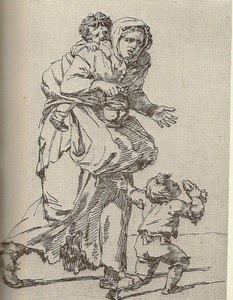
French, 18th century.
Woman with large market wallet.
Author's medium sized market wallet made from linen cloth.
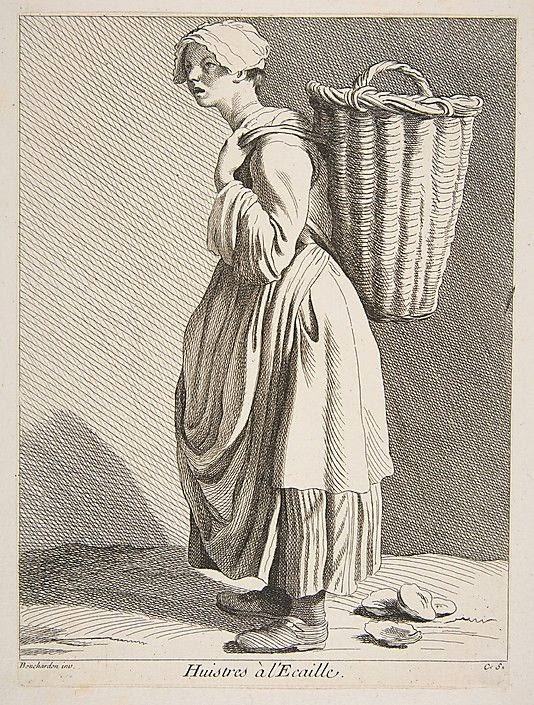
Oyster Seller using a pack basket, 18th century.
16th century camp follower.
Jacobites by Paul Sandby 1760.
A wood carrier using a pack frame.
Woman with pack basket. Attr. Basilius Grundmann 1726-1798.