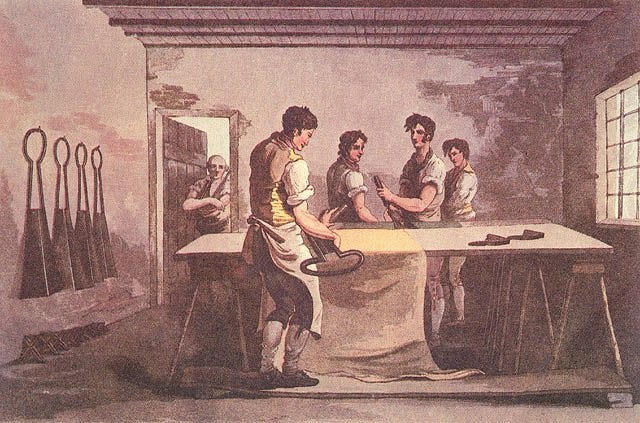
Waterproofing ingredients for oilcloth.
2.2.1 Drying Oil Recipes
A source from 1758 describes the
preparation of drying oil (mainly intended for “coarser work”) as involving
boiling or simmering the oil in conjunction with a variety of driers used at
once, including litharge, white lead, red lead, lead acetate, and sulfate of
zinc (Dossie
1758, 148–49). Reports on the color of these early drying oils indicate
that they could be very dark: “a good drying oil is not to be had of them [the
colormen], what they furnish us with being so highly colored as to be improper
for the purposes of fine painting, and only can be admitted in the darkest
shades or back grounds” (Williams
1787, 25). By contrast, recipes provided in the artists' oil painting
instruction books were largely directed toward the preparation of a drying oil
that would be as colorless as possible; these tended to include only one type
of drier.
One of the preferred methods was to use
metallic lead, either by agitating the oil with lead shot or by “grinding” the
oil with a leaden pestle in a lead-lined mortar. Prolonged storage in a leaden
vessel was also recommended. Litharge (and very occasionally white lead) was
sometimes substituted for metallic lead and used in a similar manner. For
example, Rembrandt Peale's method was to add 2 tablespoons of litharge to and
8-ounce phial which was then filled with linseed oil. It was to be kept exposed
to the sun or near a fire for a few days and shanken frequently (Sully
1873, 33).
Litharge was available in two varieties:
silver and gold. Silver, or yellow litharge, was heated higher and was reported
to be a harder material than the gold, or red litharge. Field
(1841, 108) recommended the silver over the gold because it was more highly
oxidized and would therefore make a more effective drier. Sources warned that
litharge was often contaminated with iron or copper oxides and noted that it
contained significant amounts of silica as an impurity. Although it appeared
frequently in drying oil recipes, litharge was not recommended to artists for
use by itself (to be added directly to the colors on the palette), and it was
not listed as a separate article in the colormen's catalogs.
The earliest recipes for drying oils in the
sources consulted contained the highest proportion of driers to oil. In later
publications, the ratio of 1 part drier to 8 parts oil or 1 part drier to 16
parts oil became more common. The preparation of drying oil was dangerous
because of the risk of fire and required skilled workmen to achieve a
consistently high-quality product. Judging from orders for both oil and driers,
it appears that Roberson's prepared its own drying oil between 1830 to 1853.
Sometime after, the firm consistently purchased drying oils ready-made.
OIL PAINTS
Linseed oil, obtained by crushing flax, was
the most important oil for use in oil paints. Its rather yellow colour was a
drawback, and for more delicate shades other more expensive oils, like walnut
or poppy seed, were sometimes used. These are all 'drying oils' - they absorb
oxygen from the atmosphere to form a hard flexible film. This reaction could be
accelerated by the addition of driers, notably litharge or lead monoxide, to
the linseed oil. Grinding white lead (basic lead carbonate) with linseed oil produced
a mixture called 'lead soap', which was an outstandingly flexible and adhesive
coating. It also had excellent opacity, or covering power, whilst many other
white pigments, such as chalk, became almost transparent in oil. White lead
also helped the linseed oil to dry, unlike some other pigments, such as
lampblack, which slowed the drying process.
White lead had been known since antiquity
to be the best white pigment available for use with drying oils. It was made by
suspending sheets of lead metal over vinegar in covered pots. These were then
laid in a dung heap to keep warm for several weeks to allow the fumes from the
vinegar to react with the lead. After removal, the white lead powder (lead
carbonate) which formed on the surface of the sheets was ground to a fine
powder. This was called the Dutch or stack process and was used until the late
19th century when the more efficient chamber process was developed.
The white lead was originally ground with
the linseed oil by hand using a Muller and Slab, then later by machines such as
cone mills or edge runners driven by horse or steam power. Paints typically
contained over 80 per cent white lead with the balance made up of the linseed
oil binder and turpentine as the solvent. The balance between these two dictated
the properties of the paint. More oil than turpentine gave a well-bound but
glossy paint that was more resistant to the weather, and was suitable for
outside and inside use; more turpentine than oil gave a matt finish that was
suitable for indoor use only.
To make a Composition for rendering Canvas,
Linen, and Cloth durable, Pliable, and Water-proof. To make it Black. First,
the canvas, linen, or cloth is to be washed with hot or cold water, the former
preferable, so as to discharge the stiffening which all new canvas, linen, or
cloth contains; when the stiffening is perfectly discharged, hang the canvas,
linen, or cloth up to dry; when perfectly so, it must be constantly rubbed by
the hand until it becomes supple; it must then be stretched in a hollow frame
very tight, and the following ingredients are to be laid on with a brush for
the first coat, viz., 8 qts. of boiled linseed oil, 1/2 oz. of burnt umber, 1/4 oz. of sugar of
lead, 1/4 oz. of white vitriol, 1/4 oz. of white lead.
The above ingredients, except the white lead, must be ground fine with a small quantity of the above-mentioned oil, on a stone or muller; then mix all the ingredients up with the oil, and add 3 oz. of lampblack, which must be put over a slow fire in an iron broad vessel, and kept stirred until the grease disappears. In consequences of the canvas being washed and then rubbed, it will appear rough and nappy; the following method must be taken with the second coat, viz., the same ingredients as before, except the white lead; this coat with set in a few hours, according to the weather; when set take a dry paint-brush and work it very hard with the grain of the canvas; this will cause the nap to lie smooth.
The third and last coat makes a complete jet-black, which continues its color: Take 3 galls. of boiled linseed oil, and ounce of burnt umber, 1/2 oz. of sugar of lead, 1/4 oz. of white vitriol, 1/2 oz. of Prussian blue, and 1/4 oz. of verdigris; this must be all ground very fine in a small quantity of the above oil, then add 4 oz. of lampblack, put through the same process of fire as the first coat. The above are to be laid on and used at discretion, in a similar way to paint.
CYCLOPEDIA OF PAINTING
To Make Gold Size. Take Gum Animi,
Asphaltum, of each 1 ounce, minium litharge of gold and umber, of each %
ounce, reduce all into a veryfine powder, and add to them, of linseed oil 4
ounces, of drying oil 8 ounces, digest over a gentle fire that does not flame,
so that it may only simmer and bubble up, but not boil, for fear it should run
over and set the house on fire.
Keep constantly stirring with a stick till
all the ingredients are dissolved and incorporated, and do not leave off
stirring it till it becomes thick and ropy, and is boiled enough, let it stand
till it is almost cold, and then strain it through a coarse linen cloth, and
keep it for use. To prepare for use, mix with oil of turpentine during heating,
and strain again, add vermilion, and thin as required with turpentine. http://www.forgottenbooks.com/readbook_text/Cyclopedia_of_Painting_1000230154/405
Litharge is pure lead and when boiled with linseed
or Walnut oil creates what is called black oil. Carbonate of lead contains
moisture which is forced out by the heat. The lead fumes are poisonous and the
oil becomes poisonous.
Lead is rusted and becomes white ( flake
white). When burned again it becomes red oxide (used in painting barns). When
fired again it has the look of a light gray, thus Litharge of silver, when
fired again it becomes a soft yellow in colour,(Litharge of gold). When
Litharge of gold is mixed with one of the above oils and heated between 180 and
200 degrees centigrade the oil begins to smoke and turn brownish. The litharge
at 150 degrees begins to turn into scrap and sticks to the spatula. At
210 degrees the deposits soften and mixes with the oil. At 250 the lead is permanently
suspended in the oil and the colour is of clear brown coffee. It is the black
oil developed during the 1400 century. I can't caution you enough about the
danger of lead poisoning.
"The cloth was water-proofed by coating it with a boiled linseed and
"litharge of gold" After several coats of the oil preparation
were dry, the cloth was well sealed and remained flexible." 1758.
Waterproofing
By Gene Hickman
Manuel Lisa Party - Montana Brigade
Whether you make or purchase a haversack or
knapsack you may want to waterproof them. One easy method is to impregnate it
with beeswax. This also works well for any light cotton canvas, hemp or linen,
such as used in tinder bags, meat bags, etc. You will need:
Beeswax
Old paint brush
Empty disposable butter tub
Newspapers
Old iron or hair dryer
Spread your haversack on several layers of
newspapers to absorb spilled wax. Place beeswax in butter tub and heat in
microwave oven until melted. “Paint” the melted wax on the haversack with the
paintbrush. You can reheat wax anytime as it starts to harden again. Try to get
wax to soak in the seams. It will look really ugly, but don’t give up. Now take
the old iron and start to iron the wax into the material or apply heat with the
hair dryer. You can use a new iron, but you don’t have to clean an old one. Good
idea to ask wife first. The hot iron or hair dryer melt the fabric and it will
start absorbing it. Continue until you have covered the entire bag. It will
darken linen bags and give it a good old time look. As you use the item you
will get lighter colored creases in the fabric, which makes it only look
better. I have also mixed a small amount of bear grease with the wax. On white
canvas the wax will give the material a yellow look, so if you add some artists
acrylic colors (burnt umber, brown, etc.) it will darken the fabric and give
you a more satisfactory look.
Another waterproofing method, which can be
used on packs, haversacks, ground cloths, trail tarps or tents, is to put a
pound of beeswax in a quart of turpentine and paint it on. You have to heat
both of these and mix them hot. A very hazardous procedure as they are both
flammable. Some also add hot linseed oil to the turpentine beeswax mix. Then
you wait for all of the turpentine and/or linseed oil to evaporate.
Donald Jackson's book "Letters of the
Lewis and Clark Expedition and Related
Documents,” contains an invoice from Mr. Richd. Wevill, dated June 15, 1803 in which he bills the government for:
Documents,” contains an invoice from Mr. Richd. Wevill, dated June 15, 1803 in which he bills the government for:
107 yds of brown Linen
46 1/2 yds of (Russia) Flanders sheeting
10 yds of 7/8 Country Linen
Oiling all of the linen and sheeting and
making the brown linen into 8 tents and the Russia Sheeting into 45 bags.
If you want to paint a haversack, pack,
sail cloth or tarp, the most common “period paint” was called Spanish Brown.
"Spanish Brown," which is red iron oxide paint, was one of the most
common colours of oilcloth in the 18th and 19th century frontier. This was
linseed oil with iron oxide mixed in it. It was commonly used to waterproof
tarps, military packs and to paint wood. Use boiled linseed oil and powdered
iron oxide (an earth pigment). Iron oxide comes in a variety of shades from a
yellow to a deep rust brown. The colour depends on the purity and temperature
the earth was heated too, either
geologically or artificially. These “earths” are all used in making
pottery glazes, and can be bought at pottery making shops or suppliers. The
iron oxide seems to act as the filler, filling the pores in the fabric, and it
is important in the process.
To make it simply mix iron oxide in linseed
oil. It can be mixed at about 1 – 1 ½
cups iron oxide per quart of linseed oil. Other formulas call for 3 cups
iron oxide per 2 quarts of linseed oil and 4 cups per 3 quarts. I have just
“eye-balled” the mix to what looked good and it was thick like a thick latex
paint. It can take several weeks for the linseed oil to dry out on wood and
fabric. The higher the humidity and the lower the temperature, the longer the
drying time. Drying time in some areas can be several weeks and it will still
be “tacky.” If you lay the fabric flat as described below you’ll have to paint
a side and let it dry before painting the other side. However, if you hang the
item to dry you may paint a side, flip it and then paint the other side. The
drying process can be speeded up, by adding some “Japan Dryer”. The fabric will
often be “tacky” after drying. You can take something like a pumice stone and
rub off the tackiness. This seems to work better if it is dried in the shade
rather than direct sunlight.
Linseed oil is highly flammable and rags or
papers saturated with linseed oil can spontaneously ignite. Do this project
outside and dry out all rags etc. before throwing them away.
There are also several paints on the market
called “American Pride Brand” barn paint in flat red (sold by Hardware Hank)
and Van Sickle red barn paint (sold by ACE Hardware), these may also be
obtained at a farm co-op or a well stocked paint store. The only ingredients
are boiled linseed oil, red iron oxide, and calcium carbonate[lime]. The
calcium carbonate works as a dryer. Spread out your canvas and paint the one
side and allow to cure. Flip it over and paint the other side and allow it to
cure. If needed you may flip it back over and apply a second coat to the first
side. This process takes days to allow the coats to dry. Several thin layers
are better than thick layers of paint. I have had pieces of canvas painted with
the homemade linseed oil and iron oxide mixture, and another with the Van
Sickle barn paint. They are indistinguishable in color and texture. The barn
painted canvas does seem to be lighter. These sample pieces have both been
hanging outside in a tree for almost 2 years and look as good as the day I hung
them up.
Iron oxide can also be purchased at art
supply stores and some paint or hardware stores. I get mine from the Archie
Bray Clay Business, http://www.archiebray.org/business.html,
in Helena, MT, where they carry it by the pound. You can e-mail, call or go by
the Archie Bray foundation to get some. It runs about $1.50 a pound when I
checked last. The iron oxide they carry will be from an ochre yellow to a
reddish brown, depending on the purity and its origin. All work fine.
Oiled Umbrellas
Historically, the Chiang Mai umbrella
cluster's central product is the "oiled umbrella". Oiled umbrellas
are made with a carefully carved bamboo frame, then covered with fine cotton,
to which different layers of waterproofing are applied. While the natural
waterproofing method is regarded as somewhat of a local trade secret, it
traditionally includes teak oil and colour pigment. In the modern, more
competitive marketplace, natural materials may be combined with more easily
available synthetic oils and colours.
500ml of raw linseed oil
250gm of beeswax or paraffin wax (beeswax is best so if you can get that, use it)
50ml of mineral turpentine
250gm of beeswax or paraffin wax (beeswax is best so if you can get that, use it)
50ml of mineral turpentine
Place all of the wax inside the small pot
and the small pot inside the larger pot on the stove.
2
Add water to the larger pot until it rises
two inches along the side of the smaller pot.
3
Turn on the heat until the water begins to
boil and then reduce to a simmer.
4
Add water to the larger pot every time
there is less than an inch of water remaining.
5
Turn off the heat when both waxes are
melted and mixed together.
6
Pour the melted wax into a plastic mold and
allow to solidify overnight.
Waterproof the cotton fabric
7
Lay the cotton fabric to be waterproofed
flat on a large, stable surface like a table.
8
Rub the waterproofing wax hard against the
fabric until you cannot add anymore.
9
Turn the hairdryer on high and sweep it
over the waxed cotton fabric until the wax melts into the fibers.
10
Repeat three times for a total of four
coats on each side of the fabric. The fabric will initially be darker and
stiffer with the added wax, but this will ease in time
http://www.ehow.com/how_7858140_make-waxed-cotton-fabric.html
Read more: How to Make Waxed Cotton Fabric | eHow.com http://www.ehow.com/how_7858140_make-waxed-cotton-fabric.html#ixzz2BVxXuUeJ
The same for waterproofing canvas but add
bees wax 50 parts and 50 parts sweet oil. then smoke the canvas.I note that my
great grandfather also used waterproof compound on packs .. 4oz neatsfoot, 8oz
suet,1oz lamp black,1 and 1/2oz litharge,melt together stir untill
cold.Footnote;wary of exploding linseed. Russ Tyenna.
Period Recipe: This recipe is an
approximation, since the original recipe specified "litharge," or
lead monoxide (PbO) which is extremely poisonous. Bright Idea: Leave out the
lampblack, and you have a recipe for a nice civilian waterproof cloth. I
strongly recommend this recipe because it is about as authentic as you can get
without putting life and limb in danger. Materials: • Boiled linseed oil •
Mineral spirits paint thinner (or turpentine) • Lampblack (comes in tubes or
dry powder) • Japan dryer • Corn starch Method: Make a sizing by boiling about
a quart of water and adding cornstarch mixed in cold water until the mixture becomes
a little syrupy. Paint the cloth with the cornstarch sizing and let dry. Mix
one part of boiled linseed oil with one part of mineral spirits. Add lamp black
until the paint is a very opaque black. Add one oz. (2 tbsp) of Japan dryer per
pint. With a brush, paint the cloth with the blackened linseed oil and let dry.
This can take several days. Mix one part of boiled linseed oil with two parts
of mineral spirits. Add one oz. of Japan dryer per pint. With a brush, paint
the cloth with the clear linseed oil mixture and let it dry. This can also take
several days. Two coats of this mixture should give the results you want. (You
can omit the cornstarch sizing if you want, but the oil-based paint will pretty
much soak the cloth.).
http://www.palmettobattalion.org/Oilcloth%20and%20Painted%20Accouterments.pdf