A LIVING HISTORY BLOG.

18TH CENTURY LIVING HISTORY IN AUSTRALIA.
Showing posts with label fire. Show all posts

Monday, 2 November 2015

Another Candlewood Quote 17th Century.

A 17th Century Candlewood Splint Holder.


Those same knots the planters split out into small shivers, about the thickness of a finger, or thinner; and those they burn instead of candles, giving a very good light, and they call it candlewood, and it is much used in New England and Virginia, and among the Dutch planters in the villages.
The History of the Royal Society of London, for Improving of Natural Knowledge from its First Rise. Thomas Birch. 1662.
The candle, made of either tallow or bayberry wax, was the standard lighting device at Jamestown. Pine torches were often used out of doors, and rushlights and candlewood were undoubtedly used in the humbler dwellings during the very early years of the settlement. 
The Project Gutenberg EBook of New Discoveries at Jamestown
by John L. Cotter
J. Paul Hudson


My thanks to Mr K.P. Carter for the link leading to the first quote above. 

Addition 3/2/2016 Matt Lazur  said...
Very interesting post Keith.. Bayberry is called wax myrtle here in south Carolina and the berries in season are full of wax! A whitish patina of wax covers each berry that has a pleasant odor as all as the leaves... Keeps the bugs down when leaves are crushed and applied to body.. The Candle wood here is long leaf pine aged stumps and we use them also for light I.. Great stuff!!

Saturday, 31 October 2015

Candlewood.


I have recieved enquiries regarding the use of "fat wood" as a tinder in 18th century fire lighting. The original term for this wood from the pine tree was "candlewood", & it can not be used as a tinder for use with flint & steel. It can however be used as kindling.
Another enquirie referred to no documentation found on the use of "candlewood" for fire lighting. Firstly this could be because the wrong name, fat wood, was used in the search, & secondly it seems that candlewood was more popular used as a candle for light rather than using it for kindling in a fire. However, that does not mean that someone did not use candlewood as a kindling in fire lighting in the 18th century. Certainly its use for lighting (candle) was known in the 17th century.


     "They are such candles as the Indians commonly use, having no other, and they are nothing else but the wood of the pine tree, cloven in two little slices, something thin, which are so full of the moysture of turpentine and pitch that they burne as cleere as a torch."
Rev. Mr. Higginson. 1633.
 "Out of these Pines is gotten the Candlewood that is much spoke of, which may serve as a shift among poore folks, but I cannot commend it for singular good, because it droppeth a pitchy kind of substance where it stands."
Wood, _New England's Prospect. 1642.


Wednesday, 14 October 2015

Primitive Skills and Methods. Uses For Wood Ashes.

Cavern Scene By Firelight by William smith 1753


Uses For Wood Ashes & Charcoal.
1.    For removing fur from animal skins.
2.    As lye for making soap.
3.    I have washed my hands using water and wood ashes.
4.    Spread around plants to stop slugs and snails.
5.    As garden fertilizer.
6.    For controlling mites on chooks and other fowls.
7.    Charcoal as a water filter.
8.    For protecting dry foods.
9.    Using in the toilet pit.
10. For testing wind direction.
11. Laying down to catch animal tracks.
12. Bury a fire in ashes to keep it in at night.
13. Charcoal will attract moisture.
14. Charcoal as an antidote for poisons.
15. For drawing, writing, and marking patterns on animal skins.
16. For camouflage on your face and hands.
17. Charcoal used as a slurry in a poultice for insect bites.
18. Charcoal for controlling Diarrhea


Saturday, 4 April 2015

A Change Of Opinion. Flint & Steel Striking Methods.

I am not sure when or where, but I know that I once made the statement that striking the flint with the steel was not the correct way. Now if one was using a tinderbox or the nest method, this statement would be correct, because by striking the flint with the steel you would be directing the sparks up, instead of directing them down onto the tinder. However, some people do not use either the tinderbox or the nest method. Instead they hold the tinder on the top edge of the flint, & strike the steel upon the flint to catch sparks on the tinder.
In my opinion now, this is not a modern method, but in fact an early method perhaps before the use of the tinderbox, or perhaps this method was simply easier to use when lighting a candle.
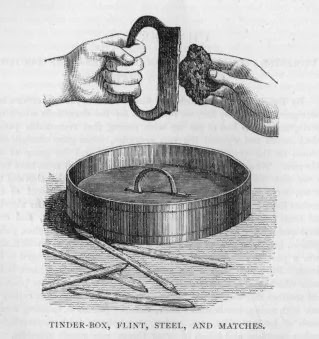
In this illustration from Gutenberg for instance a tinderbox is being used, but the sketch appears to be showing the flint being struck by the steel as no sparks are shown as being created at this stage. Using this incorrect method would send the sparks upward before they fall on the tinder. If in fact they did reach the tinder in this round about way, the sparks would have lost their heat & may not catch on the tinder at all.


Here though in this detail of the altarpiece of the Saint Georges church in Haguenau, Bas-Rhin, France, you can see the flint is about to be struck with the steel to catch sparks on the tinder held by the hand on top of the flint.

English: Detail of the altarpiece of the Saint Georges church in Haguenau, Bas-Rhin, France.
Français : Détail du retable de l'église Saint-Georges de Haguenau, Bas-Rhin, France.


Fire Steels. Researching Three Types.

Fire Steels. Researching Three Types.
I am sure after doing so much research on fire steels, that there is still a lot to learn on my part. I have not even scratched the service on iron & steel properties & whether or not all steels were a combination of the two metals.
There are such a variety of steels from different countries, both in design, & in size. It also occurred to me whilst looking at the close resemblance of one steel to another, if perhaps some of them may have had their rat tailed handles repositioned after forging by the owner. Then there is the problem of not knowing if the artefact actually belonged to the site where it was found, or whether or not a Viking may have stolen a steel from an English village & taken it home with him on his return.
So I have tried to focus on three types or designs of steels only, principally because these are the particular ones I am interested in.

Birka Grave Fire steels Viking.


Post Medieval found in England. This same fire steel has also been described as being Roman.
5 cm long fire steel.
This one is almost a dead ringer for the one above, but this one was found on the Dawson Road convict site in Tasmania, Australia.

The following two steels were found in England.

At 9 cm long, these two steels are quite large in comparison to some copies made today. Going by the design & the amount of wear, my best guess at their period of construction is 17th century to mid 18th century, & both made in England.


From The Collector's Illustrated Encyclopedia Of The American Revolution By George C. Neumann & Frank J Kravic.
Top right you can see two steels which are very close in design to the steels found in England. All the steels in this image were found at American Revolution sites, but this does not mean that they are dated to this period, they could just as easily date to the French & Indian War or earlier.


This style of steel was surprisingly the most difficult to research. There is no doubt more information out there, but to date I have been unable to find it. This steel was shown with a late 18th century tinderbox with candle holder, but again, this does not necessarily date this steel to the same period.
http://www.collectivator.com/c/wendy-hamilton-antiques/sheet-brass-tinder-box-england-late-18th-century;


Again, a very similar steel, & even with the same amount of wear, but unfortunately there is no date on the steel.


Record ID: LON-6357F6
Object type: STRIKE A LIGHT
Broad period: POST MEDIEVAL
County: Greater London Authority
Workflow stage: Awaiting validation.
A Post Medieval iron tinder strike (17th century). This object has the characteristic rectangular body and curving square-sectioned arms with coiled terminals. There is a triangular notch in the upper surface just slightly off-centre. Dimensions: length: 78.86mm; width: 40.69mm; thickness: 5.78mm; weight: 29.91g. Identification and dating by Tony Pilson and Ian Smith based on foreshore context.

 Production Date:1500-1700 Museum Of London.
This example I think comes close to matching the squarer & sharper shoulders of the original I am researching.


Amsterdam 1650-1700.

Despite the similarity of all "C" type steels to one another, it is quite obvious that the original example that I have been trying to date is quite unique in it's design, with squarer sharper shoulders than any other of this type I have found so far.


The third design has been the easiest to research, & has been far more common than I first expected. In all these types & designs we must of course bare in mind that these steels have been made far & wide by different Blacksmiths with their own ideas of how a steel should look, or what particular style was perhaps easiest to use.
This is a closer look at the steel I have been trying to date. Note that the rat tail arm reaches down only just over half way, & that the wear is quite excessive considering the amount of steel that is shaved off each time when struck a glancing blow with a piece of sharp edged flint or other similar rock. Note the double cut marks of the file it was made from.

This steel is purported to be dated to 1620ad.

This steel showing very similar wear is dated to the 18th century. Again, note the double cut of the file this was made from.


This one is very similar, but much smaller.
Record ID: LON-891A42
Object type: STRIKING EQUIPMENT
Broad period: POST MEDIEVAL
County: Greater London Authority
Workflow stage: Awaiting validation  Find awaiting validation
Fire steel, striker light, dating to the post medieval period. The lighter is U shaped, and has flat surfaces on both sides. On side of the u shape is thicker, the thinner side curves into itself at the terminous

This one when seen in comparison to the size of the tinderbox it was displayed with is obviously large, at least I would say 9cm.
Tinder box with striker and flint. Photo taken at Ludlow Museum, Castle Street, Ludlow, Shropshire, England. (Photo credit: Wikipedia). Again the file cuts can be seen.

This steel reported to be from the medieval era is again very similar in shape. These are found open as this one is, & also closed with the rat tail handle closed against the main body of the steel.


In this detail from a painting The Fire by Giuseppe Arcimboldo 1566, two different fire steels can be seen in the ear & the nose. The nose is very similar to the one above, & the original I have been researching.

Recognition:
My sincere thanks to my close friends Russ Tyenna in Tasmania & Alan Poole in England for their major contribution to this article. Without their assistance it is doubtful I would have written this article.
Keith H. Burgess 4/4/2015.

Thursday, 13 February 2014

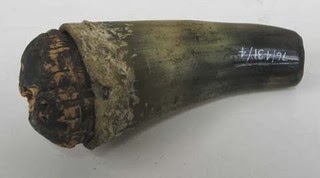
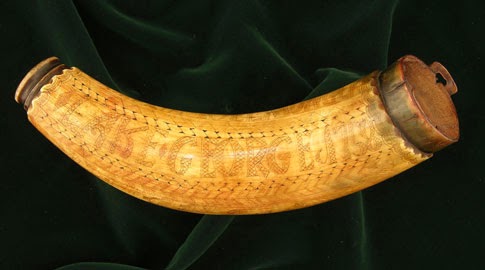
Tinder Horns.

Not everyone used a tinder box, and no doubt some of those who did have a tinder box may not have used it for making fire per se. Some people used the bird nest method of placing tinder in a bundle of small kindling & striking sparks on the tinder in the nest. Others may have used the tinder box to prepare tinder, but used the nest method to actually make fire, instead of striking sparks into the tinder box.
Others used a tinder horn, this could be used like the tinderbox and was a good alternative if you did not have a tinder box/tinderbox.
 Then again, not everyone was successful in making fire. Understanding how some people thought back in the 18th and 19th centuries is very difficult. Some having experienced hardship still failed to improve their lot so they would have better luck next time. Others however took notice and improved on their equipment. Others still did not survive because of their short comings.

“This induced me to resolve not to travel more by land without my gun, powder and shot, steel, spunge and flint, for striking a fire…”
~Patrick Campbell, Canada/New York, 1792 

"There was Dry leaves and sticks under our shelter. I stoped the tuch hole of my gun with tallow and then did ketch fire and we made up a fire and Dryed our selves."
Westward Into Kentucky, Daniel Trabue, 1779:


"There happened to be an iron pot and an ax on board--- they cut off a piece of the boat rope, and picked it to oakum, and putting it in the pan of a gun, with some powder, catched it on fire, which with some thin pieces cut from the mast, they kindled in the pot, and then cut up their mast, seats, &c. for fuel, and making a tent of their sail, wrapt themselves as well as they could;"
From The Pennsylvania Gazette, 1765


“Fierce winds and blowing snow reduced the men to huddling among large rocks, unable even to start a fire.”
Samuel Hearne, Canada, 1770.

“Fire making is a simple process with the mountaineers. Their bullet pouches always contain a flint and steel, and sundry pieces of “punk”-a pithy substance found in dead pine trees-or tinder; and pulling a handful of dry grass, which they screw into a nest, they place the lighted punk in this, and closing the grass over it, wave it in the air, when it soon ignites, and readily kindles the dry sticks forming the foundation of a fire.”
Ruxton, 1848.

 “…rain began hammering down so heavily that, one hundred miles from the nearest trees, and with nothing available but moss, nobody could start a fire.”
                        Samuel Hearne, 1770.

“In the woods we were under some disadvantage, having no fire-works”. Journal of John Woolman, 1720-1742.


Monday, 10 February 2014

Authentication. Use Of The Tinderbox.

Recently I was asked what proof did I have that the tinderbox was used for making fire. First let me say that the tinderbox was not always used by everyone to make fire, there are period ways to make fire without using the tinderbox. But, using the tinderbox is the easiest way to prepare tinder, and I have found that it is the easiest way to make fire when you know how to use the tinderbox properly, and have had plenty of experience.
Here then is the primary information that I have so far, in the written word, and in images.


The maid is stirring betimes, and slipping on her shoes and her petticoat, gropes for the tinder box, where after a conflict between the steel and the stone she begets a spark, at last the candle lights.... Matthew Stevenson, The Twelve Months, c1661.

To make Tinder.
Take three ounces of Salt-petre, put it to a Pint and a half of fair Water, set it on a Fire in a Kettle or Pan to heat till the Salt-petre be dissolved; then take a Quire of smooth brown Paper, and
put them in Sheet by Sheet into the hot water till they are wet through, and then lay them on a clean Floor or Grass to dry. You may at any Time tear a Piece off, and put it in your Tinderbox,; it will catch like Wild-Fire. By this Means you may save all your Linen Rags in the Family, keep them clean in a Bag, and, if you are careful of them, they may produce you a Pair of Shoes and Stockings at the Years End; and by this Frugality you will have the Pleasure to think of encouraging the making of Paper, and employing the Industrious.

Madam Johnson's present: or, every young woman's companion in ... - Page 181

Mary Johnson (fl. 1753.) - 1770 - 197 pages 

To make a Substitute for Tinder made with Linen.
Dissolve three ounces of Salt petre in a Pint an half of fair Water in a Kettle or Pan over a clear Fire: Then thoroughly wet twenty-four Sheets of Smooth brown Paper separately in the hot Liquor, and lay them on some clean Place to dry. When you have Occasion, yoiu may put a Piece in your Tinder-box, and using the Steel and Flint, it will catch like Wildfire

The Swiss family Robinson: or, Adventures of a father and mother (first published in 1812)
Page 296

We might make tinder by burning: some linen rag, and putting it in & close box*: but we have unfortunately^ none to spare ? and;,, therefore, the best thing for us would be to find ... Johann David Wyss, Johann Rudolf Wyss - 1818 

Take those great things which are called olde Todestooles growing out of the bottomes of nuttrees, beechtrees, okes, and such like trees, drye them with the smoke of fire, & then cut them into as many peeces as you will, and hauing well beaten them, boyle the  in strong lie with waule floure, or saltpeeter, till all the lie shal be consumend. After this laying them in a heape uppon a boorde, drie them in an oven which must not be made verie hotte, and after you haue so done, beate them well with a wooden mallet, and when you shall haue cause to use any parte of those Todestooles (now by the means above declared made touchwood) rubbe well that parte betweene your handes for to make it softe and apte to take fire. But when you will make tinder for a Gunners tinder boxe, take peeces of fustian, or of old and fine linnen clothe, make them to burn and flame in a fire, & suddenly before the flame which is in the  doth die, choke the fire, & keepe their tinder so made in a boxe lined within with clothe, to the ende that it may not be moyste at any time.

Appendix 20-1,  Lucar, C., Translation of Tartaglia, Three Bookes of Colloquies Concerning the Arte of Shooting in Great and Samll Peeces of Artillerie with Appendix, London,1588


An Indian often goes off alone...with only his musket, powder and shot, a tinderbox...
Pouchot, Pierre. Memoirs on the Late War in North America between France and England. Page 482.

"You must provide yourself with a tinder box or with a burning mirror, or with both, to furnish them fire in the daytime to light their pipes, and in the evening when they have to encamp; these little services win their hearts. "Instructions for the Fathers of our Society who shall be sent to the Hurons." l637.

It (the tinderbox) was with this instrument, long before the invention of matches, that our grandfathers obtained light. I want to show you how the trick was managed. First of all it was necessary to have good tinder. To obtain this, they took a piece of linen and simply charred or burnt it, as you see I am doing now (Fig. 4). (Cambric, I am told, makes the best tinder for match-lighting, and the ladies, in the kindness of their hearts, formerly made a point of saving their old cambric handkerchiefs for this purpose.) The servants prepared the tinder over-night, for reasons I shall explain to you directly. Having made the tinder, they shut it down in the box with the lid (Fig. 3 A) to prevent contact with air. You see I have the tinder now safely secured in my tinder-box. Here is a piece of common flint, and here is the steel. Here too are the matches, and I am fortunate in having some of the old matches made many years ago, prepared as you see with a little sulphur upon their tips. Well, having got all these etceteras, box, tinder, flint and steel, we set to work in this way:—Taking the steel in one hand, and the flint in the other, I must give the steel a blow, or rather a succession of blows with the flint (Fig. 3 B). Notice what beautiful sparks I obtain! I want one of these sparks, if I can persuade it to do so, to fall on my tinder. There! it has done so, and my tinder has caught fire. I blow my fired tinder a little to make it burn better, and now I apply a sulphur match to the red-hot tinder. See, I have succeeded in getting my match in flame. I will now set light to one of these old-fashioned candles—a rushlight—with which our ancestors were satisfied before the days of gas and electric lighting. This was their light, and this was the way they lighted it. No wonder (perhaps you say) that they went to bed early.
Delivered before a Juvenile Auditory at the London Institution
during the Christmas Holidays of 1888-89.
BY THE LATE
CHARLES MEYMOTT TIDY, M.B., M.S., F.C.S.


The fact that the tinderbox existed and was used is beyond doubt, what is being questioned here is "how was it used". My personal knowledge started a long time ago when I realised that I needed a renewable fire lighting method. As I was at that time already using flint and steel, this meant that I had to find a natural source of tinder growing in the wild, and I needed a way to prepare it.
By experimentation I started to find several plants that could be used as tinder, but I needed to char most of them in a fire to make them catch a spark. This meant that I had to find a way to smother this smouldering tinder for future use. I started by burying it under earth, this worked okay, but soiled the tinder, and, this method could not be used in wet weather. Next I wrapped the smouldering tinder in soft leather and then buried it in the earth. This worked fine, but I needed to find an easier method.
It was then one of those moments when you strike your forehead as the obvious comes to mind and you can't believe that you had not seen it before. The smouldering tinder was to be smothered in a tinderbox. From there it was but a short step to realising that in fact the fire was also created with the tinderbox. Subsequent  experimentation and further research proved my findings to be correct. That of course was many years ago, and I made my first flint, steel and tinderbox video in 2008.
Keith H. Burgess. 11/2/2014.

Thursday, 30 January 2014

Carrying Fire. A short video.

Similar plants that can serve the same purpose in America are: The Yucca plant, & the Agave or American Aloe. Also known as Sentry Plant. This Sentry Plant also grows in Australia.

Friday, 6 September 2013

One Blanket Winter Camping.

One Blanket Winter Camping.

It can get very cold here in New England NSW, but there are places where it can get much colder. So be mindful of the areas you camp in when applying my methods to your Historical Treks.
I only carry one wool blanket all year round. Rather than add the bulk & weight of extra blankets or furs, I prefer to rely on the warmth from a reflector fire built close to my open fronted shelter, and the use of extra clothing. In my blanket roll I carry a wool Monmouth cap, a wool waistcoat, and a woolen shirt. At night in winter I make sure that the clothes I have on are not damp from the day’s exertions, and then I put on these extra clothing items on top of the clothing I already wearing.


I also wear a half-blanket as a cape over my shoulders and pinned together at the front. This too is worn on cold nights, and if too warm to wear on the trail, then I simply drape it over my knapsack. Now I am not saying that this method is comfortable, or that it keeps me warm all night. I am simply saying that I can manage to live this way in the bush. I do not expect to be as comfortable as I would be in my bed at home, I am resigned to the fact that this simply is the way it is if I want to carry less weight and less bulk.
The same applies to my bed, which is simply made of sticks. If there is no snow on the ground, then I may collect some dead bracken to lay upon my bed of sticks. This method keeps me up off the cold ground, and allows any flowing water from rain to flow under me and out again. I store dry kindling inside my shelter just in case my fire should go out in the night, and I build up a good supply of firewood at the side of my shelter nearest my head so I can stoke the fire in the night without leaving my blanket. The close fire also allows me to cook food and boil water for hot drinks in rain or snow without having to leave my shelter and get wet.
Take care.

Keith.

Friday, 14 June 2013

How To Learn Primitive Skills.

I started learning primitive skills way back when I was a youngster. Of late several people have asked me where can they start to learn primitive skills. Here is an index list for my primitive skills DVDs, and the address to order from. There is also a "Buy Now" button to the left of this post.
FIRE DVD.
 MOCCASINS & MORE DVD
MUZZLE-LOADING & MORE DVD

OFF THE GRID DVD.


Saturday, 18 May 2013

Primitive Skills DVDs.


im finally starting to get the hang of this now. it took a little while but its worth it. I feel a lot better knowing I don't need char cloth or mushroom. the important factors I found were obviously having the right wood in the first place. the next was that its charred properly. then a sharp flint. you don't even need lots of sparks, just a few well directed ones. its all here in the videos, I listened to what you said keith and it works seriously well. thanks mate that's awesome
BUY NOW button to the left of this post.

Monday, 24 September 2012

The Spill Plane.

I have read that the purpose of the spill plane was primarily to produce kindling in a home where sticks and twigs were not available for making fire. I have no doubt that wood produced by this plane could be used for such a purpose, but it seems to me that it was infact designed to produce "spills". A spill was used to transfere flame from a fire to a candle, lamp or pipe for smoking. A spill was also used for making spunks by dipping one end of the spill in moulten sulphur. This spunk would then take fire from smouldering tinder in a tinderbox and could be used to light a fire, a candle or a lamp.
 Spills made into spunks which I made by hand.


Two spill planes. Note the hole in the side of the plane just below the cutting blade in the top. This is where the made spills come out.

Wednesday, 8 August 2012

Ranger Equipment & Food Rations.

"Frosts were falling
When the ranger's horn was calling,
Through the woods to Canada.

"Straggling rangers, worn with dangers,
Homeward faring, weary strangers,
Pass the farm-gate on their way.
Tidings of the dead and living,
Forest march and ambush giving,
Till the maidens leave their weaving,
And the lads forget their play."
Whittier.
 
Ranger Information 1757 as of 9/8/12
Rangers who were in uniform which consisted of a grey duffle coat and vest,
and buckskin breeches and leggings. Arms consisted of individually owned
flintlock fusils in the Rogers's Companies as well as privately owned scalping
knives and tomahawks Hobb's and Speakman's carried regulation muskets,
cartouche boxes, and wore regulation shoes from the King's stores, and were
supplied with hatchets by a contractor. Unlike the Rogers's Companies, they did not all have the Corps' most prolific weapon, the scalping knife. p.116

The Rogers's Company officers carried compasses in the large end of their
powder horns. This excellent practice was later imitated by all the officers of
Rogers' Rangers. Ammunition per man consisted of 60 rounds of powder and ball.
Provisions consisted of two weeks' supply of dried beef, sugar, rice and dried peas
and corn meal. The food rations were carried in a knapsack strapped over the
shoulder.
Rogers had allowed small fires to be built in the heavy part of the woods, in
pits about three feet deep. The coals were now rekindled and the Rangers quickly
made themselves gruel of cornmeal, which was washed down with rum from their wooden canteens.
 Transcribed by Janice Farnsworth. (Edited for script mistakes by Keith H. Burgess.)