Showing posts with label gun flints. Show all posts
Showing posts with label gun flints. Show all posts
Friday, 30 March 2018


Thursday, 31 December 2015
Flint Wallets.
I have been trying to find more information on flint
wallets, but not finding much. I do have some images, but there are no early to
mid 18th century examples and some images show very little of the pattern.
A flint wallet is used to secure spare gun flints for use in flintlock guns.

Made in Oxford, Oxfordshire, England, late 18th c. Made
of leather.
National Maritime Museum, Greenwich, London.


Red leather flint wallet.


From a cased set of Manton duelling pistols, 1792.


Joseph Gulley, London.
Superb pair of 24-bore (.58 cal.) English Duelling pistols by a best London
maker, ca. 1800.

This quote below obviously referring to a woolen flint wallet.
Quote only, no image available:
"An 18th century Continental felt flint wallet (moth
damage)".
Thursday, 14 May 2015

Friday, 27 March 2015

Sunday, 25 January 2015
A Look At Some 18th Century Artifacts.
Primary documentation can't be beat, this is what every living historian looks for. But what I like most in some of the following images, is the proof that people used to make their own things from recycled materials. This does not give us licence to make just anything because it is made from period materials, but it does allow us to make the items that we know were self-made.







A white-tailed-deer antler with saw marks from the north cellar, evidence the Spragues were working antler.
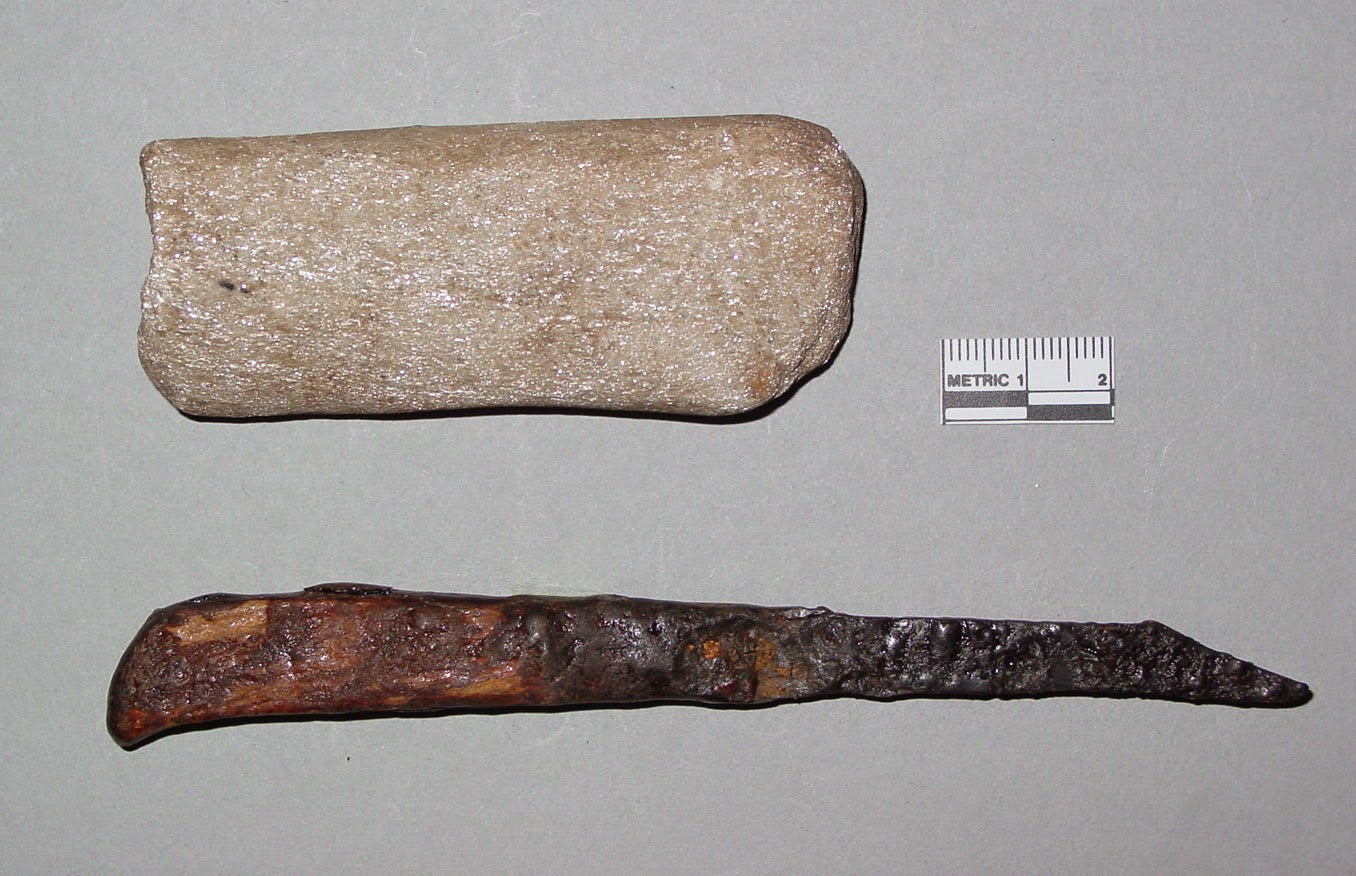
A Barlow type folding jackknife and whetstone. Barlow jackknives had large iron bolsters (the iron behind the blade) which gave them more durability.
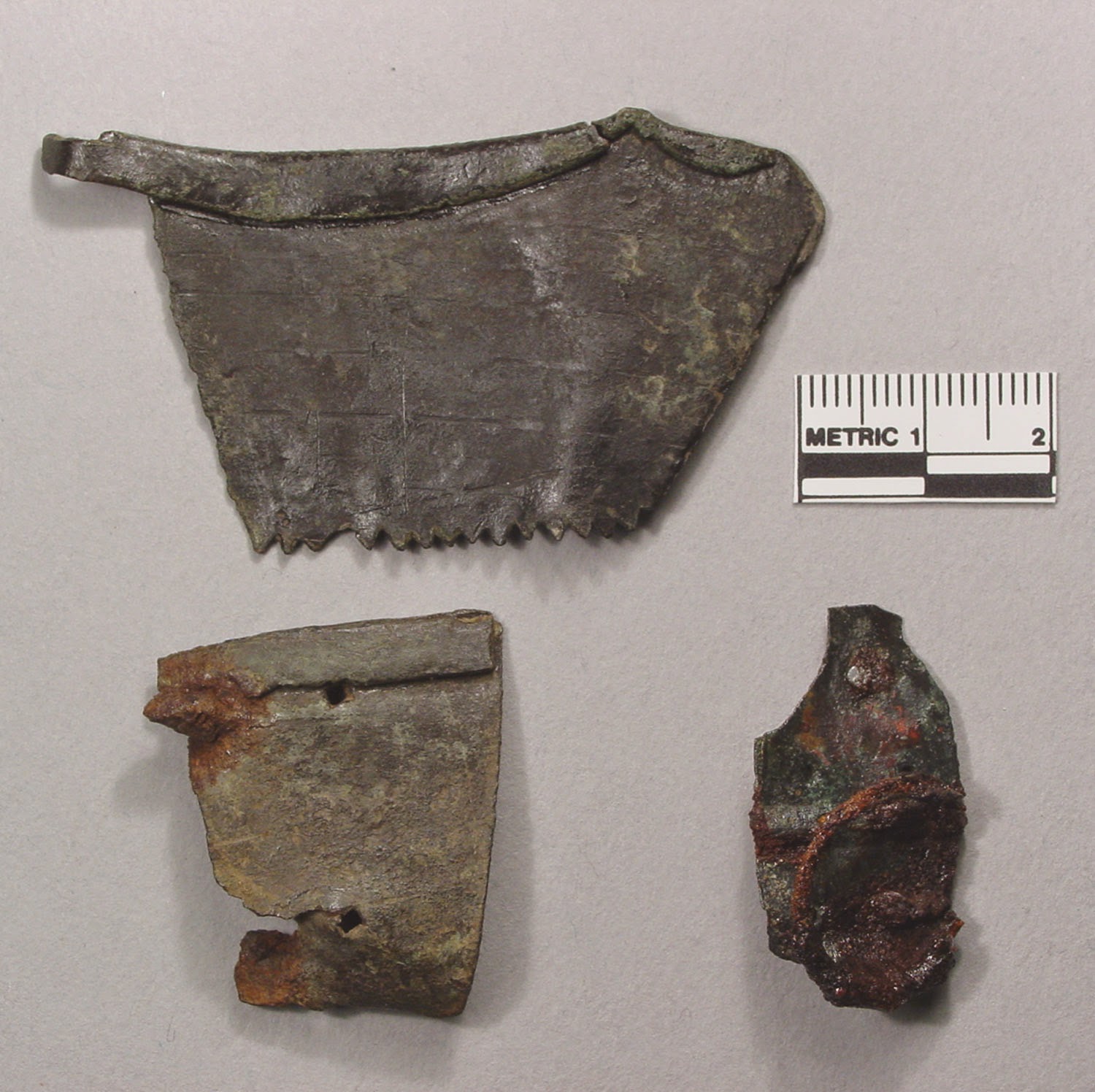
Several artifacts made from scrap brass: a small saw, a repaired kettle rim, and a small hasp for a small box.
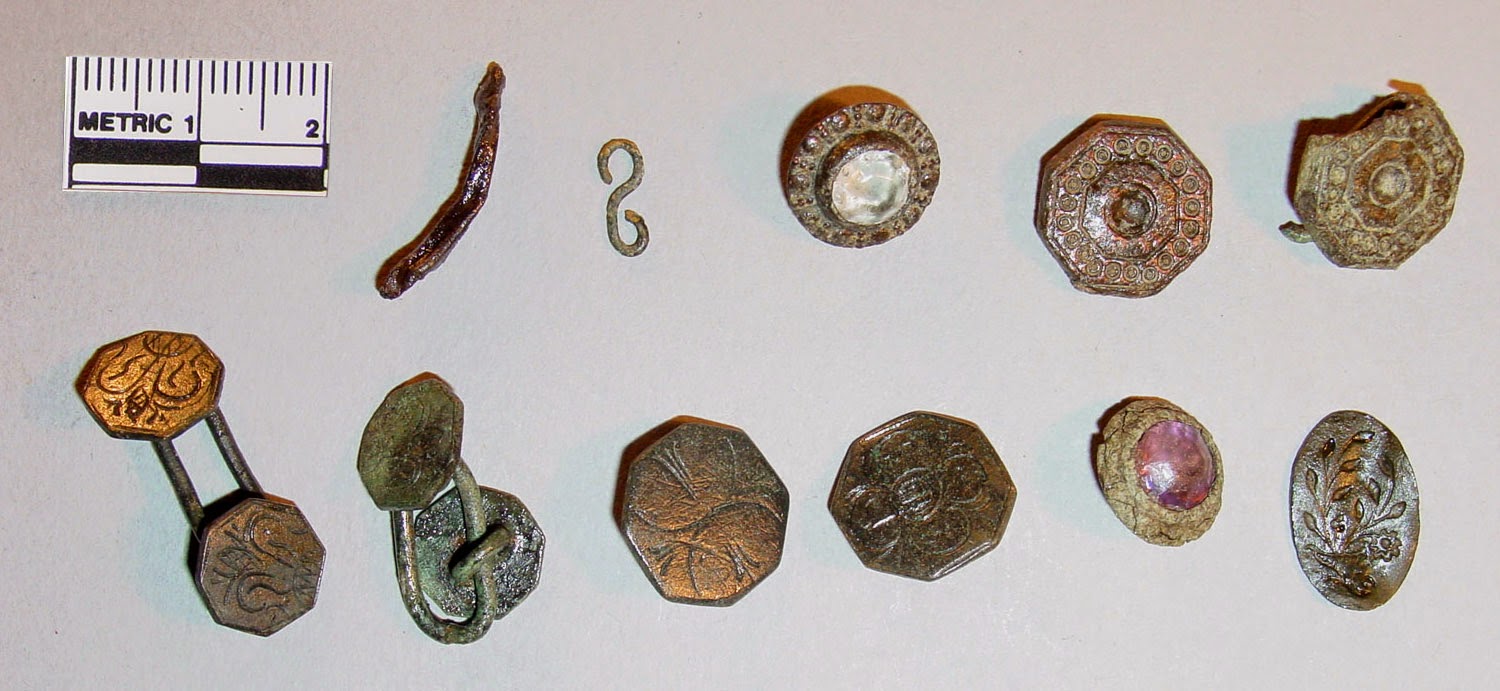
Cufflinks were often decorated. Most have geometric designs or floral themes. The cufflink on the bottom right has a cornucopia engraved on it, likely symbolic of men’s roles as growers of food. On the top left is a brass aglet for lacing clothing and a possible “hook” part to a “hook-and-eye” fastener.
A lead net weight, a lead line sinker and two fishhooks.
European flint strike-a-lights and ballast cobble debris. The largest reddish piece is a strike-a-light made from Pennsylvania jasper.
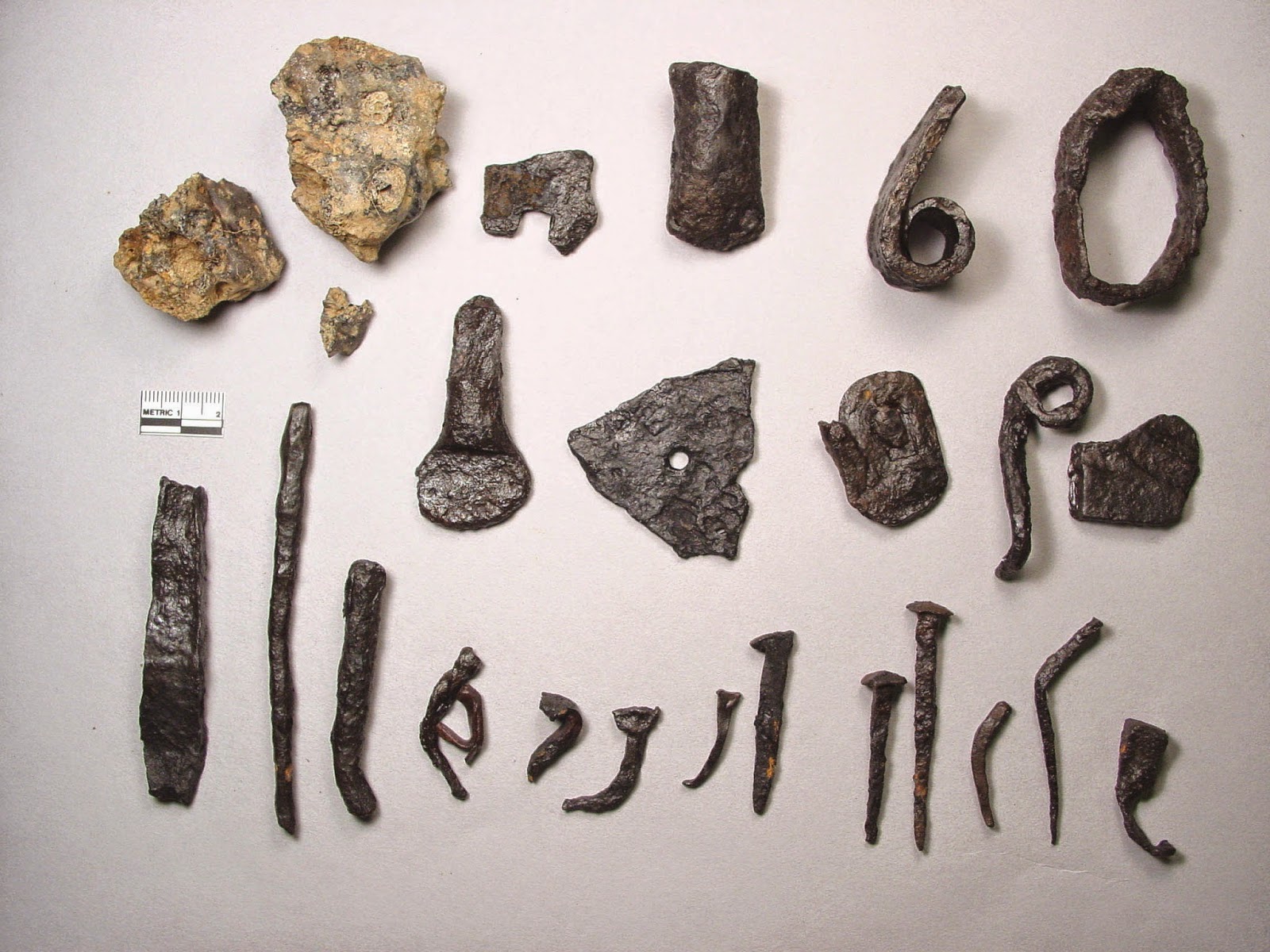
Slag, a fragment of a nail header, scrap iron, nails blanks and various types of nails, including T-head, L-head, rose-head, headless and shoeing nails.
17th-century gunflints, found at Le Vieux Fort, Placentia.
Photo courtesy of Amanda Crompton.
Gunflints, lead shot, musket balls, a lead gunflint wrap, a fragment of a brass side plate with dragon motif and the finial to a bayonet scabbard.
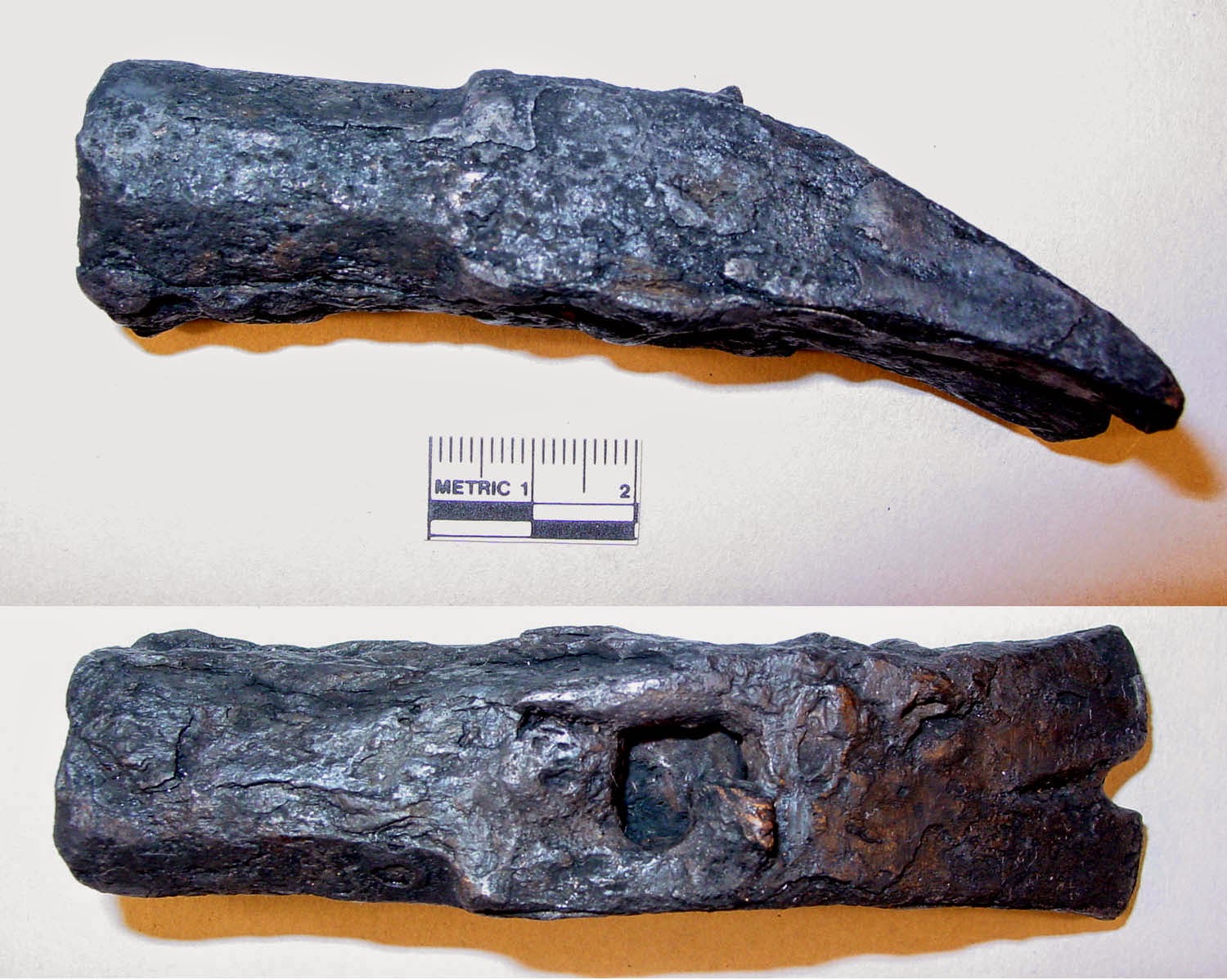
A claw hammer head, side and top view.
A variety of items made from scrap iron, including a sieve, a funnel, and two knife blades made into strapping to reinforce something.
Personal items including a George II Oldhead halfpenny (1740-1754), George I “Irish Wood” halfpenny dated 1723, a William III halfpenny dated 1699, and a small piece of a silver coin. There are a plain brass ring, iron mouth harp, and pieces of a bone comb and a copper-alloy comb. These combs have two sizes of teeth: the larger for grooming, the smaller to remove nits and lice from the hair. In the bottom left is a small brass plate with the letters “IB” stamped into it.
Scissors, a needle, glass beads, straight pins and thimbles.
Sunday, 4 September 2011
Fitting A Gun Flint In The Lock.
Fitting A Gun Flint To The Lock.

A one sided gun flint.

A Double side gun flint.

Gun flints can be fitted shoulder up or down, depending on where you want the edge of the flint to strike the face of the hammer. Go for higher rather than lower.

Using the turn screw to loosen or tighten the gun flint in the jaws of the cock.
 Bevel & shoulder up, striking the hammer face lower.

You can secure the flint in leather or in sheet lead. I have tried both but prefer leather. With the hammer forward & the cock set at half-cock position, fit the flint in loose tightening the screw with just the fingers. Close the hammer [frizzen] over the pan. Release the cock by squeezing the trigger, but hold onto the cock & release it slowly. Hold the hammer in place so the cock can’t push it forward. As the flint contacts the face of the hammer it will straighten the flint & align it with the hammer face.

If the flint is striking the hammer face at least two thirds of the way up, tighten the screw on the cock to secure the flint in that position. Try it out. If it strikes plenty of sparks fine. If not try turning the flint over & test again.

 Full cock position.
 Fired or full forward position.


A one sided gun flint.

A Double side gun flint.

Bevel & shoulder down as here, will strike the hammer face higher.
Gun flints can be fitted shoulder up or down, depending on where you want the edge of the flint to strike the face of the hammer. Go for higher rather than lower.

Using the turn screw to loosen or tighten the gun flint in the jaws of the cock.


You can secure the flint in leather or in sheet lead. I have tried both but prefer leather. With the hammer forward & the cock set at half-cock position, fit the flint in loose tightening the screw with just the fingers. Close the hammer [frizzen] over the pan. Release the cock by squeezing the trigger, but hold onto the cock & release it slowly. Hold the hammer in place so the cock can’t push it forward. As the flint contacts the face of the hammer it will straighten the flint & align it with the hammer face.

If the flint is striking the hammer face at least two thirds of the way up, tighten the screw on the cock to secure the flint in that position. Try it out. If it strikes plenty of sparks fine. If not try turning the flint over & test again.


The leather tool pouch I made to go in my shot pouch.

Items in the tool pouch: Top L-R, cork sheath for the screw, the screw, turn screw, grease container,
[lower] spare leather for the flint, small pin punch, 2 spare gun flints.


Subscribe to:
Posts (Atom)