
Showing posts with label skills. Show all posts
Showing posts with label skills. Show all posts
Wednesday, 6 September 2017


Sunday, 7 May 2017

Saturday, 24 October 2015
The Anderson Blacksmith Shop and Public Armoury
Strake NailForging a strake nail for a pair of French cannon wheels
Posted by The Anderson Blacksmith Shop and Public Armoury on Tuesday, 28 April 2015
Tuesday, 6 October 2015

Saturday, 23 May 2015
At the Sign of the Golden Scissors: To Stroke or Not to Stroke
At the Sign of the Golden Scissors: To Stroke or Not to Stroke: Stephanie Smith of Larkin & Smith After you have done your first section of gathering stitches; pull your thread tightly enough to cre...


Tuesday, 12 May 2015
Useful Australian Plants.

A bracket fungus, Ryvardenia Cretacia. Near Armidale New England NSW. Used as tinder for fire lighting (Photo By the author).
Whether Historical Trekking or working at home, it is useful to have some knowledge of Australian plants. Many of us prefer to interpret life in the New World, but in order to fully experience the lifestyle in the 17th & 18th centuries, we must use the materials available here in Australia.
http://www.mountgambier.sa.gov.au/docs/environmental/natural/indigenous-plant-guide-LOWRES%20FINAL%20Edition%201_2013-07-23.pdf
http://www.parksaustralia.gov.au/botanic-gardens/pubs/aboriginal-plantuse.pdf
http://www.arrawarraculture.com.au/fact_sheets/pdfs/14_Leaves.pdf
Monday, 10 November 2014
Friday, 21 February 2014
Sunday, 1 September 2013
The 18th Century Woodsman as a Survivalist.
The 18th
Century Woodsman as a Survivalist.

Plant tinders in the author's tinderbox.
Being an 18th
century woodsman and participating in Historical Trekking means more than just
posturing. Yes charred cloth was used in the 18th century as a
tinder for making fire, but it was not used by woodsmen in the wilderness. Some
would be woodsman choose to carry a percussion gun, but the fact is, woodsmen
did not carry a percussion gun because (a) it was not invented in the 18th
century, and (b) which is more important, percussion locks are not suitable for
survival in the wilderness. You are better off flinching and getting used to a
flinter than you are relying on percussion caps.

The woodsman’s hunting
knife was more often than not a butcher knife. With a blade between 7 and 12
inches it was well suited to skinning, butchering and self-defence. So think
about what your hunting knife is meant to be used for before purchasing. The
same goes for the tomahawk. The tomahawk was the 18th century trade
axe, and it was designed as a practicle tool and weapon. The round poll and the
square poll tomahawks were used for shelter construction, making pegs and
stakes and driving them into the ground. They could also be used in the
butchering of game, for fighting, and for throwing; either for hunting or in
battle. Hammer poll tomahawks will split stakes when driving into the ground,
and the poll on a pipe tomahawk is only of any use for smoking. If you want to
smoke a pipe, carry a pipe.

The author's blades that he always carries in the woods; tomahawk, hunting knife, friction clasp knife, and a legging knife.
Now here is a tip that
I learnt from a very close personal and family friend who went under some years
ago. Shane was an ex Ranger, and he suffered with painful feet when wearing
moccasins. But instead of looking for alternate footwear, he compromised authenticity
by adding just the foot part of a pair of modern thongs (flip flops, jangles)
as an inner sole. Personally I think this is a great idea. I guess if you are
like me and prefer not to compromise authenticity in this way, you could just
simply add leather inner soles and see if that does the job.

I do a lot of
research, but I can’t find information on a lot of things that I would like to
find. In order to determine what items might be carried by certain types of 18th
century people, it is necessary to use experimental archaeology. Again we must
think of the woodsman as a survivalist, but having said that, some woodsmen
were smarter than others. There is no definitive answer to why some people did
certain things and others did not. Family tradition would no doubt often play a
part, e.g. “my Father never bothered to carry an oilcloth so I don’t either”.
There are records of grose incompetence by some woodsmen that fairly boggles
the brain. The only thing we can do is actually use our equipment and decide
for ourselves on what we carry, how we carry it, and what period methods we use
to look after our equipment and tools.
You may only be able
to get into the woods for a weekend, but you must imagine that you are going to
be in the woods for a lot longer. This has a very practicle point to it aside
from an authenticity point of view. You can never be sure what is going to
happen to you out there. You may literally find yourself in a survival
situation. This has happened to me more than once, and if I had not payed
attention to carrying the right gear, I may not be here right now.
Think about it.
Keith.
Keith.

Sunday, 7 July 2013
Saturday, 6 July 2013
Monday, 15 April 2013
To Every Man A Gimlet. Part 2.

The gimlet and auger I made.
" Young as I
was, I was possessed of an art which was of great use. It was that of weaving
shot-pouch straps, belts and garters. I could make my loom and weave a belt in
less than one day. Having a piece of board about four feet long, an inch
auger, spike gimlet, and a drawing knife, I needed no other tools or materials
for making my loom. It frequently happened that my weaving proved serviceable
to the family, as I often sold a belt for a day's work, or making a hundred
rails. So that although a boy, I could exchange my labour
for that of a full grown person for an equal length of
time".
Doddridge. 18th
century.
Has anyone got any ideas on the sort of loom that Dodridge could have made with just a four foot board? I was thinking some form of inkle loom. A board with pegs in it?
Thank you Jenny, very much appreciated.
Regards, Keith.
Monday, 26 November 2012


Tuesday, 20 November 2012
Tuesday, 11 September 2012
Carrying Methods. Australia.
Australia.
“The women make string out of bark with
astonishing facility, and as good as you can get in England, by twisting and
rolling it in a curious manner with the palm of the hand on the thigh. With
this they make nets ... These nets are slung by a string round their forehead,
and hang down their backs, and are used like a work-bag or reticule. They
contain all the articles they carry about with them, such as fishing hooks made
from oyster or pearl shells.”
- From the
diary of an early 18th century settler in the Port Stephens area.
Monday, 2 January 2012
18th Century Brooch For Securing My Half-Blanket.
A close-up of the brooch I made from a brass ring which was a part of an old halter I had. I just added the brass pin. This is a copy of an 18th century original brooch.


On the right this brass pin is bent around the ring. If you are going to make one, do not heat the brass to bend, it will break. Always bend brass cold.
Thursday, 3 November 2011
Trailer-Cobbling Soles on Moccasins & Shoes.
There are two videos on Cobbling Soles on Moccasins & Shoes, and both are on my Primitive Skills 2 DVD. This is just the first half of the first video.
Wednesday, 2 November 2011
Thursday, 15 September 2011
Cobbling Soles On Moccasins & Shoes..
Cobbling Soles on Moccasins & Shoes.
Cobbling soles on woodland Indian moccasins is not traditional, but it is an easy way to attach & replace extra soles. The moccasins I wear in the woods have extra soles stitched on, but my work moccasins have cobbled soles because the soles wear out faster & need replacing more often.
 My iron last secured in my post vice.
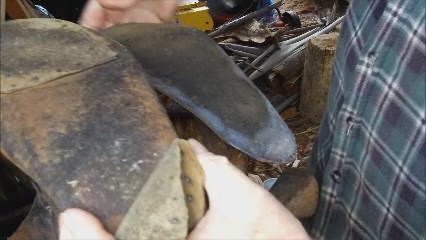 You need 2 inner soles plus the outer sole or half soles. One inner sole to attach the outer sole to, & one inner sole to protect the feet against any shoe tacks that may not be laying flat.

This half sole is worn through & is being pulled off prior to replacement.
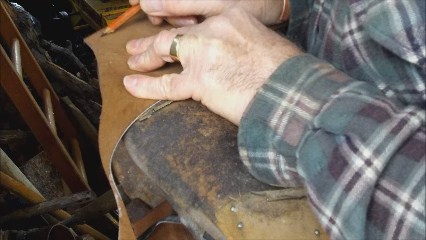 A new half sole is marked for cutting to shape.
 I cut the sole to shape with my jack knife. Now it needs tacking in place.
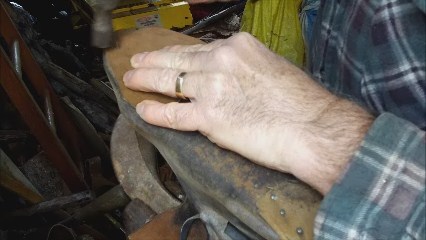
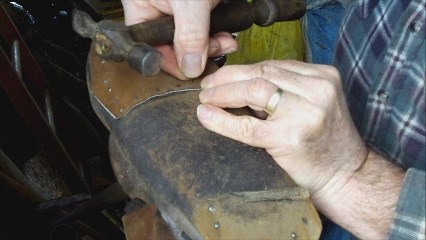
I start hammering in shoe tacks from the toe back, alternating from one side to the other to keep the sole even.
 The finished half-sole tacked in place.

When repairing the heel I just turn the moccasin round on the last & push the toe of the last into the heel of the moccasin, rather than using the smaller heel dolly on the last. But for shoes you will need to turn the iron last round & use the heel dolly to repair the heel.
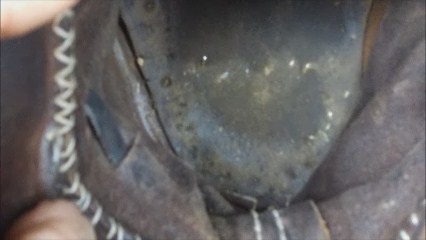
Here you can see the tacks inside the moccasin where they are bent over at the tips when they are hammered through the leather & come in contact with the iron last.
All that is left to do now is to replace the second inner sole, which just slips in to the moccasin for extra protection for your feet.
Cobbling soles on woodland Indian moccasins is not traditional, but it is an easy way to attach & replace extra soles. The moccasins I wear in the woods have extra soles stitched on, but my work moccasins have cobbled soles because the soles wear out faster & need replacing more often.


This half sole is worn through & is being pulled off prior to replacement.


I start hammering in shoe tacks from the toe back, alternating from one side to the other to keep the sole even.


When repairing the heel I just turn the moccasin round on the last & push the toe of the last into the heel of the moccasin, rather than using the smaller heel dolly on the last. But for shoes you will need to turn the iron last round & use the heel dolly to repair the heel.

Here you can see the tacks inside the moccasin where they are bent over at the tips when they are hammered through the leather & come in contact with the iron last.
All that is left to do now is to replace the second inner sole, which just slips in to the moccasin for extra protection for your feet.
Sunday, 7 August 2011
The Early to Mid 18th Century Woodsman & Woods Woman. Who & what they were.
The Early to Mid 18th Century Woodsman & Woods Woman. Who & what they were.
From here on I will refer to this persona as a Woodsrunner, which covers both genders. The woodsrunner was a person with certain skills that enabled them to survive with reasonable comfort in the woods & forests. Today we call this combination of skills & crafts woods lore. Not all woodsrunners came from the same mould, not all had that “brier in the eye” look. Daniel Boone by all accounts was a very skilled woodsman & a decent human being that would rather make friends with the woodland Indians than cause them any harm. But was Boone a typical woodsrunner of the time?
Our aim is to interpret the lifestyle of the common woodsrunner, but in doing this we also want to be as good as we can be in regard to woods lore knowledge. Even so, we are individuals, just as they were 300 years ago, & it makes sense that some of us may be better at some things than others are. So this is our quest then, to learn as much as we can & to practice these skills, this lifestyle as much as possible in the time that we have. Our quest in fact then is to become a woodsrunner.
 So what did the woodsrunner wear? Well typically they wore a workman’s frock to protect their other clothing. Their clothing consisted of a shirt and breeches or a breechclout, a weskit/waistcoat, neckerchief, a broad brimmed felt hat with a low crown. Leather woodland Indian style leggings and woodland Indian moccasins. A leather belt went round the waist though this could also be a woollen sash. This belt or sash secured a hunting knife, a tomahawk/axe, possibly a flintlock pistol, and a belt bag for carrying flint, steel and tinderbox and possibly other items as well.
 In winter they may wear stockings, woollen mittens, a half-blanket or even a French capote or a frock coat. If it is very cold they may also wear two shirts or a woollen shirt, and two weskits. Whatever it takes to stay warm.

There is no evidence to show that they ever carried more than one blanket, summer or winter. But the woodsrunner knows how to stay warm with only one blanket. Rolled up in my blanket I have a spare woollen weskit, a woollen shirt, and a woollen Monmouth cap. These items of clothing are for wearing on cold nights.

The woodsrunner could take a variety of jobs that they were well qualified for. Militia duty fell to every male between 16 and 60 years of age. Ann Bailey was also known to accompany the militia. Rangers as they were called were hired to range the surrounding country round settlements, looking for sign of any enemy. Couriers, hunters, scouts, trappers, all needed to be skilled woodsrunners. Even traders such as Mr and Mrs Pentry were woodsrunners. But many were also farmers and land owners like Boone.

Here are some skills that a typical woodsrunner might be expected to know:
• Flint & steel fire lighting
• Wet weather fire lighting
• Fire-bow fire lighting
• Flintlock fire lighting
• Flintlock use, service & repair
• Field dressing & butchering game
• Blade sharpening
• Tomahawk throwing
• Making rawhide
• Brain tanning
• Primitive shelter construction
• How to stay warm in winter with only one blanket
• Cordage manufacture
• Moccasin construction and repair
• Sewing
• Axe and tomahawk helve making
• Fishing
• Hunting
• Evasion
• Tracking
• Reading sign
• Woods lore
• Navigation
• Primitive trap construction & trapping
• Open fire cooking
• Fireplace construction
• Clothing manufacture
• Drying meat & other foods
• Knowledge of plant tinders & preparation
• Knowledge of native foods & preparation
• Scouting
• Basic first aid

Here is a list of equipment that I carry on a long trip:
• .60 cal/20 gauge fusil. 42 inch barrel.
• Shot pouch and contents.
• Powder horn.
• Butcher/Hunting knife.
• Legging knife.
• Clasp knife.
• Tomahawk.
• Tinderbox.
• Belt pouch.
• Fishing lines in brass container.
• Two snares.
• Gunpowder wallet (contains spare fungus tinder at present).
• Knapsack.
• Ball mould and swan shot mould.
• Lead ladle.
• Cup.
• Trade kettle.
• Medical pouch.
• Housewife.
• Piece of soap and a broken ivory comb.
• Dried foods in bags.
• Wooden spoon.
• Gun tools and spare springs.
• Compass.
• Whet stone.
• Oilcloth.
• One blanket (Monmouth cap, spare wool weskit and wool shirt rolled inside blanket).
• Leather costrel.


From here on I will refer to this persona as a Woodsrunner, which covers both genders. The woodsrunner was a person with certain skills that enabled them to survive with reasonable comfort in the woods & forests. Today we call this combination of skills & crafts woods lore. Not all woodsrunners came from the same mould, not all had that “brier in the eye” look. Daniel Boone by all accounts was a very skilled woodsman & a decent human being that would rather make friends with the woodland Indians than cause them any harm. But was Boone a typical woodsrunner of the time?
Our aim is to interpret the lifestyle of the common woodsrunner, but in doing this we also want to be as good as we can be in regard to woods lore knowledge. Even so, we are individuals, just as they were 300 years ago, & it makes sense that some of us may be better at some things than others are. So this is our quest then, to learn as much as we can & to practice these skills, this lifestyle as much as possible in the time that we have. Our quest in fact then is to become a woodsrunner.


There is no evidence to show that they ever carried more than one blanket, summer or winter. But the woodsrunner knows how to stay warm with only one blanket. Rolled up in my blanket I have a spare woollen weskit, a woollen shirt, and a woollen Monmouth cap. These items of clothing are for wearing on cold nights.

The woodsrunner could take a variety of jobs that they were well qualified for. Militia duty fell to every male between 16 and 60 years of age. Ann Bailey was also known to accompany the militia. Rangers as they were called were hired to range the surrounding country round settlements, looking for sign of any enemy. Couriers, hunters, scouts, trappers, all needed to be skilled woodsrunners. Even traders such as Mr and Mrs Pentry were woodsrunners. But many were also farmers and land owners like Boone.

Here are some skills that a typical woodsrunner might be expected to know:
• Flint & steel fire lighting
• Wet weather fire lighting
• Fire-bow fire lighting
• Flintlock fire lighting
• Flintlock use, service & repair
• Field dressing & butchering game
• Blade sharpening
• Tomahawk throwing
• Making rawhide
• Brain tanning
• Primitive shelter construction
• How to stay warm in winter with only one blanket
• Cordage manufacture
• Moccasin construction and repair
• Sewing
• Axe and tomahawk helve making
• Fishing
• Hunting
• Evasion
• Tracking
• Reading sign
• Woods lore
• Navigation
• Primitive trap construction & trapping
• Open fire cooking
• Fireplace construction
• Clothing manufacture
• Drying meat & other foods
• Knowledge of plant tinders & preparation
• Knowledge of native foods & preparation
• Scouting
• Basic first aid

Here is a list of equipment that I carry on a long trip:
• .60 cal/20 gauge fusil. 42 inch barrel.
• Shot pouch and contents.
• Powder horn.
• Butcher/Hunting knife.
• Legging knife.
• Clasp knife.
• Tomahawk.
• Tinderbox.
• Belt pouch.
• Fishing lines in brass container.
• Two snares.
• Gunpowder wallet (contains spare fungus tinder at present).
• Knapsack.
• Ball mould and swan shot mould.
• Lead ladle.
• Cup.
• Trade kettle.
• Medical pouch.
• Housewife.
• Piece of soap and a broken ivory comb.
• Dried foods in bags.
• Wooden spoon.
• Gun tools and spare springs.
• Compass.
• Whet stone.
• Oilcloth.
• One blanket (Monmouth cap, spare wool weskit and wool shirt rolled inside blanket).
• Leather costrel.


Subscribe to:
Posts (Atom)