Showing posts with label Bullying. Show all posts

May 11, 2018

Turning Pages Reads: YOU GO FIRST, by ERIN ENTRADA KELLY

Welcome to another session of Turning Pages!

It's another E.E. Kelly book, which means there's going to be a lot of heart, and a lot of funny. Erin Entrada Kelly is a Filipino writer, so include this book in your list of titles for the Asian American Heritage Month celebration this May.

Synopsis: Twelve-year-old Charlotte has something important to say, only, right now, it's sticking in her throat. Her best friend, Bridget, knows. Her mother knows. The teacher and the school counselor knows... but Charlotte, who is brilliant and articulate and knows the name of more rocks than you do; Charlotte can hardly say it out loud. Her father, who had a stent put into his heart, whose difficulties sent Charlotte down the rabbit hole of open-heart surgeries and knowing more about hearts than probably any other kid in junior high, Charlotte's father has had a heart attack. And it feels like the end of the world.

What's worse is that, in a way, it's only the beginning of the end. If nothing else, at least Charlotte can distract herself playing a good word on her online Scrabble game.

Ben wishes that people would take recycling more seriously. He wishes that people knew the impact of all of the plastic and paper that gets into the ocean, and harms dolphins, turtles, and fish. He wishes that people really cared about how species evolved, and he also wishes he weren't so furious with his father. If he'd paid attention to his life - and not spent so much time in his head - maybe he'd have friends. Maybe he'd be better equipped to survive middle school. Maybe all of his current difficulties wouldn't be so hard to get through.

But, right now, Ben can't even think of who he'd call if he won the lottery.

It's a good thing he plays online Scrabble with a girl called Lottie. At least he knows he can call her.

Observations: Two gifted and talented kids with the tiny bit of myopia all kids have, Ben and Charlotte are only able to see the world right in front of them, in terms of their friends, their concerns, their hobbies. Their bright minds only make their socializing challenges all the more difficult, and when there's a challenge to their families and home lives they are abruptly forced out of their unseeing days into a confusing, painful world where they question not only what they're looking at, but how they could have missed so much. Charlotte, through her father, is realizing her mortality -- and HIS. Now the times she's brushed him aside rise up, and she feels so guilty she's paralyzed - and later, as she questions her social behavior, she's paralyzed by horror and shame. Ben is furiously ignoring the chaos outside his bedroom, and is determined to evolve past the quiet, inward-turning boy who drifted along through elementary school. However, with the active pushback of some of his classmates, it seems that it may be too late for him to turn into a different kind of bird than he's always been. It's a troubling, difficult time for both tweens. Told in alternating voices, we see where both Charlotte and Ben use words to conceal and reveal the ragged edges of honesty and pain now informing both of their lives. There's a lot of emotion, a little humor, and a few hard knocks, but in the end, readers will be relieved as both Ben and Charlotte find a tiny bit of land under their flailing feet, and begin the long process of standing tall.

Conclusion: Middle school is an intense time of transition, and this seems to be one of Erin Entrada Kelly's "big idea" truths. I appreciate the realism that Ben and Charlotte do not confide in each other; they're virtual strangers, literally. While we trust each other with playing a game online, and while Charlotte and Ben share the occasional brief phone conversation, they're not emotionally equipped to use each other to lean on in the traditional sense of friendship. However, their isolation allows them to be helpful to each other at key points. This book will resonate with the emotionally intelligent tween who is looking for the truth in the statement that we're all alike, under the skin, and no one suffers alone.


I received my copy of this book courtesy of my public library. You can find YOU GO FIRST by Erin Entrada Kelly at an online e-tailer, or at a real life, independent bookstore near you!

March 30, 2018

Turning Pages Reasd: SAINTS AND MISFITS by S.K. ALI

Welcome to another session of Turning Pages!

Content commentary: This novel contains a physical assault, which is processed throughout the book, and may be unsettling to some readers. It is nothing younger readers can't read, and it is powerfully done, but FYI.

Synopsis: Fifteen-year-old Janna Yusef is smart and snarky, kind, and ...conflicted. She's navigating a new world, one where her father has married his administrative assistant and lives in a massive eight-bedroom house across town, one where her brother has changed his major and moved home from college for a year, and one where she's suddenly being inundated with the perfectly poised Saint Sarah, her brother Muhammad's fiancée - and organizer of the Fun Fun Fun Islamic Quiz Game. Janna isn't sure that this new world is all it's cracked up to be - she's wearing hijabi like her mother, but her father hates it. She's supportive of her brother changing his major at college, but she doesn't want him to move home, because sharing a room with her mother means no more privacy, ever. And Janna needs her privacy, especially as she fiddles with her graphic novel about the Prophet, daydreams a little about her non-Muslim crush, and seriously tries to figure out how to deal with the monster who has blighted her life ... and is circling, stalking her like prey.

Janna's keeping her head down, studying advanced math as hard as she can, but the sexist comments from the boys in the class against the only two girls, and the ways some students at her high school treat others, because of a birthmark or how quiet they are, just doesn't add up to the world the way it should be. At least Janna has Mr. Ram, the elderly man she walks to the Senior Center. He's always got wisdom about the world - even if Janna doesn't always have time to listen to it. And Tatyana listens - mostly, when she's not trying to Make Sure Janna gets what she wants out of life, which, Tats thinks, is her crush.

All Janna wants to do - sometimes - is run along under the radar, just keeping out of trouble, hanging with her friends, and admiring her crush on the sly. But lately, that hasn't seemed possible. Now, just when she needs her, Janna's best Muslim friend seems less friend and more faith, and her best non-Muslim friend is bent on managing her relationship with her crush's perfect forehead, and a mean girl named Sausun is friendlier than she thought possible. And now, Jeremy, the non-Muslim boy whose forehead she's been crushing on likes her back, and Janna realizes she hadn't thought things through beyond his perfect head. Muslim girls don't date... but maybe she's not as much of a saint as she ought to be? And, if she's not a saint, how can she figure out how to deal with the monster everyone calls a saint? If she calls him out, won't everyone look from him, to... her? And see how ashamed she is?

Conflicted, distracted, and nearly destroyed, Janna is a contemporary girl cherishing a traditional faith, and struggling to make sense of growing up, change, and a messy world.

Observations: Rudine Sims Bishop's "mirror books and window books" description is relevant to this novel, as non-Muslim readers will find both contemporary mirrors of their own life experiences inside, as well as mirrors into Janna's Indian-Egyptian culture, her modest clothing, and her faith practices, from the washing before prayer, to the right thing to say when someone dies. As Janna is fifteen, this book also falls into that little not-quite-middle-grade/not-quite-teen wasteland into which many books fall which are difficult for some publishers to characterize. Janna's story falls into YA because of her experience of assault, but she is otherwise a classic fifteen year old - full of weird impulses and funny thoughts; not too old, and not too young.

Janna has friends who are non-Muslim, but also people of faith. Hindu, like Mr. Ram, or open to anything, like her bestie, Tatyana, or even Christian, like Mr. Khoury. No one gets to swan through the world surrounded solely by Their People, even if they come from a fairly tightly-knit community. Janna, as her Amu - her uncle the iman - describes it, bobs through the seas of life with other souls, and the books spends time allowing her to have a critical perspective on people from other walks of life, sometimes complimenting her own, at other times, challenging it.

I was very impressed with Janna's explanation of wearing hijab, and exploration of niqab. No one's faith observance is going to be a cookie cutter same-as-hers experience, and Janna's observance is unlike her friend Fizz's, unlike her frenemy Sausan's, and also unlike her brother and mother's. Throughout the book, Janna is herself, imperfect, impatient, wrestling with her own impulses while contrasting them against what is against her personal rules and her parent's expectations.

S.K. Ali also gives readers the most horrifyingly accurate picture of the internal silencing which occurs after an assault that I've ever read. After the incident, the cognitive dissonance just swallows Janna, and she's frozen still in a moment that has long passed. This mirror resonated really strongly with me, and will with other readers who have experienced something horrible, and have struggled to move past the moment and go on. Other mirrors include Janna's crushes, her scholastic successes - and bombs - and the push-back she receives from racist teachers and sexist fellow students as she changes and grows organically throughout the story arc. A lot of this is part and parcel of the fabric of living life in contemporary times, and I think how Janna deals with them - how she thinks things through - is very appealing.

Conclusion: Goth-emo girls, fluffy floral girls, average, low-maintenance girls - all the girls are here, and quite a few of them are wearing hijab or niqab. SAINTS AND MISFITS shows that not every follower of Islam is perfect or some kind of misfit - that Muslims are real people, with real struggles, and though their communities are not perfect, neither are they the breeding grounds for insanity that some people seem to think they are. Full of wisdom, snark, and genuine emotion, this book deals with heavy, thoughtful topics in a way that is neither facile or heavy-handed, imparting a solid story with a big heart. Bring your tissues.


I received my copy of this book courtesy of Overdrive at the public library. You can find SAINTS AND MISFITS by S.K. Ali at an online e-tailer, or at a real life, independent bookstore near you!

March 23, 2018

Turning Pages Reads: PERIOD 8 by CHRIS CRUTCHER

Welcome to another session of Turning Pages!

It's another Crutcher book! And I can't really tell you much of the plot without ruining the story! Come along and read about it anyway.

Synopsis: Period 8 lunch at Heller High school is where they've always met, just to hang out. Paulie, Justin, Hannah, Josh, and the rest have always felt comfortable with Mr. Logsdon, their government teacher. Some of them have been coming to his lunchtime salons since they were sophomores and juniors, and others are new. Since this is their senior year, and Logs' last year teaching, the meetings feel necessary. Logs always says that leaving school without any clue about what's really out there is what messes people up, so they meet at Period 8 to be honest, to talk about what's really on their minds, to purge their family griefs, and to just ...make it through. Period 8 is honesty - and confidentiality. What's said in Period 8 stays in Period 8.

It was supposed to be a safe place for everyone. And it is, mostly, except if student body president Arney's doing his usual politician schtick. Lately Paulie's made it a little less safe for himself, since he cheated on Hannah - and she needs to talk about betrayals and guys and their stupidity. Paulie needs to talk about it, too... because he's still not quite sure what happened. He's terrified he's turning out to be like his philandering father -- but there was just something weird about the whole thing. Mary Wells, the girl they call "the Virgin Mary" came on to him, hardcore. What was that about? And, why is Arney, his supposed friend so... smug about it? And lying to him? And, worse, making time with Hannah? What kind of friend does that? Certainly not a real one.

At least there's truth to be found in open water. Paulie and Logs have been swimming as a year-round workout for a long, long time, and as things unspool, Paulie discovers more lies, and Mary continues to fling herself at him. Everything is unclear - people he thought he knew are wearing masks more than at any point in his life, but there are answers. Until he finds them, Paulie pushes himself harder and harder in the water. When no where else is safe, it will be his salvation.

Observations: Wonderland loves Chris Crutcher. I may have even stalked him at Conferences (Tanita style, which is, showing up where he was speaking, but not looking at/speaking to him), and AF and I interviewed him back in 2006. Which made discovering I'd missed the release of one of his books a bit bittersweet. On one hand, the field has changed immensely since I first started reading Crutcher; there are more honest, diverse voices speaking louder in the field, so his books maybe don't stand alone on a solitary plane anymore. That's all to the good -- but I'm a little sad I missed this release, yet grateful he's still writing and that I eventually discovered this book, though I must admit, it's slightly different from Crutcher's usual fare.

The realistic male voices and the immense athletic focus usually found in Crutcher books is present - swimming again - but this time it's sport unrelated to school, but to a personal challenge, which I loved. There is ethnic and gender diversity, the usual wry send-up of the "thumpers" - the Bible-reading religious kids -- but with a sense of humor this time, giving them the grace of allowing them to be characters with their own thoughts, and lessening, a bit, their usual roles as narrow-minded idiots, which was LOVELY. Also, as expected in a Crutcher book, there's the great discussions of values and ethics, and the sympathetic, wise adult figure - in this case, he's nearly retired, so has a lot less to lose than many adults within a school system, thus the conversations really go deep. Finally, there's the group of kids who are, on the surface, average teens, wrestling with issues of life and love. This time, there are real stakes -- real losses, and real pains which don't come up in the presence of the honest, wise adult mentor, or even the values-clarifying classmates. This time, the secrets stay hidden until it's nearly too late, and everything is destroyed. Without telling too many details, when all is said and done, it's a helluva way to end a senior year.

Conclusion: I wanted to put this book down - repeatedly - and spent time screaming pointlessly at the characters "Nooooooooo!" Readers will anguish as characters are manipulated and make Really Bad Choices, but there is within the human psyche the inability to look away from a train wreck for very long. Suspenseful, unnerving, and a subtle, nuanced discussion of whether we really know each other, and what we owe each other, this fast-paced book will reverberate with readers for days.


I received my copy of this book courtesy of the bookstore. You can find PERIOD 8 by Chris Crutcher at an online e-tailer, or at a real life, independent bookstore near you!

October 17, 2017

Cybils SpecFic Bookmark: DREADNOUGHT by APRIL DANIELS

The Cybils Speculative Fiction Bookmark:

As a panelist for Cybils YA Speculative Fiction, Round 1, I'm going to be briefly writing up some of the hundreds of books I read as part of the award. As panelist conclusions are not for public consumption, the purpose of these write-ups is to keep track of what I'm reading, and will mostly touch on plot synopsis, with minimal comments on thematic tropes.


Synopsis: A quiet kid and longtime recipient of the grade school bullying, even in high school Danny doesn't feel safe without an empty corridor and a wall at her back. Faced with impossible pressures - her own inner identity as a girl and her father's testosterone poisoned insistence that Danny be "the man" her father raised her to be, Danny finds relief - and a little rebellion - with a downtown New Port City nail polish purchase. But a covert pedicure puts Danny in the unenviable position of witnessing a superhero fight - and seeing a white cape go down. Dreadnought has been one of The Good Guys forever, and when Danny sees him crash and burn, her heart is broken... but then her heart is reformed... along with her body. Now Danny-the-boy is good for good. Taking on the mantle of Dreadnought's powers means that Danny has a new power: the power to truly be Danielle. Everything is going to be awesome now, right?

Ri... No. First of all, there's the white capes - Danny is a minor, and can't officially join Legion Pacifica. Second, there's Danny's best friend, a loner like Danny who desperately just wants a chance with a girl - and thinks the new and improved Danielle is now his chance... and that Danny, like, owes him that chance. What? Third, there's Danny's Dad... and his belief that Danny is a disease to be cured. All this plus battling a malicious flying cyborg...? Means Danny's life just got a lot more complicated.

“I see a world that is terrified of me. Terrified of someone who would reject manhood. Terrified of a girl who knows who she is and what she’s capable of. They are small, and they are weak, and they will not hurt me ever again. My name is Danielle Tozer. I am a girl. No one is strong enough to take that from me anymore.”

Reader's Advisory: In looking at this book for accurate representation, the obviously fictional nature of a presto-change-o gender transition can be overlooked in favor of the realities the author puts forth in other areas. The focus Danny's father had on "curing" her seems accurate to the way many people view transgender people, that they have some sort of a mental instability that needs to be fixed. Danny seems to believe that most of her issues stem from her a mismatch of body and brain. However, in the "right" body she discovers that she nevertheless has to experience being female in all its aspects, positive and negative, (and I can attest that it sucks sometimes), that other people's experiences of gender and their understanding of yours can be the single most frustration barricade to happiness, and, finally, that choosing to be yourself in all your authenticity has less to do with your genetics and everything to do with your choices. I feel this book will read well with older teens who are interested in trans issues or who don't know much about them and just want to read an adventure.


I received my copy of this book courtesy of the public library. You can find DREADNOUGHT by April Daniels at an online e-tailer, or at a real life, independent bookstore near you!

October 10, 2017

Turning Pages Reads: I AM ALFONSO JONES by TONY MEDINA, ill. JOHN EDWARD JENNINGS & STACY ROBINSON

Welcome to another session of Turning Pages!

Usually A.F. is the one with the graphic novels, but I was given the opportunity for an early peek at this one - thanks, Lee & Low! Lee & Low is coming up with a new vibe in terms of their offerings; this is the first graphic of theirs that I know of, and the another book for older teens that isn't from their Tu Books imprint. This novel is both awful and gorgeous, horrifying and heroic in its execution, and will strike readers in the heart. I appreciate that it's not played for entertainment - this isn't about pain for the drama and entertainment value, but a conversation about the reality of what's going on in our world - and hopefully it will bring those more flexible, intelligent minds of younger readers to lean on the question of what it's going to take to stop this.

ff

Synopsis: I AM ALFONSO JONES opens with anticipation of a joyful event. Fifteen-year-old high school student and bike messenger Alfonso has just learned that his father’s fifteen-year prison term has ended, and with DNA evidence, his name has been cleared. The ensuing celebration promises to be epic, and Alfonso and his crush, Danetta, are in the mall buying Alfonso’s first suit when an off-duty policeman mistakes the hanger Alfonso is holding for a gun. Alfonso dies of multiple gunshot wounds, but his story doesn’t end there. Alfonso’s class has been studying Shakespeare’s play, Hamlet, and to bear witness to how his story evolved, Alfonso too becomes a ghost, one riding the ghostly subway back through time, to revisit the history of his neighborhood, his people, and himself.

Observations: The tragedy of Hamlet is an appropriate vehicle for the contemporary tragedy of Alfonso Jones. Betrayed by those who should have loved and cared for him, Prince Hamlet’s rage and confusion mirrors that of Alfonso and his classmates. King Hamlet, as Ghost, does not help his son to solve his murder, but bears witness to the inevitable reverberations from his death, and brings up questions for Prince Hamlet to consider. Likewise, Ghost Alfonso, as he bears witness to the others on the Ghost subway, reverberates these question from the other side of the veil: When did black males become public enemy number one? When did children stop being seen as innocent, and become thugs? When did the color of one’s skin become cause for fear, and anticipated violence? When will this war on black lives cease?

This story of love and rage is conveyed with a surreal cast of characters. Alfonso’s story, and the stories of the others on the ghost subway will both grieve and inform, allowing readers to access the language to talk about class and race discrimination, and the very real fact of the propensity for violence by police against people of minority race and class. Despite the grim topic, there are sparks of light in Alfonso’s family relationships, his classmates’ clowning, and the love his community shows him, which will enable readers to consider parallels within their own lives. There is no solution to Alfonso’s murder, no tidy wrap-up of his death in which the rest of his community lives happily ever after, but they do live, as we do – in love and defiance, never forgetting that justice has not been served.

Conclusion: There are always some people who can say, "But he shouldn't have been --" or, "If she hadn't --" to blame the victims, excuse the racist reflexes, and justify the injustice on the part of our nation's police force. This is a painful, yet cathartic read as the author provides new ways to look at the situation, and new ways to keep it before our eyes -- so that we never can not see, and so that we never forget.


I received my copy of this book courtesy of Lee & Low. October 2017 and beyond, you can find I AM ALFONSO JONES by Tony Medina, illustrated by J.E. Jennings & Stacy Robinson at an online e-tailer, or at a real life, independent bookstore near you!

September 19, 2017

Surveying Stories: Soul Survival in Erin Entrada Kelly's HELLO UNIVERSE

Bullying was a problem in middle schools in the dinosaur years when I was there, so it's not like it's a new phenomenon. However, the "just ignore them and they'll leave you alone" school of thought has finally wised the heck up (and not before time, either) and since about 2006, after the film "Mean Girls" had its success, a new wave of middle grade books has begun to explore some of the more painful realities of living with the dichotomy of "being yourself" while being assured by your peers and classmates that your "self" is unacceptably and irreparably flawed.

Because middle school to high school is a time of immense pressure and personal development, these books are necessary, as social media and its adjacent technologies are giving sadistic little bullies more and more access to peers at an earlier and earlier age. Now that it's become even more obvious that adults are finding their strength in bullying (you needn't look too deeply into our politics to see that link), books which examine the painful and individual repercussions of being bullied are more important than ever. Bullies suffer from an unwillingness or inability to recognize or identify with the feelings and needs of others. They won't be able to learn to act with empathy until they more clearly see the results of its lack. One cannot heal what has not been revealed.

Granted, this is hard for some adult readers to grasp. Complaints that a book is "too sad," "dark and depressing" or "guilt-inducing" are unfortunately common when less mainstream (privileged?) characters are presented in fiction. Fortunately, through the auspices of adults with a little more emotional range who are , the kids who need these books find them. All it takes, adults, is decentering your feelings on the matter, and realizing that there's always at least one child who takes refuge in books because they really don't fit in. And these stories of kids who are sad but surviving can be the path through the jungle, the maps to the treasure, the how-to-deal manual that every kid needs. With that in mind,

Let's survey a story!


Acclaimed and award-winning author Erin Entrada Kelly’s Hello, Universe is a funny and poignant neighborhood story about unexpected friendships. Told from four intertwining points of view—two boys and two girls—the novel celebrates bravery, being different, and finding your inner bayani (hero), and it’s perfect for fans of Lynda Mullaly Hunt, Thanhha Lai, and Rita Williams-Garcia.

In one day, four lives weave together in unexpected ways. Virgil Salinas is shy and kindhearted and feels out of place in his crazy-about-sports family. Valencia Somerset, who is deaf, is smart, brave, and secretly lonely, and she loves everything about nature. Kaori Tanaka is a self-proclaimed psychic, whose little sister, Gen, is always following her around. And Chet Bullens wishes the weird kids would just stop being so different so that he can concentrate on basketball. They aren’t friends, at least not until Chet pulls a prank that traps Virgil and his pet guinea pig at the bottom of a well. This disaster leads Kaori, Gen, and Valencia on an epic quest to find the missing Virgil. Sometimes four can do what one cannot. Through luck, smarts, bravery, and a little help from the universe, a rescue is performed, a bully is put in his place, and friendship blooms. The acclaimed author of Blackbird Fly and The Land of Forgotten Girls writes with an authentic, humorous, and irresistible tween voice that will appeal to fans of Thanhha Lai and Rita Williams-Garcia.

One of the things easily apparent in Erin Entrada Kelly's books is the link each character has between the present and the past. Like a string at the end of a balloon, each needs the other to keep the story grounded. In BLACKBIRD FLY, Apple Yengo reaches back to the past both with the Beatles' music, and with what she's literally holding onto from the past; something she believes belonged to her late father. These things, brought together into the present, help give Apple the wings she needs to fly. In THE LAND OF FORGOTTEN GIRLS, Soledad and Dominga hold onto their mother through sharing the fantastical tales of Auntie Jove. Soledad also holds onto Amelia, her late sister, through the whispering of her own conscience. In HELLO, UNIVERSE, Kelly takes a slightly different approach, stretching each character to reach toward something bigger than themselves for comfort. This is both grounding, and a means of expanding the character's worldview.

The deeply shy Virgilio clings to his guinea pig, and to his Lola's myriad tales of boys who get eaten by rocks and crocodiles and girls who ask so many questions they have to travel the world to find their destinies. Through his imagination, a starring character in a story speaks back to him from his deepest despair, reminding him that he is a hero, and that the worst thing he can do is give up. Independent-but-lonely Valencia, whose parents love her without understanding her, looks to the natural world as a larger organism to absorb and make unimportant the isolation she endures. The psychically inclined Kaori opens herself to dreams, crystals, portents, spirits, and the universe to guide her steps (even when opening her eyes to the here-and-now might help her a bit more), and even self-aggrandizing Chet frequently imagines himself a big, important hero like his father - not a truly larger-than-life guide through the world, but a familiar one.

This imaginative reach is also a survival tool, perhaps the best survival tool of all. Looking outside of themselves saves each of these children. Soledad has a strong, battle-cry of a name, but she is so lonely and isolated in her silent world that even religious solicitation at seven-thirty in the morning isn't viewed as something entirely horrible - besides, she's always open to learning a new thing, and maybe that church is interesting. Being open to finding out makes Soledad unique. Seeking an outlet for both her nightmares and her prickly moments with her mother, she unexpectedly finds Kaori... whose sense of wonder about life, the universe, and everything spurs her to be useful to many different people - even though Kaori only has two clients and one little sister in her sphere of influence so far. Despite having only her little sister for company, Kaori is never lonely, and never bored, because the universe is right there with so much to teach her, despite her parents preference for TV, March Madness, and earthbound concerns. Virgilio, the family turtle, constantly compares himself to his louder, livelier family, and it is his rich imagining of one of Lola's characters that sees him through his time alone in the woods. (Of course, that also plays against him a bit, since Radu is there, too.) Chet whistles in the dark by imagining himself a conquering hero... and in the end, his imagination of what the words "you'll regret it" mean just maybe will set him on a better path. We'll never know!

Far from guilting or making sad the children who read these books, this quiet story of a summer day in which four kids become better known to each other hits that sweet spot of being intriguing and well characterized while still leaving room for readers. Real life kids will draw conclusions, make assumptions and guesses and write their own "and the next day" hopes for these characters. And then, hopefully, they'll take the tools to reach out that the characters have set before them - a ladder, a handful of stones, a pink jump rope, a notebook - and go out and find their own way through the vast universe.


I received my copy of this book courtesy of the public library. You can find HELLO UNIVERSE by the inimitable Erin Entrada Kelly at an online e-tailer, or at a real life, independent bookstore near you!

September 12, 2017

Turning Pages Reads: BLACKBIRD FLY, by ERIN ENTRADA KELLY

Welcome to another session of Turning Pages!

It's another Erin Kelly book! I heard a lot of good things about this book from the Cybils crew last year, and was happy to read it. Also, not gonna lie, the title does good things for me, because I can just hear that pretty little guitar riff from the Beatles song. ☺ Content commentary: The bullying in this novel seems pretty brutal to some people, but to me, for middle grade, it feels gruelingly spot on. Your mileage may vary.

Synopsis: Chapel Spring, Louisiana, where Apple Yengko lives, isn't the type of place you'd write songs about. Certainly Apple won't do so, when she becomes famous. She's going to run away to New Orleans where she can have a guitar and make her living from it. Of course, she doesn't have a guitar yet. Her mother won't let her get one, even though music is all Apple has of her father, who died in the Philippines when she was only three. Since they emigrated to the U.S., Apple's mother has become the block in the road to a great many things Apple feels like she needs - like pizza and a normal name, and good friends. Why can't her mother understand the Beatles are everything? Why must they always eat pancit? Why can't her mother stay out of her way, and start calling her Analyn?

Apple knows, if she thinks about it, that it's not anyone's fault that she's on the Dog Log as the third ugliest in the school... and now even her best friends believe that she eats dog - and that her tilted eyes mean she's Chinese. Just as her girlfriends are beginning to "date" suddenly Apple is a social pariah - the boys bark at her in the hall as she passes, and her friends, humiliated by her mere existence, first won't speak to her, then actively seem to hate her... but why? Why don't they care that she's actually Filipino, and has never eaten dog in her life? Why are they acting like the Hot List matters, and listening to the boys? Apple's only escape comes through listening to Abbey Road and other Beatles albums. Her father loved the Beatles, and all Apple has left from him is a single old tape. She holds on to that tenuous link between herself and a man she doesn't really remember, and longs to fly away from her life. When she finds out that her class is going on a field trip to New Orleans, one of the only places Apple has ever seen musicians making a living from their art, she knows where she wants to go, to start a new life. Now, if she could just get a guitar...

As Apple's unhappiness grows, and she bends her natural personality more and more to accommodate her friends, she slowly begins to realize what she's giving up - dignity and character, and for what? For people who don't really see her, and want her to be the same as everyone else. Readers will cheer as Apple learns to stand up against bullying and her new friends help her to cherish the self she was throwing away. And finally, like the blackbird song she adores, she flies.

Observations: Erin Kelly writes emotional books - close to the root of one's feelings, allowing readers into the character's deepest inner mind - yet without making the reader feel guilty about things. Apple falls in line with the mean girls, and through her guilty silence, she shares in their worst behavior. She doesn't outwardly believe in the popularity "tiers" as her friend Alyssa does, but she acts like it, making her complicity actually worse. Because Apple doesn't sit in the seat of the Unassailably Right Behavior Judgment Panel like many other bullied characters do, she is realistically flawed - which as a protagonist makes her easier to relate to and to understand.

Despite her complicity, this is recognizably a redemption story. When it begins, Apple is in a place where nothing she IS is okay, and everything she is NOT is what she wants. She wants to be JUST an American, not a Filipino-American. She wants to be fair and blonde like her friends, have "good eyes," which to her meant eyes with no tilt and no epicanthal fold. She wants to throw away her native language and culture. It takes having a friend who has no special link to a particular heritage valuing her language and food and culture for her to be able to see it as anything worth keeping. Additionally, it's significant that he's white and male -- at Apple's school, where she is the ONLY Filipina, other white males are devaluing her for the same reasons Evan values her. As she learns to look at her mother with fresh eyes, her love outpaces Evan's regard for her culture, and she comes back into valuing herself for her own sake again. This is important, and allows Evan to be simply a catalyst for the work that needs to be done, and not the whole reason Apple sees herself correctly again by the story's end.

Conclusion: In middle school, kids are encouraged to step out of childhood and grow into themselves - but no one can reassure them that their "selves" are okay except their peers, who unfortunately are, at that point, jockeying for position and trying to shine as their best selves. It's an exhilarating and awful time - usually with more emphasis on the awful, unfortunately - but Kelly's characters see themselves through this awfulness into triumph, allowing readers to come along for the ride.


I received my copy of this book courtesy of the public library, but it, like all of Kelly's books, is worth not just a Borrow but a Buy. You can find BLACKBIRD FLY by Erin Entrada Kelly at an online e-tailer, or at a real life, independent bookstore near you!

September 01, 2017

Turning Pages Reads: THE LAND OF FORGOTTEN GIRLS by ERIN ENTRADA KELLY

Welcome to another session of Turning Pages!

Though I don't often do so, after reading this book, I checked to see what kind of critical acclaim it had received. I was pleasantly surprised to see a star from SLJ, a star from Booklist, as well as a commendation from Bulletin of the Center for Children’s Books.

Content Commentary: This is may be painful or distressing to people who have experienced physical and psychological abuse. It's indirect enough that most kids will likely simply express unhappy surprise at some of the interactions, but more sensitive children (and knowing adults) may find themselves utterly brokenhearted. Provide tissues.


Synopsis: Auntie Jove never did come to take them to live with her. Soledad expected her at seven, after her mother died, but now that she's twelve, she knows Auntie Jove was just a story - her mother didn't have a sister, and now she's dead. To comfort her little sister now, Sol shares the arresting, vibrant, beautiful adventure stories of the dashing Auntie Jove with her little sister, Dominga, to keep Ming's spirits up. Since their father left them, three years ago, things have been going from bad to worse with their stepmother, Tita Vea. Ming doesn't talk to Vea, and sometimes, she hardly talks to Sol. Her silence just pushes Vea to get worse and worse, to scream louder and louder, to pinch and throw ice water, and take their toys... They're not little girls in a fairytale story. There's no one going to step in and save them. And really, who should save them? Tita Vea always says Sol is a bad, bad girl.

Soledad is so bad, she and her best friend, Manny, sometimes pick on the kids from other schools for fun. She's so bad, she steals from the corner store - and now Ming's done it, too, which is NOT what Soledad intended. Sol is so bad, she's responsible for her other little sister, Amelia's death, when Amelia was only ten. And recently Sol threw a pinecone at a girl's head, and the girl ....had to get stitches. Oops.

Sol believes herself to be bad, but not quite that bad. After some effort, she tracks down the girl, with her pale skin and paler complexion, and Soledad apologizes. In doing so, she discovers that it's not so hard to make a enemy a friend... All it takes is listening. The girls share stories, and Soledad begins to feel a little bit heard, realizing that harsh realities feel just as harsh to others, even when they've got different problems. Now that the weird skateboarding girl from the snobby school talks to her, and the boy who hangs around with her, Sol's almost got three new friends. Things get a tiny bit brighter, for Sol, at least. But after Ming's theft, Tita Vea has been told, and there was Real Trouble. Since then, Ming's been... acting odd. She's insisting that Auntie Jove is coming for her -- and her silences grow louder. She's packing her bags. She's retreating inside of her own head, and Soledad can't get her out. Now all of her trips to Blackbeard's junkyard to find her a special something just might be in vain. She's got to find someone to help her -- but is there anyone who sees them?

Observations: It's rare to see a book with Filipino main characters, and these girls were born in the Philippines, and immigrated to the U.S. Most of us who live in California grew up with immigrants surrounding us at work, at school, and in our neighborhoods. More of us who lived on the margins will recognize that at times, the real America to which these families came did not mesh well with dreams the families brought with them, nor with the cultures and mores of the countries these families had left behind. This caused some tension in those families, and for a variety of reasons, in a variety of ways, many of us observed this tension. While I dealt with the fallout from this tension, teaching group home students, I have never seen a book deal with this specifically. It was heartbreaking and strengthening in myriad ways, because how often do kids in trouble - immigrants or no, being bullied by children, or by the adults who are meant to care for them - how often do they wish desperately that someone saw them? The children in this story were visible, by virtue of finding people to listen amongst their peers, by virtue of learning to listen to others, and through the salvation of a silent but kind neighbor. This made me wonder how I could do better at seeing, and will spark some important conversations with the big-hearted and intelligent children who read this.

There are magical elements of the story, as Amelia appears and reappears as Soledad's conscience, in a manner of speaking, but she is ambiguously not much of a ghost, but more of Soledad's inner mind, or what she believes a protective adults would think or say. Amelia tries to help Soledad be an amazing sister to their baby sister, Ming, and her proactiveness allows Ming as much protection as their rough world affords. This tender relationship provides a tendril of hope and allows mature readers to set aside their sadness at the circumstances in which the girls find themselves, and embrace the truths, that story is a lifeline, that sisters can be fierce protectors, and that hope is sometimes found by taking less traditional and unexpected paths.

Conclusion: This novel is not tied neatly in a bow; life, especially lives in the margin, are a series of victories and defeats. The story certainly ends with the traditional "kernel of hope" however, and most readers can clearly see better days ahead. Some readers will find it "too depressing" and be upset that an adult writer articulated so clearly the struggles of children, but I encourage you not to allow your feelings to be centered, and shift your focus to potential young readers. It's important that more privileged children learn that not everyone has their privileges, and it's important for less privileged children to know that their lives and struggles have meaning and validity and that they are seen. The voices in this book are real and true, and Soledad is allowed to be "bad," angry, confused, and flawed. The adults in this book are not irredeemably bad, either; Vea is a selfish, monstrously abusive woman, but she is also an immature person who paid a staggeringly high price for what she wanted, feels trapped, and doesn't know how to better herself. There are complexities available to the reader who doesn't assume this entire book can be understood in a single glance.


I received my copy of this book courtesy of the public library, but for me, this is a Buy book not a Borrow. You can find THE LAND OF FORGOTTEN GIRLS by Erin Entrada Kelly an online e-tailer, or at a real life, independent bookstore near you!

June 13, 2017

SURVEYING STORIES: Historical Without History, in REAL FRIENDS by Shannon Hale

While May is indeed National Mental Health month, I'm... behind. I'm choosing to ignore that and the fact that Sarah did the actual review of this book weeks ago. Part of good mental health is accepting our... limitations.

*cough*

This book is actually a 'twofer' for things I don't see often in MG lit: one, it's an American narrative memoir, and two, it's a graphic novel which has a clear depiction of a mental health issue, in this case, anxiety. This is an occasional series which proposes to study elements of children and young adult fiction from a writer's perspective.

Let's survey a story!


Shannon and Adrienne have been best friends ever since they were little. But, on day, Adrienne starts hanging out with Jen, the most popular girl in class, and the leader of a circle of friends called The Group. Everyone in it wants to be Jen's #1, and some girls would do anything to stay on top... even if it means bullying the others.

Now every day is like a roller coaster for Shannon. Will she and Adrienne stay friends? Can she stand up for herself? And is she in The Group - or out?

There's been a lot of praise for this books already, so I'll spare you my recap of the storyline - and how much I cried reading it. (Plus, Sarah already did that. Not the crying, the recap.) Instead, I want to focus on genre.

Memoir can be tricky. In this day and age, we're all amateur memoirists, constantly Instagramming and Pintersting our lives into scrapbooks of who we are, and what we did and what we wanted in our life and times. When a writer doesn't have a historical incident or a larger-than-life world to outline, memoir can seem self-involved and narcissistic. At least, that's how the New York Times criticizes most memoirists. However, memoir is actually a really good way to write for middle grade readers. It's a fun way to come to grips with the talking points of history, and I know that I read a metric TON of memoir in elementary school, as "acceptable" reading in the eyes of my parents. Told generally in the first person, memoir is truthful, without being totally factual. It takes giant bites of history and masticates them into digestible slivers, often taking readers back to a child's-eye-view of incidents, including historical incidents. The fact that memoir is more about episodes in someone's life than the day-to-day details of it make it good for younger readers as well, to read an episode, and set the book aside and think about it, or react to it. There are plenty of middle grade memoir books, but very few of them are quite so painfully personal, wherein the failures of parents, teachers, family, and friends are so clearly displayed. Rather than that casting shadow on the main character, however, or making her the most important character, it sheds life on how other people are living within the moment the main character feels is of utmost importance. More importantly, it turns the question around to the reader: Has this ever happened to you? What would YOU do? These are relatable questions, especially to younger folk.

As I've mentioned, memoir for me meant capital-H-history. It does seem like most of the memoir I've read for middle graders is from both the past, and is international. I've read books about growing up with rice paddies, the Communist Revolution, and the Holocaust. American memoir hasn't had too many huge historical incidents to grapple with in the past seventy years (although I distinctly remember reading We Were There books about the Normandy invasion in the fifth grade). Hale's book is rare in that it's recent history - just a slice-of-life from 1980's Utah. No big historical incidents happened there during that time: just life in elementary and middle school.

And, especially because both the writing and illustrations are brilliant? That's enough.

That's enough to let a kid know that their life has historical context. That's enough to remind them that "now" is not all there is, that someday, they will be 'looking back.'

The best memoir holds, once again, two ideas in tension. One, that life is a big-picture forest, and two, that this one, tiny ant is toiling along through this forest, trying to hang onto its load and keep in line behind its fellows. This keeps the characterization vivid. While this is both a story about one version of ant-Shannon growing up with anxiety and loneliness, it is also a story about the forest of imagination, and how ant-Shannon's lonesomeness was both cause and fuel for her imagination. Would she have had one without the other?

It's something to consider, while you're, as Dame Yolen puts it, telling your true.

Kelly Jensen put together a list of YA/MG non-fiction titles during the Cybils last year, of excellent narrative non-fiction. There's more great memoir out there, writers and readers.


I received my copy of this book courtesy of the public library. You can find REAL FRIENDS by Shannon Hale & LeUyen Pham at an online e-tailer, or at a real life, independent bookstore near you!

June 07, 2017

SURVEYING STORIES: The Personal & Political in Rita Williams-Garcia's ONE CRAZY SUMMER trilogy

Middle grade books can run a broad gamut from stories of dead dogs to bridesmaids to adventures on scouting trips. There can be romances, or not, ghosts or not, fear of the dark, braces, or spiders - or not. Middle grade is a great, transitional time. In recent years, there have been a few books about voting for class presidents and such, as tween transition into older, more political thinkers, but I haven't seen as much writing about politics outside of the classroom. In these very odd times, however, I can imagine that's coming. Ask the kid who refused the photo-op with Paul Ryan. "We're not brainwashed," said Jordan McCray-Robinson. "We live in the real world." And indeed, she and her fellow classmates may not know all the issues, but they're old enough to have the outline. Old enough, when paying attention, to have an opinion.

Eleven year old Delphine, at the beginning of this series, is fairly indifferent to the news - it's something Big Ma watches, it's part of the stream-of-consciousness "fussing" with which Big Ma fills the air - with her opinions, prayers, and criticism of the world at large. The personal in this book is immediate -- there are details real and specific only to black people, black girls, black families, in the 1960's or otherwise. Williams-Garcia does not include a glossary, nor does she explain them all. These things are personal to her, as a writer, as a woman who grew up in a black family, and personal to some black people. However, unlike the personal issues of "country" relatives, hot combs, and free breakfast, there are universal themes, too, like bickering siblings, a critical grandparent, and a missing parents. Both the personal and the political stand tall in all three of Rita Williams-Garcia's books, giving writers and readers alike the vocabulary and the scope to enable them to look at their world against a push and pull of different background. This is an occasional series which proposes to study these elements in children and young adult fiction from a writer's perspective.

Let's survey a story!


    "Does anyone know another word for the earth's constant spinning?"

    That was how I knew Sister Mukumbu was a real teacher, aside from her welcoming smile and her blackboard penmanship.She asked a teacher's type of question. The kind that says: Join in.

    Thanks to my time spent with Merriam Webster, I had a few words in mind. Rotating. Orbiting. Turning. Circling. I wanted to join in, but I felt silly, being one of the older kids. Not as silly as Hirohito spinning around, but too old to wave my hand frantically as all the younger kids around me were doing...

    When one of the kids called out "Revolving," Sister Mukumbu clapped her hands. Her bangles jingled. "Yes! All of your words are right, but 'revolving' is right on!"

    ...Sister Mukumbu said, "Revolving. Revolution. Revolutionary. Constant turning. Making things change." - ONE CRAZY SUMMER, Williams-Garcia, p. 71-2

It's hard to think of politics, for some, in terms of children. It's harder for some with privilege to imagine the worlds of childhood as a microcosm of the larger world, but in many ways, it is. What kids hear at home plays out, full script, at times on the playground. The power dynamics, and the beliefs which parents might never have articulated are observed and displayed. The issues which with we grapple (or don't) at home are largely the issues which we explore or neglect in the public sphere. ONE CRAZY SUMMER introduces us to Delphine, Vonetta and Fern, and tells the story of the summer they spent in Oakland with their poet mother, who didn't want to be a parent, hadn't sent for them, and wasn't fussed about feeding them or keeping much track of them, really. Through trial and error - and a whole lot of bossiness on Delphine's part, the girls are herded through the summer, and develop the sprouts of a relationship with their mother. This book was praised for showing a particular facet of a lived experience of some black children in the sixties, contrasted against the swirling of political unrest, the Black Power movement, and the larger story of the Black Panthers of the 1960's. In this first of the trilogy, black families are revealed as both familiar and new, dimensional, and real, and the Panthers are seen less as solely paramilitary protestors, but as teachers and social workers, reminding some of a forgotten piece of their history.
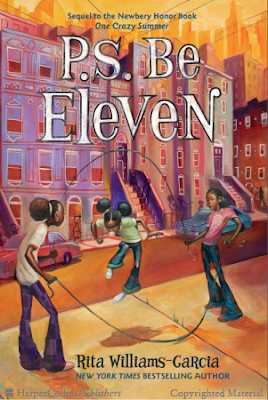
P.S. BE ELEVEN might have seemed, on the surface, less political. After the girls return home for the school year, they're immersed in the business of school, and home. Delphine faces major changes in her classroom, but learns the worth of a "Malcolm X Muslim" student in her classroom. The girls bear up under more of their endless grandmother's fussing, and must make peace with their father getting a girlfriend, and marrying her. Delphine's letters to her mother are filled, not with a little girl's thoughts, but with a growing young woman's questions. I love that her mother's constant refrain is Be Eleven. Be who you are, and where you are, right now. This is, of course, hard for an eleven-year-old to hear.

A more personal political exploration came from Uncle Darnell's storyline. Uncle Darnell, who, since being back from Vietnam, was sleepy-eyed and always sniffling. Uncle Darnell, whose dimpled never showed anymore, and whose protective, uncle ways changed dramatically. Though my story was ten years after this one - the war lasted so long - I was Fern's age with a beloved uncle home from Vietnam, and I remember vast and bitter disappointments of broken promises and zoo trips that never happened. I suspect that children in this generation who are losing beloved family to alcohol and opiates and PTSD in this endless state of war that we're in, might weep in recognition. Though many people expect a second book in a trilogy to be a place-holder or filler, P.S. BE ELEVEN, with its secondary theme of enabling and independence, has a poignancy that once again brought the struggles of families of color - and really, families of any kind - who have stepmothers, on-again-off-again best friends, and the vicious claws of addiction dug into them into painful clarity.

    Turning eight hadn't grown Fern any taller. It had just made her mouthy.

    "Where's my watch?" she repeated.

    "Safe in my drawer, where you won't lose it."

    "Well, I want it," Fern said. "And you can't keep it from me. If you don't cough it up, I'll tell Mrs."

    I shrugged. "Tell Mrs."

    "I'll tell her, and she'll tell you --"

    Then Vonetta, her ally, cleared her throat, fluttered her eyelashes, and finished ina voice as close to our stepmother's as she could mimic, "Delphine. Your sister is capable of wearing a watch." Capable was one of Mrs.'s words. She used it against me to make me stop helping my sisters. Vonetta is capable of doing her own hair Then Vonetta burned her ears with the hot comb, and who had to rub Vaseline on burned ears and finish pulling the hot comb through Vonetta's thick, thick head? Not Mrs.

    "Fine," I told them both. "And when you lose your watch, don't come crying to me."- GONE CRAZY IN ALABAMA, Williams-Garcia, p. 4
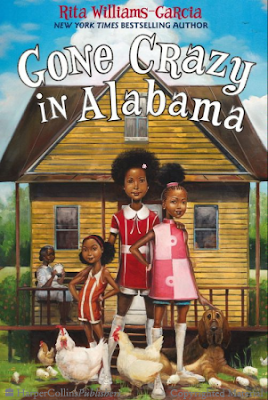
As the little sisters grow up, they begin to slip from Delphine's grip. Naturally, Delphine has gotten tired of gripping them - she expressed this in ONE CRAZY SUMMER, when she doesn't break up a fight between her sisters, preferring instead to take the tongue-lashing when her mother has to leave the sanctuary of the kitchen to deal with it, but once you become accustomed to being the one in charge, that position of First has a little you-shaped divot. Now that her father has married Mrs., Delphine is being required to walk back the need to finish all the sentences, do for three little girls and learn to worry about just herself - otherwise she's finding herself cast in the role of the oppressor, trying to keep her sisters down, in Mrs.'s way of thinking. Since Big Ma has moved back to Alabama, and they're spending the summer with she, and Ma Charles and Ma Charles' sister across the creek, Delphine, Vonnetta, and Fern are also having to come to grips with Uncle Darnnell - and Delphine tries to force forgiveness from her sister. As the personal moves to the political, Delphine's eyes are opened to the difference between Oakland, Brooklyn, and small-town Alabama when the Sheriff is both a cousin and a white man, and when an emergency and a hospital stay brings up that "same old story" that both Papa and their cousin JimmyTrotter are familiar with - boundaries, walls, and obstacles put in the road these characters must walk. Racial prejudice, which itself accompanies each book, takes a new form as the girls learn versions of their family history, and how knots in the ties that bind them have also served as ropes keeping her great-grandmother and her sister apart. The history explored in this novel will likely encourage readers to dig into their own pasts for weird little quirks, big family secrets, and places where history intersected with lived experiences.

Multiple layers of emotively personal and political history combine to braid together a narrative that is satisfyingly broad, yet very individually real. I cried tears of rage, grief, and laughter reading these books. Rita Williams-Garcia is a masterful storyteller.


I received my copies of these book courtesy of the Benicia Public Library. You can find ONE CRAZY SUMMER, P.S. BE ELEVEN, and GONE CRAZY IN ALABAMA, by the inestimable Rita Williams-Garcia at an online e-tailer, or at a real life, independent bookstore near you!

April 25, 2017

Turning Pages Reads: ROAD SIGNS THAT SAY WEST by SYLVIA GUNNERY

Welcome to another session of Turning Pages!

Synopsis: A content warning for suicide and troubling attention from adult men.When their parents depart on their long-planned for trip to Europe, 19-year-old Hanna springs the plan on her sisters, Megan and Claire - to take Mom's car the following day and go on a cross-country drive, from the Atlantic to the Pacific, Nova Scotia to Vancouver. Adventure, in the form of the Trans-Canada Highway is just a breath away - if they'll agree to it. 17-year-old Megan's not interested. She has a job and a life plan, to get fit for swim team tryouts come the fall, and she wants to stick to it. She likes adventure in measured, planned doses, nothing spur-of-the-second, like Hanna seems to always be. Claire, at fifteen, idolizes her older sisters, and only wants peace. If Hanna offers adventure, Claire wants to make sure she gets in on it - and that Megan goes along. And she does -- grudgingly -- briefly helping Claire create the united front of sisterhood. It lasts -- briefly -- until cracks begin to show.

There are other road-trippers along the way, hitchhikers, families, street buskers. Like a friendly butterfly, Hanna seems to alight on each one and engage with them, much to Megan's bitter observation. Aren't the sisters enough? Why does Hanna always have to go? Why can't she be average, like everyone else? She quits everything she starts - first University, then her nannying job in Italy, and now their big sisterhood trip. She talks them into attending the weddings of strangers, of bowling and partying, and she's not paying enough attention to Claire. She's such a sucky big sister.

There's something Hanna and Megan aren't telling Claire - something that happened with Hanna in Italy. Sometimes, Claire hates being the youngest, gets tired of keeping the peace between Megan's acid tongue and Hanna's blithe merriness. Can't Megan see there's something wrong with Hanna? No... of course not. Megan's suddenly got a crush on one of the people they meet along the road - and it's flaring up faster than Claire's ever seen. Hanna keeps disappearing, and Megan doesn't even notice. And, neither of her sisters can quite see that not all is well with Claire, either.

What started out as a lark turns into something deeper and broader, as the last summer three sisters are together ebbs and flows. They share a closeness and silently affirm their love, even as their good time eventually fades, like all things do, into memory.

Observations: This is a quiet book, a literary book, and a difficult story to cram between two plain paper covers. A sisterly Bildungsroman is both vast and deep; it covers the happenings over a summer, but also the tendencies of a lifetime thus far, in a way. The narrative is more a series of observations from inside the mind of each girl, and isn't always seamless. The "head-hopping" can be frustrating for a reader seeking a typical narrative with a rising narrative arc, and this book might be more appropriate to an older reader. I think it crosses over well into being an adult read.

Things happen in this novel, and yet, not much does. It's a road trip; there are long silences, periods of silent anger, spontaneous, giddy parties with strangers, and a lot of examining internal thoughts. Hanna thinks a lot about the terrible job in Italy, and the way it ended, with confusion and accusation of things which didn't happen - but things which, she is ashamed to admit, she dreamed of happening. Are we responsible for our dreams? Because we might want something, does that make us as bad as if we'd reached out and tried to take it? Does that mean we attract more of the same? Is it our fault?

Megan seems merciless; unforgiving, exacting, keeping count of how many times Hanna has disappointed her, to the detriment of her own enjoyment of life, and of her seeing Claire as anything but Hanna's yes-woman. When she finally thaws, her sisters are surprised -- but she freezes up again quickly. The novel unfortunately doesn't spend as much time with Megan, or on expository dialogue to help the reader see her inner mind, and the reader is left wondering what she really wants, except for her sister, Hanna, to stop leaving her behind. Her prickly resentfulness is shown at the end as a held-over childhood resentment, which makes her seem more pathetic than angry.

Claire's loss is recent enough that the shock hasn't finished with her. She's walking wounded, but doesn't know it, until she sits down long enough for the thoughts to filter through. It hits her, on this trip, that the friend she lost is never coming back, ever. She doubts herself, and second-guesses all of the conversations she had. Why hadn't she seen it coming? What does it say about her, that she missed so much pain? What if it happens again? Suddenly, Claire feels like a tiny speck in a massive world that has spun out of control... and her sadness is so great that it's crushing her. Maybe this is how her friend had felt, too...

The novel ends with trailing threads, and for some, the end will seem jarring. But, a road is a constant, just as the narrative of sisterhood and the process of growing, maturing, and separating is a common experience, in many ways. This constantly shifting narrative means that some things aren't resolved in this novel - bitterness remains bitter 'til the end, losses still pain, good times are ephemeral. The road goes on, but the one thing that remains is sisterhood. Despite everything, these girls will always be related.

Conclusion: Definitely not for the common crowd, this novel is made up of the pauses between growing pains, and will find its audience among those who have wished to draw closer to their families and see them as complex and enigmatic human beings, instead of the familiar souls they've always known. Perfect for people transitioning through stages of life, and wondering what more is out there.


I received my copy of this book courtesy of the publishers. After May 1, you can find ROAD SIGNS THAT SAY WEST by Sylvia Gunnery at an online e-tailer, or at a real life, independent bookstore near you!

April 14, 2017

Turning Pages Reads: VIGILANTE by KADY CROSS

Welcome to another session of Turning Pages!

NB: Content advisory for rape, suicide, and violence.

Synopsis: Junior year, Hadley's best friend, Magda, is assaulted at a party. Hadley doesn't understand why Magda doesn't speak up about it, retaliate against the boys who are catcalling her, and stiffen her spine. Hadley urges Magda to act, but Magda chooses not to, and Hadley is grief-stricken and enraged at the loss of her friend, and most of her rage centers on seeing the perpetrators in class every day. As her senior year goes forward, Hadley looks not to the future, but to the past, which remains to her out of balance. She sets herself as the avenger for Magda's death, encouraging girls to join a self-defense course and learn martial arts while plotting to provide the justice against the four boys that no one else has given them. Along the way, she grows closer to Magda's brother, and begins a wave of pink ski-mask vigilantism to save other women from bad situations. This is the basic narrative, without providing too much detail or spoilers.

Observations: Content advisory again: this novel is pretty violent, and some of the scenes of violence are pretty sustained, and I skipped them. Normally, I wouldn't review a novel I skipped part of, but I picked up this novel because the jacket copy said it was a "brutally honest" look at retribution - and since I'd just read a novel on someone faking being who they were, I thought "honest" was a good thing. I assumed that a female main character taking matters into her own hands would be somewhat empowering - and I know other people may come to this work with that in mind.

The biggest problem that I had with Vigilante - one of many problematic things - is how Hadley implies, in a variety of ways, that Magda is at fault for her rape. I know that's framed in their disagreement in the beginning of the novel as 'a bad thing to say' and the kickoff for the narrative arc and Hadley's vigilantism, but the same is implied elsewhere, later, and the novel doesn't really take it back. For example, as Hadley implies that is doing what Magda should have done, as she learns martial arts and physically empowers herself. Unfortunately, physical power does not guarantee that you can repel a physical attack, and the novel doesn't seem to really take much time to point this out. Hadley is very, very secure in her physical prowess, as if women who are not are somehow taking a chance with their ...safety, and thus somehow doing something wrong. Someone asks Hadley and the detective leading her self-defense course "shouldn't we be teaching men not to rape?" and Hadley says, "Yeah, good luck with that," which... yeah. I'm aware that the character is written in part to be an unreliable narrator, but unfortunately the narrative itself doesn't work through some of her unreliableness.

Early in the novel, Hadley evinces her interest in Magda's brother. Their relationship leaps into reality after Magda's death, and that didn't work as realistic entirely for me - although I do understand how loss can lead people into a physical expression of "we're still alive," but attraction and arousal was a strange third party to a novel about grief, and it seemed to float around just as awkwardly in scenes which would have otherwise been Magda centered. This seemed like the pitfall of All YA Novels Must Have Romance, and... no.

I assumed that the narrative would point out the problems inherent in that ideology. They didn't really. Instead, the novel seemed to glorify actions taken in a white-hot rage, almost identifying Hadley as a superhero, with copycats and a special name, even going so far as to contemplate sexual assault against someone (which she says there's no such thing as sexual assault against a man - oh, yes there is, and the novel doesn't correct her assumption on that, either), in the name of making right her friend's assault - an assault she's allegedly decrying by her actions. She spends inordinate amounts of time in the novel worrying about getting caught, yet her repeated behaviors almost seem as if she's hoping she does -- she wants to talk about This Elephant In The Room -- Magda, whom she feels no one cares about but her, thinks about but her, or talks about as they should - but her. This exaggeratedly centering herself in someone else's story persists throughout the novel. In the end, she's the "heroine" of the piece, which didn't work for me.

Conclusion: This book has a lot of action, a lot of roaring, feel-good kind of anger, and a righteous cause, but I feel like it has more problems than I'm comfortable recommending along with it. Readers who like a riproaring, girls-kick-butt kind of narrative, and don't worry about subtext may enjoy it.


I received my copy of this book courtesy of Harlequin Teen. You can find VIGILANTE by Kady Cross at an online e-tailer, or at a real life, independent bookstore near you!

January 09, 2017

Monday Review: FALLING OVER SIDEWAYS by Jordan Sonnenblick

So yeah, my goal here is to not let my normal urge to be terrifyingly exhaustive or my inexplicable desire to adhere to established organizational habits keep me from posting a book review. Therefore this is a quicker one, but it doesn't mean I liked the book less or anything of that nature. It JUST MEANS that I'm busily working on a) a novel rewrite that is kicking my butt, and b) Cybils Round 2 judging (I'm reading several excellent graphic novels that I'll post about after the winners are announced).

Summary: I read one of Jordan Sonnenblick's novels quite some time ago (long enough ago that I'm not 100% sure which one it was, but I think it was Drums, Girls, and Dangerous Pie) and really remember loving the sense of humor--and also hating the font in which it was typeset. Anyway, I've been meaning to pick up another one ever since, and Falling Over Sideways showed up in my 3M Cloud Library app, so I took the opportunity to read it.

Fortunately, the font is less of an issue when you're e-reading, but aside from issues that only graphic design nerds care about, I enjoyed this story as well. Again, the author brings an unexpected and poignant sense of humor to really serious family health issues--in this case, 8th grader Claire's father suffers a sudden stroke, and she is the only one at home to witness it and call in the emergency. As if the huge changes at home weren't enough, school is also providing one aggravation after another, mainly in the form of the annoying, not-quite-but-pretty-much-almost-a-bully Ryder, who competes with her in everything, including jazz band.

Observations: The two things I really enjoyed about this book: 1. The portrayal of the parents and Claire's family in general--they are sympathetic, funny, and very real. 2. The portrayal of the kids who bug Claire at school rang true for me. These aren't necessarily out-and-out bullies, but those kids who are just really, REALLY annoying and get on your last nerve. There's a lot of exploration of WHY those types of kids behave the way they do; the reader's able to have sympathy for them, too, and learn to love them and to realize that middle school kids behave like jackasses for all kinds of reasons.

Conclusion: This was a quick read and an interesting portrayal of serious family trauma that is nevertheless not too heavy for younger middle grade readers.


I received my copy of this book courtesy of my library's ebook collection. You can find FALLING OVER SIDEWAYS by Jordan Sonnenblick at an online e-tailer, or at a real life, independent bookstore near you!

November 28, 2016

Monday Review: REALITY BOY by A.S. King

Synopsis: I picked this one up (and got it signed; woot!) at the most recent Kidlitosphere Conference in Wichita—somehow I missed it when it came out a few years ago, but I'm so glad I went back for it, because it's up there with my favorite A.S. King novels.

Picture one of those awful, Nanny 9-1-1 reality TV shows that were so popular there for a while. Now, imagine being a teenager, and having been one of the luckless kids who was featured on such a show as a toddler, too young to have any say about it. Imagine you'd been acting out your anger at your manipulative older sister in all kinds of sad and horrible ways, but thanks to oblivious parents and heartless TV studio execs, you're the one who takes the blame. That's what happened to Gerald Faust. Now seventeen, he's biding his time until he graduates, working a job at the local sports arena and still working on his anger issues. You'd be angry, too, if all the kids at school knew you as "the Crapper" and your awful sister was still living in the basement, making your life hell.

Gerald feels very much alone at the beginning of this novel, but it is those who dare to reach out to him that begin to truly open him up to the world: his boss at the arena, who is everything his mom isn't; and Hannah, a girl with enough troubles of her own that she doesn't seem to care about Gerald's past. In tiny ways, and then in more pronounced ways, his walls start to come down, and his life starts to change. And, to his surprise…he finds hope out there beyond the walls.

Observations: This story was incredibly gripping, told as it was in alternating sections: Gerald's childhood on the TV show, and his experiences with the TV nanny, are juxtaposed with his present-day life and tribulations with schoolmates and family. Some of his problems are new, and some of them just never went away…and through it all, he struggles with his anger and powerlessness. Overcoming his anger, and realizing the power that he DOES have, is one of the core themes of this book. Feeling powerless, feeling like you're subject to the whims of your family and those around you—it's basically a childhood/adolescent truism, but Reality Boy takes it to heretofore unexplored heights.

I had so, SO much sympathy and righteous anger on behalf of Gerald—how could parents do something like that? How could they raise their children in such a dysfunctional way?—and yet these types of small tragedies happen every day, albeit not necessarily in such visible ways. Still, the presence of the media panopticon in this story is frighteningly relevant.

Conclusion: A.S. King does such an incredible job of telling Gerald's story here, making us feel for him AND feel his anger—and making us root for him to heal. Fans of her books won't want to miss this.


I purchased my copy of this book from Watermark Books in Wichita. You can find REALITY BOY by A.S. King at an online e-tailer, or at a real life, independent bookstore near you!

November 02, 2016

Cybils Speculative Reader: FLAWED by CECILIA AHERN

Welcome to the 2016 Cybils Speculative Reader!

As a first run reader for the Cybils, I'll be briefly introducing you to the books on the list, giving you a mostly unbiased look at some of the plot.

Enjoy!


One of the strengths of speculative fiction is allowing a reader to look at a subject without the trappings of modern society. This is what makes dystopian novels such a useful blank slate on which to dissect an idea. Many readers felt last year's ALL AMERICAN BOYS was a good starting point for discussing police violence in society; I maintain that this novel will work better for those who feel that issues are too political in current events. This novel takes place... elsewhere, which maybe makes it easier to see how the labeling of imperfection in the flawed hands of a abusive State can hurt, especially in terms of a young person of color's (the family is biracial) imperfect performance of adulthood.

Readers should be advised that there are descriptions of violence in this book.

       “HARP!” I shout at the police officer, feeling the anger fully within me now. I learned this at school. I learned all this. Why doesn't he know these basic principles that I was taught, that he was surely taught too? Why doesn't anybody in the real world do what we're taught? H is for honesty,” I say, hearing the tremble in my voice, not from fear but from anger. ... A is for accountability. Accepting individual responsibility and ensuring public accountability... R is for respect. Having respect for people, their human rights and their needs.”
       The police officer lifts the baton from his hip belt.
       “Whoa, now,” the man to my right says. “What are you going to do with that?”        “You keep quiet,” he says, sweat on his upper lip now.
       “She's just a child,” a woman calls out. “For the love of God, would you all leave her alone.”
       Her desperate cry introduces a whole new wave of emotion.
       “And you” - he looks at me menacingly - “need to keep your mouth shut. Understand?”
       I take a deep breath. I'm not finished. It would be logical to at least finish what I was saying before the inevitable happens... Professionalism,” I say finally, gently, just to the police officer. “Providing a professional policing service to all communities.”


from FLAWED, p. 309-10

Synopsis: Celestine's mother is a model, so she knows how to walk the walk, to stand tall and straight and let the world look. If you're flawless, you shouldn't gloat, but you definitely should own it. Sure, Mom gets a little help with her flawless look, but that's okay - nobody's perfect. Celestine isn't perfect, either, but she's specific. Exact. Her skill in mathematics and her linguistic prowess are something her boyfriend, Art, laughs at her about a great deal, but she doesn't mind. She likes definitions, things that have boundaries, rules that clearly edge the path she must walk. Because she lives in the Guild, where the highest ideal is to be Flawless, Celestine is in good company. It's a horrific thing to be Flawed; to wear on your skin the brand which tells the world how you fell from grace. Whether it's on your temple, your hand, your foot, chest, or your tongue, the world will still know by the red band you're legally obliged to wear on your sleeve. Nobody wants to be Flawed, so nobody pushes the envelope.

Well, Celestine's sister, Juniper, does. Though they appear to be almost twins, Juniper is grumpy, sarcastic, and always seems pissed and on edge. She's linguistically vague, too, which bugs Celestine a great deal, but at least she's consistently inconsistent. She always pushes authority. Celestine never does. She's always late, always a disaster, always trying to stand out from the family - Celestine's total opposite... until one day, Celestine acts from the heart -- not from the predigested set of rules the Guild lives by. Juniper is frozen in fear, Art tries to hold her back, but it's all too late. And when they come for Celestine, she is shocked.

But, are they right? Is she Flawed to the bone? Or, are the Flawed - the imperfect ones, marked and ignored in society - not the ones violating the laws of human decency? Not the ones who are wrong?

Observations: Celestine is flawed.

She's human.

She's a human teen.

She makes mistakes - big ones. Dumb ones. She clearly doesn't believe people's true colors once they've shown them. She's naive. She was sheltered. She is swollen like a tick on her privilege, and it makes her blind to the pitfalls of the society in which she lives. When that life ends for her, when she is treated as others who have fewer privileges, it is a short, sharp, shock. She reels. She hates herself. She rejects the truth she knows. And then, she decides to own it.

Readers who has been quiet and good, hopeful that their "respectability' would save them from whatever, if they just kept your head down and were nice, will find that this book resonates strongly. Readers who have been pressured and have "gone along to get along," and found themselves doing so with a stomach ache will also find this book to resonate. Taking our choices in our hands and saying "NO" to what we perceive as injustice and wrong in this society, whatever the cost, has never been as serious an issue as it is now, and this book just blew me away with how seriously it presented these issues.

When you decide to own your power, that's when you make a difference in the world.

Conclusion: Though the novel doesn't quite end with a cliffhanger, Celestine begins her journey in her new understanding at its conclusion. Readers who've only read Ahern's adult work aren't sure what to make of this book, but I think many young adults will find this worth their while, and if you're looking for a valuable tool to open discussion on society, our place in it, and how we change it... have I got a book for you!


I received my copy of this book courtesy of my public library, but this is a BUY book for me. You can find FLAWED by Cecelia Ahern at an online e-tailer, or at a real life, independent bookstore near you!