Showing posts with label mocumentary. Show all posts
Thursday, 15 January 2015
Low-Budget Film Fest: Found Footage/Mockumentary Edition
Found footage was invented for the low/no budget filmmaker to exploit. That, of course, hasn't stopped high profile directors and studios from hijacking the FF bandwagon. Unsurprisingly, big-budget FF movies are often less well made than their low-budget country cousins, the result of confusing money for creativity.
Here's a short list of brilliant FF and mockumentary movies, made on the cheap. I could go on about how the proof is in the pudding, but the mention of pudding has made me hungry. Onto the list!
The Blair Witch Project
BWP should have launched the FF genre but that wouldn't happen for another ten years. Made for $30-50K, depending on who you read, the movie scared the crap outta audiences with the mere suggestion of a monster living in the woods.
The Last Broadcast
Made for an estimated $900, and released a year before BWP, The Last Broadcast is a more accomplished but less well-known take on the monster-in-the-woods trope. Unfortunately, the ending is terrible and completely ruins the film. But everything up to that point is amazing.
Lake Mungo
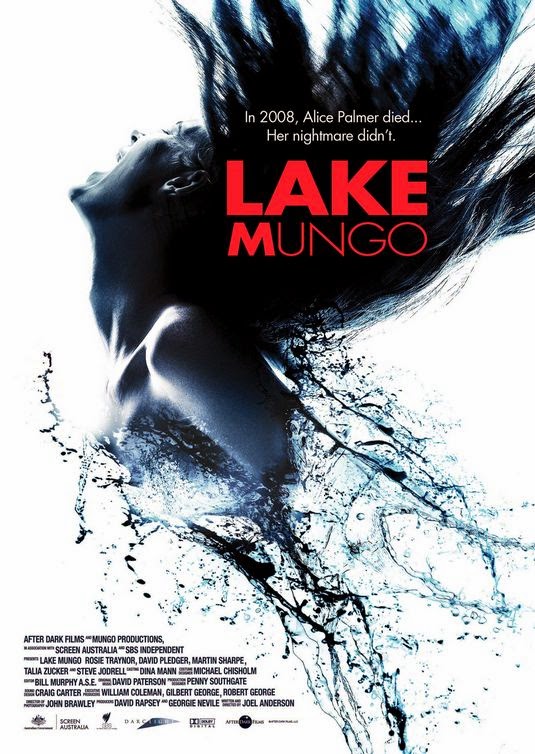
A fake documentary about how a family deals with grief, Lake Mungo is very nearly perfect in its verisimilitude. This slow burning film is less scary than the others on this list, but the climax will leave you cold. It's impossible to say anything more about the movie without spoiling it, so just go see it already.
The Conspiracy
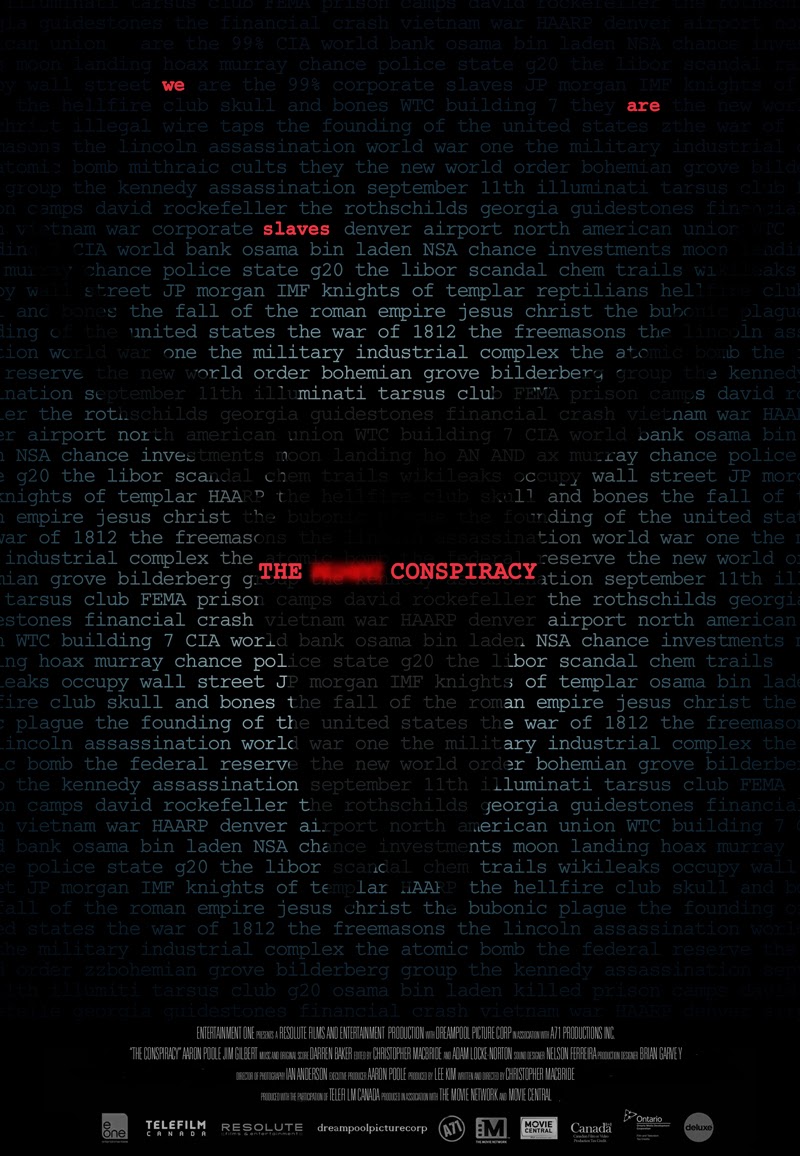
This mockumentary about a conspiracy theorist weaves together documentary and found footage to tell its story. What begins as a run-of-the-mill doc about an unbalanced conspiracy nut is, in fact, a meta-text about conspiracies. Listen to my interview with the director. But also, see this movie.
Ghostwatch
The infamous British TV broadcast. In a modern-day version of Well's War of Worlds, Brits tuned into the BBC1 on Halloween 1992 and thought they were watching a live broadcast from a haunted house in London. Viewers were so upset with the show that it was banned for ten years. Even watching it now, knowing that it's a fiction, doesn't lessen the impact of the story or its scares.
Behind the Mask: The Rise of Leslie Vernon
I have no idea how much this cost to make, but I'm guessing less than my $3M cutoff. If you love slashers, you'll appreciate all this mockumentary has to offer. Behind the Mask is an intimate look at the life of a slasher villain, at the challenges he faces, and the planning and detail that goes into successfully executing his killing spree.
Long Pigs
Ever wondered why or how a man becomes a cannibal? Long Pigs answers that question. Two documentary filmmakers stumble upon a serial killer/cannibal who agrees to let them film his exploits. Although you can imagine how it ends, the meat of the film is dedicated to profiling the cannibal. At times funny and disturbing, it's a good little film that's worth seeing. DO NOT confuse this movie with Long Pig (2008), a long and boring diatribe about the evils of corporate greed.
Honourable Mentions:
Devil's Pass
This Renny Harlin-directed FF movie seeks to answer the mystery of what happened to the ill-fated hikers who died in Dyatlov Pass in 1959 (true story). The answers, when they come, are completely unexpected. The film has received middling reviews but it's creative in ways other lower-budget films can't afford to be, and I rather liked it.
Troll Hunter
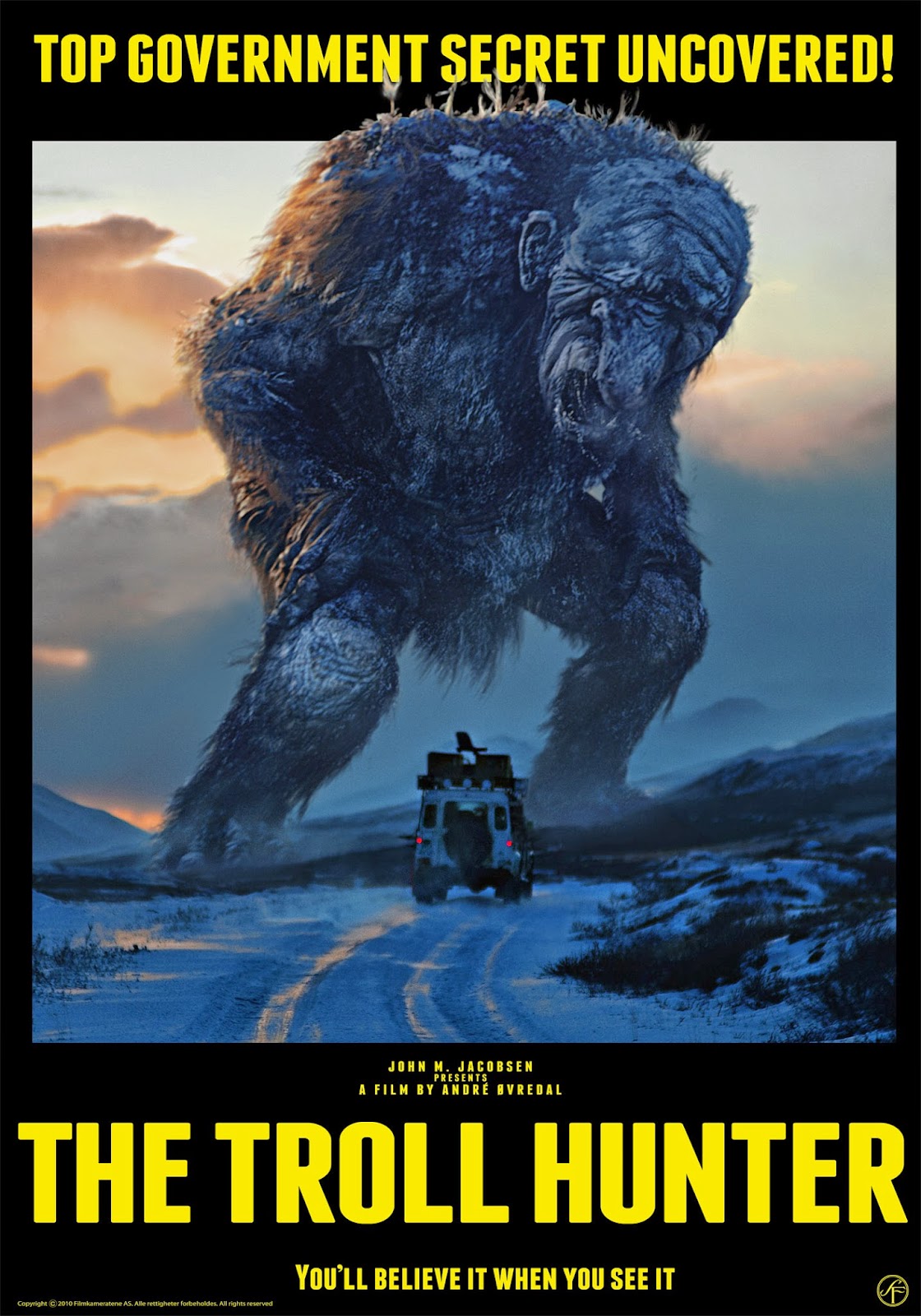
Screw Cloverfield. If you really want to see an FF movie with giant monsters, Troll Hunter is the one to watch. What Cloverfield failed to grasp is that no one gives a damn about the people and their plight--everyone just wants to see the monsters. Troll Hunter is a delightful FF movie about a group of documentary filmmakers who stumble upon then follow around a government-paid troll hunter.
Labels:
found footage,
low-budget,
mocumentary
Monday, 18 February 2013
Trailer Review: Bioshock Infinite
Normally I use this space to mock movie trailers and the movies they're trailering. But not today! This time I'm going to praise a game trailer. Two game trailers, actually.
Trailer the first:
Trailer the second:
I remember seeing a trailer for Bioshock Infinite about a year ago. It was your standard game trailer, showcasing the game's art and design. I thought it looked amazing. And then, just this morning I had the good fortune to catch two more recent ads. The trailers perfectly capture the look and feel of a (pseudo)history documentary series from the late '70s or early '80s.
The first in the series was particularly resonant for me because I finished reading Devil in the White City a couple of days ago, a book that details the building of the World's Fair. Having read the book, I could easily contextualize the trailer's content, which made the whole thing seem that much more real. I understand that most viewers won't have this same experience, but that doesn't lessen the trailer's genius or its impact. The historical context of the World's Fair, the blending of game art with historical photographs, blur the lines between fact and fiction. The mockumentary format helps to further the mystery of Columbia, inviting viewers to join narrator Alistair Bloom on a journey of discovery.
The second trailer, I think, surpasses the first, which is saying a lot. Here the mystery deepens as we learn a bit more about Columbian culture and history. Legend speaks of a great bird, but we know precious little about it is and what it does. Again, the mockumenary format draws us in, this time with more recent discoveries relating to Columbia's society and fate.
Trading on nostalgia, the way these trailers do is a tricky move. The style will appeal to older gamers but it runs the risk of alienating younger players unfamiliar with this kind of filmmaking. The skill involved in the trailers' production, however, may overcome the generation gap. The storytelling in the trailers is first-rate, suggesting the game itself will weave an epic tale of mystery and intrigue.
If only movie trailers were as good at telling stories and selling their films.
Trailer the first:
Trailer the second:
I remember seeing a trailer for Bioshock Infinite about a year ago. It was your standard game trailer, showcasing the game's art and design. I thought it looked amazing. And then, just this morning I had the good fortune to catch two more recent ads. The trailers perfectly capture the look and feel of a (pseudo)history documentary series from the late '70s or early '80s.
The first in the series was particularly resonant for me because I finished reading Devil in the White City a couple of days ago, a book that details the building of the World's Fair. Having read the book, I could easily contextualize the trailer's content, which made the whole thing seem that much more real. I understand that most viewers won't have this same experience, but that doesn't lessen the trailer's genius or its impact. The historical context of the World's Fair, the blending of game art with historical photographs, blur the lines between fact and fiction. The mockumentary format helps to further the mystery of Columbia, inviting viewers to join narrator Alistair Bloom on a journey of discovery.
The second trailer, I think, surpasses the first, which is saying a lot. Here the mystery deepens as we learn a bit more about Columbian culture and history. Legend speaks of a great bird, but we know precious little about it is and what it does. Again, the mockumenary format draws us in, this time with more recent discoveries relating to Columbia's society and fate.
Trading on nostalgia, the way these trailers do is a tricky move. The style will appeal to older gamers but it runs the risk of alienating younger players unfamiliar with this kind of filmmaking. The skill involved in the trailers' production, however, may overcome the generation gap. The storytelling in the trailers is first-rate, suggesting the game itself will weave an epic tale of mystery and intrigue.
If only movie trailers were as good at telling stories and selling their films.
Labels:
game trailers,
mocumentary,
nostalgia
Thursday, 3 March 2011
The Last Horror Movie
I really don't have much to say about this one, but I feel I need to comment nonetheless.
I watched it because it purports to be a movie about snuff. Yeah, I know how that sounds. But anyway, the synopsis went something like this: Kevin has taped over the VHS copy of a film called "The Last Horror Movie" with his own snuff film. He arrives at the home of the renters and then kills them, adding their deaths to the video.
Seems promising, right?
Now that I've actually seen The Last Horror Movie, I'm here to tell you that it is not at all what that synopsis suggests. Yes, there's a video that's been taped over. And yes, there's a Kevin that goes around filming murders. But this movie isn't about that, it is that.
I've got no problems with mocumentaries. I've got few problems with recursive horror movies. But I've got a lot of problems with recursive mocumentaries that are self-conscious and self-aware to the point of diminishing their postmodern premise. The Last Horror Movie is little more than one man's sophomoric philosophizing on morality and psychopathy.
Kevin's waxing is repetitive and tiresome. Also, he fails to understand the difference between knowing right from wrong and caring about it. This misunderstanding fuels a lot of his discussion. He's also impossibly egotistical, which I suppose is an effect of him being psychopathic, but really it's just irritating. The kills are good, I have to say. And there is one funny moment, when Kevin comments on self-conscious horror movies--it's delightfully self-reflexive, but it can't redeem the film's overblown sense of self-importance.
I watched it because it purports to be a movie about snuff. Yeah, I know how that sounds. But anyway, the synopsis went something like this: Kevin has taped over the VHS copy of a film called "The Last Horror Movie" with his own snuff film. He arrives at the home of the renters and then kills them, adding their deaths to the video.
Seems promising, right?
Now that I've actually seen The Last Horror Movie, I'm here to tell you that it is not at all what that synopsis suggests. Yes, there's a video that's been taped over. And yes, there's a Kevin that goes around filming murders. But this movie isn't about that, it is that.
I've got no problems with mocumentaries. I've got few problems with recursive horror movies. But I've got a lot of problems with recursive mocumentaries that are self-conscious and self-aware to the point of diminishing their postmodern premise. The Last Horror Movie is little more than one man's sophomoric philosophizing on morality and psychopathy.
Kevin's waxing is repetitive and tiresome. Also, he fails to understand the difference between knowing right from wrong and caring about it. This misunderstanding fuels a lot of his discussion. He's also impossibly egotistical, which I suppose is an effect of him being psychopathic, but really it's just irritating. The kills are good, I have to say. And there is one funny moment, when Kevin comments on self-conscious horror movies--it's delightfully self-reflexive, but it can't redeem the film's overblown sense of self-importance.
Labels:
mocumentary,
philosophy,
snuff
Thursday, 3 December 2009
Behind the Mask: The Rise of Leslie Vernon
I have complained at length, here and on TheAvod, about self-reflexive cinema. In the post-Scream era, a lot of people jumped on the postmodern bandwagon, but it seemed they forgot why that movie was such a success. It wasn't because it folded in on itself, but how it did so. Scream was self-aware without being self-conscious about it, but it's just the opposite for a lot of horror films today. If a movie takes itself seriously, then it shouldn't draw attention to itself with ironic, and often poorly written, insight.
Now, that's not to say that I don't enjoy postmodern horror, I just find that most of it is terribly done. So you can understand that I was a bit anxious when I sat down to watch Behind the Mask. The movie blends mocumentary with narrative film to tell the story of Leslie Vernon's attempt to become a legendary serial killer in the same vein as Jason, Freddy, and Michael.
Many years ago, Leslie Vernon was taken from his home by an angry mob after he brutally murdered his abusive parents. Leslie was thrown from the top of a waterfall and was never seen or heard from again. Some say that if you till the soil in the Vernon apple orchard under a havest moon, the dirt will become thick with blood, and if you listen close, you can still hear the creaks and groans of his mother's body as it hangs from a tree, swaying in the wind. Now, years later, Leslie has returned to his ancestral home to murder a group of kids partying in his house. And grad students, Taylor, Doug, and Todd are there to document it.
Taking a page from Man Bites Dog, Behind the Mask is about a group of documentary filmmakers who follow Leslie around as he plans is killing spree, and they even help out once or twice. In the world of the film, Jason Voorhees and the like are real people, and Leslie hopes to become like them--iconic. So he plans and works hard to ready himself for his big night. And while we follow him as he stalks his "survivor girl" and tours us around his property, he tells us about what it means to be a killer, how it all works.
Most people don't know that it takes months of planning and preparation to select the right group of kids, and choose the right final girl. A killer has to make sure he can accurately predict what people will do, where they will run to. And a killer has to work hard to train his body and his mind to withstand the endurance trail that is the horrific killing spree. Leslie walks us through these revelations with good cheer and introduces us to his mentor, Eugene, who terrorized nubile teens back in the 60s.
To counter Leslie's moral ambiguity and general cheerfulness is Taylor, the documentary's director and host. She's clearly opposed to what Leslie plans to do, but has committed herself to documenting his story, and tempers her outrage with the false hope that Leslie might not actually follow through. Only when Leslie claims his first victims, does Taylor fully understand the kids are in a horror movie.
Behind the Mask uses all the stereotypes and archetypes we've come to expect from horror to pit the genre against itself in what might be the most successfully recursive horror movie I've ever seen. Not only does the movie provide a humorous discourse on genre expectations, it also breaks down genre analysis by explaining how imagery is used to communicate ideas about characters and story.
If I had to complain about something (and let's face it, I usually do) it would have to be Taylor. Once she figures out Leslie's endgame, she fails to use her insider knowledge to her advantage and continues to operate within the confines of Leslie's horror movie. This would suggest a kind of inevitability, that horror movies generally work off the same standard script. I don't really have a problem with this, but I would have preferred if Taylor at least tried to break free from convention only to find that she can't.
The rest of the movie, however, is wonderfully done. The documentary sequences are delightfully crummy, and Leslie himself is very engaging and his enthusiasm is infectious. The film also features Robert Englund, and that's always a plus. I really enjoyed Behind the Mask, and it's given me a new appreciation for all the hard work that Jason, Freddy, and Michael do.
Now, that's not to say that I don't enjoy postmodern horror, I just find that most of it is terribly done. So you can understand that I was a bit anxious when I sat down to watch Behind the Mask. The movie blends mocumentary with narrative film to tell the story of Leslie Vernon's attempt to become a legendary serial killer in the same vein as Jason, Freddy, and Michael.
Many years ago, Leslie Vernon was taken from his home by an angry mob after he brutally murdered his abusive parents. Leslie was thrown from the top of a waterfall and was never seen or heard from again. Some say that if you till the soil in the Vernon apple orchard under a havest moon, the dirt will become thick with blood, and if you listen close, you can still hear the creaks and groans of his mother's body as it hangs from a tree, swaying in the wind. Now, years later, Leslie has returned to his ancestral home to murder a group of kids partying in his house. And grad students, Taylor, Doug, and Todd are there to document it.
Taking a page from Man Bites Dog, Behind the Mask is about a group of documentary filmmakers who follow Leslie around as he plans is killing spree, and they even help out once or twice. In the world of the film, Jason Voorhees and the like are real people, and Leslie hopes to become like them--iconic. So he plans and works hard to ready himself for his big night. And while we follow him as he stalks his "survivor girl" and tours us around his property, he tells us about what it means to be a killer, how it all works.
Most people don't know that it takes months of planning and preparation to select the right group of kids, and choose the right final girl. A killer has to make sure he can accurately predict what people will do, where they will run to. And a killer has to work hard to train his body and his mind to withstand the endurance trail that is the horrific killing spree. Leslie walks us through these revelations with good cheer and introduces us to his mentor, Eugene, who terrorized nubile teens back in the 60s.
To counter Leslie's moral ambiguity and general cheerfulness is Taylor, the documentary's director and host. She's clearly opposed to what Leslie plans to do, but has committed herself to documenting his story, and tempers her outrage with the false hope that Leslie might not actually follow through. Only when Leslie claims his first victims, does Taylor fully understand the kids are in a horror movie.
Behind the Mask uses all the stereotypes and archetypes we've come to expect from horror to pit the genre against itself in what might be the most successfully recursive horror movie I've ever seen. Not only does the movie provide a humorous discourse on genre expectations, it also breaks down genre analysis by explaining how imagery is used to communicate ideas about characters and story.
If I had to complain about something (and let's face it, I usually do) it would have to be Taylor. Once she figures out Leslie's endgame, she fails to use her insider knowledge to her advantage and continues to operate within the confines of Leslie's horror movie. This would suggest a kind of inevitability, that horror movies generally work off the same standard script. I don't really have a problem with this, but I would have preferred if Taylor at least tried to break free from convention only to find that she can't.
The rest of the movie, however, is wonderfully done. The documentary sequences are delightfully crummy, and Leslie himself is very engaging and his enthusiasm is infectious. The film also features Robert Englund, and that's always a plus. I really enjoyed Behind the Mask, and it's given me a new appreciation for all the hard work that Jason, Freddy, and Michael do.
Subscribe to:
Posts (Atom)


.jpg)


