The power goes out about 10 seconds in
Not good
We now have some information on
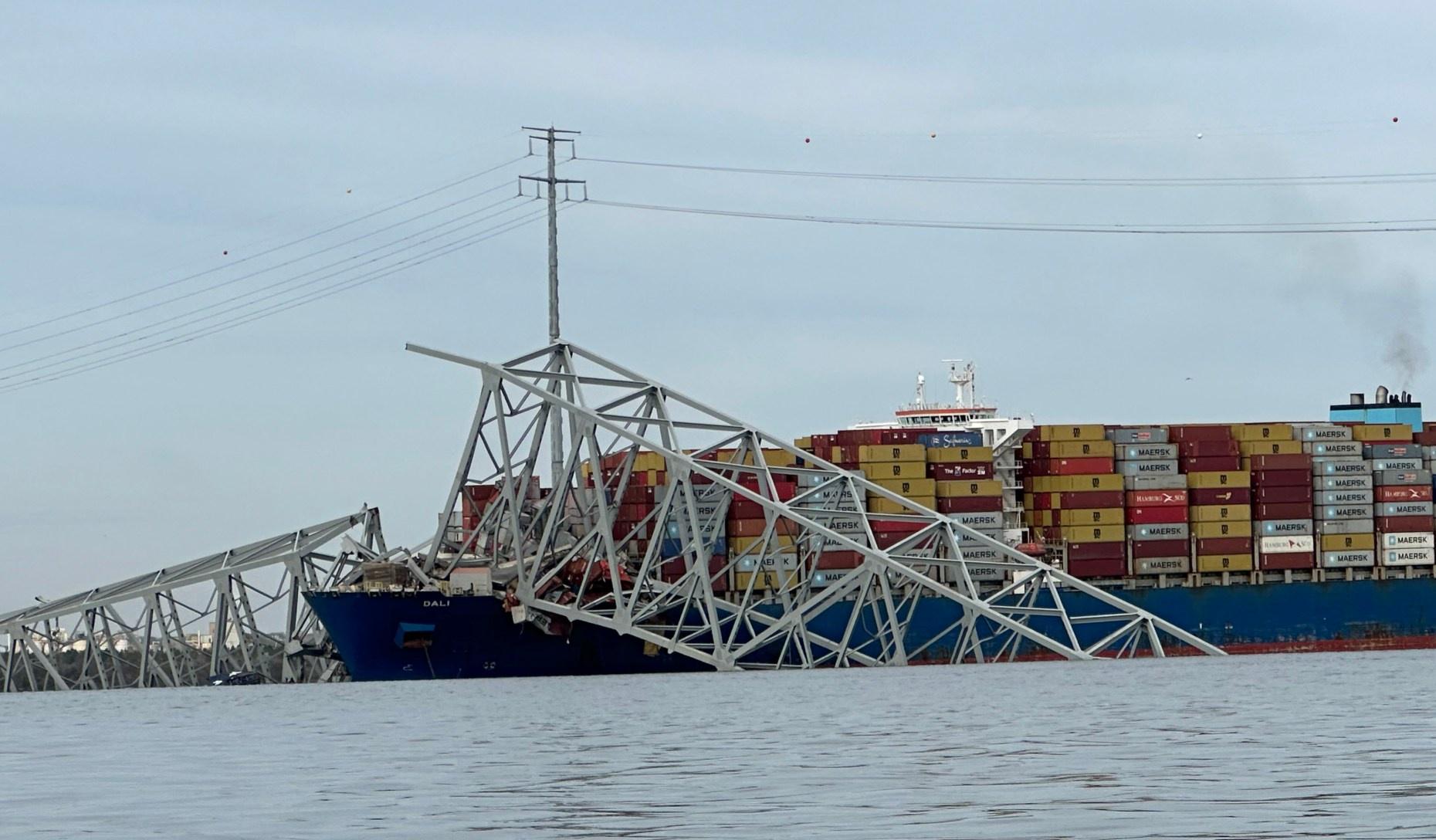
the container ship that took down the Francis Scott Key Bridge at the mouth
of Baltimore harbor.
The ship, the MV Dali was, if you cannot tell by the prefix, a diesel powered
container ship, 300m long, and about 116,000 tons, so it was almost as long as
a Ford Class carrier, and had about 15% more mass.
From this video, it appears that there was some sort of power failure, and a
loss of steering, with the lights going off at least 3 times.
It is known that the ship sent out a Mayday before hitting the bridge.
That, and the voluminous smoke from the stack before impact, which implies
that they tried to reverse to slow down, seems to reinforce this.
BTW, there is a lot of kinetic energy in play here, it looks like it was doing
about 7 knots (3.6m/s) and at maximum weight, you are looking about 682 mJ of
energy. Given that TNT has a an energy contendt of 4.184 MJ/kg, this
means that the impact was likely equivalent to somewhere around 100-160 kg of
TNT applied directly to the bridge support.
That bridge was going down after that.
The bridge is toast, and at least 6 construction workers are missing and
presumed dead:
A massive container ship adrift at 9 mph issued a “mayday” early Tuesday as
it headed toward the iconic Francis Scott Key Bridge, losing power before
colliding with one of the vital support columns. As the 984-foot vessel
struck the bridge in the middle of an otherwise calm night, it caused a din
that woke people ashore and immediately toppled an essential mid-Atlantic
thoroughfare into the frigid waters.
The effects were immediate
and catastrophic: Authorities began searching for six construction workers
who had been repairing potholes on the Interstate 695 bridge at the time of
the collapse. By Tuesday evening, their employer said they were presumed
dead, and the Coast Guard said it was ending rescue efforts.
The
ship, a Singapore-flagged vessel named Dali with thousands of containers on
it, departed the Port of Baltimore around 1 a.m., then quickly ran into
trouble. It’s unknown what, precisely, caused the collision at 1:27 a.m.,
but the ship reported losing power just before it struck the bridge. The
National Transportation and Safety Board is investigating the accident —
which authorities said does not appear to be intentional nor an act of
terrorism — but had not boarded the vessel to collect evidence, such as
recorders, as of Tuesday afternoon.
It did not want to disturb
the more pressing matter: search efforts led by the U.S. Coast Guard. But
Tuesday night, Rear Adm. Shannon Gilreath said the rescue efforts would be
suspended.
“Based on the length of time that has gone on in the
search, the extensive search efforts that we’ve put into it, the water
temperature, at this point we do not believe we are going to find any of
these individuals still alive,” Gilreath said.
The water temperature in the bay at this time of year is around 47°F/8°C, so
the it's hihgly unlikely that anyone would have survived in that water for
more than an hour.
Two people — one who was briefly hospitalized and another who declined a
trip to a hospital — were rescued, authorities said.
Who the f%$# decides, after falling 180 feet into Baltimore Harbor, not to go to
the hospital?
Oh, yeah, the ambulance probably wasn't covered by their health
insurance. (F%$# private healthcare)
………
As for the bridge itself, which opened in 1977 after five years of construction, Federal Highway Administration records indicate the bridge had been considered in “good” or “fair” condition going back at least three decades. A 2023 Maryland Transportation Authority inspection found the bridge to be in “overall satisfactory condition.”
[Maryland Governor Wes] Moore said the bridge was “fully up to code” and Benjamin W. Schafer, a Johns Hopkins professor of structural and civil engineering who reviewed video of the incident, said he didn’t see anything that immediately stood out as a “red flag” in regard to the bridge’s structural integrity. He called the collapse “more of an acute event.”
The bridge had two supports holding it up; if you take one away, “it’s not a bridge anymore,” he told The Sun.
I would be remiss if I did not note that the ship's owner, Maersk, was recently subject to penalties for retaliating against a whistle-blower.
The company that chartered the cargo ship that destroyed the Francis Scott Key Bridge in Baltimore was recently sanctioned by regulators for blocking its employees from directly reporting safety concerns to the U.S. Coast Guard — in violation of a seaman whistleblower protection law, according to regulatory filings reviewed by The Lever.
Eight months before a Maersk Line Limited-chartered cargo ship crashed into the Baltimore bridge, likely killing six people and injuring others, the Labor Department sanctioned the shipping conglomerate for retaliating against an employee who reported unsafe working conditions aboard a Maersk-operated boat. In its order, the department found that Maersk had “a policy that requires employees to first report their concerns to [Maersk]... prior to reporting it to the [Coast Guard] or other authorities.”
Federal regulators at the Occupational Safety and Health Administration, which operates under the Labor Department, called the policy “repugnant” and a “reprehensible and an egregious violation of the rights of employees,” which “chills them from contacting the [Coast Guard] or other authorities without contacting the company first.”
Maersk’s reporting policy was approved by company executives, federal regulators found in their investigation into the incident.
There is at this time, there are no indications that this contributed to whatever failures led to the accident, but I would not be at all surprised to find that Maersk's official (!) policy of retaliation contributed to whatever went wrong.