Showing posts with label Copyright. Show all posts

11 May 2026

The Supreme Court Gets One Right

I should have discussed this earlier, but inCox Communications v. Sony Music Entertainment, the Supreme Court ruled (9-0) that simply providing internet access to someone is not contributory infringement of copyright.

This is a good ruling.

Sony and other major record labels recently suffered a thorough defeat at the Supreme Court in their attempt to make Internet service providers pay huge financial penalties for their customers’ copyright infringement. Sony’s loss is certain to have wide-ranging effects on copyright lawsuits, offering protection for ISPs, their customers, and potentially other technology companies whose services can be used for both legal and illegal purposes.

In Cox Communications v. Sony Music Entertainment, the Supreme Court ruled that cable Internet firm Cox is not liable under the Digital Millennium Copyright Act (DMCA) when its customers use their broadband connections to download or upload pirated materials. Music copyright holders claimed that once Cox was informed that specific users repeatedly infringed copyrights, it should have terminated their accounts.

A jury agreed with Sony in 2019, hitting Cox with a $1 billion verdict. While the damages award was overturned by an appeals court in 2024, that court gave Sony a partial win by finding that Cox was guilty of contributory copyright infringement—a type of secondary liability for contributing to others’ infringement.

Cox was facing the prospect of another damages trial until the Supreme Court took up its case and unanimously ruled in its favor on March 25 of this year. The court found that Cox isn’t liable for its customers’ misdeeds because it did not induce them to infringe copyrights and did not “tailor” the broadband service so that it could be used for infringement.

………

While the Cox ruling’s most immediate effect is on other ISPs that were also sued by record labels, one of the attorneys who represented Cox at the Supreme Court told Ars that the decision seems to apply broadly to all other kinds of technology platforms.

“I think it applies to any technology provider. I didn’t see any basis in the opinion or its reasoning for limiting it only to a particular type of technology provider,” attorney Christopher Cariello said. Whether Cox applies to another case “basically just depends on if it’s the same configuration, providing technology that someone else uses for infringement, then it’s the same analysis,” he said.

………

Sony itself laid the groundwork for its 2026 defeat in 1984 when it convinced the court that the Betamax was capable of noninfringing uses and that selling it did not constitute contributory infringement. The 1984 Betamax case and the 2005 ruling in MGM Studios v. Grokster both factored heavily into the Cox decision authored by Justice Clarence Thomas.

A Sony victory against Cox could have made it easier for copyright owners to sue companies whose offerings have both legitimate and illegitimate uses. The firm’s loss will surely make such cases more difficult. As Thomas wrote in Cox, a service provider can be held contributorily liable “only if it intended that the provided service be used for infringement.” Such intent “can be shown only if the party induced the infringement or the provided service is tailored to that infringement,” he wrote.

This means that when a service is capable of “substantial” or “commercially significant” noninfringing uses, its provider can worry a bit less about being held liable for infringement. Users of those services can also worry a bit less about the service provider aggressively terminating accounts.

I think that this is an indication of a cultural shift, where even institutions like SCOTUS are thinking that the current IP regime is way over its skis.

I could not imagine such a ruling even a decade ago. 

01 May 2026

Osama Take Me Now

Welp, this has never happened to me before but an artist has issued a takedown notice on my most recent video on YouTube in what is in my opinion a comically obvious case of fair use, and you will never guess which band it is.

[image or embed]

— Lindsay Ellis (@lindsayellis.bsky.social) May 1, 2026 at 2:42 PM

Seriously, the Grateful Dead Issued the Take-Down?

Look closely.

Yes, the Grateful Dead, the band who was so supportive of home tapers that they sometimes allowed people to plug their recorders into the mixing board at concerts, is issuing a copyright take-down for what is obviously fair use.

This is the biggest mind-f%$# that I have seen so far this year, and we are living under the Trump administration.

I'm pretty sure that the residents of Bizarro World are looking at us right now and saying, "They am so stupid."

Seriously, stop the world, I want to get off. 

04 March 2026

No Virginia, AI Cannot Hold Copyright

The Supreme Court has refused to hear an appeal of a lower court ruling that AI generated material cannot be copyrighted.

I'd rather that they had ruled definitively on this, but is OK.

The US Supreme Court has declined to hear a case over whether AI-generated art can obtain a copyright, as reported earlier by Reuters. The Monday decision comes after Stephen Thaler, a computer scientist from Missouri, appealed a court’s decision to uphold a ruling that found AI-generated art can’t be copyrighted.

In 2019, the US Copyright Office rejected Thaler’s request to copyright an image, called A Recent Entrance to Paradise, on behalf of an algorithm he created. The Copyright Office reviewed the decision in 2022 and determined that the image doesn’t include “human authorship,” disqualifying it from copyright protection.

After Thaler appealed the decision, US District Court Judge Beryl A. Howell ruled in 2023 that “human authorship is a bedrock requirement of copyright.” That ruling was later upheld in 2025 by a federal appeals court in Washington, DC. As reported by Reuters, Thaler asked the Supreme Court to review the ruling in October 2025, arguing it “created a chilling effect on anyone else considering using AI creatively.”

Ironically enough if I were to paint a copy of his "Artwork" on my belly, hung gummy bears from my nipples, and videotaped myself engaging in interpretative dance, that would be covered by copyright. 

Note to my reader(s):  I promise not to do this.

06 December 2025

How Can They Both Lose?

In this case, the entities in conflict are Amazon and Perplexity.

The former is a retail and eCommerce giant, and the latter is one of the increasingly ubiquitous AI companies.

Amazon has sent demand letters demanding that Perplexity stop offering its users access to its comparison shopping comparison features on Amazon.

Amazon is claiming that this is insecure, and Perplexity is claiming that Amazon does not want its users to find better deals which make Jeff Bezos' monster less money, including showing them non-Amazon sources for things that they want to buy.

Both accusations are probably true.

Amazon has told Perplexity to get its agentic browser out of its online store, the companies both confirmed publicly on Tuesday. After warning Perplexity multiple times that Comet, its AI-powered shopping assistant, was violating Amazon’s terms of service by not identifying itself as an agent, the e-commerce giant sent the AI search engine startup a sternly worded cease-and-desist letter, Perplexity wrote in a blog post titled “Bullying is not innovation.”

“This week, Perplexity received an aggressive legal threat from Amazon, demanding we prohibit Comet users from using their AI assistants on Amazon. This is Amazon’s first legal salvo against an AI company, and it is a threat to all internet users,” Perplexity lamented in the blog post.

Perplexity’s argument is that, since its agent is acting on behalf of a human user’s direction, the agent automatically has the “same permissions” as the human user. The implication is that it doesn’t have to identify itself as an agent.

………

If Amazon is to be believed, then Perplexity could simply identify its agent and start shopping. Of course, the risk is that Amazon, which has its own shopping bot called Rufus, could also block Comet — or any other third-party agentic shopper — from its site.

Amazon suggests as much as its statement, which also says, “We think it’s fairly straightforward that third-party applications that offer to make purchases on behalf of customers from other businesses should operate openly and respect service provider decisions whether or not to participate.”

Perplexity claims that Amazon would block the shopping bot because Amazon wants to sell advertising and product placements. Unlike human shoppers, a bot tasked with buying a new laundry basket presumably wouldn’t find itself buying a more expensive one, or getting lured into buying the latest Brandon Sanderson novel and a new set of earphones (on sale!).

What Perplexity is doing is creating the sort of "lite" version of the adversarial interoperability proposed by Corey Doctorow.

It's pretty likely that the DMCA prevents this, which is all the more reason to abolish the DMCA.

29 July 2025

Good

As the reader(s) of the blog know, I think that IP protections are far too expansive, and now are little more than an exercise in corrupt rent seeking.

As the reader(s) of the blog also know, I think that LLM AI's are complete hokum, and will never be more than an overgrown Eliza program. (It may make our lives when we phone in to tech support more miserable, but that's not going to change the world.)

Also, I have profoundly mixed emotions regarding the claims by copyright holders that training Large Language Model Artificial Intelligence on copyrighted works is an infringement of their exclusive licenses.

On one hand, it seems to me that learning from a copyrighted work is allowed, on the other hand, calling what AI does, "Learning," seems to be to be a bit of a stretch.

That being said, it appears that Anthropic, which claims to be the "Ethical" AI, appears to have been training its system on pirated books.

The judge has ruled that this IS copyright infringement, as it would be for a human being, and as such, Anthropic could be liable for billions of dollars in damages because of the extremely high (IMNSHO excessively high) statutory damages.

I am amused:

Anthropic, the AI startup that’s long presented itself as the industry’s safe and ethical choice, is now facing legal penalties that could bankrupt the company. Damages resulting from its mass use of pirated books would likely exceed a billion dollars, with the statutory maximum stretching into the hundreds of billions.

Last week, William Alsup, a federal judge in San Francisco, certified a class action lawsuit against Anthropic on behalf of nearly every US book author whose works were copied to build the company’s AI models. This is the first time a US court has allowed a class action of this kind to proceed in the context of generative AI training, putting Anthropic on a path toward paying damages that could ruin the company.

The judge ruled last month, in essence, that Anthropic's use of pirated books had violated copyright law, leaving it to a jury to decide how much the company owes for these violations. That number increases dramatically if the case proceeds as a class action, putting Anthropic on the hook for a vast number of books beyond those produced by the plaintiffs.


………

Just a month ago, Anthropic and the rest of the industry were celebrating what looked like a landmark victory. Alsup had ruled that using copyrighted books to train an AI model — so long as the books were lawfully acquired — was protected as “fair use.” This was the legal shield the AI industry has been banking on, and it would have let Anthropic, OpenAI, and others off the hook for the core act of model training.

But Alsup split a very fine hair. In the same ruling, he found that Anthropic’s wholesale downloading and storage of millions of pirated books — via infamous “pirate libraries” like LibGen and PiLiMi — was not covered by fair use at all. In other words: training on lawfully acquired books is one thing, but stockpiling a central library of stolen copies is classic copyright infringement.

Statutory damages are $150,000.00 per book.  While I find this level excessive, see my comments above on , "Rent seeking," this would add up to over $750,000,000,000.00 in damages, which would likely bankrupt the company.

Well, that's going to put a kink in their $100,000,000,000.00+ valuation. 

Personally, I would prefer that the jury seize their entire training set in lieu of such a fine, but I am unclear on the law on this matter.

14 April 2025

Dean Baker Nails It Again

I read economist Dean Baker regularly, and I highly recommend following his blog at the CEPR, Beat the Press.

Dean Baker predicted the real-estate crash of 2008, and had sold his house and moved into a rented home a few years before, so he got it right and acted on this.

More significant is his focus on how IP absolutism with regard to copyright, patent, and other forms of government enforced exclusivity have become a drag on the economy and a contributor to inequality.

By definition, IP is a form of rent-seeking, because there would be no profit without the state, and the guns of the state, enforcing these provisions, there would be far less value in the products involved.

Well, he just made a fascinating proposal for a counter-measure for Trump's tariffs.  Instead of reciprocal tariffs, simply ignore IP protections of US entities.

There is historical precedent, during World War II, the US issued compulsory licenses for free against German and Japanese entities under the Trading with the Enemy act.

What's more, the firms targeted, Pharma, Media, etc. have large and aggressive lobbying operation, because their business models require the expansion of IP protections into hitherto uncovered areas.

I like it:

Most forms of retaliation that countries are planning in response to Donald Trump’s tariff-fest involved higher tariffs and import restrictions. These measures may hurt the US economy, but they will also hurt the country imposing them. The logic is that the measures will be crafted so that the pain in the US will be greater than the pain the other country experiences.

That will likely prove correct, but the EU, Canada, and other newly created enemies can go one better. They can pursue retaliatory measures that will badly hurt the United States while actually helping their own economies. Specifically, they can announce a policy of no longer respecting US patent and copyright monopolies for as long as Donald Trump is playing his silly tariff game.

There is serious money at stake here. Last year the United States received almost $150 billion in royalties and licensing fees. That’s more than 5 percent of all after-tax corporate profits.

And this is just in straight fees. It doesn’t count all the cases where the intellectual property is embedded in the product. For example, it would not count the value of the software in a US-made computer that was shipped to Canada or the EU. US computer makers would have a much harder time competing overseas if their competitors could use the Windows operating system and other Microsoft software at zero cost.

There actually is precedent for not respecting the patents of countries in a confrontation. The United States used the Trading with the Enemy Act in World War I to allow compulsory licensing of patents held by German companies or nationals. This meant that companies were free to use these patents without permission of the German patentholders as long as they paid a modest licensing fee set by the US government. Canada, the EU, and other U.S. trading partners can go the same route.

I believe that the increasingly large role of exclusivity is an example of lobbying driven parasitism which we all pay for.

The rest of his post is reproduced after the break with Dr. Baker's permission.

12 February 2025

Where are the Prosecutions?


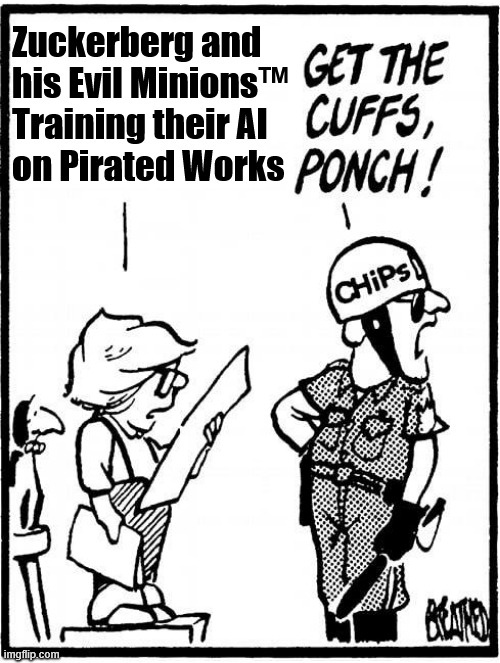
I do not support enforcing copyright violations with criminal prosecutions, but in Zuckerberg's case, I'll make an exception
It seems that the criminal enterprise formerly known as Facebook™ knowingly and deliberately used pirated works to train its LLM artificial intelligence program.

I'm not particularly surprised.  Zuckerberg has been a serial (to the point of being surreal) law breaker.

I rather think that the Chinese breakthroughs, which show the Eliza programs of Zuckerberg and Altman to irrelevant, make much of the effort here wasted, but I am grateful for this quote from a newly released email, "Torrenting from a corporate laptop doesn’t feel right." 

Newly unsealed emails allegedly provide the "most damning evidence" yet against Meta in a copyright case raised by book authors alleging that Meta illegally trained its AI models on pirated books.

Last month, Meta admitted to torrenting a controversial large dataset known as LibGen, which includes tens of millions of pirated books. But details around the torrenting were murky until yesterday, when Meta's unredacted emails were made public for the first time. The new evidence showed that Meta torrented "at least 81.7 terabytes of data across multiple shadow libraries through the site Anna’s Archive, including at least 35.7 terabytes of data from Z-Library and LibGen," the authors' court filing said. And "Meta also previously torrented 80.6 terabytes of data from LibGen."

"The magnitude of Meta’s unlawful torrenting scheme is astonishing," the authors' filing alleged, insisting that "vastly smaller acts of data piracy—just .008 percent of the amount of copyrighted works Meta pirated—have resulted in Judges referring the conduct to the US Attorneys’ office for criminal investigation."

Don't these lawyers understand?  Mark Zuckerberg is worth $237,000,000,000.00.

In the USA, people with that much money do not get prosecuted.

Why do these lawyers hate America? 

………

Emails discussing torrenting prove that Meta knew it was "illegal," authors alleged. And [Meta research engineer Nikolay] Bashlykov's warnings seemingly landed on deaf ears, with authors alleging that evidence showed Meta chose to instead hide its torrenting as best it could while downloading and seeding terabytes of data from multiple shadow libraries as recently as April 2024.

………

Supposedly, Meta tried to conceal the seeding by not using Facebook servers while downloading the dataset to "avoid" the "risk" of anyone "tracing back the seeder/downloader" from Facebook servers, an internal message from Meta researcher Frank Zhang said, while describing the work as being in "stealth mode." Meta also allegedly modified settings "so that the smallest amount of seeding possible could occur," a Meta executive in charge of project management, Michael Clark, said in a deposition.

Now that new information has come to light, authors claim that Meta staff involved in the decision to torrent LibGen must be deposed again because the new facts allegedly "contradict prior deposition testimony."

Mark Zuckerberg, for example, claimed to have no involvement in decisions to use LibGen to train AI models. But unredacted messages show the "decision to use LibGen occurred" after "a prior escalation to MZ," authors alleged.

Yeah.  Sounds like a conspiracy to lie during depositions.  It came from the top.

Book him, Danno, criminal conspiracy to violate copyright.  (Not as catchy as, "Book him, Danno, Murder 1," but I'll take it.)

21 November 2024

Yeah, "Accidentally"

The good folks at TechCrunch have a story with the headline, "OpenAI accidentally deleted potential evidence in NY Times copyright lawsuit." 

The good folks at TechCrunch accept that this is accidental.

Bullsh%$:

Lawyers for The New York Times and Daily News, which are suing OpenAI for allegedly scraping their works to train its AI models without permission, say OpenAI engineers accidentally deleted data potentially relevant to the case.

Earlier this fall, OpenAI agreed to provide two virtual machines so that counsel for The Times and Daily News could perform searches for their copyrighted content in its AI training sets. (Virtual machines are software-based computers that exist within another computer’s operating system, often used for the purposes of testing, backing up data, and running apps.) In a letter, attorneys for the publishers say that they and experts they hired have spent over 150 hours since November 1 searching OpenAI’s training data.

But on November 14, OpenAI engineers erased all the publishers’ search data stored on one of the virtual machines, according to the aforementioned letter, which was filed in the U.S. District Court for the Southern District of New York late Wednesday.

OpenAI tried to recover the data — and was mostly successful. However, because the folder structure and file names were “irretrievably” lost, the recovered data “cannot be used to determine where the news plaintiffs’ copied articles were used to build [OpenAI’s] models,” per the letter.

The judge should consider sanctions.

03 November 2024

You May Be Able to Get Your McFlurries Again

The USPTO has ruled that McDonald’s restaurants will be allowed to fix their ice cream machines.

Previously, the manufacturer of the notoriously unreliable machines have been using the DMCA to prevent store owners from diagnosing or repairing their machines.

McDonald’s often maligned, seemingly perennially-broken ice cream machines could soon become a thing of the past.

On Oct. 25, the United States Copyright Office granted a copyright exemption that gives restaurants like McDonald's the “right to repair” broken machines by circumventing digital locks that prevent them from being fixed by anyone other than its manufacturer.

The Golden Arches’ vanilla cones, sundaes and McFlurries are all made in machines from Taylor Company, as they have been for nearly 70 years. Back in 1956, future McDonald’s CEO Ray Kroc made a handshake agreement with Taylor to supply milkshake machines as McDonald’s exclusive supplier.

The Taylor company holds a copyright on its machines, and in the past that has meant that if one broke, only its repair people were legally allowed to fix it, according to a 2021 Wired article. This is due to the Digital Millennium Copyright Act (DMCA), a 1998 law that criminalizes making or using technology, devices or services that circumvent the control access of copyrighted works.  

………

The exemption granted by the United States Copyright Office went into effect on Oct. 28 and was jointly petitioned for by repair-focused website iFixIt and advocacy group Public Knowledge. In 2023, iFixit documented its teardown of McDonald’s machines and said it spat out multiple “nonsensical, counterintuitive, and seemingly random” error codes, but it couldn’t do anything to repair it.

Although the full request wasn’t granted, retail-level commercial food preparation equipment received an exemption that will allow third parties to bypass digital locks on machines for repairs.

Meredith Rose, senior policy counsel at Public Knowledge, said that the Copyright Office’s decision will lead to an “overdue shake-up of the commercial food prep industry.”

The DMCA is a horrible law, it serves primarily to reinforce the corrupt and monopolistic practices of bad actors in our economy, whether it be Taylor, or HP preventing the use of 3rd party toner in HP products, or John Deere's horrible repair policies.

Repeal it.

26 May 2024

Cola Corporation is Experiencing Supply Chain Problems

The Cola Corporation, which describes itself as being, "Started in 2019 with the simple goal of trolling MAGA," makes T-shirts, hoodies, and similar protest related apparel. 

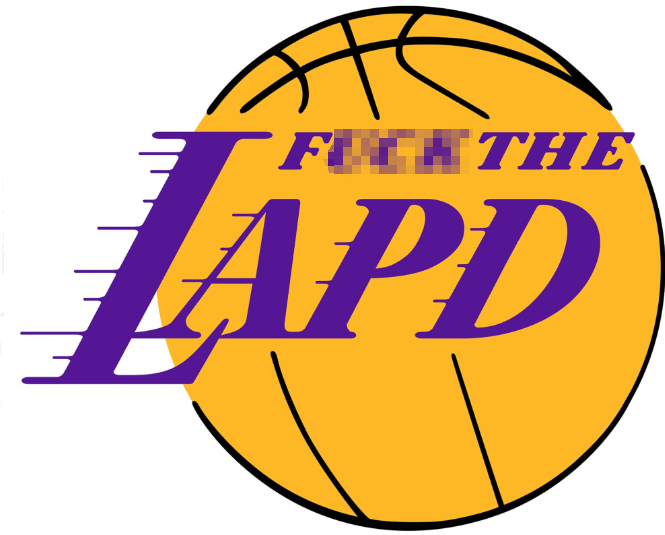
Among these sartorially exquisite products is a T-shirt which states, "F%$# the LAPD."

In response to this T-shirt, the LAPD Foundation sent a DMCA takedown letter, claiming violation of the copyright on the use of LAPD.  (Yes there are some legal errors there, but I'll get to those)

Cola Corporation, contacted their counsel, Mike Dunford,  who, perhaps taking taking a page from noted anti-Fascist fighter then Brigadier General Anthony Clement McAuliffe, responded, "LOL, no."

This has subsequently gone viral, and Cola has had their entire stock bought out during the past few days.

If this is not the Streisand Effect, it is certainly Streisand Effect adjacent.

For a slightly more in-depth response, and one that provides a bit mroe in the way of explanation, you can read this legal analysis, which additionally provides more information as to the nature of the legal errors made.

Short version:

  • LAPD cannot be copyrighted, so a DMCA take-down request is wrong.
  • If they were referring to trademark, there is no possibility of confusion, between LAPD and F%$# the LAPD, so that is moot as well.
  • The law firm that sent the cease and desist letter specializes in IP law, and as such, had to have known that the request was not in accordance with the law, and as such why they, and their client should not be sued. (see 7 U.S.C. § 512(f))
  • The use of IP law to interfere with criticism of a government agency is ruled out by the First Amendment.

31 December 2023

Good News in the Copyright Front

An appeals court in the UK has ruled that if a work is out of copyright, then museum photographs of those works is out of copyright as well.

This will have the effect of preventing museums from erecting toll booths in front of authors who want to comment and research on art.

A recent judgement on copyright in the Court of Appeal (20 November) heralds the end of UK museums charging fees to reproduce historic artworks. In fact, it suggests museums have been mis-selling “image licences” for over a decade. For those of us who have been campaigning on the issue for years, it is the news we’ve been waiting for.

The judgement is important because it confirms that museums do not have valid copyright in photographs of (two-dimensional) works which are themselves out of copyright. It means these photographs are in the public domain, and free to use.

Museums use copyright to restrict the circulation of images, obliging people to buy expensive licences. Any thought of scholars sharing images, or using those available on museum websites, was claimed to be a breach of copyright. Not surprisingly, most people paid up. Copyright is the glue that holds the image fee ecosystem in place.

What has now changed? Museums used to rely on the 1988 Copyright, Designs and Patents Act, which placed a low threshold on how copyright was acquired; essentially, if some degree of “skill and labour” was involved in taking a photograph of a painting, then that photograph enjoyed copyright. But subsequent case law has raised the bar, as the new Appeal Court judgement makes clear.

In his ruling (THJ v Sheridan, 2023), Lord Justice Arnold wrote that, for copyright to arise: “What is required is that the author was able to express their creative abilities in the production of the work by making free and creative choices so as to stamp the work created with their personal touch”. Importantly, he went on: “This criterion is not satisfied where the content of the work is dictated by technical considerations, rules or other constraints which leave no room for creative freedom”. In other words, if the aim of a museum photograph is to accurately reproduce a painting (which it must be), then it cannot acquire copyright.

(emphasis mine)

It turns out that changes to copyright have made this the case since 2009.

There has been a sea change in how many governments and institutions, with the unfortunate exception of patent offices and WIPO, have viewed IP protections.

This is a good thing.

30 December 2023

Upcoming Good Year for the Public Domain

First, I want to note that under our current copyright regime, both the totality of Shakespeare's works and Herman Melville's Moby Dick would be largely unknown. 

Next, you should look at Cory Doctorow's survey of what is entering the public domain this year.

To put it mildly, it ain't just Steam Boat Willie:

They stole something from you. For decades, they stole it. That thing they stole? Your entire culture. For all of human history, works created in living memory entered the public domain every year. 40 years ago, that stopped.

First in 1976, and then again in 1998, Congress retroactively extended copyright's duration by 20 years, for all works, including works whose authors were unknown and long dead, whose proper successors could not be located. Many of these authors were permanently erased from history as every known copy of their works disappeared before they could be brought back into our culture through reproduction, adaptation and re-use (copyright is "strict liability," meaning that even if you pay to clear the rights to a work from someone who has good reason to believe they control those rights, if they're wrong, you are on the hook as an infringer, and the statutory damages run to six figures).

 ………

But at least we'll get some music in the public domain again this year. Indeed, this year's public domain is shaping up to be an even bigger banger than 2023

And here is a list of the most prominent works entering the public domain from the above link:

Books and Plays

  • D.H Lawrence, Lady Chatterley's Lover
  • Bertolt Brecht, The Threepenny Opera (in the original German, Die Dreigroschenoper)
  • Virginia Woolf, Orlando
  • Erich Maria Remarque, All Quiet on the Western Front (in the original German, Im Westen nichts Neues)
  • W.E.B. Du Bois, Dark Princess
  • Claude McKay, Home to Harlem
  • A. A. Milne, illustrations by E. H. Shepard, House at Pooh Corner (introducing the Tigger character)
  • J. M. Barrie, Peter Pan; or the Boy Who Wouldn't Grow Up (because it was not "published" for copyright purposes until 1928)[4]
  • Radclyffe Hall, The Well of Loneliness
  • Evelyn Waugh,Decline and Fall
  • Agatha Christie, The Mystery of the Blue Train
  • Wanda Gág, Millions of Cats (the oldest American picture book still in print)
  • Robert Frost, West-Running Brook
  • Ben Hecht and Charles MacArthur, The Front Page

Films

  • D.H Lawrence, Lady Chatterley's Lover
  • Bertolt Brecht, The Threepenny Opera (in the original German, Die Dreigroschenoper)
  • Virginia Woolf, Orlando
  • Erich Maria Remarque, All Quiet on the Western Front (in the original German, Im Westen nichts Neues)
  • W.E.B. Du Bois, Dark Princess
  • Claude McKay, Home to Harlem
  • A. A. Milne, illustrations by E. H. Shepard, House at Pooh Corner (introducing the Tigger character)
  • J. M. Barrie, Peter Pan; or the Boy Who Wouldn't Grow Up (because it was not "published" for copyright purposes until 1928)[4]
  • Radclyffe Hall, The Well of Loneliness
  • Evelyn Waugh,Decline and Fall
  • Agatha Christie, The Mystery of the Blue Train
  • Wanda Gág, Millions of Cats (the oldest American picture book still in print)
  • Robert Frost, West-Running Brook
  • Ben Hecht and Charles MacArthur, The Front Page

 Musical Compositions

  • Animal Crackers (musical starring the Marx Brothers; book by George S. Kaufman and Morrie Ryskind and lyrics and music by Bert Kalmar and Harry Ruby)
  • Mack the Knife (original German lyrics by Bertolt Brecht and music by Kurt Weill; from The Threepenny Opera)
  • Let’s Do It (Let’s Fall in Love) (Cole Porter; from the musical Paris)
  • Sonny Boy (George Gard DeSylva, Lew Brown & Ray Henderson; from the film The Singing Fool starring Al Jolson)
  • When You're Smiling (lyrics by Mark Fisher and Joe Goodwin and music by Larry Shay)
  • Empty Bed Blues (J. C. Johnson)
  • I Wanna Be Loved By You (lyrics by Bert Kalmar and music by Herbert Stothart and Harry Ruby; from the musical Good Boy)
  • Makin’ Whoopee! (lyrics by Gus Khan and music by Walter Donaldson)
  • You’re My Necessity, You’re The Cream in My Coffee (George Gard DeSylva, Lew Brown & Ray Henderson; from the musical Hold Everything!)
  • I Can’t Give You Anything But Love, Baby (lyrics by Dorothy Fields and music by James Francis)
  • Ramona (lyrics by L. Wolfe Gilbert and music by Mabel Wayne)
  • There’s a Rainbow ‘Round My Shoulder (Al Jolson, Billy Rose, Dave Dreyer; from the film The Singing Fool)
  • Beau Koo Jack (lyrics by Walter Melrose and music by Alex Hill and Louis Armstrong)
  • Pick Pocket Blues (Bessie Smith)

Sound Recordings:

  • Charleston (recorded by James P. Johnson)
  • Yes! We Have No Bananas (recorded by Billy Jones; Furman and Nash; Eddie Cantor; Belle Baker; The Lanin Orchestra)
  • Who’s Sorry Now (recorded by Lewis James; The Happy Six; the Original Memphis Five)
  • Down Hearted Blues (recorded by Bessie Smith; Tennessee Ten)
  • Lawdy, Lawdy Blues (recorded by Ida Cox)
  • Southern Blues and Moonshine Blues (recorded by Ma Rainey)
  • Down South Blues (recorded by Hannah Sylvester; The Virginians)
  • Wolverine Blues (recorded by the Benson Orchestra of Chicago)
  • Tin Roof Blues (recorded by the New Orleans Rhythm Kings)
  • That American Boy of Mine and Parade of the Wooden Soldiers (recorded by Paul Whiteman and his Orchestra)
  • Dipper Mouth Blues and Froggie More (recorded by King Oliver’s Creole Jazz Band, featuring Louis Armstrong)
  • Bambalina (recorded by the Ray Miller Orchestra)
  • Swingin’ Down the Lane (recorded by the Isham Jones Orchestra; The Shannon Four; The Columbians)

This is a huge benefit for society.

Let me explain my comments about both Shakespeare and Melville, starting with Melville.

In 1851, Herman Melville published the novel Moby Dick, and it was a resounding critical and commercial failure, and remained out of the public eye.

In 1891, Melville died and Moby Dick was republished, again vanishing without a ripple.

Almost 30 years after his death, the novella Billy Budd, which was unfinished among his effects, creating a renaissance in his works, and Moby Dick was still available at that time, and critically reevaluated, and became the classic that almost everyone reads in high school today.

Under the current copyright regime, Moby Dick would have been caught in the layer of publication hell reserved for orphan works until 1951, by which time there might have been no more than a dozen copies extant.

And now onto Shakespeare:

William Shakespeare died in 1616 without heir, and his plays, generally considered to be low-brow entertainment, as all theater was at the time, were not published.

What remained were copies used by actors.

In 1623, these workes were assembled through the efforts of John Heminges and Henry Condel, members of Shakespeare's theater company, and published as the First Folio.

Under the current copyright statute, his works would not have entered the public domain for 100 years from the date of publication, which means that anyone with a memory of these this work, and more importantly anyone with a copy of his scripts, would have been dead.

The vast bulk of his work would have been lost for eternity, because ownership of the rights was unclear, and even if acting in good faith, anyone republishing could have been subject to hundreds of thousands of dollars in penalties, even though they had acted in the best of faith.

There is little to no money to be made for the rights holders publish, but there is ALWAYS enough in statutory penalties to support pursuing and suing anyone who wants to republish this.

So our cultural heritage is wiped out, because some people want those last few pennies.

F%$# that.
 

19 August 2023

Today in Enshittification

Enshittification was defined by Cory Doctorow:

Here is how platforms die: first, they are good to their users; then they abuse their users to make things better for their business customers; finally, they abuse those business customers to claw back all the value for themselves. Then, they die.


It looks like the enshittification of the streaming services is progressing with breathtaking speed.

It took more than 3 decades for cable to hit this cycle, and streaming has hit it in less than ¼ of the time.

It's more than that though. When Netflix was just distributing DVDs, they could profit and deliver a good service, because once the bought the DVDs, they could rent them out, no muss no fuss.

For physical media, the content distributors have no control over the resale or renting of DVDs and tapes.

Then, Netflix started streaming, they had to deal with the studios, and the nature of IP rules was that the distributors could take most, if not all of the profits, because they had exclusivity enforced through copyright law.

It's why, when Netflix moved to streaming, you constantly had titles cycling in and out of the library.

Every time that this happened, it was a studio turning the screws.

So, Netflix turned to producing its own content, and did so using every possible trick to avoid paying the people who actually directed, wrote, and acted in these productions.

Which is what led to the current writers and actors strikes, and Netflix is the most aggressively rapacious of the content distributors.

OK, after this bit of history, we have Netflix streaming original and archival content.

The legacy content distributors, Fox, Paramount, etc., realize that streaming has little or no barriers to entry, so they can stream their own stuff from their own websites.

What follows is an orgy of distributing content at a loss to pick up market share, which is unsustainable over the long term.

As the old bromide states, "What cannot continue, will not continue," and now the streaming services are raising prices and reducing the quality of the services.

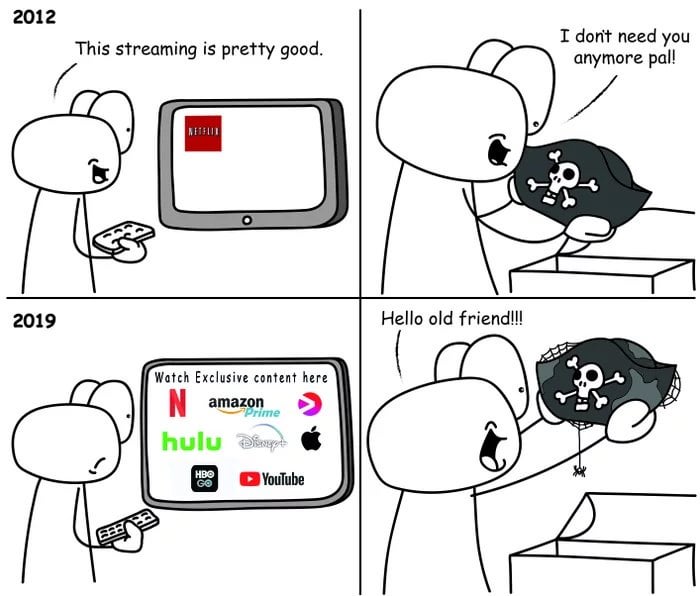
There is an alternative, and it is readily available, and has been readily available for more a very long time.

It only has fallen into abeyance because streaming was more convenient, and worth the cost.

Not any more:

The average cost of watching a major ad-free streaming service is going up by nearly 25% in about a year, according to a Wall Street Journal analysis, as entertainment giants bet that customers will either pay up or switch to their cheaper and more-lucrative ad-supported plans.

Disney last week raised the price of its Disney+ and Hulu streaming services for the second time since last fall, following a string of similar announcements by the owners of Peacock, Max, Paramount+ and Apple TV+.

The recent wave of price increases signals a new phase in the streaming wars. After years of charging bargain-basement prices in pursuit of fast growth, most of the big players face a financial reckoning, with tens of billions of dollars in losses piling up.

Now, in a push for profitability, they are testing the loyalty of their customers, betting that ratcheting up prices won’t lead more people to cancel service, an industry phenomenon known as churn.

Nope.  The issue will not be churn, that was already a fact of life.

Using technology to share content without permission is the issue.  

As streaming services become more expensive and offer less content, this will expand, at the cost of subscriptions.

Expect to see a lot more interest in torrents, or whatever new protocol is in the wings, out there.

21 July 2023

Yes

Laila Medina, the Advocate General for the European Court of Justice has issued an opinion that harmonized technical standards should not be subject to copyright protections.

Given that observing these standards is required by EU law, it seems to me that allowing a company, even a non-profit, to act as a gatekeeper is a bad thing. (We have a similar situation in the United States, where standards such as the NFPA are hundreds, or thousands, of dollars for a set.

One of the most pernicious ideas that copyright maximalism has spread is that preventing people from freely accessing creative material is not just a good thing to do, but should be the natural state of affairs. This has made questioning whether copyright is really the best way to support artists and promote creativity hard. Against that background, there’s an interesting opinion from one of the top EU court’s special advisers, known as advocates general, suggesting a situation in which copyright definitely should not be applied. The Court of Justice of the European Union’s press release explains the background:
Public.Resource.Org Inc. and Right to Know CLG are two non-profit organisations whose focus is to make the law freely accessible to all citizens. The organisations had challenged before the [EU] General Court a Commission Decision refusing to grant them access to four harmonised technical standards (HTS) adopted by the European Committee for Standardisation (CEN) with respect to the safety of toys in particular. As their challenge was unsuccessful, they appealed the General Court judgment before the Court of Justice.

In today’s Opinion, Advocate General Laila Medina looks into the question whether the rule of law as well as the principle of transparency and the right of access to documents of EU institutions require that HTS are freely available without charge.
The conclusion reached by Advocate General Laila Medina is straightforward:
for the purposes of EU law in general and for the access to EU law in particular, and, given HTS indispensable role in the implementation of EU secondary legislation and their legal effects, they should, in principle, not benefit from copyright protection.
Moreover:
even if HTS could be protected by copyright, free access to the law has priority over copyright protection.
The basic idea is simple: people can’t be expected to follow a law (or technical standard) if they don’t have ready access to it. Copyright is a barrier to access, and therefore should not be allowed for harmonized technical standards (HTS), just as it is not permitted for EU laws. And even if for some reason HTS were subject to copyright, free access must be granted anyway, blunting its negative impact.
This is only an advisory opinion, but it is a good one.

10 July 2023

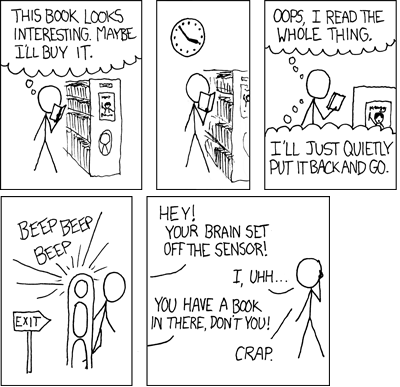
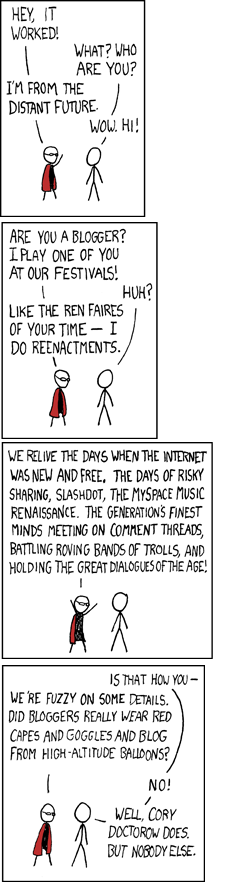
xkcd as Prophet


Link to cartoon

So, it appears that Sarah Silverman and a some other authors have sued AI vendors for training with their material.

I don't get it.  Isn't reading a book and learning from it part of the deal?

On Friday, the Joseph Saveri Law Firm filed US federal class-action lawsuits on behalf of Sarah Silverman and other authors against OpenAI and Meta, accusing the companies of illegally using copyrighted material to train AI language models such as ChatGPT and LLaMA.

Other authors represented include Christopher Golden and Richard Kadrey, and an earlier class-action lawsuit filed by the same firm on June 28 included authors Paul Tremblay and Mona Awad. Each lawsuit alleges violations of the Digital Millennium Copyright Act, unfair competition laws, and negligence.

The Joseph Saveri Law Firm is no stranger to press-friendly legal action against generative AI. In November 2022, the same firm filed suit over GitHub Copilot for alleged copyright violations. In January 2023, the same legal group repeated that formula with a class-action lawsuit against Stability AI, Midjourney, and DeviantArt over AI image generators. The GitHub lawsuit is currently on path to trial, according to lawyer Matthew Butterick. Procedural maneuvering in the Stable Diffusion lawsuit is still underway with no clear outcome yet.

In a press release last month, the law firm described ChatGPT and LLaMA as "industrial-strength plagiarists that violate the rights of book authors." Authors and publishers have been reaching out to the law firm since March 2023, lawyers Joseph Saveri and Butterick wrote, because authors "are concerned" about these AI tools' "uncanny ability to generate text similar to that found in copyrighted textual materials, including thousands of books."

I'll use small words so that lawyers can can understand:  Learning and training from copyrighted work is not theft.

Furthermore, given the current state of generative artificial intelligence, which cannot even manage to get the chronology of Star Wars movies right, if Sarah Silverman is threatened by AI training on her works, maybe she is just not that funny.

23 April 2023

What's the Difference Between a Cockroach and Science Publisher Elsevier?

As near as I can determine, it is that cockroaches are far less expensive.

The rentier capitalism of Elsevier, in which they have the articles peer reviewed, and pay the reviewers nothing or next to nothing, charge the authors to publish the articles, and then charge (a lot) so that people can read the articles, is an exercise in parasitism, and the editors at NeuroImage and Imaging Neuroscience have resigned en masse in response to their rapacious greed.

More than 40 editors have resigned from two leading neuroscience journals in protest against what the editors say are excessively high article-processing charges (APCs) set by the publisher. They say that the fees, which publishers use to cover publishing services and in some cases make money, are unethical. The publisher, Dutch company Elsevier, says that its fees provide researchers with publishing services that are above average quality for below average price. The editors plan to start a new journal hosted by the non-profit publisher MIT Press.

The decision to resign came about after many discussions among the editors, says Stephen Smith, a neuroscientist at the University of Oxford, UK, and editor-in-chief of one of the journals, NeuroImage. “Everyone agreed that the APC was unethical and unsustainable,” says Smith, who will lead the editorial team of the new journal, Imaging Neuroscience, when it launches.

The 42 academics who made up the editorial teams at NeuroImage and its companion journal NeuroImage: Reports announced their resignations on 17 April. The journals are open access and require authors to pay a fee for publishing services. The APC for NeuroImage is US$3,450; NeuroImage: Reports charges $900, which will double to $1,800 from 31 May. Elsevier, based in Amsterdam, says that the APCs cover the costs associated with publishing an article in an open-access journal, including editorial and peer-review services, copy editing, typesetting, archiving, indexing, marketing and administrative costs. Andrew Davis, Elsevier’s vice-president of corporate communications, says that NeuroImage’s fee is less than that of the nearest comparable journal in its field, and that the publisher’s APCs are “set in line with our policy [of] providing above average quality for below average price”.

Lets look at the charges:

  • Copy editing? For an article, well under $100.
  • Typesetting?  Pennies, done automatically by computers.
  • Archiving? Pennies, done automatically by computers.
  • Indexing? Pennies, done automatically by computers.
  • Peer review?  Most peer reviewers are not paid or a very small fee? 
  • Editorial services?  That should mostly be covered peer review, so it's a bullsh%$ profit center.
  • Marketing and Administration?  Again a bullsh%$ profit center.

Publishers have introduced APCs — part of a pay-to-publish model — as an alternative to pay-to-read subscriptions as journals increasingly become freely accessible, and researchers typically pay APCs from their grant funds. Journal APCs vary, typically depending on factors such as the publisher’s size, the proportion of papers sent for peer review and metrics such as impact factor, as well as whether they employ in-house editors and press officers. The Lancet Neurology, published by Elsevier, has an APC of $6,300; the fee at Nature Neuroscience, published by Springer Nature, is $11,690; and Human Brain Mapping, published by Wiley, charges $3,850. (Nature’s news team is editorially independent of Nature Neuroscience and of Springer Nature.)
Pay to read has stopped working because researchers are increasingly unwilling to pay to read the journals or to put their articles behind paywalls.

Additionally, Sci-Hub, which has made millions of articles that were previously behind paywalls freely available, has made the old business model unsustainable, though the be fair, the ever increasing levies charged by the for-profit publishers likely made something like Sci-Hub inevitable.

………

The editors decided to set up an open-access journal with MIT Press, based at the Massachusetts Institute of Technology in Cambridge. Ted Gibson, who sits on MIT Press’s editorial board and is an editor of its cognitive-science journal Open Mind, looks forward to hosting the new title. “These editors have done it the right way. I think it’s a slow process but eventually more scientists will resign from the profit-oriented journals,” Gibson says.

The journal move echoes a 2019 case, in which the editorial board of an Elsevier scientometrics journal — the Journal of Informetricsresigned in protest over the publisher’s open-access policies, including the journal’s APCs. The researchers launched a free-to-read journal with MIT Press called Quantitative Science Studies, with the same editorial board.

The for profit model of academic publishing is consuming itself through its own unbridled greed.

The current IP regime, particularly copyright, serves no one but the gate-keepers who contribute nothing to society.

01 April 2023

How to Handle These Things

It turns out that there is a flaw in early versions of some of the Creative Commons (CC) series of copyright licenses.

They are to allow content creators to specify the level of sharing possible with a relative fine granularity.

Unfortunately, some of the earlier versions of the license, relatively minor errors in attributions can be construed as terminating the licenses, and some so-called, "Copyleft Trolls," have been exploiting this in order to extort money.

The photograph sharing app Flikr has rolled out a policy that these trolls are to be immediately and permanently banned from the site.

Sic Semper Copyright and Patent Trolls:

Today's a big day for users of Creative Commons images: Flickr has declared zero tolerance for copyleft trolls, predators who exploit a bug in out-of-date versions of the CC licenses in order to threaten good-faith users of CC images who make minor errors in the way they credit the images.

First things first: Flickr's new community guidelines prohibit copyleft trolling: "Failure to allow a good faith reuser the opportunity to correct errors is against the intent of the license and not in line with the values of our community, and can result in your account being removed."

https://www.flickr.com/help/guidelines

If you are targeted by a copyleft troll who demands that you pay them because of minor errors in your Creative Commons attribution, here's how to report them and get them kicked off Flickr forever:

https://www.flickrhelp.com/hc/en-us/articles/4404057906068-How-to-report-Community-Guidelines-violations

Now, some background. Early versions of the Creative Commons licenses have a bug, a clause that says that the permissions conferred by CC licenses "terminate automatically upon any breach" – that is, if you violate any term of the license, it ceases to be in effect:

https://doctorow.medium.com/a-bug-in-early-creative-commons-licenses-has-enabled-a-new-breed-of-superpredator-5f6360713299

Core to the CC licenses is the idea of attribution. When you use a Creative Commons image, you must name the creator and link to the original, and name the license and link to it. Many CC users don't understand this; they use an image and add something like "Image: Cory Doctorow/Creative Commons" with no links or specific licenses.

Under the pre-4.0 versions of the license, this can be construed as a "breach" which "terminates" the CC license. That's where the copyleft trolls come in.

Copyleft trolls post CC-licensed stock art and then wait for a naive person to make a minor attribution error, and then they pounce, sending a legal threat and a speculative invoice demanding hundreds or thousands of dollars, under the threat of a $150,000 statutory damages award.

………

But after Flickr was sold to Yahoo, it joined Yahoo's haunted armada of Web 2.0 ghost-ships, tossed back and forth in the storms created by the dueling princelings of Yahoo's bloated management layer, who spent more time sabotaging one another than they did making anything anyone else wanted to use. Yahoo eventually sold off all of those holdings at fire-sale prices to Verizon, who neglected them still further.

An abandoned ship is easy picking for the rats that live in its bilges. Pixsy and its photographers actually became official Flickr partners, pitching themselves as a way for photographers who didn't want their images shared to hunt down infringers – even as they facilitated a revolting campaign of copyleft trolling that depended on Flickr as their base of operations.

The depravity of copyleft trolls is truly boundless. Take Marco Verch, a prolific copyleft troll who hosts nearly 47,000 photos on Flickr. Verch hires low-waged gig work photographers through platforms like Upwork to take photos, then harasses people who make minor attribution errors:

https://www.computerweekly.com/news/252488167/Automated-image-recognition-How-using-free-photos-on-the-internet-can-lead-to-lawsuits-and-fines

Verch boasts that his predation lets him work for four hours a week, leaving him with ample time to focus on his hobby, running. Verch is a truly prolific predator, and his attacks have made untold numbers of victims miserable – including the small Dutch charity that was forced to shut down after paying his ransom demand. Pixsy has been Verch's US counsel and filed dozens of suits on his behalf.

………

The reason I thought Flickr might take this in hand is that it is finally under decent, responsive leadership – since 2018, Flickr has been owned by Smugmug, a family-owned business that really cares about photographers and the open internet.

Flickr hasn't taken all of my suggestions yet – my understanding is that they are laboring under enormous technological debt thanks to years of neglect by Yahoo and Verizon, and even small changes require weeks of all-hands technological work.

But what they have done is modify their policies to create a de facto CC 4.0 environment for their users, by promising to terminate the accounts of any user who repeatedly threatens legal action over bad attribution strings without first offering a 30-day grace period.

Flickr's done more than that, actually. For one thing, they ditched Pixsy, severing their relationship with the company (Pixsy still lists them on its "partner" page). They also created the Flickr Foundation, a nonprofit devoted to providing long-term, responsible stewardship for their CC and public domain image respositories:

I know that I frequently sound like I am implacably opposed to all forms of exclusive licensing, whether though copyright, patent, or trademark.  I am not.

But I do understand that the current IP regimes have lost their way.  The purpose of Copyright and Patent is public interest, specifically to, "To promote the progress of science and useful arts," while trademark's purpose is primarily to protect consumers from being defrauded.

By elevating limited time exclusive licenses to the level of eternal property without any exception does not serve the public good.

29 March 2023

The Jurisprudence Around IP is F$#@ed up and Sh$#

The internet archive bought books, scanned them, and lent them out.

This was a 1 to 1 thing.  The book was unavailable, so there was only one book out there.

The judge just made a summary judgement that the Internet Archive violated copyright.

The basis of the judge's ruling,  as Anna Russel would say, "I'm not making this up, you know," was that it the actions of the Internet Archive were an infringement on the publishers business model.

A federal judge rejected the Internet Archive's claim that it has a fair use right to lend out a digital copy of each printed book that it has purchased, raising the possibility of it facing huge damages for copyright infringement.

A week ago, Judge John Koeltl from the Southern District of New York heard oral arguments in Hachette v. Internet Archive, a lawsuit filed by four large publishers (Hachette Book Group, HarperCollins Publishers, John Wiley & Sons and Penguin Random House) that challenged the Internet Archive's Controlled Digital Lending (CDL) initiative.

The Internet Archive has been making digital copies of physical books that it acquires and lending those copies to online library patrons in a controlled manner – it circulates only as many digital books as it has actual copies. It is offering a digital proxy that stands in for the physical title.

Copying works protected by US copyright law may be excused if the copying falls under the fair use exemption.

The non-profit claims its book scanning and distribution qualifies as fair use because its digital lending scheme is "transformative" – which conveys a different meaning than the original – and non-commercial. These are among the factors considered when assessing whether the fair use defense can be applied.

It also asserts that the goals of the "first sale doctrine" – which allows the purchaser of a copyrighted work to sell, display or otherwise dispose of that particular copy without seeking permission from the copyright holder – support its controlled lending of digitized purchased books.

Judge Koeltl, however, found the Internet Archive's arguments wanting. In a decision [PDF] published on Friday, he wrote.

"The crux of IA’s first factor argument is that an organization has the right under fair use to make whatever copies of its print books are necessary to facilitate digital lending of that book, so long as only one patron at a time can borrow the book for each copy that has been bought and paid for," Koeltl opined.

"But there is no such right, which risks eviscerating the rights of authors and publishers to profit from the creation and dissemination of derivatives of their protected works. IA’s wholesale copying and unauthorized lending of digital copies of the Publishers’ print books does not transform the use of the books, and IA profits from exploiting the copyrighted material without paying the customary price."

You see what I am saying here?  The judge has manufactured a claim to an inalienable right to profit.

I would note that this is one step from telling people that they cannot share books, or resell them once they are done with them.

They actually tried to claim this, and lost in a 6-3 Supreme Court decision in Kirtsaeng v. John Wiley & Sons, Inc, where they attempted to prevent resales of books.

There is something very wrong with how the powers that be address a licensing issue that is supposed to be for the public interest, and any private profit is incidental to that public interest.

12 January 2023

Dungeons and Dragons Rat Fuckery

There has been an explosion of outrage over Wizards of the Coast LLC, a subsidiary of Hasbro, Inc. changing their "Open Gaming License", which will have the effect of making their license.

Well, writing from his hot air balloon secret base, (Way cooler than S.H.I.E.L.D.'s helicarrier) Cory Doctorow observes something very interesting, that the license that they have issued is complete garbage in either the old or the new version, because it licenses things that are not subject to copyright.

While Wizards of the Coast LLC, a subsidiary of Hasbro, Inc. can apply IP to things like the actual words used to write the rules, characters, names, places, etc, they cannot actually copyright the meaning of the rules.

Copyright covers expression, not ideas: (Some slight reformatting for prettier links)

Last week, Gizmodo's Linda Codega caught a fantastic scoop –a leaked report of Hasbro's plan to revoke the decades-old Open Gaming License, which subsidiary Wizards Of the Coast promulgated as an allegedly open sandbox for people seeking to extend, remix or improve Dungeons and Dragons:

The report set off a shitstorm among D&D fans and the broader TTRPG community – not just because it was evidence of yet more enshittification of D&D by a faceless corporate monopolist, but because Hasbro was seemingly poised to take back the commons that RPG players and designers had built over decades, having taken WOTC and the OGL at their word.

………

Free/open licenses were invented specifically to prevent this kind of fuckery. First there was the GPL and its successor software licenses, then Creative Commons and its own successors. One important factor in these licenses: they contain the word "irrevocable." That means that if you build on licensed content, you don't have to worry about having the license yanked out from under you later. It's rugproof.

Now, the OGL does not contain the word "irrevocable." Rather, the OGL is "perpetual." To a layperson, these two terms may seem interchangeable, but this is one of those fine lawerly distinctions that trip up normies all the time. In lawyerspeak, a "perpetual" license is one whose revocation doesn't come automatically after a certain time (unlike, say, a one-year car-lease, which automatically terminates at the end of the year). Unless a license is "irrevocable," the licensor can terminate it whenever they want to.

FWIW, as Doctorow notes, this sort of rug pull is actually rather common.  For profits go from, "We encourage the community to create content," to, "Fuck you, pay me," as soon as they feel that they no longer need to that community's content.

Here is the important bit:

………

The perpetual/irrevocable switcheroo is the least of the problems with the OGL. As gsllc@chirp.enworld.org – an actual lawyer, as well as a dice lawyer – wrote back in 2019, the OGL is a grossly defective instrument that is significantly worse than useless.

The issue lies with what the OGL actually licenses. Decades of copyright maximalism has convinced millions of people that anything you can imagine is "intellectual property," and that this is indistinguishable from real property, which means that no one can use it without your permission.

The copyrightpilling of the world sets people up for all kinds of scams, because copyright just doesn't work like that. This wholly erroneous view of copyright grooms normies to be suckers for every sharp grifter who comes along promising that everything imaginable is property-in-waiting (remember SpiceDAO?)

Copyright is a lot more complex than "anything you can imagine is your property and that means no one else can use it." For starters, copyright draws a fundamental distinction between ideas and expression. Copyright does not apply to ideas – the idea, say, of elves and dwarves and such running around a dungeon, killing monsters. That is emphatically not copyrightable.

Copyright also doesn't cover abstract systems or methods – like, say, a game whose dice-tables follow well-established mathematical formulae to create a "balanced" system for combat and adventuring. Anyone can make one of these, including by copying, improving or modifying an existing one that someone else made. That's what "uncopyrightable" means.

………

Which brings me back to the OGL, and what, specifically, it licenses. The OGL is a license that only grants you permission to use the things that WOTC can't copyright – "the game mechanic [including] the methods, procedures, processes and routines." In other words, the OGL gives you permission to use things you don't need permission to use.

Things like specific characters, maps, dialogue, etc. are subject to copyright, but if you want to create a new character class, say for example a boomerang spoon thrower, you can do using dice, and levels, and experience point requirements for levels, etc. without permission, and you can sell it.

You could also create an app to calculate character stats and otherwise aid in game play, because the fact that hit points for a fighter use a D10 (in my day, they only got a D8, and we liked it, you kids) is not copyrightable.

The original (allegedly good) OGL never gave its users any rights, it took them away, albeit for free, and there is no reason for anyone to continue to use this license.

Just write and release your works, and maybe form a coop to deal with the nuisance suits that might come your way from Wizards of the Coast LLC, a subsidiary of Hasbro, Inc.

11 October 2022

Pay the Artist is a Fraud

I don't mean that artists should not be paid, but rather that the draconian measures taken by distributors of artistic content to restrict access, things like copyright filters, actually leave artists worse off, though I am sure that record label and studio executives do better with this in place:

The EU Copyright Directive contains one of the worst ideas in modern copyright: what amounts to a requirement to filter uploads on major sites. Despite repeated explanations of why this would cause huge harm to both creators and members of the public, EU politicians were taken in by the soothing words of the legislation’s proponents, who even went so far as to deny that upload filters would be required at all.

The malign effects of the EU Copyright Directive have not yet been felt, as national legislatures struggle to implement a law with deep internal contradictions. However, upload filters are already used on an ad hoc basis, for example YouTube’s Content ID. There is thus already mounting evidence of the problems with the approach. A new report, from the Colombian Fundación Karisma, adds to the concerns by providing additional examples of how creators have already suffered from upload filters:

Providing additional examples of how creators have already suffered from upload filters:
This research found multiple cases of unjustified notifications of supposed violation of copyright directed at content that is either part of the public domain, original content, or instances of judicial overreach of copyright law. The digital producers that are the target of these unjust notifications affirm that the appeal process and counter-notification procedures don’t help them protect their rights. The appeals interface of the different platforms that were taken into account did not help resolve the cases, which leaves digital creators defenseless with no alternative other than what they can obtain from their contacts. This system damages the capacity of these producers to grow, maintain and monetize an audience at the same time that it affects the liberty of expression of independent producers as it creates a strong disincentive for them. On the contrary, this system incentivizes the bigger production companies to claim copyright on content to which they hold no rights.

And those bigger production companies make campaign donations, and hold events for important people in Brussels, so their voices get heard, while the folks who actually do creative work are told to pound sand.

The current IP regime is just another example of how ostensible efforts to, "Protect the artist," are little more than rent seeking by large corporations to better enable their ability to steal from the little guy.