
Showing posts with label Cryptography. Show all posts

22 January 2026

Yeah, It's a Scam


Get Out Now!
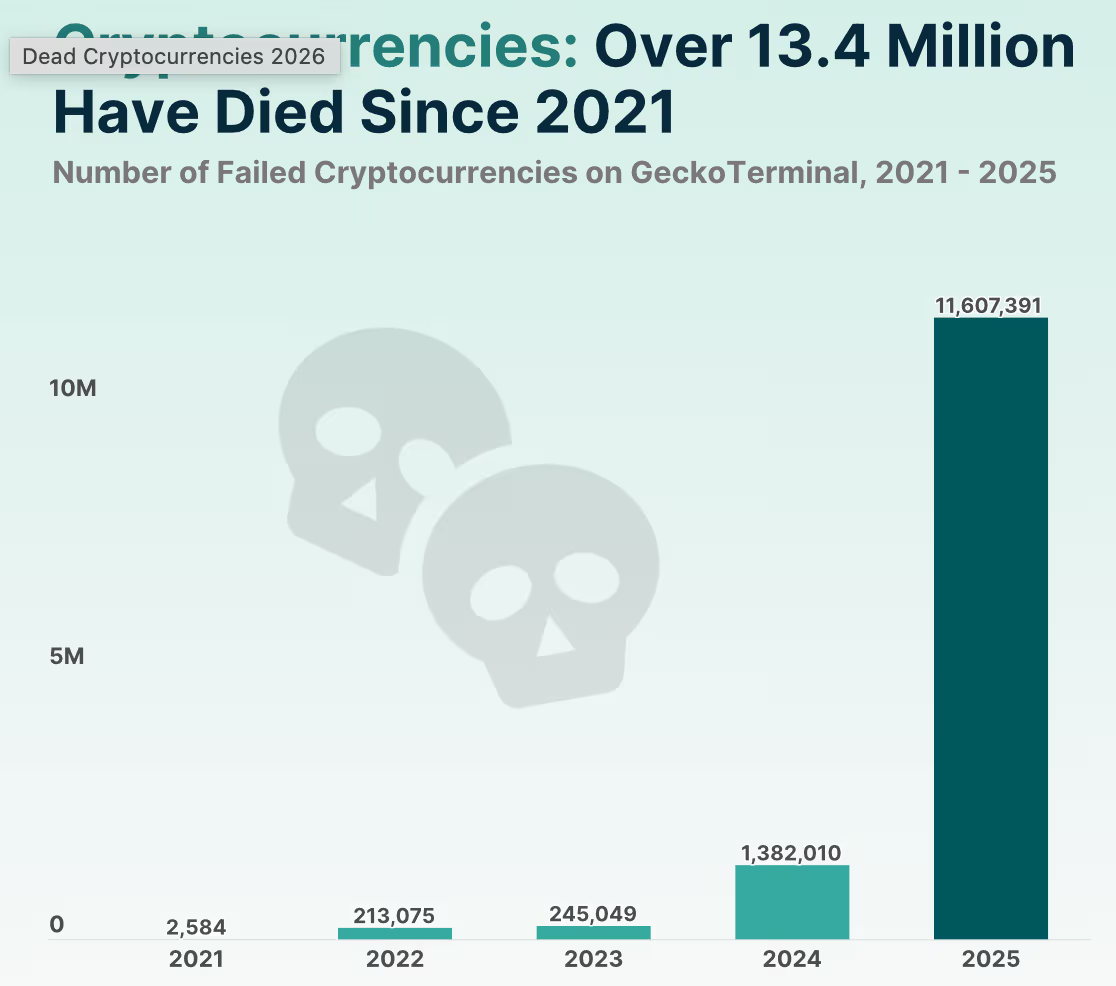
Are you aware that 53% of all cryptocurrency offerings since 2021 have failed?

Are you aware that 45% of all cryptocurrency offerings since 2021 failed in just the past year?

Well, now you do.

More than half of all cryptocurrencies ever launched are now defunct, with most failures occurring in 2025, according to a new analysis by CoinGecko.

The study looked at token listings on GeckoTerminal between mid-2021 and the end of 2025. Of the nearly 20.2 million tokens that entered the market during that period, 53.2% are no longer actively traded. A staggering 11.6 million of those failures happened in 2025 alone — accounting for 86.3% of all token deaths over the past five years.

One key driver behind the surge in dead tokens was the rise of low-effort memecoins and experimental projects launched via crypto launchpads like pump.fun, CoinGecko analyst Shaun Paul Lee said. These platforms lowered the barrier to entry for token creation, leading to a wave of speculative assets with little or no development backing. Many of these tokens never made it past a handful of trades before disappearing. 

20 January 2026

Headline of the Day

Wall Street And Crypto Are At War Over Who Gets To Rob You

The Lever, describing how banks and crypto bros are are in a lobbying war over legislation regulating cryptocurrencies in Congress.

Both sides are contemptible ganefs, and this is a dispute over the spoils.

The short version is that banks lowball their customers interest rates, and particularly among the larger banks, this has gotten progressively worse.

The new legislation allows the crypto bros to have unregulated deposits that function in much the same way, eliminating a profit center.

Wall Street and Silicon Valley are embroiled in a legislative slugfest over which business interests will get to fleece more of their customers’ money.

A loophole under current law allows stablecoins — crypto tokens pegged to the U.S. dollar — to essentially pay interest on their investors’ holdings, similar to a bank account except without the same regulatory guardrails.

This carveout could lure depositors away from banks’ savings accounts — a move that would threaten a multitrillion-dollar scheme by the banking industry in recent years, in which they’ve paid minuscule interest on customers’ financial deposits while enjoying far higher interest rates from the country’s central bank and pocketing the difference.

Now, banks have launched a last-minute lobbying offensive to protect their margins and avoid competition by preventing crypto from copying their business model. They’re trying to insert new language related to the loophole into a piece of stablecoin legislation, known as the Clarity Act, which the crypto industry had been backing for months.

………

This difference between interest paid to depositors and interest collected from loans — called net interest income — has always been central to banks’ business model. But in a Senate letter sent to executives at Wells Fargo, JPMorgan Chase, Bank of America, and other major financial institutions last year, Sen. Elizabeth Warren (D-Mass.) wrote that banks’ refusal to pass down any of their mounting profits to consumers over the last three years has allowed this net interest income to reach historic levels, creating a massive upward transfer of wealth from account holders to banks.

If savers moved their money to higher-yielding accounts — or to smaller regional and local banks, which have historically passed down more money to depositors than megabanks when interest rates increase — they could recoup tens of billions of dollars, as the Wall Street Journal has reported. But the cartel-like grip that megabanks have on the economy has helped quell competition and kept savers collecting paltry interest rates on their nest eggs.

From this vantage point, stablecoins that pay interest to investors — which the crypto exchanges call “rewards” — could pose a competitive threat to banks’ interest-rate arrangements.

I cannot believe that I am saying this, but I am on the side do the banks, because they are regulated and slightly less likely to just steal folks' money. 

25 July 2025

Headline of the Day

“Crypto” Is Silicon Valley Speak for Waste, Fraud, and Abuse
Dean Baker discussing the cryptocurrency bill going through Congress.

He's right.

I particularly like his analogy between trucking and finance here.  It describes the problem:

The Republicans in Congress, along with many Democrats, are rushing ahead with legislation to promote crypto currencies in various ways. Their motivation is not hard to understand; they got hundreds of millions of dollars in campaign contributions from the industry. In terms of economic policy, the effort to promote crypto is taking the country 180 degrees in the wrong direction. The only real question is how bad the results will be.

When we think of finance, we need to think of trucking. Just as we need the trucking industry to transport items to factories and stores, we need the financial sector to make payments and allocate capital. But both finance and trucking are intermediate goods; they don’t directly make us better off, like healthcare or housing.

The fewer resources (labor and capital) we devote to these sectors, the better. If we have fewer people working in these industries, it means that we have more people available to work in sectors that provide the items we value.

Everyone can understand this with trucking. If the size of the trucking sector had quintupled relative to the size of the economy in the last half century, we would probably all be talking about how incredibly inefficient our trucking industry is.

But almost no one complains about the inefficiency of our financial system, even though the share of some components (the securities and commodities trading sector) has quintupled over the last half century. Maybe this is because people in the financial industry teach at elite institutions, have columns in elite media outlets, and hold top positions in administrations of both parties.

But political power does not change reality. An efficient financial sector is a small financial sector, and our financial sector is clearly not small.

This is all essential background for any discussion of crypto. The crypto industry obviously intends to make money by pushing the stuff. The question is what will the rest of us get out of the increased use of crypto?

The answer is at best, not much. The best story from the crypto bros is that it will reduce transactions costs. They focus largely on the high swipe fees charged to retailers by credit cards.

Spoilers: Swipe fees in the EU are almost an order of magnitude less, because they regulate these fees, and transaction costs of cryptocurrency are huge compared to cards or Western Union wire transfers. 

Preach it, Brother. 


13 July 2025

Finally, a Use Case for AI

The use case is stealing cryptocurrency from exchanges.

Seeing as how the only use case for cryptocurrency is crime, money laundering, blackmail, and the occasional murder for hire.

I am amused:

Using AI models to generate exploits for cryptocurrency contract flaws appears to be a promising business model, though not necessarily a legal one.

Researchers with University College London (UCL) and the University of Sydney (USYD) in Australia have devised an AI agent that can autonomously discover and exploit vulnerabilities in so-called smart contracts.

Smart contracts, which have never lived up to their name, are self-executing programs on various blockchains that carry out decentralized finance (DeFi) transactions when certain conditions are met.

Like most programs of sufficient complexity, smart contracts have bugs, and exploiting those bugs to steal funds can be remunerative. Last year, the cryptocurrency industry lost almost $1.5 billion to hacking attacks, according to Web3 security platform vendor Immunefi [PDF]. Since 2017, crims have pilfered around $11.74 billion from DeFi platforms.

And it looks like AI agents can make taking those funds even easier.

Gee, you mean that software has bugs?  Hoocoodanode?

To quote Nathaniel Borenstein, the inventor of MIME:

The most likely way for the world to be destroyed, most experts agree, is by accident.

That's where we come in. We're computer professionals. We cause accidents. 


31 May 2025

I See the Flaw in Your System


xkcd abides 
Business partners of a crypto-millionaire attempted to steal all of his money by beating his passwords out of him.

There is an interesting twist to this, it appears that some members of the New York Police Department, one of whom were part of Mayor Eric Adams' security detail.

When juxtaposed with Adams status as a cryptocurrency booster, it all seems to be a bit ……… curious.

At least two NYPD officers have been placed on modified duty as part of an internal investigation into the kidnapping and torture of a man in SoHo, the department confirmed Thursday.

A police spokesperson said "members of the service were modified" on Wednesday, but declined to elaborate, saying only that the matter “is under internal review.”

One of the officers under investigation worked on Mayor Eric Adams’ security detail according to multiple reports, which the mayor confirmed in a television appearance Thursday night. 

………

The development follows the surrender of William Duplessie, the second suspect in the case, who turned himself in to police Tuesday morning. His attorney did not immediately respond to a request for comment.

Police arrested John Woeltz, 37, earlier this month after his alleged victim escaped and alerted authorities. Prosecutors said Woeltz and Duplessie held the man captive for 17 days starting May 6, beating and shocking him in an attempt to access his Bitcoin account.

………

On Thursday, he defended a recent taxpayer-funded trip to a cryptocurrency summit in Las Vegas, calling Bitcoin “a great product” and arguing that the city needs to reclaim its place in the industry. 

 Yeah, curious.

27 May 2025

Headline of the Day

Crytpo: There’s Just No Legit Use Case for It. But, Man, Are These Bros Lobbied Up
Jared Bernstein and Ryan Cummings

Anyone who thinks that Crypto "Currency" is anything but a vehicle for gambling, extortion, money laundering, and fraud is either corrupt or stupid.  (Maybe both)

Dan Davies and Henry Farrell have penned an important oped about the systemic risk embedded in digital currencies—the many stablecoins and cryptocurrencies out there—a risk that is significantly heightened by bipartisan Congressional support for legitimizing these non-sovereign assets. The authors explain how Congress’ blessing of these highly volatile currencies, particularly the normalization of stablecoins through the so-call GENIUS Act, could both undermine the role of dollar and create bail-out risk. Re the latter point, should they become a sizable part of the banking system, there’s a good chance that they’d end up being too-big-to-fail, and, should they crash, require tax-payer bailouts to stabilize the system.

But the oped does not say enough about the foundational problems with private digital currencies that should disqualify them from getting anywhere near the broader financial system. In this post, co-written with Ryan Cummings of the Stanford Institute for Economic and Policy Research, we go back a few steps prior to the current moment, and explain why, in our view, stablecoins and crypto are just fundamentally useless-at-best and harmful at worst. And, in agreement with Davies and Farrell, how the so-called GENIUS Act is a dangerous piece of legislation.

Unless you’re a criminal, there are no use cases for these currencies.

Crypto, and by extension, stablecoins, whose primary use is to buy and sell crypto, are, for reasons we explain, useless for normal commerce. Yet, they have two very prominent uses that have fostered their proliferation over the last decade-and-a-half. First, their anonymity makes them the currency-of-choice for scammers and thieves, and second, cryptocurrency speculators can trade them with each other and in so doing, quickly make—and lose—a lot of money.

(emphasis original)

Unlike cash, which is at least as hard to trace, crypto has no use as a currency.

One cannot buy a stick of gum with crypto.  It takes at least a day for the currency to clear.

25 November 2024

The Thing About Corporate Structures is

If you can dream up a scenario, you have an entity that already exists, and already has legal requirements for it.

It's kind of like Rule 34, but for business.

Rather unsurprisingly, it turns out that this applies to the fever dreams of crypto-bros, at least according to federal judge Judge Vince Chhabria.

He noted that the Lido DAO, which claims that it is, "Just software," is actually a general partnership, and as such can be sued or prosecuted for dealing in unregistered securities:

The cryptocurrency industry has long been fueled by a libertarian ethos that sees government oversight and regulatory scrutiny as the enemy of economic freedom. At the same time, it is also an industry that has sought to reproduce goods and services that already exist in the traditional, regulated economy. In theory, the end result of this setup is a marketplace ungoverned by the traditional strictures (or, more accurately, guardrails) of modern economies. In practice, it means that crypto organizations often flout financial laws, only to then claim that the law does not (or should not) apply to them.

This week, the Lido DAO, one of web3’s largest decentralized autonomous organizations, suffered a legal blow in a litigation case that has sought to clarify yet another one of crypto’s many legal gray areas. Lido is currently being sued in a class-action lawsuit that accuses it of having sold unregistered securities. An LLC representing the DAO has leaned heavily into web3’s notion of “decentralization,” in an effort to get Lido and its associates off the hook. Dolphin CL, LLC, which represents Lido, has made the claim that the organization is just “software” and does not represent a “legal entity” and, therefore, cannot be held liable for its action, court documents claim. However, a federal judge shot down that argument this week, maintaining that Lido is, indeed, a “legal entity” and, therefore, must be subject to the same laws and regulations.

Judge Vince Chhabria found that, under California law, Lido represents a “general partnership” and is therefore subject to the same regulations that such arrangements are beholden to. He also found that those organizations deemed Lido’s “institutional investors”—that is, the large companies that fronted much of its money and managed its operations—should be deemed members of that partnership and, therefore, held liable. Those companies include investment firm Paradigm Operations, well-known venture capital firm Andreessen Horowitz, and investment firm Dragonfly Digital Management. A fourth firm, Robot Ventures, was excluded as a partner.

First, a16z seem to be aggressively investing in every cryptocurrency scam on the internet. When will Mark Andreeson be frog marched out of his offices in handcuffs?

Second, Robot Ventures got off because, the plaintiff did not provide sufficient evidence that they made decisions for Lido.

On a more serio0us note, why the f%$# is cryptocurrency legal at all.  

It does not work as currency, with days to process a transaction and fees that make credit companies look like the good guys, and its only real world application appears to be ransoms.

12 November 2024

Headline of the Day

FTX Sues Binance for $1.76b in Battle of Crypto Exchanges Founded by Convicts

Ars Technica

If this does not make absolutely clear Crypto is a scam, and always has been, you have not been paying attention.

The bankruptcy estate of collapsed cryptocurrency exchange FTX has sued the company's former rival Binance in an attempt to recover $1.76 billion or more. The lawsuit seeks "at least $1.76 billion that was fraudulently transferred to Binance and its executives at the FTX creditors' expense, as well as compensatory and punitive damages to be determined at trial."

The complaint filed yesterday in US Bankruptcy Court in Delaware names Binance and co-founder and former CEO Changpeng Zhao among the defendants. FTX founder Sam Bankman-Fried sold 20 percent of his crypto exchange to Binance in November 2019, but Binance exited that investment in 2021, the lawsuit said.

"As Zhao would later remark, he decided to exit his position in FTX because of personal grievances he had against Bankman-Fried," the lawsuit said. "In July 2021, the parties negotiated a deal whereby FTX bought back Binance's and its executives' entire stakes in both FTX Trading and [parent company] WRS. Pursuant to that deal, FTX's Alameda Research division directly funded the share repurchase with a combination of FTT (FTX's exchange token), BNB (Binance's exchange token), and BUSD (Binance's dollar-pegged stablecoin). In the aggregate, those tokens had a fair market value of at least $1.76 billion."

Because FTX and Alameda were balance-sheet insolvent by early 2021, the $1.76 billion transfer "was a constructive fraudulent transfer based on a straightforward application" of bankruptcy law, and an intentional fraudulent transfer "because the transfer was made in furtherance of Bankman-Fried's scheme," the lawsuit said.

02 September 2024

Totally Not Surprising

Researchers at the University of Toronto and the University of Miami have found that people who use cryptocurrencies are more likely to exhibit psychopathic tendencies.

Not surprised at all:

Cryptocurrency is an industry notably rife with fraudsters, nutjobs, and criminals. Now, in a development that just makes sense, an academic team has published a study asserting that people who are really into fake internet money are more likely to display psychopathic tendencies.

Researchers at the University of Toronto and the University of Miami recently set out to answer the question: “How are cryptocurrency buyers different from those who do not purchase cryptocurrency?” To get to the bottom of this, they surveyed 2,001 American adults, asking them questions about themselves and about their interest in cryptocurrency. They found that crypto’s core demographic is a bunch of maladjusted young men who believe everybody’s out to get them.

“The results presented here suggest that cryptocurrency ownership is associated with several nonnormative and arguably maladaptive characteristics,” the report says. “Crypto ownership was associated with belief in conspiracy theories, ‘dark’ personality characteristics (e.g., the ‘Dark Tetrad’ of narcissism, Machiavellianism, psychopathy, and sadism), and more frequent use of alternative and fringe social media platforms,” it continues.

When one consider what makes cryptocurrency attractive to some people, it comes down to money for nothing, and, in the case of folks like A16Z, the ease of using insider access to make a profit before the pyramid comes tumbling down.

It follows that this would select for psychopathic traits.

13 August 2024

In Related News, Water is Wet

So, people are now suggesting that Sam Altman has been less than forthright in his support for safety initiatives at OpenAI?

Well knock me over with a BLU-82, I could never imagine Altman, who has been removed from prominent positions for self-dealing, could be doing this:

OpenAI is facing increasing pressure to prove it's not hiding AI risks after whistleblowers alleged to the US Securities and Exchange Commission (SEC) that the AI company's non-disclosure agreements had illegally silenced employees from disclosing major safety concerns to lawmakers.

In a letter to OpenAI yesterday, Senator Chuck Grassley (R-Iowa) demanded evidence that OpenAI is no longer requiring agreements that could be "stifling" its "employees from making protected disclosures to government regulators."

Specifically, Grassley asked OpenAI to produce current employment, severance, non-disparagement, and non-disclosure agreements to reassure Congress that contracts don't discourage disclosures. That's critical, Grassley said, so that it will be possible to rely on whistleblowers exposing emerging threats to help shape effective AI policies safeguarding against existential AI risks as technologies advance.

Grassley has apparently twice requested these records without a response from OpenAI, his letter said. And so far, OpenAI has not responded to the most recent request to send documents, Grassley's spokesperson, Clare Slattery, told The Washington Post.

………

In July, whistleblowers told the SEC that OpenAI should be required to produce not just current employee contracts, but all contracts that contained a non-disclosure agreement to ensure that OpenAI hasn't been obscuring a history or current practice of obscuring AI safety risks. They want all current and former employees to be notified of any contract that included an illegal NDA and for OpenAI to be fined for every illegal contract.

The current LLM artificial "Intelligence" machines have a lot of similarity with cryptocurrency.

They don't work for the purposes that they are sold for, they are more expensive and clunkier than promised, and their only potential market seems to be criminal and near-criminal activity.

What could go wrong?

12 August 2024

Tru Dat

Whatever Else Is Claimed about It, Crypto Is Not a Currency

Funding the Future

I've been saying this for years.

The root of currency is current, and "Cryptocurrencys," have enormous transaction fees and transaction delays.

They are in no way current: 

Cryptocurrencies aren't currencies. That needs explanation, of course.

I'm worried about crypto. I don't believe in it. I should lay my cards straight on the table because the whole of the crypto market seems to me to be devoid of any meaning, content, purpose, or value. But let me explain why these things are most definitely not currencies.

A currency is used as a medium of exchange between willing participants in a marketplace. I suspect the amount of crypto so-called currency that has been used for this purpose in proportion to the total crypto, whatever you call it, that exists is absolutely minute. Cryptocurrencies are not used for trading.

What I can say for certain, though, are two things. One is that they are not created by a government. And the only way that you can be sure that what you offer in exchange for something else has value is if it is offered by a government who has backed it up with a promise to pay, as is true of almost all the world's major currencies.

And secondly, this money cannot be used to pay tax in almost any country in the world, and therefore it lacks that aspect of being a currency as well.

As an FYI, the idea that origins of money come from government requiring taxes, and not a development from a barter economy, is called "Chartalism".

As an additional data point, there is no archeology evidence of any transition from a barter economy, but there is lots of archeological evidence for chartalism.

Crypto is simply gambling.

31 July 2024

Interesting Point


Crashing a CNET event


This one is real life with penis drones crashing a Gary Kasperov speech.
One of the arguments made by cryptocurrency enthusiasts is that it is currency.

The thing is, it does not fit the most basic definition of currency, because it is not current.

If you want to buy something with Bitcoin, it takes hours, or days, or fees far higher than what it would cost to wire money to Guatemala.

In fact, Bitcoin is used less often to buy stuff, as opposed to things like paying a ransom, less than are Linden dollars.

I know what you are thinking, "What the f%$# are Linden dollars?"

They are the currency used in Second Life, an online game in which one participates in a virtual world.

You may not remember it, it began in 2003, and passed its zenith sometime around 2006, when corporate virtual events were ravaged by flying penises.  (As Anna Russel would say, "I'm not making this up, you know.")

I know what you are thinking now, "Oh, yes it it is still around."

No disrespect to people who are still participate in the environment, not that there's anything wrong with that, but the fact that there is still more commerce generated from a 2 decade old game than is generated by Bitcoin says something about how profoundly ill suited to, well, anything, Bitcoin is:

At a recent high tech conference (I forget which one, so let's just say SXSW), the topic of Bitcoin came up, with a very young developer enthusing to me how it was going to be The Next Big thing. I pointed out (as I often do) that Bitcoin still lacks the key thing a currency needs to be a currency -- that is to say, a mass group of people regularly using it to buy, you know, stuff.

But my new friend stood his ground. "Transactions have been growing like crazy since last year," he insisted, "they're over 100,000 a day now." I checked Bitcoin's daily transaction info, and that's indeed the case: Over 100K transactions a day, almost double what it was in the Summer of last year. Which is definitely solid growth of some kind, I'll give him that. 

But here's the thing, and it bears emphasis: At 100K transactions a day, Bitcoin is still less used than Linden Dollars.

 (emphasis original)

………

This isn't to say Linden Dollars are superior to Bitcoin -- which after all, are a virtual currency intrinsically tied to a social game MMO platform. However, after all that hype, you'd think Silicon Valley would be quick to have the same skepticism for Bitcoin as they did for Second Life after it failed to deliver on its promises in 2006-2008.

Indeed, but there is an important difference, the people running and participating in Second Life are not in this to scam people, while the people supporting Bitcoin, most notably Marc Andreessen and Ben Horowitz, are actively scamming people.

The big money and hype is in cryptocurrency is from investors who are pumping and dumping in the hope that the retail investors will make them profits, and take their losses.
28 July 2024

It Will Also Kill You

It looks like Bitcoin is not just a way for people to defraud each other or collect ransoms, it also can make you very very sick, even if you have never worked with it.

A town in Texas (because, of course Texas) is experience multiple health complications from the noise created by Bitcoin mining, such as hearing loss, heart damage, vertigo, etc..

Seriously, just ban this sh%$:

On an evening in December 2023, 43-year-old small business owner Sarah Rosenkranz collapsed in her home in Granbury, Texas and was rushed to the emergency room. Her heart pounded 200 beats per minute; her blood pressure spiked into hypertensive crisis; her skull throbbed. “It felt like my head was in a pressure vise being crushed,” she says. “That pain was worse than childbirth.”

Rosenkranz’s migraine lasted for five days. Doctors gave her several rounds of IV medication and painkiller shots, but nothing seemed to knock down the pain, she says. This was odd, especially because local doctors were similarly vexed when Indigo, Rosenkranz’s 5-year-old daughter, was taken to urgent care earlier that year, screaming that she felt a “red beam behind her eardrums.”

It didn’t occur to Sarah that these symptoms could be linked. But in January 2024, she walked into a town hall in Granbury and found a room full of people worn thin from strange, debilitating illnesses. A mother said her 8-year-old daughter was losing her hearing and fluids were leaking from her ears. Several women said they experienced fainting spells, including while driving on the highway. Others said they were wracked by debilitating vertigo and nausea, waking up in the middle of the night mid-vomit.

None of them knew what, exactly, was causing these symptoms. But they all shared a singular grievance: a dull aural hum had crept into their lives, which growled or roared depending on the time of day, rattling their windows and rendering them unable to sleep. The hum, local law enforcement had learned, was emanating from a Bitcoin mining facility that had recently moved into the area—and was exceeding legal noise ordinances on a daily basis.

………

Much of the American Bitcoin mining industry can now be found in Texas, [because, of course Texas] home to giant power plants, lax regulation, and crypto-friendly politicians. In October 2021, Governor Greg Abbott hosted the lobbying group Texas Blockchain Council at the governor’s mansion. The group insisted that their industry would help the state’s overtaxed energy grid; that during energy crises, miners would be one of the few energy customers able to shut off upon request, provided that they were paid in exchange. After meeting with the lobbyists, Abbott tweeted that Texas would soon be the “#1 [state] for blockchain & cryptocurrency.” The following month, the Commissioners Court of Hood County approved the development of a cryptocurrency operation at Wolf Hollow. The owners promised local jobs and said that they would mostly use “stranded energy” that would otherwise go unused. 

………

Some nearby residents say they haven’t been affected. But the number of strange medical emergencies in the area have piled up. In addition to Potts’ discharge papers, TIME reviewed medical records provided by several Granbury residents. Hospital notes from 72-year-old Geraldine Lathers’ three-day stay document new prescriptions for high blood pressure and vertigo. Jenna Hornbuckle, 38, lost hearing in her right ear and was diagnosed with heart failure; ear exams document her hearing loss along with that of her 8-year-old daughter Victoria, who contracted ear infections that forced doctors to place a tube in her ear. And Avari Burns, a 19-year-old cancer patient, says she suffered from crippling migraines at home—but whenever she went to a Fort Worth hospital for chemotherapy, the migraines subsided.

………

The level of noise is appalling to Dr. Thomas Münzel, a German cardiologist who is a leader in the growing field of scientific researchers measuring the impact of urban and industrial noise on humans. For the last 15 years, Münzel has studied how transportation and urban noise, especially at night, can be debilitating stressors on the heart, brain, and cardiovascular systems. In one study, he exposed young, healthy students to noise events up to 63 decibels, and found that their vascular function diminished after just a single night. In other studies, he’s found that nighttime noise pollution directly leads to heart failure and molecular changes in the brain, which may lead to impaired cognitive development of children and make some people more prone to developing dementia.

“The European Environmental Agency tells us that everything above 55 decibels is making us sick,” he says. The fact that the Granbury Bitcoin mine is emitting 70 or even 90 decibels on a nightly basis is “like torture,” he says. “The most spectacular cardiovascular diseases will develop. They have to stop the machines.”

Can we give Texas back to Mexico?

H/t Atrios

03 June 2024

Yeah, About that Crypto Account

The SEC passed a regulation requiring banks to treat cryptocurrency accounts as a liability, in order to prevent banks taking excessive risk upon themselves and on their customers.

In response, Congress passed a Congressional Review Act resolution rolling back the regulation, and Biden promptly vetoed the CR.

Given the nature of cryptocurrency, and Sam Bankman-Fried and FTX is the least of this, putting strong protections in place is just basic common sense: 

President Joe Biden has vetoed H.J.Res. 109, a congressional resolution that would have overturned the Securities and Exchange Commission’s current approach to banks and crypto.

Specifically, the resolution targeted the SEC’s Staff Accounting Bulletin 121, which presents guidance around how banks can handle customers’ crypto assets — in effect, they must treat those assets as liabilities. Banking groups have criticized this approach as making it prohibitively expensive for them to handle crypto, while regulators argue it’s necessary to protect investors, particularly after the collapse of high-profile crypto companies like FTX.

“SAB 121 reflects considered technical SEC staff views regarding the accounting obligations of certain firms that safeguard crypto-assets,” Biden said in a statement. “By virtue of invoking the Congressional Review Act, this Republican-led resolution would inappropriately constrain the SEC’s ability to set forth appropriate guardrails and address future issues.”

………

H.J.Res. 109 was passed with mostly Republican support — but 21 Democrats supported the resolution in the House, and Majority Leader Chuck Schumer was among the Democrats who supported it in the Senate.

Yeah, f%$# Ch%$# Schumer.

Crypto currency is a confidence game.  If you can't ban it, you can at least minimize the damage..

08 May 2024

Snark of the Day

[Ohio State University President Ted] Carter has a vested interest in propagating Bitcoin, which, again, is the fake internet currency preferred by drug dealers, money launderers, pedophiles, and a host of other cybercriminals.
The Rooster, on how Ohio State University President Ted "Slapshot" Carter chose a commencement speaker who spent his time hawking Bitcoin and admitting that he wrote his speech while tripping balls.

The short version of this is that  "Slapshot" sits on the board of a crypto mining firm, so he chose said drug addled crypto evangelist.

This guy, by which I mean the college President, should be fired immediately.

He should be fired out of a cannon and into the sun.

Read the article and its companion articles.  They are hysterically funny, or at least they are hysterically funny to someone who did not have it happen to them.

01 April 2024

Nice Lede

I’m fond of effective altruists. When you meet one, ask them how many people they’ve killed.
—Leif Wenar in Wired

That is a wonderful start to an article about the now disgraced philosophy Effective Altruism, whose most famous (now infamous) adherent was incompetent bunco artist Samuel Bankman-Fried.

The philosophical foundation for EA begins with modern Utilitarianism, where right and wrong are defined (generally, I am summarizing) as the greatest good for the greatest number of people.

EA is not just that, it looks at people as human capital, and decrees that people in the future are more valuable than people today, so an effective altruist is not justified, but required to accumulate as much wealth as possible in order to save those future people, even though it might result in suffering and death today.

For anyone with even the vaguest concept of finance, this is incoherent.  Since current capital is always (dollar for dollar) more valuable than future capital, since you can use capital you have today to do something that might create benefit, while you cannot with capital in the future.

This (and risk pricing) are why you pay interest on loans.

It is the John Kenneth Galbraith quote, "The modern conservative is engaged in one of man's oldest exercises in moral philosophy; that is, the search for a superior moral justification for selfishness," made manifest.

………

Before the fall of SBF, the philosophers who founded EA glowed in his glory. Then SBF’s crypto empire crumbled, and his EA employees turned witness against him. The philosopher-founders of EA scrambled to frame Bankman-Fried as a sinner who strayed from their faith.

Yet Sam Bankman-Fried is the perfect prophet of EA, the epitome of its moral bankruptcy. The EA saga is not just a modern fable of corruption by money and fame, told in exaflops of computing power. This is a stranger story of how some small-time philosophers captured some big-bet billionaires, who in turn captured the philosophers—and how the two groups spun themselves into an opulent vortex that has sucked up thousands of bright minds worldwide.

The real difference between the philosophers and SBF is that SBF is now facing accountability, which is what EA’s founders have always struggled to escape.

Ouch.  Very well deserved shade, but ouch.

………

The core of EA’s philosophy is a mental tool that venture capitalists use every day. The tool is “expected value” thinking, which you may remember from Economics 101. Say you’re trying to maximize returns on $100. You guess that some stock has a 60 percent chance of gaining $10 and a 40 percent chance of losing $10. Multiplying through, you find that this stock has an expected value of $102. You then repeat these calculations for the other stocks you could buy. The most rational gamble is to buy the stock with the highest expected value.

………

Expected value thinking can be applied to any choice, and it needn’t be selfish. You can aim at the most value-for-you, or the most value-for-the-universe—the method is the same. What EA pushes is expected value as a life hack for morality. Want to make the world better? GiveWell has done the calculations on how to rescue poor humans. A few clicks and you’re done: Move fast and save people. EA even set up a guidance counseling service that championed the earning-to-give strategy. EA showed math-talented students that getting really rich in finance would let them donate lots of money to EA. A huge income for yourself can SAVE HUNDREDS OF LIVES.


Expected value thinking can be useful in finance. But what if someone actually hacked their whole life with it? What if someone tried to calculate the expected value of every choice they made, every minute of every day?

That’s Sam Bankman-Fried. SBF was easy for EA to recruit because its life hack was already his mindset. As Michael Lewis writes, with every choice SBF thinks in terms of maximizing expected value. And his calculations are “rational” in being free from emotional connections to other people. EA encourages people to be more “rational” like this. SBF is a natural.

It should be noted that SBF was literally raised from birth to engage in this sort of absurd moral reductionism by his parents, who are quite notable extreme adherents of utilitarianism.  (Also, they are unindicted co-conspirators with their son, but that's beyond the scope of this analysis.)

………

When SBF’s frauds were first revealed, the EA philosophers tried mightily to put as much distance as they could between themselves and him. Yet young EAs should think carefully about how much their leaders’ reasoning shared the flaws of Sam Bankman-Fried’s.

With the philosophers too, good-for-others kept merging into good-for-me. SBF bought his team extravagant condos in the Bahamas; the EAs bought their crew a medieval English manor as well as a Czech castle. The EAs flew private and ate $500-a-head dinners, and MacAskill’s second book had a lavish promotion campaign that got him the cover story of Time magazine. For philosophers who thought themselves bringing such extraordinary goodness to the world, these personal benefits must have seemed easy to justify. Philosophy gives no immunity against self-deceit.

While SBF’s money was still coming in, EA greatly expanded its recruitment of college students. GiveWell’s Karnofsky moved to an EA philanthropy that gives out hundreds of millions of dollars a year and staffed up institutes with portentous names like Global Priorities and The Future of Humanity. Effective altruism started to synergize with adjacent subcultures, like the transhumanists (wannabe cyborgs) and the rationalists (think “Mensa with orgies”). EAs filled the board of one of the Big Tech companies (the one they later almost crashed). Suddenly, EA was everywhere. It was a thing.

This was also a paradoxical time for EA’s leadership. While their following was growing ever larger, their thinking was looking even soggier.

………

At some point, the money took over. The philosophers invited the tech billionaires to dance. Then the billionaires started calling the tunes.

I suspect that the tech billionaires didn’t want to be heroes merely by saving individual lives. That’s just what firemen do; that’s just what Spider-Man does. The billionaires wanted to be heroes who saved the whole human race. That’s what Iron Man does. SBF was never really interested in bed nets. His all-in commitment was to a philosophy of creating maximum value for the universe, until it ends.

So that became the philosophers’ goal too. They started to emphasize a philosophy, longtermism, that holds the moral worth of unborn generations equal to the worth of living ones. And actually, unborn generations could be worth a lot more than we are today, given population growth. What’s the point in deworming a few hundred kids in Tanzania when you could pour that money into astronautical research instead and help millions of unborn souls to escape Earth and live joyfully among the stars?

Conveniently for both the billionaires and the philosophers, longtermism removed any risk of being proved wrong. No more annoyances like bad press for the charities you’ve recommended. Now they could brag that they were guarding the galaxy, with no fear of any back talk from the people of the 22nd century.

Once again, we see both the Galbraith quote and the financial and temporal incoherence of EA.

I would argue that this is a feature of Effective Altruism, and not a bug.

By going in with extreme long-termism, and creating a moral justification for the mindless accumulation of excess wealth, they create a perfect philosophy for the hyper-rich to extract even more resources from the rest of us.

………

In other words, we’re still in the land of precise guesses built on weak evidence, but now the stakes are higher and the numbers are distant probabilities. Longtermism lays bare that the EAs’ method is really a way to maximize on looking clever while minimizing on expertise and accountability. Even if the thing you gave a 57 percent chance of happening never happens, you can still claim you were right. These expected value pronouncements thus fit the most philosophically rigorous definition of bullsh%$.

(%$ mine)

EA is dangerous incoherent garbage, but because it allows people like Elon Musk to see themselves, and represent themselves, as heroes for hoarding money the way that the Collyer brothers hoarded ……… well ……… everything, and so it gets funding from rich hypocrites.

Simply put, it justifies psychopathic greed.

29 March 2024

Not Long Enough


This is a very good description of the culture of impunity behind this.
The original tweet chain is here.
Crypto-Fraudster Sam Bankman-Fried was sentenced to 25 years in prison for the orgy of fraud he conducted as head of the FTX cryptocurrency exchange.

I need to be clear here.  I do not think that his crimes were worse, or even as bad as a school shooter, and probably less bad than something like soon to be ex-Senator Bob Menendez' corruption, but a message needs to be sent about perceived class impunity.

At the core of the attitudes of SBF's parents (why are they not charged, they were knowing beneficiaries of the fraud) is the idea that, "People like them," should not be subject to the same scrutiny nor be subject to the same consequences, because they are just so f%$#ing special.

A federal judge sentenced Sam Bankman-Fried to 25 years in prison on Thursday. The already jailed founder of FTX just turned 32; if he serves 85 percent of his sentence, he’ll be free after 21 years, when he’s 53. Bankman-Fried is preparing to appeal his conviction last fall on seven fraud, conspiracy, and money laundering charges, but most everyone agrees that this effort is a long shot. His sentencing ends his time in the spotlight as America’s newsiest financial crook. (At least among convicted ones.)

Before imposing the sentence, Judge Lewis Kaplan dismissed the most potent arguments by Bankman-Fried’s defense team and made clear his anger at Bankman-Fried’s behavior leading up to and during his trial. Bankman-Fried’s lawyer spoke, and then Bankman-Fried did, too, focusing largely on the harm he’d caused to FTX’s employees who had staked their careers on him. He awkwardly alluded to an argument he has made since FTX collapsed, that customers could’ve gotten their money back if he’d been given more time to fix the situation instead of ceding control to a bankruptcy team. Prosecutors argued he still hadn’t accepted responsibility, and it looked like he hadn’t. Kaplan noted Bankman-Fried’s lack of remorse and habit of lies and evasions at his trial. Then the judge sent him away. It’s a stiff sentence, though Bankman-Fried may have thought it would be even longer given what the judge said about him before handing it down.


Bankman-Fried’s sentencing presented an odd situation. Ordinarily, an influential component of federal sentencing is a presentence report from the probation officers, who submit a recommendation to the judge alongside the requests of prosecutors and the defense. The presentence report for Bankman-Fried called for 100 years out of a maximum 110, a term his lawyers called “barbaric” and that even the prosecutors for the Southern District of New York found too aggressive. Bankman-Fried’s team asked the judge to sentence him to six and a half years or less. Prosecutors countered at between 40 and 50 years.

………

The whole argument about calculating loss might have been window dressing. The most obvious problem Bankman-Fried faced throughout his trial was the mountain of evidence and cooperative testimony against him. But next most obvious was his obnoxious behavior as a defendant, which prosecutors made sure to remind the judge of as they urged the stiffer sentence. (Not that Kaplan needed a reminder.) Kaplan sent Bankman-Fried to jail before the trial, revoking his bail, because Bankman-Fried had tampered with witnesses, prosecutors argued, and violated an agreement not to use a VPN. And indeed, Kaplan found that Bankman-Fried had attempted to tamper with witnesses.

That is yet another example of perceived impunity by SBF.

Basically, he thought that he was smarter and better than the mud people that he fleeced, and the mud people that were the prosecutor and the judge.

I do not know about smarter, but he certainly was not any better.

06 March 2024

Bullsh%$ Bingo

Sam Altman, the current maven of, "Artificial Intelligence," and likely future criminal defendant for fraud, has a side gig, hawking the Worldcoin cryptocurrency, which juxtaposes the worst characteristics of crypto and biometrics.

Short version, he is offering Worldcoin to people if they scan their retinas so that it is more difficult for AI to masquerade as them.

I'm not quite sure how this works, any verification system will see an image of a retina as the same as an actual retinal scan, but there is a bezzle to be made.

It turns out that Spain is having none of this, they have ordered that Worldcoin and its Orb cease operating there, and that they stop working with the data collected:

Spain has moved to block Sam Altman’s cryptocurrency project Worldcoin, the latest blow to a venture that has raised controversy in multiple countries by collecting customers’ personal data using an eyeball-scanning “orb.”

The AEPD, Spain’s data protection regulator, has demanded that Worldcoin immediately ceases collecting personal information in the country via the scans and that it stops using data it has already gathered.

The regulator announced on Wednesday that it had taken the “precautionary measure” at the start of the week and had given Worldcoin 72 hours to demonstrate its compliance with the order.

Mar España Martí, AEPD director, said Spain was the first European country to move against Worldcoin and that it was impelled by special concern that the company was collecting information about minors.

“What we have done is raise the alarm in Europe. But this is an issue that affects... citizens in all the countries of the European Union,” she said. “That means there has to be coordinated action.”

Worldcoin, co-founded by Altman in 2019, has been offering tokens of its own cryptocurrency to people around the world, in return for their consent to have their eyes scanned by an orb.

The scans are used as a form of identification as it seeks to create a reliable mechanism to distinguish between humans and machines as artificial intelligence becomes more advanced.

Sam Altman claims that such a system is essential to preventing advanced AI systems from masquerading as humans.

Of course, what Sam Altman calls, "Advanced AI systems," I call, "An overgrown Eliza program with a lot of hype," buy YMMV.

Needless to say for both crypto and AI advocates, the real purpose is to create buzz for AI and an opportunity to make money from a pump and dump scheme, but they don't say this out loud.

30 December 2023

Of Course They Won't

Prosecutors have ended their prosecution of Sam Bankman-Fried for (among other things) campaign finance violations.

They are basically saying that it is not necessary.

I think that the reality is that there are far too many people, on both sides of the political aisle, who would be implicated, and the prosecutors decided that this would not be worth it:

US prosecutors say they do not plan to conduct a second trial against Sam Bankman-Fried, who was convicted last month of stealing from customers of his now-bankrupt FTX cryptocurrency exchange.

In a letter filed on Friday night in federal court in Manhattan, prosecutors said the “strong public interest” in a prompt resolution of their case against the 31-year-old former billionaire outweighed the benefits of a second trial.

Prosecutors said that interest “weighs particularly heavily here”, given that Bankman-Fried’s scheduled sentencing on 28 March 2024 is likely to include orders of forfeiture and restitution for victims of his crimes.

Jurors convicted Bankman-Fried on 2 November on all seven fraud and conspiracy counts he faced. Prosecutors had accused him of looting $8bn from FTX customers out of sheer greed.

………

Bankman-Fried had faced six additional charges that had been severed from his first trial, including campaign finance violations, conspiracy to commit bribery and conspiracy to operate an unlicensed money transmitting business.

He had been extradited in December 2022 from the Bahamas, where FTX was based, to face the seven earlier charges.

The Bahamas, however, had yet to grant its consent for a trial on the remaining charges, leaving the timetable uncertain, prosecutors said.

Unless I miss my guess, the Bahamas is reticent about granting consent because they fear that the beneficiaries of SBF's donations, which include people such as Nancy Pelosi and Mitch McConnell, might use their power to retaliate against them,

I do hope that the prosecutions are restarted after sentencing, not because SBF deserves more jail time, though he probably does, but because we need to turn over the rocks in our political system, and following the money will do just that.

02 November 2023

Guilty


The Mel Abides
So, the trial of Samuel Bankman Fried has ended, and gone to the jury.

So, all we have to do now is wait for the jury to render a ver……… What?  They are already back?

That was quick.

Basically, it was go to the deliberation room, select a foreman, have everyone introduce themselves to everyone else, and mmediately voted to convict SBF on all charges, 6 fraud charges and 1 money laundering charge.

I don't think that their coffee had the chance to get cold:

Sam Bankman-Fried, the co-founder and former CEO of crypto exchange FTX and trading firm Alameda Research, has been found guilty on all seven counts related to fraud and money laundering.

………

The jury took about four hours to come to a verdict on six counts relating to fraud and one count relating to money laundering.

Bankman-Fried fell quickly from the top of the crypto totem pole after a faulty Alameda balance sheet was unveiled by CoinDesk in November 2022, which resulted in industry-wide panic and concern around FTX and its liquidity.

As the story unraveled, we learned that the problem was much, much bigger than many originally thought: The executives behind the now-bankrupt FTX and Alameda allegedly stole over $8 billion in customer funds.

In his trial, Bankman-Fried testified that he didn’t defraud FTX customers or take their funds, but that Alameda “borrowed” money from the exchange. Prosecutors argued Bankman-Fried made false promises and was responsible for the loss of billions of dollars for thousands of investors on FTX. They also argued he had many opportunities to come clean, but instead doubled down.

………

The seven charges bring a total possible sentence of 115 years in prison for the defendant.

Of course, SBF, won't get that.  That's only for poor black people who steal 14 dollars in loose change.

With time served, my guess is that he will far less time than David Coulson.

(Update

He has additional charges pending for campaign finance violations and bribery of foreign officials, so maybe he will get a few more years for that.

One does hope that this results in a crackdown on the cryptocurrency scam, and not the normalization of the this rigged casino (all casinos are rigged, even the legal one) as an investment.