Showing posts with label IP. Show all posts

11 May 2026

The Supreme Court Gets One Right

I should have discussed this earlier, but inCox Communications v. Sony Music Entertainment, the Supreme Court ruled (9-0) that simply providing internet access to someone is not contributory infringement of copyright.

This is a good ruling.

Sony and other major record labels recently suffered a thorough defeat at the Supreme Court in their attempt to make Internet service providers pay huge financial penalties for their customers’ copyright infringement. Sony’s loss is certain to have wide-ranging effects on copyright lawsuits, offering protection for ISPs, their customers, and potentially other technology companies whose services can be used for both legal and illegal purposes.

In Cox Communications v. Sony Music Entertainment, the Supreme Court ruled that cable Internet firm Cox is not liable under the Digital Millennium Copyright Act (DMCA) when its customers use their broadband connections to download or upload pirated materials. Music copyright holders claimed that once Cox was informed that specific users repeatedly infringed copyrights, it should have terminated their accounts.

A jury agreed with Sony in 2019, hitting Cox with a $1 billion verdict. While the damages award was overturned by an appeals court in 2024, that court gave Sony a partial win by finding that Cox was guilty of contributory copyright infringement—a type of secondary liability for contributing to others’ infringement.

Cox was facing the prospect of another damages trial until the Supreme Court took up its case and unanimously ruled in its favor on March 25 of this year. The court found that Cox isn’t liable for its customers’ misdeeds because it did not induce them to infringe copyrights and did not “tailor” the broadband service so that it could be used for infringement.

………

While the Cox ruling’s most immediate effect is on other ISPs that were also sued by record labels, one of the attorneys who represented Cox at the Supreme Court told Ars that the decision seems to apply broadly to all other kinds of technology platforms.

“I think it applies to any technology provider. I didn’t see any basis in the opinion or its reasoning for limiting it only to a particular type of technology provider,” attorney Christopher Cariello said. Whether Cox applies to another case “basically just depends on if it’s the same configuration, providing technology that someone else uses for infringement, then it’s the same analysis,” he said.

………

Sony itself laid the groundwork for its 2026 defeat in 1984 when it convinced the court that the Betamax was capable of noninfringing uses and that selling it did not constitute contributory infringement. The 1984 Betamax case and the 2005 ruling in MGM Studios v. Grokster both factored heavily into the Cox decision authored by Justice Clarence Thomas.

A Sony victory against Cox could have made it easier for copyright owners to sue companies whose offerings have both legitimate and illegitimate uses. The firm’s loss will surely make such cases more difficult. As Thomas wrote in Cox, a service provider can be held contributorily liable “only if it intended that the provided service be used for infringement.” Such intent “can be shown only if the party induced the infringement or the provided service is tailored to that infringement,” he wrote.

This means that when a service is capable of “substantial” or “commercially significant” noninfringing uses, its provider can worry a bit less about being held liable for infringement. Users of those services can also worry a bit less about the service provider aggressively terminating accounts.

I think that this is an indication of a cultural shift, where even institutions like SCOTUS are thinking that the current IP regime is way over its skis.

I could not imagine such a ruling even a decade ago. 

03 May 2026

Good News Everyone!

The forces of evil have failed in their efforts to emasculate Colorado's right to repair laws.

I am pleased and shocked by this. 

A controversial bill in Colorado that would have undone some repair protections in the state has failed. The bill had been the target of right-to-repair advocates, who saw it as a bellwether for how tech companies might try to undo repair legislation more broadly in the US.

Colorado’s landmark 2024 repair law, the Consumer Right to Repair Digital Electronic Equipment, went into effect in January 2026 and ensured access to tools and documentation people needed to modify and fix digital electronics such as phones, computers, and Wi-Fi routers. The new bill, SB26-090, would have carved out an exception to those repair protections for “critical infrastructure,” a loosely defined term that repair advocates worried could be applied to just about any technology.

SB26-090 was introduced during a Colorado Senate hearing on April 2 and was supported by lobbying efforts from companies such as Cisco and IBM. It passed that hearing unanimously. The bill then passed in the Colorado Senate on April 16. On Monday evening, the bill was discussed in a long, delayed hearing in the Colorado House’s State, Civic, Military, and Veterans Affairs Committee. Dozens of supporters and detractors gave public comments. Finally, the bill was shot down in a 7-to-4 vote and classified as postponed indefinitely.

It's rare to get a pleasant surprise these days. 

04 March 2026

No Virginia, AI Cannot Hold Copyright

The Supreme Court has refused to hear an appeal of a lower court ruling that AI generated material cannot be copyrighted.

I'd rather that they had ruled definitively on this, but is OK.

The US Supreme Court has declined to hear a case over whether AI-generated art can obtain a copyright, as reported earlier by Reuters. The Monday decision comes after Stephen Thaler, a computer scientist from Missouri, appealed a court’s decision to uphold a ruling that found AI-generated art can’t be copyrighted.

In 2019, the US Copyright Office rejected Thaler’s request to copyright an image, called A Recent Entrance to Paradise, on behalf of an algorithm he created. The Copyright Office reviewed the decision in 2022 and determined that the image doesn’t include “human authorship,” disqualifying it from copyright protection.

After Thaler appealed the decision, US District Court Judge Beryl A. Howell ruled in 2023 that “human authorship is a bedrock requirement of copyright.” That ruling was later upheld in 2025 by a federal appeals court in Washington, DC. As reported by Reuters, Thaler asked the Supreme Court to review the ruling in October 2025, arguing it “created a chilling effect on anyone else considering using AI creatively.”

Ironically enough if I were to paint a copy of his "Artwork" on my belly, hung gummy bears from my nipples, and videotaped myself engaging in interpretative dance, that would be covered by copyright. 

Note to my reader(s):  I promise not to do this.

09 January 2026

Headline of the Day

Tesla Loses Trademark to "Cybercab" Due to Its Own Staggering Incompetence

Futurism, letting their schadenfreude freak fly.

In a blunder that sums up Tesla’s struggling efforts in the self-driving space, Electrek reports that the Elon Musk-owned automaker has badly screwed up trying to get a trademark for its upcoming “Cybercab.”

………

According to a US Patent and Trademark Office suspension notice obtained by Electrek, the trademark “Cybercab” has been formally suspended as of November 14, 2025, for two main reasons: a “likelihood of confusion,” the USPTO’s examining attorney wrote, and because another company called Unibev, a French beverage outfit, beat Tesla to the punch.

This wasn’t down to bad luck. Per the reporting, Musk unveiled the Cybercab at the “We, Robot” event on October 10, 2024, but neglected to file an application until November — an astonishing oversight for a company so large and ambitious. Unibev, meanwhile, saw the opening and filed a “Cybercab” application before the end of the month. Tesla had weeks to secure its trademark, even after making the questionable decision of not filing for it before unveiling the new product at a highly covered event.

Unibev is using a tactic called trademark squatting, and it apparently has a vendetta with Tesla, having three trademarks for “TESLAQUILA” in the US, the same name Tesla tried to use for its own line of tequila, Electrek noted.

As we alluded to earlier, this isn’t the only branding blow Tesla has suffered for its self-driving cab efforts. Last summer, the USPTO turned down Tesla’s application for trademarking the term “Robotaxi” for being too generic. Or in the examiner’s words, “merely descriptive,” since the term robotaxi is “used to describe similar goods and services by other companies.” It may as well have tried to trademark its cars as Cars. 

So, not only did they fuck this up, they fucked this up at least twice before. 

If you think that they can screw the pooch like this on business 101 and still make self-driving work, you are smoking some bad LSD. 

06 December 2025

How Can They Both Lose?

In this case, the entities in conflict are Amazon and Perplexity.

The former is a retail and eCommerce giant, and the latter is one of the increasingly ubiquitous AI companies.

Amazon has sent demand letters demanding that Perplexity stop offering its users access to its comparison shopping comparison features on Amazon.

Amazon is claiming that this is insecure, and Perplexity is claiming that Amazon does not want its users to find better deals which make Jeff Bezos' monster less money, including showing them non-Amazon sources for things that they want to buy.

Both accusations are probably true.

Amazon has told Perplexity to get its agentic browser out of its online store, the companies both confirmed publicly on Tuesday. After warning Perplexity multiple times that Comet, its AI-powered shopping assistant, was violating Amazon’s terms of service by not identifying itself as an agent, the e-commerce giant sent the AI search engine startup a sternly worded cease-and-desist letter, Perplexity wrote in a blog post titled “Bullying is not innovation.”

“This week, Perplexity received an aggressive legal threat from Amazon, demanding we prohibit Comet users from using their AI assistants on Amazon. This is Amazon’s first legal salvo against an AI company, and it is a threat to all internet users,” Perplexity lamented in the blog post.

Perplexity’s argument is that, since its agent is acting on behalf of a human user’s direction, the agent automatically has the “same permissions” as the human user. The implication is that it doesn’t have to identify itself as an agent.

………

If Amazon is to be believed, then Perplexity could simply identify its agent and start shopping. Of course, the risk is that Amazon, which has its own shopping bot called Rufus, could also block Comet — or any other third-party agentic shopper — from its site.

Amazon suggests as much as its statement, which also says, “We think it’s fairly straightforward that third-party applications that offer to make purchases on behalf of customers from other businesses should operate openly and respect service provider decisions whether or not to participate.”

Perplexity claims that Amazon would block the shopping bot because Amazon wants to sell advertising and product placements. Unlike human shoppers, a bot tasked with buying a new laundry basket presumably wouldn’t find itself buying a more expensive one, or getting lured into buying the latest Brandon Sanderson novel and a new set of earphones (on sale!).

What Perplexity is doing is creating the sort of "lite" version of the adversarial interoperability proposed by Corey Doctorow.

It's pretty likely that the DMCA prevents this, which is all the more reason to abolish the DMCA.

19 August 2025

Right to Repair Now

Rolling stock manufacturer NEWAG was discovered to have been bricking trains if they were not serviced at their facilities.

It was unbelievably bad PR for the train manufacturer, and their response is to sue rail lines, repair shops, and tech experts who made it possible for the trains to run, claiming that repairing and running equipment that you purchase violates their copyright.

Because owning a 50 tonne locomotive doesn't mean that you can operate it as if you own it.

This is what is wrong with our current IP system.

It encourages rent-seeking, increases inequality, and stifles innovation:

Back in 2023 we wrote about how regional Polish rail company and a train manufacturer NEWAG had taken to using DRM to lock down trains that are repaired by independent technicians, in a bid to both monopolize — and drive up the costs of repair. This kind of effort to monopolize repair is common across numerous industries, driving an organic, grass roots “right to repair” reform movement.

The original story by 404 Media noted that NEWAG put code in their train’s control systems preventing them from running if a GPS tracker detected that it spent any time at an independent repair company, and if certain parts had been replaced without a manufacturer-approved serial number. Some independent companies responded by hiring a white hat hacking group dubbed Dragon Sector to bypass the DRM and get the trains running again.

Two years later and it sounds like NEWAG has taken all the wrong lessons from the experience.

The folks at iFixit note that the company has now sued both the Polish repair service SPS that fixed those original trains, and has also gone after the individual members of ethical hacking group Dragon Sector for helping them. NEWAG is looking for $1.7 million for copyright violations and “unlawful competition” in one court, and $1.36 million for unlawful competition and infringement of personal rights in another.

 This, as well as the sh%^$ that John Deer, and HP printers, and Tesla, and Ford, and GM, etc. pull needs to stop.

29 July 2025

Good

As the reader(s) of the blog know, I think that IP protections are far too expansive, and now are little more than an exercise in corrupt rent seeking.

As the reader(s) of the blog also know, I think that LLM AI's are complete hokum, and will never be more than an overgrown Eliza program. (It may make our lives when we phone in to tech support more miserable, but that's not going to change the world.)

Also, I have profoundly mixed emotions regarding the claims by copyright holders that training Large Language Model Artificial Intelligence on copyrighted works is an infringement of their exclusive licenses.

On one hand, it seems to me that learning from a copyrighted work is allowed, on the other hand, calling what AI does, "Learning," seems to be to be a bit of a stretch.

That being said, it appears that Anthropic, which claims to be the "Ethical" AI, appears to have been training its system on pirated books.

The judge has ruled that this IS copyright infringement, as it would be for a human being, and as such, Anthropic could be liable for billions of dollars in damages because of the extremely high (IMNSHO excessively high) statutory damages.

I am amused:

Anthropic, the AI startup that’s long presented itself as the industry’s safe and ethical choice, is now facing legal penalties that could bankrupt the company. Damages resulting from its mass use of pirated books would likely exceed a billion dollars, with the statutory maximum stretching into the hundreds of billions.

Last week, William Alsup, a federal judge in San Francisco, certified a class action lawsuit against Anthropic on behalf of nearly every US book author whose works were copied to build the company’s AI models. This is the first time a US court has allowed a class action of this kind to proceed in the context of generative AI training, putting Anthropic on a path toward paying damages that could ruin the company.

The judge ruled last month, in essence, that Anthropic's use of pirated books had violated copyright law, leaving it to a jury to decide how much the company owes for these violations. That number increases dramatically if the case proceeds as a class action, putting Anthropic on the hook for a vast number of books beyond those produced by the plaintiffs.


………

Just a month ago, Anthropic and the rest of the industry were celebrating what looked like a landmark victory. Alsup had ruled that using copyrighted books to train an AI model — so long as the books were lawfully acquired — was protected as “fair use.” This was the legal shield the AI industry has been banking on, and it would have let Anthropic, OpenAI, and others off the hook for the core act of model training.

But Alsup split a very fine hair. In the same ruling, he found that Anthropic’s wholesale downloading and storage of millions of pirated books — via infamous “pirate libraries” like LibGen and PiLiMi — was not covered by fair use at all. In other words: training on lawfully acquired books is one thing, but stockpiling a central library of stolen copies is classic copyright infringement.

Statutory damages are $150,000.00 per book.  While I find this level excessive, see my comments above on , "Rent seeking," this would add up to over $750,000,000,000.00 in damages, which would likely bankrupt the company.

Well, that's going to put a kink in their $100,000,000,000.00+ valuation. 

Personally, I would prefer that the jury seize their entire training set in lieu of such a fine, but I am unclear on the law on this matter.

14 April 2025

Dean Baker Nails It Again

I read economist Dean Baker regularly, and I highly recommend following his blog at the CEPR, Beat the Press.

Dean Baker predicted the real-estate crash of 2008, and had sold his house and moved into a rented home a few years before, so he got it right and acted on this.

More significant is his focus on how IP absolutism with regard to copyright, patent, and other forms of government enforced exclusivity have become a drag on the economy and a contributor to inequality.

By definition, IP is a form of rent-seeking, because there would be no profit without the state, and the guns of the state, enforcing these provisions, there would be far less value in the products involved.

Well, he just made a fascinating proposal for a counter-measure for Trump's tariffs.  Instead of reciprocal tariffs, simply ignore IP protections of US entities.

There is historical precedent, during World War II, the US issued compulsory licenses for free against German and Japanese entities under the Trading with the Enemy act.

What's more, the firms targeted, Pharma, Media, etc. have large and aggressive lobbying operation, because their business models require the expansion of IP protections into hitherto uncovered areas.

I like it:

Most forms of retaliation that countries are planning in response to Donald Trump’s tariff-fest involved higher tariffs and import restrictions. These measures may hurt the US economy, but they will also hurt the country imposing them. The logic is that the measures will be crafted so that the pain in the US will be greater than the pain the other country experiences.

That will likely prove correct, but the EU, Canada, and other newly created enemies can go one better. They can pursue retaliatory measures that will badly hurt the United States while actually helping their own economies. Specifically, they can announce a policy of no longer respecting US patent and copyright monopolies for as long as Donald Trump is playing his silly tariff game.

There is serious money at stake here. Last year the United States received almost $150 billion in royalties and licensing fees. That’s more than 5 percent of all after-tax corporate profits.

And this is just in straight fees. It doesn’t count all the cases where the intellectual property is embedded in the product. For example, it would not count the value of the software in a US-made computer that was shipped to Canada or the EU. US computer makers would have a much harder time competing overseas if their competitors could use the Windows operating system and other Microsoft software at zero cost.

There actually is precedent for not respecting the patents of countries in a confrontation. The United States used the Trading with the Enemy Act in World War I to allow compulsory licensing of patents held by German companies or nationals. This meant that companies were free to use these patents without permission of the German patentholders as long as they paid a modest licensing fee set by the US government. Canada, the EU, and other U.S. trading partners can go the same route.

I believe that the increasingly large role of exclusivity is an example of lobbying driven parasitism which we all pay for.

The rest of his post is reproduced after the break with Dr. Baker's permission.

03 March 2025

Snark of the Day

I get a special pleasure from citing Milton Friedman. I like to imagine that as I do, he groans around the red-hot spit protruding from his jaws, prompting howls of laughter from the demons who pelt him with molten faeces for all eternity.
Cory Doctorow

Seriously, Mr. Doctorow, stop pussy-footing around.  Tell us how you REALLY feel about Milton Friedman. (Full disclosure, I know his son David, and have a number of on and off-line discussions with him regarding elements of Medieval history, particularly as it pertains to the Middle East)

In this case, the goggled and caped is not citing Friedman's economics, he is citing Friedman's theory of change:

……… 

In his crank days, people were justifiably skeptical of this project. "Milton," they'd say, "people like New Deal programs. They like the minimum wage, the 40-hour work-week, and the assurance that they won't be maimed, poisoned, burned alive, or otherwise killed on the job. They relish a dignified retirement, quality education for their children, and the assurance that no one is starving to death in their country's borders. People like national parks! They like Medicare! They like libraries, museums, and reliable weather forecasts! How, Milton, do you propose to convince the vast majority of people that they should settle for being forelock-tugging plebs, groveling before their social betters for the chance to scrub their toilets?"

Friedman had an answer: "In times of crisis, ideas can move from the fringe to the center in an eyeblink. Our job is to keep good ideas lying around, in anticipation of that crisis."

If this sounds similar, it's probably because this is what Naomi Klein accused Friedman and his minions of doing in her book The Shock Doctrine.

His suggestion, one that has also been supported by economist Dean Baker, is that in response to an increasingly isolationist United States, that other nations should abandon the current IP straight jacket that allows tech and big pharma and big ag to extract undeserved rents from the rest of us.

………

This is our oil crisis, in other worlds: a moment in which a belligerent superpower's ill-considered monkeying with the underpinnings of global production will cause chaos, the crisis in which "ideas can move from the periphery to the center" in an eyeblink. If Steve Bannon can call himself a Leninist, then leftists can call themselves Friedmanites. This is our opportunity.

Or rather, it's our opportunity to seize – or lose. Governments are defaulting to retaliatory tariffs as the best response to Trump's tariffs. This is political poison: making everything your country imports from the USA more expensive is a very weird way to punish America for its trade war. Remember the glaring lesson of pandemic inflation: a government that presides over rising prices will be destroyed by the electorate.

There's a much better alternative, one that strikes at the very roots of American oligarchy, whose extreme wealth and corrosive political influence comes from its holdings in rent-extracting monopolies, especially Big Tech monopolies.

I would love to see us happen, but I do not see it coming from Europe, which is at least as in the thrall of rent seeking oligarchs as the United States, and if any other country were to attempt this, the result would be attempts at destabilization, if not outright invasion, by the West in general and the United States in particular.

18 February 2025

Our Corrupt Markets

Terumo Cardiovascular, makes a perfusion system used in open heart surgery has changed its terms of service, so now hospitals will be forbidden from doing any maintenance on these machines.

So, they are going to f%$# hospitals just like John Deere f%$#s farmers.

The manufacturer of a machine that costs six figures used during heart surgery has told hospitals that it will no longer allow hospitals’ repair technicians to maintain or fix the devices and that all repairs must now be done by the manufacturer itself, according to a letter obtained by 404 Media. The change will require hospitals to enter into repair contracts with the manufacturer, which will ultimately drive up medical costs, a person familiar with the devices said.

The company, Terumo Cardiovascular, makes a device called the Advanced Perfusion System 1 Heart Lung Machine, which is used to reroute blood during open-heart surgeries and essentially keeps a patient alive during the surgery. Last month, the company sent hospitals a letter alerting them to the “discontinuation of certification classes,” meaning it “will no longer offer certification classes for the repair and/or preventative maintenance of the System 1 and its components.”

This means it will no longer teach hospital repair techs how to maintain and fix the devices, and will no longer certify in-house hospital repair technicians. Instead, the company “will continue to provide direct servicing for the System 1 and its components.”

………

Hospitals are increasingly being pushed into signing maintenance contracts directly with the manufacturers of medical equipment, which means that repair technicians employed by hospitals can no longer work on many devices and hospitals end up having to employ both their own repair techs and keep up maintenance contracts with device manufacturers. 

“One of my fears is that if a device goes down, we’re going to be subject to their field engineers’ availability,” a source who works in hospital medical device repair told 404 Media. 404 Media agreed to keep the source anonymous because they were not authorized by their hospital to speak to the media. “They may not be able to get here that same day or the next day, and if you’ve got people waiting to get an open-heart surgery, you have to tell them ‘Oh, the machine’s down, we’re going to have to postpone this.’ That’s detrimental to a patient who has a life-altering, very serious thing that they’re having to cancel and reschedule.” 

………

This specific ventilator repair crisis during COVID led experts at Harvard Medical School to write that “For years, manufacturers have curtailed the ability of hospitals to independently repair and maintain medical equipment by preventing access to the necessary knowledge, software, tools, and parts” in a piece calling for right-to-repair legislation. The FTC, meanwhile, suggested in a report that medical device manufacturers sometimes charge two-to-three times what an independent repair tech would charge for the same repair. 

………

Medical equipment manufacturers have strongly lobbied against right to repair legislation all over the country, and have been successful in getting medical devices exempted from right to repair legislation by claiming that the machines are too sensitive and complex to be repaired by anyone besides the manufacturer. The medical device giant AdvaMed, for example, says “the risk to patient safety is too high.”

What AdvaMed is really saying is that, "The risk to senior executive stock options are too high."

We no longer have a free market in America, we have lobbyist driven looting.

This ain't gonna end until we start arresting and imprisoning senior executives who do this.

12 February 2025

Where are the Prosecutions?


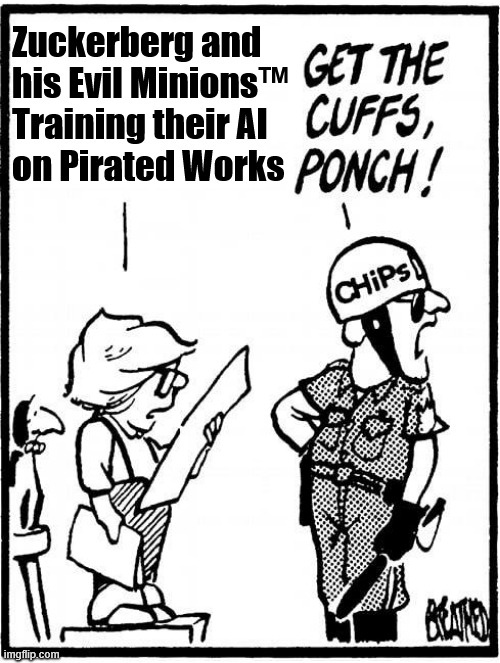
I do not support enforcing copyright violations with criminal prosecutions, but in Zuckerberg's case, I'll make an exception
It seems that the criminal enterprise formerly known as Facebook™ knowingly and deliberately used pirated works to train its LLM artificial intelligence program.

I'm not particularly surprised.  Zuckerberg has been a serial (to the point of being surreal) law breaker.

I rather think that the Chinese breakthroughs, which show the Eliza programs of Zuckerberg and Altman to irrelevant, make much of the effort here wasted, but I am grateful for this quote from a newly released email, "Torrenting from a corporate laptop doesn’t feel right." 

Newly unsealed emails allegedly provide the "most damning evidence" yet against Meta in a copyright case raised by book authors alleging that Meta illegally trained its AI models on pirated books.

Last month, Meta admitted to torrenting a controversial large dataset known as LibGen, which includes tens of millions of pirated books. But details around the torrenting were murky until yesterday, when Meta's unredacted emails were made public for the first time. The new evidence showed that Meta torrented "at least 81.7 terabytes of data across multiple shadow libraries through the site Anna’s Archive, including at least 35.7 terabytes of data from Z-Library and LibGen," the authors' court filing said. And "Meta also previously torrented 80.6 terabytes of data from LibGen."

"The magnitude of Meta’s unlawful torrenting scheme is astonishing," the authors' filing alleged, insisting that "vastly smaller acts of data piracy—just .008 percent of the amount of copyrighted works Meta pirated—have resulted in Judges referring the conduct to the US Attorneys’ office for criminal investigation."

Don't these lawyers understand?  Mark Zuckerberg is worth $237,000,000,000.00.

In the USA, people with that much money do not get prosecuted.

Why do these lawyers hate America? 

………

Emails discussing torrenting prove that Meta knew it was "illegal," authors alleged. And [Meta research engineer Nikolay] Bashlykov's warnings seemingly landed on deaf ears, with authors alleging that evidence showed Meta chose to instead hide its torrenting as best it could while downloading and seeding terabytes of data from multiple shadow libraries as recently as April 2024.

………

Supposedly, Meta tried to conceal the seeding by not using Facebook servers while downloading the dataset to "avoid" the "risk" of anyone "tracing back the seeder/downloader" from Facebook servers, an internal message from Meta researcher Frank Zhang said, while describing the work as being in "stealth mode." Meta also allegedly modified settings "so that the smallest amount of seeding possible could occur," a Meta executive in charge of project management, Michael Clark, said in a deposition.

Now that new information has come to light, authors claim that Meta staff involved in the decision to torrent LibGen must be deposed again because the new facts allegedly "contradict prior deposition testimony."

Mark Zuckerberg, for example, claimed to have no involvement in decisions to use LibGen to train AI models. But unredacted messages show the "decision to use LibGen occurred" after "a prior escalation to MZ," authors alleged.

Yeah.  Sounds like a conspiracy to lie during depositions.  It came from the top.

Book him, Danno, criminal conspiracy to violate copyright.  (Not as catchy as, "Book him, Danno, Murder 1," but I'll take it.)

21 November 2024

Yeah, "Accidentally"

The good folks at TechCrunch have a story with the headline, "OpenAI accidentally deleted potential evidence in NY Times copyright lawsuit." 

The good folks at TechCrunch accept that this is accidental.

Bullsh%$:

Lawyers for The New York Times and Daily News, which are suing OpenAI for allegedly scraping their works to train its AI models without permission, say OpenAI engineers accidentally deleted data potentially relevant to the case.

Earlier this fall, OpenAI agreed to provide two virtual machines so that counsel for The Times and Daily News could perform searches for their copyrighted content in its AI training sets. (Virtual machines are software-based computers that exist within another computer’s operating system, often used for the purposes of testing, backing up data, and running apps.) In a letter, attorneys for the publishers say that they and experts they hired have spent over 150 hours since November 1 searching OpenAI’s training data.

But on November 14, OpenAI engineers erased all the publishers’ search data stored on one of the virtual machines, according to the aforementioned letter, which was filed in the U.S. District Court for the Southern District of New York late Wednesday.

OpenAI tried to recover the data — and was mostly successful. However, because the folder structure and file names were “irretrievably” lost, the recovered data “cannot be used to determine where the news plaintiffs’ copied articles were used to build [OpenAI’s] models,” per the letter.

The judge should consider sanctions.

03 November 2024

You May Be Able to Get Your McFlurries Again

The USPTO has ruled that McDonald’s restaurants will be allowed to fix their ice cream machines.

Previously, the manufacturer of the notoriously unreliable machines have been using the DMCA to prevent store owners from diagnosing or repairing their machines.

McDonald’s often maligned, seemingly perennially-broken ice cream machines could soon become a thing of the past.

On Oct. 25, the United States Copyright Office granted a copyright exemption that gives restaurants like McDonald's the “right to repair” broken machines by circumventing digital locks that prevent them from being fixed by anyone other than its manufacturer.

The Golden Arches’ vanilla cones, sundaes and McFlurries are all made in machines from Taylor Company, as they have been for nearly 70 years. Back in 1956, future McDonald’s CEO Ray Kroc made a handshake agreement with Taylor to supply milkshake machines as McDonald’s exclusive supplier.

The Taylor company holds a copyright on its machines, and in the past that has meant that if one broke, only its repair people were legally allowed to fix it, according to a 2021 Wired article. This is due to the Digital Millennium Copyright Act (DMCA), a 1998 law that criminalizes making or using technology, devices or services that circumvent the control access of copyrighted works.  

………

The exemption granted by the United States Copyright Office went into effect on Oct. 28 and was jointly petitioned for by repair-focused website iFixIt and advocacy group Public Knowledge. In 2023, iFixit documented its teardown of McDonald’s machines and said it spat out multiple “nonsensical, counterintuitive, and seemingly random” error codes, but it couldn’t do anything to repair it.

Although the full request wasn’t granted, retail-level commercial food preparation equipment received an exemption that will allow third parties to bypass digital locks on machines for repairs.

Meredith Rose, senior policy counsel at Public Knowledge, said that the Copyright Office’s decision will lead to an “overdue shake-up of the commercial food prep industry.”

The DMCA is a horrible law, it serves primarily to reinforce the corrupt and monopolistic practices of bad actors in our economy, whether it be Taylor, or HP preventing the use of 3rd party toner in HP products, or John Deere's horrible repair policies.

Repeal it.

05 October 2024

Not a Surprise

Attempting to outflank right-to-repair legislation, John Deere made promises to ease repair of their tractors and other agricultural equipment.

They lied.

This is not a surprise.  Extracting maximum money to the detriment of their customers is a core business strategy for Deere:

US Senator Elizabeth Warren (D-MA) has sent a letter to John May, CEO of agricultural equipment maker Deere & Company, questioning whether John Deere is living up to the promises it made to support people's right to repair.

And if it's not fulfilling those promises, it may be failing in its obligations under America's Clean Air Act, she added.

In January 2023, following years of legal challenges from farmers wanting to simply fix their own farm equipment outside authorized dealerships, John Deere signed a memorandum of understanding with the American Farm Bureau Federation (AFBF).

The agreement [PDF] calls for the manufacturing giant to provide farmers and independent repair shops with the tools, software, and documentation necessary to fix broken Deere-made agricultural machines, such as tractors and harvesters. In exchange, the AFBF agreed "to refrain from introducing, promoting, or supporting federal or state 'Right to Repair' legislation" that goes beyond what's promised in the MOU.

Essentially, Deere promised to play nice and help people fix their machines, by providing the tools and support needed, and the federation would back off from pushing for tough laws enshrining the right to repair.

But according to Senator Warren's missive [PDF], dated Wednesday, John Deere has not lived up to those commitments, and the MOU looks like a gambit to sabotage strong right-to-repair legislation, which is being adopted in various states and has the support of the Biden administration. 

John Deere has been promising to play nice for some time, and they never keep their promises.

Stop negotiating, and fire up the lawsuits, lobbying for right to repair laws, and institute administrative actions to make their business plan untenable.

Trusting the company is a losing proposition.

18 September 2024

Today in Bad Ideas

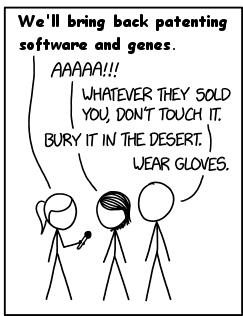
There are bills in the Senate Judiciary Committee that would restore patents for software and genes, because ……… a f%$# tonne of lobbyists and corrupt campaign contributions I guess?

I don't think that this Supreme Court has done much good, but their work in reining in excesses of our current IP regime is good.

The current regime is a license for parasite rent seekers.

It creates massive inequality and it destroys innovation when some patent troll can shake you down at a moment's notice:

The Senate Judiciary Committee is scheduled to consider two bills Thursday that would effectively nullify the Supreme Court's rulings against patents on broad software processes and human genes. Open source and Internet freedom advocates are mobilizing and pushing back.

The Patent Eligibility Restoration Act (or PERA, S. 2140), sponsored by Sens. Thom Tillis (R-NC) and Chris Coons (D-Del.), would amend US Code such that "all judicial exceptions to patent eligibility are eliminated." That would include the 2014 ruling in which the Supreme Court held, with Justice Clarence Thomas writing, that simply performing an existing process on a computer does not make it a new, patentable invention. "The relevant question is whether the claims here do more than simply instruct the practitioner to implement the abstract idea of intermediated settlement on a generic computer," Thomas wrote. "They do not."

Yeah, Clarence f%$#ing Thomas got this right. ¯\_(ツ)_/¯  

That case also drew on Bilski v. Kappos, a case in which a patent was proposed based solely on the concept of hedging against price fluctuations in commodity markets.

………

Software and Internet advocates have taken notice. This week, the Linux Foundation, working with the Cloud Native Computing Foundation (CNCF), announced an expanded partnership with Unified Patents, intended to defend open source software against what it gamely calls "non-practicing entities" (NPEs), but most people would term patent trolls. "As the risk and volume of frivolous litigation against open source projects grows, the need to provide accessible protection from NPEs has become crucial," the Linux Foundation writes.

In interviews with The Register, leaders at CNCF and Unified Patents described patent trolls as actively chasing any widespread technology, aiming for settlements over the cost of trials. Nearly 98 percent of NPE claims are settled, according to Unified Patents, but NPE claims challenged at the US Patent and Trademark Appeals Board lose 67 percent of the time.

Challenging patent claims, however valid, could get tougher under the PREVAIL Act, the other bill being considered by the Senate Judiciary Committee this week. PREVAIL would, among other changes, limit patent challenge petitions to 14,000 words, hampering attempts to debunk complex patents. The Act would also eliminate clearance patents, which companies can use to clear any infringement claims prior to their own products' release.

………

Another wrinkle in the PERA bill involves genetic patents. The Supreme Court ruled in June 2013 that pieces of DNA that occur naturally in the genomes of humans or other organisms cannot, themselves, be patented. Myriad Genetics had previously been granted patents on genes associated with breast and ovarian cancer, BRCA1 and BRCA2, which were targeted in a lawsuit led by the American Civil Liberties Union (ACLU). The resulting Supreme Court decision—this one also written by Thomas—found that information that naturally occurs in the human genome could not be the subject to a patent, even if the patent covered the process of isolating that information from the rest of the genome. As with broad software patents, PERA would seemingly allow for the patenting of isolated human genes and connections between those genes and diseases like cancer.

This is a horrendously bad idea. 

Shut it down

07 September 2024

Both Inevitable and Justified

It appears that activists are distributing information that would allow for anyone to make some of the most expensive medications in the world themselves.

A case in point is Sofosbuvir (brand name Sovaldi), which is at this point the only drug which cures Hepatitis C, which sells for $1,000.00 a pill but can be made in a relatively simple home lab for $0.87 a pill, a 114,943% markup.

This means that the treatment regimen can be had for less than $100.00, as opposed to almost $100,000.00.

Drug patents have gotten out of hand, and it needs to stop:

I’ve been video chatting with Mixæl Swan Laufer for about 30 minutes about an exciting discovery when he points out that to date, the best way he’s been able to bring attention to his organization is “the old school method of me performing a bunch of federal felonies on stage in front of a bunch of people.”

I stop him and ask: “In this case, what are the felonies?”

“Well, the list is pretty long,” he said.

Laufer is the chief spokesperson of Four Thieves Vinegar Collective, an anarchist collective that has spent the last few years teaching people how to make DIY versions of expensive pharmaceuticals at a tiny fraction of the cost. Four Thieves Vinegar Collective call what they do “right to repair for your body.”

Laufer has become well known for handing out DIY pills and medicines at hacking conferences, which include, for example, courses of the abortion drug misoprostol that can be manufactured for 89 cents (normal cost: $160) and which has become increasingly difficult to obtain in some states following the Supreme Court decision in Dobbs.

In our call, Laufer had just explained that Four Thieves’ had made some miscalculations as part of its latest project, to create instructions for replicating sofosbuvir (Sovaldi), a miracle drug that cures hepatitis C, which he planned to explain and reveal at the DEF CON hacking conference.

Unlike many other drugs that treat viruses, Sovaldi does not suppress hepatitis C, a virus that kills roughly 250,000 people around the world each year. It cures it.

“Normally you have a virus, and your body fights it off or your body fights it to a standstill and you just have it forever, basically, and hope it remains dormant more or less,” Laufer said. “The holy grail for every virologist is to find a way to drain the viral reservoir, and Sovaldi does this. You take one pill of Sovaldi a day for 12 weeks and then you don’t have hepatitis C anymore.”

The problem is that those pills are under patent, and they cost $1,000 per pill.

“Literally, if you have $84,000 then hepatitis C is not your problem anymore,” Laufer said. “But given that there are other methodologies for managing hepatitis C that are not curing it and that are cheaper, insurance typically will not cover [Sovaldi]. And so we’ve got this incredible technology and it’s sitting on the shelf except for people who are ridiculously wealthy.”

So Four Thieves Vinegar Collective set out to teach people how to make their own version of Sovaldi. Chemists at the collective thought the DIY version would cost about $300 for the entire course of medication, or about $3.57 per pill. But they were wrong. “It’s actually just a little under $70 (83 cents per pill), which just kind of blew my mind when they finally showed me the results,” Laufer said. “I was like, can we do the math here again?”

Our current IP regime, particularly with regard to pharmaceuticals does not work.

Furthermore, it runs counter to the Constitutional requirements of such a system, (Article I, Section 8, Clause 8) "To promote the Progress of Science and useful Arts, by securing for limited Times to Authors and Inventors the exclusive Right to their respective Writings and Discoveries."

This sort of looting and rent seeking does not promote the, "Progress of Science and useful Arts," it promotes corrupt business models.

Patent and copyright are a tax on the rest of us that is provided in order to benefit the public.

Our current IP regime does not do this.

06 August 2024

Ever Heard of the Streisand Effect?

Well, the alleged cyber security firm CrowdStrike apparently has not heard of the Streisand Effect, which is why they have attempted a DMCA take-down of the ClownStrike parody site

For those who do not know what the Streisand Effect is, it is when a public figure takes actions to suppress information or mockery of them, and as a results increases interest and exposure of that information and mockery.

The singer Barbara Streisand attempted to remove photos of her house from a web site in 2003, and as a result, those photographs became well known and widely distributed.

So the clowns at CrowdStrike are attempting to take down ClownStrike, and as a result the latter is attracting crowds:

Doesn't CrowdStrike have more important things to do right now than try to take down a parody site?

That's what IT consultant David Senk wondered when CrowdStrike sent a Digital Millennium Copyright Act (DMCA) takedown notice targeting his parody site ClownStrike.

Senk created ClownStrike in the aftermath of the largest IT outage the world has ever seen—which CrowdStrike blamed on a buggy security update that shut down systems and incited prolonged chaos in airports, hospitals, and businesses worldwide.

………

Setting up the parody site at clownstrike.lol on July 24, Senk's site design is simple. It shows the CrowdStrike logo fading into a cartoon clown, with circus music blasting throughout the transition. For the first 48 hours of its existence, the site used an unaltered version of CrowdStrike's Falcon logo, which is used for its cybersecurity platform, but Senk later added a rainbow propeller hat to the falcon's head.

………

It was all fun and games, but on July 31, Senk received a DMCA notice from Cloudflare's trust and safety team, which was then hosting the parody site. The notice informed Senk that CSC Digital Brand Services' global anti-fraud team, on behalf of CrowdStrike, was requesting the immediate removal of the CrowdStrike logo from the parody site, or else Senk risked Cloudflare taking down the whole site.

Senk immediately felt the takedown was bogus. His site was obviously parody, which he felt should have made his use of the CrowdStrike logos—altered or not—fair use. He immediately responded to Cloudflare to contest the notice, but Cloudflare did not respond to or even acknowledge receipt of his counter notice. Instead, Cloudflare sent a second email warning Senk of the alleged infringement, but once again, Cloudflare failed to respond to his counter notice.

I would note that there are no ads at all on the ClownStrike Site, not that it matters from a legal perspective.  (Hopefully, Senk is one of those hippie pinko types)

I agree with Mr. Senk.  CrowdStrike's lawyers have more pressing matters to attend to than attempting to shut down a 2 page web site on the .lol domain.

03 July 2024

Snark of the Day

Must Be Hard to Face a Huge, Unexpected Bill, Amirite?
—The subhead for a story in The Register about an $847,000,000.00 judgement against Verizon for patent infringement.

There is, as there always is, a story behind all of this.  This case was held in United States District Court for the Eastern District of Texas, the most patent troll friendly jurisdiction in the nation, and it was presided over by Judge Rodney Jockstrap Gilstrap, who is the most patent troll friendly judge in the USA. (So much so that he typically hears over ¼ of all patent cases in the country.

There are literally thousands of offices in and around Marshall and Beaumont, Texas which are nothing but a door with a name on it.  They are used by patent trolls as "Headquarters" in order for them to have their case heard there.

I can't speak to the specifics of the patent, it about various radio signal technologies, and if it were in my wheel house, I would still find the obscure verbiage of patents hard to penetrate, but the plaintiff is a non-practicing entity (NPE, better described as a patent troll), so I'm inclined to call bullsh%$ on the verdict.

I cannot believe that I am saying this, but I'm with Verizon on this one.

02 June 2024

Hopefully, Deere Loses Big Time

Federal Judge Iain Johnston has ruled that the class action lawsuit against John Deere’s repair practices can go forward.

Considering the fact that he was appointed by Trump, and that he was a member of the Federalist Society, this is a pleasant surprise.

If you have been living in a cave, you are probably unaware that John Deere has been locking down its tractors so that farmers and independent mechanics cannot repair them or use 3rd party parts.

This is one reason why older unrestricted tractors actually sell for a premium over the newer models.

Of course, the certification of class action is not a victory in court, but frequently, particularly in front of Republican appointed judges and Federalist Society members, it is the highest hurdle to clear.

But clear it they did:

A U.S. judge on Monday said Deere & Co must face claims from crop farms and farmers that the agricultural machinery maker has unlawfully conspired to restrict services for maintenance and repair.

U.S. District Judge Iain Johnston in Rockford, Illinois, rejected Deere's effort to dismiss consolidated lawsuits accusing the Moline, Illinois-based company of violating U.S. antitrust law.
The judge said the plaintiffs had met legal thresholds to pursue their claims.

"According to the complaint's allegations, Deere has the ultimate control of the repair services market," Johnston wrote in his 89-page order. "These allegations are not mere legal conclusions. The complaint is chock-full of factual allegations to support this conclusion."

Deere has denied the allegations and will have a chance at a later stage in the case to dispute the merits of the farmers' claims. 

………

 In the Deere litigation, six prospective class actions were consolidated last year before Johnston. The cases allege Deere has conspired with dealerships to control where and how machines are maintained and repaired. 

The complaint said farmers are "prevented from using trusted, less expensive, and more conveniently located skilled mechanics who are not affiliated with Deere."

It is self evident that people should be allowed to repair stuff that they own, and even (former)Federalist Society members get that.

26 May 2024

Cola Corporation is Experiencing Supply Chain Problems

The Cola Corporation, which describes itself as being, "Started in 2019 with the simple goal of trolling MAGA," makes T-shirts, hoodies, and similar protest related apparel. 

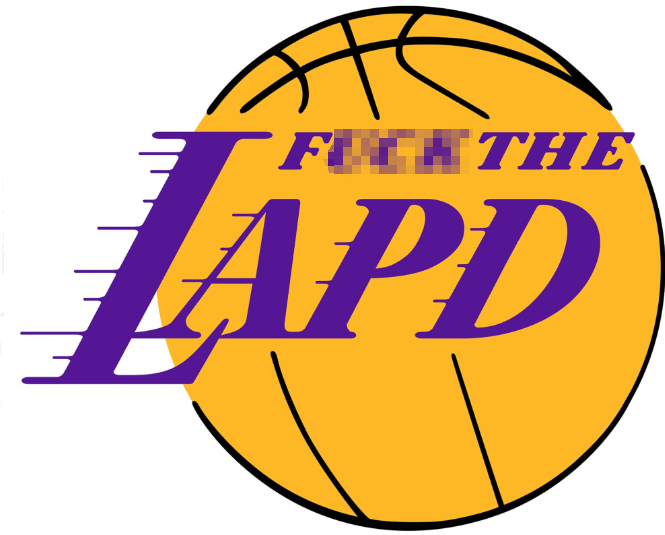
Among these sartorially exquisite products is a T-shirt which states, "F%$# the LAPD."

In response to this T-shirt, the LAPD Foundation sent a DMCA takedown letter, claiming violation of the copyright on the use of LAPD.  (Yes there are some legal errors there, but I'll get to those)

Cola Corporation, contacted their counsel, Mike Dunford,  who, perhaps taking taking a page from noted anti-Fascist fighter then Brigadier General Anthony Clement McAuliffe, responded, "LOL, no."

This has subsequently gone viral, and Cola has had their entire stock bought out during the past few days.

If this is not the Streisand Effect, it is certainly Streisand Effect adjacent.

For a slightly more in-depth response, and one that provides a bit mroe in the way of explanation, you can read this legal analysis, which additionally provides more information as to the nature of the legal errors made.

Short version:

  • LAPD cannot be copyrighted, so a DMCA take-down request is wrong.
  • If they were referring to trademark, there is no possibility of confusion, between LAPD and F%$# the LAPD, so that is moot as well.
  • The law firm that sent the cease and desist letter specializes in IP law, and as such, had to have known that the request was not in accordance with the law, and as such why they, and their client should not be sued. (see 7 U.S.C. § 512(f))
  • The use of IP law to interfere with criticism of a government agency is ruled out by the First Amendment.